Meta description: Drone licence Australia cost guide comparing façade cleaning drones, scaffolding and rope access. Model ROI and compliance, start your pathway.
The short answer
For many Australian commercial buildings, a façade cleaning drone can cost 30–60% less than scaffolding, swing stage or rope access. A typical drone clean may cost $800–$25,000+, depending on height and surface area. However, safe commercial work still requires proper CASA approvals, procedures and trained pilots.
The real saving comes from avoiding access equipment, reducing labour, limiting downtime and using less water. For operators, a commercial cleaning drone setup may reach payback after 15–40 jobs, depending on equipment cost and utilisation.
Why commercial buildings are comparing drones with scaffolding
Façade cleaning has traditionally required scaffolding, elevated work platforms, swing stages or rope-access technicians. Those methods remain useful for some buildings. Yet they can create long mobilisation periods and high indirect costs.
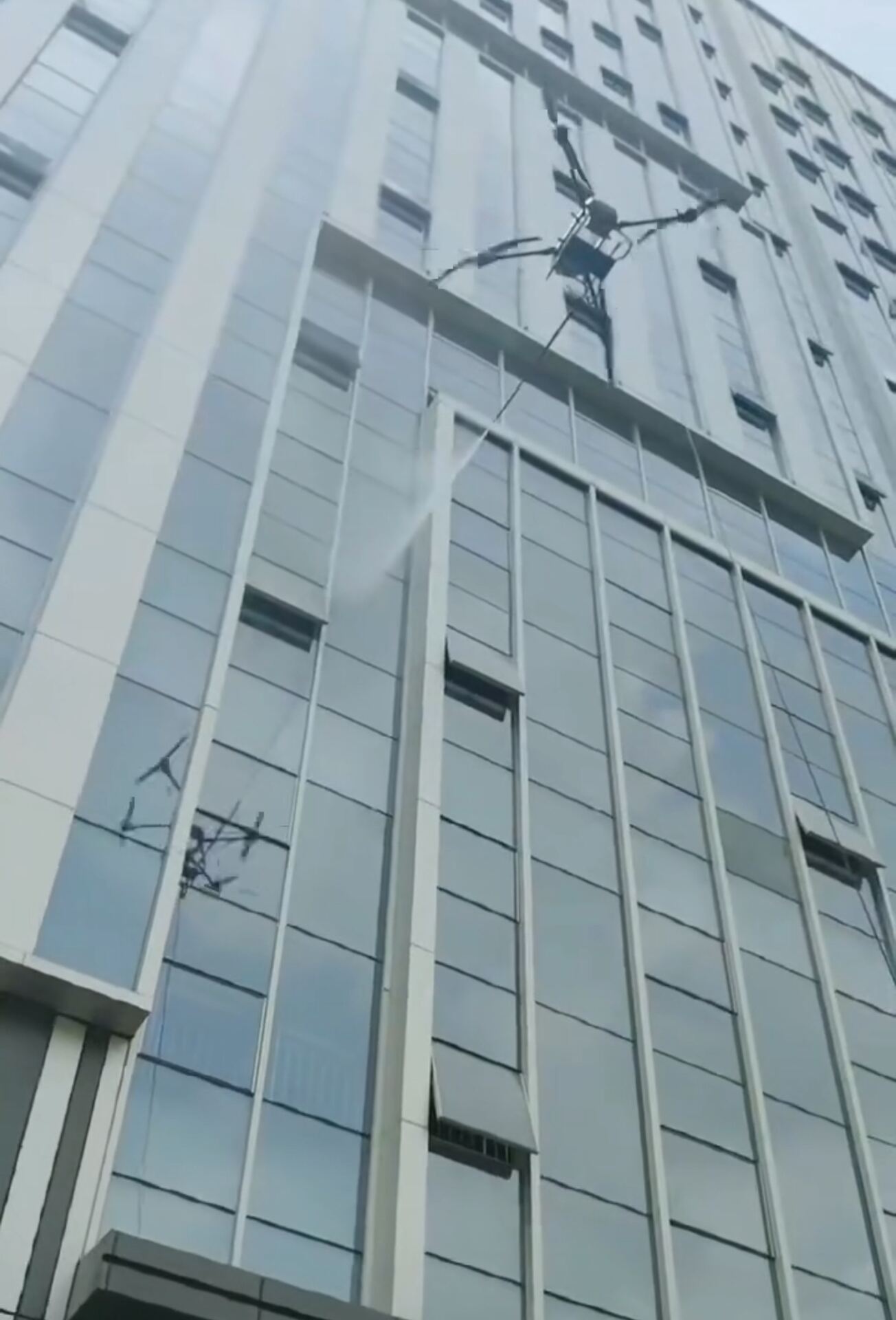
A commercial cleaning drone changes the cost structure. The aircraft works from the ground while the crew controls spray pressure, distance and flight paths. The building owner may avoid scaffold hire, anchor installation, working-at-heights exposure and extended tenant disruption.
However, drones are not a shortcut around aviation law. A professional service still needs a site assessment, exclusion zone, documented procedures, insurance and a CASA-compliant operating model.

What a façade cleaning drone actually does
A façade cleaning drone is an industrial remotely piloted aircraft fitted with spray equipment. It may apply water, detergent or a soft-wash solution to glass, concrete, cladding and selected painted surfaces.
There are two main configurations:
- Tether-less spraying: The drone carries a tank and pump. This improves mobility but limits flight time and liquid capacity.
- Ground-fed spraying: A hose supplies water or cleaning solution from a pump on the ground. This supports longer jobs and higher pressure but adds hose-management risks.
A typical workflow includes:
- Inspect the building and identify surface materials.
- Test pressure and cleaning chemistry on a small area.
- Establish a landing zone and ground exclusion area.
- Plan vertical or horizontal spray passes.
- Use RTK positioning to maintain accurate flight paths.
- Monitor wind, overspray, pedestrians and building occupants.
- Complete visual quality checks and document the work.
RTK means real-time kinematic positioning. It improves aircraft position accuracy when the drone receives correction data from a base station or network.
Water use depends on the nozzle, pressure, surface and cleaning method. Some Australian systems advertise flow rates around 24 litres per minute. Controlled spray patterns can reduce waste, but operators should not promise a fixed saving on every site. A reasonable planning assumption is 40–60% less water than uncontrolled pressure washing, subject to testing.
Solar panel cleaning
A solar panel cleaning drone can clean rooftop arrays without sending workers onto fragile or difficult roofs. The drone may use a soft wash, rinse or controlled pressure system.
The business case is strongest when:
- The array is large.
- Roof access is difficult.
- Soiling reduces generation.
- Manual cleaning would require edge protection or access equipment.
- The site needs regular cleaning.
One Australian provider lists commercial solar cleaning at approximately $4,000–$5,000 per visit for larger arrays. Exact pricing depends on panel count, access, contamination and location.
Key facts and cost assumptions
| Cost or factor | Drone cleaning | Scaffolding | Swing stage or EWP | Rope access |
|---|---|---|---|---|
| Typical small commercial job | $800–$2,500 | $10,000–$25,000+ | $5,000–$15,000 | $4,000–$10,000 |
| Typical 10-storey project | $8,000–$15,000 | $15,000–$30,000 | $12,000–$30,000 | $10,000–$25,000 |
| Large or complex project | $15,000–$25,000+ | $20,000–$80,000+ | $25,000–$60,000+ | $20,000–$50,000+ |
| Mobilisation | Low to moderate | High | Moderate to high | Moderate |
| Main labour requirement | Two-person crew is common | Larger erection and cleaning teams | Operators, riggers and cleaners | Trained access technicians |
| Downtime | Hours to several days | Days or weeks | Days to weeks | Days to weeks |
| Water efficiency | Controlled and targeted | Depends on cleaning method | Depends on cleaning method | Often hand-controlled |
| Height exposure | Ground-based crew | Workers at height | Workers at height | Workers at height |
| Main compliance issue | Aviation and exclusion zones | Structural and height safety | Anchors, lifting and height safety | Rope systems and rescue plans |
These figures are indicative Australian market ranges that vary by state, building type and access difficulty. Readers should obtain site-specific quotes before making decisions.
The real cost breakdown
1. Mobilisation
Scaffolding can require delivery, erection, inspection, modification and dismantling. A swing stage may need roof anchors, engineering checks and formal sign-off.
A drone crew usually needs a vehicle, aircraft, pumps, hoses, water supply, barriers and a ground-control area. Mobilisation is faster, but the site may still need traffic management or a council permit.
2. Labour
Traditional cleaning can require several technicians, supervisors, riggers and safety personnel. Labour grows when the building has multiple elevations or restricted access.
A drone operation may use one remote pilot and one ground operator. Larger jobs may require additional observers, spotters or safety staff. Lower crew numbers do not remove the need for competent supervision.
3. Permits and planning
Scaffolding over a footpath may require council approval, pedestrian management and traffic control. Rope access also requires building access, anchor checks and rescue planning.
Drone operations require airspace checks, site assessments and operational documentation. If the work is near people, above 120 metres, near an aerodrome or in controlled airspace, additional CASA requirements may apply.
4. Height-safety compliance
Drones can remove workers from the façade. That reduces exposure to falls, dropped objects and difficult rescues.
Nevertheless, the drone itself creates aviation risks. Operators must manage loss of control, spray drift, battery failure, obstacles, hose failure and emergency landing areas.
5. Downtime and tenant disruption
Scaffolding can block windows, footpaths, entrances and views for an extended period. A swing stage may restrict areas below the work face.
Drone cleaning usually needs a ground exclusion zone. It may therefore be scheduled outside business hours or during weekends. The building does not always need to close, but the site manager must control people and vehicle movement.
ROI for a cleaning-drone business
A new operator should calculate contribution margin rather than revenue alone.
Consider this indicative model:
| Item | Conservative assumption |
|---|---|
| Aircraft, pump, hoses and safety equipment | $60,000–$120,000 |
| Training, compliance and insurance setup | $8,000–$25,000 |
| Average job revenue | $5,000–$12,000 |
| Direct costs per job | $2,000–$6,000 |
| Contribution before overheads | $3,000–$6,000 |
| Indicative operator day rate | $900–$1,500 |
| Estimated payback | 15–40 jobs |
This is a planning model, not a guaranteed return. A cleaning company with existing customers may reach payback quickly. A new business may need 12–36 months because sales, weather, travel, maintenance and compliance reduce utilisation.
For example, a $90,000 setup producing $3,500 contribution per job reaches hardware payback after about 26 jobs. At four jobs per month, that is roughly seven months before fixed overheads and tax. At two jobs per month, the same investment takes about 13 months.
Building owners see ROI differently. If a traditional clean costs $25,000 and a drone clean costs $12,000, the direct saving is $13,000 on one project. Add reduced tenant disruption and shorter mobilisation, and the commercial case becomes stronger.
The ACE AIR ORION example
The ACE AIR ORION is a useful example of the platform class being considered for commercial cleaning. For this article, the supplied example specifications are:
- 23.9 kg maximum take-off weight.
- Dual RTK positioning.
- High-pressure spray capability.
- Commercial façade and solar-cleaning applications.
- Ground-based operators and documented flight procedures.
At 23.9 kg, this is not a casual consumer drone. Payload, water, batteries and spray equipment must all remain within the approved aircraft limits. The operator must also understand how pressure, hose drag, wind and spray reaction affect flight control.
A high-pressure system is not automatically better. Glass, coatings, stone and solar panels need different treatment. A professional operator begins with a surface test and uses the lowest effective pressure.

CASA compliance: where a drone licence Australia pathway matters
A RePL is the pilot qualification. A ReOC is the operator certificate held by the business or organisation.
A sub-25 kg operation may fit within an excluded category only when it meets every applicable condition. Those conditions generally include:
- Maximum height of 120 metres above ground level.
- Visual line of sight.
- Day operations.
- No flight over people or populous areas.
- Required separation from uninvolved people.
- No prohibited aerodrome or controlled-airspace activity.
- Compliance with aircraft and operational limits.
Many façade-cleaning jobs do not fit neatly within those limits. Buildings are often beside footpaths, roads, tenants and workers. Spray operations may also require a close standoff distance from the façade.
A RePL and ReOC pathway becomes especially important when the operation involves:
- Work within 30 metres of uninvolved people.
- Operations over or near people.
- Flights above 120 metres.
- Controlled airspace or aerodrome proximity.
- Night operations.
- BVLOS or other specialised approvals.
- A complex aircraft, payload or safety case.
Tethered operations do not automatically remove CASA requirements. A tether can reduce some risks, but it introduces others. The aircraft may still be treated as an RPA, and the operator must assess tether failure, snagging, emergency descent and ground equipment.
An AROC, or Aeronautical Radio Operator Certificate, is relevant when aviation radio communications are required. This may include controlled-airspace work or approved operations near a non-controlled aerodrome using the CTAF. It does not replace a RePL or ReOC.
Read CASA’s flight approvals and permissions guidance before planning a commercial job.
Step-by-step pathway for pilots adding cleaning services
-
Choose the correct licence pathway.
Start with a RePL category that matches the aircraft you intend to fly. For a 23.9 kg platform, a sub-25 kg pathway is the logical starting point. -
Add AROC training where needed.
This supports aviation radio knowledge for controlled-airspace or CTAF-related work. -
Build commercial flight skills.
Practise precision hovering, façade standoff, emergency landing, wind management and payload handling. -
Learn the cleaning process.
Study detergents, surface compatibility, runoff, water recovery, pressure control and solar-panel risks. -
Create a compliant operating system.
Develop SOPs, risk assessments, maintenance records, site checklists and emergency procedures. -
Establish the business pathway.
If operating independently, investigate ReOC requirements, insurance, contracts and local permits. -
Start with controlled jobs.
Begin with warehouses, low-rise façades or closed commercial sites before moving into complex urban work. -
Build demand and measure margins.
Track job time, water use, travel, repairs, labour, rework and gross contribution.
ACE Aviation provides commercial drone training pathways, including RePL, AROC, ReOC setup and advanced aircraft categories. Students can also explore cleaning specialisations, DroneWork opportunities and Altitude+ benefits through the ACE comparison program.
ACE operates under CASA.ReOC.1421 and has trained more than 4,000 students. Its training footprint extends across Australia, Singapore, Dubai, Korea and Malaysia. The academy also works with industry partners to keep training connected to commercial standards.
Training is available for operators seeking a drone course in Brisbane, Sydney, Melbourne, Perth and Hobart.
Common mistakes
- Buying the aircraft before confirming the operating category.
- Treating a tether as a complete safety solution.
- Quoting jobs without measuring façade area.
- Ignoring pedestrian, traffic and tenant controls.
- Using one pressure setting on every surface.
- Failing to price weather delays and rework.
- Assuming a RePL alone permits near-people operations.
- Forgetting water supply, wastewater and chemical handling.
- Promising savings without recording baseline costs.
- Failing to maintain a rescue and lost-link procedure.
FAQ
1. Is a drone cheaper than scaffolding in Australia?
Often, yes. Drone cleaning can be 30–60% cheaper on suitable commercial projects, especially when scaffolding mobilisation and hire are expensive.
2. What does façade drone cleaning cost?
Indicative prices range from $800–$2,500 for smaller buildings and $8,000–$25,000+ for large high-rise work.
3. What is a commercial cleaning drone?
It is an industrial RPA fitted with spray, soft-wash or pressure-cleaning equipment for façades, roofs, solar panels and infrastructure.
4. Does a façade cleaning drone carry water?
Some systems carry a small onboard tank. Others use a ground pump and hose for longer operation and higher flow.
5. How much water does drone cleaning use?
Flow varies widely. Controlled systems may use less water than traditional pressure washing, but operators should provide site-specific estimates.
6. Is a solar panel cleaning drone safe?
It can be, when the operator controls pressure, standoff distance, chemicals and runoff. Panels should be tested before full cleaning.
7. Do I need a RePL to operate a cleaning drone?
The answer depends on the aircraft, operation and category. Complex commercial work above 7 kg or near people commonly requires a RePL and ReOC pathway.
8. Does a 23.9 kg drone need a RePL?
A 23.9 kg platform is in a professional aircraft category. The exact requirement depends on the operation, but commercial operators should plan for appropriate RePL training.
9. Does tethered operation remove the need for a RePL?
No. Tethering does not automatically remove Part 101 obligations or other approval requirements.
10. Can I clean a building above 120 metres?
Only with the required CASA authorisation and an operating system that supports the approval. The standard limit is 120 metres above ground level.
11. Can I fly close to pedestrians?
Standard operations require separation from uninvolved people. Near-people work may require specific approval, controls and an appropriate ReOC scope.
12. Do I need an ReOC for a cleaning business?
A business conducting included or higher-risk commercial operations will generally need an ReOC or must work under an appropriate existing operator.
13. When is an AROC relevant?
An AROC is relevant when the operation requires aviation radio communications, including some controlled-airspace and CTAF scenarios.
14. How many jobs repay a cleaning drone?
An indicative range is 15–40 jobs. Actual payback depends on setup cost, margin, job frequency and equipment finance.
15. What day rate should a cleaning-drone operator charge?
Planning assumptions often sit around $900–$1,500 per operator day. Final pricing should reflect aircraft cost, compliance, insurance and site risk.
16. Is drone cleaning suitable for every façade?
No. Surface material, wind, geometry, drainage and contamination must be assessed. Fragile coatings may need a different method.
17. Can drone cleaning replace rope access completely?
No. Rope access remains useful for detailed repairs, sealing, inspections and areas unsuitable for drone spraying.
18. What is the CASA RePL cost?
The CASA RePL cost depends on the training provider, aircraft category and inclusions. Review current ACE course options for package pricing.
19. Can training lead to drone pilot jobs Australia-wide?
Yes. Licensed pilots work in cleaning, inspection, construction, agriculture, mining and utilities. ACE graduates can access DroneWork job pathways.
Summary
For commercial building owners, the comparison is not simply drone versus scaffold hire. It is total project cost, including mobilisation, labour, permits, safety controls, water, tenant disruption and downtime.
For cleaning companies, a drone can create a strong new service line. Yet the business case depends on utilisation, correct pricing and CASA compliance. A RePL is only one part of the pathway. Commercial operators also need suitable aircraft training, procedures, insurance and, where required, ReOC and AROC capability.
ACE Aviation combines CASA-approved training, commercial aircraft pathways, Altitude+ support and access to DroneWork. Its CASA.ReOC.1421 status, 4,000+ graduates and international footprint provide a strong foundation for pilots entering specialist operations.
Ready to start? Book your training at aaa.edu.au or call 1300 336 366.
{“@graph”:[{“@id”:”https://aaa.edu.au/blog/drone-licence-australia-2026-facade-cleaning-drones-vs-scaffolding”,”@type”:”Article”,”image”:”https://aaa.edu.au/assets/orion_cleaning_facade_1785054145142.jpg”,”author”:{“url”:”https://aaa.edu.au/”,”name”:”Ace Aviation Aerospace Academy”,”@type”:”Organization”},”headline”:”Drone Licence Australia 2026: Façade Cleaning Drones vs Scaffolding — The Real Cost Breakdown for Commercial Buildings”,”publisher”:{“url”:”https://aaa.edu.au/”,”logo”:{“url”:”https://aaa.edu.au/assets/ace-logo-transparent.png”,”@type”:”ImageObject”},”name”:”Ace Aviation Aerospace Academy”,”@type”:”Organization”},”description”:”Drone licence Australia cost guide comparing façade cleaning drones, scaffolding and rope access. Model ROI and compliance—start your pathway.”,”dateModified”:”2026-09-19″,”datePublished”:”2026-09-19″,”mainEntityOfPage”:”https://aaa.edu.au/blog/drone-licence-australia-2026-facade-cleaning-drones-vs-scaffolding”},{“@id”:”https://aaa.edu.au/#organization”,”url”:”https://aaa.edu.au/”,”logo”:”https://aaa.edu.au/assets/ace-logo-transparent.png”,”name”:”Ace Aviation Aerospace Academy”,”@type”:”Organization”,”telephone”:”+61-1300-336-366″,”description”:”CASA-approved aviation training provider delivering RePL, AROC, ReOC and specialist commercial drone training.”},{“@id”:”https://aaa.edu.au/blog/drone-licence-australia-2026-facade-cleaning-drones-vs-scaffolding#faq”,”@type”:”FAQPage”,”mainEntity”:[{“name”:”Is a drone cheaper than scaffolding in Australia?”,”@type”:”Question”,”acceptedAnswer”:{“text”:”Often, yes. Drone cleaning can be 30–60% cheaper on suitable commercial projects, especially when scaffolding mobilisation and hire are expensive.”,”@type”:”Answer”}},{“name”:”What does façade drone cleaning cost?”,”@type”:”Question”,”acceptedAnswer”:{“text”:”Indicative prices range from $800–$2,500 for smaller buildings and $8,000–$25,000 or more for large high-rise work.”,”@type”:”Answer”}},{“name”:”What is a commercial cleaning drone?”,”@type”:”Question”,”acceptedAnswer”:{“text”:”It is an industrial remotely piloted aircraft fitted with spray, soft-wash or pressure-cleaning equipment for façades, roofs, solar panels and infrastructure.”,”@type”:”Answer”}},{“name”:”Does a façade cleaning drone carry water?”,”@type”:”Question”,”acceptedAnswer”:{“text”:”Some systems carry a small onboard tank. Others use a ground pump and hose for longer operation and higher flow.”,”@type”:”Answer”}},{“name”:”How much water does drone cleaning use?”,”@type”:”Question”,”acceptedAnswer”:{“text”:”Flow varies widely. Controlled systems may use less water than traditional pressure washing, but operators should provide site-specific estimates.”,”@type”:”Answer”}},{“name”:”Is a solar panel cleaning drone safe?”,”@type”:”Question”,”acceptedAnswer”:{“text”:”It can be safe when the operator controls pressure, standoff distance, chemicals and runoff. Panels should be tested before full cleaning.”,”@type”:”Answer”}},{“name”:”Do I need a RePL to operate a cleaning drone?”,”@type”:”Question”,”acceptedAnswer”:{“text”:”The answer depends on the aircraft, operation and category. Complex commercial work above 7 kg or near people commonly requires a RePL and ReOC pathway.”,”@type”:”Answer”}},{“name”:”Does a 23.9 kg drone need a RePL?”,”@type”:”Question”,”acceptedAnswer”:{“text”:”A 23.9 kg platform is in a professional aircraft category. The exact requirement depends on the operation, but commercial operators should plan for appropriate RePL training.”,”@type”:”Answer”}},{“name”:”Does tethered operation remove the need for a RePL?”,”@type”:”Question”,”acceptedAnswer”:{“text”:”No. Tethering does not automatically remove Part 101 obligations or other approval requirements.”,”@type”:”Answer”}},{“name”:”Can I clean a building above 120 metres?”,”@type”:”Question”,”acceptedAnswer”:{“text”:”Only with the required CASA authorisation and an operating system that supports the approval. The standard limit is 120 metres above ground level.”,”@type”:”Answer”}},{“name”:”Can I fly close to pedestrians?”,”@type”:”Question”,”acceptedAnswer”:{“text”:”Standard operations require separation from uninvolved people. Near-people work may require specific approval, controls and an appropriate ReOC scope.”,”@type”:”Answer”}},{“name”:”Do I need an ReOC for a cleaning business?”,”@type”:”Question”,”acceptedAnswer”:{“text”:”A business conducting included or higher-risk commercial operations will generally need an ReOC or must work under an appropriate existing operator.”,”@type”:”Answer”}},{“name”:”When is an AROC relevant?”,”@type”:”Question”,”acceptedAnswer”:{“text”:”An AROC is relevant when the operation requires aviation radio communications, including some controlled-airspace and CTAF scenarios.”,”@type”:”Answer”}},{“name”:”How many jobs repay a cleaning drone?”,”@type”:”Question”,”acceptedAnswer”:{“text”:”An indicative range is 15–40 jobs. Actual payback depends on setup cost, margin, job frequency and equipment finance.”,”@type”:”Answer”}},{“name”:”What day rate should a cleaning-drone operator charge?”,”@type”:”Question”,”acceptedAnswer”:{“text”:”Planning assumptions often sit around $900–$1,500 per operator day. Final pricing should reflect aircraft cost, compliance, insurance and site risk.”,”@type”:”Answer”}},{“name”:”Is drone cleaning suitable for every façade?”,”@type”:”Question”,”acceptedAnswer”:{“text”:”No. Surface material, wind, geometry, drainage and contamination must be assessed. Fragile coatings may need a different method.”,”@type”:”Answer”}},{“name”:”Can drone cleaning replace rope access completely?”,”@type”:”Question”,”acceptedAnswer”:{“text”:”No. Rope access remains useful for detailed repairs, sealing, inspections and areas unsuitable for drone spraying.”,”@type”:”Answer”}},{“name”:”What is the CASA RePL cost?”,”@type”:”Question”,”acceptedAnswer”:{“text”:”The CASA RePL cost depends on the training provider, aircraft category and inclusions. Current ACE course options provide package pricing.”,”@type”:”Answer”}},{“name”:”Can training lead to drone pilot jobs Australia-wide?”,”@type”:”Question”,”acceptedAnswer”:{“text”:”Yes. Licensed pilots work in cleaning, inspection, construction, agriculture, mining and utilities. ACE graduates can access DroneWork job pathways.”,”@type”:”Answer”}}]}],”@context”:”https://schema.org”}