

A bushfire is moving across scrub near a regional airstrip. A caller reports smoke, but the location is uncertain, roads are closing, and the nearest ground crews are still travelling. A drone team may be able to provide an aerial view quickly, but only if someone has requested the aircraft, assessed the airspace, established communications, and knows how the imagery will reach the incident controller.
That is the practical meaning of an emergency response system. It isn't a drone, a dispatch console, or a warning platform operating in isolation. It is a coordinated arrangement of people, communications, command decisions, aircraft, vehicles, data, and procedures. Drones can add valuable aerial intelligence, but they only improve outcomes when they fit that arrangement.
Table of Contents
- Why Emergency Response Systems Need Faster Aerial Intelligence
- How Drones Fit Inside an Emergency Response System
- Key Components of a Drone-Enabled Emergency Response Workflow
- Choosing Between Ad Hoc Support and Embedded Drone Operations
- CASA Regulations and Safety Requirements for Emergency Drone Operations
- Training and Certification Pathways for Emergency Drone Operators
- Frequently Asked Questions
Why Emergency Response Systems Need Faster Aerial Intelligence
An emergency call often begins with incomplete information. The caller may be distressed, visibility may be poor, and the location may be described using a road, property, track, or landmark that responders don't immediately recognise. In metropolitan areas, multiple services may be nearby. In regional and remote Australia, distance can shape the entire response.
Australia's ambulance system illustrates the scale of that challenge. In 2024–25, government ambulance services recorded 5.9 million responses to 4.5 million incidents, supported by 26,603 registered paramedics and $6.4 billion in total government real recurrent expenditure on ambulance services, according to the Report on Government Services health data. The nationally used performance measure runs from receipt of an emergency call to the arrival of the first ambulance resource at the scene.
The same data shows why a single national expectation can't describe every operating environment. In 2024–25, 90th-percentile capital-city ambulance response times ranged from 17.8 minutes in the Australian Capital Territory to 49.3 minutes in the Northern Territory, while state-wide figures ranged from 17.8 minutes in the ACT to 47.9 minutes in the Northern Territory. Those figures don't establish what a drone can achieve, but they do show why early information matters when crews are travelling through large or difficult areas.
Where aerial information changes the first decision
A drone can help answer questions that a caller can't:
- Access: Which road, track, landing area, or approach remains usable?
- Scale: Is the reported fire, flood, crash, or structural failure localised or spreading?
- People at risk: Are people visible, isolated, injured, or moving into a hazardous area?
- Responder safety: Are power lines, unstable structures, smoke, floodwater, or other hazards present?
- Resource choice: Does the incident require additional ground crews, aircraft, medical support, or evacuation planning?
Fire and emergency management demand is broader than medical response. In 2024–25, fire service organisations attended 472,361 emergency incidents, with fire events representing 21.5% of those incidents. State and territory emergency services attended 101,662 incidents, of which 71.7% were storm and cyclone events, while total government expenditure for fire services and state and territory emergency services reached $7.4 billion. These figures are reported in the emergency management section of the Report on Government Services.
A drone doesn't remove the need for dispatchers, incident controllers, paramedics, firefighters, or pilots. It gives those people another source of information, provided the operation is authorised, communicated, and managed within the wider response plan. Operators building that understanding can also benefit from the Australian drone ecosystem overview, which places drone work within the wider aviation and industry environment.
How Drones Fit Inside an Emergency Response System
A drone-enabled emergency response system has a simple division of responsibility. Dispatch identifies the need. Command sets the operational priority. The drone crew conducts the flight. Communications carries the information. The incident team decides what action follows.
That division prevents a common error, treating live video as the objective. Video is only useful when it answers an operational question and reaches the person who can act on it. A flight that produces attractive footage without a clear task, location reference, update method, and handover process may add workload rather than intelligence.
Australia's warning architecture demonstrates why information pathways matter. The national Emergency Alert system uses the Location Based Number Store, a geocoded telephone-number database. The database stores number and address records from the IPND and assigns latitude and longitude values using the Geo-coded National Address File, enabling location-targeted warnings. All states and territories except Western Australia use Emergency Alert, while Western Australia uses StateAlert, fed by the same LBNS, as described in the Australian Parliament document on the emergency warning system.
The lesson for drone teams is direct. Location data, communications, and operational ownership are as important as the aircraft.
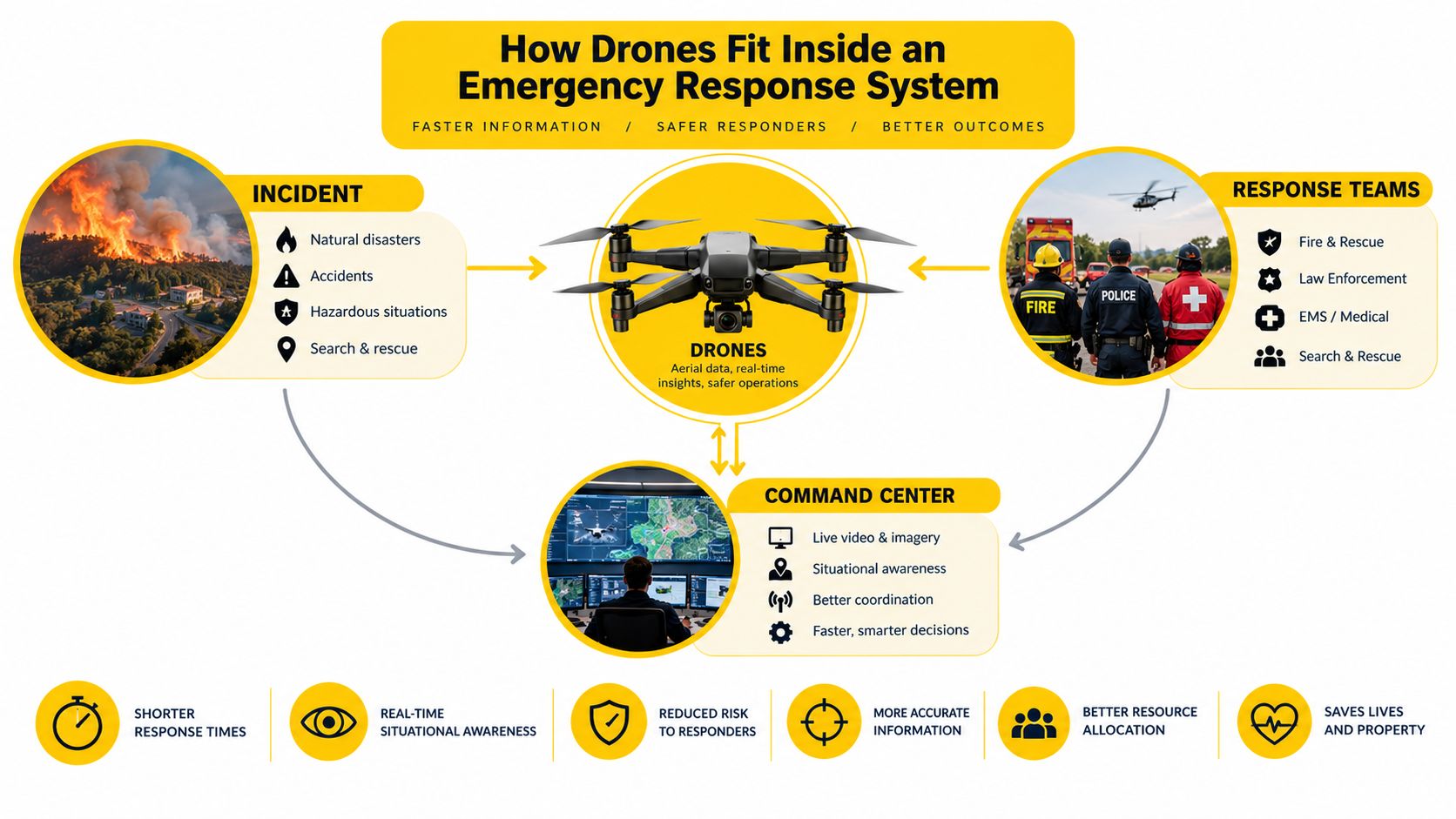
The operational chain
| Emergency response function | Drone integration point | Failure if unmanaged |
|---|---|---|
| Call-taking and dispatch | A defined request for aerial intelligence | A pilot self-deploys without a task |
| Incident command | Approval, priorities, and task changes | The drone collects irrelevant imagery |
| Communications | Reliable pilot, observer, and command links | The crew misses a hazard or instruction |
| Airspace coordination | Separation from crewed aircraft and other drones | A response aircraft faces an avoidable conflict |
| Data management | Secure delivery, labelling, and retention | Imagery can't support decisions or review |
| Operational review | Logs, reports, and lessons identified | The organisation repeats the same weaknesses |
A standalone flight usually sits outside this chain. An integrated operation has a nominated controller, a defined area, a communication plan, a launch and recovery point, and a method for reporting observations. Operators who want a broader grounding in incident information and aviation safety can use the drone pilot emergency handbook as part of their preparation.
For beginners, ACE READY provides entry-level drone training covering drone fundamentals, aviation safety, CASA regulations, flight operations, and preparation for advanced RePL training in Australia. That foundation is useful, but a live emergency deployment still requires organisation-specific procedures and authorisation.
Key Components of a Drone-Enabled Emergency Response Workflow
A reliable drone workflow starts before the aircraft leaves the ground. The organisation should know who can request a flight, who approves it, who controls the incident, who communicates with the pilot, and who receives the output. If those roles are unclear, urgency tends to produce improvisation.
Command and control
The incident controller or delegated decision-maker should define the task in operational terms. “Provide an aerial view” is too broad. A better task identifies the area, the question to answer, the required update, and the conditions that end the flight.
A sound tasking brief covers:
- Objective: locate people, assess access, map damage, check fire behaviour, or support a search.
- Area: a defined operating area, launch point, recovery location, and exclusion zone.
- Priority: immediate life safety, responder safety, resource allocation, or documentation.
- Time: start window, update points, and maximum operating period.
- Handover: the person who receives the live feed, photographs, coordinates, or written report.
The controller must also be able to cancel the task. A drone shouldn't remain airborne because the original request hasn't been formally closed.
Communications and data
The pilot needs a dependable link to the aircraft, but the incident team also needs a dependable route to the pilot. Those are separate requirements. A control link can remain available while mobile coverage to the command post is poor, or a video stream can be visible to a remote viewer without giving the pilot timely operational instructions.
Teams should agree on:
- The primary communication channel.
- A backup channel and lost-communications action.
- Plain language for hazards, locations, and task changes.
- How imagery is labelled and transmitted.
- Who can release information outside the response organisation.
A live feed isn't automatically a record. If imagery may support investigation, damage assessment, or later review, the organisation should set its own procedures for secure storage, time references, file naming, and access.
Dispatch and airspace management
The dispatch function coordinates the drone with ground crews, helicopters, aircraft, road closures, and other resources. That coordination matters because emergency scenes can change rapidly. A drone launched into an area where a crewed aircraft is arriving creates a new hazard instead of solving the original problem.
Australia's emergency service data shows that geography affects response performance. In 2024–25, the 50th-percentile arrival time for first responding fire crews ranged from 6.0 to 9.0 minutes in major cities, compared with 7.1 to 17.5 minutes in remote areas. At the 90th percentile, the ranges were 9.3 to 13.2 minutes in major cities and 13.1 to 36.0 minutes in remote areas, according to the Emergency Services data. Aerial information can help during that window, but only when the drone is dispatched as part of the response rather than flown independently.
Operators considering operations beyond visual line of sight should understand the specific planning, approvals, risk controls, and communications involved. The BVLOS resource from Ace Aviation Aerospace Academy is relevant to that planning, but it doesn't replace CASA approval or the organisation's operational risk assessment.
Operational rule: If the incident controller can't explain what decision the drone output will support, the task isn't ready for launch.
Choosing Between Ad Hoc Support and Embedded Drone Operations
An organisation with occasional incidents doesn't necessarily need a permanent drone unit. A permanent unit, however, isn't created just by buying aircraft and nominating an employee. The right model depends on incident frequency, geography, internal capability, regulatory obligations, and the consequences of delay or error.
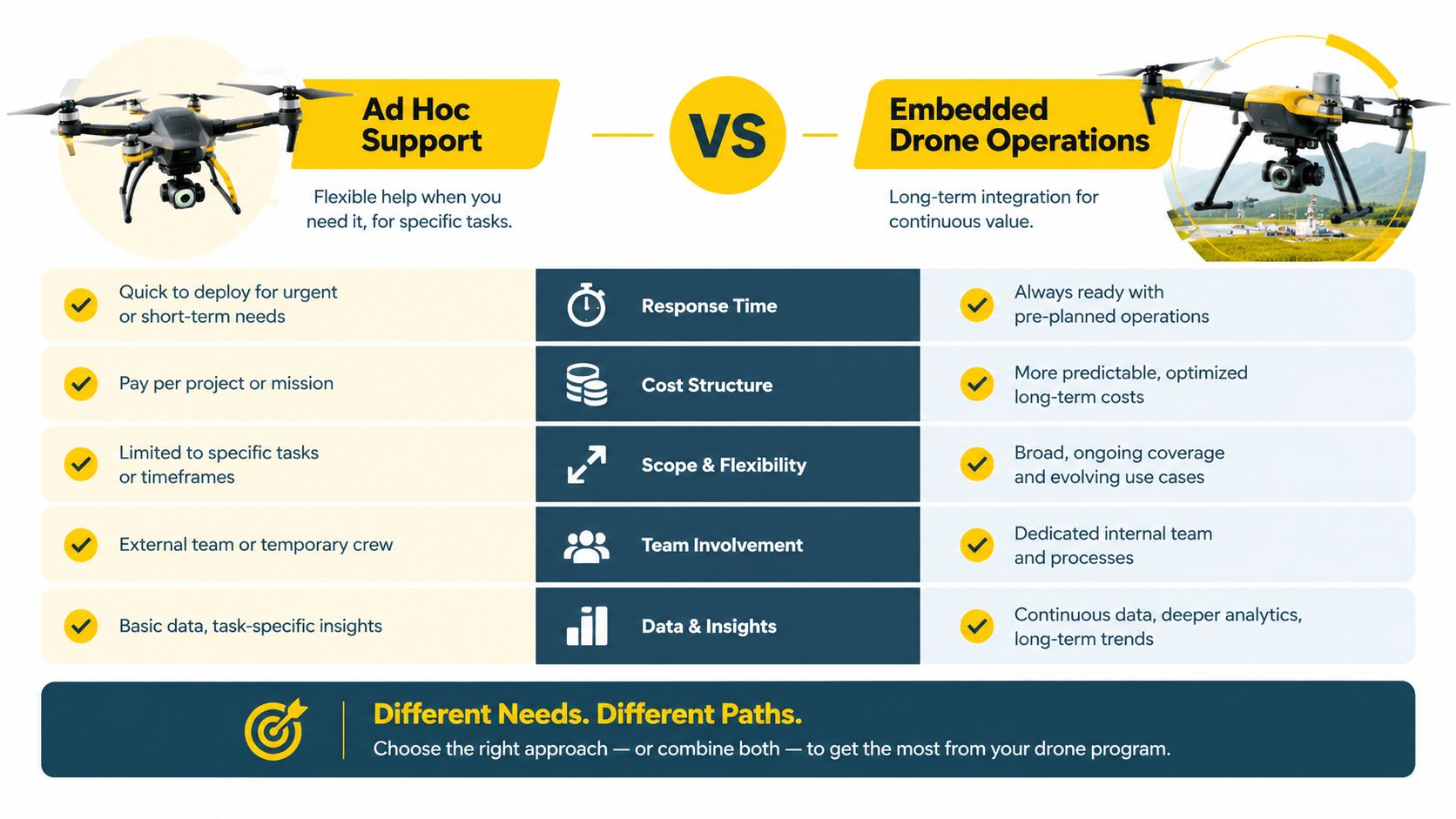
Two workable models
| Decision area | Ad hoc drone support | Embedded drone operations |
|---|---|---|
| Staffing | External provider or available local pilot | Dedicated or rostered internal personnel |
| Activation | Request made during the incident | Dispatch pathway already exists |
| Procedures | Provider and client must align quickly | Standard operating procedures are familiar |
| Local knowledge | May vary by pilot and location | Team understands sites, hazards, and access |
| Cost profile | Suits occasional demand | Requires ongoing training, equipment, and governance |
| Surge capacity | Can draw on external capability | May be limited by roster and fleet size |
| Main risk | Delayed briefing or unclear authority | Complacency, skill fade, or poor internal oversight |
Ad hoc support works well when the organisation has infrequent demand and can maintain a vetted provider list. The contract or standing arrangement should define response contacts, insurance responsibilities, data handling, airspace coordination, pilot qualifications, equipment limitations, and who controls the task. A provider shouldn't arrive at a scene and negotiate the entire operating model while crews are waiting.
Embedded capability suits organisations with recurring operational needs, large sites, dispersed assets, or a strong requirement for immediate local intelligence. It can reduce briefing friction, but it creates continuing obligations. The organisation must maintain aircraft, batteries, records, training, currency, risk assessments, privacy controls, and replacement coverage when the primary operator is unavailable.
What doesn't work
Three patterns create avoidable weakness:
- Buying before designing: Equipment is selected before the organisation defines its emergency tasks, communication needs, and airspace constraints.
- Treating the pilot as the whole capability: One competent remote pilot can't replace command authority, dispatch access, maintenance, data governance, and relief staffing.
- Calling it emergency response without exercising it: A procedure that hasn't been tested under realistic communications and weather conditions remains theoretical.
A hybrid model can be sensible. An internal team may handle initial assessment and routine incidents, while an external provider supplies specialist aircraft, additional pilots, mapping capability, or surge support. The arrangement must still make clear who has operational control at each stage.
A drone programme becomes dependable when the organisation can activate it, brief it, supervise it, and close it without inventing the process during the incident.
CASA Regulations and Safety Requirements for Emergency Drone Operations
Emergency conditions don't create a general exemption from aviation safety obligations. A drone operator still needs to determine the applicable operating rules, permissions, aircraft limitations, airspace requirements, and organisational procedures before conducting the flight. The urgency of the incident may affect priorities, but it doesn't remove the need for controlled decision-making.
A commercial operator should establish whether the work requires a Remote Pilot Licence, an organisation's Remotely Piloted Aircraft Operator's Certificate, or other permissions and approvals relevant to the operation. Radio use may also require appropriate training, including the Aeronautical Radio Operator Certificate where the operational environment calls for it. The exact pathway depends on the operation, aircraft, airspace, and proposed method of control, so operators should verify current requirements with CASA and their aviation training provider. The drone laws guide for Australia can support that initial review, but it isn't a substitute for current regulatory advice.
Aerodrome and emergency scene controls
Certified Australian aerodromes must have emergency response arrangements under CASR 1998 and Part 139 MOS. CASA states that the required extent depends on air transport passenger numbers, aircraft movement numbers, and whether scheduled international air transport operations occur, as set out in the aerodrome emergency planning advisory circular.
The aerodrome rescue and firefighting framework requires ARFFS at any aerodrome serving an international passenger air service, and at aerodromes where more than 350,000 passengers travelled on air transport flights in the previous financial year, according to the Australian Parliament material on aerodrome rescue and firefighting. Under CASR regulation 139.710, the service must be able to rescue people and property from an aircraft crash or fire during landing or take-off, and control and extinguish fires on the aerodrome whether or not they involve an aircraft, as described in CASA consultation material.
A drone near an aerodrome emergency therefore belongs inside the aerodrome's command and airspace arrangements. A pilot shouldn't launch because the incident appears urgent, then rely on other crews to notice the aircraft.
Reporting and operational discipline
CASA's RPAS emergency response template requires all RPAS operators and personnel to have access to the emergency response plan and undergo emergency response training. For Type 1 operations, immediately reportable matters include death or serious injury, accidents, loss of separation with aircraft, and serious property damage. Less serious matters must be reported to the ATSB within 72 hours, according to the CASA RPAS emergency response plan template.
Operators should also manage privacy, people on the ground, temporary flight restrictions, crewed aircraft, smoke, wind, night conditions, battery limitations, and the risk of distraction during a crisis. A compliant operation is not merely one with a qualified pilot. It is one where the organisation can show that the task was authorised, risks were assessed, communications were established, the flight was supervised, and incidents were recorded correctly.
Training and Certification Pathways for Emergency Drone Operators
Emergency drone operators need more than aircraft handling. They need aviation judgement, radio discipline, task management, reporting habits, and the ability to work within a command structure while conditions change. The Remote Pilot Licence supports professional remote piloting, while an Aeronautical Radio Operator Certificate can support radio communication in relevant aviation environments.
A broader pathway may include the Certificate III in Aviation, particularly for people developing an aviation career or seeking structured operational knowledge. Organisations may also need ReOC Consulting to develop compliant systems, manuals, risk controls, and operating arrangements rather than relying on an individual pilot to carry the entire compliance burden.
For businesses and agencies, Enterprise Drone Training or Corporate Drone Training can align multiple personnel with the same procedures, emergency communications expectations, and operational boundaries. The right option depends on whether the need is individual qualification, organisational authorisation, or an established emergency capability. Further career context is available in the Certificate III in Aviation and drone pilot careers guide.
The practical sequence is clear:
- Define the incidents and decisions the drone will support.
- Identify the required qualifications, approvals, and organisational controls.
- Train pilots and support personnel together where possible.
- Exercise dispatch, communications, airspace coordination, and reporting.
- Review each operation and update procedures before the next deployment.
Ace Aviation Aerospace Academy provides training relevant to this pathway, including RePL, AROC, Certificate III in Aviation, ReOC Consulting, Enterprise Drone Training, and Corporate Drone Training. Organisations and aspiring operators can review the available options and contact Ace Aviation Aerospace Academy to match training and compliance planning to their emergency response needs.
Frequently Asked Questions
Can a drone replace an ambulance, fire crew, or helicopter?
No. A drone can provide aerial intelligence, but it can't transport patients, suppress fires, perform most rescues, or replace incident command. Its value comes from helping authorised responders understand conditions and choose safer actions.
Does an emergency allow a drone pilot to ignore CASA requirements?
No. Urgency doesn't create a blanket exemption from aviation safety obligations. The operator must still identify applicable rules, permissions, airspace controls, aircraft limitations, and reporting requirements.
Should an emergency service build an internal drone team?
It depends on demand, geography, risk, staffing, and the organisation's ability to maintain governance. An embedded team suits recurring operational needs, while a vetted external provider may suit occasional incidents. A hybrid model can provide local readiness with additional surge capacity.
What should a drone emergency task brief contain?
It should state the operational objective, area, launch and recovery arrangements, priority, communications channels, airspace considerations, update requirements, data recipient, and conditions for cancelling or ending the flight.
Is a RePL enough to conduct emergency drone operations?
A RePL may support the remote piloting component of relevant professional operations, but it doesn't by itself provide organisational authorisation, incident command access, airspace approval, emergency procedures, or all qualifications required for a particular task. The complete operating model must be assessed.