A common starting point looks simple enough. A small business needs roof photos, a construction team wants a quick site overview, or a property manager asks for a short inspection flight. The drone is charged, the weather seems fine, and the job appears straightforward.
That's exactly where many early mistakes happen.
In Australia, flying a drone commercially sits at the intersection of hands-on flying skill and CASA compliance. A pilot can be technically capable and still breach a rule on registration, airspace, altitude, or separation from people. The reverse is also true. A pilot can know the rules and still struggle with control inputs, landing discipline, or emergency response.
The gap between those two areas causes most of the hidden problems. A first paid job with a sub-2 kg drone may feel informal, but that doesn't remove legal obligations. A move from a backyard practice flight to a live worksite also changes risk. Nearby workers, vehicles, structures, radio interference, battery management, and controlled airspace all matter.
Australia's drone sector has matured quickly, and the wider drone work ecosystem in Australia reflects that shift from hobby-style flying to regulated commercial operations. For new pilots, the practical challenge isn't just getting airborne. It's building a repeatable routine that stands up on every job.
Table of Contents
- Introduction to Flying a Drone in Australia
- Preflight Preparation and CASA Compliance
- Basic Flight Manoeuvres and Controls
- Emergency Procedures and Troubleshooting
- Maintenance Best Practices
- CASA Rules and Permissions
- Commercial Use Cases and Operational Planning
- Training and Certification Pathways
- Conclusion
- FAQ
- Does a business need insurance to fly a drone commercially in Australia
- Can a drone be used to film a sporting event or beach gathering
- Is night flying allowed for commercial drone work
- What's the difference between operator accreditation and a RePL
- How should a pilot log flight practice properly
- Is enterprise drone training different from training a single pilot
Introduction to Flying a Drone in Australia
A first commercial flight often begins with assumptions that don't survive contact with the actual job. The site may be close to a controlled airport. The client may want footage over people. The drone may fall into a category that still requires accreditation and registration even though the aircraft feels small and easy to fly.
That's why safe flying starts well before the motors arm. The pilot needs a clear legal pathway, a site-specific risk check, a reliable control routine, and enough discipline to stop the flight when conditions change.
The practical difference between hobby habits and work habits
A hobby pilot might fly when the paddock is empty and no one is waiting for results. A commercial pilot works to a brief, a schedule, and a documented process. That shift changes everything.
The strongest operators build habits around:
- Site review: checking obstacles, bystanders, nearby roads, and possible take-off and landing areas
- Flight purpose: knowing whether the mission is inspection, mapping, imagery capture, or progress reporting
- Evidence: recording what was checked before flight and what happened during it
- Decision limits: setting a point where the flight is delayed, moved, or cancelled
A short flight with a simple brief can still produce a serious compliance issue if the pilot treats it casually.
What competent flying actually looks like
Competence isn't flashy. It shows up in smooth take-offs, stable hover control, measured turns, conservative battery decisions, and a willingness to abandon a shot that isn't safe. It also shows up in paperwork. That's less exciting than cinematic footage, but it's what keeps a commercial operation legal and sustainable.
For Australian pilots, the baseline is clear. Safe operations depend on understanding CASA requirements, practising the core manoeuvres until they become automatic, and preparing for the problems that eventually appear in the field.
Preflight Preparation and CASA Compliance
Preflight preparation is where most preventable problems are caught. If the pilot rushes this stage, the rest of the operation is built on weak ground.
The compliance steps that come before take-off
For a commercial drone under 2 kg operating in Australia, the legal process requires RPA Operator Accreditation via myCASA, registration of the specific drone, and notification to CASA before flight while following Standard Operating Conditions. Those conditions include a 120 metres AGL limit, Visual Line of Sight, and a 30-metre lateral distance from uninvolved people. The same guidance notes that over 60% of drone-related infringement notices in the excluded category result from altitude violations or flying near people without consent, according to Drone Training Hub's summary of CASA requirements.
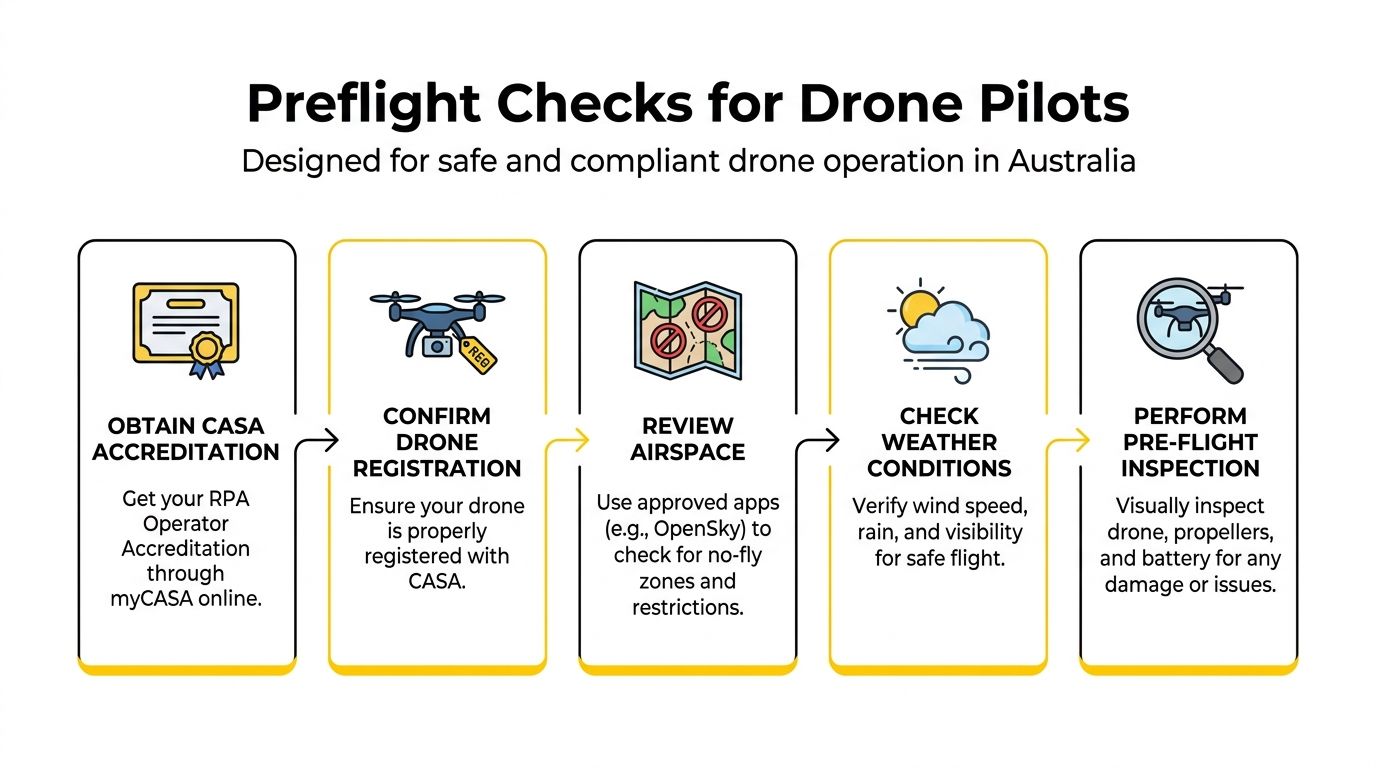
A practical compliance flow usually works best in this order:
Confirm the operation type
Decide whether the flight fits standard conditions or needs a higher permission pathway.Check the aircraft paperwork
Confirm the drone is registered correctly and tied to the right operator details.Review the location
Controlled airspace and nearby aviation activity should be checked before travel, not after arrival. AAA's guide to drone safety around airports and helicopter landing sites in Australia is useful context for this step.Assess weather and ground risk
Wind, gust spread, visibility, rain, obstacles, and foot traffic all affect whether the job should proceed.Log the intended flight
Keep a record of the purpose, location, aircraft, batteries, and any site-specific controls.
A practical preflight routine
A useful checklist doesn't need to be long. It needs to be used every time.
| Preflight item | What to verify | What often goes wrong |
|---|---|---|
| Aircraft condition | Props secure, battery seated, firmware current, payload attached properly | Loose propeller fit, damaged arms, unlatched battery |
| Site suitability | Safe launch area, clear recovery area, no overhead hazards | Pilots launch too close to vehicles, fences, or workers |
| Airspace review | Restrictions checked before arrival | Pilots realise too late the job is too close to controlled airspace |
| Mission settings | Return-to-home altitude, camera mode, home point | Default settings don't match the actual site |
| Human factors | Fatigue, distractions, client pressure | The pilot rushes because the client is waiting |
Practical rule: If the client is already asking for “just a quick flight” before checks are complete, the risk level has already increased.
For beginners building those habits, ACE READY is an entry level drone training course covering drone fundamentals, aviation safety, CASA regulations, flight operations, and preparation for later RePL training in Australia.
Basic Flight Manoeuvres and Controls
Most flight errors come from weak fundamentals, not advanced operations. A pilot who can't hold a precise hover or land cleanly will struggle much more once wind, obstacles, and client pressure enter the picture.
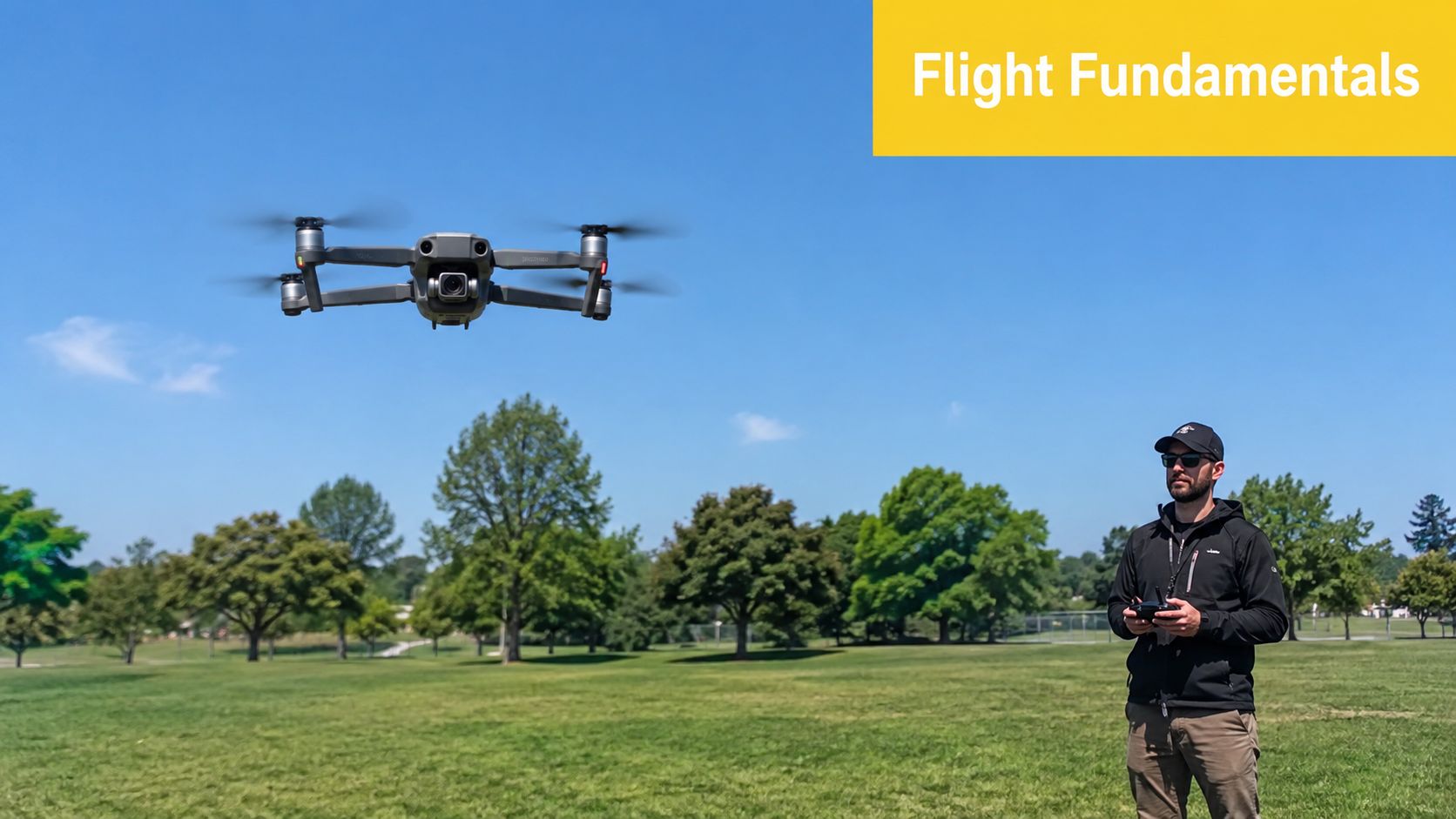
The first drills that build control
The best early practice happens in a broad open area with clear visual references. A marked field, empty open ground, or another unobstructed site gives the pilot room to learn without forcing constant corrections around hazards.
Core drills should include:
Vertical take-off and steady climb
Lift to a safe hover height smoothly. Avoid abrupt throttle inputs that create instability straight after lift-off.Stationary hover
Hold position without chasing every small movement. The goal is measured correction, not constant stick activity.Yaw control
Rotate the aircraft slowly while keeping height and position stable. This teaches orientation management.Straight-line forward and backward flight
Fly a clean path between two markers, then return on the same line.Controlled landing
Descend with patience. Many pilots fly well until the last few seconds and then rush the touchdown.
A pilot working through these basics can also compare training options such as ACE BRONZE, which covers drone operations, flight safety, aviation theory, and practical skills for students starting the path toward licensed commercial flying in Australia.
How to stop over-correcting
Over-correction is the classic beginner pattern. The drone drifts slightly, the pilot reacts too strongly, then reacts again to undo the first input. The aircraft ends up oscillating instead of stabilising.
Three habits fix that:
Use visual markers
Pick a line on the ground, a cone, or a fixed reference point. Without a marker, position drift is harder to judge.Pause after each input
Small drones respond quickly, but not instantly. Give the aircraft time to settle.Train nose-in and nose-out orientation separately
Many pilots handle one well and the other poorly. That gap shows up fast on real jobs.
The next layer is to combine basic manoeuvres into mission patterns. For inspection work, that may mean rectangular passes along a roofline or façade. For imagery capture, it may mean repeated lateral runs at a fixed height and speed.
This training clip is useful for seeing control inputs and flight posture in context:
For operators planning a broader commercial pathway, ACE PLATINUM is a complete enterprise drone training package that includes RePL, AROC, Aviation English, Express ReOC, Certificate III in Aviation, advanced operations training, and preparation to operate and manage a commercial drone business.
Emergency Procedures and Troubleshooting
When a drone problem starts in the air, the pilot doesn't have time to invent a response. The actions need to be familiar before the event happens.
The first actions in any in-flight problem
The first priority is simple. Keep people safe, keep visual awareness, and choose the least risky recovery option available.
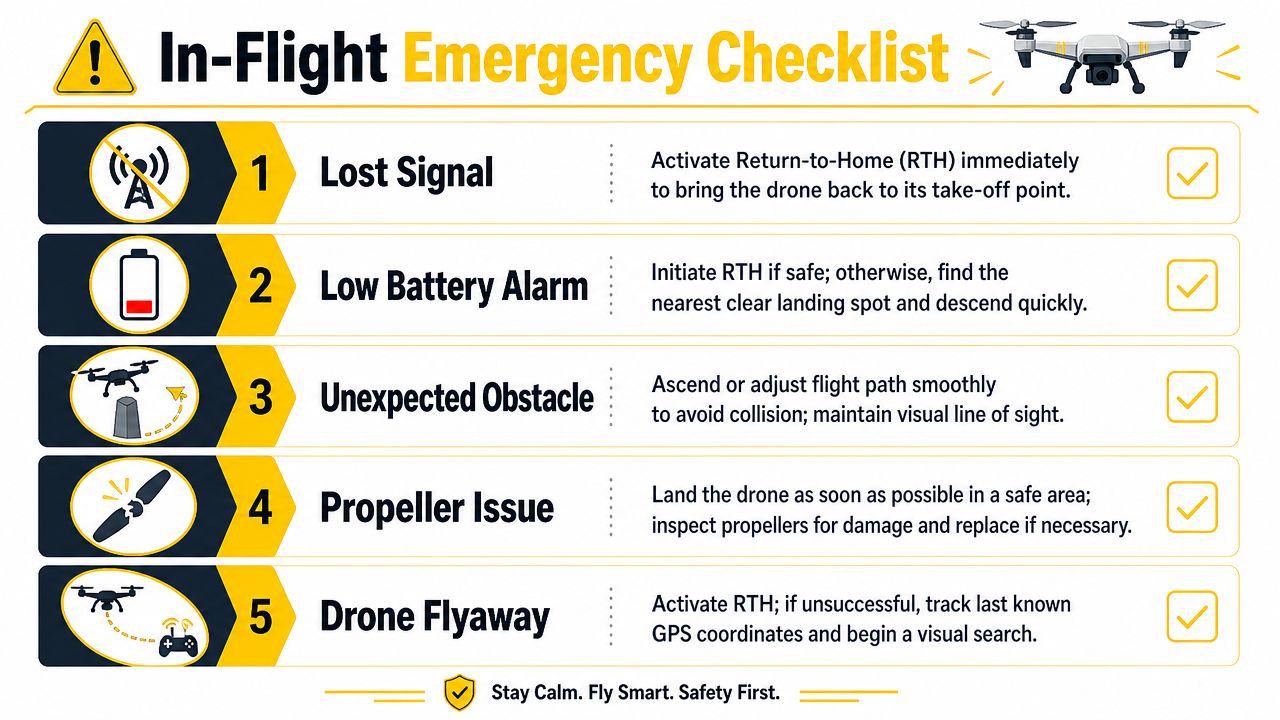
A usable in-flight response checklist includes:
Lost signal
Activate return-to-home if the aircraft response and site conditions make that safe. If obstacles make the programmed return path risky, a controlled manual recovery may be safer.Low battery warning
Stop trying to complete the shot. Recover early. If the aircraft can't return comfortably, use the nearest safe landing area.GPS dropout or unstable positioning
Reduce manoeuvring. Keep inputs gentle and prepare for manual control changes in drift behaviour.Unexpected obstacle or aircraft movement
Climb or alter path smoothly if separation can be maintained safely. Sudden stick inputs often create the collision the pilot was trying to avoid.Propeller or motor abnormality
Land as soon as a safe area is available. Don't continue the mission to “see if it settles down”.
Many newer operators still misunderstand what small commercial drones require. A 2024 Australian industry survey found 68% of new commercial drone operators were confused about whether excluded category flights require accreditation, a problem linked to unlicensed operations and avoidable safety risk in the Taylor & Francis article on Australian drone operator confusion.
When a fault appears in flight, the mission is over. The pilot's job changes from capture to recovery.
Battery incidents deserve their own planning. Teams storing, charging, or transporting multiple flight batteries should also understand external resources on solutions for lithium-ion battery fires, especially where batteries are handled in vehicles, workshops, or field kits.
What to record after an incident
An incident log should be written while details are fresh. That record should include:
- Time and place: exact site, launch point, and weather conditions
- Aircraft status: battery used, warnings shown, and controller behaviour
- Sequence: what happened first, what response was used, and where the drone landed
- Outcome: property damage, near miss, injury risk, or equipment fault
Operators looking for a structured incident-response mindset can also review AAA's drone pilot emergency handbook on ANCA, CANCA, and ATSB reporting.
Maintenance Best Practices
Good maintenance isn't about keeping a drone looking tidy. It's about reducing avoidable failures and proving that the aircraft has been managed responsibly.
What to inspect every time
A reliable maintenance routine starts before and ends after each flight. The pilot should look for physical damage, contamination, wear, and any sign that a component isn't performing normally.
The most useful checks are usually simple:
Propellers and motors
Inspect for chips, cracks, looseness, or uneven resistance during rotation.Airframe and landing gear
Look for hairline damage after transport or hard landings.Sensors and camera surfaces
Clean dust, moisture marks, and debris before the next job, not at the launch point under pressure.Firmware and controller status
Keep systems current, but avoid major updates immediately before an operational job unless they've already been tested.
Battery care and storage discipline
Battery care is where disciplined operators separate themselves from casual users. Batteries should be labelled, rotated sensibly, and monitored for swelling, heat anomalies, or unusual discharge behaviour.
A practical logbook should record:
- Flight date and site
- Aircraft used
- Battery cycle history or identifying number
- Observed issues
- Maintenance action taken
Clean equipment matters less than predictable equipment. A spotless drone with a tired battery is still an operational risk.
Storage also matters. Drones and batteries should be kept dry, protected from impact, and packed so propellers, gimbals, and terminals aren't stressed in transit. That routine reduces surprises at the next launch site.
CASA Rules and Permissions
Australian drone rules become much easier to follow once the main thresholds are understood properly. Most confusion comes from operators half-remembering one rule while missing the related condition that changes how it applies.
The thresholds that change what you must do
In Australia, all drones over 250 grams must be registered with CASA, and drones over 500 grams attract an annual registration fee of AUD $40. Commercial operations are limited to 120 metres above ground level and can't take place within 5.5 kilometres of a controlled airport without clearance, as outlined in this Australian drone rules explainer.
That means a pilot needs to think in layers, not single rules.
| Rule area | Threshold or limit | Operational meaning |
|---|---|---|
| Registration | Over 250 g | The aircraft must be registered |
| Annual levy | Over 500 g | Registration includes an annual AUD $40 fee |
| Altitude | 120 m AGL | Height is measured from the ground below the drone |
| Controlled airport separation | 5.5 km | Clearance is required if operating inside that area |
A common mistake is misunderstanding altitude in sloping terrain. The limit is tied to ground level beneath the aircraft, not a broad estimate of local sea level or launch-point intuition.
When standard conditions are no longer enough
Some jobs stop fitting ordinary operating conditions very quickly. Night operations, operations near controlled aerodromes without the required clearance, or work over populous areas move the task into a more complex legal category.
A Remote Pilot Licence is required for commercial operations using aircraft of 2 kg or more, or for work outside standard conditions such as night flying, operations within 5.5 km of a controlled aerodrome without ATC clearance, or operations over populous areas, as explained in AAA's guide to the ultimate ReOC framework in Australia.
The practical lesson is straightforward. If the brief sounds more complicated than a daytime visual line of sight operation in a clear, low-risk area, the pilot should stop assuming standard permissions are enough.
Commercial Use Cases and Operational Planning
Commercial drone work isn't one job type. The planning process changes depending on what the client needs and how much operational control the site allows.
How different jobs change the flight plan
Australia's commercial drone sector expanded quickly. As of mid-June 2020, Australia had over 16,300 RePL holders and more than 1,900 ReOC entities. By 2021, that had grown to over 20,000 RePLs and 2,100 ReOCs, showing strong uptake across industries such as agriculture, mining, and infrastructure inspection, according to the Australian government drone discussion paper.
That growth makes sense because the operational uses are broad:
Agriculture
Flights often cover large open areas, but wind exposure, patchy reception, and battery planning become central issues.Construction and civil works
These sites are dynamic. Plant movement, workers, deliveries, and changing exclusion areas can alter the risk picture during the day.Infrastructure inspection
The drone may need stable proximity work near poles, façades, roofs, or raised structures. Precision matters more than speed.Emergency and government support tasks
The technical flying may be straightforward, but documentation, coordination, and chain-of-command discipline become more important.
What a workable operations plan includes
A useful site-specific plan should answer operational questions before the aircraft leaves the case.
Key elements include:
- Flight objective: imagery, inspection, mapping, or monitoring
- Launch and recovery zones: primary and alternate areas
- Ground hazards: people, vehicles, wires, structures, vegetation
- Air risk: nearby aviation activity and restrictions
- Battery plan: expected sorties, swap points, and recovery margin
- Deliverables: stills, video, stitched outputs, or observational notes
One practical difference between hobby and commercial work is repeatability. A client doesn't just want a successful flight. They want the same standard next week, next month, and on the next site. That only happens when the pilot can turn a brief into a consistent operating plan instead of improvising every mission.
Training and Certification Pathways
Formal training matters because commercial drone work is more than aircraft handling. It requires legal literacy, operational judgement, communication discipline, and repeatable standards.
Why formal training changes operational quality
For commercial use, CASA requires a pilot seeking a Remote Pilot Licence to complete at least five hours of supervised flying on the specific type and weight class of drone, covering pre-flight checks, take-offs, landings, emergency procedures, and controlled manoeuvres, followed by a practical flight test assessed by a qualified instructor, according to UAS National Training's RePL guide.
That supervised structure matters because self-taught pilots often develop gaps they don't notice:
- weak emergency habits
- poor radio discipline around controlled environments
- inconsistent briefings
- uncertainty about when a job falls outside standard permissions
A proper pathway can include:
- Remote Pilot Licence RePL for commercial piloting where licence-level privileges are required
- Aeronautical Radio Operator Certificate AROC for operators who need radio communication competence
- ReOC Consulting for businesses building an operator-level approval framework
- Certificate III in Aviation where a broader aviation foundation supports career development
- Enterprise Drone Training or Corporate Drone Training where teams need shared procedures and standardisation
Choosing the right pathway for the work
The right training path depends on the intended operation, not just the aircraft. A sole operator doing routine visual inspection work has different needs from a construction firm training multiple staff across sites.
For organisations producing internal operating procedures, it also helps to build training material that staff can revisit. Resources on planning and editing video lessons can help teams document workflows, briefing standards, and equipment handling in a format that supports refresher learning.
Ace Aviation Aerospace Academy is one Australian training provider in this space. It offers CASA-aligned drone education including RePL, AROC, Certificate III in Aviation, ReOC Consulting, Enterprise Drone Training, and Corporate Drone Training.
The biggest advantage of formal training isn't the certificate itself. It's that trained operators usually make better decisions before the aircraft leaves the ground.
Conclusion
Safe commercial drone work in Australia depends on discipline at every stage. The aircraft still needs the basics of smooth take-off, controlled hover, orientation management, and accurate landing. But the larger difference between a casual flight and a professional one sits in planning, legal compliance, maintenance, and incident readiness.
Preflight checks stop rushed decisions. Core manoeuvre practice removes avoidable handling errors. Emergency procedures reduce hesitation when something goes wrong. Maintenance routines keep equipment predictable. CASA thresholds around registration, altitude, and controlled airspace determine whether the job is legal before the motors even start.
Commercial work adds another layer. The pilot must turn a client brief into a flight plan, identify risk controls, choose the right permissions, and capture useful outputs without drifting outside the rules. That's where training becomes more than a formality. It creates standard operating habits that hold up under pressure.
For anyone serious about flying a drone for work, the next step isn't just more airtime. It's structured airtime, logged carefully, with legal understanding and supervised development where required. CASA requirements can change, so checking current information through myCASA remains essential. A pilot who combines current compliance knowledge with clean flying habits will be far better placed to build a reliable commercial career.
FAQ
Does a business need insurance to fly a drone commercially in Australia
Insurance requirements can depend on the work type, client contract, and organisational policy. Many commercial clients expect evidence of suitable cover before allowing work on site. Even where a specific policy isn't discussed upfront, flying without appropriate insurance can expose the operator or business to significant liability after property damage or personal injury.
Can a drone be used to film a sporting event or beach gathering
Not automatically. Operations over populous areas or near uninvolved people can move the job outside standard conditions. If the site includes crowds, active public access, or dense foot traffic, the pilot should assess whether the intended operation needs a different approval pathway instead of assuming a standard commercial setup will cover it.
Is night flying allowed for commercial drone work
Night flying isn't something a pilot should assume is covered by ordinary daytime operating habits. In Australia, operations outside standard conditions can trigger additional licensing or approval requirements. Before planning any night job, the operator should confirm the exact legal basis for that operation and whether extra training, permissions, or organisational approvals are needed.
What's the difference between operator accreditation and a RePL
Operator accreditation is part of the legal pathway for certain lower-complexity commercial operations, particularly in the excluded category. A RePL sits at a higher training and licensing level and is required for commercial operations using aircraft of 2 kg or more, or for operations outside standard conditions. The right option depends on the aircraft, the site, and the mission profile.
How should a pilot log flight practice properly
A useful flight record should identify the date, location, aircraft, battery used, flight purpose, weather conditions, and any issues observed. It should also note what was practised, such as hover work, emergency drills, controlled landings, or inspection patterns. Detailed log entries help with progression, internal review, and operational accountability.
Is enterprise drone training different from training a single pilot
Yes. Enterprise training usually focuses on standardisation across staff, sites, aircraft, and reporting processes. A single-pilot pathway centres on individual handling skill and personal compliance habits. A business often needs both. Individual competency still matters, but the organisation also needs common procedures, records, escalation rules, and management oversight.
For pilots, businesses, and government teams looking for structured Australian drone training, Ace Aviation Aerospace Academy provides aviation and drone education pathways including RePL, AROC, Certificate III in Aviation, ReOC Consulting, and enterprise-focused training options.