If you are looking to turn a passion for flying drones into a professional career, you have made a great choice. While flying a small drone for fun is relatively straightforward, stepping up to commercial work in booming sectors like agriculture, construction, or filmmaking is a different matter. It requires formal certification, and this guide will explain the process.
We will break down exactly what you need to do, cutting through the jargon and regulatory complexity to get you qualified and ready for the job market.
Table of Contents
- Your Path to a Professional Drone Career in Australia
- Obtaining Your CASA Licences and Certifications
- Choosing Your CASA-Approved Drone Training Program
- Budgeting for Your Drone Licence and Associated Costs
- Launching Your Career and Finding Drone Pilot Jobs
- Frequently Asked Questions (FAQ)
Your Path to a Professional Drone Career in Australia
The journey to becoming a professional drone pilot in Australia is a clear, structured process managed by the Civil Aviation Safety Authority (CASA). It all begins with obtaining your Aviation Reference Number (ARN), which is your unique ID in the aviation system. Think of it as your first official step.
From there, you will need to complete a Remote Pilot Licence (RePL) course. This is not just an administrative exercise; it is essential training that covers aviation law, safety procedures, and the practical flight skills you will need on the job. This licence is your ticket to operating legally and professionally.
The infographic below outlines the core steps to launching your drone career.
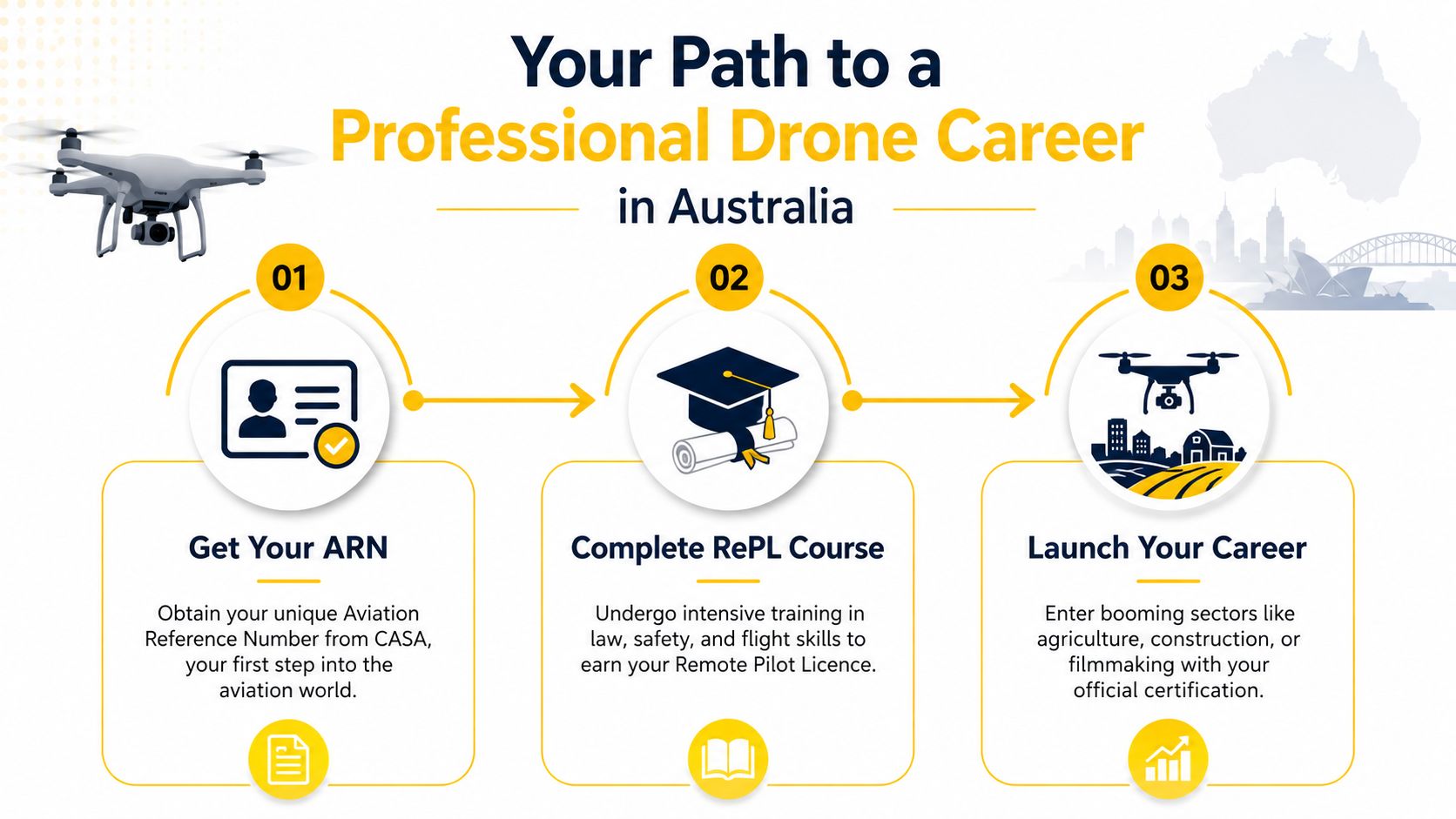
As you can see, the path is logical: get your ARN, get trained and certified with a RePL, and then you are ready to enter the industry.
Your first task is to visit the CASA website and apply for your Aviation Reference Number. You cannot enrol in any formal training without one, making it a non-negotiable starting point.
This guide will walk you through the specifics of each certification, what to look for in a training provider, and the career opportunities that await. For a deeper dive into where the jobs are, it is worth exploring the current Australian drone ecosystem to see which industries have the highest demand for qualified pilots.
Obtaining Your CASA Licences and Certifications
Before you can earn an income from flying a drone in Australia, you must obtain the right qualifications. This means familiarising yourself with the Civil Aviation Safety Authority, or CASA, as they set the regulations and issue the licences that will form the foundation of your career.
Your first major requirement is a Remote Pilot Licence (RePL). This is your personal authorisation to fly. Consider it your driver's licence for drones; it proves you have the knowledge and skill to operate a remotely piloted aircraft safely and legally for commercial purposes. Without one, you are limited to recreational flying.
Adding Key Skills for Professional Work
In many scenarios, a RePL alone is not sufficient. If your work takes you into controlled airspace—and a surprising amount of commercial work does—you will also need an Aeronautical Radio Operator Certificate (AROC).
This certificate is crucial. It qualifies you to use aviation-grade radio equipment and, more importantly, to communicate effectively with air traffic controllers and other pilots. It is a non-negotiable skill for operating safely in busy skies. Reputable training providers often bundle the RePL and AROC together for this reason. Ace Aviation Aerospace Academy includes an AROC as standard in our Remote Pilot Licence (RePL) course.
Taking the Next Step: The Business Certification
What happens when you want to start your own drone business or operate as a sole trader? This is where the Remotely Piloted Aircraft Operator's Certificate (ReOC) becomes relevant.
It is important to understand the distinction: the RePL is for you, the pilot. The ReOC is for the business or organisation.
If you plan on establishing your own drone business, you will need a ReOC. It demonstrates to CASA that your entire operation—not just you as a pilot—has the robust safety systems, risk assessments, and documented procedures required to handle more complex jobs.
These are the jobs that often pay more, such as flying at night, operating above 400 feet, or working closer to people than standard rules permit. If you join an existing drone company, you will simply work under their ReOC. For any aspiring entrepreneur, however, obtaining your own is a vital step. Our ReOC Consulting service can guide you through this complex process.
Figuring out the exact path can feel overwhelming. To get a clear recommendation based on your goals, you can use a helpful licence finder tool to map out your best route.
Choosing Your CASA-Approved Drone Training Program
Selecting the right training program is one of the most important decisions you will make on your journey to becoming a commercial drone pilot. The quality of your training does not just result in a certificate; it shapes your skills, your safety mindset, and ultimately, your job prospects. It is crucial to look beyond the price tag, as not all CASA-approved providers are created equal.
To fly a drone commercially in Australia, you must complete a Remote Pilot Licence (RePL) course. The industry standard, as outlined by CASA, is a five-day program, typically comprising three days of theory and two days of practical, hands-on flight training. This structure ensures you have a solid grasp of aviation rules and can proficiently control the aircraft before your assessment. You can find more details in the official CASA student guide.
Evaluating Training Providers
When you compare training providers, your number one priority should be their safety culture. After that, investigate the details of what they offer.
Here are a few factors aspiring pilots should consider:
- Instructor Experience: Are your instructors simply delivering course material, or are they seasoned aviators with real-world commercial drone experience? Learning from someone who has worked in the field is invaluable.
- Training Aircraft: Find out what kind of drones they use for training. You want to be learning on modern, industry-relevant equipment that you will likely encounter on the job, not outdated hobbyist models.
- Course Inclusions: Does the price cover only the bare-minimum RePL? Top-tier providers, like Ace Aviation Aerospace Academy, often bundle other vital certifications into their courses. For example, obtaining your Aeronautical Radio Operator Certificate (AROC) is essential if you plan to operate in controlled airspace, and having it included saves considerable hassle.
Advancing Beyond the Basics
While the RePL is your entry ticket, if you are serious about this as a career, you should consider what comes next. Enrolling in a more advanced qualification from the outset can give you a significant advantage in the job market.
For anyone wanting to build a long-term career, a qualification like the Certificate III in Aviation (Remote Pilot) is the ideal pathway. It is a nationally recognised VET course that provides more in-depth training than a standard RePL, preparing you for complex operations and specialised roles that are in high demand.
By choosing a provider with a clear educational pathway, you are investing in a sustainable career, not just a licence. Take the time to explore a full range of CASA-approved aviation courses and find the program that truly matches your ambitions.
Budgeting for Your Drone Licence and Associated Costs
One of the first questions aspiring drone pilots ask is, "What will this actually cost?" It is a fair question, and understanding the investment from the start is crucial. The course fee for your Remote Pilot Licence (RePL) is the largest expense, but it is not the only one.
The price for a RePL course can vary based on the delivery method. For a fully in-person course, you can expect to pay around $2,400 plus GST. These are excellent for hands-on, immersive learning. Alternatively, many pilots opt for a blended model, which mixes online theory with in-person practicals. These are often more budget-friendly, costing about $1,650 including GST. You can get a sense of current RePL pricing and industry averages to understand the market.
Core Costs Beyond Your Course Fee
Your training fee covers the qualification, but there are other essential costs to become legally and commercially ready to fly. Do not let these catch you by surprise.
-
Aviation Reference Number (ARN): You will need this unique ID from CASA before you can enrol. The good news is that it is free to apply for one.
-
Drone Registration: Any drone used for commercial purposes in Australia, regardless of size, must be registered with CASA. It is a small annual fee, typically between $25–$30 per drone, depending on its weight.
-
Public Liability Insurance: This is absolutely non-negotiable. Flying without it poses a massive financial risk. Annual premiums can range from $500 to $1,500, based on your drone's value and the type of work you plan to undertake.
In total, you are realistically looking at an initial investment between $2,500 and $4,000 to become fully licensed, insured, and ready for your first commercial job. While a significant outlay, it is the cost of entry into an industry where skilled, professional operators are in high demand.
To get a more precise figure for your specific situation, you can use an online quote calculator to build a personalised breakdown of the costs.
Launching Your Career and Finding Drone Pilot Jobs
Congratulations, you have earned your Remote Pilot Licence (RePL). This is a significant achievement, but as any seasoned pilot will attest, it is the beginning of your journey, not the end. The real work begins now: turning that licence into a career by building a solid flight portfolio and making connections in Australia’s expanding drone industry.
Your new qualification opens up numerous pathways. You could be conducting agricultural surveys, capturing high-end real estate footage, or performing critical asset inspections in the mining sector. Your career will largely be determined by one key decision: whether to work for an established company with a Remotely Piloted Aircraft Operator's Certificate (ReOC), or operate as a sole trader.
Building Your Flight Portfolio
Think of your portfolio as your professional calling card—it is tangible proof of your skills that speaks louder than any certificate. A weak portfolio can do more harm than good, so it is crucial to get it right.
- Demonstrate Your Range. Do not just include a handful of landscape shots. Show potential employers your versatility by including different types of work, such as aerial mapping data, detailed asset inspections, and polished creative videography. This proves you can adapt to various commercial needs.
- Quality is Everything. Every photo and video must be sharp, correctly exposed, and demonstrate smooth, precise flight control. This is your opportunity to show you are a professional, not just a hobbyist.

You are entering a strong job market. The commercial drone industry in Australia is projected to employ over 10,000 licensed remote pilots by 2030, driven by high demand in sectors like agriculture, construction, and resources. For new pilots, this translates to excellent career prospects. Many are gaining a competitive edge by completing advanced qualifications like the Certificate III in Aviation (Remote Pilot) to stand out. You can read more about the growth of the drone pilot profession in Australia.
Remember that learning is continuous. Earning more advanced endorsements and staying current with new technology is key to increasing your value and income. To understand what employers are looking for right now, it is a great idea to review current drone pilot job listings and see what skills are in demand.
Frequently Asked Questions (FAQ)
Here are answers to some of the most common questions from aspiring drone pilots, based on current Australian CASA regulations.
Do I need to own a drone for my RePL course?
No, you do not. Any reputable training provider, including Ace Aviation Aerospace Academy, will provide all necessary drones and equipment for your training. This allows you to learn on industry-standard aircraft without needing to purchase your own equipment before you are licensed.
Can I fly commercially in Australia without a licence?
Technically, yes, but it is extremely restrictive. You are permitted to fly a drone under 2 kg for commercial work under the 'Excluded Category'. However, you must still register the drone with CASA and adhere strictly to the standard operating conditions, which limit you from flying near people or in controlled airspace. For almost any professional job, a full Remote Pilot Licence (RePL) is required by employers.
How long is a Remote Pilot Licence valid for?
Your Australian RePL is valid for life and does not expire. However, you are responsible for maintaining your skills and knowledge. This means flying regularly to maintain practical currency and staying up-to-date with any changes to CASA regulations, which is an essential part of being a professional pilot.
What is the difference between a RePL and a ReOC?
This is a critical distinction. A Remote Pilot Licence (RePL) is an individual qualification that allows you, the pilot, to fly a drone commercially. A Remotely Piloted Aircraft Operator's Certificate (ReOC) is a business certification that authorises an organisation to conduct more complex drone operations (e.g., flying at night or beyond visual line of sight) and employ a team of pilots. You need a RePL to be a pilot; you need a ReOC to run an advanced drone business.
At Ace Aviation Aerospace Academy, we offer comprehensive drone and aviation training for individuals and businesses across Australia. Our CASA-approved courses include the Remote Pilot Licence (RePL), Aeronautical Radio Operator Certificate (AROC), and the Certificate III in Aviation. For businesses, we provide Enterprise Drone Training and ReOC Consulting to help you establish safe, compliant, and efficient operations. Explore our courses and services at https://aaa.edu.au.