If you want to fly a drone for work or business in Australia, obtaining a Remote Pilot Licence (RePL) is the first crucial step. While some very specific exceptions exist, the RePL is the standard qualification required by the Civil Aviation Safety Authority (CASA) for any serious commercial work. It is your ticket to operating legally, building a professional reputation, and ensuring you comply with Australian aviation law.
Table of Contents
- Your Path to Flying Drones Commercially in Australia
- Navigating CASA's Drone Licensing Framework
- Kicking off Your RePL Application and Training
- Going Beyond Your RePL: Essential Certifications
- Building Your Career as a Licensed Drone Pilot
- Frequently Asked Questions (FAQ)
Your Path to Flying Drones Commercially in Australia
Considering a career as a professional drone pilot is an excellent move. Opportunities are expanding across various sectors, from real estate photography and agricultural surveys to critical infrastructure inspections. However, before you can operate a drone for a client, you must have the correct qualifications.
The primary qualification you will need is the Remote Pilot Licence (RePL). This is not just an administrative requirement; it is formal evidence that you possess the skills and knowledge to fly a remotely piloted aircraft safely and professionally. It demonstrates to clients and regulators that you understand Australian aviation law, can navigate complex airspace, and know how to manage operational risks.
Obtaining your RePL is the foundation for a sustainable career in the drone industry. It separates professional pilots from hobbyists and opens the door to more advanced and lucrative opportunities.
The journey involves a few key milestones:
- Obtaining an Aviation Reference Number (ARN) from CASA.
- Enrolling in a certified training course to learn the required aeronautical theory.
- Undertaking hands-on flight practice with expert instructors.
- Passing the theory examinations and practical flight assessments to demonstrate competency.
A reputable training provider will guide you through this entire process. If you are unsure which licence or certifications you need for your specific goals, our drone licence finder tool can help clarify your specific needs.
Navigating CASA's Drone Licensing Framework
To fly a drone for your job in Australia, you first need to understand the regulations managed by the Civil Aviation Safety Authority (CASA). Their framework is not a one-size-fits-all document; it is a tiered system designed to match the level of operational risk with the appropriate qualifications.
At its core, the regulations draw a clear line: are you flying for fun, or are you flying professionally? If money changes hands or the drone is part of any business activity, you have crossed into commercial territory. This comes with a higher standard of responsibility and a different set of rules designed to keep our skies safe.
Recreational vs. Commercial Drone Operations
Flying a drone as a hobby is relatively straightforward—just follow the standard drone safety rules and do not accept payment. Commercial flying, however, is a different matter. This is where you encounter two main pathways: operating under the 'excluded category' or becoming a fully qualified Remote Pilot Licence (RePL) holder.
For example, a wedding photographer might use a small drone under 2 kg to capture aerial shots under the 'excluded category'. However, a surveyor using a 5 kg drone with advanced sensors on a large construction site must hold a RePL due to the increased complexity and risk.
This graphic breaks down the fundamental choice between flying for fun and building a professional career.
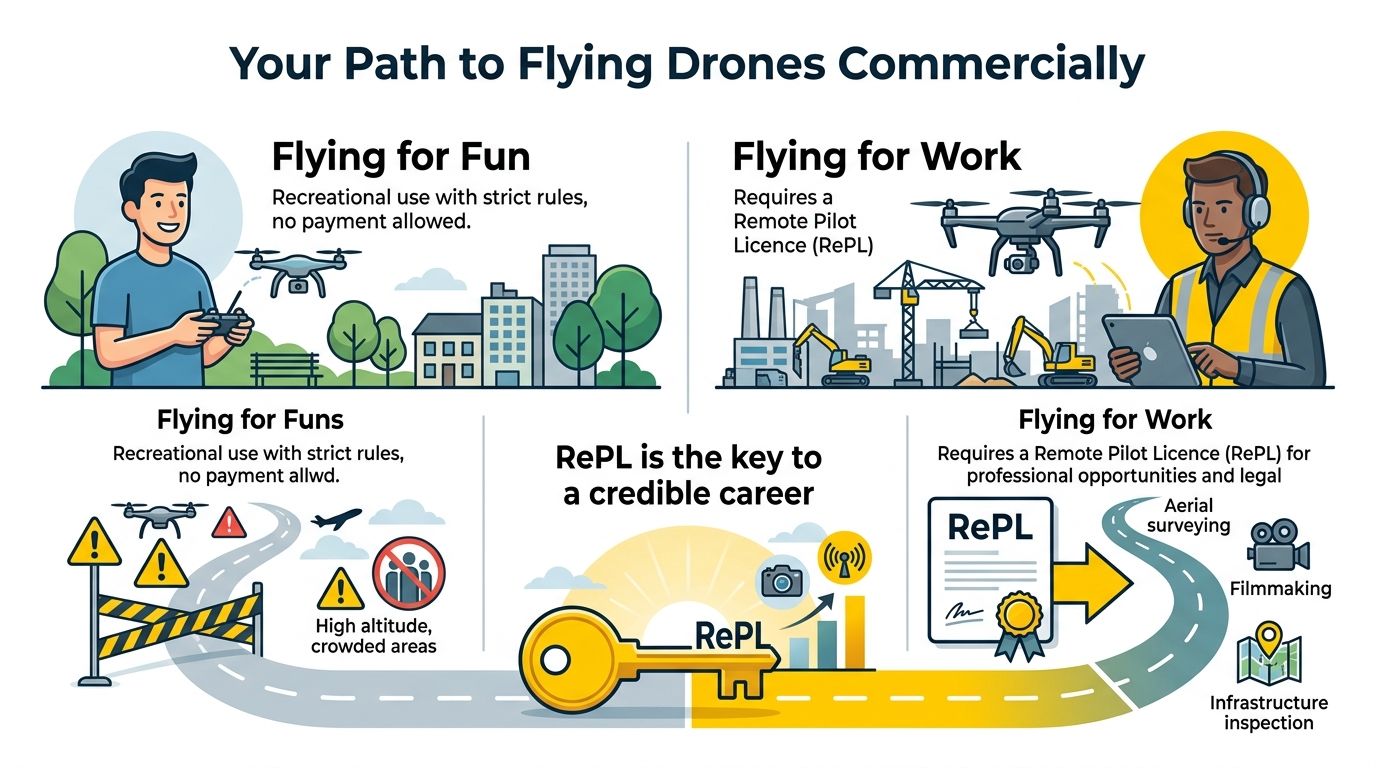
As you can see, the excluded category provides a very narrow entry point into commercial work and is loaded with restrictions. While it may seem like a shortcut, it can severely limit your operational capabilities and career opportunities. To get the full picture, we have prepared a guide on the rules and risks of excluded category drone operations.
Ultimately, your choice depends on your career ambitions. If you are serious about flying drones professionally and want to take on more complex, higher-paying jobs, a RePL is not just an advantage—it is essential.
Kicking off Your RePL Application and Training
Let's break down the practical steps to obtaining your commercial drone licence. The very first action you must take is to apply for an Aviation Reference Number (ARN) through the myCASA online portal.
The ARN is your unique identifier within Australia's aviation system. CASA will use this number for all your future interactions, including licensing and registrations. The online application is straightforward, and you should receive your number within a few business days.
Once your ARN is sorted, it is time to choose a CASA-certified training provider. This is arguably the most important decision in the process. The quality of your training determines not only your qualification but also the foundation of your skills, safety culture, and career prospects.
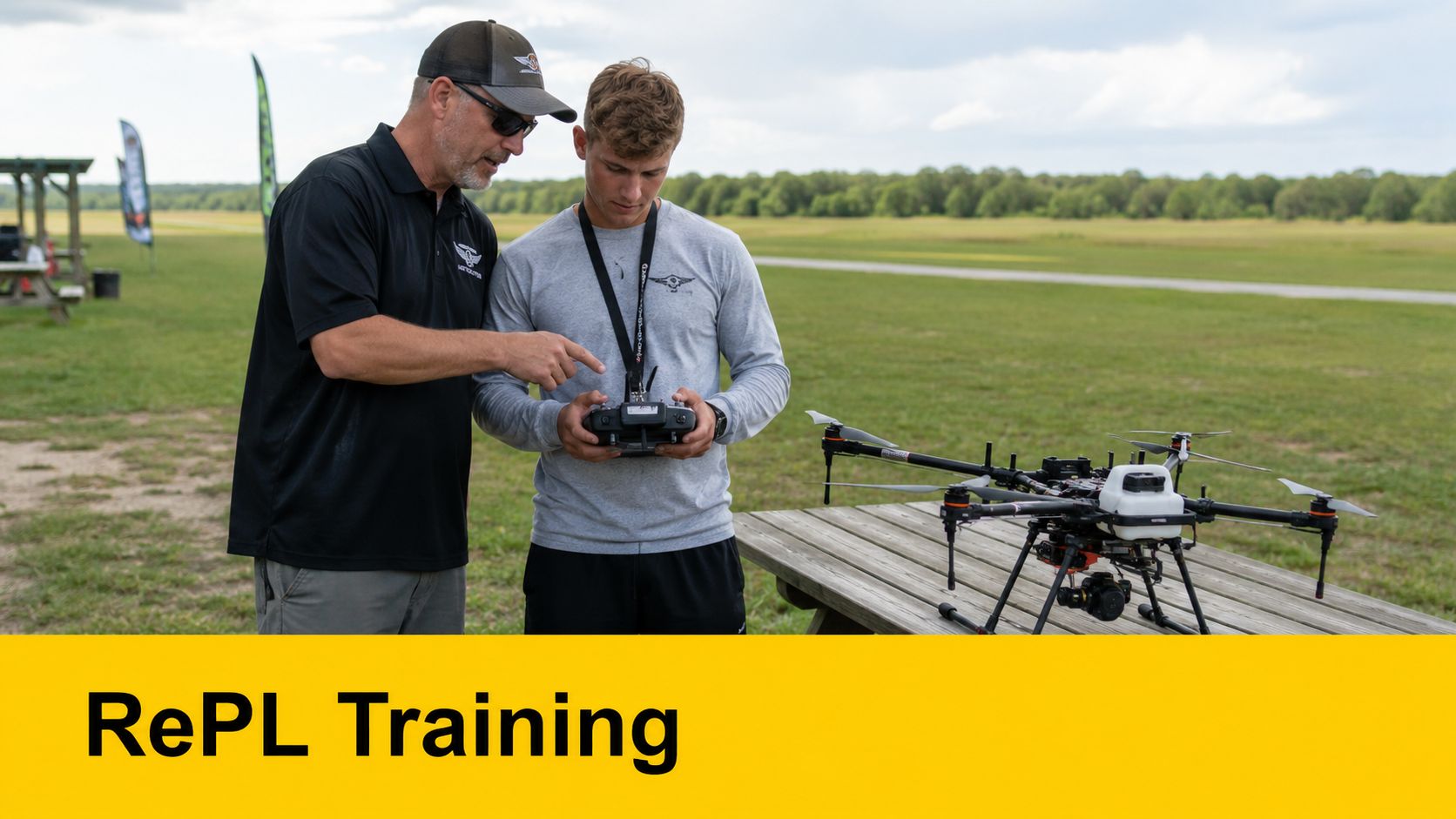
What to Expect from Your RePL Training Course
The Remote Pilot Licence (RePL) course is the core qualification you are aiming for. A high-quality course provides a comprehensive mix of classroom theory and practical, hands-on flight training.
- Theory Component: You will delve into the essential knowledge that keeps pilots safe and compliant. This includes Australian aviation law, airspace management, meteorology, aerodynamics, and human factors. This knowledge provides the 'why' behind every action you take as a pilot.
- Practical Component: This is where you apply the theory. Under the supervision of an experienced instructor, you will learn to fly, mastering everything from pre-flight checklists and basic manoeuvres to handling simulated emergency scenarios.
At the end of your training, you will need to pass a theory examination and demonstrate your skills in a practical flight assessment. The flight test is not about performing complex manoeuvres; it is a competency check to ensure you can operate the drone safely and professionally according to established standards.
In Australia, the RePL is the mandatory licence for anyone flying a drone over 2 kg for commercial purposes. Most new pilots start with courses covering the popular sub-7kg and sub-25kg multi-rotor categories. You can see how this qualification fits into the wider aviation landscape by exploring the various aviation courses available, including our Certificate III in Aviation.
Going Beyond Your RePL: Essential Certifications
Obtaining your Remote Pilot Licence (RePL) is a fantastic achievement, but in the professional sphere, it is often just the starting point. To unlock the most sought-after and rewarding jobs, you may need additional qualifications.
The first and most important of these is the Aeronautical Radio Operator Certificate (AROC).
Why the AROC is a Non-Negotiable Qualification
If you plan to fly anywhere near controlled airspace—and a surprising amount of commercial work occurs in these areas—you must be able to communicate with air traffic control and other aircraft. The Aeronautical Radio Operator Certificate (AROC) is the qualification that gives you this capability. It teaches you the specific phraseology and procedures of aviation radio communications.
Without an AROC, you are effectively flying silent. This severely restricts where you can legally operate and makes you a less versatile and valuable pilot. Most reputable training providers, including Ace Aviation Aerospace Academy, bundle the AROC training with their Remote Pilot Licence (RePL) course, as it is the most efficient way to become job-ready.
The ReOC: Understanding the Business Side of Flying
Sooner or later, you will encounter the term Remote Operator’s Certificate (ReOC). It is easy to confuse this with a pilot's licence, but they are entirely different.
Think of it this way: The RePL is your personal driver's licence. The ReOC is the taxi company's business licence. One authorises you to fly the drone; the other authorises the business to conduct commercial drone operations.
A ReOC is held by a business, not an individual pilot. It allows that company to employ licensed pilots and authorises them to conduct more complex flights that go beyond standard operating conditions, such as flying at night or closer to people.
For many pilots, the goal is to work for a reputable ReOC holder. For the more entrepreneurial, the ultimate aim is to start their own drone business, which means undertaking the comprehensive process of obtaining their own ReOC. Ace Aviation Aerospace Academy offers ReOC Consulting to guide businesses through this complex application process. This certification is the gateway to advanced operations, and for those at the forefront of the industry, understanding concepts like Beyond Visual Line of Sight (BVLOS) operations is the next logical step.
Building Your Career as a Licensed Drone Pilot
Congratulations on earning your Remote Pilot Licence (RePL)! This licence is your entry into the commercial drone industry, but the real journey of building a career starts now. Before your first paid flight, there are two crucial administrative tasks to complete.
First, every drone you fly for work, regardless of its size, must be registered with CASA. This can be done easily through your myCASA portal. Second, you must have appropriate insurance. Public liability insurance is non-negotiable for any professional. It protects you, your equipment, your client, and the public in the event of an incident.

Finding Your Niche and Building a Portfolio
With the paperwork sorted, it's time to think strategically. The drone industry is a collection of highly specialised fields. Trying to be a jack-of-all-trades is rarely effective. Instead, focus your skills where they can make the biggest impact. Some of the fastest-growing sectors include:
- Construction and Surveying: Creating 3D models for digital twins, conducting asset inspections, and providing stakeholders with visual progress reports.
- Precision Agriculture: Using advanced multispectral sensors to analyse crop health, manage water resources, and help farmers optimise yields.
- Public Safety: Working alongside emergency services to provide critical aerial situational awareness during incidents or assisting in search and rescue operations.
To get hired, you need to demonstrate your capabilities. Start building a portfolio that showcases your expertise in a specific area. Do not be afraid to start with smaller projects to build a collection of high-quality, professional results. A strong portfolio is your most powerful marketing tool.
The best pilots are lifelong learners. A RePL is your starting point, not your final destination. Technology and regulations change, and staying current is essential for long-term success.
This means you should always be honing your flying skills and seeking opportunities to upskill. Specialised training, such as an Enterprise Drone Training program, can provide a significant competitive advantage. These courses delve into sought-after skills like thermal imaging or LiDAR data capture, opening doors to more complex and higher-paying work. To see what employers are looking for, check our regularly updated list of drone pilot jobs.
Frequently Asked Questions (FAQ)
Here are answers to some of the most common queries about getting a drone licence in Australia.
How long does a Remote Pilot Licence last?
Your CASA-issued Remote Pilot Licence (RePL) does not expire. However, the commercial drone industry requires you to maintain currency of experience. You are professionally responsible for staying up-to-date with evolving aviation regulations and keeping your flying skills sharp. Most employers and ReOC holders will require evidence of recent flight hours or refresher training to ensure you remain a safe and competent pilot.
Can I fly commercially with a drone under 2 kg without a licence?
Yes, you can operate a drone that weighs less than 2 kg for commercial work without a RePL, which is known as operating in the 'excluded category'. However, this pathway has significant limitations. You must still register your drone with CASA and strictly follow all standard operating conditions. We strongly recommend obtaining a RePL, as it provides greater operational freedom, allows you to fly for a certified business (ReOC holder), and demonstrates a higher standard of training and safety to clients.
What is the difference between a RePL and a ReOC?
This is a simple but vital distinction. A RePL (Remote Pilot Licence) is an individual qualification, like a driver's licence, proving you have the skills to fly a drone commercially. An ReOC (Remote Operator's Certificate) is a business certification, allowing a company to conduct complex drone operations and employ licensed pilots. In short, a person holds a RePL; a business holds a ReOC.
Do I really need an AROC with my RePL?
While you can technically get a RePL without an Aeronautical Radio Operator Certificate (AROC), any pilot serious about a professional career will need one. If your work takes you into controlled airspace (e.g., near airports or in major cities), you are legally required to hold an AROC to communicate with air traffic services. It is essential for advanced drone operations, which is why reputable training providers bundle the AROC certification with their RePL course.
How long does it take to get a drone licence?
The process begins with obtaining an Aviation Reference Number (ARN), which can take a few days. The training itself is typically an intensive course conducted over several consecutive days. Once you complete the theory and practical assessments, your training provider submits the application to CASA on your behalf. Generally, you can expect to have your licence in hand within a few weeks of completing your training.
What is the next step after getting a RePL?
After obtaining your RePL and AROC, the next step is to gain experience and build a professional portfolio. Consider specialising in a high-demand niche like aerial surveying, asset inspection, or agricultural mapping. For those looking to advance their career or start a business, pursuing further qualifications or seeking ReOC certification for your company are logical next steps. Our Corporate Drone Training programs are designed to help businesses upskill their teams for specialised missions.
Ready to turn your passion for flight into a career? At Ace Aviation Aerospace Academy, we provide CASA-compliant RePL and AROC training designed to make you industry-ready. Explore our courses today and learn what it takes to become a safe, skilled, and certified drone pilot. Find out more at our website.