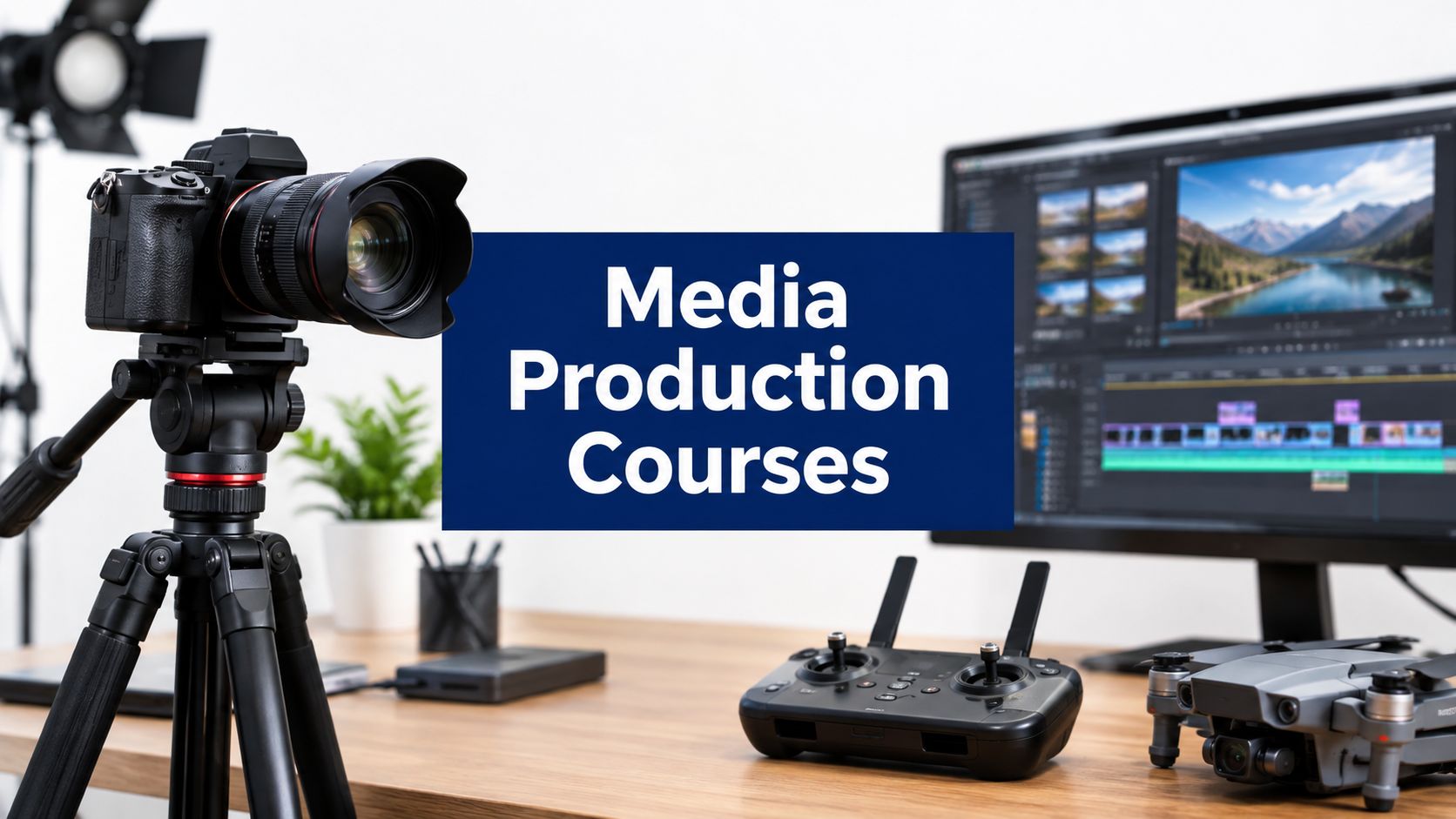
The most popular advice about media production courses is often the least useful: study directing, build a personal brand and wait for major productions to discover the next filmmaker. Directing and producing remain valuable ambitions, but they represent only part of how Australian screen work gets done. The people who keep a production moving also include production managers, editors, sound specialists, camera operators, location managers, production accountants and technical broadcast crews.
A more practical question is not, “Which course sounds most glamorous?” It's, “Which course develops skills that a production needs on Monday morning?” In Australia, that answer increasingly includes hands-on technical training, below-the-line capability and complementary aviation skills such as compliant drone operation. The strongest pathway combines storytelling with the ability to plan, capture, process and deliver professional media safely.
Table of Contents
- The Reality of Studying Media Production
- Comparing Certificates, Diplomas, and Degrees
- Core Curriculum and Production Workflows
- Integrating Drone Cinematography into Media Production
- Career Outcomes and Industry Skills Shortages
- How to Choose the Right Media Production Course
- Building a Complete Technical and Aviation Skill Set
The Reality of Studying Media Production
Directing is only one part of the production
A director may shape the creative vision, but a finished production depends on a much larger team. Someone must schedule the work, manage locations, prepare equipment, record clean audio, organise footage, edit scenes, mix sound, create graphics and deliver files for the intended platform. A media production course that focuses only on creative concepts can leave graduates unprepared for those practical responsibilities.
Australian screen and media education is formally connected to nationally recognised vocational qualifications. Current Australian course structures show that students can progress from foundational camera, sound, editing and production competencies into more specialised roles through certificates and diplomas. This structure matters because it treats production as a set of assessable workplace capabilities, not just an opportunity to discuss film theory.
Industry scoping work also identifies persistent gaps in roles such as production managers, line producers, location managers, production accountants, editors, sound editors and mixers, and VFX or animation specialists. The same research points to continuing differences between formal education and job readiness, with employers seeking short courses, micro-credentials and workplace training alongside traditional qualifications (Creative Workforce Scoping Study summary report).
Practical rule: A course should be judged by the work a student can competently perform, not only by the title printed on the certificate.
The below-the-line advantage
Below-the-line roles don't always receive the attention given to directors, actors or lead producers, yet they form the operational foundation of screen production. An editor who can organise media properly, a sound specialist who understands clean capture and post-production, or a production coordinator who can keep a complex schedule under control can become useful across many types of projects.
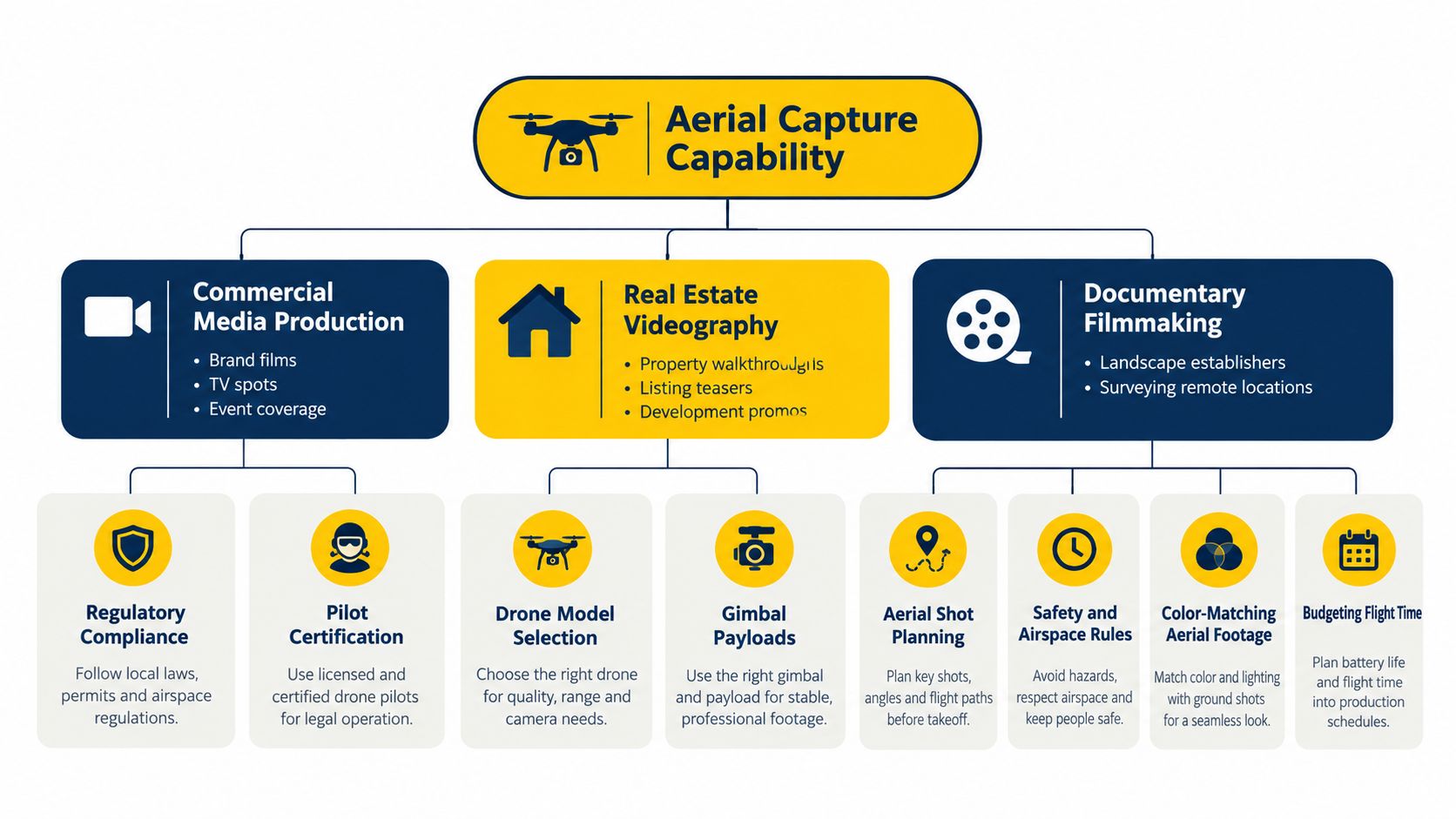
Drone cinematography adds another technical layer. A camera operator who understands aerial shot planning, airspace restrictions and safe flight procedures can contribute to commercial media, property content, documentaries and corporate productions. That skill doesn't replace traditional cinematography. It expands the range of services a production professional can support.
Prospective students comparing providers can also examine how the organisation connects training with practical aviation education and career guidance. Information about the approach taken by Ace Aviation Aerospace Academy is available through its aviation training philosophy, but the same evaluation should be applied to every provider. The central test remains simple: does the course produce reliable, repeatable production skills?
Comparing Certificates, Diplomas, and Degrees
Australian qualifications differ in purpose, depth and learning environment. A short course may introduce a specific tool or workflow, while a vocational certificate or diploma normally maps learning to recognised competencies. A bachelor degree can offer broader study in theory, culture, research and creative practice, but it may take longer to produce narrowly targeted workplace capability.
Qualification pathways at a glance
| Qualification Level | Typical Duration | Primary Focus |
|---|---|---|
| Short course | Focused period | A defined technical or introductory skill |
| Certificate IV | 12 months over two semesters, with 13 units in one current Australian example | Core production capability with electives and vocational progression |
| Diploma | Can extend to 2 years across 4 semesters in a diploma pathway, while some specialist diplomas run for 1 year full time | More advanced production, technical and role-specific skills |
| Bachelor degree | Longer higher-education pathway | Broader creative, theoretical, analytical and production development |
RMIT describes its Certificate IV in Screen and Media as a 12-month program delivered over two semesters, with 13 units, made up of 4 core units and 9 elective units. The same course information lists a Skills First government-subsidised place at $5,800, although fees and eligibility should always be confirmed directly with the provider because course details may change (RMIT Certificate IV in Screen and Media).
A diploma can provide a deeper production environment, but duration varies by institution and specialisation. Torrens University and Billy Blue describe a Diploma of Media Production as 1 year full time, with six core subjects and two electives, and each subject requiring 10 hours of study per week. Its subjects include video production and editing, editorial and documentary, and motion design (Torrens University Diploma of Media Production).
Choosing depth without over-investing
A student with little production experience may need a foundation that establishes camera, sound, editing and production vocabulary. Someone who already works with content may gain more from a targeted diploma or technical credential than from repeating introductory theory. A degree can suit a learner seeking broad academic development, but it isn't automatically the fastest route to paid technical work.
The vocational pathway also connects with adjacent aviation education. Certificate III in Aviation pathways may be relevant for students who want a wider aviation foundation alongside media or drone interests. For a beginner seeking an introduction to drone fundamentals, aviation safety, CASA regulations and flight operations before advanced RePL training, ACE READY is an entry-level drone training course.
Before enrolling, a prospective student should compare assessment methods, equipment access, portfolio expectations and work-based learning. A certificate with genuine practical assessment may serve an aspiring camera operator better than a longer course with limited time behind equipment. The right level depends on the desired role, existing experience and how quickly the student needs usable skills.
Core Curriculum and Production Workflows
A useful media production course follows the order in which real work happens. Students should move from an idea to a workable brief, then through planning, capture, post-production and delivery. Subjects listed separately in a handbook should still connect into complete projects.
From concept to finished file
The production workflow normally begins with concept development and storytelling. Students clarify the audience, purpose, format and creative treatment before preparing a script, shot list, schedule and production plan. Pre-production is where a feasible idea becomes a controlled shoot, with locations, crew responsibilities, equipment, permissions and safety considered before cameras roll.
Production then tests technical judgement. A student should learn how single-camera and multi-camera work differ, how lighting changes the image, how microphones are selected and placed, and how a crew communicates during a live or recorded session. These skills matter for narrative work, interviews, events, branded content and streaming.
Post-production completes the chain. Editing requires media organisation, continuity decisions, pacing and version control. Audio editing and mixing affect whether the audience can follow the story. Graphics, colour correction and platform-specific exports determine whether the final content is ready for broadcast, social media, a client review or a public release.
RMIT's screen and media training describes a progression through concept development, storytelling, pre-production, production and post-production for single-camera and multi-camera work. Related live broadcast and streaming pathways include producing, production management, directing, camera, lighting, audio, graphics and post-production, reflecting the range of roles found in a working production pipeline (RMIT Diploma of Screen and Media Content Creation).
What to inspect in practical classes
A provider's media and aviation course catalogue can show how a course connects production capability with specialist drone education. A foundation commercial drone course such as ACE BRONZE covers drone operations, flight safety, aviation theory and practical skills for students beginning a pathway towards becoming licensed drone pilots in Australia.
A strong curriculum should let students demonstrate more than isolated exercises. Useful evidence includes:
- Production planning: A brief becomes a schedule, shot list, risk assessment and crew plan.
- Technical capture: Students record usable images and sound under controlled conditions.
- Multi-camera operation: Learners understand camera matching, directing cues, live switching and the demands of streaming.
- Post-production discipline: Footage is backed up, labelled, edited, mixed and exported in an organised workflow.
- Platform delivery: The final file is prepared for the intended client, broadcaster, website or social channel.
Short-form distribution also deserves attention. Students can benefit from learning how to create engaging Reels and TikToks, provided that editing tools support rather than replace decisions about framing, pacing, sound and audience. The best portfolio demonstrates a complete process, from brief to delivery, rather than a collection of disconnected clips.
Integrating Drone Cinematography into Media Production
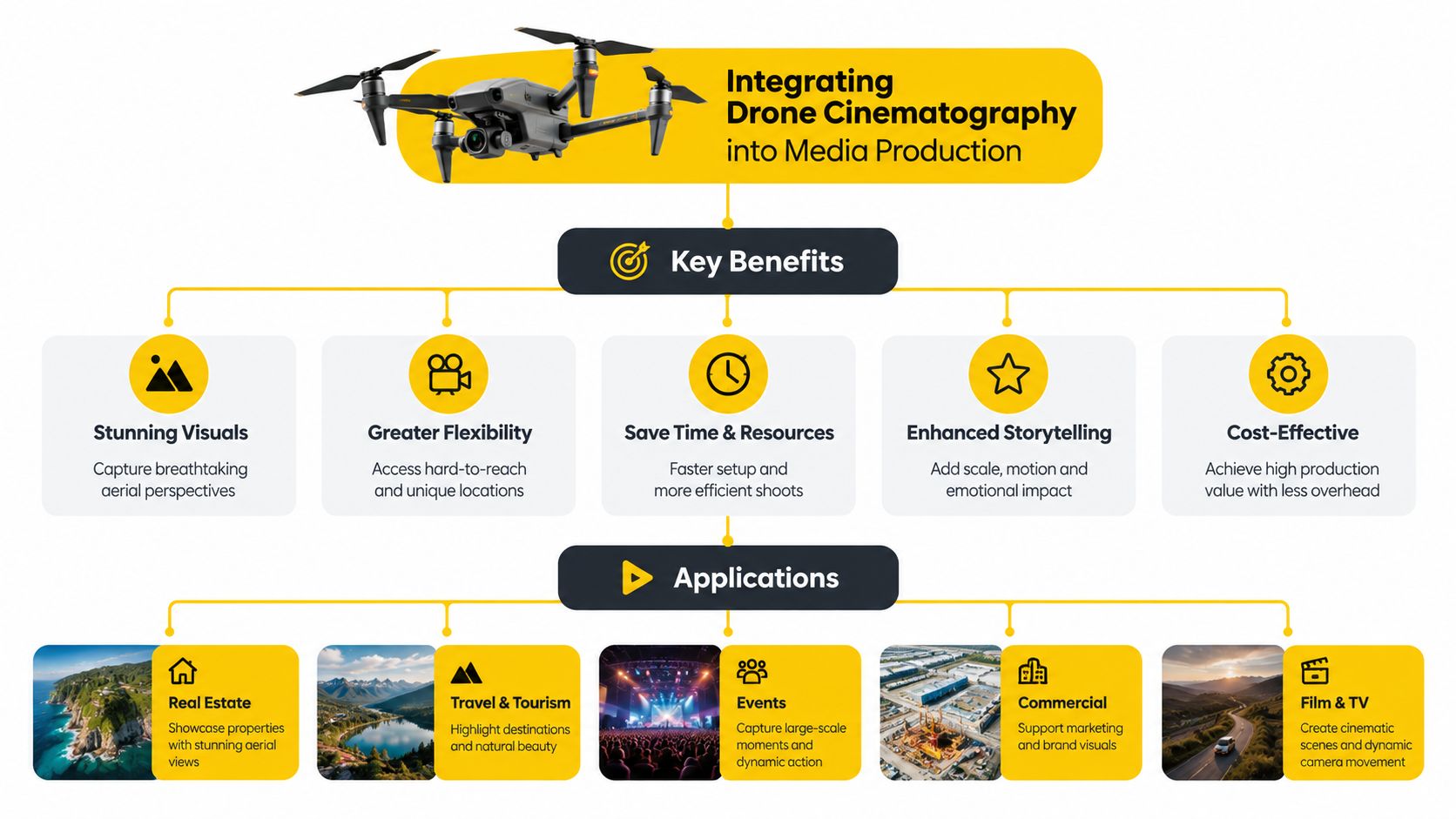
Drone cinematography works best when treated as part of the production plan, not as an impressive shot added at the last moment. Aerial footage has to serve the story, match the visual language of ground footage and fit within the schedule, location plan and safety controls.
CASA requirements for commercial work
CASA states that a Remote Pilot Licence, or RePL, is required to fly a drone or remotely piloted aircraft weighing more than 2 kg for work or business. CASA says RePL training generally takes about 5 days, consisting of 3 days of theory and 2 days of practical training, and that training must be completed with a CASA-certified provider (CASA student drone guide).
Weight categories affect the level of approval and licensing required. CASA states that micro drones weighing 250 g or less and very small drones weighing up to 2 kg can be flown for business without a RePL or ReOC. CASA also states that drones weighing more than 2 kg and no more than 25 kg may be flown over the operator's own land for business only when no payment is accepted for the service (CASA drone weight categories and requirements).
That distinction can confuse media students. Owning a small drone doesn't automatically mean every commercial filming scenario is permitted. The operator still needs to understand the applicable operating conditions, privacy considerations, people and property risks, aircraft limitations and site-specific restrictions.
Radio and airspace competence
An Aeronautical Radio Operator Certificate, or AROC, is required by anyone who needs to communicate on an aviation air-band radio frequency and isn't already licensed or qualified. CASA includes RePL holders among those who may need an AROC, and applicants must be at least 17 years old, hold an aviation reference number and demonstrate the required competency (CASA radio operator requirements).
CASA also sets approval thresholds for operations above 120 m or 400 ft AGL, within 5.5 km or 3 nm of a controlled aerodrome, over a controlled aerodrome movement area, and in runway approach or departure paths. RePL holders operating in controlled airspace with an RPA over 2 kg must meet the relevant aeronautical radio qualification and use requirements under regulation 101.285 (CASA flight approvals and permissions).
A media student can begin with a ground-based shot list, then add an aerial sequence only after checking the aircraft, pilot credentials, location, airspace and approvals. The drone licence pathway can help a prospective operator identify the aviation training required for commercial operations. The resulting skill set is useful in branded films, property marketing, documentaries, events and location-based content, but only when creative ambition remains within lawful and safe operating limits.
Career Outcomes and Industry Skills Shortages
A course doesn't guarantee a job. It can, however, make a candidate easier to use when the training reflects the work production companies struggle to staff. The practical employment question is whether a graduate can enter a team as a dependable specialist, assistant or operator and contribute without requiring every basic task to be explained.
Where technical capability matters
Australian industry reporting describes shortages in several below-the-line and operational roles, including production management, line producing, location management, production accounting, editing, sound editing and mixing, and VFX or animation. These areas are less visible than directing, but they carry responsibility for schedules, budgets, technical quality and delivery.
The same workforce evidence identifies pressures involving business scalability, skills gaps, limited career progression and infrastructure constraints. It also points to burnout, long hours, weak progression and an aging workforce as factors that can contribute to attrition. That makes mid-career development important. Screen workers need routes from technician to supervisor, specialist or manager, not only an entry point into the industry.
The training cohort for one qualification also shows how specialised this pathway can be. The Australian Jobs and Skills Atlas records 0 total commencements in January to December 2025 and 5 total in training as at 31 December 2025 for the Certificate IV in Screen and Media under apprentices and trainees (Jobs and Skills Atlas Certificate IV data). Those figures don't describe every media student or every course format, but they do indicate that this particular apprenticeship and traineeship cohort is small.
Building a portfolio that answers employer questions
A graduate portfolio should show how the person works, not only how polished the final image looks. A useful portfolio might include:
- Production coordination: Call sheets, schedules, location planning or production documentation with confidential information removed.
- Camera and lighting: Carefully framed interviews, controlled movement and evidence that exposure and colour have been considered.
- Audio: Clean dialogue, room tone, sound design or a before-and-after demonstration of an organised mix.
- Editing: A finished short piece plus evidence of structured media management and version control.
- Aerial work: Legal, safely planned drone footage that shows shot purpose, not just altitude or movement.
A drone operator can add aerial capture to a broader media portfolio, but shouldn't present flight footage without showing an understanding of CASA obligations. Employers and clients need to know who can operate the equipment, who can plan the flight and who can deliver footage that fits the wider production.
Students can monitor opportunities through media production jobs and career resources, while also seeking workplace learning, assistant roles and targeted technical training. The more useful goal is employability across a production pipeline, rather than attachment to a single job title.
How to Choose the Right Media Production Course
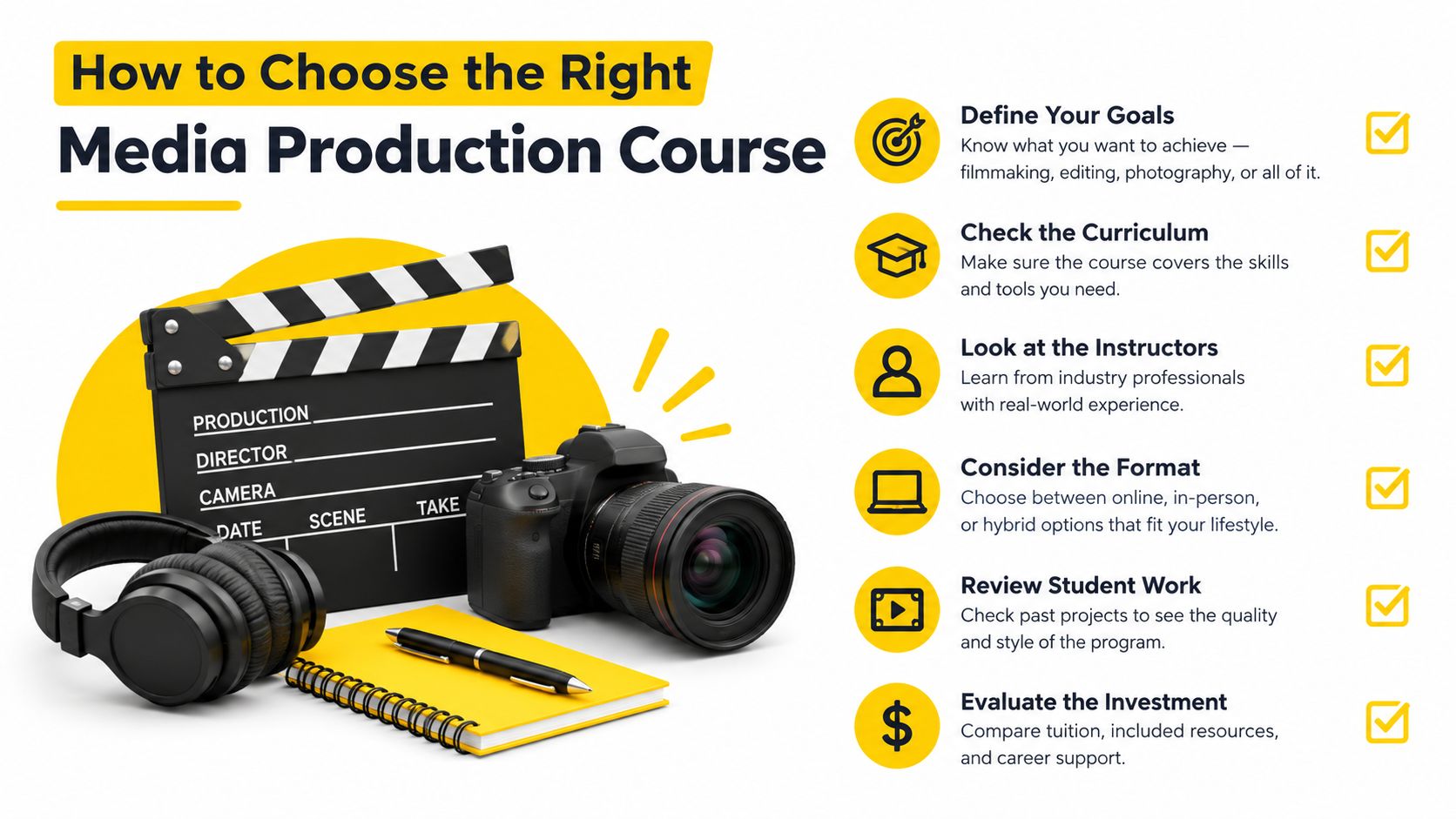
Course selection should begin with the intended work, then move backwards to the qualification. A student interested in editing needs different access and assessment from someone aiming for live broadcast, production management or aerial cinematography. A brochure may use broad creative language, so prospective students need to inspect what happens in class.
Six checks before enrolment
1. Confirm the qualification. Check whether the course is a nationally recognised qualification, a higher-education award or a non-accredited short course. Where a provider refers to AQF alignment or national recognition, the enrolment material should explain the level and assessment requirements clearly.
2. Inspect the practical timetable. Ask how often students use cameras, lighting, audio equipment, editing suites and broadcast facilities. A course can mention production without giving each learner meaningful responsibility for capture and post-production.
3. Review assessment outputs. Look for completed productions, edited sequences, production documents, sound work and delivery formats. Assessments should resemble the decisions made on real briefs, including planning, collaboration, troubleshooting and revisions.
4. Check industry contact. Industry speakers can be useful, but work-based learning and client-style briefs provide stronger evidence of workplace relevance. The provider should explain how students receive feedback and how graduates access career guidance.
5. Match specialist training to the role. A prospective aerial cinematographer should verify whether drone content is taught as a regulated aviation activity or merely discussed as a camera technique. RePL, AROC, enterprise operations and corporate training are separate considerations, and a media course may not provide all of them.
6. Calculate the actual commitment. Compare attendance, independent study, equipment access, travel, software requirements and assessment deadlines. A shorter course isn't automatically easier, and a longer course isn't automatically better. The useful choice is the one that fits the student's current capability and target role.
A student should also ask to see examples of graduate work and a clear explanation of complaint, safety and supervision processes. Providers that answer those questions directly make it easier to distinguish genuine job preparation from attractive course language.
Building a Complete Technical and Aviation Skill Set
A sustainable media career can start with a conventional production qualification, then develop through targeted technical training. One student may begin by learning editing and sound, another by assisting on camera, and another by coordinating small productions. Each can add drone capability once the creative and aviation requirements are understood.
The combination is valuable because media work has two distinct demands. The first is creative and technical communication, including framing, light, sound, narrative, editing and delivery. The second is operational responsibility, including risk management, airspace awareness, licensing, radio procedures and compliance when aircraft are involved.
A sensible progression may look like this:
- Build a foundation in screen and media production.
- Select a technical specialisation with clear workplace applications.
- Create portfolio pieces that show complete workflows.
- Add CASA-compliant drone training when aerial work fits the intended market.
- Continue towards supervisory, specialist or operational responsibilities.
A drone operator who can also understand a producer's brief is easier to integrate into a production than an operator who only captures attractive aerial images. Likewise, an editor who understands how footage was planned and recorded can make better decisions in post-production. The strongest professionals connect departments rather than treating each skill as an isolated badge.
Frequently asked questions
Are media production courses only suitable for aspiring directors?
No. They can prepare students for camera, editing, sound, production management, broadcast, graphics and other technical roles. Directing is one pathway within a wider production team.
Does a media qualification include a Remote Pilot Licence?
Not necessarily. A screen and media qualification and a CASA RePL are separate forms of training. Students should confirm whether a provider includes aviation training or whether it must be completed separately.
Can a small drone be used for commercial media work without a RePL?
CASA permits some business operations involving micro and very small drones without a RePL, subject to the applicable category and operating conditions. The aircraft weight, location, operation and payment arrangement all matter, so the relevant CASA requirements should be checked before a flight.
What should a graduate include in a media portfolio?
A portfolio should show completed work and the process behind it, including planning, camera or audio decisions, editing, delivery and collaboration. For aerial work, it should also demonstrate lawful and safe flight planning.
Is a degree always better than a vocational qualification?
No. A degree and a vocational qualification serve different purposes. The better option depends on whether the student needs broad academic study, practical competency, specialist training or a faster route into a particular production role.
Ace Aviation Aerospace Academy offers training relevant to this pathway, including the Remote Pilot Licence, Aeronautical Radio Operator Certificate, Certificate III in Aviation, ReOC consulting, enterprise drone training and corporate drone training. Students and organisations can explore the available aviation education options and visit Ace Aviation Aerospace Academy to identify training that complements media production and commercial drone operations.