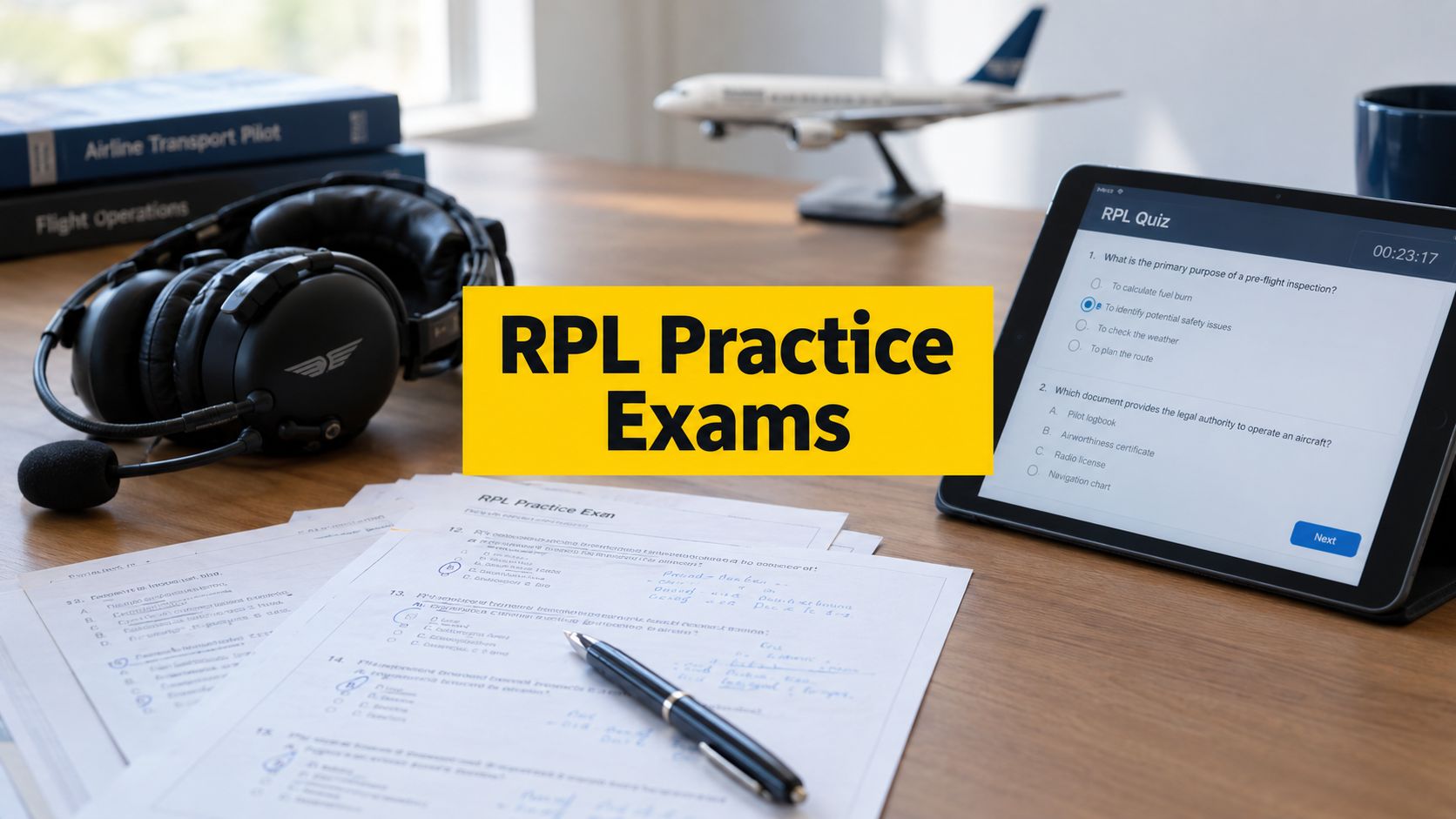
A learner has opened a search tab for “RPL practice exams”, found resources for aeroplane pilots, helicopter pilots and drone operators, and still isn't sure which qualification applies. That confusion matters because RPL usually means the Australian Recreational Pilot Licence, while RePL means the Remote Pilot Licence for drones. The study resources, assessment pathways and training providers are different.
Practice exams are revision tools, not substitutes for approved instruction, ground training, practical assessment or current regulatory guidance. CASA requirements and the learner's course materials should be checked before an assessment, particularly where rules, syllabuses or category requirements may have changed. The strongest resources can be compared by question coverage, timed mock exams, explanations, progress tracking, print or mobile access and suitability for Australian aviation learners.
The ten options below are separated by pathway. The first nine focus on crewed-aircraft RPL study. The final option is aimed at drone RePL learners.
Table of Contents
- 1. Ace Aviation Aerospace Academy
- 2. PilotTrain RPL Practice Exams
- 3. Pilot Practice Exams
- 4. PPL Prep RPL and PPL Practice Exams
- 5. PilotIQ CASA RPL Exam Practice and Theory Prep
- 6. The Pilot Exam
- 7. SkyLogic Aviation Theory Practice Exams
- 8. Aviation Theory Centre Practice Exams via PilotTrain
- 9. Avfacts RPL and BAK Practice Exams in Hard Copy
- 10. Easy-Quizzz CASA RePL Test Simulator
- Top 10 RPL Practice Exams, Comparison Guide
- Turn Practice Scores Into Exam Readiness
1. Ace Aviation Aerospace Academy
Ace Aviation Aerospace Academy is the strongest choice for an Australian learner who means RePL, not the crewed-aircraft Recreational Pilot Licence. It's an Australian drone training provider operating within a CASA-approved training framework, with practical instruction, regulatory education and commercial-operation support rather than a standalone anonymous question bank.
The key advantage is integration. A learner can prepare for the Remote Pilot Licence and, where relevant, the Aeronautical Radio Operator Certificate, then seek support with ReOC requirements and operational compliance. That approach suits commercial pilots, enterprise teams, agricultural operators and organisations that need more than theory-test familiarity.
Practical rule: A drone practice quiz should support the approved RePL course, not replace the course's theory instruction or practical competency assessment.
The delivery model combines self-paced online study with live theory and practical flight training. Public training is available through Australian locations, while corporate delivery can be arranged on site. Advanced pathways may cover specialised operations such as agriculture, mapping, medium-category RPAS, BVLOS, EVLOS, night operations or drone cleaning, but those activities require training and approvals beyond a basic RePL preparation pathway.
For beginners who need foundational knowledge before advanced licensing, ACE READY covers drone fundamentals, aviation safety, CASA regulations, flight operations and preparation for RePL training.
Why it suits serious RePL candidates
CASA's pathway is formal. Applicants without prior aeronautical qualifications need an approved RePL training course, the theory component, operational training and assessment, including at least 5 hours of flight experience before a licence can be granted, as stated on CASA's remote pilot licence guidance. A Swinburne RePL unit also specifies an 85% minimum theory result, followed by practical flight training and a competency assessment, according to Swinburne's unit description.
Practice questions are useful here, but they can't certify practical skill, issue a licence or establish an operator's complete compliance system. Ace is best for learners who want CASA-aligned training connected to real drone work.
2. PilotTrain RPL Practice Exams
PilotTrain's RPL practice exams are designed for the crewed-aircraft Recreational Pilot Licence pathway. This is the correct category for a learner preparing for aeroplane or broader RPL theory, not a remote pilot licence for drones.
The platform's main strength is its exam simulation. It provides five full-length timed RPL exams, with fresh question draws available through repeated attempts. That makes it more useful than a short quiz collection for learners who need pacing practice and want to experience a complete assessment session before booking the official exam.
Feedback is also a strong feature. SmartKDR identifies weaker areas, while flashcards, quick quizzes and video answers give learners several ways to revisit a topic. A leaderboard and short demonstration exam can help learners understand the interface before committing to a longer session.
Best fit and limitations
PilotTrain suits a self-directed aeroplane student who wants one membership that can continue into PPL, CPL or IREX study. It's less suitable for someone who wants a single printed question pack or a drone-specific RePL resource. The membership model also makes less sense if the learner only needs a brief final revision period.
Before selecting the platform, a learner should confirm which licence category applies through the AAA licence finder. A question bank can't correct a pathway mistake, and RPL and RePL preparation shouldn't be treated as interchangeable.
For exam realism, PilotTrain is a strong option. For regulatory interpretation, it should sit alongside the learner's approved theory course, current CASA material and instructor feedback. Its explanations and targeted feedback make it particularly useful after the learner has already studied the underlying subjects.
3. Pilot Practice Exams
Pilot Practice Exams is a straightforward Australian platform with separate tracks for RPLA and RPLH, covering aeroplane and helicopter learners. That separation is important because a candidate should practise against the relevant aircraft category rather than rely on generic aviation questions.
The service offers licence-specific practice exams and supporting tools for topics such as altitude and altimeter work, radio calls and calculations. Its access model is simple, with study windows ranging from 3 to 12 months, according to the provider's published offering. The RPL option is listed at A$59 for 3 months on the provider's page, so learners should verify the current price before purchase.
What PPE does well
PPE suits learners who want a focused, uncomplicated study environment. It's a practical choice for candidates who already have ground-school notes and need repeated question exposure rather than a full teaching system. The licence-specific tracks also make it easier to avoid mixing aeroplane and helicopter material unnecessarily.
The interface is more utilitarian than newer mobile-first applications, and explanation depth varies between subjects. That means the platform works best as a testing layer, not as the only source of understanding. Learners should investigate every wrong answer instead of recording only the score.
A sensible workflow is to complete topic practice first, then attempt full mocks under timed conditions. Calculation questions should be worked manually where appropriate, because recognising a familiar answer pattern isn't the same as understanding the method. PPE's additional tools can support that process, but they don't replace instruction from an approved flight school or current operational references.
4. PPL Prep RPL and PPL Practice Exams
PPL Prep's practice exam platform is a strong fit for an Australian aeroplane learner who wants a clear progression from RPL into PPL theory. It offers both randomised and full-length exam modes, allowing the learner to move from targeted revision into more realistic assessment sessions.
The platform also records performance statistics and keeps study records, which helps reveal whether a learner is improving across subjects or repeating familiar questions. Subject drills, including areas such as Principles of Flight, are useful when a full mock shows a specific weakness.
Where the bundle matters
PPL Prep's standalone exams are more suitable for learners who already understand the syllabus. Detailed answer explanations and video instruction require the online ground-school bundle, so a candidate seeking extensive teaching should price and compare the combined option rather than assume the practice-only product includes every explanation.
The provider presents an Australian focus and updates content in response to CASA changes. That's useful in a regulated environment, but learners should still check their current course requirements before relying on any third-party question bank. The access period is listed as six months, which suits planned study but may not suit someone seeking only a very short cram session.
PPL Prep is best used in two stages. First, a learner should use subject drills to identify and repair knowledge gaps. Then the learner should switch to randomised, full-length mocks and review every error. A high score achieved through memorisation is a weak readiness signal if the learner can't explain the rule, calculation or decision behind the answer.
For learners comparing broader Australian aviation courses alongside practice resources, the AAA course catalogue provides a separate point of reference. The catalogue doesn't turn PPL Prep into an approved training replacement, but it can help clarify whether the learner needs crewed-aircraft or drone education.
5. PilotIQ CASA RPL Exam Practice and Theory Prep
PilotIQ's CASA RPL preparation platform combines a substantial question bank with worked explanations, timed mocks and readiness tracking. It covers both RPLA and RPLH, making it suitable for aeroplane and helicopter students who want category-specific practice within one web platform.
The provider lists more than 1,400 practice questions across RPL and PPL preparation on its product page. Every question includes a worked explanation, which is more valuable than a simple correct-or-incorrect result. Learners can identify the rule or concept behind an error and then return to the relevant theory material.
PilotIQ also presents timed mock exams aligned to the provider's stated CASA parameters, including a 2-hour duration and 70% pass standard. Those figures should be checked against the learner's current official assessment information before being treated as a booking requirement.
Best use case
The strongest use case is a learner who wants structured digital feedback during a six-month access window, which the provider lists at A$65. Area-by-area performance reporting helps turn a broad result into a revision plan. A digital logbook and integrated theory library may also appeal to learners who want fewer separate study tools.
The limitation is delivery. PilotIQ is a web platform, and no dedicated mobile app experience is noted in the supplied product information. It's also focused on RPL and PPL rather than higher-level licence preparation.
PilotIQ is not a drone RePL system. Learners seeking CASA drone licensing should use an approved RePL course and drone-specific material instead. The AAA drone licence information is more relevant to that pathway than an aeroplane and helicopter RPL question bank.
6. The Pilot Exam
The Pilot Exam takes a mobile-first approach to Australian student-pilot theory. Its Android app and website provide practice questions, explanations, performance charts and timed mock exams for learners working towards RPL or PPL subjects.
The platform covers common theory areas including air law, meteorology, navigation, engines and human factors. That breadth makes it useful for learners who want to revise during short study sessions rather than sit at a desktop for every quiz.
A listed in-app example uses 37 questions, 90 minutes and a 70% pass mark, as shown in the supplied product information. That example demonstrates the platform's timed format, but it shouldn't be assumed to define the learner's official CASA assessment. The current course and CASA information remain authoritative.
Delivery and feedback
Performance charting gives learners a visual way to monitor progress. Explanations are available for practice questions, and the Android listing indicates that the app receives updates. The Australian focus and stated CASA references are useful signals, but candidates should still cross-check rules and syllabus coverage against approved training materials.
The major limitation is platform access. Android users receive the strongest mobile experience, while iOS users need to rely on the website or another study method. Full content also requires in-app purchases, with current pricing set through Google Play rather than the public website.
The Pilot Exam suits a learner who values portability and frequent short quizzes. It doesn't suit a candidate who needs a printed pack, extensive instructor-led explanation or drone-specific RePL preparation. Used properly, it's a convenient supplement to ground school, especially for reinforcing terminology and testing recall between formal study sessions.
7. SkyLogic Aviation Theory Practice Exams
SkyLogic offers Australian aviation theory preparation across RPL, PPL, CPL and IREX levels. Its RPLA stream focuses on CASA-style wording, while tutoring and virtual classes delivered through partner schools provide an option for learners who need more support than a self-service question bank can offer.
The distinctive feature is the combination of delivery modes. A learner can begin with independent practice, then seek one-to-one coaching or online classroom support when a topic remains unclear. That makes SkyLogic better suited to students who learn through discussion, correction and worked examples rather than repeated unassisted attempts.
Best fit for supported study
SkyLogic is a sensible choice for an RPL learner who finds tricky wording more difficult than the underlying subject matter. Tutor access can help separate a genuine knowledge gap from a reading error, calculation mistake or misunderstanding of a scenario.
The public site doesn't present granular pricing prominently at the top level, so learners should confirm the current package and access terms before enrolling. The catalogue is also smaller than the largest online platforms, which may matter to candidates seeking broad question variety and highly detailed progress analytics.
SkyLogic's practice exams should be treated as preparation for the official assessment, not as a source of live CASA questions. A learner should still study the approved syllabus and use instructor guidance for topics involving navigation, meteorology, air law and aircraft performance. The platform's strongest role is feedback through human support, not volume of questions.
8. Aviation Theory Centre Practice Exams via PilotTrain
Aviation Theory Centre's practice exam resource is useful for learners who prefer study materials connected to a recognised Australian theory publisher. ATC directs students to PilotTrain for online RPL and PPL practice exams, while also offering printed materials and workbooks aligned with its syllabus and textbooks.
That connection creates a useful blend of digital testing and paper-based study. Learners can use online mocks for timed practice, then return to printed theory material when an incorrect answer exposes a conceptual gap. Candidates who experience screen fatigue can complete some revision away from a device.
Strengths and trade-offs
The main strength is syllabus continuity. Using practice exams alongside the publisher's textbooks can reduce the risk of studying disconnected material or learning terminology that doesn't match the learner's ground-school resources. The online and print options also suit different learning preferences.
The workflow has a practical drawback. Online practice is delivered through PilotTrain, so learners must use two brands and possibly two separate purchasing or account experiences. That inconvenience is minor for a student who values the ATC textbook connection, but it may frustrate someone seeking one unified app.
ATC and PilotTrain resources are for crewed-aircraft RPL and PPL preparation. They don't replace flight training, formal theory instruction or practical assessment, and they aren't intended as drone RePL tools. For learners considering a drone business, licensing and operational compliance must be studied through the appropriate CASA-aligned RePL pathway instead.
9. Avfacts RPL and BAK Practice Exams in Hard Copy
The Aviator Store's Avfacts RPL and BAK practice exam pack is the clearest option for learners who want paper rather than a subscription platform. The spiral-bound pack contains four complete RPL and BAK practice exams, with solutions, feedback, performance diagrams and worked E6B examples, according to the product information.
The paper format creates a classroom-style assessment experience. A learner can write calculations by hand, annotate diagrams and work through questions without notifications, browser tabs or app prompts. The spiral binding also allows the pack to lie flat during study.
Who should choose paper
This resource suits a student who learns through handwriting, attends a traditional ground school or wants a fixed set of papers for supervised revision. Worked E6B examples are particularly useful when the learner needs to practise technique rather than merely check a final answer.
The trade-off is flexibility. Unlike a digital bank, a printed pack doesn't randomise questions or provide unlimited fresh attempts. Shipping also takes longer than instant online access, and the supplied product information identifies it as a 2023 first edition, so the learner should confirm that the content remains appropriate for the current course and regulatory environment.
Printed resources work best when paired with current references and instructor clarification. A learner studying ReOC responsibilities or commercial drone operations should not assume that crewed-aircraft RPL material covers those obligations. The AAA guide to ReOC requirements in Australia addresses a different operational pathway and should be considered separately from an aeroplane RPL practice pack.
10. Easy-Quizzz CASA RePL Test Simulator
Easy-Quizzz's CASA RePL simulator is aimed at the Remote Pilot Licence pathway for drones. It's included because many learners search for “RPL practice exams” when they need RePL study.
The simulator offers practice and exam modes, configurable test length and pass-mark settings, flashcards and mobile access. The site also advertises free sample quizzes and a larger paid question bank, with the provider claiming 700+ questions on its public page. That claim belongs to the product listing and should be verified before purchase.
Use it as a checking tool
Easy-Quizzz is useful because public RePL practice resources are less common than crewed-aircraft RPL platforms. It can help a beginner test familiarity with Australian drone topics, identify terminology that needs further study and practise on a mobile device.
The platform is generic, however. Question depth and accuracy should be cross-checked against the approved course, the Part 101 Manual of Standards and current CASA guidance. CASA's training guidance requires unique exam questions, multiple exam sets and coverage of aeronautical knowledge units. It also allows calculation-based multiple-choice questions, so a bank that focuses mainly on simple recall won't represent the full assessment challenge. See CASA's RePL training guidance for the regulator's expectations.
For learners beginning commercial drone study, ACE BRONZE covers drone operations, flight safety, aviation theory and practical skills as a foundation towards becoming a licensed drone pilot in Australia. A simulator can reinforce those lessons, but it can't replace approved instruction, flight assessment or qualifications such as AROC where an operation requires aviation radio communication.
Top 10 RPL Practice Exams, Comparison Guide
| Provider | Core features ✨ | Quality & UX ★ | Price & Value 💰 | Target audience 👥 | USP / Notes 🏆 |
|---|---|---|---|---|---|
| Ace Aviation Aerospace Academy 🏆 | CASA‑approved RePL/AROC/ReOC consulting; blended online + 3 theory days + 2 practical days; nationwide on‑site delivery | 4.9★; 4,000+ students; mission‑focused practical assessments | 💰 Packages from AUD 1,799; 0% finance; AUD 100 online cashback | 👥 Aspiring commercial drone pilots, enterprise teams, agri operators | 🏆 End‑to‑end ecosystem (UAMP + DroneWork job placements 250+); strategic XAG partner; CASA compliance |
| PilotTrain, RPL Practice Exams | Full‑length timed RPL mocks; SmartKDR feedback; flashcards & video answers | ★ Targeted feedback; membership progression to PPL/CPL | 💰 Subscription membership (good value if continuing study) | 👥 Students preparing RPL/PPL who want adaptive mocks | ✨ SmartKDR performance reports; leaderboard & unlimited draws |
| Pilot Practice Exams (PPE) | Dedicated RPL (aeroplane/helicopter) papers; access windows; extra tools (radio, calculators) | ★ Widely used; consistent updates; utilitarian UI | 💰 A$59 (3 months RPL option), straightforward pricing | 👥 Budget‑minded RPL students wanting exam realism | ✨ Simple pricing; extra study aids (altimeter, E6B practice) |
| PPL Prep, RPL & PPL Exams | Randomized & full‑length exam modes; subject drills; performance stats | ★ CASA‑focused updates; clear performance tracking | 💰 Bundles available; 6‑month access typical | 👥 RPL/PPL students seeking realism + ground school bundles | ✨ Option to bundle with online ground school for explanations |
| PilotIQ, CASA RPL Prep | 1,400+ questions; worked explanations; timed mocks; digital logbook | ★ Good feedback; area‑by‑area tracking | 💰 ~A$65 (6 months), good value for depth | 👥 RPL students wanting detailed explanations & tracking | ✨ Integrated theory library + digital logbook |
| The Pilot Exam (Android + web) | Mobile app + site; timed mocks; topic coverage across CASA syllabus | ★ Mobile‑first convenience; in‑app progress charts | 💰 In‑app purchases for full content | 👥 Android users & on‑the‑go learners | ✨ App experience with interactive charts; frequent updates |
| SkyLogic, Theory Practice Exams | RPL/PPL/CPL practice exams; tutoring & partner live classes | ★ Mixed delivery; positive testimonials for RPL prep | 💰 Pricing not always listed publicly | 👥 Learners wanting tutoring or virtual classes | ✨ One‑on‑one coaching via partner schools; CASA‑style wording focus |
| Aviation Theory Centre (ATC), via PilotTrain | ATC syllabus alignment; online via PilotTrain; printed workbooks | ★ Trusted publisher; syllabus‑aligned materials | 💰 Varies (PilotTrain online + print packs) | 👥 Students who prefer textbook‑aligned study | ✨ Choice of printed workbooks + online practice |
| Avfacts RPL/BAK (hard copy), The Aviator Store | Spiral‑bound pack: 4 practice exams, solutions, E6B workings | ★ Classroom‑style; clear worked solutions | 💰 One‑off purchase + shipping | 👥 Learners who prefer paper & classroom exam practice | ✨ Paper format avoids screen fatigue; worked E6B examples |
| Easy‑Quizzz, CASA RePL Simulator | RePL‑focused quizzes; configurable test length; flashcards; ~700+ Qs | ★ One of few public RePL tools; variable content accuracy | 💰 Free samples; paid unlock (price unclear) | 👥 Drone/RePL candidates seeking dedicated RePL practice | ✨ Rare public RePL simulator focused on drone syllabus |
Turn Practice Scores Into Exam Readiness
The first decision is categorical. A person preparing to fly a recreational aeroplane or helicopter needs RPL resources. A person preparing to operate drones under Australia's remote-pilot framework needs RePL resources. The names look similar, but the training, assessment and operational responsibilities aren't the same.
Once the pathway is confirmed, one primary question bank is enough. A learner should avoid collecting several platforms and mistaking quantity for preparation. The better sequence is structured and repeatable:
- Learn the syllabus first: Use approved ground training, course notes and current CASA material before relying on mock results.
- Practise by topic: Start with air law, meteorology, navigation, human factors, aircraft knowledge or the relevant RePL units.
- Review every error: Record why the selected answer was wrong, then find the rule, calculation or concept that resolves it.
- Use timed mocks later: Full-length tests are most useful after the learner understands the subject matter. They should be completed without interruptions and with realistic pacing.
- Track weak areas: A progress report, notebook or spreadsheet can show whether errors are concentrated in one subject.
- Repeat under pressure: Reattempt questions only after understanding the explanation. Memorising repeated answer patterns creates false confidence.
CASA's RePL guidance makes the distinction between quizzes and real examinations especially important. Approved course providers must use unique exam questions rather than recycle quiz items, and exam construction must cover the required knowledge areas. A practice score therefore indicates readiness only when the learner can explain unfamiliar questions, apply calculations and handle changed wording.
The same principle applies to crewed-aircraft RPL. Online platforms can improve familiarity with timing and question style, while printed packs can strengthen manual calculation and annotation skills. Neither format replaces an approved course, instructor guidance or the official assessment.
Learners should check current CASA requirements before booking an exam or beginning a category upgrade. If repeated practice exposes gaps in radio procedures, air law, meteorology, navigation or operational planning, qualified instruction is the correct response. For broader preparation principles, these evidence-backed exam strategies can complement, but not replace, aviation-specific training.
Frequently asked questions
What's the difference between RPL and RePL?
RPL generally refers to the Australian Recreational Pilot Licence for crewed aircraft. RePL refers to the Remote Pilot Licence for drone operations. Learners should confirm the abbreviation used by their training provider before buying practice materials.
How often should learners use mock exams?
Mock exams should be used after the relevant theory has been studied, then repeated as readiness checks. Topic drills are more useful during early revision, while timed full-length tests are better for final preparation.
Do practice tests replace ground training?
No. Practice tests reinforce knowledge but don't replace approved instruction, practical flight training, competency assessment or current CASA requirements. RePL applicants must complete the regulated training sequence applicable to their circumstances.
Should learners choose online or printed resources?
Online tools suit learners who want instant feedback, progress tracking, mobile access and repeated question draws. Printed resources suit learners who prefer handwriting, diagrams and screen-free revision. A blended approach works well when each format has a defined purpose.
How can Ace Aviation Aerospace Academy support RePL learners?
Ace provides CASA-compliant drone education, including RePL training, AROC training and practical preparation for commercial operations. Learners who need a complete pathway should use practice questions as revision alongside approved instruction and practical assessment.
Ace Aviation Aerospace Academy provides CASA-aligned RePL and AROC training, practical drone instruction and support relevant to commercial operators preparing for regulated work. Learners can use the training pathway to replace uncertain quiz-only preparation with structured theory and practical assessment. Visit Ace Aviation Aerospace Academy to review the relevant drone training options.