The XAG P150 Max is the standout choice for sub-150kg agricultural drone operations in Australia because it delivers bigger payloads, faster work rates, and tougher build quality than many competing platforms. If you want serious output, serious earning potential, and the right CASA-aligned pathway, this is the machine to watch.
The Great Shift: Why the 25kg Limit is No Longer Enough
For years, the Australian agricultural drone industry has been defined by the "under 25kg" category. These smaller Remote Pilot Aircraft (RPA) served as an excellent proof-of-concept, allowing farmers in regions like the Darling Downs in Queensland or the Riverina in New South Wales to experiment with spot-spraying and mapping. However, as the industry matures in 2026, the limitations of these lighter rigs have become a bottleneck for serious commercial production.
A 25kg drone typically carries a 10-litre to 15-litre payload. For a broadacre farmer in Western Australia or a large-scale orchardist in Victoria, this capacity results in frequent battery swaps and chemical refills, significantly increasing the "non-spray" time. To truly replace or augment ground rigs and manned aviation, the payload must scale.
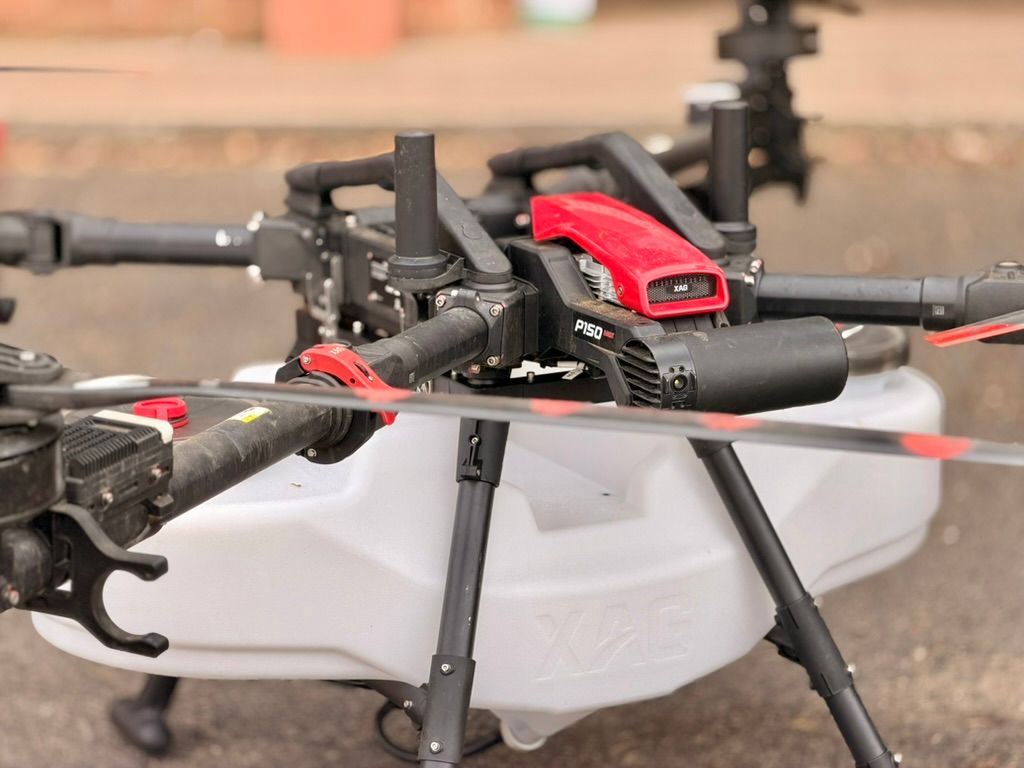
Enter the Sub-150kg category. By stepping into the Medium RPA bracket (drones weighing between 25kg and 150kg), operators can now utilise platforms like the XAG P150 Max. This machine is not just a slightly bigger drone. It is a serious jump in agricultural capability, with higher payload, stronger throughput, and a tougher commercial build that makes smaller systems look underdone for real production work. This leap in capacity represents the future of high-efficiency farming, but it requires a specialised Sub-150kg Type Rating, a certification that Ace Aviation Aerospace Academy is uniquely positioned to provide.
The XAG P150 Max: Built to Outwork the Pack
The XAG P150 Max is where agricultural drone operations start getting properly commercial. When we talk about heavy lift drone training in Australia, we are talking about mastering a machine built for operators who need to move fast, stay productive, and hold up in harsh conditions. Put simply, the P150 Max leaves plenty of other brands in the dust on efficiency, output, and day-to-day practicality.
Efficiency at Scale
With higher payload capacity than the standard P150 and work rates built for serious acreage, the XAG P150 Max cuts down refill cycles, battery downtime, and wasted paddock-to-paddock time. For operators working broadacre country near Toowoomba, Dubbo, or the WA Wheatbelt, that matters. More litres in the air and more hectares covered per day means better margins and less dead time.
Versatility and Durability
The P150 Max is a modular workhorse. It can switch between the RevoSpray P4 system for liquids and the RevoCast P4 for spreading seed or fertiliser, while its rugged construction and IPX6K protection make it well suited to Australian dust, mud, and hard-use farm environments. It is built like commercial equipment, not a fragile tech toy, and that difference shows up very quickly in the field.
Precision Agriculture
Equipped with the SuperX5 Pro flight control system and RTK-grade positioning, the P150 Max delivers centimetre-level precision while maintaining strong productivity. That means fewer overlaps, cleaner application patterns, and better use of expensive inputs. It is exactly the kind of platform that helps contractors and farm operators lift output without losing control of quality.

Understanding the Regulatory Landscape: CASA and the Medium RPA
Operating a drone like the XAG P150 Max is not the same as flying a Mavic or a small 10kg sprayer. Under CASA (Civil Aviation Safety Authority) regulations, any RPA with a Maximum Take-Off Weight (MTOW) over 25kg falls into the Medium RPA category.
In Australia, your standard Remote Pilot Licence (RePL) with a "less than 25kg" endorsement is not sufficient. To legally operate the P150 Max, you must obtain a type-specific rating for that exact aircraft. CASA does not issue a "blanket" 150kg licence; instead, you are certified for the specific model you have been trained on.
This regulatory hurdle is designed to ensure safety. A 150kg aircraft carries significant kinetic energy. Pilots must understand advanced flight dynamics, emergency procedures, and the specific maintenance requirements of heavy-lift hardware. Ace Aviation simplifies this complex certification process, guiding pilots through the theory and practical assessments required to add the P150 Max type rating to their RePL.
Key Facts: XAG P150 Max and Regulatory Requirements
| Feature / Category | Specification / Requirement |
|---|---|
| Drone Model | XAG P150 Max |
| Weight Category (CASA) | Medium RPA (>25kg to ≤150kg) |
| Max Payload (Spray) | Up to 80kg / high-capacity liquid application platform |
| Max Payload (Spread) | Higher-capacity spreading suited to large-scale ag work |
| Max Flight Speed | Up to 20 m/s |
| Required Licence | RePL with <150kg Type Specific Endorsement |
| Operational Authority | Must operate under a ReOC (Remote Operator Certificate), unless a specific excluded category pathway applies |
| Radio Requirement | AROC (Aeronautical Radio Operator Certificate) strongly recommended and often operationally required |
| Training Provider | Ace Aviation Aerospace Academy (CASA Approved) with direct manufacturer support |
The Step-by-Step Process to Obtaining Your Sub-150kg Type Rating
Transitioning to heavy-lift operations requires a structured approach. At Ace Aviation, we have streamlined this path for both new pilots and experienced operators looking to upgrade.
1. Obtain Your Aviation Reference Number (ARN)
Before you can hold any CASA license or certificate, you need an ARN. This is your unique ID in the Australian aviation system.
2. Complete Your Base RePL Training
If you don't already hold a RePL, you will typically start with a multirotor <25kg course. This covers the foundational aeronautical knowledge, including meteorology, navigation, and uncrewed aircraft law. Ace Aviation offers this training across Australia, including Brisbane, Sydney, Melbourne, Perth, and Adelaide.
3. Obtain Your AROC
Operating heavy-lift drones often involves working in closer proximity to other aircraft or within controlled airspace. An Aeronautical Radio Operator Certificate (AROC) is essential for communicating on aviation radio frequencies (VHF).
4. Enroll in Sub-150kg / XAG P150 Max Type Training
Once you have the basics, you move into the specialised agricultural drone training for the Medium category. This includes:
- Ground Theory: Deep dive into the P150 Max, its SuperX5 Pro system, battery management, and the RevoSpray/RevoCast hardware.
- Maintenance: Understanding service intervals, cleaning procedures, and IPX6K care for a commercial-use airframe.
- Flight Training: Practical sessions focused on high-speed spray runs, obstacle avoidance, and emergency failsafes.
- Direct Manufacturer Support: Our training includes direct manufacturer support, giving pilots better insight into setup, operation, and platform-specific best practice from the source.
5. Pass the CASA-Recognised Flight Test
A CASA-authorised examiner will conduct a flight test on the XAG P150 Max. You must demonstrate competency in both normal and abnormal flight conditions.
6. Licence Endorsement
Upon successful completion, the results are submitted to CASA, and your RePL is updated to include the XAG P150 Max <150kg Type Rating.

Real-World Examples: Where the P150 Max Excels
Broadacre Grain in the Wheatbelt (WA)
In Western Australia, where paddocks are measured in thousands of hectares, the P150 Max is built for serious throughput. Its larger working capability and faster performance let contractors intervene quickly against pests, disease, or nutrient issues, while covering more country per day than smaller ag drones can realistically manage.
Macadamia and Avocado Orchards (QLD/NSW)
In the dense canopies of the Sunshine Coast or the Northern Rivers, ground rigs often struggle with access and soil compaction. The P150 Max combines strong downwash, precise control, and commercial payload capacity to drive droplets deeper into the canopy, where coverage really matters.
Pasture Renovation (VIC/TAS)
Using the RevoCast P4 system, the P150 Max is a strong fit for oversowing pasture, spreading fertiliser, and working hilly ground where conventional equipment has limits. It is exactly the kind of machine that turns a slow job into a scalable one.
The Earning Potential is Massive
For ag pilots, this is not some hypothetical future market. The earning potential is real, and the demand is real. In many agricultural regions, $3000 per day rates are very real for capable operators running the right equipment and servicing the right clients. Broadacre spraying, orchard work, seed spreading, and seasonal contract jobs can all command strong daily returns when you are licensed, insured, and equipped properly.
Agriculture is also one of the most resilient drone sectors going. Crops still need treatment, weeds still need control, and farms still need efficient application windows regardless of what the broader economy is doing. That is why ag is often described as evergreen. The market keeps moving, and right now it is short on qualified operators who can legally and safely run sub-150kg platforms.
For pilots looking at career options in Brisbane, regional Victoria, the Riverina, Dubbo, Griffith, or the WA Wheatbelt, this matters. The barrier is training and compliance, not lack of work. Ace Aviation helps close that gap with CASA-aligned training, type-specific endorsements, and practical support that gets you job-ready faster.
Common Mistakes in Heavy-Lift Drone Operations
- Ignoring Weight Limits: Attempting to fly a P150 Max on a standard <25kg RePL is a major compliance breach. CASA takes this seriously, and it can result in heavy fines or the loss of your operator certificate (ReOC).
- Poor Battery Management: Heavy drones consume power rapidly. Failing to account for return thresholds at high operating weights can lead to expensive crashes.
- Underestimating Maintenance: A sub-150kg ag drone is a serious piece of aviation hardware. Skipping pre-flight checks or ignoring pump and airframe service intervals on the P150 Max will lead to downtime.
- Inadequate Training: Thinking that flying a small camera drone translates to a heavy agricultural platform. The inertia, momentum, and workload of the P150 Max demand a completely different piloting mindset.
CASA Considerations: Beyond the Pilot License
While the pilot needs a RePL with a type rating, the business entity must also be compliant. To operate a Medium RPA commercially, the company must hold a Remote Operator Certificate (ReOC).
The ReOC must specifically have "Medium Multirotor" on its scope, and the XAG P150 Max must be listed in the operations manual. As a leader in the industry, Ace Aviation doesn't just train pilots; we assist businesses in navigating the complex ReOC application and variation process, ensuring your entire operation is above board. Just as importantly, we support operators, enterprises, and training outcomes connected to some seriously recognisable names across industry, which gives clients confidence that our compliance advice is grounded in real operational demands.

Extensive FAQ: Everything You Need to Know About Sub-150kg Training
1. Do I really need a different license for the XAG P150 Max?
Yes. Because its MTOW is over 25kg, you need a type-specific rating added to your RePL. Your standard "under 25kg" endorsement is not valid for this aircraft.
2. Can I fly the P150 Max on my own farm without a RePL?
CASA allows for a "Landholder Excluded Category" for medium drones, but you still need a RePL with the type rating for the specific drone. You do not necessarily need a ReOC if you are flying only over your own land and not for hire or reward, but the pilot certification is mandatory.
3. How long does the sub-150kg training take?
Typically, if you already hold a RePL, the type-specific training for the XAG P150 Max takes 2-3 days of intensive theory and practical flight work.
4. What is the cost of the training?
Costs vary depending on whether you need a full RePL or just a type upgrade. Contact Ace Aviation for a tailored quote that includes our Altitude+ student benefits.
5. Where can I do this training?
Ace Aviation provides training across Australia. We have facilities in Brisbane, Sydney, Melbourne, Perth, and Adelaide, and we can often travel to regional hubs for group bookings.
6. Is the XAG P150 Max easy to fly?
While the SuperX5 Pro system makes it highly autonomous, the responsibility of managing a sub-150kg aircraft is still significant. Our training ensures you are comfortable with both the automation and manual overrides.
7. Do I need an AROC for agricultural spraying?
While not always mandatory for rural spraying in low-level airspace, it is highly recommended and often required by ReOC holders to ensure safety and professional standards.
8. What happens if I crash a 150kg drone?
The risks are higher than with small drones. This is why proper training in emergency procedures is the core of our heavy lift drone training in Australia.
9. Can I operate two P150 Max drones at once?
Under standard operating conditions, it's one pilot per drone. Swarm or multi-drone operations require specific CASA approvals and a complex safety case, which Ace Aviation can help you develop.
10. What is the difference between the P150 and P150 Max?
The P150 Max offers higher payload capacity and faster performance, making it the better fit for operators chasing throughput, efficiency, and stronger daily earning potential. Both fall into the same regulatory category and require the same type-rating approach.
11. Is there a Certificate III in Aviation for drone pilots?
Yes, Ace Aviation offers a Certificate III in Aviation (Remote Pilot) in partnership with Reach Community College. This is a formal qualification that can include heavy-lift components.
12. How do I maintain an IPX6K rated drone?
The rating means it is protected against high-pressure water jets, making cleaning easy. However, electrical contacts and sensors still require specific care, which we cover in our maintenance modules.
13. Does Ace Aviation provide the drone for training?
Yes, we use the latest XAG hardware for our training sessions, ensuring you learn on the actual equipment you'll be using in the field, with direct manufacturer support included in the training pathway.
14. Why choose Ace Aviation over other providers?
We have trained over 4,000 students and maintain a global footprint. Our status as a CASA-approved provider and our deep industry relationships make us the authority on heavy-lift certification.
15. Can international students take this course?
Yes, we have a global presence and cater to international clients, though the specific license issued is a CASA (Australian) qualification.
Summary
The transition to sub-150kg training is not just a trend; it is a necessary evolution for Australian agriculture. The XAG P150 Max is leading that shift with stronger output, better efficiency, and the kind of build quality commercial operators actually need. For pilots and businesses that want to move beyond the limitations of lighter platforms, this is where the serious opportunity starts.
At Ace Aviation Aerospace Academy, we help operators turn that opportunity into a legal, practical, and profitable pathway. From CASA-approved training and type-specific endorsements to direct manufacturer support, we make it easier to get qualified and get moving. If you want a platform that works hard and a market that still pays well, the P150 Max is a very smart place to start.

{“@type”:”BlogPosting”,”image”:”https://cdn.marblism.com/FAgn-gxOJBq.webp”,”author”:{“name”:”Ace Aviation Aerospace Academy”,”@type”:”Organization”},”faqPage”:{“@type”:”FAQPage”,”mainEntity”:[{“name”:”Do I really need a different license for the XAG P150?”,”@type”:”Question”,”acceptedAnswer”:{“text”:”Yes. Because its MTOW is over 25kg, you need a type-specific rating added to your RePL. Your standard ‘under 25kg’ endorsement is not valid for this aircraft.”,”@type”:”Answer”}},{“name”:”Can I fly the P150 on my own farm without a RePL?”,”@type”:”Question”,”acceptedAnswer”:{“text”:”CASA allows for a ‘Landholder Excluded Category’ for medium drones, but you still need a RePL with the type rating for the specific drone.”,”@type”:”Answer”}}]},”@context”:”https://schema.org”,”headline”:”Why the Sub-150kg Type Rating is the Future of Australian Agriculture”,”publisher”:{“logo”:{“url”:”https://cdn.marblism.com/4Us45emMyQU.png”,”@type”:”ImageObject”},”name”:”Ace Aviation Aerospace Academy”,”@type”:”Organization”},”articleBody”:”The Sub-150kg Type Rating is essential for operating high-capacity drones like the XAG P150… [Full content of the blog post] …”,”description”:”Learn why the sub-150kg type rating and the XAG P150 are the future of high-efficiency drone farming in Australia. Get certified with Ace Aviation.”,”datePublished”:”2026-06-11″,”mainEntityOfPage”:{“@id”:”https://aaa.edu.au/blog/sub-150kg-type-rating-agriculture”,”@type”:”WebPage”}}