

A drone pilot launches a mapping job near a regional aerodrome, checks the NOTAMs, and then hears traffic calls on a handheld airband radio from the ute tray. The temptation is obvious, buy the radio, listen in, and assume that alone makes the operation safer. In Australia, that's where confusion starts, because aviation band radio sits inside a tightly managed spectrum environment, and the line between listening, transmitting, and licensing matters just as much as the hardware itself.
Table of Contents
- Why Aviation Band Radio Matters to Drone Pilots in Australia
- Understanding the Aviation Radio Frequency Range
- How Aviation Radio Signals Work
- Comparing Aviation Radio Equipment Options
- Legal and Licensing Considerations in Australia
- Practical Use of Aviation Band Radio in Drone Operations
- Common Misconceptions About Aviation Band Radio
- Frequently Asked Questions About Aviation Band Radio
Why Aviation Band Radio Matters to Drone Pilots in Australia
A regional mapping crew sets up outside a controlled aerodrome boundary. One pilot is watching the airspace, another is checking wind, and someone has bought an airband handheld after reading that “aviation radio” is a safety essential. The key question is narrower than that. Can the team legally use it, does it help with awareness, and does it fit the task?
Aviation band radio means the dedicated aeronautical VHF and HF spectrum reserved for air-ground voice and related communications, not general-purpose CB, marine VHF, or amateur radio. Aviation has always needed its own channels because pilots and air traffic services have to share information quickly, clearly, and with very little room for interference. The early history shows how quickly that became infrastructure rather than a hobby, with the first recorded air-to-ground voice transmission in June 1915 over about 20 miles, and aviation radio in the United States already split into multiple national and international networks by 1931 (aviation communication history).
For drone operators, that history matters because airband is not just a technical curiosity. It sits inside the communication environment around airports, approach paths, and controlled airspace, where even passive monitoring can improve situational awareness. It also explains why training for communications, including AROC-related competence, focuses on discipline and clarity rather than casual radio use.
Practical rule: a handheld can help a drone team hear what manned aircraft are doing, but it does not automatically give that team the right to transmit.
That distinction is the thread running through the rest of this topic. A drone pilot who understands the band, the equipment, and the legal boundary is far less likely to buy the wrong radio, misread a frequency chart, or treat a listening device as a substitute for radio operating authority. For airport-adjacent work, the best starting point is often a careful read of drone safety around airports in Australia, because the spectrum question and the airspace question usually arrive together.
Understanding the Aviation Radio Frequency Range
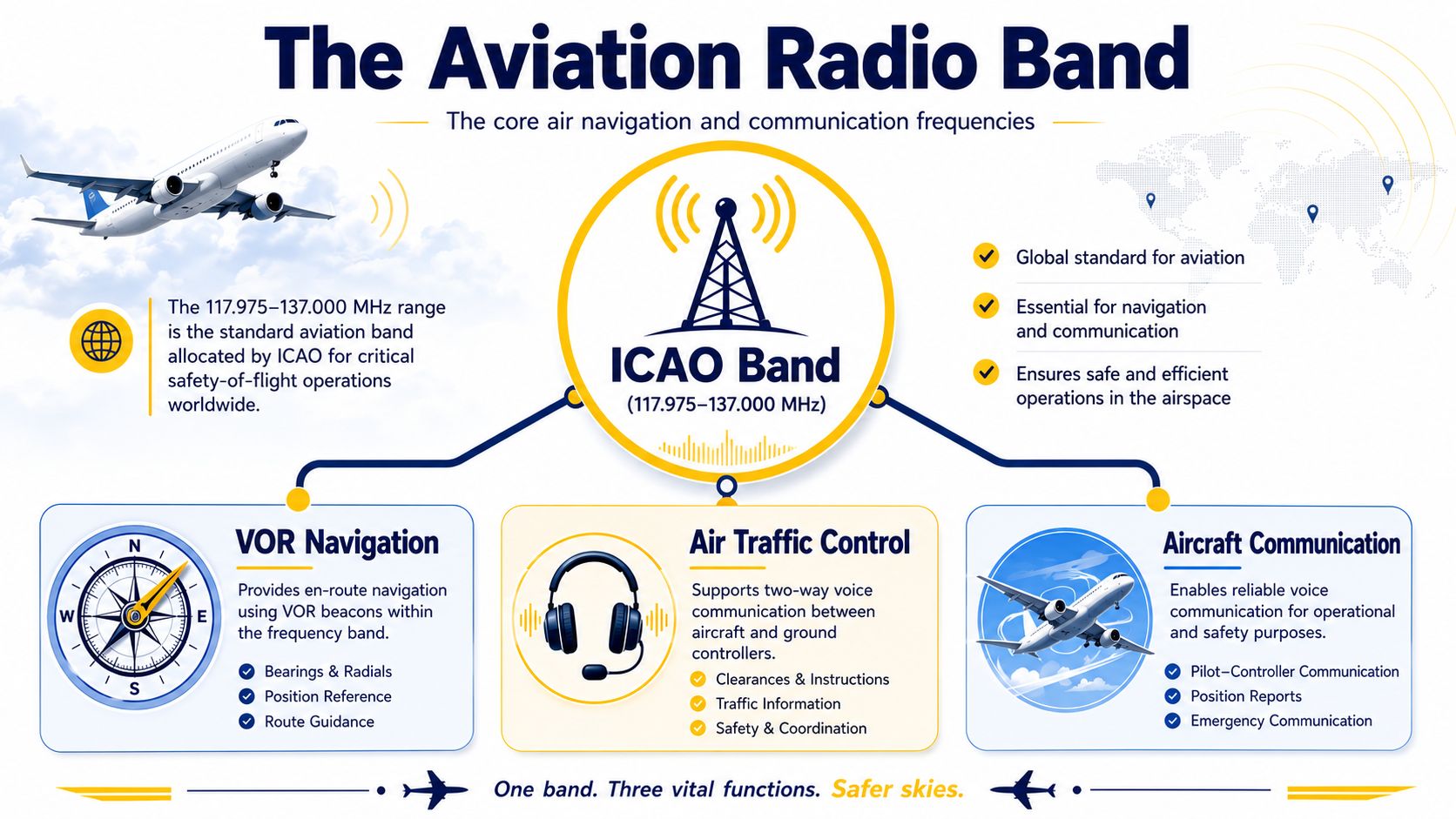
A drone pilot who first sees an aviation band chart can easily assume it is just a wider version of a normal scanner range. The truth is more precise. The civil aeronautical VHF envelope is commonly described as 117.975–137.000 MHz, while ICAO Annex 10 sets the lowest assignable aviation frequency at 118.000 MHz and the highest at 136.975 MHz (ICAO Annex 10 frequency limits). That distinction matters because charts, radios, and channel plans are built around assignable channels, not just the rounded band label people often repeat.
Channel spacing is part of the story
Aviation radio capacity changed when international and regulatory steps reduced channel spacing to 25 kHz in 1972, which increased usable airband capacity to 720 channels. A further spectrum expansion on 1 January 1990 added the 136.000–136.975 MHz segment for aeronautical use and brought the total to 760 channels (FAA advisory circular history). For Australian pilots and RPAS teams, that history explains why radio training places so much emphasis on exact frequency selection and channel discipline.
The modern airband is also moving toward 8.33 kHz spacing in tightly channelised environments. Frequency stability and receiver selectivity matter more than they did with older wide-channel systems. A handheld that sounds fine in a quiet shop can still feel sloppy near a busy aerodrome if its tuning and filtering are not up to the task.
Named frequencies matter
Aviation radio is not one block with one job. ICAO identifies 121.5 MHz as an emergency frequency, and also lists 123.1 MHz and 243 MHz in aeronautical spectrum tables (ITU aeronautical frequency bands). For a drone operator, that means emergency monitoring is a specific task, not a vague best practice.
Aviation communication also extends beyond VHF. ICAO and related spectrum references allocate 2850–22,000 kHz for HF air-ground communications, and identify 3023 kHz and 5680 kHz for search and rescue use (ICAO spectrum chapter). That matters because it shows aviation radio is a family of services, not a single frequency block.
A practical way to read the band is simple.
- 118.000–136.975 MHz is the assignable civil VHF airband.
- 121.5 MHz is the emergency guard frequency.
- HF allocations exist for long-range communication where VHF line-of-sight will not reach.
- Spacing determines how tightly channels are packed and how accurately radios must hold frequency.
That framework helps a drone pilot look at a frequency list and know what kind of communication space they are dealing with before the aircraft even leaves the ground. For a training pathway that includes communications discipline alongside flight skills, ACE SILVER combines RePL training with AROC and aviation English proficiency for professional drone pilots.
How Aviation Radio Signals Work
Aviation voice traffic uses amplitude modulation, AM, rather than FM. That choice is deliberate. AM tolerates fading, overlap, and static better in air-ground voice work, and it remains the normal mode for aeronautical voice services in the VHF band. For anyone using a handheld or scanner near an aerodrome, the radio has to be set up for aviation use, not just general voice reception.
Why line-of-sight dominates
VHF aeronautical communications are mostly line-of-sight. ICAO describes 117.975–137 MHz as the main line-of-sight air-ground communications band for airports, en route, approach, landing, and short-range general-aviation tasks (ICAO radio spectrum guidance). That is why tower and approach calls often sound clean while the aircraft is in range, then fade quickly when terrain, buildings, or distance block the path.
Aviation coverage is engineered, not guessed at. If the site design is weak, a transmitter that sounds strong in the shop can still sound thin at the edge of the operating area.
ICAO radio-engineering guidance sets a minimum field strength of 75 μV/m throughout the area of coverage, with desired-to-undesired ratios of 20 dB or 14 dB where applicable (ICAO engineering guidance). For a drone team, that becomes a practical setup issue. Antenna placement, squelch setting, and receiver selectivity can determine whether you understand a tower call or only hear fragments of audio.
What that means on the ground
A handheld near a busy airport does not need brute power as much as clean reception and correct setup. If the squelch is set too high, weak transmissions disappear. If the antenna is poorly placed, the receiver can miss the edge of coverage. If the radio's selectivity is poor, adjacent-channel traffic becomes harder to separate under tighter channel spacing.
For Australian RPAS teams, the main point is simple. A radio that works well enough for casual scanning can still be a poor tool for operational monitoring near controlled airspace. The radio has to match the environment, not just the label on the box.
Comparing Aviation Radio Equipment Options
Aviation radio gear looks similar from the outside, but the use case changes everything. A drone operator who only wants passive awareness has different needs from a flight-training student, and both are different again from a crew that needs transmit capability for aviation work. One of the clearest ways to avoid buying the wrong device is to separate listening-only, transmit-capable, panel-mounted, and software-defined options.
The main equipment categories
| Equipment Type | Can Listen | Can Transmit | Best Fit For |
|---|---|---|---|
| Handheld airband receiver or scanner | Yes | No | Passive monitoring near aerodromes, training observation, basic situational awareness |
| Handheld airband transceiver | Yes | Yes | Approved aviation use, trained operators, operational comms where legal |
| Panel or base station | Yes | Yes | Fixed sites, flight training, ground coordination, more permanent setups |
| Software-defined radio setup | Yes | Usually no direct operational transmit use | Learning, spectrum analysis, hobby monitoring, classroom demonstrations |
What to look for before buying
A receiver that only listens can be useful for a drone crew standing outside a controlled airport boundary. It can't replace the authority to transmit, and it won't solve every coordination problem. A transceiver can do more, but only if the operator has the right training and the operation is set up to use it legally.
A good entry-level buyer should ask four questions.
- Do they only need to monitor? A receiver or scanner may be enough.
- Do they need to speak on airband? That shifts the issue into licensing and authorised use.
- Is the site fixed or mobile? Panel or base stations suit stable locations better.
- Will the radio face busy spectrum conditions? Then selectivity and frequency stability matter more.
For a beginner who is still learning the broader aviation environment, ACE READY is an entry-level training option that covers drone fundamentals, aviation safety, CASA regulations, and flight operations before advanced RePL training.
The mistake many buyers make is assuming that “aviation radio” automatically means “appropriate for drone operations”. It doesn't. Some gear is built for aircraft owners, some for students, and some for people who want to hear traffic. The right choice depends on whether the operator is observing, training, or participating in aviation communications.
Legal and Licensing Considerations in Australia
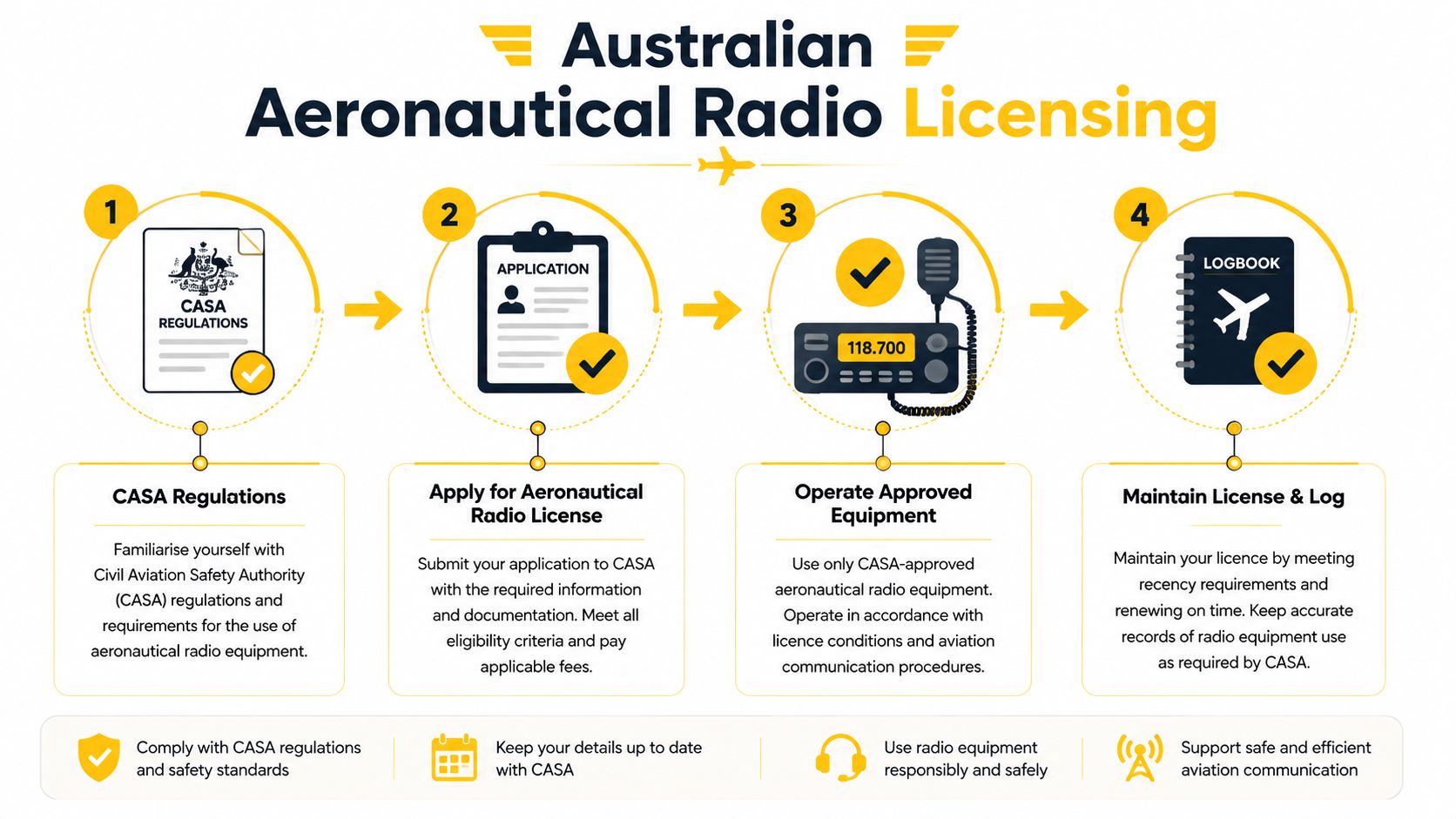
An Australian drone crew standing near a controlled aerodrome can hear airband traffic and still be unsure about the legal line between listening and speaking. That line is clearer than many online discussions suggest. Receive-only monitoring of public aeronautical transmissions is one matter, but transmitting on aeronautical frequencies is another, and that is where AROC and station authority come into play.
Where CASA and AROC fit
ICAO describes 117.975–137 MHz as the main line-of-sight air-ground communications band used at airports, en route, approach, landing, and short-range general-aviation tasks. Australian RPAS teams that plan around this band need to match equipment and licensing decisions to internationally harmonised rules, not casual radio habits.
The Aeronautical Radio Operator Certificate covers operating aeronautical radio stations when transmission is part of the job. For drone pilots, that usually becomes relevant where operations intersect with manned aviation, controlled airspace, or formal coordination duties. A handheld that can transmit is not a substitute for competence, and competence is not the same as holding the authority to use the frequency.
How the training pathways fit together
The training pathway matters because radio competence rarely stands alone. RePL covers remote pilot competency, ReOC sits at the organisational level, and Certificate III in Aviation can support broader aviation career development. Enterprise Drone Training and Corporate Drone Training are relevant where organisations want standard operating procedures, repeatable communication habits, and compliance-focused training for teams.
One useful way to set the boundary is this.
- Listening only: useful for situational awareness, generally the least complicated path.
- Transmitting: this moves into radio operator competence and station authority.
- Operational integration: once a drone team is coordinating with aviation traffic, the radio becomes part of a regulated system.
For Australians trying to work out what applies to their operation, this licence finder can help match the training and certification pathway to the intended task. The deciding factor is still the operation itself, not the brand of the handheld.
Practical Use of Aviation Band Radio in Drone Operations
A pre-flight routine near a manned aerodrome works best when the radio serves awareness first. The operator powers on the handheld, listens to traffic, and notes the callsigns, runway direction, and any patterns in departures or arrivals. That early listening period often tells the crew more about the day's rhythm than a quick glance at a chart.
A simple operating sequence
The best workflow is short and repeatable.
- Identify the relevant frequency. Use the aerodrome chart or published frequency information.
- Listen before takeoff. Hear traffic flow, runway use, and any special calls.
- Write down what matters. Callsigns, runway direction, and any weather-related comments.
- Keep transmissions brief if authorised. Clear, standard phraseology beats long explanations.
- Monitor emergencies separately. Keep 121.5 MHz on the watch list when the operation justifies it.
What drone crews should actually listen for
A drone team does not need to understand every phrase on first hearing. It needs to catch enough to avoid conflict and stay aware of changing traffic. Position reports from manned aircraft can show when traffic is converging on the same area, and a change in runway direction can alter the risk picture quickly.
Emergency monitoring deserves a separate mention. ICAO identifies 121.5 MHz as an emergency frequency, alongside 123.1 MHz and 243 MHz in aeronautical spectrum tables (ITU emergency frequencies). If a crew hears a distress call or something that sounds like one, the correct response is to stop treating the channel as background noise and escalate through the appropriate safety channels.
Useful habit: keep the radio in the case until the team can explain why it's needed on that job. If nobody can name the frequency, the call type, and the authority to transmit, the radio is just extra baggage.
For emergency decision-making around drone work, this emergency handbook is a sensible companion piece. In practice, the highest-value use of airband in RPAS work is usually situational awareness, not control. That keeps the radio in its proper place, as one part of a wider operating picture.
Common Misconceptions About Aviation Band Radio
A common myth says every drone pilot should carry an airband handheld “just in case”. That sounds cautious, but it misses the core boundary. If the job is far from aerodrome traffic, and the crew is neither trained nor authorised to use the radio, the handset adds another thing to manage without necessarily improving safety.
The most common mistakes
Another misconception says listening is illegal without an AROC. That is too broad. The line sits between receive-only monitoring and transmitting, because transmitting on aeronautical frequencies is where qualification and station authority become relevant. A third misconception claims UHF CB or marine VHF can stand in for aviation band radio. They cannot. Different services, different rules, different users, different jobs.
Some crews also assume the VHF airband will stay fixed as a long-term purchase. Spectrum planning does not support that assumption. The ITU spectrum coordination outlook treats radio-spectrum coordination as a critical component for safe aviation, with active strategy work on aeronautical spectrum management. For Australian operators, that means a radio should be chosen for the current operating need, not for an idea that the band will never face pressure or change.
| Myth | Reality |
|---|---|
| Every drone crew needs a handheld | Only crews with a real monitoring or coordination need should buy one |
| Listening needs AROC | Receive-only use is different from transmitting |
| UHF CB or marine VHF can substitute | They serve other services and do not replace aviation band radio |
| The band will not change | Spectrum management is active and under pressure |
For operators trying to separate sensible planning from social-media advice, these excluded-category examples are a better reference point than forum chatter. The practical rule is simple. Buy for the job, train for the task, and do not assume a radio accessory solves a licensing problem.
Frequently Asked Questions About Aviation Band Radio
Do Australian drone pilots need an AROC?
Only if they need to transmit on aeronautical frequencies as part of their role. Listening alone is a different issue.
Can a drone pilot listen to airband without a licence?
Receive-only monitoring is generally the practical boundary people use, but the moment the operation moves into transmitting, the licensing question changes.
What's the difference between aviation band radio and UHF CB?
Aviation band radio is for aeronautical communications. UHF CB is a separate service with different users and rules.
What's a sensible first radio for a beginner?
A listening-only airband receiver or scanner is often the simplest starting point for situational awareness. If transmitting is needed, the operator should match the equipment to the correct training and authority.
Will airband stay the same in the future?
Spectrum coordination is under active management, and aviation teams should expect continued pressure on how the band is used.
For more guidance on training and certification questions, Ace Aviation Aerospace Academy's FAQ page is a practical next stop.
Ace Aviation Aerospace Academy supports drone and aviation learners who need training that lines up with real-world CASA expectations, including RePL, AROC, and workplace-ready communication habits. If a crew needs to understand where airband fits in safe Australian operations, Ace Aviation Aerospace Academy offers courses and guidance that connect spectrum knowledge to compliance and day-to-day flying.