In Australia, the manned-aircraft CPL pathway and the commercial drone RePL pathway are the two main routes for a course to be a pilot. The right choice depends on whether the goal is to carry passengers and freight or to operate drones commercially for industries like agriculture, mining, and surveying.
A lot of beginners start with the wrong question. They ask which course is “the pilot course”, when the better question is what kind of flying work they want to do in Australia. Under CASA, pilot training is tied to a licence outcome, a medical standard, and logged competency, so the first step is matching the pathway to the job.
Table of Contents
- Two Pilot Pathways You Can Choose From in Australia
- How CASA Structures Pilot Qualifications
- What RePL, AROC and ReOC Actually Cover
- Comparing Course Structure, Duration and Outcomes
- Where Each Course Can Take You in Australia
- How to Choose a CASA-Compliant Training Provider
- Matching the Right Course to Your Goal
- Frequently Asked Questions About Pilot Training in Australia
Two Pilot Pathways You Can Choose From in Australia
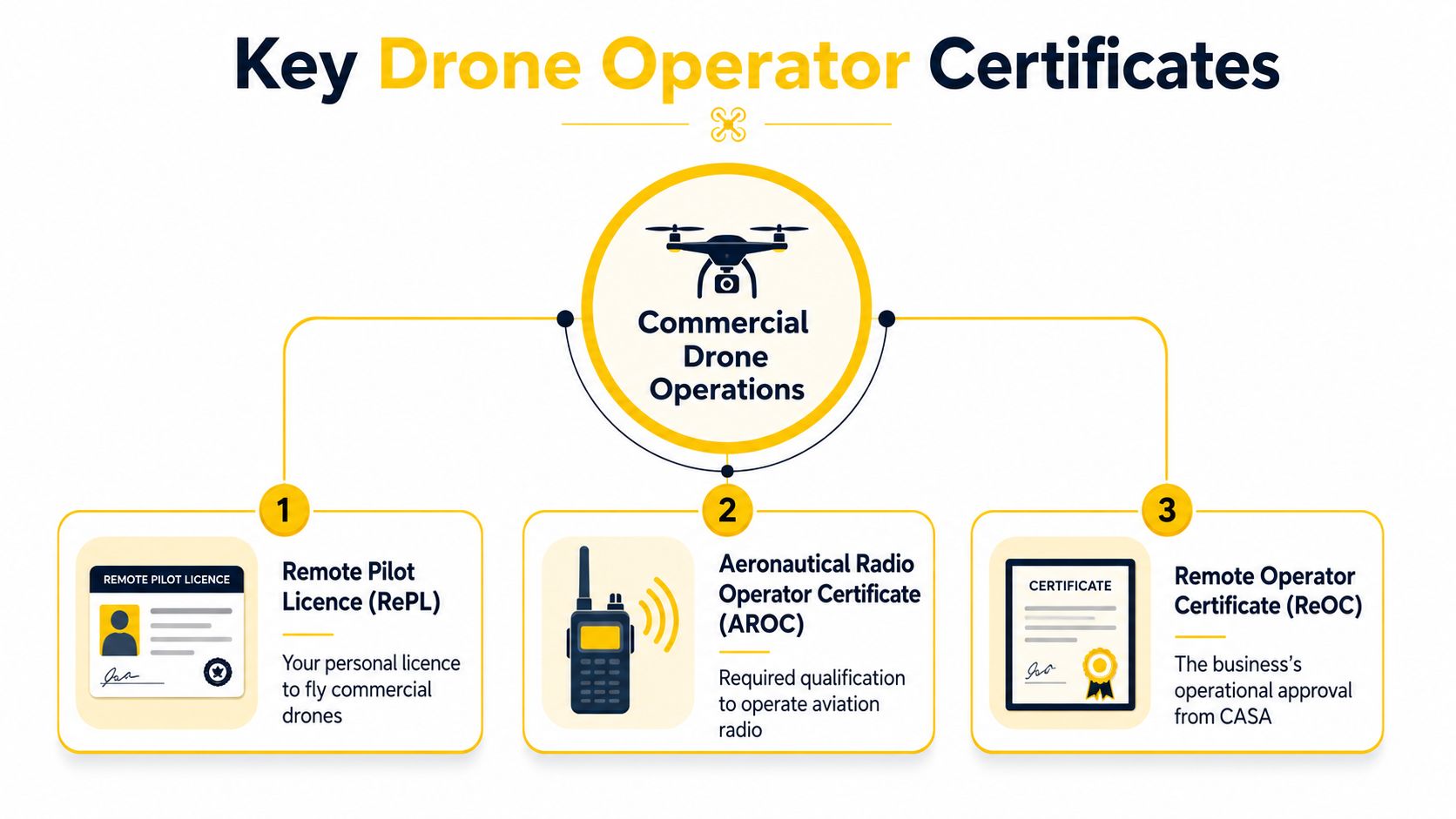
A beginner usually reaches a fork very early in a course to be a pilot. One route is the manned aircraft path, which leads through CASA's licence structure toward a Commercial Pilot Licence and, if the goal keeps growing, an Airline Transport Pilot Licence. The other route is commercial drone operations, where the main qualifications are the Remote Pilot Licence (RePL), the Aeronautical Radio Operator Certificate (AROC), and, for businesses, the Remote Operator's Certificate (ReOC).
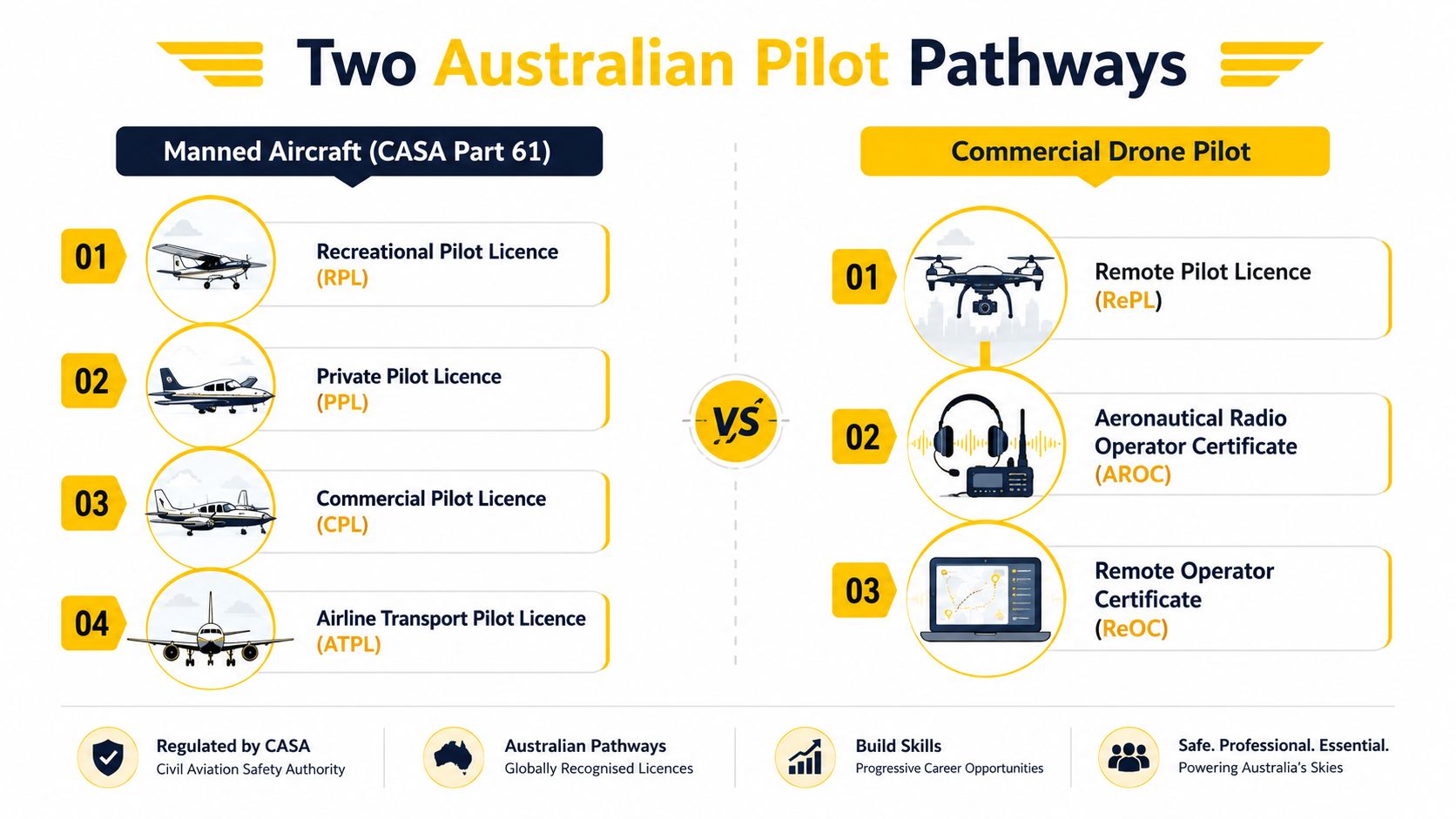
The decision is usually clearer than people expect. If the work is about carrying passengers, freight, or doing charter flying, the manned-aircraft route is the one that fits. If the work is aerial mapping, inspection, spraying, media, or asset monitoring, the drone pathway is often the more direct commercial option in Australia. That difference matters because the training, operational rules, and job outcomes are not the same, even though both sit under aviation regulation.
Manned aircraft path
For anyone aiming to fly passengers, freight, or charter work, the relevant route is the manned-aircraft ladder under CASA Part 61. Training usually starts with basic flying skills, then builds into higher licences as the pilot gains experience and theory knowledge. CASA structures the path this way because commercial flying depends on judgement, navigation, air law, meteorology, and aircraft systems, not just smooth control inputs.
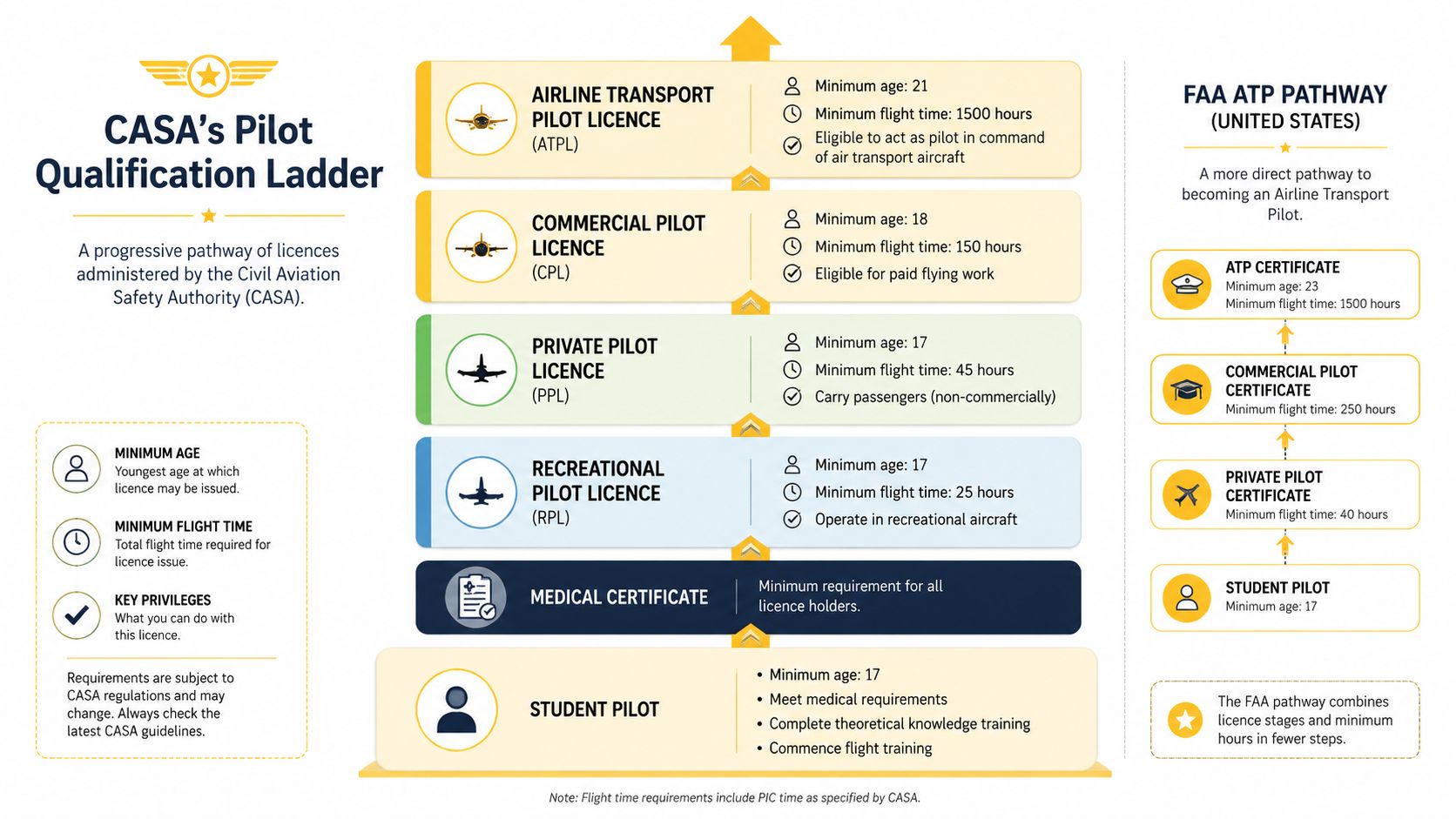
An airline benchmark helps show why this route takes time. The FAA pilot certification overview describes the airline transport pilot framework as requiring a minimum age of 23 and at least 1,500 hours of flight time, plus 500 hours cross-country, 100 hours night, and 75 hours instrument time, with some exceptions (FAA pilot certification overview). Those requirements show how much experience sits behind airline-level flying.
Commercial drone path
For aerial mapping, inspection, spraying, media, or asset monitoring, the faster commercial entry point is usually the drone pathway. CASA treats commercial RPAS work as a real aviation activity, not a hobby add-on, because the operator still has to manage airspace rules, communication procedures, and safety risks. A useful way to get a feel for structured aviation training is the virtual tour of a hotel flight simulator, which gives a beginner a sense of how formal cockpit training environments are arranged, even though drone training itself follows a different skill set.
If the job title sounds like “pilot in command of an aircraft”, the CPL ladder is the right frame. If the job title sounds like “commercial drone operator”, the RePL and ReOC structure is the better fit.
How CASA Structures Pilot Qualifications
CASA's qualification model is staged on purpose. A learner does not jump straight to the highest licence, because each level adds new responsibility, new flight privilege, and a stricter safety standard. Australian pilot training works more like a progression than a single enrolment choice, and that is true whether someone is aiming for an airline cockpit or a commercial drone role.
The licence ladder
The Australian pathway often begins with a Recreational Pilot Licence (RPL), then moves to a Private Pilot Licence (PPL), then a Commercial Pilot Licence (CPL), and finally an Air Transport Pilot Licence (ATPL) for the highest level of airline flying. The same staged logic appears in the UNSW pilot pathway, where learners move through RPL, PPL, then CPL instead of treating each licence as a separate, disconnected course.
For learners comparing pathways, the point is straightforward. Each licence is a gate, not a bonus badge. A course has to prepare the candidate for the next regulatory milestone, which means theory, flying hours, and medical fitness all need to line up together.
Experience builds over time
Higher licences ask for more experience, because regulated aviation is built on demonstrated competence, not classroom attendance alone. The framework used for airline transport pilots in the United States shows how demanding that final step can be, with a strong emphasis on hours, night flying, cross-country flying, and instrument experience. That structure helps explain why the manned-aircraft route cannot be treated like a short vocational class.
For learners focused on a professional drone start, the Australian pathway is still staged, just differently. A structured program such as ACE SILVER covers Commercial Remote Pilot Licence (RePL) training, classroom instruction, practical flight training, CASA compliant certification, AROC, and aviation English proficiency for professional drone pilots. For readers who want the fastest in-demand commercial entry point, the drone licence pathway is often the first place to check, because it fits paid RPAS work rather than manned-aircraft progression.
Medical fitness sits alongside skill
Aviation training is not only about flying well. It also depends on medical certification, because the regulator needs to know the pilot can safely perform the role. In practical terms, that means an Australian pilot course has to be planned around the right Class 1 or Class 2 aviation medical as well as the flying syllabus. That keeps the pathway aligned with operational fitness, not just classroom progress.
What RePL, AROC and ReOC Actually Cover
For many Australian readers, the drone pathway is the part that causes the most confusion. The names sound technical, but each certificate has a clear job. Once the roles are separated, the commercial RPAS pathway becomes much easier to map.
RePL is the personal flying licence
The Remote Pilot Licence (RePL) is the operator-level qualification for flying drones commercially in Australian aviation settings. It sits at the centre of most paid drone work because it shows the pilot has been trained to operate a drone safely and legally in a commercial context. In plain terms, it is the personal licence that lets an individual fly for work, rather than as a hobbyist.
That matters for jobs like roof inspection, mapping, filming, and many agricultural tasks. If one person is offering drone services to clients, the RePL is usually the starting point.
AROC covers aviation radio
The Aeronautical Radio Operator Certificate (AROC) is about radio communication, not flying skill. It becomes relevant whenever a drone operation needs aviation radio use to coordinate with airspace users or services. In a professional environment, that can be the difference between a simple local job and a more complex operation near controlled airspace or other aircraft activity.
Good training habit: A drone pilot should treat radio skills as operational discipline, not a box-ticking exercise.
ReOC is the business approval
The Remote Operator's Certificate (ReOC) belongs to the business, not the individual pilot. It gives an organisation the approval framework to run its own drone operations under its own safety system. That is why a business with multiple pilots, standard procedures, and repeat client work usually needs more than just one licensed operator.
A sole operator doing occasional freelance mapping may only need a RePL for the work itself, while a larger agriculture firm that runs a team of pilots for spraying or spreading would normally need a ReOC to structure those operations properly. For readers wanting a deeper compliance view, the ultimate guide to ReOC Australia is a useful follow-up.
If a full commercial drone training pathway is the goal, ACE GOLD combines advanced commercial drone pilot training with RePL, ReOC support, practical flight training, aviation compliance, and business readiness for commercial drone operations.
Comparing Course Structure, Duration and Outcomes
The manned-aircraft and drone routes can both lead to aviation work, but they are built for very different timelines and job outcomes. The table below gives the clearest side-by-side view.
Manned Aircraft CPL vs Commercial Drone RePL in Australia
| Factor | Manned CPL Pathway | Drone RePL Pathway |
|---|---|---|
| End goal | Fly aircraft commercially, including passenger or freight roles | Fly drones commercially for clients or employers |
| Training structure | Multi-stage licence ladder with theory, flying, and medicals | Focused commercial RPAS training with practical and compliance elements |
| Entry pathway | Often begins with foundational licence stages before CPL | Often begins with RePL, then AROC if radio is needed |
| Business layer | Flying role and operator role may sit inside separate employment structures | ReOC becomes relevant for businesses running their own drone operations |
| Medical requirement | Aviation medical standards are part of the pathway | Medical expectations are generally less demanding than manned-aircraft flying, but compliance still matters |
| Job outcome | Commercial flying roles, then advanced airline progression | Surveying, inspection, agriculture, media, and other RPAS work |
The reason the CPL track takes longer is structural. It is designed around a higher-risk environment, a bigger aircraft, more passengers, and much deeper operational responsibility. The drone route is shorter because the aircraft are smaller and the scope is different, but that does not mean the standards are loose.
For Australian learners, the practical difference is often time and cost planning. A manned-aircraft career needs a long runway, while a RePL-based drone career can be a much faster move into commercial work. If a reader is still comparing options, the broader course list at AAA courses can help show how entry, commercial, and advanced training sit beside each other.
Where Each Course Can Take You in Australia
The same qualification can support very different careers, depending on the industry and the business model behind it. Three common Australian scenarios show how that works in practice.
Surveying graduate
A surveying graduate who adds a RePL and AROC can move into aerial mapping, site capture, and asset documentation for engineering firms. The pilot side of the job stays highly regulated, because the operator still needs safe airspace judgement, communication discipline, and recorded competency. A structured course path can help that graduate turn technical site knowledge into aviation capability.
Family-run agribusiness
A family business that wants to use drones for spraying or spreading may need a ReOC so the operation can run legally under its own system. In that model, one pilot licence is not enough on its own, because the business has to manage procedures, people, and operational responsibility. Enterprise training thus becomes practical, not theoretical.
Sole trader offering inspections
A tradie or sole trader who adds RePL training can offer roof inspections, façade checks, or asset surveys to construction clients. That person is still operating inside an aviation framework, even if the work looks more like building services than flying. For readers also considering a formal qualification pathway, the drone pilot careers and Certificate III in Aviation guide is a useful bridge between entry training and broader aviation progression.
A complete enterprise pathway such as ACE PLATINUM includes RePL, AROC, Aviation English, Express ReOC, Certificate III in Aviation, advanced operations training, and preparation to operate and manage a commercial drone business.
The best drone qualification is the one that matches the actual work model, not the most impressive-looking certificate.
How to Choose a CASA-Compliant Training Provider
A serious aviation training provider should look like a training organisation, not a reseller with glossy landing pages. The first thing to check is whether the provider's scope matches the qualification being offered. If a course leads to RePL, AROC, or ReOC consulting, the training should be delivered with CASA compliance in mind, not just generic flying talk.
What matters most
- CASA alignment: The provider should clearly show how its training sits within Australian aviation rules and certification pathways.
- Instructor background: Good instructors usually bring aviation, air traffic, or operational experience, not just sales experience.
- Full pathway support: A strong provider can help with foundational training, RePL, AROC, and related compliance support rather than only selling one course.
- Ongoing guidance: Refresher training, career support, and educational resources matter after enrolment, because compliance does not stop at course completion.
- Enterprise capability: For businesses and agencies, provider experience with consulting, team training, and operational support is important.
Ace Aviation Aerospace Academy fits into that conversation as one Australian provider offering RePL, AROC, ReOC consulting, Certificate III in Aviation, and Enterprise Drone Training as part of its training footprint. Readers who want to compare providers can also use the licence finder tool to narrow the path before speaking with a course adviser.
A good rule is to ask what happens after the course ends. If a provider can explain the next compliance step, the refresher expectation, and the pathway to operational work, that is a stronger sign than a slick brochure.
Matching the Right Course to Your Goal
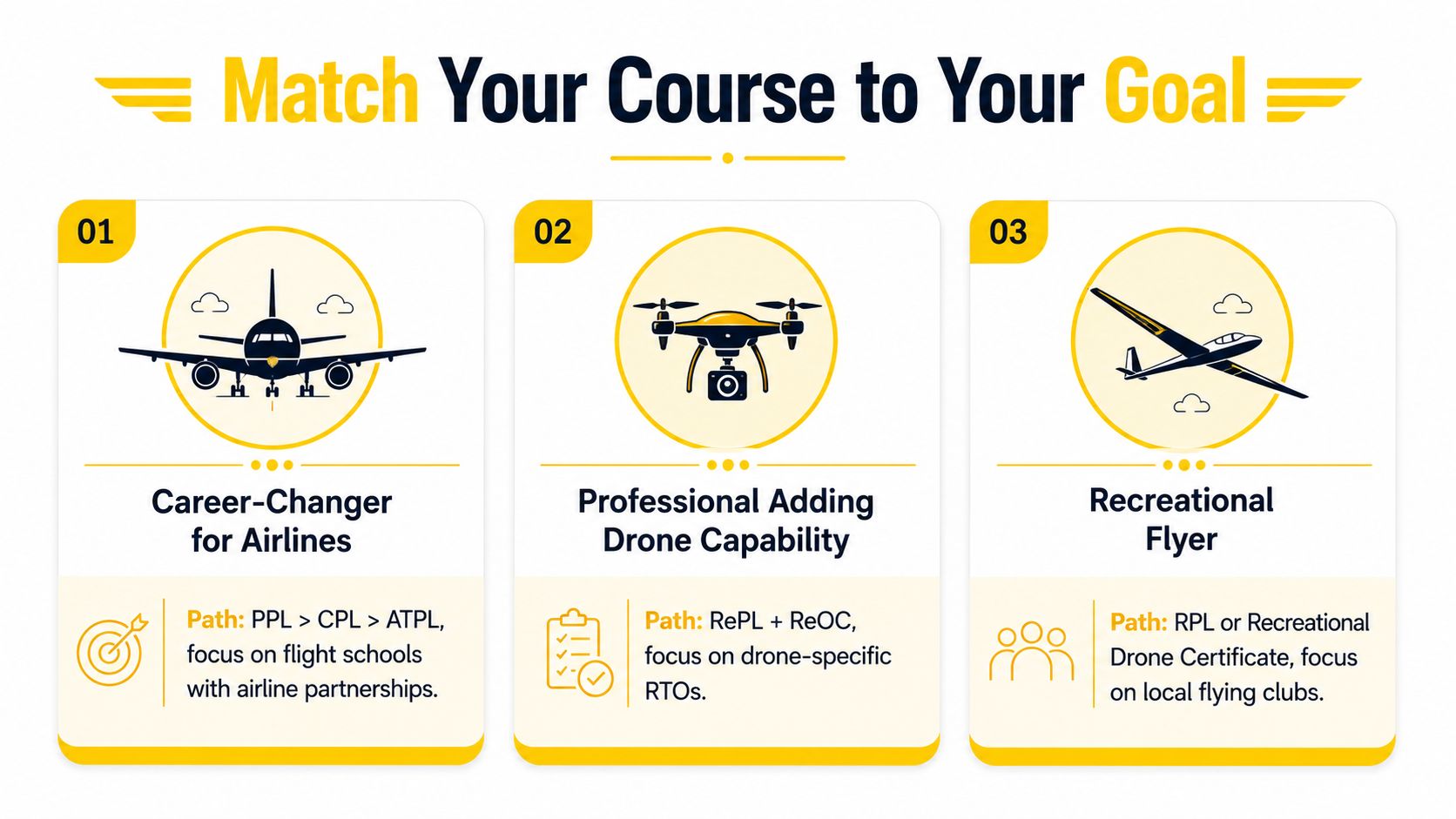
A career-changer aiming for the airlines should stay on the manned-aircraft ladder, starting with the foundational licence stages that lead toward CPL and, later, ATPL. A professional who needs to add regulated drone capability should focus on RePL and, where radio or business structure demands it, AROC and ReOC. A business owner who wants compliant operations should look for the training and consulting pieces that support the organisation, not just the individual pilot.
For anyone still deciding, the sequence is straightforward. Check the CASA requirement first, compare providers second, then book a foundation or readiness course before committing to the full pathway. If the goal is commercial drone work, starting with an entry course like ACE READY can help build the aviation basics before moving into RePL training.
Frequently Asked Questions About Pilot Training in Australia
A learner standing at the start of a flight path usually wants one thing first, a clear answer about what each qualification lets them do. In Australia, that question often splits into two tracks. One is the manned-aircraft route for people aiming at cockpit flying. The other is the commercial drone route, which is often faster to enter and more closely aligned with immediate market demand.
Is a RePL enough to start a drone business in Australia?
A RePL lets an individual fly commercially, but a business often needs more than one licence or approval. If the work involves multiple pilots, written procedures, or broader organisational control, a ReOC becomes part of the picture. A sole operator may only need the individual licence, while a growing operation usually needs the compliance structure that sits around it.
When is a ReOC necessary?
A ReOC is usually needed when a business wants to run its own drone operations under its own safety and compliance system. That matters for teams, recurring commercial work, and businesses that manage pilots rather than only contracting one person for a job. It is the organisational side of the operation, the part that sets the rules the pilots work under.
Does every RePL holder need an AROC?
No. AROC relates to aviation radio use. It becomes relevant when the operation needs that communication skill, not for every simple commercial flight. If the job does not call for radio work, the licence alone may be enough for that task.
What English and age requirements apply?
The exact requirements depend on the licence or course path. For advanced manned-aircraft benchmarks, the FAA airline transport pilot framework includes a minimum age of 23 and specific experience thresholds, while Australian providers may also assess aviation English where operational communication matters. The practical point is simple. Training organisations check whether a learner can understand instructions, read procedures, and speak clearly in the environment they will train for.
Can Australian pilot or drone qualifications be used overseas?
Recognition varies by country and by regulator. Australian qualifications are respected, but overseas work usually depends on the local aviation authority's rules, medical standards, and licence conversion process. A qualification that works in one country may still need extra paperwork or additional checks before it is accepted elsewhere.
Do all pilot courses require a medical?
Manned-aircraft pathways do, because fitness is part of the licensing system. Drone pathways still require compliance and safe operation, but the medical framework is generally not the same as for cockpit crew. That difference is one reason the drone route can feel more direct for people who want to start commercial flying sooner.
Ace Aviation Aerospace Academy offers CASA-compliant drone and aviation training for learners who need a clear, regulated pathway into commercial flying. For readers comparing RePL, AROC, ReOC consulting, or broader aviation options, visit Ace Aviation Aerospace Academy to review the training path that fits the work they want to do.