

You're due to send a logbook to CASA, or a client, or an insurer, and that familiar question lands hard, is every entry defensible? For Australian pilots and drone operators, the logbook isn't a private diary of flights, it's a compliance record that can be checked years later, and the details matter when someone asks you to prove what was flown, when, and under what conditions.
That's where the CASA pilot logbook requirements become more than a paperwork exercise. Traditional flight crew logbooks and RPAS records overlap in purpose, but they don't overlap perfectly, and that's where many new aviators get caught out. A student pilot building hours in a light aeroplane, and a commercial drone operator managing multiple aircraft, are both keeping records for the same regulator, but the entries, retention rules, and exemptions are not identical.
A good way to think about it is this, CASA cares less about how neat the book looks and more about whether the record can stand up in an audit. A logbook that is incomplete, lost, or impossible to reproduce can create problems for licence progression, insurance reviews, and commercial approvals. For drone operators, the line between casual record-keeping and regulatory evidence can be even thinner, especially when fleet operations and multiple sites are involved.
For readers also building a drone career pathway, practical training matters early. ACE READY is an entry-level drone training course for beginners that covers drone fundamentals, aviation safety, CASA regulations, and flight operations, which makes it relevant before more advanced Remote Pilot Licence training. For operators comparing the manned and unmanned sides of aviation, the core habit is the same, write down the flight properly, keep it safely, and be ready to show it.
Table of Contents
- Why Your Logbook Is More Than Just a Flight Diary
- Mandatory Entries for Every Flight Record
- Choosing Between Digital and Paper Logbooks
- Understanding the Seven-Year Retention Rule
- Drone Operator Record-Keeping Obligations
- Building an Audit-Ready Logbook System
- Common Logbook Mistakes and How to Avoid Them
- Key Takeaways and Frequently Asked Questions
Why Your Logbook Is More Than Just a Flight Diary
A pilot gets an email from CASA asking for the logbook within a week. The aircraft has been flown correctly, the operation was legal, and the day looked routine, but the first thing checked is not memory, it is the record. That is the point where a logbook stops being a convenience and becomes evidence.
For more on excluded-category drone operations, see https://aaa.edu.au/blog/excluded-category-drone-operations.
The same logic applies to drone operations, just in a different operational context. A commercial RPAS operator may have flight records spread across several aircraft, sites, and jobs, and when an audit or compliance review lands, those records need to line up cleanly. CASA's record-keeping framework for drones and flight crew logbooks both reflect the same principle, if it isn't recorded properly, it can't be relied on later.
What makes the logbook legally important
A logbook supports more than hour-building. It helps show whether the pilot or operator complied with aircraft type, role, location, and operating conditions, which is exactly what inspectors and insurers tend to look for in a review. Under CASA's flight crew logbook rules, the logbook must also be retained for 7 years from the last entry, and if CASA directs production it must be provided within 7 days.
That time horizon matters because aviation paperwork rarely gets reviewed on the same day it is written. A gap discovered later can become a licensing headache, particularly for student pilots moving through training, or for businesses managing compliance across staff and aircraft.
Practical rule: treat every entry like someone outside the operation will read it later, because that is exactly what can happen.
For modern Australian aviators, the overlap between logbook disciplines is clear. Manned aviation uses a flight crew logbook with specific post-flight entries. RPAS operations use flight logs and maintenance records with their own scope and exemptions. The same habit applies in both settings, write down the flight properly, keep it safely, and be ready to show it if an audit asks for it.
Mandatory Entries for Every Flight Record
A compliant post-flight entry needs more than a flight date and an approximate block of time. The record has to identify the flight clearly enough that, if an auditor, chief pilot, or insurer checks it later, there is no confusion about what happened. For traditional pilot logbooks, that means the entry needs the details CASA expects. For RPAS operators, the same habit applies in a different record format, because drone logs also need to show who operated, what was flown, and under what conditions.
A common student mistake is to write only “training flight” or “local area” and stop there. That kind of note may remind the pilot what the sortie felt like, but it does not help anyone verify the aircraft, the role flown, or whether the time was day, night, or instrument time. The safer habit is to complete the entry straight after shutdown, while the details are still fresh and easy to check against the aircraft documents or the operation itself.
The fields CASA expects
For flight crew records, the entry needs the flight date, aircraft type, registration marks, take-off and landing points, flight role such as PIC or dual, day/night status, and any instrument time. Flight time is measured from when the aircraft first moves under its own power until it comes to rest at the end of the flight. CASA flight crew logbooks
That detail catches many new pilots out. Taxi time counts in the overall flight time measurement, because the clock starts when the aircraft first moves under its own power. Pilots who are used to app-based drone logs sometimes expect the timer to begin at take-off, but manned aviation logbooks are tied to aircraft movement on the ground as well as in the air.
| Required Logbook Entry Fields | Description | Example |
|---|---|---|
| Flight date | The actual date of the flight | 12 August 2026 |
| Aircraft type | The make or category of aircraft | Cessna 172 |
| Registration marks | The aircraft registration identifier | VH-ABC |
| Take-off and landing points | Where the flight began and ended | Jandakot to Jandakot |
| Flight role | The role flown by the pilot | PIC or dual |
| Day/night status | Whether the flight was conducted in daylight or at night | Night |
| Instrument time | Any instrument time logged for the flight | 0.7 instrument time |
If the logbook is digital, the same discipline still applies. The format changes, the content does not. A pilot working through Remote Pilot Licence training often finds it helpful to compare fixed-wing or helicopter logbook discipline with RPAS logging, because the compliance mindset is the same. Record what happened, and make sure the entry can stand up if someone asks for it later.
Choosing Between Digital and Paper Logbooks
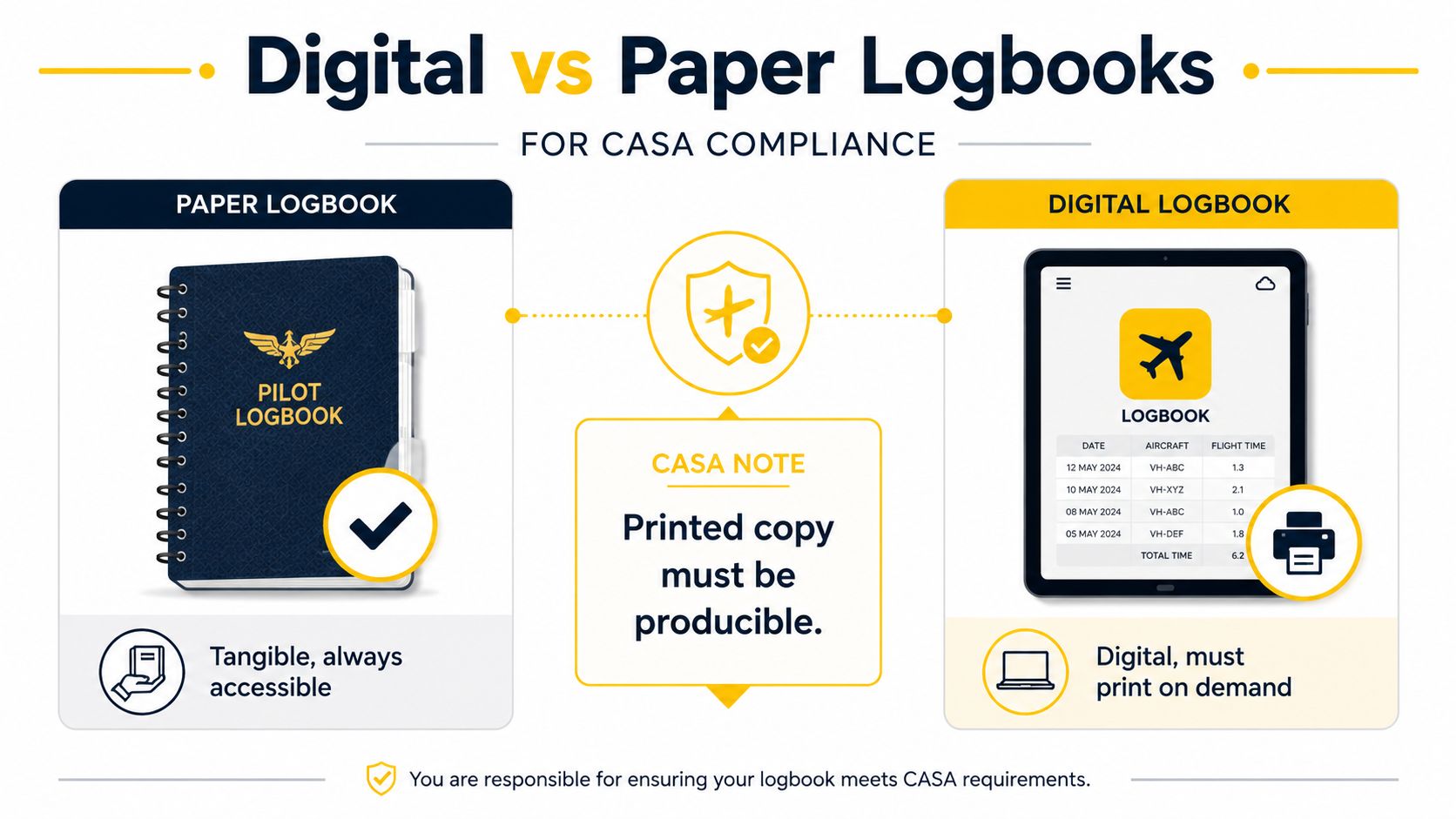
A student arrives with a tablet-based logbook and asks why the printed copy still matters. The answer sits at the centre of CASA pilot logbook requirements. Digital logbooks are allowed, but the record must be producible on paper, and each page must be certified as a true copy. A system that looks tidy on screen still has to survive a paper audit when someone asks for the record in a form they can inspect and file.
That changes the choice in practical terms. A polished app can track totals, sort entries, and back up data, yet it still has to produce a complete printable record that can be certified. Paper removes the software question altogether. There is no export format to test, no login to recover, and no device battery to worry about when the book needs to be shown.
Side by side comparison
| Format | Strengths | Limits |
|---|---|---|
| Paper logbook | Easy to keep, no software needed, simple to present | Manual totals, physical loss risk, harder to search |
| Digital logbook | Searchable, backed up, easier to total and copy | Must be printable and certifiable as a true copy |
For a student pilot working through Certificate III in Aviation, paper can be a practical starting point because the entry structure is visible and easy to check. For a commercial drone operator managing multiple aircraft, a digital system can be easier to search, reconcile, and back up, as long as the export and print functions support compliance. The overlap matters. Both manned aviation and RPAS records need to be accurate, readable, and ready to produce if an auditor asks for them.
A logbook app should help with accuracy, not replace the obligation to understand the entry itself.
Common Australian options include flight logging platforms and basic spreadsheet-based systems. The format matters less than the output. If the record can be printed clearly, certified correctly, and produced without scrambling through menus or missing files, it can support the audit trail. Paper suits pilots who want simplicity. Digital suits operators who want speed and backup. Drone operators often need both discipline and flexibility, because their record-keeping may sit beside maintenance files, flight condition notes, and other operational records.
Understanding the Seven-Year Retention Rule
A logbook can look finished and still remain live compliance material. The 7-year retention period starts from the last entry, not from the first page in the book. A folder on a shelf, or a file on a hard drive, is not “old enough” just because the early pages were written years ago. If the most recent entry is recent, the record is still within the retention window.
For a pilot or drone operator, that timing matters in an audit because CASA can ask for the record to be produced on short notice. The practical lesson is simple. If you cannot find the logbook quickly, the problem is not the entries themselves, it is the way the record has been stored and organised.
What good retention looks like
Good retention is plain and disciplined. Keep the current logbook within easy reach, keep older volumes or exports in a labelled archive, and make sure a recent copy can be produced without a hunt through boxes or menu tabs. For digital systems, that means tested backups and an export you know works. For paper systems, it means dry storage, clear labelling, and a place where the book will not be damaged, lost, or separated from the papers that support it.
If a logbook is stored so safely that it cannot be produced quickly, it is not set up properly for compliance.
Aviation record-keeping is often a matter of keeping separate pieces connected. A pilot logbook, a maintenance note, or an operational remark all have to make sense when an auditor reads them later. That is true in traditional flying and in RPAS work, where one aircraft's history should never get mixed into another's file.
Drone operators need the same discipline, but the record set is usually wider. A fleet may have flight logs, maintenance records, and condition notes spread across different people or aircraft, so the retention system has to keep those records aligned for later review. For a broader explanation of how drone rules fit into everyday compliance, this guide on Australian drone laws is a useful companion. The core point stays the same, retention is about being able to produce the right record on demand, not just saving data somewhere in the background.
Drone Operator Record-Keeping Obligations
A commercial drone can leave the ground with a clean battery, a charged controller, and a clear mission, yet still fail compliance if the record trail is thin. RPAS record-keeping follows the same basic logic as a pilot logbook, but CASA expects the operational record to show the parts that matter for a drone flight, not the full story a manned-aircraft log might capture. Operators must keep flight logs that include accumulated flight time, aircraft type/model/serial number, date, location, flight length, and whether the flight was VLOS, BVLOS, EVLOS, or at night. Those logs must be kept for 7 years. CASA drone record-keeping
In an audit, that record works like a flight path on paper. It shows which aircraft flew, where it flew, how long it was airborne, and under what operating condition. In fleet work, that separation matters because one drone's history must stay attached to that drone alone, just as you would not mix entries from different airframes in a traditional pilot logbook.
Where the drone rules draw the line
CASA also draws boundaries by aircraft size and category. Very small drones of 250 g or less and excluded-category aircraft under 2 kg are exempt from certain record-keeping obligations. Small drones of 2 to 25 kg and medium drones of 25 to 150 kg flown over private land fall within the record-keeping scope. CASA drone record-keeping
That distinction matters in day-to-day operations because different aircraft bring different compliance duties. A light recreational device does not carry the same recording burden as a commercial drone used for mapping, inspection, or land management. Operators who run mixed fleets need to separate the aircraft that fall inside the scope from those that do not, otherwise the records quickly become blurred and harder to defend in front of an auditor.
For businesses building formal compliance systems, ACE PLATINUM sits alongside the practical governance issues that come with commercial drone work. The same applies to ReOC Consulting, because record-keeping and operational control usually sit side by side in a real CASA audit, and a drone operator who understands both is better placed to keep the paperwork aligned with the flights.
Building an Audit-Ready Logbook System
An audit-ready logbook system starts with timing. Entries should be completed immediately after each flight, while the aircraft, route, role, and conditions are still clear. If that habit is missed, the record becomes a memory exercise, and memory is a weak compliance tool.
A simple operating rhythm
A weekly review catches missing fields before they spread across several flights. A monthly check confirms totals, checks for blank sections, and makes sure the paper or digital archive is still intact. The value of the review isn't just neatness, it's that small errors are much easier to fix before someone else asks for the records.
Supporting documents matter too. Maintenance releases, flight plans, and any related compliance papers should live beside the logbook or in a cross-referenced digital folder, so the record can be understood in context. For paper systems, a secure binder works well if it is indexed and stored safely. For digital systems, a backed-up folder structure is the minimum standard.
A practical checklist helps keep the system stable:
- Complete entries straight away: write the flight details before the day moves on.
- Check for missing fields weekly: confirm date, aircraft details, role, and conditions are all present.
- Back up digital records regularly: keep copies in more than one place.
- Store paper records securely: use a labelled binder or archive box.
- Test your export process: make sure a printed, certifiable copy can be produced quickly.
If the logbook is digital, the printed version should be tested before an actual CASA request arrives. If the logbook is paper, a scan or copy can provide a useful backup, but the original still needs to be protected from damage and loss. The goal is simple, a record that survives the flight, the month, and the audit.
Common Logbook Mistakes and How to Avoid Them
A student pilot finishes a training flight, writes the date, then leaves out the role and registration marks. A drone operator logs a flight time from app launch to shutdown instead of the actual operation, then discovers the totals don't make sense during a compliance review. These are the kinds of mistakes that look small on the day and become much bigger later.
The errors that show up most often
Incomplete entries are the most obvious problem. Missing aircraft details, omitted flight roles, and unclear take-off or landing points make it hard to prove what was flown. The fix is straightforward; use a consistent template and complete every field before putting the logbook away.
Incorrect time calculations are another common issue. Manned flight time is measured from first movement under its own power until the aircraft comes to rest at the end of the flight, so a guess based on airborne time alone can understate the record. Drone logs can drift in the opposite direction if operators record the wrong start and finish point.
Audit rule: if another person can't understand the entry without asking follow-up questions, the entry probably needs fixing.
Mixing personal notes with official records also causes trouble. A logbook should stay clean, factual, and readable. Casual comments belong in a separate notebook, not in the compliance record that CASA may later inspect.
Loss is the final, and often most painful, mistake. A logbook lost before the retention period expires can't be recreated from memory with the same strength as a live record. For operators who want to build better emergency planning around documentation, this aviation emergency handbook resource is a useful related read because the same discipline that supports flight safety also supports record resilience.
Key Takeaways and Frequently Asked Questions
A logbook entry is the record that stands up in an audit, not the memory of the flight. For CASA flight crew logbooks, the practical rule is simple, record the flight clearly, keep it for the required period, and be ready to produce it if asked. Electronic logbooks are allowed, but they still have to be printable, and each page must be certified as a true copy. Drone operators work under a related system, but the obligations are framed differently, with record-keeping focused on the aircraft details, operating mode, and the type of operation being conducted.
The safest habit is consistency. Fill in the entry while the details are fresh, keep the backup where it can be found quickly, and store the record in a way that survives a routine check, a licence review, or a compliance request.
Frequently asked questions
Does simulator time go in the logbook?
Simulator time can be recorded when it matters for training or a licence pathway, but it is not the same as flight time under CASA's flight crew logbook rules. Treat it as a separate activity and make sure the entry reflects what transpired in the simulator, not airborne flight.
Can a logbook entry be corrected after it's written?
Yes. The correction should leave a clear trail, so the original record is still traceable. A clean correction protects the integrity of the logbook better than wiping the entry and starting again.
What happens if aircraft ownership changes?
The record history still matters. The new owner needs access to the relevant documentation, because the logbook is part of the aircraft's continuity of records, not a file that restarts with each sale.
Can international flight time be recorded in an Australian logbook?
Yes, if it is truthful and complete. The location of the flight does not change the need for accurate details, so the role, route, and conditions still need to be written down clearly.
Do very small drones always need full records?
No. CASA says very small drones of 250 g or less and excluded-category aircraft under 2 kg are exempt from certain record-keeping obligations.
Ace Aviation Aerospace Academy supports pilots and drone operators who need a practical understanding of compliance, from flight logging habits to structured operator record systems. If the goal is to tighten logbook discipline, prepare for RePL or ReOC pathways, or build cleaner aviation records across a team, visit Ace Aviation Aerospace Academy and review the training options that fit the operation.