A student pilot sees the approach becoming unstable but stays silent because an overbearing instructor appears confident. The aircraft continues towards an unsuitable landing until the instructor finally notices the problem. The technical knowledge was present. The missing capability was the willingness to recognise personal pressure, communicate clearly, and act before the risk grew.
Drone operations create similar moments. A remote pilot may feel pressure from a client deadline, hesitate to challenge a site manager, or minimise fatigue because the aircraft is already prepared for launch. Personal and social capability gives those decisions a practical structure. It helps operators understand their own reactions, regulate behaviour, read the needs of other people, and manage relationships while maintaining safe operations.
Table of Contents
- Why personal and social capability matters in aviation training
- The four elements of personal and social capability explained
- Learning outcomes connected to RePL and AROC training
- Teamwork and communication in real drone operations
- How personal and social capability supports aviation safety culture
- Practical ways to build these capabilities every day
- Common questions about personal and social capability in aviation
Why personal and social capability matters in aviation training
A drone crew is preparing for a confined-site inspection when a client asks whether the launch can happen immediately. The remote pilot knows the operating requirements, yet deadline pressure, fatigue, or reluctance to challenge the request can still influence the decision. Technical knowledge alone does not prevent unsafe choices. Safe performance also requires recognising pressure, communicating clearly, and acting before a concern grows.
The Australian Curriculum identifies Personal and Social Capability as one of its seven general capabilities. It is taught across learning areas and stages of schooling through self-awareness, self-management, social awareness, and social management. The framework connects these abilities with understanding people, regulating thoughts and behaviour, collaborating, developing empathy, setting goals, and resolving conflict. The Australian Curriculum explains the capability and its four elements.
For aviation, this school-level framework provides a practical map of non-technical skills. It helps explain why a pilot who understands the rules may still make a poor decision if ego, fatigue, uncertainty, or social pressure affects how that knowledge is applied. The same principle applies in a cockpit, at a launch site, or during a radio exchange. Personal behaviour influences the quality of operational decisions.
Australian teaching guidance also highlights the value of these capabilities in development and learning. The discussion draws on findings about emotional maturity, social competence, and children's mental health competence, including differences associated with socioeconomic circumstances. These findings are summarised in Australian teaching guidance on Personal and Social Capability.
Operational rule: A pilot should treat the ability to speak up, pause, and reassess as part of flight competence, not as a personality preference.
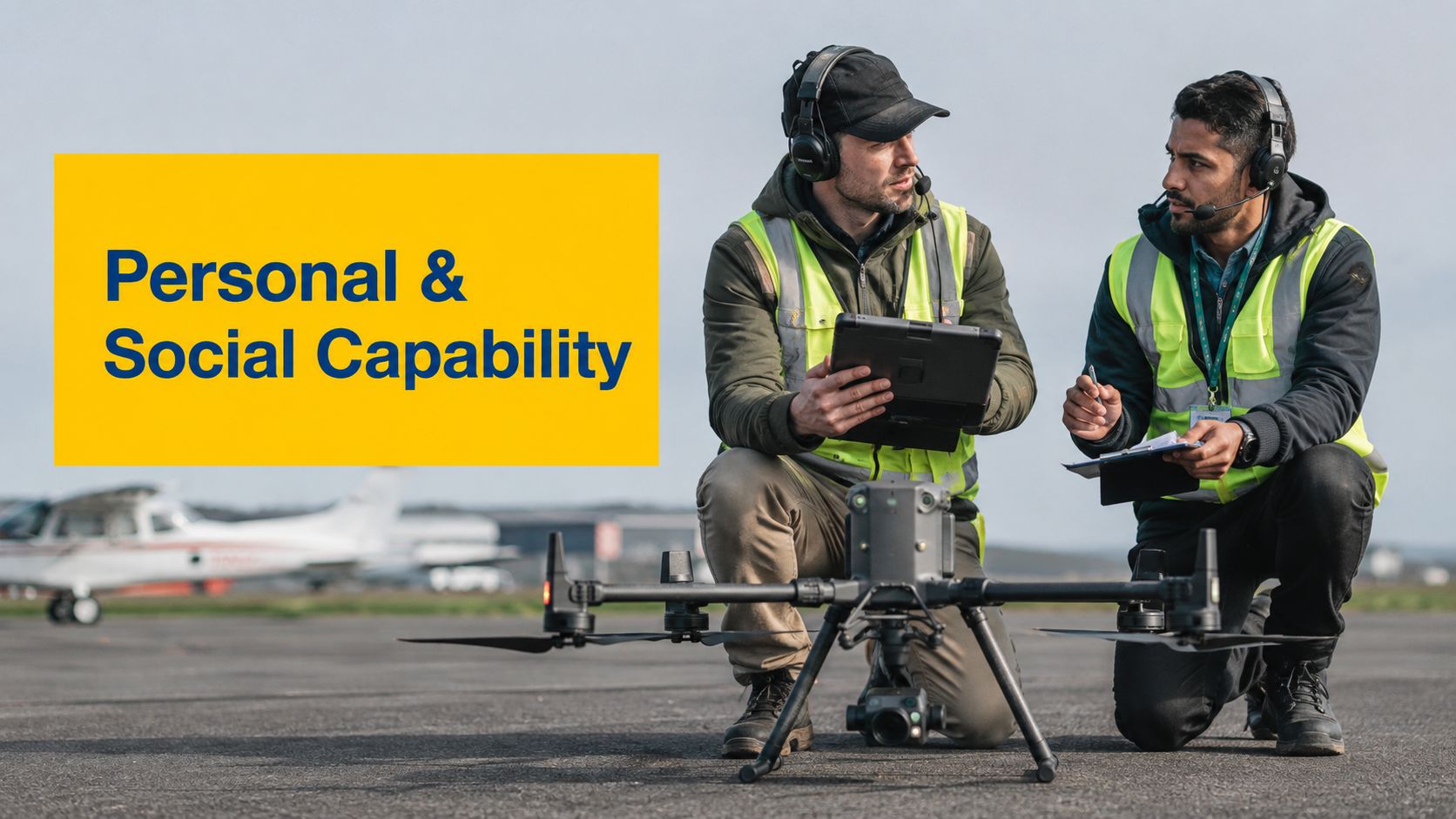
Drone work can expose these skills quickly. A RePL operator may work without a co-pilot to identify a blind spot, while a visual observer may be the only person who notices a change near the operating area. More complex operations, including those requiring additional approvals and coordination, demand accurate communication, controlled responses to pressure, and the judgement to stop when the plan no longer fits the conditions.
A structured introduction to drone fundamentals can help learners practise these habits before advanced training. The certificate III in aviation fundamentals can provide broader preparation, while ACE READY covers drone fundamentals, aviation safety, CASA regulations, flight operations, and preparation for advanced RePL training in Australia.
The four elements of personal and social capability explained
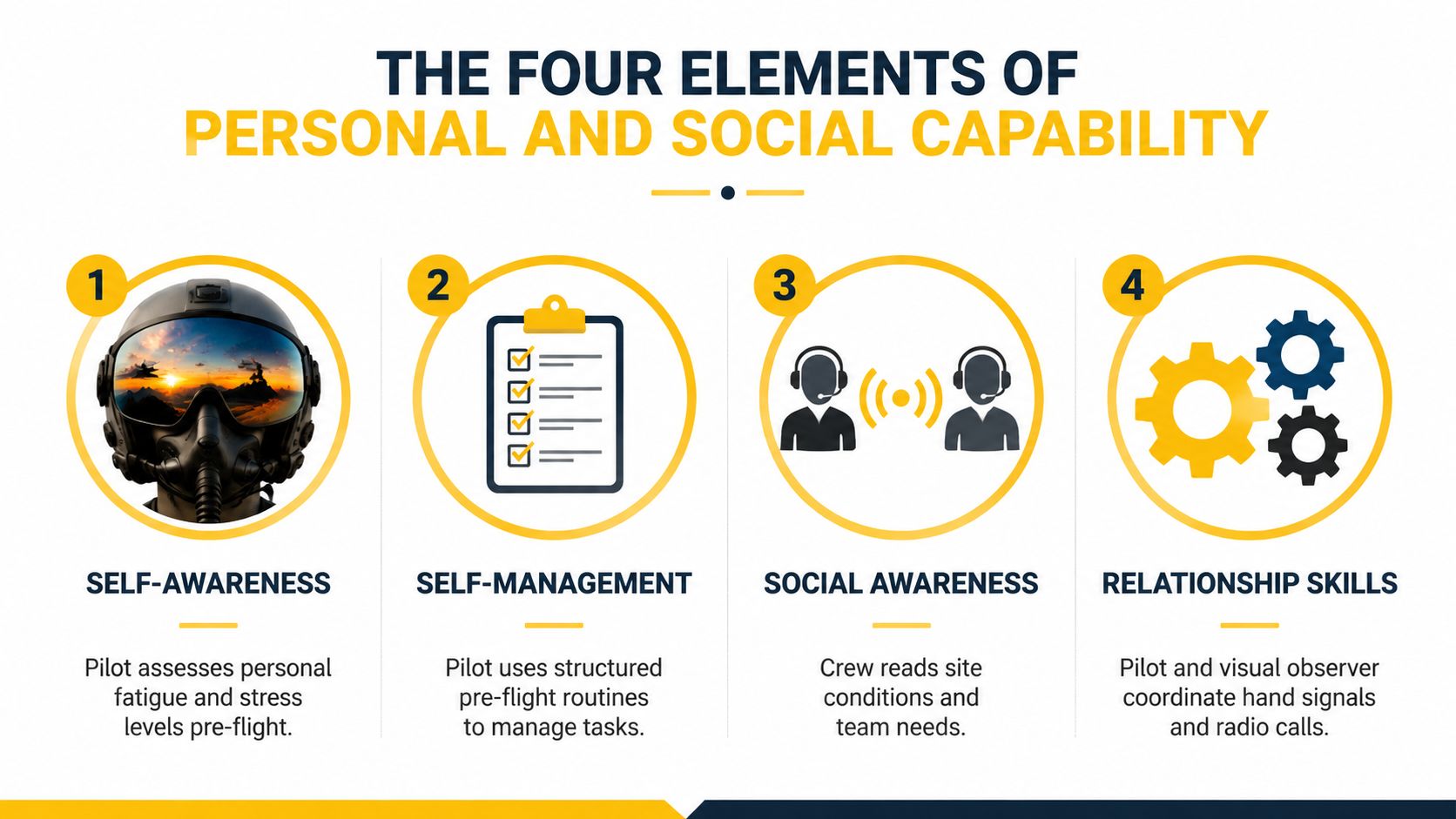
The four elements work together rather than operating as isolated personality traits. A pilot first notices what's happening internally, then manages the response, reads the people and environment around the operation, and coordinates action with others.
Self-awareness
A pilot arrives at a confined-space inspection and notices a rising pulse, shortened attention span, and an urge to launch quickly to prove readiness. Self-awareness doesn't mean eliminating nerves. It means identifying the signal before it affects judgement.
The useful cue is simple: notice the physical and mental state before touching the launch control. The pilot can then identify whether fatigue, anxiety, frustration, overconfidence, or unfamiliarity is influencing the plan.
Self-management
Self-management turns awareness into controlled action. A RePL student preparing for a client flight notices that a CASA NOTAM change affects the intended operating area. Instead of rushing to preserve the schedule, the student delays launch, checks the revised information, and confirms whether the operation remains appropriate.
The cue is a decision that protects the process from urgency. A pilot who can postpone, re-plan, or stop without becoming defensive is managing behaviour in service of safety.
Social awareness
Social awareness involves reading other people and the operating environment. At a rooftop site, the visual observer becomes hesitant when wind shifts across the structure. The observer may not yet have a complete explanation, but the hesitation is valuable information.
The cue is a change in another person's voice, posture, confidence, or response time. A capable pilot asks for clarification rather than dismissing the concern because the aircraft remains within the planned area.
Social management
Social management is the practical coordination of people, roles, and disagreement. During a mapping job, a pilot and payload operator may disagree about whether to prioritise image overlap or a return-to-home margin. They can resolve the issue by checking the approved plan, clarifying who has authority for the flight decision, and allocating tasks without personal criticism.
The cue is a clear exchange that leaves no uncertainty about who is doing what, who makes the decision, and how concerns are escalated. Personal and social capability becomes visible to the entire crew.
Learning outcomes connected to RePL and AROC training
Training should make capability observable. A student doesn't demonstrate self-management by describing it in general terms. The evidence appears in preparation, communication, decision-making, and response to changing conditions.
For RePL learners, the progression often begins with a personal check, moves into a structured operational behaviour, and ends with an assessment artefact such as a briefing, checklist, radio exchange, or scenario response. AROC training adds the discipline required to use VHF aviation radio frequencies where authorised, while ReOC systems provide the organisational setting for manuals, roles, and escalation pathways. Australian training commonly pairs the RePL with an AROC where required, because the AROC supports the use of VHF aviation radio frequencies and operations in controlled airspace when the necessary CASA approvals are also in place, as outlined by Swinburne University's AROC unit information.
| Capability outcome | RePL milestone | AROC / ReOC milestone |
|---|---|---|
| Recognise personal limits and changing stress | Complete a pre-flight METT briefing and confirm personal minimums before flight | Identify when a task should be escalated under the operator's procedures |
| Regulate behaviour under pressure | Apply battery, fuel, weather, and duty-time discipline during operational planning | Maintain consistent process compliance when schedules or clients create pressure |
| Read the needs of others and the environment | Conduct crew briefings, interpret NOTAM information with the team, and respond to observer cues | Coordinate roles through the operator's manual and confirm shared understanding |
| Manage communication and disagreement | Use clear task allocation and contingency language during flight preparation | Apply standard radio phraseology and follow conflict-resolution and escalation pathways |
From knowledge to demonstrated behaviour
A learner working through a METT briefing should identify more than weather and equipment. The process should also expose personal readiness, task complexity, and the points at which the operation needs another review. A personal minimums checklist gives the student a repeatable way to convert self-awareness into a launch decision.
Operational theory then gives self-management a technical shape. Battery planning, fuel discipline where relevant, duty-time awareness, and contingency preparation stop a pilot from treating the remaining margin as permission to continue. The assessment is not the checklist alone. It's the quality of the decision that follows it.
Visual observers and other crew members provide the social dimension. The pilot needs to brief them, listen to their reports, and interpret hand signals or radio calls without ambiguity. Training teams can use a training video generator from Trupeer Inc. to create scenario-based practice material for briefings and communication drills, provided the resulting content remains aligned with approved procedures and instructor oversight.
The organisational layer becomes more important as operations grow. The ultimate guide to ReOC operations in Australia can support learners who need to connect individual flight skills with operator responsibilities, documented procedures, and accountable roles.
Teamwork and communication in real drone operations
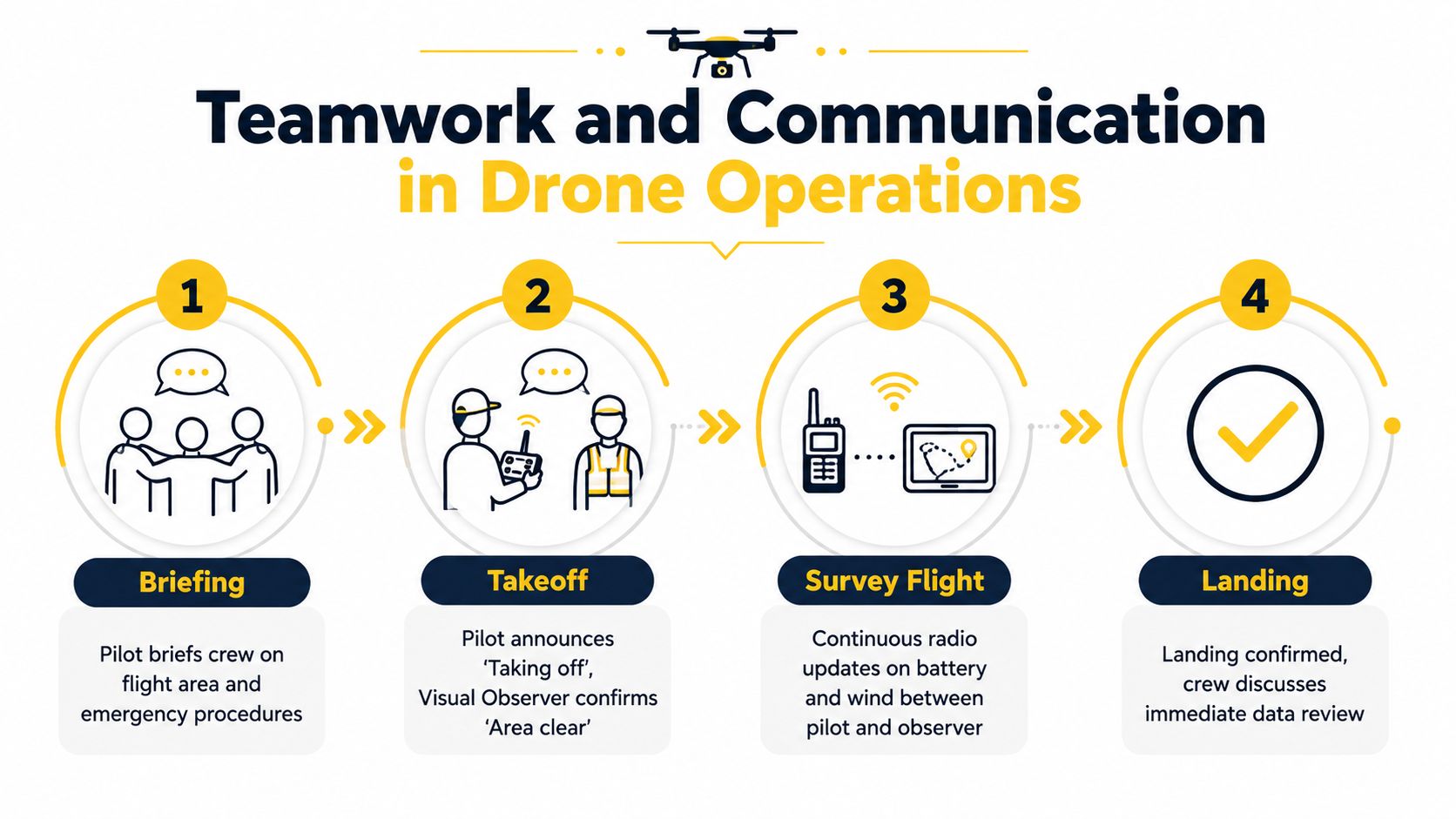
A survey crew begins with a short briefing. The remote pilot confirms the operating area, planned route, battery sequence, emergency actions, and the visual observer's responsibility. The site liaison confirms where workers and members of the public may move, while the observer identifies the position from which the aircraft can be monitored.
The launch call should be unambiguous. The pilot announces that the aircraft is taking off. The visual observer confirms that the area is clear. That exchange demonstrates self-management through a standard routine, social awareness through environmental scanning, and social management through a shared communication pattern.
When conditions change
Mid-flight, the wind shifts across a rooftop survey. The visual observer reports that the aircraft's movement appears less stable near the structure. The pilot doesn't need to defend the original plan. A calm response confirms the observation, checks the available margin, and selects the appropriate contingency.
The same principles apply during a battery swap. A disciplined crew confirms the aircraft state, the replacement battery, the flight segment, and the area around the launch point. A rushed handover creates uncertainty precisely when the operation needs shared attention.
Practical rule: Every important change should produce a clear call, a clear acknowledgement, and a clear owner for the next action.
A lost-link procedure also depends on social management. The pilot follows the approved response, the observer monitors the relevant area, and the site liaison keeps people away from the expected path where necessary. The crew shouldn't improvise competing instructions or assume that silence means agreement.
A multi-aircraft site adds another layer. Pilots need to coordinate launch windows, operating areas, traffic information, and deconfliction arrangements. Social awareness helps each pilot notice when another crew is uncertain or overloaded, while self-management prevents one team from extending its task into another team's operating space.
For teams strengthening these habits outside formal flight training, a practical guide to team communication challenges can help frame listening, role clarity, and disagreement as operational skills rather than personal shortcomings. Emergency planning should remain tied to aviation procedures, and operators can use the drone pilot emergency handbook as a reference point for structured preparation.
Solo mapping looks different but still requires communication. The pilot may have no verbal crew exchange during the flight, yet still needs disciplined contact with stakeholders, airspace managers, and nearby members of the public. In that setting, self-awareness and self-management replace some of the external checking that a crew would otherwise provide.
How personal and social capability supports aviation safety culture
A safety culture becomes credible when people can report concerns without hiding mistakes or protecting their image. Personal and social capability supports that culture at the individual level, while crew resource management provides the operational method for using it.
Self-awareness helps a pilot recognise when an error, distraction, or emotional reaction has affected performance. Self-management helps the pilot slow down before task saturation turns a manageable problem into a loss of control. Social awareness helps the crew identify threats that one person may overlook. Social management allows a visual observer, trainee, or site liaison to raise a concern and ensures the pilot responds constructively.
These behaviours align with the Australian Curriculum's description of capability as support for engaging with new ways of thinking, knowing, and doing in a demanding and diverse society. The curriculum also includes Level 1a to support students with disability in accessing age-equivalent content, reinforcing the idea that capability development should support universal participation rather than rely on one narrow communication style. The Australian Curriculum's detailed capability information provides the formal structure.
| Capability element | Aviation safety principle | Practical application |
|---|---|---|
| Self-awareness | Honest reporting and personal readiness | A pilot identifies fatigue, uncertainty, or stress before accepting a task |
| Self-management | Workload control and threat management | A pilot pauses, re-plans, or uses a contingency instead of allowing urgency to dictate action |
| Social awareness | Crew resource management | A pilot listens for concerns, reads environmental cues, and checks assumptions with the crew |
| Social management | Assertive communication and leadership | A pilot assigns roles, resolves disagreement, and gives clear escalation instructions |
From compliance to culture
CASA compliance establishes the legal and operational boundaries, but written procedures can't anticipate every human interaction on a worksite. A RePL holder still needs to decide how to respond when a client asks for an informal deviation, when an observer becomes uncertain, or when a schedule begins to dominate the conversation.
That's why instructors can assess more than aircraft handling. During aeronautical decision-making briefings and emergency scenarios, they can observe whether a learner identifies a problem, communicates it, accepts correction, and follows through. Those are non-technical behaviours with direct safety consequences.
A business building a documented operation should connect these behaviours to its procedures rather than placing them in a separate wellbeing programme. The drone safety guide for airports and HLS operations can help operators think about the interaction between airspace constraints, people on the ground, communication, and escalation.
Practical ways to build these capabilities every day
Capability improves through repetition and feedback. Instructors and learners can select one behaviour before each flight, observe it during the operation, and discuss it during the debrief.
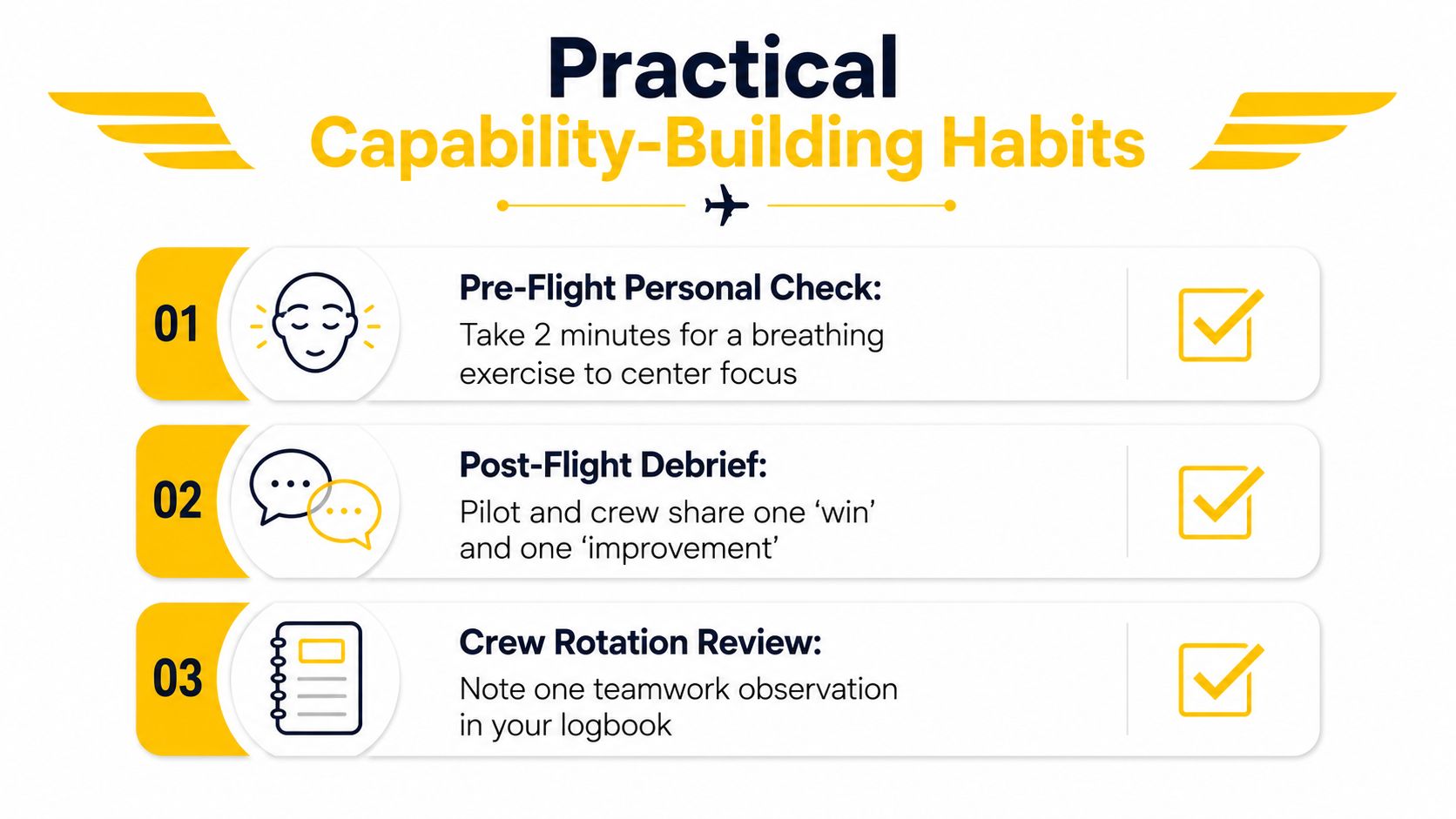
A short pre-flight personal check should ask whether the pilot is focused, rested, emotionally settled, and ready to stop if conditions change. The point isn't to produce a perfect state. It's to identify a condition that needs a control, such as a slower briefing, a second check, or a change of role.
Post-flight debriefs should be specific. The pilot and crew can identify one decision that supported the operation and one behaviour that needs improvement. A logbook entry can capture a single teamwork observation, such as whether the observer's concern was acknowledged promptly or whether the battery handover was clear.
A useful daily checklist includes:
- Self-awareness prompt: What internal signal might affect judgement today?
- Self-management trigger: What condition will cause the pilot to pause, return, or stop?
- Social awareness cue: What change in a person, site, or aircraft needs clarification?
- Social management practice: Which role, call, or escalation path must be confirmed before launch?
Common questions about personal and social capability in aviation
Does CASA treat these as formal RePL and ReOC requirements?
CASA licensing and operator obligations focus on safe, compliant operations, but safe performance also depends on communication, decision-making, workload control, and response to changing conditions. Instructors can connect personal and social capability to the behaviours demonstrated during training and scenario work without presenting the school framework as a separate CASA licence requirement.
How can enterprise drone teams use the capability?
Enterprise teams can build it into induction, crew briefings, role allocation, emergency exercises, and post-flight reviews. The four elements give managers a shared language for discussing hesitation, workload, communication, and escalation without reducing the conversation to personality.
Can instructors assess it alongside flight skills?
Yes. An instructor can observe whether a learner prepares consistently, identifies personal limits, listens to the visual observer, communicates a change, and accepts corrective feedback. These observations can sit alongside technical flight competencies and operational knowledge.
How can school experience transfer into aviation?
A learner can map group projects, leadership activities, sport, volunteering, or practical work onto aviation roles. The relevant question isn't whether the activity involved aircraft. It's whether the learner can recognise limits, manage tasks, read a team, and communicate clearly when the plan changes.
Further questions about training pathways and aviation education can be directed to the Ace Aviation Aerospace Academy FAQ.
Ace Aviation Aerospace Academy offers training relevant to these capabilities, including the Remote Pilot Licence, Aeronautical Radio Operator Certificate, Certificate III in Aviation, ReOC Consulting, Enterprise Drone Training, and Corporate Drone Training. Readers can explore the training pathways and practical aviation education available through Ace Aviation Aerospace Academy.