
A new commercial drone operator has competing training quotes open on a laptop. One looks affordable; the other includes practical instruction, assessment and equipment, but neither makes the final cost obvious. The sensible decision isn't to choose the cheaper total. It's to establish what each provider will deliver, what remains payable, and whether the training matches the intended operation.
Table of Contents
- Why Aviation Training Cost Is Hard to Read at a Glance
- The Anatomy of an Aviation Training Quote
- Comparing the Main Pathways a Buyer Will Encounter
- What Actually Moves the Price Up or Down
- A Worked Example of Training Spend Turning Into Revenue
- Financing Options for Australian Aviation Students
- A Short Budgeting Checklist Before You Enrol
- Frequently Asked Questions
Why Aviation Training Cost Is Hard to Read at a Glance
Aviation training cost is a delivery problem before it's a pricing problem. A learner isn't buying classroom access. The purchase may include instruction, supervised practice, competency assessment, licence administration and the resources needed to deliver those activities safely.
Providers can package those components differently. A bundled course and a tuition-only quotation may look like direct competitors even when their inclusions are materially different. Comparing them without checking scope produces a misleading result.
Start with the operational outcome
The first question should be what the applicant intends to do after training. A beginner learning drone fundamentals, an agricultural contractor preparing for commercial work and an organisation developing its own operating procedures have different requirements.
The useful comparison separates:
- The training outcome: A licence, vocational qualification, introductory course or organisational compliance service.
- The delivery commitment: Theory access, practical instruction, assessment and administrative support.
- The learner's additional spending: Equipment, travel, accommodation and medical requirements where applicable.
- The operational budget: Procedures, ongoing competency and other preparation needed after course completion.
A quote that doesn't identify its endpoint is incomplete. Course attendance, successful assessment, licence issue and readiness to deliver a particular commercial service shouldn't be treated as interchangeable outcomes.
Practical rule: Compare quotations at the same endpoint, not merely at the same advertised course name.
Separate training from business readiness
A provider may deliver the agreed training correctly while leaving the graduate with further business expenses. That isn't necessarily a hidden fee. It becomes a problem when the applicant assumes the course includes everything needed to begin work.
The strongest purchasing approach uses separate budgets for qualification completion and commercial deployment. Each expense should have a clear owner: the training provider, the student or the employing organisation. That makes omissions visible before enrolment rather than after the training budget has been committed.
The Anatomy of an Aviation Training Quote
A defensible quotation explains what the learner receives and how completion is assessed. An attractive total without those details isn't enough to approve expenditure.
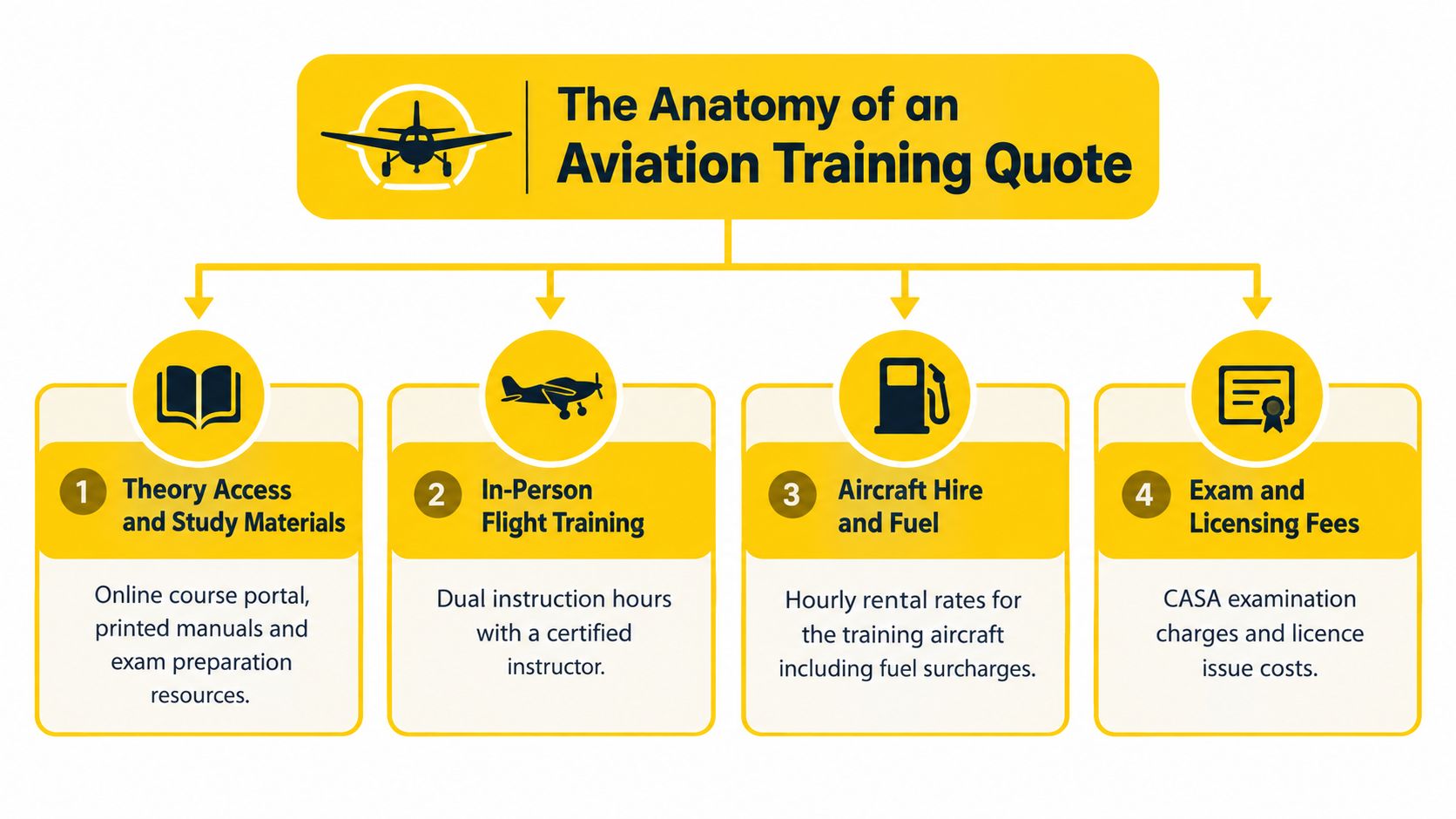
The major components can be grouped visually, but buyers should request a more detailed written breakdown.
What the tuition component buys
Theory access may include a learning portal, manuals, instructor-led sessions and examination preparation. The quote should identify access duration, included materials and the support available when a learner needs clarification.
For a Remote Pilot Licence, CASA's student guidance describes training as generally taking about five days, with three days of theory and two days of practical training; theory may sometimes be online, but the examination and practical training must occur in person, and applicants must log five hours of drone flying under standard operating conditions after passing the assessments, as outlined in the CASA student drone guide.
Online theory therefore doesn't make the entire pathway remote. The learner still needs a workable plan for attendance, practical completion and assessment.
What practical delivery and assessment buy
CASA requires RePL training to cover aeronautical knowledge, practical competency, examination, flight testing and administration, delivered by a provider holding an ReOC authorising remote-pilot training, according to its remote-pilot training provider requirements.
That delivery requires more than access to a drone. The provider must organise instructors, aircraft, suitable operating areas, safety supervision and competency assessment.
| Quote component | What the buyer should establish |
|---|---|
| Practical instruction | Included supervised practice, individual flight access and instructor support |
| Aircraft or drone use | Hire inclusions, batteries or fuel, and responsibility for damage |
| Assessment | Examination, flight test, booking and reassessment charges |
| Administration | Provider processing charges versus any separate CASA charges |
| Equipment and insurance | Supplied equipment, required personal purchases and applicable excesses |
| Remedial training | The charging method if additional instruction is needed |
A flight test conducted through a training provider shouldn't automatically be described as a CASA examination booking fee. The quotation should name the assessment and the organisation collecting the charge.
Applicants can use the training quote calculator to organise an initial enquiry, then request written confirmation of every inclusion. A calculator estimate isn't a substitute for the provider's final scope and terms.
Comparing the Main Pathways a Buyer Will Encounter
The main pathways address different needs. Buying the wrong credential cheaply is still a poor purchasing decision, particularly when the intended work requires additional competency or organisational preparation.
Licences, radio training and operator systems
Remote Pilot Licence training addresses remote-pilot competency within the CASA licensing pathway. It shouldn't be priced as though it also establishes an entire drone business.
Aeronautical Radio Operator Certificate training concerns aviation radio operation. Buyers planning work around controlled or busy airspace should establish whether radio qualifications are relevant to their proposed activities. An AROC shouldn't be treated as permission to enter controlled airspace or conduct an otherwise unauthorised operation.
ReOC consulting serves a different buyer: an organisation preparing its operator certificate application and documented procedures. Its scope should distinguish application assistance, procedure development, staff responsibilities and any ongoing support. Consulting doesn't replace pilot training or guarantee approval.
Vocational qualifications and conventional aviation
The AVI30419 Certificate III in Aviation (Remote Pilot) requires a minimum of 14 units of competency, comprising 9 core units, 2 general electives, at least 1 specialist elective and at least 2 operation-type electives, under the cited remote-pilot qualification packaging rules.
The selected units matter. Buyers should ask which operational skills are assessed, rather than assuming every Certificate III offers identical content or that vocational enrolment automatically includes a particular licensing outcome.
Pathway comparison at a glance
| Pathway | Typical Australian price band | What it actually buys |
|---|---|---|
| RePL | Provider-specific; an itemised quote is required | Remote-pilot training and assessment within the specified scope |
| AROC | Provider-specific; check whether bundled or separate | Aviation radio training and certification |
| Certificate III in Aviation (Remote Pilot) | Qualification-specific; no defensible national range is available here | Assessment across the selected vocational competencies |
| ReOC consulting | Scope-dependent organisational expenditure | Application and documented-system assistance |
| CPL or Bachelor of Aviation | Substantial expenditure measured in tens of thousands of dollars or more, depending on pathway | Conventional pilot training, with academic study where included |
These aren't interchangeable price bands. Conventional aviation involves a different aircraft-training commitment; it shouldn't be confused with a short remote-pilot pathway.
The aviation course catalogue provides an option for comparing course categories. For beginners, ACE READY covers drone fundamentals, aviation safety, CASA regulations and flight operations, with preparation for advanced RePL training. It's an introductory pathway, not a substitute for the advanced training it prepares students to undertake.
What Actually Moves the Price Up or Down
The cheapest headline price isn't necessarily the lowest completion cost. The relevant comparison is the amount needed to reach the agreed competency outcome, including foreseeable extra instruction and attendance expenses.
The price drivers below are useful prompts for enquiries. Their actual effect should be checked against the provider's delivery arrangements rather than assumed from location or aircraft appearance alone.

Delivery choices that change the budget
A regional learner may save on tuition but spend more reaching the practical venue. A business enrolling staff must also account for time away from normal duties. Neither expense appears automatically on the school's invoice.
Instructor-to-student ratios deserve close attention. Group size alone doesn't establish value; buyers need to know how practical access is allocated and how much direct supervision each learner receives.
- Location and scheduling: Compare the complete attendance cost, including travel and accommodation, and establish what happens after cancellations.
- Equipment allocation: Confirm whether practical equipment is supplied and whether training matches the intended aircraft or operational context.
- Delivery mode: Online theory may reduce attendance commitments, but the practical obligations remain.
- Completion assumptions: Establish how the provider charges for extra practice, an unsuccessful assessment or a return visit.
A more expensive course can be better value when it includes the practical access and completion support excluded from a cheaper offer.
Keep the conventional aviation benchmark in perspective
The federal Expert Panel on Aviation Skills and Training reported in 2018 that graduates needed at least AUD 100,000 for minimum industry-entry qualifications; its Bachelor of Aviation example produced a minimum indicative education-related burden of AUD 132,563, excluding living, travel and accommodation costs, while the AUD 102,392 FEE-HELP limit was insufficient for all licences and ratings needed by many students, according to the Expert Panel's aviation skills and training report.
Those are historical benchmarks, not current quotations. They demonstrate why aircraft-based professional training and remote-pilot education shouldn't be compared as equivalent purchases.
Drone buyers face a smaller direct flight-training commitment, but organisations still need to assess recurrent competency and procedure-management expenditure. Applicants considering the Certificate III in Aviation pathway should request the selected units, delivery arrangements and licensing inclusions before comparing its price with a standalone RePL course.
A Worked Example of Training Spend Turning Into Revenue
Consider a hypothetical Australian agricultural-services business preparing a drone capability for mapping, spraying and inspection contracts. The business plans RePL training for two pilots, considers AROC training for relevant radio duties, and seeks ReOC consulting for its proposed operating structure. This is a budgeting example, not a reported client result.
The operational setting helps explain why staff training and business preparation belong in the same investment decision.

Build the budget around deliverable work
The business should first define the services it can realistically sell and deliver. Mapping, spraying and inspection shouldn't be assumed to have identical aircraft, competency or approval requirements. The team must establish the applicable requirements for each proposed activity before accepting contracts.
Training belongs in the establishment budget alongside procedure development and any necessary equipment preparation. Job-specific travel, consumables, processing and labour belong in the delivery budget.
The useful calculation is:
Commercial test: Training payback depends on the establishment expenditure divided by the contribution remaining from completed work after delivery costs.
Revenue alone is a weak measure. A contract can produce substantial invoicing while leaving little money available to recover the initial investment.
Allocate costs without overstating the return
The business can allocate training and consulting expenditure across expected first-season work for internal budgeting. That allocation isn't proof that the investment will pay for itself during the season, and it isn't advice about accounting or tax treatment.
An additional pilot may require individual training, assessment and familiarisation even when the organisation already has procedures in place. The marginal cost therefore differs from the original establishment cost.
- Use confirmed demand: Separate contracted work from enquiries and speculative opportunities.
- Include deployment time: Allow for staff preparation and the period before services can be delivered.
- Test contribution: Use job income after direct operating costs, not gross revenue.
- Match skills to services: Fund training that supports the proposed work rather than collecting unrelated credentials.
The drone pilot careers and Certificate III discussion provides context for aligning education with a work direction. The investment decision should still rest on the business's own contracts, capability and operating margins.
Financing Options for Australian Aviation Students
Funding availability and course affordability are separate questions. A loan may make enrolment possible without covering the full pathway, and a payment plan may spread expenditure without reducing it.
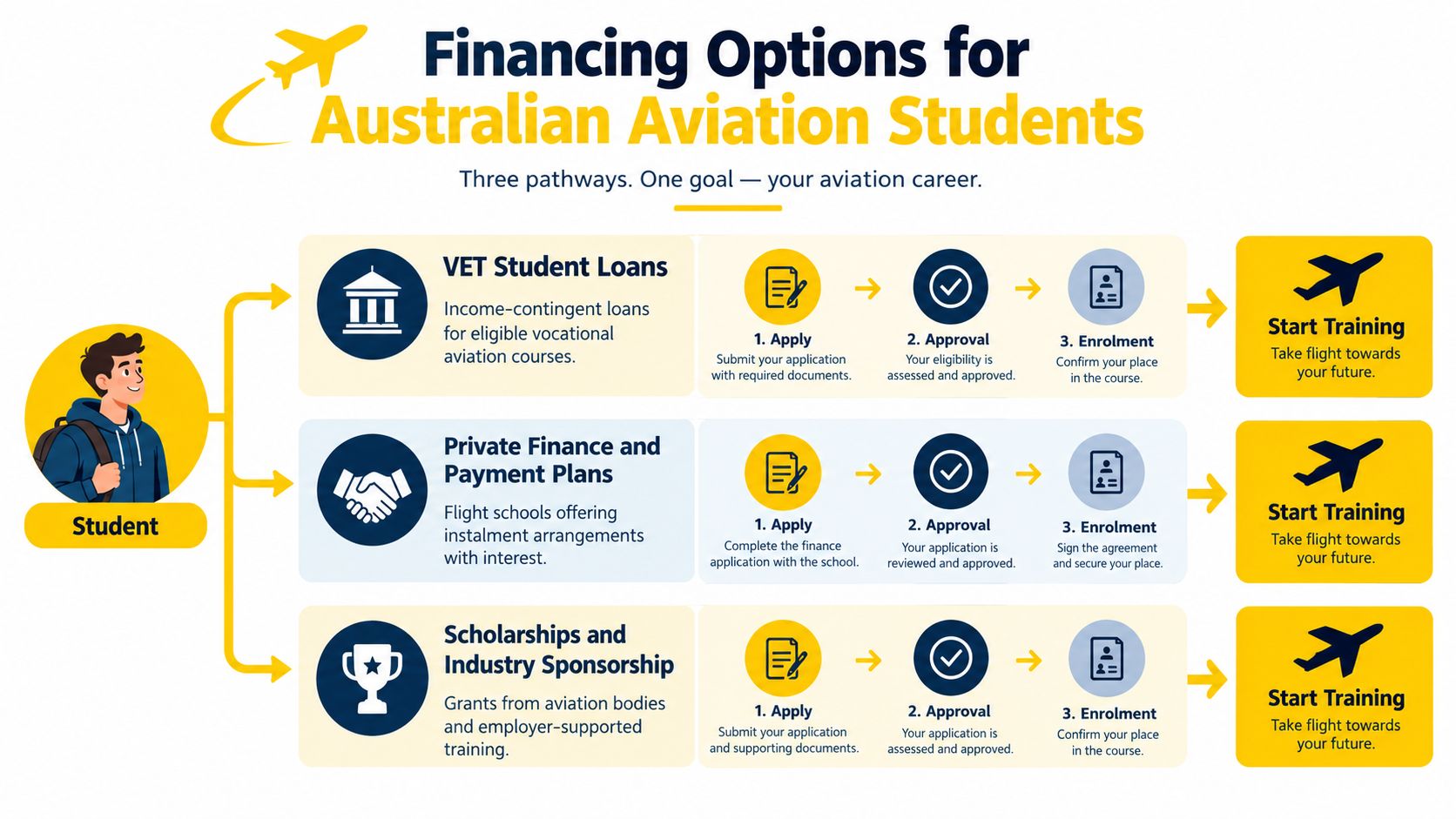
The financing routes below should be treated as options to investigate, not evidence that a particular applicant or course qualifies.
Confirm assistance before committing
For vocational aviation study, applicants should ask whether VET Student Loans apply to the exact course and provider, what eligibility conditions apply, and which expenses remain outside the funded amount. National recognition alone shouldn't be treated as confirmation of loan access.
The Commonwealth Ombudsman identified commercial pilot training costs of up to AUD 90,000 and a Diploma of Aviation funding maximum of AUD 90,497 as at 1 January 2024, in its aviation courses issues paper. A funding maximum isn't a current course quote, an individual entitlement or a guarantee that ancillary expenses are covered.
Higher-education applicants should similarly verify FEE-HELP eligibility, their available balance and the current applicable limit. The historical funding gap identified earlier is a warning to budget the entire pathway, not evidence of today's loan settings.
Plan for the unfunded portion
Short drone-course applicants shouldn't assume access to government student lending. The provider should confirm assistance for the specific enrolment before the applicant relies on it.
Other avenues worth investigating include:
- State-based assistance: Confirm current availability and applicant eligibility in writing.
- Provider instalments or private finance: Check interest, fees, payment dates and withdrawal obligations.
- Employer sponsorship: Agree which costs the business pays and whether repayment conditions apply.
- Scholarships: Treat assistance as available only after an award is confirmed.
For repayable finance, Toya AI's guide on how to estimate loan payments can help applicants organise repayment scenarios. Australian government income-contingent lending should be assessed under its own rules, not treated as an ordinary fixed-instalment loan.
Businesses should also test whether training can be funded from operational cashflow without compromising equipment purchases or contract delivery.
A Short Budgeting Checklist Before You Enrol
An enrolment decision should leave a written record of the training scope, exclusions and payment obligations. A verbal assurance that the course covers every required topic isn't enough for a student, procurement officer or business owner approving expenditure.
The quotation verification sheet
- Theory and materials: Confirm learning access, manuals, instructor support and any separate resource purchases.
- Practical allocation: Obtain the included supervised training arrangements and equipment access.
- Assessment and administration: Identify examination, flight-test, booking, licence-processing and reassessment inclusions.
- Equipment and insurance: Establish supplied items, required purchases, damage responsibilities and applicable excesses.
- Additional instruction: Request the charging method and approval process for remedial training.
- Attendance expenses: Budget travel, accommodation and time away from work.
- Qualification scope: Confirm the exact award, selected units where relevant, and any excluded licensing outcome.
- Payment and withdrawal: Check deposits, due dates, cancellation arrangements and refund conditions.
Protect the completion budget
Applicants should keep committed tuition separate from money reserved for completion-related expenses. The Money Maniac's envelope budgeting system comparison offers a useful way to consider allocating funds by category without treating every available dollar as spendable course money.
Before payment, applicants should read the relevant provider terms, including the terms and refund policy, and resolve unclear inclusions in writing. Refund arrangements deserve the same attention as the advertised price.
The conclusion is straightforward: a defensible aviation training budget identifies the intended outcome, itemises delivery and retains funds for confirmed exclusions. A low price becomes useful only when the buyer knows what completion will require.
Frequently Asked Questions
How soon does commercial drone training pay for itself?
There's no fixed payback period. It depends on completed work and contribution after delivery costs.
Which fees are easiest to overlook?
Reassessment, additional instruction, equipment, travel and administration charges deserve explicit checks.
Is an RePL alone enough for paid drone work?
No. CASA requires business-use drone registration and operator accreditation or an RePL, even below 250 grams, with further conditions for ReOC operations, as recorded in the business-use drone requirements.
Why can Certificate III pricing differ from RePL pricing?
A Certificate III covers assessed vocational units; an RePL addresses licensing competency. Buyers must compare scope and inclusions.
Ace Aviation Aerospace Academy offers RePL and AROC training, aviation qualifications and ReOC consulting for individual and organisational pathways. Prospective students and business teams can visit Ace Aviation Aerospace Academy to discuss the intended operation and request an itemised training scope before committing a budget.