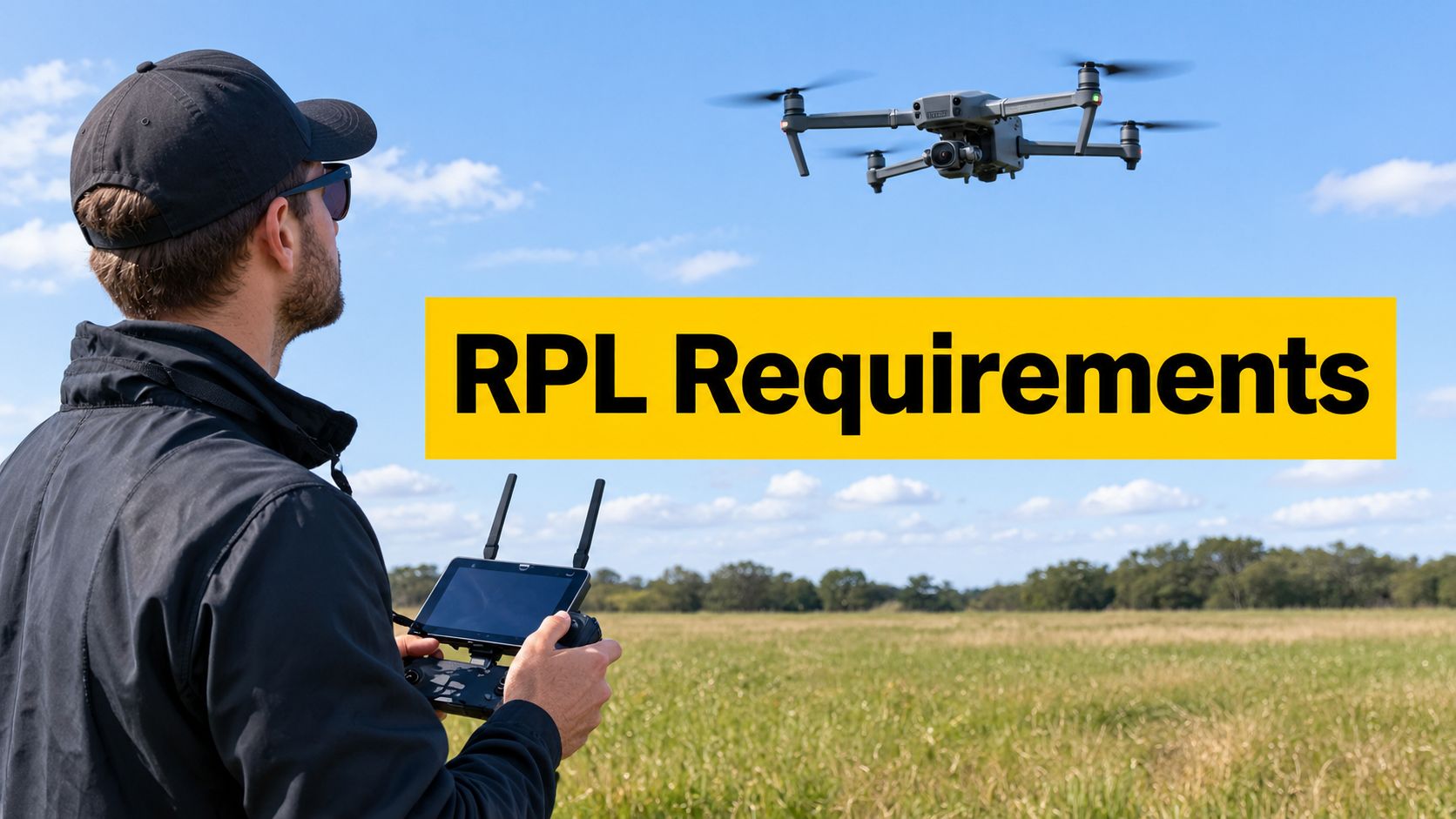
The quickest way to get RPL requirements wrong is to assume every drone job needs the same paperwork. In Australia, the licensing question changes with the aircraft's weight, where it's flown, and whether the operation is commercial or recreational, so a pilot can waste weeks preparing for the wrong pathway.
That confusion is common because holding an RePL is not the same as being cleared for commercial work. CASA's framework separates the pilot, the aircraft category, and the operating business, which means the right answer depends on how those pieces fit together. A careful read of the rules saves time, money, and a lot of backtracking later.
Table of Contents
- Who Needs an RePL Under CASA Rules
- Eligibility, Age and Document Requirements Before You Enrol
- The Structure of a CASA-Compliant RePL Training Course
- Theory Exam and Practical Flight Test Explained
- Logbook, Application and What CASA Audits Later
- Choosing a Training Provider and Avoiding Common Pitfalls
- From the RePL to a Commercial Drone Career
Who Needs an RePL Under CASA Rules
A pilot trying to work out whether they need a licence usually starts with the wrong question. The better question is what kind of operation is planned, what aircraft is being flown, and where the flight will happen. Get that part wrong, and the rest of the paperwork can be unnecessary or incomplete.

The licensing line in plain English
A Remote Pilot Licence is generally required when a pilot operates for a business or individual holding a Remotely Piloted Aircraft Operator's Certificate (ReOC), and for pilots operating a remotely piloted aircraft above 25 kg and below 150 kg over their own land, according to CASA's published guidance on Remote Pilot Licence requirements. It is generally not required for recreational flying, micro RPAs weighing 250 g or less, or certain excluded-category operations, including some aircraft above 250 g and up to 25 kg when flown over the operator's own land. The operating context matters as much as the drone itself.
A media pilot using a sub-2 kg aircraft for hobby flying can fall outside the RePL framework if the flight remains recreational and within the applicable conditions. An agricultural operator planning to fly a 30 kg spray drone faces a very different answer because the weight and operation place the work inside the licensing pathway. The same aircraft can sit in different parts of the rules depending on why it is flown and under what authority.
Practical rule: if the flight is for business, check the operator certificate and aircraft weight before you choose a course.
RePL on its own is not commercial authorisation
A licence alone does not create a commercial right to fly. CASA's framework generally expects the business to hold a ReOC, the pilot to hold the appropriate RePL, and any required flight approval or permission to be in place before the operation begins. For medium aircraft flown over private land in the relevant excluded category, CASA identifies a specific exception from the ReOC requirement, but the pilot still needs the right RePL for the aircraft type and model.
That distinction matters because many people treat the licence as the finish line. It is only one part of a wider set of conditions that also covers the operating organisation, the flight environment, and the aircraft category. A company cannot assume a licensed pilot automatically covers every commercial task on its roster.
For readers comparing excluded-category work with full commercial operations, the excluded-category drone operations guide is a useful companion. It shows why some pilots can work legally without following the same pathway required for larger or more complex jobs.
Eligibility, Age and Document Requirements Before You Enrol
The enrolment stage is where a lot of applicants slow down, not because the rules are complex, but because they arrive without the basics ready. Training providers and CASA both need enough information to confirm identity, eligibility, and the right pathway before the course starts. A smooth application usually comes down to preparation.
What has to be in place first
For sub-25 kg operations, CASA's rules use a minimum age of 16. Pilots intending to fly aircraft between 25 kg and 150 kg face a higher threshold and medical expectations that are more demanding than the standard recreational pathway. English-language proficiency also matters across Australian aviation licences, because pilots need to understand instructions, manuals, assessments, and operational briefings clearly.
An Aviation Reference Number (ARN) is mandatory because it links the candidate to CASA's systems and is used throughout the application process. That number should be in place before enrolment or at least before the formal application stage, because it becomes the reference point for records, assessment outcomes, and any later verification. For international students or interstate applicants, proof of identity and residency status may also be requested alongside the training provider's own enrolment documents.
The documents most candidates should prepare
Before booking a date, a candidate should have the following ready:
- Proof of identity, so the training provider can match the applicant to the correct record.
- ARN details, because without them the CASA application can stall.
- Residency or visa evidence, where the provider or the training pathway asks for it.
- Any existing aviation records, if the candidate has prior flying or related qualifications.
- Medical documentation, if the intended aircraft category or operation triggers a medical expectation.
CASA's medical and language expectations are not paperwork for paperwork's sake, they're there because pilots need to make correct decisions under pressure.
Readers who want a quick way to match their current situation to a likely pathway can use the licence finder tool before enrolling. It's a simple way to avoid paying for a course that doesn't line up with the intended operation.
The Structure of a CASA-Compliant RePL Training Course
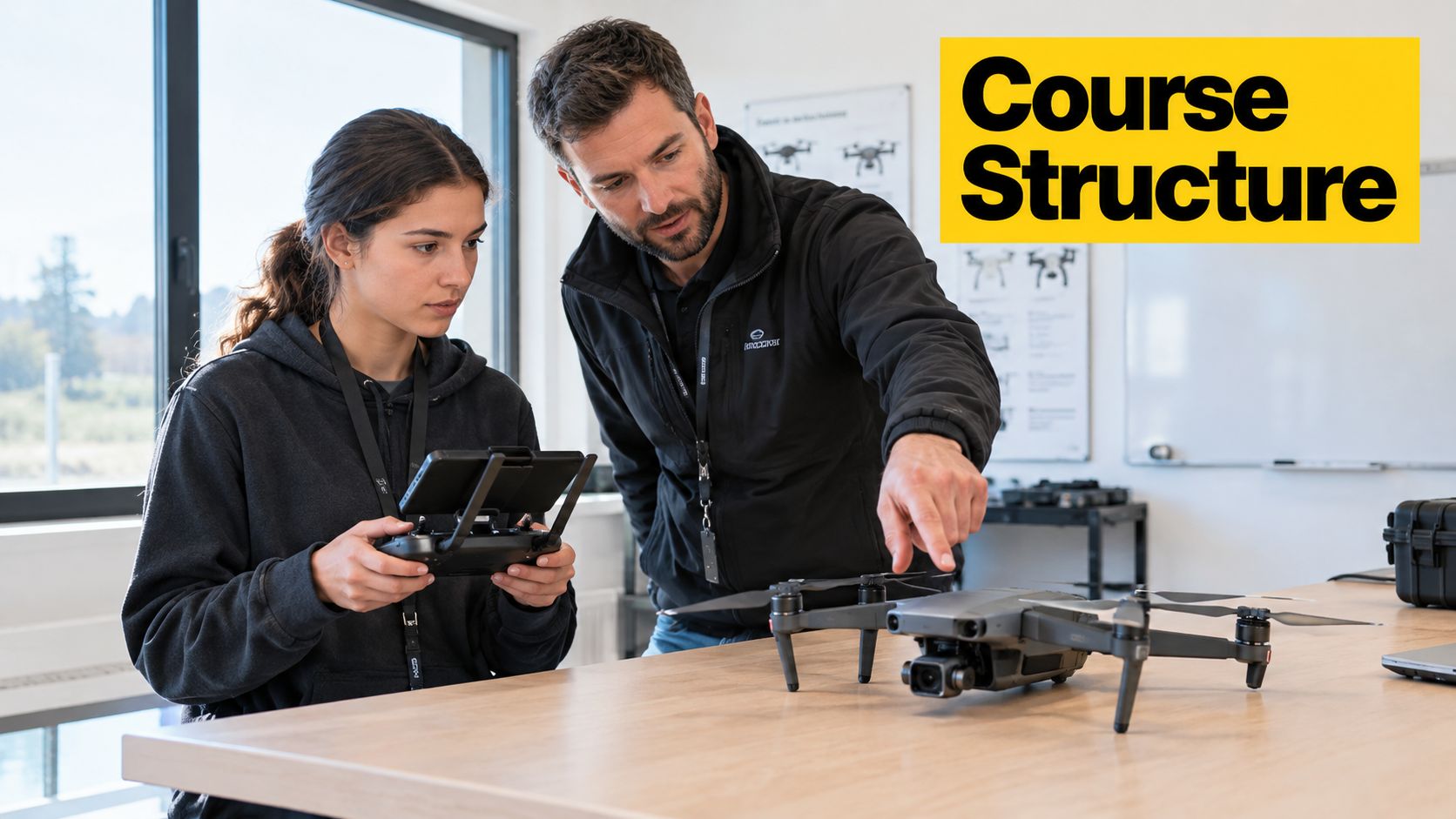
A legitimate RePL course is not just a workbook and a payment receipt. CASA only allows RePL training to be delivered by an organisation certified under regulation 101.335 of the Civil Aviation Safety Regulations and authorised to conduct training, and the course must comply with Chapter 2 of the Part 101 Manual of Standards. That framework is what keeps one provider's course equivalent to another's.
What a compliant provider must have
A proper provider must hold, or vary, a ReOC authorising remote-pilot training and nominate a chief remote instructor in addition to a chief remote pilot. CASA's requirements also cover aeronautical knowledge standards, practical competency standards, aeronautical knowledge examination, flight testing, and administrative records. A course page should make those points easy to verify, and a reader comparing options can start with the list of CASA-compliant RePL training courses.
The aeronautical knowledge component requires at least 15 hours of instructor contact time in the applicable pathway, followed by the practical elements for the relevant RPA. Those hours are not a casual estimate. They form part of the regulated pathway that supports a candidate's knowledge before any assessment outcome is issued under the approved process, as set out in the legislation at the Part 101 training requirements.
A candidate should be cautious with phrases like “CASA-approved certificate”. That phrase can sound convincing while telling the reader very little about whether the training meets the RePL standards. The better question is whether the organisation is certified and authorised to deliver the regulated course, not whether its brochure sounds official.
What a proper week of training looks like
A compliant syllabus usually includes ground school, instructor briefings, practical drills, and supervised flight work. A candidate might spend one day on air law and meteorology, another on navigation and operational planning, then move into simulated exercises before live-flight practice under supervision. That sequence lets the instructor see whether the candidate can apply knowledge, not just recite it.
The academy model also matters. ACE READY is an entry-level drone training course for beginners that covers drone fundamentals, aviation safety, CASA regulations, flight operations, and preparation for advanced RePL training in Australia. For a reader who is still early in the pathway, that kind of structured preparation can make the later assessment stage less abstract.
A provider's course page should make it clear whether it includes supervised practical competency, assessment against the relevant standards, and evidence collection for the candidate's file. If those elements are missing, the course may be useful for awareness, but it is not enough on its own for RePL purposes.
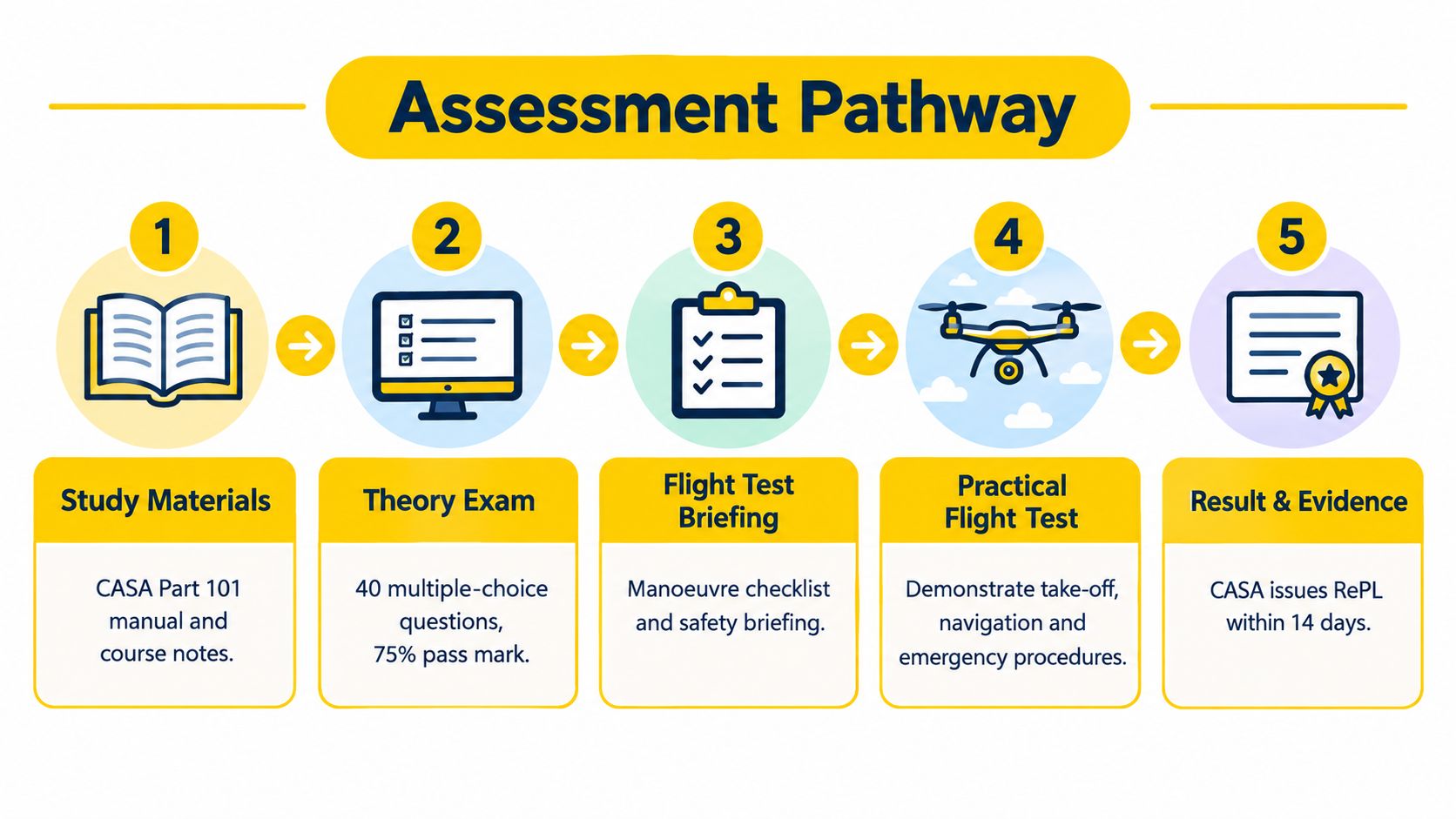
Theory Exam and Practical Flight Test Explained
The assessment phase is where many candidates find out whether they've learned the material or only recognised familiar words on a page. CASA's process splits knowledge and skill into separate checks, and each one answers a different question. A good candidate prepares for both rather than treating them as one combined hurdle.
What the theory exam is measuring
The closed-book aeronautical knowledge examination tests the candidate's understanding of air law, meteorology, navigation, RPA technical principles, operations, and human performance. It's not a memory quiz in the casual sense, because the questions are built to show whether the pilot understands the operating environment and can make safe decisions under pressure. The candidate needs to know the rules well enough to apply them without notes.
The exam format and pass mark should be confirmed with the training provider before the assessment date, because candidates often assume every course handles the testing the same way. They don't. The important part is that the theory assessment checks whether the candidate can interpret conditions, understand limitations, and link the regulations to an actual flight task.
Exam advice: use your notes to practise scenarios, not just definitions. Most mistakes come from misunderstanding the situation, not forgetting a single term.
What the flight test is actually checking
The practical flight test measures whether the candidate can handle the aircraft safely and consistently against the competency standards for the specific RPA category and model. Examiners look for control, planning, normal procedures, and responses to abnormal or emergency situations. That means a candidate needs to show more than take-off and landing.
The aircraft used for training can create confusion here. An operator in agriculture, mapping, or inspection work may eventually fly a different aircraft, with different payloads, automation features, and risk considerations from the training drone. That's why category and model competency matter, especially where the operational aircraft doesn't match the practice aircraft one-for-one.
A practical way to organise the test day paperwork is to scan and save it as a single file set. A guide on how to turn paper into PDF files can help keep briefs, notes, and assessment evidence in one place so nothing goes missing between the course and the application.
Logbook, Application and What CASA Audits Later
Passing the assessments is important, but the evidence trail doesn't stop there. Many pilots discover the weak point in their file only after an operator audit, when a missing log entry or incomplete assessment record becomes a problem. Good records are part of compliance, not an optional extra.
What has to be recorded after the test
CASA guidance says applicants need to log 5 hours of RPA flying under standard operating conditions. That logbook evidence should show supervised and solo flying correctly, with the flights recorded in a way that supports the claimed competency. The application then goes through myCASA using the candidate's ARN, which ties the training and assessment record back to the correct person.
The files worth keeping are the ones CASA may ask for later during an audit or when reviewing a ReOC holder's pilots. That includes the course completion certificate, the examination result, the flight test report, the logbook, and any category or model endorsements. If a candidate later works for an operator, those documents can be the difference between a smooth audit and a paperwork scramble.
Documents to keep after completing the RePL
| Document | Purpose | Retain For |
|---|---|---|
| Course completion certificate | Shows completion of the approved training pathway | Indefinitely |
| Theory exam result | Confirms knowledge assessment outcome | Indefinitely |
| Flight test report | Evidence of practical competency against the relevant standards | Indefinitely |
| Logbook | Records flying experience, supervised and solo | Indefinitely |
| Category or model endorsement records | Shows the aircraft type or model competency | Indefinitely |
A pilot with a clean digital logbook can usually answer audit questions quickly. A pilot with gaps in a spreadsheet may still be competent, but the operator has to spend time reconstructing what should already be obvious. That delay is exactly why the paperwork matters from the beginning.
For readers who want to see how RePL evidence fits into the broader commercial framework, the ReOC guide is the logical next step.
Choosing a Training Provider and Avoiding Common Pitfalls
A provider can look polished and still leave a student with weak evidence. Before comparing dates or price, check whether the training path produces documentation that will stand up later if CASA or an operator asks how the licence was earned. That is where many problems start.

What to verify before paying a deposit
A serious candidate should confirm that the provider:
- Holds an active ReOC if remote-pilot training is being delivered under that structure.
- Has 101.335 authorisation for the training activity.
- Names a chief remote instructor, not only a sales contact.
- Uses Chapter 2 of the Part 101 Manual of Standards as the course basis.
- Includes supervised practical competency, not theory-only delivery.
Those checks matter because a certificate that looks tidy on paper may still sit outside the regulated pathway. The same caution applies to aircraft category. If the work will involve agriculture, inspection, or another specialist task, the training drone should match the aircraft type the student expects to use.
Common misunderstandings that create trouble later
A common mistake is assuming a RePL covers every drone. It does not. The licence is tied to the aircraft category and the privileges attached to it, so moving to a different class or model may require more competency evidence. Another mistake is mixing up the drone licence with the AROC, which is a separate aviation radio qualification.
For commercial work that involves radio use beyond basic line-of-sight communication, the AROC should be planned alongside the RePL pathway, not treated as an afterthought. A broader training option can also help when a student wants more than the licence alone. ACE PLATINUM is a complete enterprise drone training package that includes RePL, AROC, Aviation English, Express ReOC, Certificate III in Aviation, advanced operations training, and preparation to operate and manage a commercial drone business. ACE SILVER is the verified catalog option to compare if the student wants a narrower entry point.
A new drone's operating manual helps with handling, but it does not replace a competency assessment or the legal requirements for the job.
From the RePL to a Commercial Drone Career
A newly earned RePL often marks the point where training becomes a working pathway, but it does not cover every commercial job. Some operators will still need a ReOC, and others will need radio training or broader business setup before they can take on the work they want. The key question is not just whether the pilot can fly, but whether the aircraft, task, and paperwork all line up with CASA's requirements.
What often comes next
A sensible order is to confirm whether the RePL is required, enrol with a certified provider, complete the theory exam and practical flight test, record the supervised flying evidence, and lodge the application through myCASA. After that, the pathway can widen into a ReOC, an AROC where radio use is part of the job, and formal study such as a Certificate III in Aviation for pilots who want a more structured commercial pathway. Readers who want the career side mapped out can review the drone pilot careers and Certificate III in Aviation guide.
The business side matters too. A pilot who starts trading regularly may need to consider structure and registration, and the 2026 ABN registration rules can help frame that conversation alongside the aviation requirements. The licence and the business registration are separate steps, but both affect how the work is set up.
ACE BRONZE is a foundation commercial drone course covering drone operations, flight safety, aviation theory, and practical skills for students beginning their journey toward becoming licensed drone pilots in Australia. It suits readers who need a structured first step before the regulated commercial pathway.
FAQ
Does prior drone flying experience count towards the RePL?
Experience helps with handling the aircraft, but the candidate still has to meet the regulated theory, flight test, and evidence requirements for the licence pathway.
What happens if the pilot switches aircraft category later?
The licence and competency evidence need to match the aircraft being operated, so a category change can trigger extra training or assessment.
Can a RePL be used for work outside Australia?
The RePL is an Australian licence tied to CASA's framework, so overseas use depends on the other country's rules and recognition arrangements.
Does a radio certificate replace the RePL?
No. The AROC and the RePL serve different purposes, and one does not replace the other.
What training makes sense for specialist agricultural or inspection work?
Specialist work usually benefits from training that matches the aircraft, payload, operating environment, and compliance obligations, not just a generic introductory course.
Ace Aviation Aerospace Academy offers CASA-compliant drone training, including RePL, AROC, ReOC consulting, and aviation qualifications that sit alongside commercial drone operations. For a training pathway that aligns with these licensing requirements and the evidence CASA expects, visit Ace Aviation Aerospace Academy.