If a business is asking for a drone pilot tomorrow, the question is rarely "Which licence looks easiest?" It's more often, "Which part of the Australian drone system fits this job, this aircraft, and this site?"
That's where uav certification Australia gets confusing fast. A commercial pilot may need a Remote Pilot Licence (RePL), a business may need a Remotely Piloted Aircraft Operator's Certificate (ReOC), and some operations also need an Aeronautical Radio Operator Certificate (AROC). Those three credentials work as one connected system, not three separate products, and the right mix depends on whether the operator is proving personal flying competence, running an approved operation, or communicating safely on aviation frequencies.
Table of Contents
- How UAV Certification Works in Australia
- The Regulatory Backstory Behind Australian Drone Licensing
- Getting Your RePL Step by Step
- The ReOC as an Organisational Compliance Framework
- Adding the AROC for Safe Radio Communication
- Matching the Right Credential to Your Operation
- Training Pathways, Eligibility and What to Expect
- Building a Compliance System That Survives CASA's 2025 Changes
- FAQ
- Do all drone pilots in Australia need a RePL?
- What does a ReOC actually let a business do?
- Is the AROC the same as air traffic controller training?
- Can a pilot change from one drone type to another with the same RePL?
- Who applies for higher-risk approvals under a ReOC?
- What's the safest way to choose a training pathway?
How UAV Certification Works in Australia
A person standing at the start of a drone career usually needs three questions answered before they spend time or money: Can this pilot fly the aircraft legally? Can this business run the mission legally? Does the team need radio communication training as well? In Australia, that normally brings the RePL, ReOC, and AROC into the same conversation.
The RePL proves individual competency for a specific remotely piloted aircraft category. The ReOC sits at the business level and authorises the organisation to conduct certain operations under its own compliance framework. The AROC supports safe aeronautical radio communication where that skill is needed, especially when a drone operation has to speak with other airspace users or handle aviation phraseology correctly.
A new operator often gets stuck by treating these as interchangeable. They aren't. A pilot can be trained and still be unable to conduct the job if the business lacks the right organisational approval, and a business can have a good operating framework but still need pilots with the correct licence privileges.
Practical rule: start with the mission, then match the credential to the risk, the aircraft, and the operating environment.
That's the simplest way to read the rest of this guide. If the reader is an aspiring solo pilot, the RePL section will matter most. If the reader is adding drone services to a business, the ReOC section becomes central. If the operation will involve aviation radio work, the AROC needs to sit alongside the flying qualification, not in place of it.
The Regulatory Backstory Behind Australian Drone Licensing
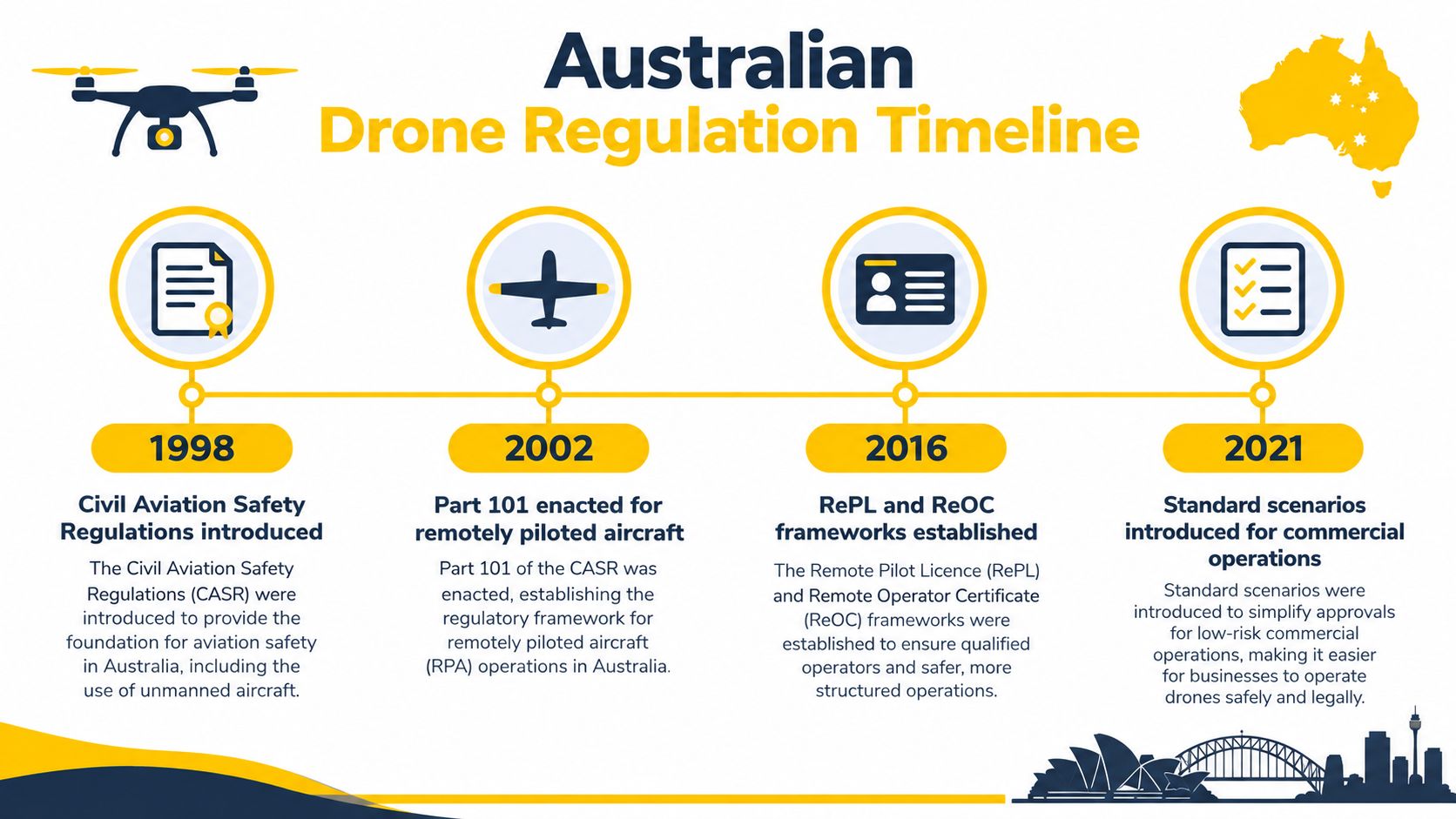
Australia did not wait for the drone boom to invent rules. It built one of the world's earliest dedicated remotely piloted aircraft frameworks through Part 101 of the Civil Aviation Safety Regulations 1998, introduced in 2002 to let remotely piloted aircraft develop while protecting other airspace users, people, and property on the ground. The framework grew alongside conventional aviation rules rather than replacing them, which is why drone compliance still feels like aviation compliance, not consumer electronics compliance. CASA's regulatory background on Part 101
By 24 July 2017, CASA had recorded 5,870 RePL holders and 1,106 ReOC holders, while estimating at least 50,000 drones were operating nationally, most for recreational use. Those numbers matter because they show the certification system was already formal and active before commercial drone work became mainstream. The rules weren't bolted on later as an afterthought.
Why that history matters now
CASA's later licensing data shows the system has kept expanding. The number of RePLs rose from fewer than 3,300 around 2016 to approximately 16,500 in mid-2020, then passed 40,000 in 2025, and CASA reported 38,874 licensed drone operators as of 1 May 2025 compared with 30,845 conventional crewed pilots. CASA's 2025 licensed drone pilot milestone
The message for operators is simple. The system is mature, busy, and increasingly central to Australian aviation. A compliance mindset built around CASA's actual framework will age better than one built on shortcuts, assumptions, or whatever happens to be popular in online forums this month.
Getting Your RePL Step by Step
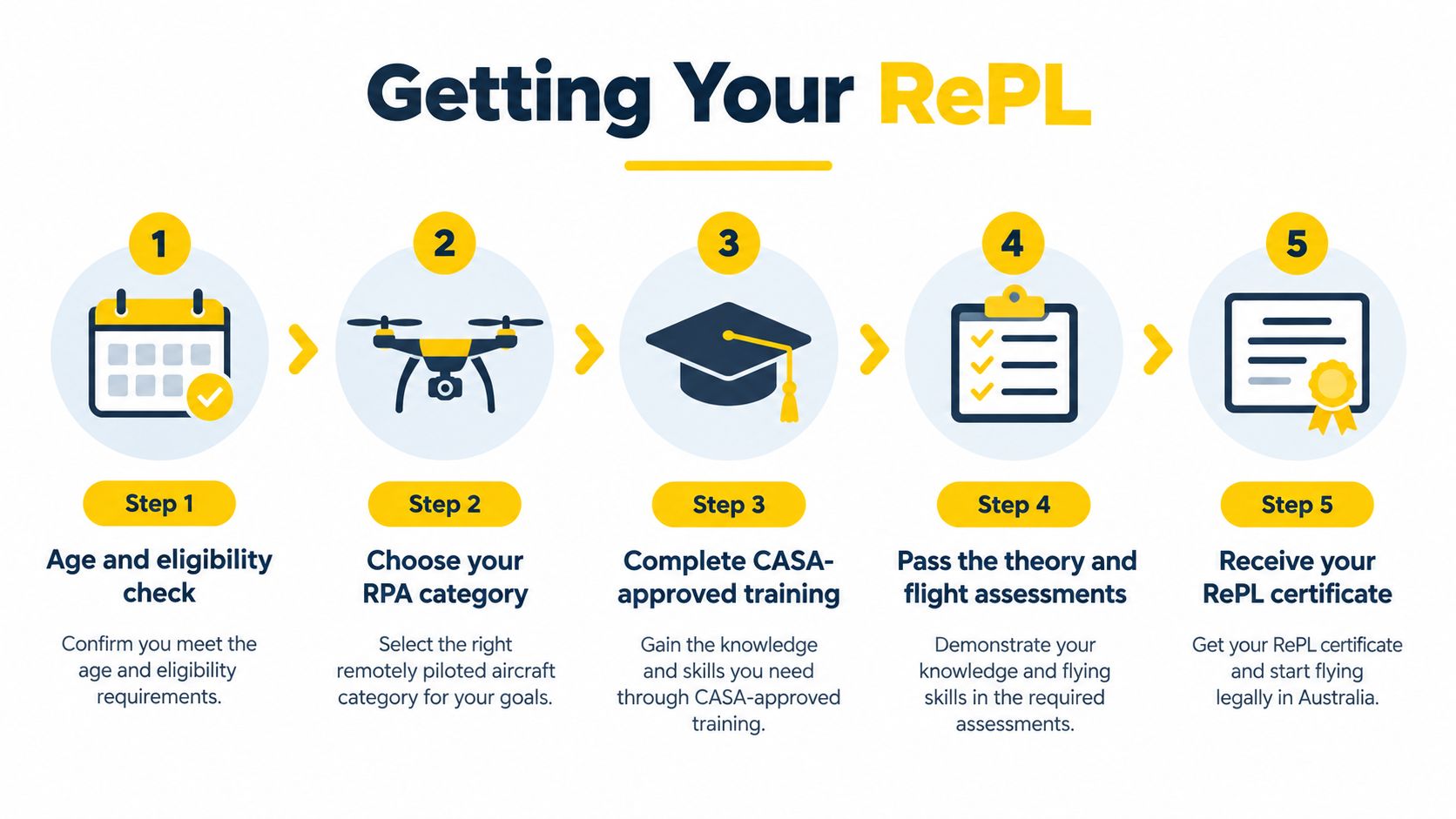
The RePL is the personal credential that shows a pilot can operate a specified remotely piloted aircraft category safely. It is type- and category-specific, not a blanket licence for every UAV, which is where many beginners get tripped up. CASA requires approved theory and practical competency training for the relevant aircraft, plus 5 hours of flying under standard operating conditions. CASA's RePL requirements
That means the first check is simple: match the aircraft, the category, and the job. A pilot moving from a multirotor to a fixed-wing aircraft, or into another category, may need extra training or an upgrade before the new work fits their licence. The rule follows the machine, not the person's confidence level.
When the RePL is mandatory
A RePL is required when a pilot works for a business holding a ReOC, or when flying an RPA over 25 kg and up to 150 kg commercially over the operator's own land. A serious applicant should map the aircraft model, weight class, and mission profile against the licence privileges before signing a contract or taking a rostered job.
Training and permission are different things. Training builds competence, but the licence is the credential CASA recognises for those specific privileges. If the aircraft or job changes, the pilot needs to check whether the current RePL still covers the work.
A sensible starting point is to use a course chooser that matches the pilot's current stage, such as ACE READY for beginners who need drone fundamentals, aviation safety, CASA regulations, and preparation for advanced RePL training. A training provider's licence finder can also help align the right pathway to the right aircraft and operating profile, which matters more than picking the shortest course.
The ReOC as an Organisational Compliance Framework
A ReOC sounds like a pilot ticket, but CASA treats it as an organisational authorisation. For commercial work under a ReOC, the remote pilot still needs a RePL, the drone must be registered, and the operator must follow the procedures approved under the certificate. CASA's drone safety rules
That difference matters because a compliant drone business runs on a system, not on one qualified person. CASA requires the ReOC holder to nominate a Chief Remote Pilot, keep Part 101-compliant operational procedures and manuals, train and induct remote pilots into those procedures, maintain the required operational records, and register every RPA operated under the certificate unless a specific test-flight exception applies. CASA's ReOC guidance
For businesses growing into a formal drone program, ReOC setup guidance helps make those moving parts visible before operations start.
The audit trail that keeps a mission legal
A ReOC works like an auditable chain. Aircraft registration, pilot RePL privileges, risk controls, operating procedures, competency checks, records, and approvals all need to line up. If one link is missing, a pilot can still be grounded even after completing the flying training.
Operations outside standard conditions need the relevant CASA approval or permission. That includes flights above 120 m/400 ft above ground level and work in controlled or restricted airspace. Only the Chief Remote Pilot of a ReOC holder can apply. CASA's flight approvals and permissions guidance
The practical test for a ReOC environment is simple: can the business show its procedures, records, and approvals in one place? If the answer is no, the operation is not ready.
A training pathway such as ACE SILVER can fit into that broader compliance setup for teams that need structured preparation rather than isolated certificates.
Adding the AROC for Safe Radio Communication
The AROC is the credential that supports radio communication, not flight control. It matters when a drone operator needs to speak legally and clearly on aviation frequencies, especially where the operation sits near or within the communication environment of other airspace users. A RePL covers flying competence, but it doesn't replace radio communication training.
A useful way to think about AROC training is that it covers the language and discipline of aeronautical radiotelephony. That keeps the pilot from guessing at phraseology or using ordinary conversation when precise communication is needed. It also helps teams avoid confusing this certificate with the different radio ratings held by air traffic service personnel.
Where a drone operation regularly needs to coordinate with other aircraft or aviation stakeholders, the AROC often sits beside the RePL as part of the working toolkit. It complements the flying licence and doesn't substitute for it.
If radio communication is part of the job, a training pathway like AROC training helps operators build that skill in a way that fits the wider certification system, rather than treating it as an optional extra after the mission is already planned.
Matching the Right Credential to Your Operation
The cleanest way to choose a credential mix is to start with the job, not the product page. A solo commercial pilot running standard work has a different compliance load from a business operating multiple aircraft under a ReOC, and both differ again from a team that also needs radio procedures.
| Credential | Purpose | Holder | When Typically Required | What It Covers |
|---|---|---|---|---|
| RePL | Proves individual remote pilot competence | The pilot | Commercial flying, and for pilots working under a ReOC | Theory, practical training, and aircraft-category privileges |
| ReOC | Authorises the organisation to conduct operations | The business or organisation | Commercial operations that need an organisational approval framework | Procedures, manuals, records, approvals, and governance |
| AROC | Supports safe aeronautical radio communication | The person who needs to use aviation radio procedures | Operations where radio communication with aviation stakeholders is required | Radiotelephony theory and practical communication skills |
Some jobs stay simple. Others add layers fast. If you are only comparing entry points, start with the drone licence overview and then work outward from there.
Higher-risk jobs change the picture quickly. Operations above 120 metres (400 feet) above ground level, within 5.5 kilometres of a controlled aerodrome, and above 120 metres within that 5.5-kilometre zone, including around military-controlled aerodromes, fall into a tighter approval path. CASA's controlled airspace and aerodrome proximity rules explain where those boundaries sit, and the operator then needs the right organisational authority, the pilot needs a RePL, and the operation must have the relevant approval in place.
For readers comparing aviation training outside drones, TP Training's flight school breakdown shows the same basic split between personal qualification and organisational approval. The details differ, but the structure is familiar, a licence for the person and a separate authority for the business.
Common starting points
- Solo commercial pilot: start with the RePL, then add AROC if the work requires radio communication.
- Growing drone services business: build the RePL holder base and the ReOC framework together.
- Enterprise or government team: choose the mix that covers pilot competence, operational governance, and radio communication from day one.
The right first credential depends on the mission, not the brochure. A business that starts in the wrong order often ends up retraining later, which costs time and slows the operation.
Training Pathways, Eligibility and What to Expect
A solid training pathway starts with eligibility and ends with records CASA can assess. The classroom part should cover airspace, weather, aircraft performance, and CASA rules, then move into practical competency training on the exact RPA category the pilot plans to operate. The process should finish with a documented assessment, not an informal sign-off.
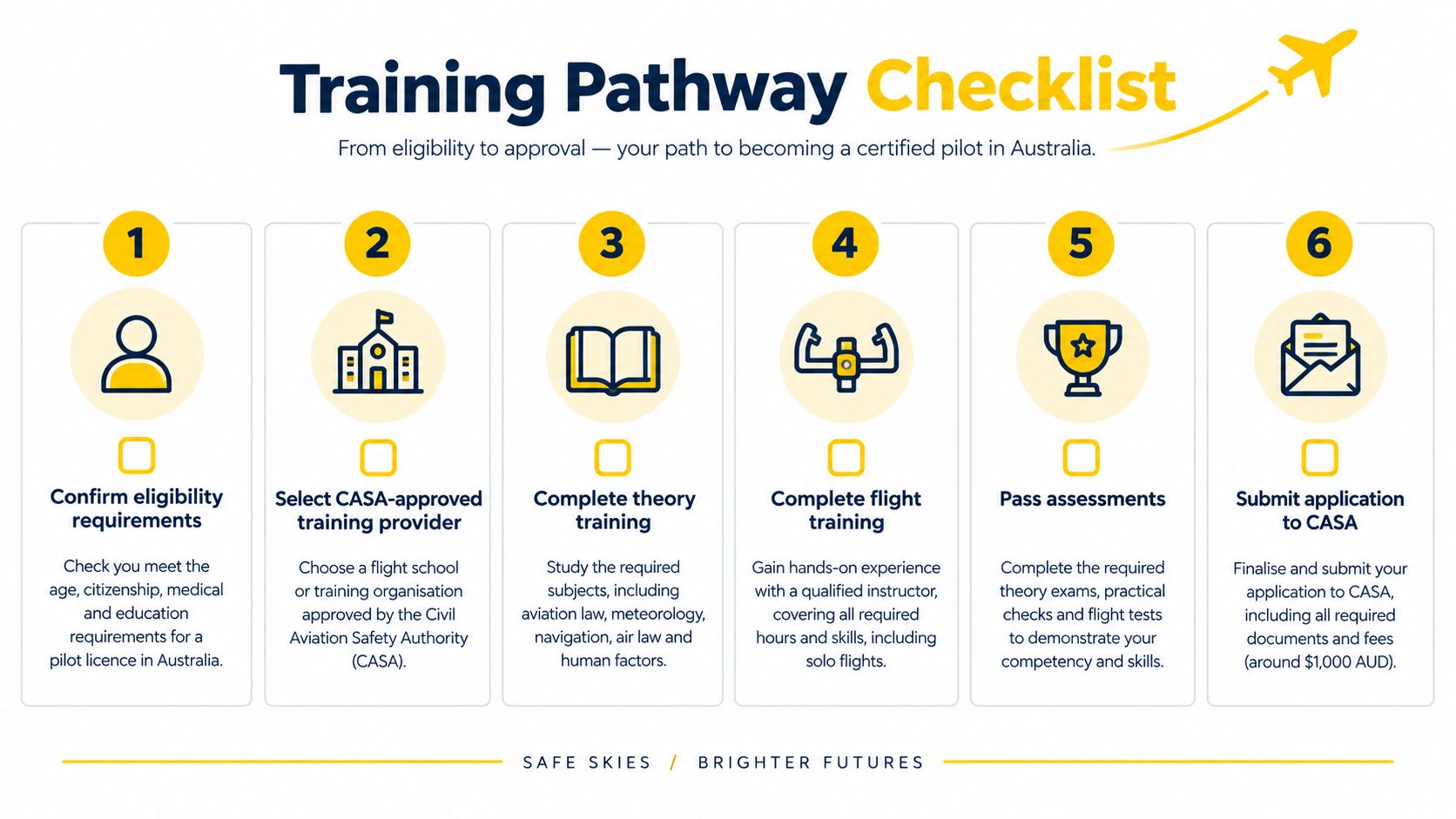
What a clean application file usually includes
A CASA-ready file normally includes the pilot's identification, training evidence, logbook entries, and any required certifications. If the operation also needs radio training or organisational approval, those documents should sit in the same file trail, so every item lines up when CASA reviews it later.
For a connected pathway, many operators start with CASA-aligned RePL and AROC training, then add ReOC consulting once the organisation is ready to formalise procedures. Ace Aviation Aerospace Academy is an Australian aviation training provider specialising in professional drone pilot education, aviation qualifications, and industry certification, delivering CASA-compliant drone training including RePL, AROC and ReOC support. It also offers ACE READY for students beginning their journey toward becoming licensed drone pilots in Australia.
Timing varies by learner, but the practical way to plan is to treat study, flight practice, assessment, and application processing as separate steps. That avoids the common mistake of booking client work before the credential pathway is complete.
Building a Compliance System That Survives CASA's 2025 Changes
The biggest risk for new operators is building a compliance setup that only works for one aircraft model, one approval style, or one narrow job. CASA's 2025 policy work pointed toward category-based RePL and ReOC permissions instead of model-specific medium-RPA permissions, and a later trial allowed assessed instructors to receive a generic category rating rather than completing a flight test for every medium-drone model. CASA also reported work on a BVLOS application process and a possible assisted-VLOS trial involving observers, with the latter delayed to 2026. CASA's 2025 RPAS conference update For a full walkthrough of what is changing, see our guide to Australian drone laws in 2026.
That shift matters for operators in agriculture, infrastructure, and emergency services, because larger aircraft and BVLOS capability usually demand more technical, operational, and organisational evidence than lower-risk SAIL II operations. The safer approach is to train for portability, write procedures that survive scope changes, and treat the Chief Remote Pilot role as a real governance position, not a form-filling title.
Design principles that age better
- Train across categories where possible. That makes future aircraft changes easier to absorb.
- Document risk assessments clearly. Future approvals are easier when the logic is already written down.
- Keep the Chief Remote Pilot accountable. The role should own procedures, records, and approval pathways.
- Review the ReOC scope regularly. If the operation grows, the compliance system should grow with it.
The operators who stay flexible usually avoid an expensive rebuild later. Those who hard-code today's assumptions into every process often find that CASA's next update forces a full rewrite.
If the next step is getting the right credential path in place, Ace Aviation Aerospace Academy can help with RePL, AROC, and ReOC-aligned training that fits the Australian drone compliance system. Visit Ace Aviation Aerospace Academy to compare the options and choose the pathway that matches the aircraft, operation, and approval level needed.
FAQ
Do all drone pilots in Australia need a RePL?
No. The RePL is required for commercial work and for pilots operating under a ReOC, but not every recreational or very small operation needs it. The aircraft, operating conditions, and use case determine the pathway.
What does a ReOC actually let a business do?
A ReOC authorises the organisation to conduct approved drone operations under its own procedures and governance framework. It is not a pilot licence.
Is the AROC the same as air traffic controller training?
No. The AROC supports aeronautical radio communication for operators who need it. It is separate from controller ratings and does not replace a flying licence.
Can a pilot change from one drone type to another with the same RePL?
Not always. The RePL is type- and category-specific, so a change in aircraft or category may require additional training or an upgrade.
Who applies for higher-risk approvals under a ReOC?
Only the Chief Remote Pilot of the ReOC holder can apply for the relevant CASA approval or permission.
What's the safest way to choose a training pathway?
Start with the mission, then match the aircraft, operating environment, and approval needs to the right mix of RePL, ReOC, and AROC.