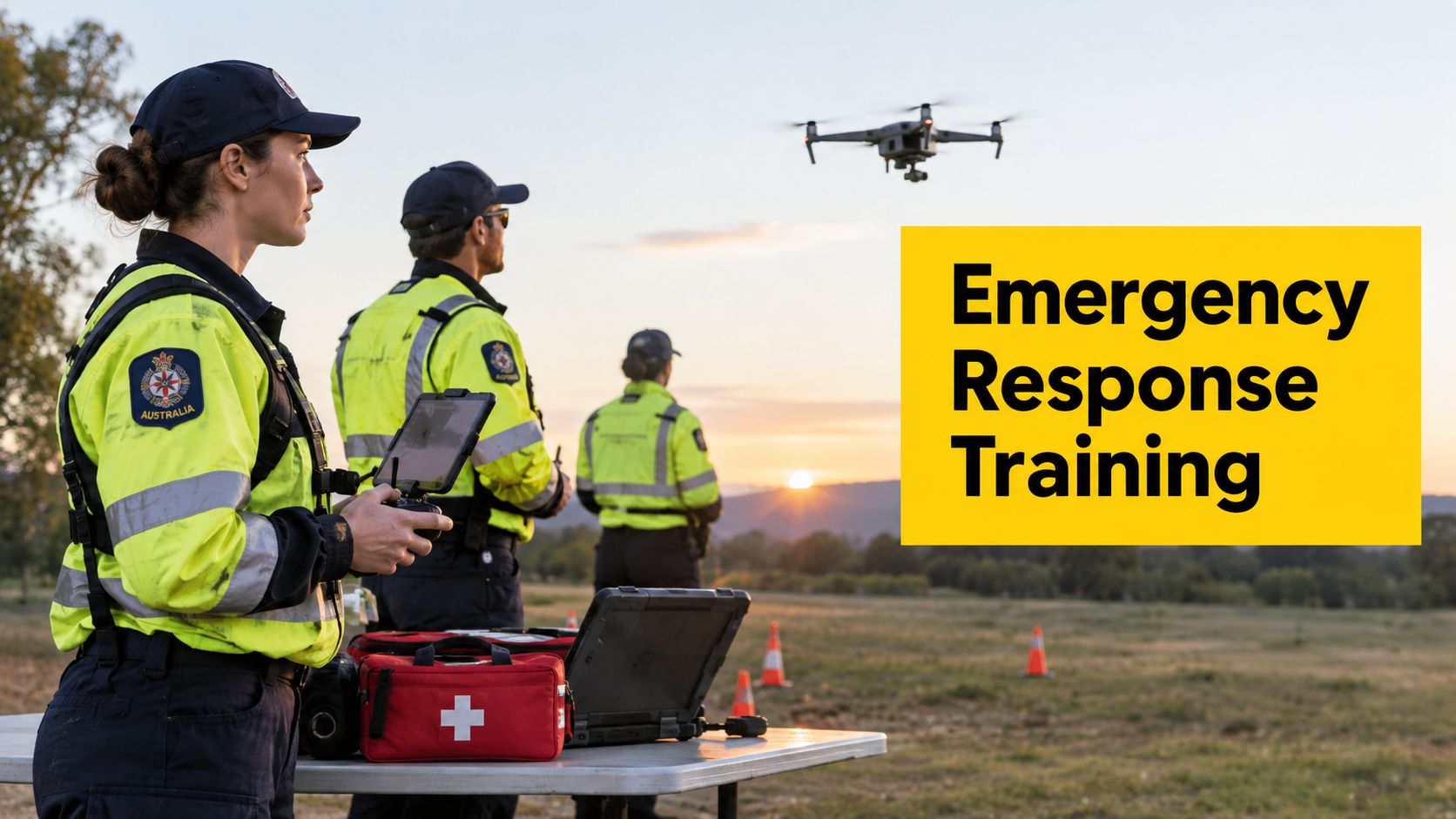
A drone team is surveying flood damage when the aircraft loses its command-and-control link. One operator watches the screen, another contacts the incident controller, and a nearby crew manages public safety around the launch area. The aircraft, the weather, the radio channel and the people on the ground all become part of one emergency.
That moment tests more than flying skill. It tests whether the team has rehearsed who makes the decision, which procedure applies, how the event is reported and when the operation must stop. Emergency response training for Australian operators is therefore a system of competencies, not a single certificate. It combines workplace preparedness, first aid, fire and evacuation procedures with aviation-specific controls for remotely piloted aircraft systems, or RPAS.
The need extends beyond emergency services. Commercial drone pilots, mining and construction businesses, infrastructure owners, government agencies, land managers and aviation professionals all need a response plan that matches their hazards and operating environment. A facility may need an Emergency Control Organisation, while an RPAS team may need a remote pilot with a Remote Pilot Licence, a radio-qualified crew member and a documented lost-link procedure.
The practical question is simple: can people act safely when the normal plan has broken down? The answer depends on training that is current, role-specific and exercised under realistic conditions. Ace Aviation Aerospace Academy provides information about its aviation education approach through its academy overview, while this guide focuses first on the principles that any Australian organisation should apply.
Table of Contents
- Introduction to Emergency Response Training in Australia
- What Emergency Response Training Covers and Why It Matters
- Key Types of Emergency Response Training Explained
- Regulatory Links and National Standards in Australia
- How to Choose the Right Emergency Response Training
- Drone Specific Emergency Procedures in Practice
- Conclusion and Frequently Asked Questions
Introduction to Emergency Response Training in Australia
Emergency response training begins before an incident, usually in a meeting room, a training area or beside a vehicle with equipment laid out for inspection. A team identifies hazards, assigns responsibilities, rehearses communications and checks that each person understands the limits of their role. The value appears later, when people need to act without waiting for someone else to interpret the plan.
For a drone operation, the trigger might be a flyaway near a road, a battery warning during a search task, a sudden change in visibility or an aircraft entering controlled airspace unexpectedly. The response must protect people first, maintain situational awareness and prevent a developing problem from becoming a wider aviation incident. A pilot who knows how to fly but hasn't practised abnormal procedures may lose valuable time deciding what to do next.
Traditional workplace arrangements remain essential. AS 3745 emergency planning, first aid, evacuation, warden duties and first attack firefighting address the people and facilities around the operation. RPAS training adds another layer, including pre-flight risk controls, airspace awareness, communications, aircraft recovery and post-incident reporting. Neither layer replaces the other.
Who needs this training
A business should consider the full operating chain rather than only the person holding the controller. The relevant people may include:
- Remote pilots, who manage the aircraft and apply aviation emergency procedures.
- Observers and ground crew, who watch the operating area and communicate hazards.
- Incident controllers and supervisors, who coordinate decisions and liaise with emergency services.
- Wardens and first aiders, who manage immediate workplace risks.
- Managers and contractors, who need to understand stop-work authority and reporting duties.
The training requirement changes with the mission. A short inspection on a controlled site creates different risks from a search operation near a flood, fire or public gathering. A sound programme starts with the location, aircraft, people, weather, airspace and task, then maps each hazard to a trained response.
What Emergency Response Training Covers and Why It Matters
Emergency response training is a rehearsal for a live performance where the audience isn't allowed to see mistakes. The rehearsal doesn't predict every event. It gives people a reliable sequence for recognising danger, protecting life, communicating clearly and restoring safe operations.
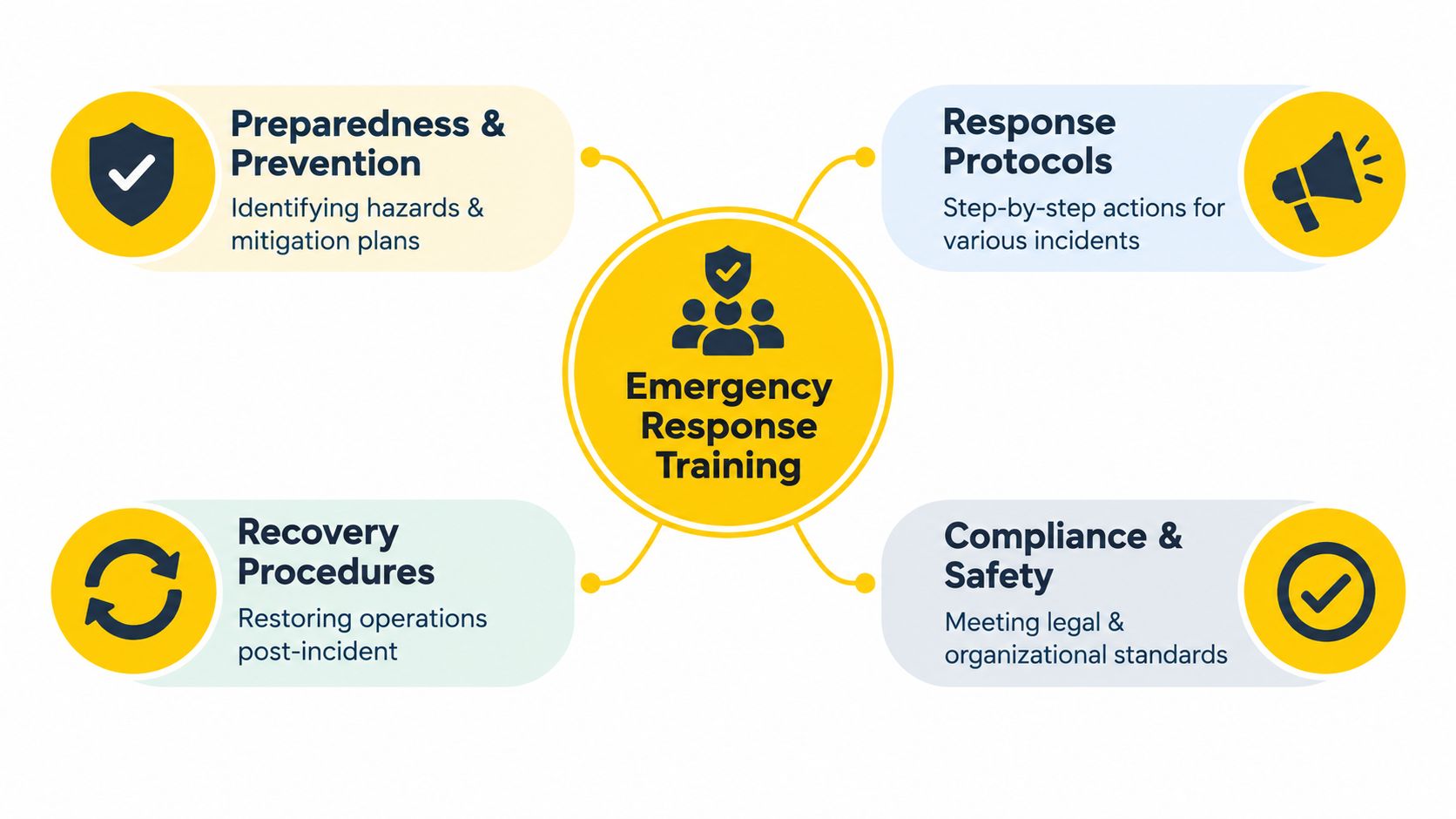
The four connected parts
Preparedness and prevention cover hazard identification, site familiarisation, equipment checks and mitigation. For a drone crew, this may include identifying people who could be exposed to a falling aircraft, checking launch and recovery areas, confirming weather limits and establishing a communication method before take-off.
Response protocols turn a general intention into an ordered action. A lost-link procedure should state what the pilot monitors, which contingency applies, how the team warns people nearby and when the operation is terminated. A workplace evacuation plan serves the same purpose. It reduces uncertainty when stress narrows attention.
Recovery procedures begin once immediate danger is controlled. The team may secure the aircraft, provide first aid, preserve relevant records, notify the responsible manager and assess whether the site is safe to reopen. Recovery isn't just repairing equipment. It includes learning from the event and restoring operational confidence.
Compliance and safety connect the plan to applicable standards, organisational procedures and aviation obligations. A procedure that looks sensible but ignores airspace, radio, workplace or reporting requirements can create a second risk while the first one is being managed.
Training also needs levels. Awareness training gives general occupants enough knowledge to recognise an alarm, follow instructions and avoid interfering with responders. Operational training gives wardens, supervisors and pilots defined tasks. Specialist training supports roles such as incident controllers, emergency planners, remote pilots and personnel working with unusual hazards.
Australia's formal emergency capability has long relied on trained people. The Report on Government Services emergency management data recorded 6,372 students enrolled in accredited paramedic training courses nationally in 2014, equivalent to 271.3 enrolments per million people. It also recorded state variation, from 106.9 to 419.1 enrolments per million. The figures show that structured emergency education was already embedded nationally at scale by the mid-2010s.
Practical rule: A procedure is only useful if the person expected to carry it out can explain it, demonstrate it and recognise when it no longer applies.
Refresher training matters because infrequently used skills decay. Organisations should also track completion, exercise attendance and corrective actions. Clear records can support improve sales team accountability in wider business processes, but emergency records have a more immediate purpose: they show who is current, who has a defined role and which gaps remain open.
For beginners, ACE READY introduces drone fundamentals, aviation safety, CASA regulations and flight operations, and prepares learners for advanced RePL training in Australia. It sits at the aviation foundation layer, while a business still needs workplace emergency arrangements suited to its own facility and operation.
Key Types of Emergency Response Training Explained
The phrase emergency response training covers several distinct disciplines. A first aider doesn't replace an incident controller, and a remote pilot doesn't automatically qualify as a fire warden. Each role solves a different part of the problem.
| Training Type | Primary Purpose | Key Outcomes | Typical Audience |
|---|---|---|---|
| Incident response | Coordinate people, information and decisions | Clear command structure, communications and escalation | Supervisors, incident controllers, emergency planners |
| Spill response | Contain hazardous material and protect people and the environment | Isolation, notification, containment and recovery actions | Industrial teams, site workers, environmental personnel |
| First aid | Protect life until medical assistance is available | Initial assessment, immediate care and escalation | First aiders, field crews, supervisors |
| Firefighting | Control an incipient fire when safe to do so | Alarm raising, extinguisher selection, evacuation and personal safety | Wardens, ECO members, trained facility personnel |
| Drone emergency procedures | Manage aviation and RPAS-specific failures | Lost-link, flyaway, battery, weather, airspace and recovery actions | Remote pilots, observers, RPAS supervisors |
Incident response and coordination
Incident response training teaches people to build a shared picture. The emphasis falls on roles, information flow and decisions, not on one piece of equipment. A controller needs to know who has authority, which agencies should be contacted and how changing conditions affect the plan.
This becomes difficult when several organisations arrive with different terminology, equipment and procedures. Training should therefore include joint briefings, common communication practices and clear handover points.
First aid, fire and spill control
First aid focuses on immediate life safety. Firefighting training focuses on alarms, evacuation and the limited use of first attack equipment where the person is trained, the fire is suitable and a safe exit remains available. Spill response focuses on preventing exposure, controlling the source where safe and protecting drainage, land and waterways.
The physical demands of emergency roles vary. Organisations assessing fire service readiness may find background information on firefighter physical assessment equipment, but equipment selection never replaces a documented risk assessment or competency decision.
Australian guidance commonly uses AS 3745 as a benchmark for facility emergency procedures and training. The cited guidance states that skills training should occur at intervals of no more than 6 months for wardens and Emergency Control Organisation members, 12 months for general occupants, and 2 years for first attack firefighting. These intervals should be checked against the organisation's current arrangements and any applicable state or territory obligations.
Drone-specific procedures
Drone emergency training deals with events that can develop quickly and affect people outside the crew. It should cover aircraft abnormal behaviour, battery problems, loss of command and control, unexpected persons or aircraft entering the area, deteriorating weather and the need to stop or recover the mission.
Operators seeking role-specific aviation education can review specialised drone training options. The correct course depends on the operation, the person's duties and the organisation's regulatory structure.
Regulatory Links and National Standards in Australia
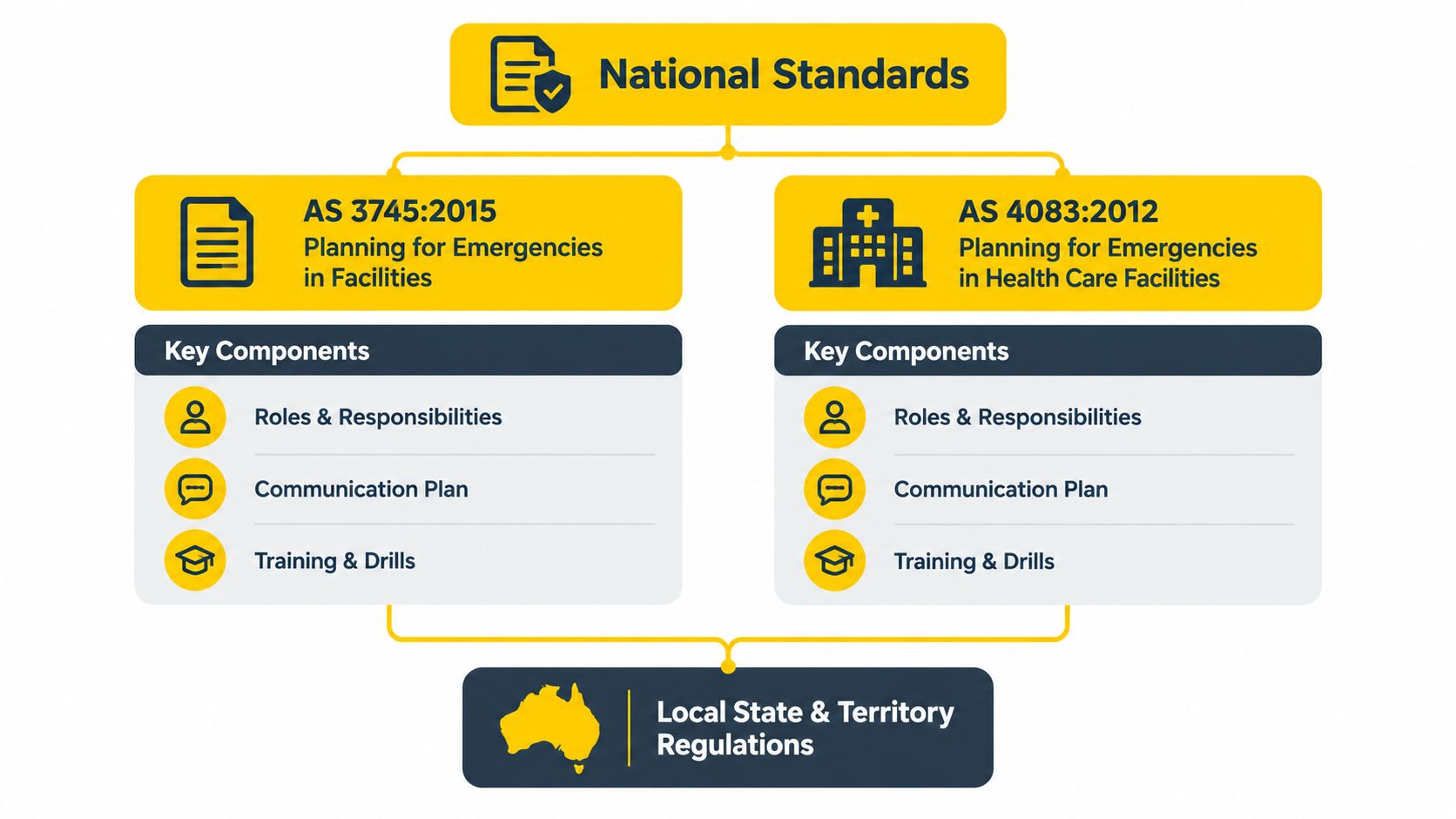
Australian emergency planning sits across several layers. A facility may use AS 3745 for emergency procedures, while health care facilities may also consider AS 4083. Local workplace and emergency-management requirements still matter, because national standards don't remove state and territory responsibilities.
Facility emergency planning
AS 3745 addresses the organisation of emergency procedures in facilities. Its practical focus includes responsibilities, communications, training and drills. The framework works best when the plan reflects the actual building, occupants, equipment and hazards rather than copying a generic template.
The national training unit PUAFER010 facility emergency response planning is explicitly developed around AS 3745 and AS 4083. It defines a facility as a building, structure or workplace occupied by people such as employees, contractors, students or residents. That scope is relevant to drone businesses operating from offices, workshops, depots, campuses and client sites.
National consistency and interoperability
The Royal Commission into National Natural Disaster Arrangements noted in 2020 that Australia had made substantial progress towards national consistency in emergency-management training and qualification recognition through the Public Safety Training Package and AFAC's Emergency Management Professionalisation Scheme. The Royal Commission material on national emergency response links that progress to more consistent competencies and recognition.
Consistency matters during large incidents. Teams from different jurisdictions may need to work together despite different local systems. Shared competencies don't make every procedure identical, but they give responders a more dependable basis for coordination.
Aviation obligations
A commercial drone operation must also address CASA requirements. A Remote Pilot Licence, or RePL, relates to the pilot's qualification. An Aeronautical Radio Operator Certificate, or AROC, is relevant where the operator needs the associated aviation radio competency. A Remotely Piloted Aircraft Operator's Certificate, or ReOC, concerns the organisation's approved operating framework and responsibilities.
The exact requirements depend on the aircraft, operation, location and proposed activity. A business should verify current CASA rules and permissions before relying on a procedure. Its internal emergency plan should connect the RPAS operations manual with facility evacuation, first aid, fire, communications and incident reporting arrangements. The drone laws and operational requirements guide can help readers identify the aviation questions that need checking, but it shouldn't substitute for current regulator guidance.
How to Choose the Right Emergency Response Training
Training selection should begin with exposure, not course titles. A business needs to identify what can hurt people, damage property, disrupt operations or create an aviation risk, then assign each hazard to a person who can act.
Start with the operating picture
The first review should examine:
- People: Employees, contractors, visitors, members of the public and emergency services.
- Place: Buildings, roads, water, remote terrain, launch areas and recovery zones.
- Aircraft and equipment: Aircraft type, batteries, payloads, ground stations and support vehicles.
- Task: Inspection, mapping, search, observation, delivery or another operation.
- Conditions: Weather, visibility, nearby aircraft, communications coverage and changing hazards.
A routine site inspection may need a straightforward emergency plan. A search task near a flood or fire may require stronger coordination with the incident controller, more disciplined radio use and a procedure for withdrawing the aircraft when conditions change.
Match training to roles
The pilot needs aviation competence, but the wider team may need other training. A business can map roles in a simple matrix:
| Role | Core capability to verify |
|---|---|
| Remote pilot | RePL status where required, aircraft procedures, risk controls and abnormal operations |
| Radio operator | AROC relevance, radio discipline and communication plan |
| Observer or ground crew | Visual monitoring, hazard calls, public separation and escalation |
| Site warden | Evacuation, assembly and facility emergency procedures |
| First aider | Current first aid competency and access to equipment |
| Operations manager | ReOC responsibilities where applicable, records, reporting and review |
For operations involving VLOS, the team should understand the visual observation requirement and the limits of that method. If an operation may involve EVLOS or excluded-RPA procedures, the training and operating controls need to reflect the applicable rule set, communications and risk management. The mission profile should drive the training decision, not the other way around.
Verify the provider and the refresh plan
A provider should be able to explain the qualification outcome, practical assessment, regulatory basis and relationship between the course and the organisation's operation. Businesses should confirm whether the training is nationally recognised, delivered through the appropriate registered pathway where required and supported by records that identify currency.
A useful audit asks:
- Can each person state their emergency role?
- Has the team practised the procedure, not just read it?
- Does the RPAS plan connect to the facility emergency plan?
- Are VLOS, EVLOS or excluded-RPA needs understood?
- Are batteries, payloads, weather and airspace included in drills?
- Are corrective actions assigned and closed?
Refresher timing should follow the applicable standard, qualification and risk profile. AS 3745 guidance provides different intervals for different facility roles, so a single annual session may not meet every need.
Drone Specific Emergency Procedures in Practice
A capable RPAS team treats an emergency procedure like a checklist used in aviation. The checklist doesn't replace judgement. It protects the crew from skipping a critical action while attention is drawn towards the aircraft.
Before launch
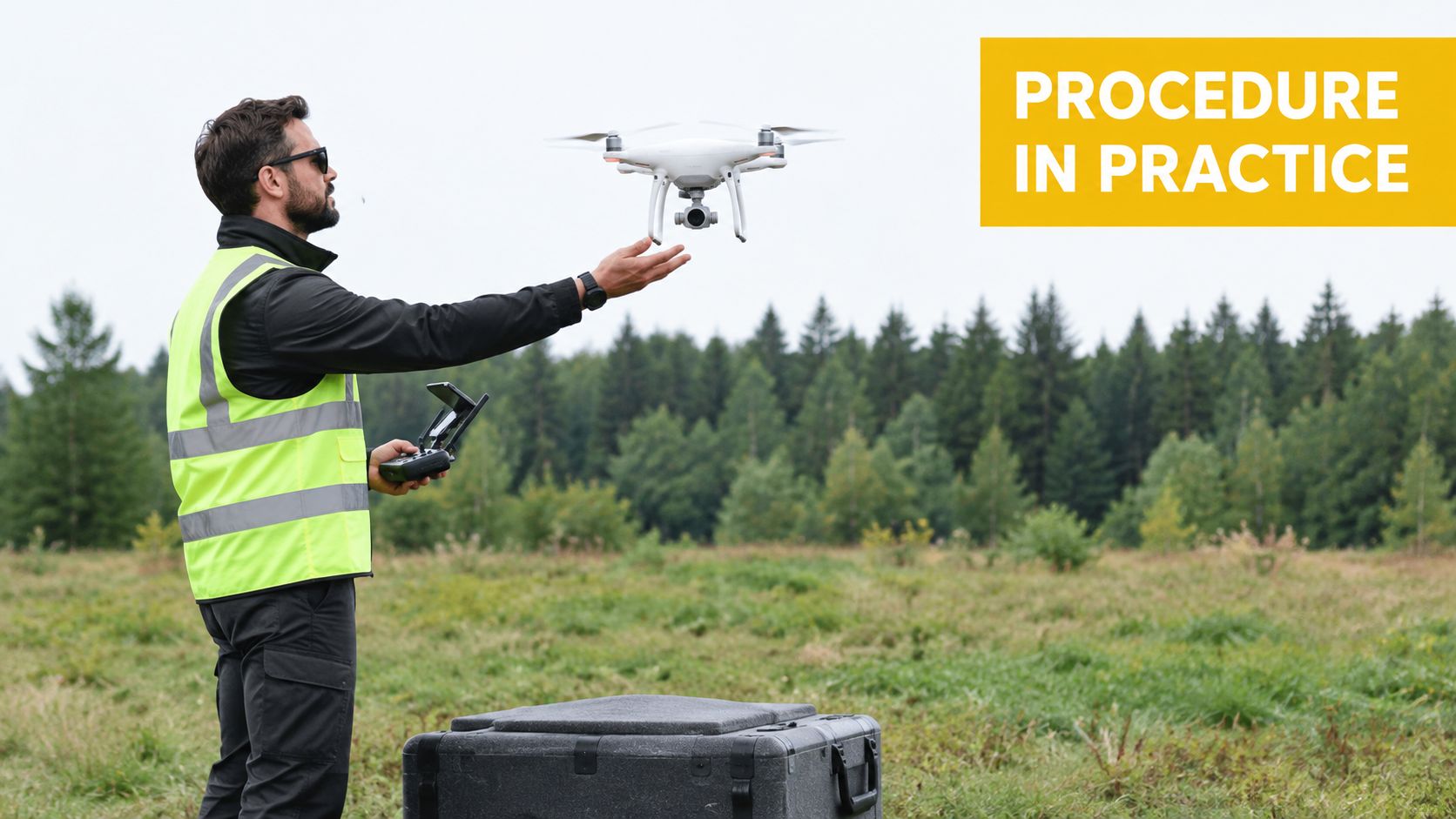
Launch readiness starts with the site and the people, not the propellers. The team confirms the operating area, identifies hazards, checks communications, reviews weather and confirms who can stop the operation. The pilot and observer should agree on concise calls for aircraft position, people entering the area, loss of visual contact and termination.
Surf Life Saving NSW's Australian UAV Service reports deploying more than 200 qualified UAV operators and pilots each season. Its Operator Induction Program includes operationally specific content, risk assessment and a full day of instructor-led flight training, alongside UAV kits, job planning and one-on-one support. The Australian UAV Service training model illustrates why operational readiness requires more than basic control inputs.
During an abnormal event
A flyaway demands immediate prioritisation. The pilot should follow the approved aircraft procedure, maintain awareness of people and airspace, communicate the problem and avoid improvised manoeuvres that increase exposure. A low-battery event requires a controlled recovery decision, not a hope that the aircraft will complete the task.
Loss of command and control should trigger the relevant contingency procedure. If an aircraft, person or other airspace user creates a conflict, the crew should protect separation and suspend the mission. If weather moves beyond the planned limits, the safest decision may be an early return or landing.
The drone pilot emergency handbook can support further reading on emergency considerations, but every operator still needs procedures matched to its aircraft, approvals, location and operation.
VLOS, EVLOS and multi-agency work
Australian incident-response guidance treats drones as a fast-deploy tool because they're relatively easy to deploy, have straightforward training requirements and can remain useful in adverse conditions. The Australian Institute for Disaster Resilience article on drones for emergency services notes that VLOS drones are typically used where immediate local support is needed, while South Australian emergency-service courses teach EVLOS Class 1 and excluded-RPA operations for SASES remote pilots.
The operational lesson is direct. VLOS supports rapid local awareness, but EVLOS and excluded-RPA workflows require formal procedures, communications discipline and airspace and risk controls. A drone crew working with police, fire, surf lifesaving or civil defence should agree on tasking, authority, radio channels, image handling and handover before the aircraft launches.
Conclusion and Frequently Asked Questions
Effective emergency response training is layered. Facility procedures protect people on the ground, while aviation training manages the aircraft, airspace and remote crew. The strongest arrangements connect both systems through named roles, rehearsed communications, realistic drills and records that show current competency.
Interoperability deserves particular attention. National discussions identify difficulties caused by incompatible equipment, different training standards, communication channels and policy differences, while a Cyclone Gabrielle case study found inadequate and inconsistent CIMS training among volunteers and civil defence staff. Australian organisations should therefore practise coordination with the agencies and contractors likely to attend a real event, not only with their own team.
Emerging hazards need the same discipline. National emergency-response materials state that Australia doesn't yet have a nationally consistent strategy for hydrogen-related disasters, and advanced hydrogen training was expanded in Phase 4 to address operational needs created by new energy technologies. Businesses using or supporting new energy infrastructure should identify who provides specialist training and how that capability connects to local response arrangements.
Frequently asked questions
What should emergency response training include for a drone business?
It should combine facility emergency procedures, first aid and fire arrangements with RPAS procedures for flyaways, lost links, batteries, weather, airspace conflicts, recovery and reporting.
How can teams train across states and agencies?
They should use clearly defined roles, shared terminology, agreed communications and joint exercises. Nationally recognised competencies can support consistency, but local procedures still need to be checked.
What training is relevant to hydrogen incidents?
Organisations should seek specialist training aligned with their hydrogen hazards, facility arrangements and emergency-service interfaces. There isn't yet a nationally consistent hydrogen disaster response strategy.
How often should refresher training occur?
The interval depends on the role, standard, qualification and risk. AS 3745 guidance identifies intervals of no more than 6 months for wardens and ECO members, 12 months for occupants, and 2 years for first attack firefighting.
Does a RePL replace emergency response training?
No. A RePL addresses remote pilot qualification. It doesn't replace first aid, fire, evacuation, incident coordination or site-specific emergency procedures.
Ace Aviation Aerospace Academy offers relevant aviation pathways including RePL and AROC training, ReOC consulting, and enterprise and corporate drone training. Businesses and operators can review the Ace Aviation Aerospace Academy resources and select training that connects aviation compliance with practical emergency readiness.