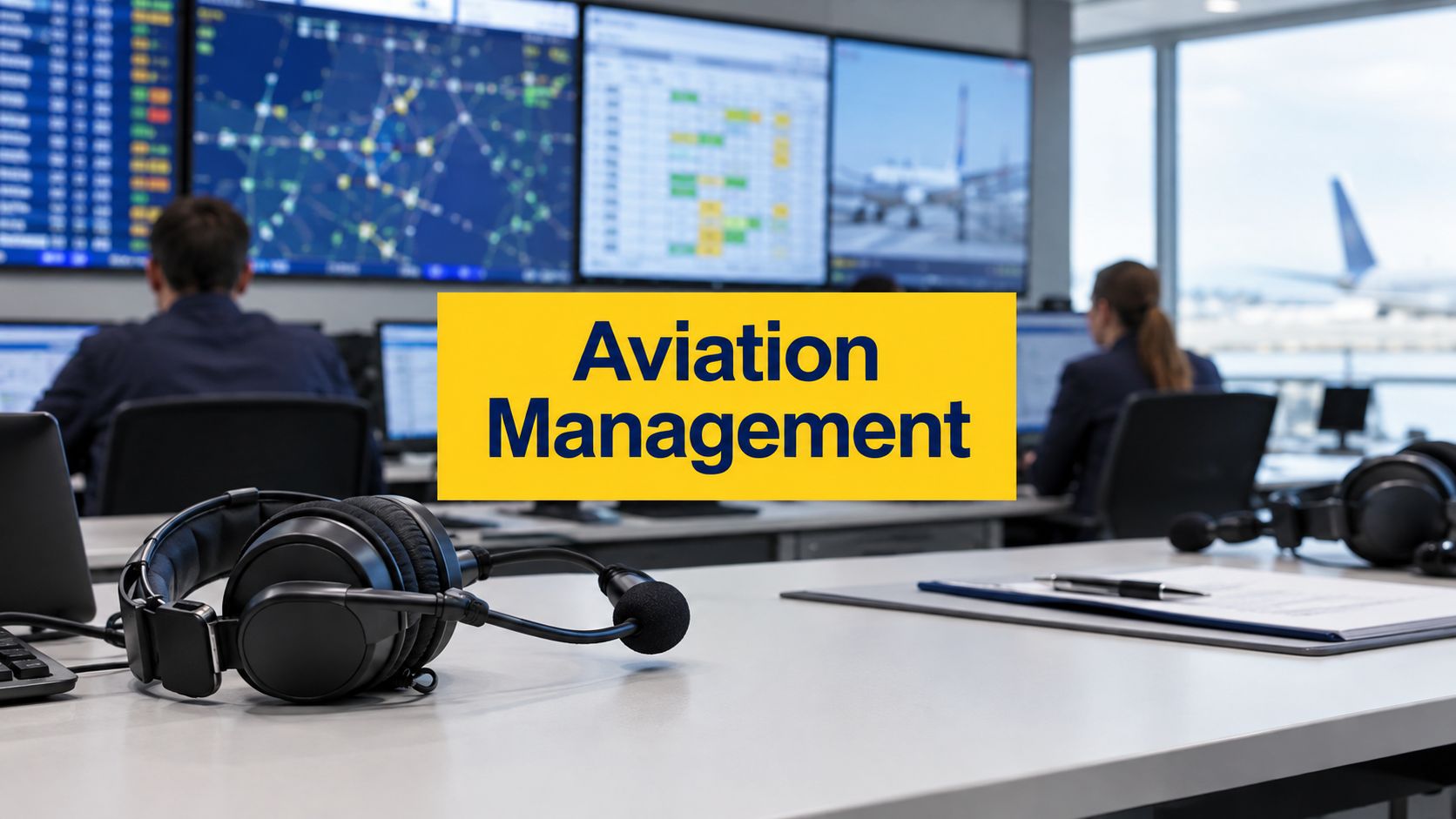
A new operations coordinator arrives before sunrise to review a drone mission near a controlled aerodrome. The pilot is qualified, the aircraft is registered, and the client expects the work to begin on schedule. Then the weather briefing changes, a temporary airspace restriction appears, and the manager must decide whether to proceed, modify the route, or stop the operation.
That decision captures the true meaning of aviation management in Australia. It is not merely administration, and it is not limited to obtaining a licence. It combines people, aircraft, airspace, weather, safety systems, documentation, and CASA requirements into decisions that keep operations lawful and controlled. The path can lead through drone operations, airport coordination, airline support, safety management, compliance, or broader aviation leadership.
Table of Contents
- Starting Your Aviation Management Journey
- What Aviation Management Actually Involves
- CASA and the Australian Safety Framework
- Key Qualifications and Certifications Explained
- Career Paths in Aviation Management
- Risk Management in Modern Australian Aviation
- How Ace Aviation Aerospace Academy Prepares Managers
- Frequently Asked Questions
- Can someone enter aviation management without an aviation background?
- How long does it take to obtain a RePL?
- Can an AROC alone lead to operations work?
- How does CASA's safety data affect training?
- Are online theory options available?
- Can overseas qualifications or international study lead to Australian aviation work?
Starting Your Aviation Management Journey
Jordan has a background in logistics and an interest in drones. A local infrastructure company has asked whether Jordan could coordinate inspection flights, but the role involves more than flying. It includes checking pilot authority, confirming aircraft records, reviewing the operating area, organising a safe work method, and explaining delays to the client.
That is often the first useful distinction for someone considering this field. A person may be attracted by aircraft and technology, yet aviation management requires consistent attention to planning, communication, risk, and regulation. A technically capable pilot who cannot maintain clear records will struggle. A strong administrator who cannot understand operational limits will also create risk.
Begin with a realistic self-assessment
Before enrolling, a prospective student should examine several practical questions:
- Technical comfort: Can the student learn aircraft systems, airspace concepts, weather information, and operating limitations?
- Communication habits: Can the student give concise instructions, challenge an unsafe plan, and document decisions clearly?
- Regulatory discipline: Can the student follow a rule even when a client or schedule creates pressure?
- Operational temperament: Can the student remain organised when weather, equipment, staffing, or airspace conditions change?
- Learning commitment: Is the student prepared to continue updating knowledge as aviation requirements and operating models evolve?
Aviation management has layered entry points. Some people begin in ramp coordination, dispatch, scheduling, or ground operations. Others start as drone pilots and later coordinate crews, aircraft, clients, safety controls, and approvals. A person comparing pathways can review the aviation courses available through Ace Aviation Aerospace Academy, then match training to the intended role rather than choosing a qualification by title alone.
Practical rule: A licence may establish what a person can do operationally. Management capability determines how safely and consistently an entire activity is organised.
The right starting mindset is structured curiosity. New entrants don't need to know every aviation acronym on the first day, but they do need to accept that each flight sits inside a larger system. The strongest early decisions usually involve identifying the desired role, understanding its authority requirements, and building both operational knowledge and professional judgement.
What Aviation Management Actually Involves
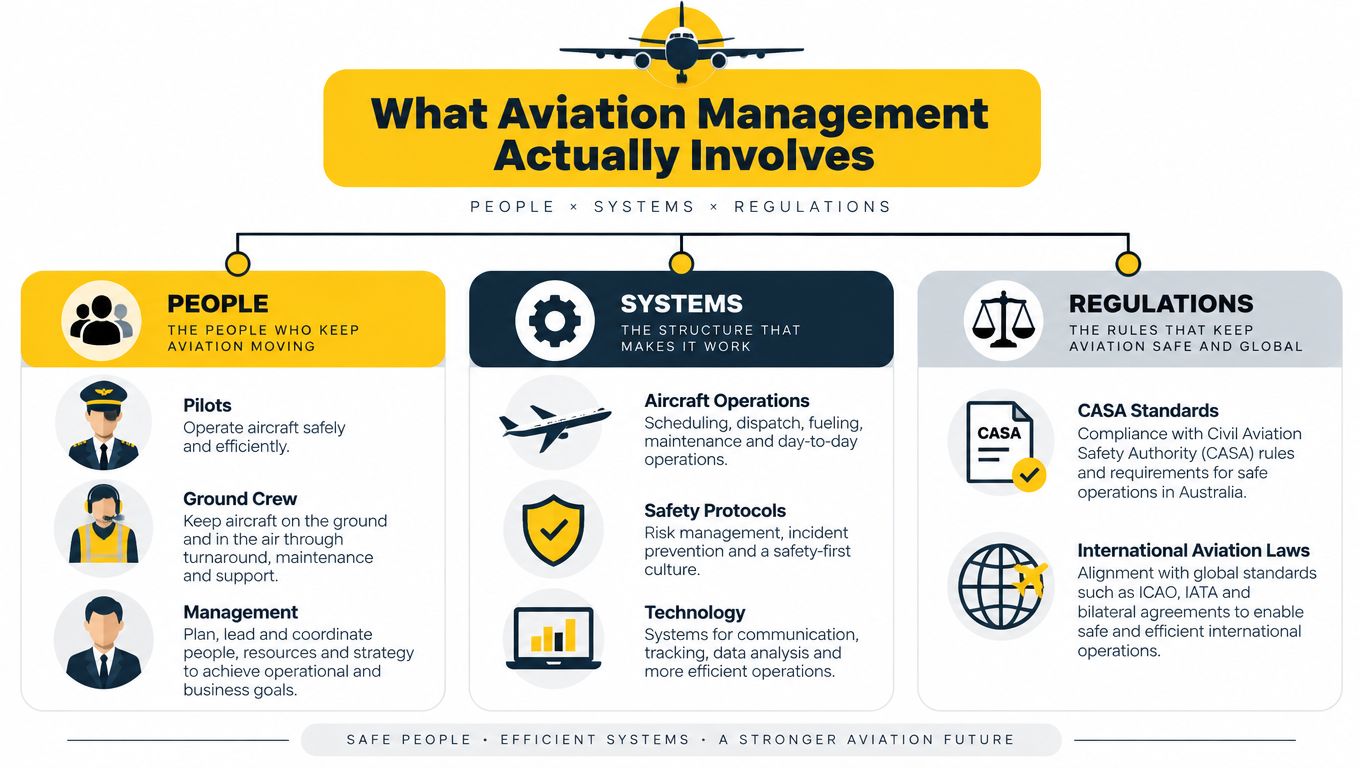
Aviation management becomes easier to understand when the work is separated into people, systems, and regulations. These areas overlap during every operational day, but each creates different responsibilities for a manager.
People and operational leadership
The people pillar covers pilots, remote pilots, ground crew, maintenance personnel, dispatchers, clients, and managers. A manager may need to check whether the assigned pilot holds the authority required for a flight, confirm that a spotter understands the task, or make sure ground staff know where to stand and what to do if conditions change.
A roster is more than a list of names. It must reflect qualifications, availability, fatigue considerations, aircraft type, operating location, and the nature of the mission. In a drone business operating under a ReOC, the manager may also allocate work according to the organisation's approved procedures and the remote pilot's certified scope.
Systems and administrative control
The systems pillar turns intention into repeatable practice. It includes scheduling, aircraft airworthiness records, maintenance tracking, occurrence reporting, risk assessments, operating manuals, training records, and document control.
Consider a drone inspection near infrastructure. The manager may coordinate a client brief, select an aircraft, verify battery and maintenance status, review the proposed route, confirm the operating area, and record the approval decision. Each task supports the next one. A missing record can weaken the whole chain, even if the flight itself appears uneventful.
ACE READY can be relevant to beginners who need an entry-level course covering drone fundamentals, aviation safety, CASA regulations, flight operations, and preparation for advanced RePL training in Australia.
Regulations and external coordination
The regulations pillar keeps operations within CASA requirements and applicable airspace procedures. It can involve checking standard operating conditions, confirming the organisation's authority, maintaining compliance documentation, and liaising with air traffic control where communication or coordination is required.
Aviation management therefore isn't paperwork separated from flying. It is the coordination of people and systems under regulatory authority. The manager's technical literacy helps identify a problem, while communication skills ensure that pilots, clients, and ground teams receive a clear and usable decision.
CASA and the Australian Safety Framework
CASA was established on 6 July 1995 as an independent statutory authority under the Civil Aviation Act 1988, creating a dedicated civil aviation safety regulator in Australia. Its regulatory relationship now spans crewed and uncrewed aviation, including pilots, aircraft, aerodromes, air operators, remotely piloted aircraft operators, and registered drones. CASA's published annual report information provides the relevant national context.
The scale managers must understand
By 30 June 2025, CASA reported a direct regulatory relationship with the following groups and assets:
| Indicator | Approximate Figure |
|---|---|
| Pilots | 70,507 |
| Registered aircraft | 16,545 |
| Certified aerodromes | 333 |
| Air operator certificates | 624 |
| Remotely piloted aircraft operator certificates | 3,011 |
| Active registered drones | 30,984 |
These figures show why aviation management cannot rely on informal coordination. The system includes established airlines and general aviation, but it also includes a substantial uncrewed sector with different aircraft, operators, operating environments, and risk profiles.
Australia released its first Aviation State Safety Program in February 2011, followed by a second edition in April 2012. The programme described how aviation safety is managed through safety systems, supporting a move towards measurable safety performance rather than rule checking in isolation. In CASA's latest available annual reporting, 168 accidents occurred in 2024–25, below the 10-year average of 198.1 accidents. These figures are reported in the State Safety Programme addendum.
What evidence-based oversight changes
A manager must ask what the available evidence says about an operation. Reported occurrences, surveillance findings, weather records, training outcomes, maintenance information, and safety indicators can all influence procedures and priorities.
For a student comparing qualifications, the licence and qualification finder can help organise the initial pathway, but the underlying principle remains broader than selecting a credential. The qualification must match the intended authority, and the organisation must support it with competent people, procedures, and records.
ACE SILVER is described as commercial RePL training with classroom instruction, practical flight training, CASA-compliant certification, AROC, and aviation English proficiency for professional drone pilots. Those elements are relevant to operators who need to connect flight competence with formal aviation communication and compliance knowledge.
Key Qualifications and Certifications Explained
Different aviation credentials answer different questions. The RePL concerns a remote pilot's authority and aircraft ratings. The AROC concerns aviation radio communication. The ReOC concerns an organisation's authority to conduct specified remotely piloted aircraft operations. Broader aviation qualifications support management, planning, and safety roles but don't automatically replace a CASA operational credential.
Comparing operational and management authority
| Qualification | Who Needs It | Scope | Management Relevance |
|---|---|---|---|
| RePL | Remote pilots working for an operator with a ReOC, and certain business operations involving heavier drones | Remote pilot authority with weight and type ratings | Helps a manager allocate work within the pilot's certified scope |
| AROC | Anyone who needs to communicate on an aviation air-band radio frequency and isn't already authorised through another listed pilot qualification | Aviation radio communication | Supports safe coordination where air-band radio use is required |
| ReOC | Organisations conducting relevant commercial remotely piloted aircraft operations under the applicable CASA framework | Operator-level authority and documented systems | Establishes the organisation's approved operating structure and responsibilities |
| Certificate III in Aviation | Students seeking a structured vocational aviation pathway | Foundational aviation knowledge and practical capability, subject to the course and role | Supports entry into operational and coordination work |
| Diploma or degree in aviation | People targeting broader management, planning, safety, or strategic roles | Wider organisational and aviation management knowledge | Helps develop analysis and leadership capability beyond a single flight role |
CASA states that a drone weighing more than 250 g but no more than 2 kg can be flown for business under the very small excluded category, provided the operator obtains an aviation reference number, gains operator accreditation, registers the drone, and follows the standard operating conditions. A RePL or ReOC isn't required for that category, as explained in CASA's drone weight and requirement guidance.
A RePL is needed when a person works as a remote pilot for an operator holding a ReOC, or when flying a drone weighing more than 25 kg but less than 150 kg over the pilot's own land for business. CASA identifies ratings such as less than 7 kg, less than 25 kg, and up to 150 kg, with type-specific ratings shown on the RePL card. The RePL application guidance should be checked for the current requirements.
Why radio certification can matter
An AROC is required for a person who needs to communicate on an aviation air-band radio frequency and isn't already licensed or qualified to transmit. Licensed pilots with listed qualifications, including PPL, CPL, MPL, or ATPL endorsements, are already authorised to transmit and don't need to apply separately. Australian Government business guidance also confirms that the AROC applies to unmanned aircraft use of the device during flight, on the ground, and in connection with an aircraft. The relevant CASA radio-operator guidance should be read alongside the Australian Government AROC service information.
The Certificate III in Aviation can suit a student seeking a formal vocational route. Higher education may become useful for strategic roles in airline operations, airport management, air traffic support, or safety management. The correct ladder depends on the authority a role requires, the organisation's operating model, and the level of responsibility assigned to the individual.
Career Paths in Aviation Management
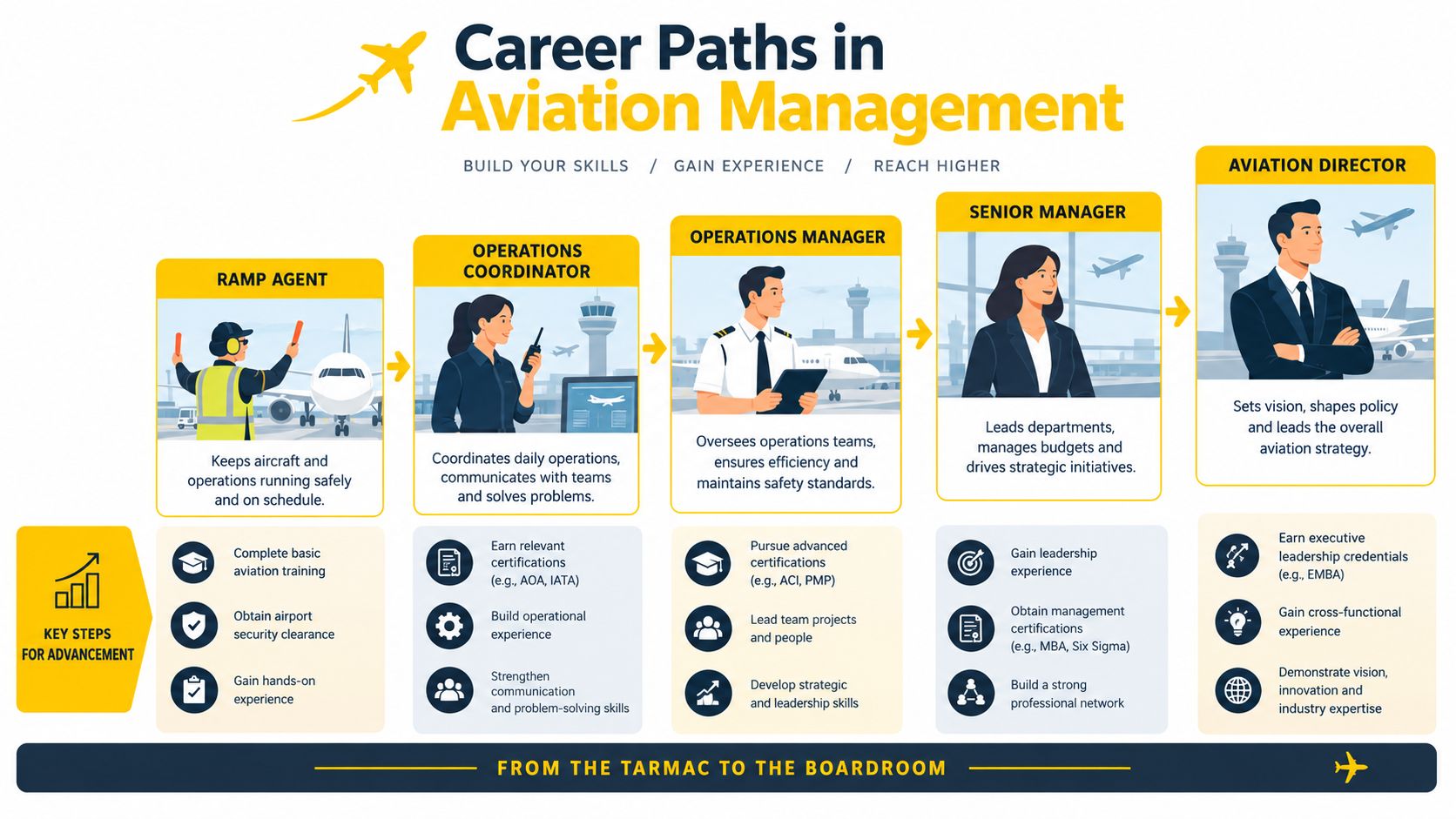
Aviation management careers usually develop through responsibility rather than title alone. A new entrant may begin by coordinating people, records, or schedules, then progress towards decisions that affect an entire operation.
Frontline experience builds operational judgement
Entry-level roles can include ramp coordination, drone operations coordination, flight dispatch, and scheduling. These positions teach how plans interact with aircraft availability, crew qualifications, weather, clients, ground activity, and time pressure.
A drone operations coordinator may not fly every mission. The role can still require a practical understanding of flight planning, aircraft limitations, CASA requirements, client communication, and records. That combination creates a credible base for operations control, compliance auditing, or safety investigation.
Mid-level roles connect evidence to action
At the next stage, professionals may manage a control function, review occurrences, audit procedures, or supervise several operators. A RePL can support operational work, while ReOC knowledge becomes important when the professional takes responsibility for organisational systems.
Career principle: Progression comes from proving that a person can make safe decisions consistently, explain them clearly, and improve the system after an event.
Senior roles can include head of operations, safety manager, accountable manager under CASR Part 119, and director-level positions at airlines, airports, or RPAS integrators. A diploma in aviation management or a tertiary degree may support strategic progression, especially where the role involves budgets, governance, workforce planning, or organisational change.
The transition isn't automatic. Each step should be measured against the next role's actual authority, experience expectations, and organisational responsibilities. A pilot who wants to become an operations manager should deliberately add scheduling, documentation, audit, investigation, and leadership experience rather than relying on flight hours alone.
Risk Management in Modern Australian Aviation
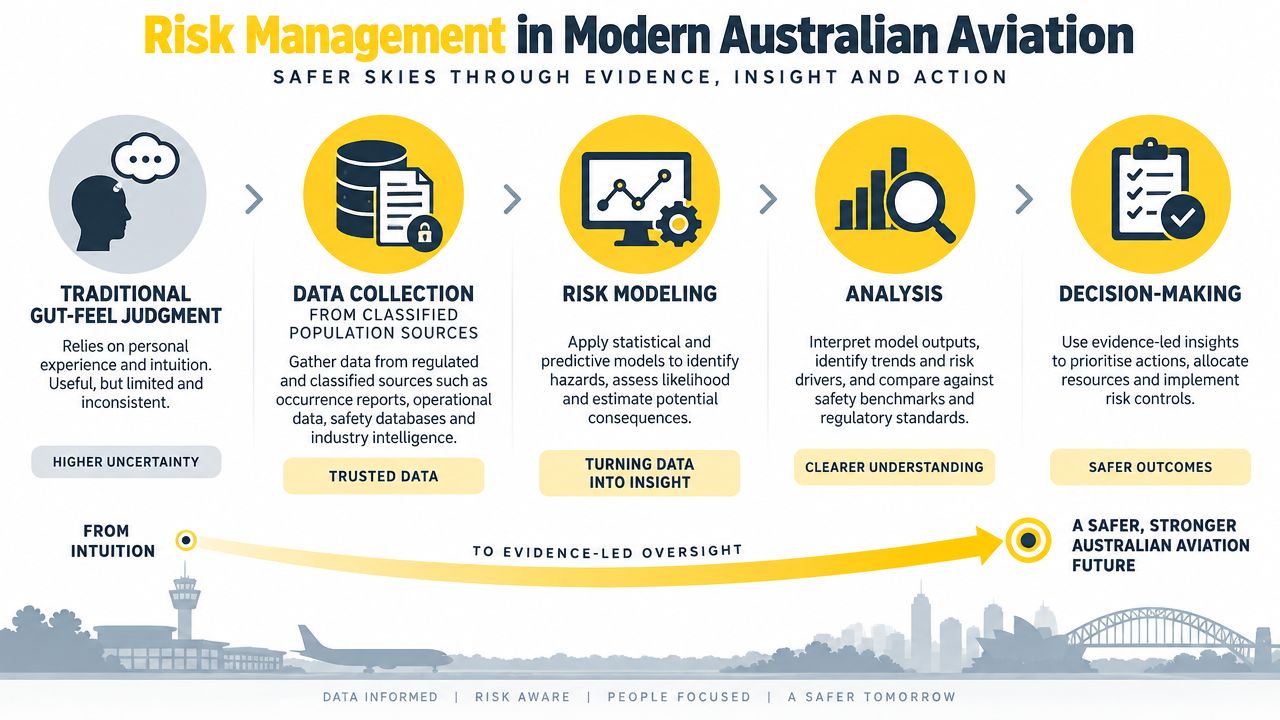
A drone operator plans a route beside a controlled aerodrome. A pilot prepares for a flight through forecast turbulence. In both cases, aviation management starts before take-off, by turning evidence about airspace, weather, aircraft capability, and people into operating limits. This is the practical value of Australia's data-driven safety approach.
Airspace decisions become measurable
For drone operations, CASA's Airspace Risk Modelling System, or ARMS, uses an expanding record of historical flight trajectories. It estimates how changes in traffic mix or flightpath design may affect mid-air collision likelihood and risk to people on the ground. The Australian UTM Action Plan sets out the practical direction of this work.
A manager assessing a route near a controlled aerodrome or infrastructure corridor can review traffic interaction, operating height, route design, and likely conflict points before deployment. The model does not make the decision by itself. It gives the manager a clearer evidence base for choosing a route, adding controls, or stopping the operation.
Weather adds another layer. The Bureau of Meteorology categorises turbulence by intensity and provides relevant information through GAF, AIRMET, TAF and TAF3, SIGWX, and SIGMET products. ATSB guidance aligned with Bureau categories describes light turbulence as typically producing 5 to 14 kt airspeed fluctuations and 0.15 to 0.49 g loading, moderate turbulence as 15 to 24 kt and 0.50 to 0.99 g, and severe turbulence as more than 25 kt and 1.00 to 1.99 g. Severe turbulence can cause momentary loss of control. The Bureau's turbulence education material explains these categories in detail.
From forecast information to operating rules
The manager converts information into instructions people can apply. A weather briefing may require a go/no-go decision, a lower operating limit, a revised route, extra contingency planning, or an aircraft with different capabilities. Airspace modelling follows the same path. Its result must become a clear instruction for the pilot, remote operator, dispatcher, and ground team.
BVLOS operations make this process more demanding. CASA has indicated that broad-area BVLOS trial approvals are scheduled to run through 15 October 2026, according to the annual report for the National Aviation Safety Plan. The report also records that the uncrewed RPA accident rate increased over the last year and was the highest as of 30 June 2025. Training and risk controls therefore need to develop alongside new operating models.
For planning around controlled locations, operators can use this drone safety guide for airports and high likelihood security locations. A manager's value lies in converting risk information into decisions that a team can follow under pressure.
How Ace Aviation Aerospace Academy Prepares Managers
Effective aviation management training must connect CASA compliance with operational judgement. Memorising a rule isn't enough if a student can't recognise when weather, airspace, aircraft condition, staffing, or client pressure changes the risk profile of a mission.
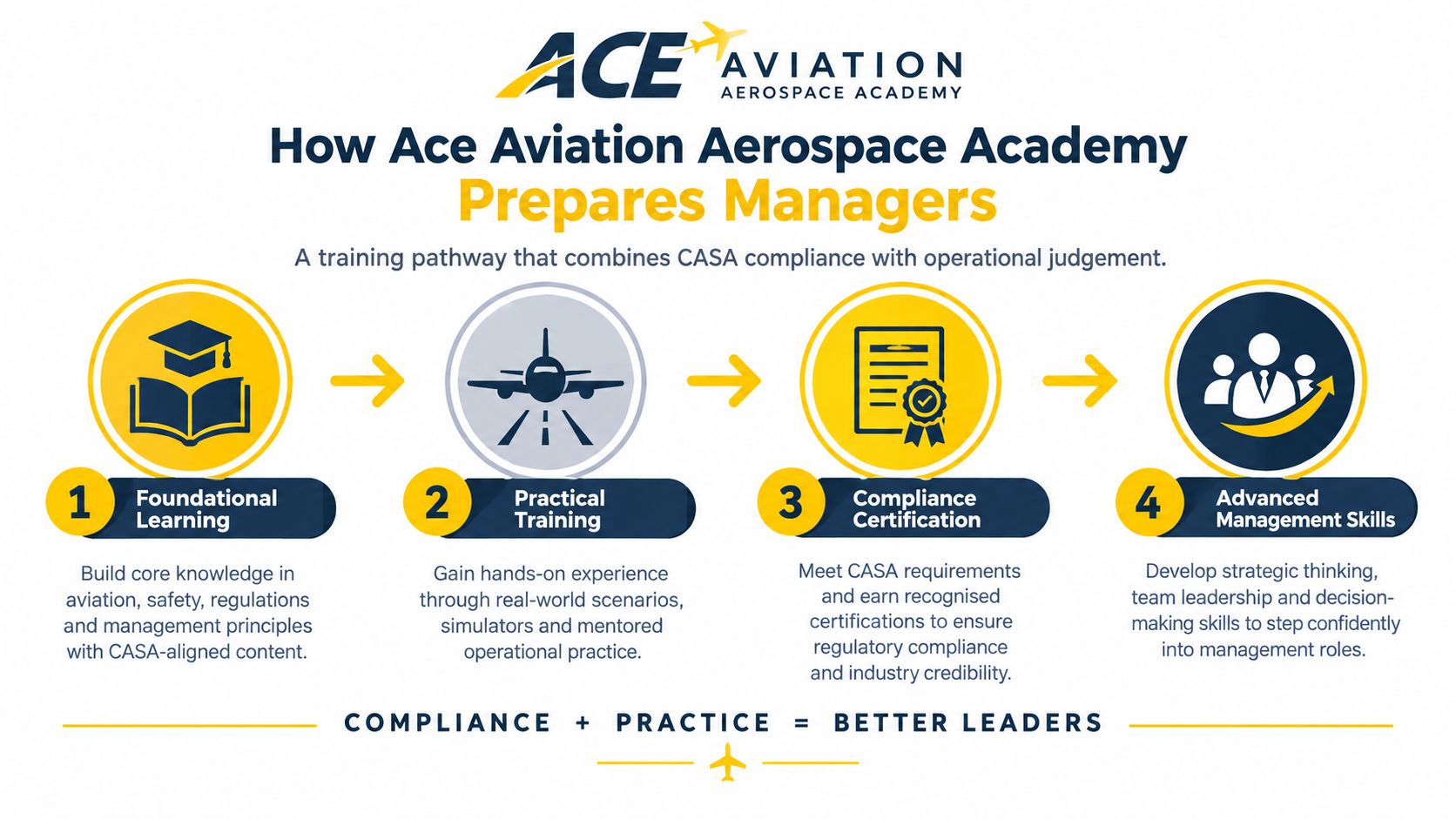
A structured pathway generally moves through foundational theory, practical or simulator-based work, compliance certification, and advanced management capability. Exercises should resemble real RePL, AROC, and ReOC workflows, including flight planning, radio procedures, records, risk assessments, and responses to changing conditions.
Training should reflect operational decisions
Scenario-based assessment helps students practise the judgement a coordinator or compliance officer uses every day. A useful scenario might require a student to review a proposed drone mission, identify an airspace conflict, interpret weather information, check the pilot's authority, and document a decision that another team member can understand.
Ace Aviation Aerospace Academy provides drone pilot education, aviation qualifications, industry certification, ReOC consulting, and specialised drone operation courses. Its training model is described through its information about why students choose Ace, while students should still compare providers against their intended role, current CASA requirements, practical content, and support arrangements.
Instructors who can connect regulations to daily operations add value beyond rote learning. Mentorship, scenario work, practical sessions, documentation exercises, and refresher learning can help professionals remain adaptable as uncrewed aviation develops, particularly around BVLOS approvals and drone integration.
A manager should leave training able to ask better questions. Which authority applies? What evidence supports the route? What does the weather mean for the aircraft and task? Who has the decision-making responsibility? Those questions produce safer operations than certification treated as an endpoint.
Frequently Asked Questions
Can someone enter aviation management without an aviation background?
Yes, entry pathways can begin with foundational aviation or drone training, operations coordination, scheduling, or ground roles. Year 12 completion requirements depend on the specific course and provider, while mature-age applicants may be considered under the provider's entry process. A prospective student should confirm prerequisites directly before enrolling.
How long does it take to obtain a RePL?
The timeframe depends on the selected training pathway, the student's preparation, the aircraft rating required, assessment arrangements, and CASA-related processing. A RePL is an operational credential, so moving into management also requires experience in planning, records, compliance, and team coordination.
Can an AROC alone lead to operations work?
An AROC addresses aviation radio communication. It doesn't by itself establish remote pilot authority, organisational authority, or broad operations-management competence. Employers may value it for roles involving air-band communication, but the complete role requirements still need to be checked.
How does CASA's safety data affect training?
Training increasingly needs to cover risk assessment, airspace analysis, weather interpretation, occurrence reporting, and evidence-based decision-making. Students should look for practical scenarios rather than theory that treats compliance as a list of disconnected rules.
Are online theory options available?
Some providers may offer remote learning for theory components, while practical flight and assessment requirements may still need an approved in-person arrangement. Each provider should confirm delivery method, attendance expectations, equipment, assessment, and current CASA compliance before enrolment.
Can overseas qualifications or international study lead to Australian aviation work?
Recognition depends on the qualification, issuing authority, role, and applicable Australian requirements. International students also need to check visa conditions, English language expectations, and whether the provider is authorised to enrol them. Overseas credentials shouldn't be assumed to transfer automatically.
Ace Aviation Aerospace Academy offers pathways covering RePL, AROC, aviation qualifications, ReOC consulting, and enterprise or corporate drone training relevant to Australian operations. Prospective students can review the available options and discuss the pathway that matches their intended aviation management role by visiting Ace Aviation Aerospace Academy.