
A drone operator can hold the right aviation credentials, arrive at an Australian mine site ready to work, and still be refused at the gate. Mining permit requirements sit outside CASA's aviation approval system, so a lawful drone flight also depends on state mining tenure, environmental permissions, heritage clearances, site safety controls, and contractor access.
The practical lesson is simple. A RePL, ReOC, drone registration and flight authorisation establish the aviation baseline, but they don't give a pilot permission to enter or operate on someone else's mining lease. The following guide breaks the approval pathway into the same layers a commercial operator should check before mobilising.
Table of Contents
- Arriving at the Mine Gate with the Wrong Paperwork
- What Mining Permit Requirements Cover
- The Layers of Approval a Drone Operator Must Clear
- How State Mining Permit Frameworks Differ
- Securing the Right Approvals Before Your First Flight
- A Realistic Mining Site Drone Operation Scenario
- Documentation Checklist for Mining Site Drone Work
- Key Takeaways and Connecting Permits to Your Pilot Credentials
Arriving at the Mine Gate with the Wrong Paperwork
The operator has driven for hours towards a remote Pilbara haul road entry point. In the vehicle folder are a current ReOC, an aerial work certificate, insurance documents and a carefully prepared flight plan. The equipment is secured, batteries are protected and the mapping mission is ready.
At the gate, the security controller asks for the mine's site induction confirmation, the relevant tenement reference and the job safety paperwork. None of those documents appears in the contractor portal. The operator has aviation approval, but the mine has no record of an authorised visit. The vehicle turns around.
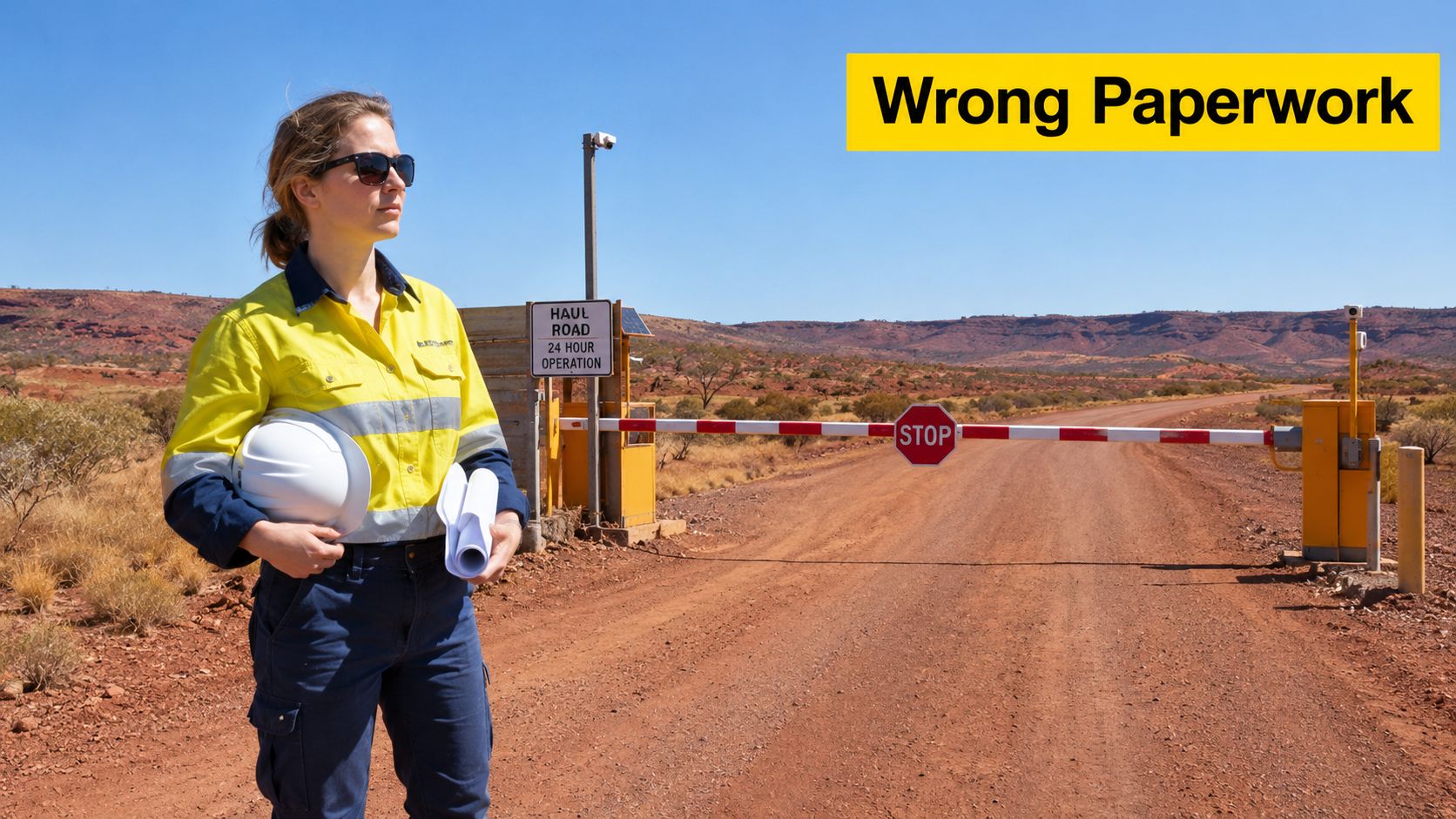
This situation is common because two different permission systems are being confused. CASA regulates the aircraft operation and the aviation credentials of the pilot or operator. State and territory authorities regulate mining tenure and related resource approvals. The mine owner or principal contractor then adds its own access and safety controls.
A useful way to understand a mine gate is as a controlled access point, not merely a security checkpoint. The site may use systems comparable to commercial gate access control to verify that a person, vehicle and task have been approved before entry.
The four practical layers are:
- State mining tenure: The lease, exploration permit or other authority must cover the relevant area and activity.
- Environmental and heritage clearances: The work must fit the project's environmental approvals and cultural heritage controls.
- Site-specific safety: Inductions, risk assessments, traffic controls and personal protective equipment must be accepted.
- Contractor management: The principal contractor may require insurance, prequalification, competency evidence and approved work documentation.
The flying skill still matters. It just isn't the first question at the gate. A CASA-aware operator checks every approval layer before treating the mission as ready.
What Mining Permit Requirements Cover
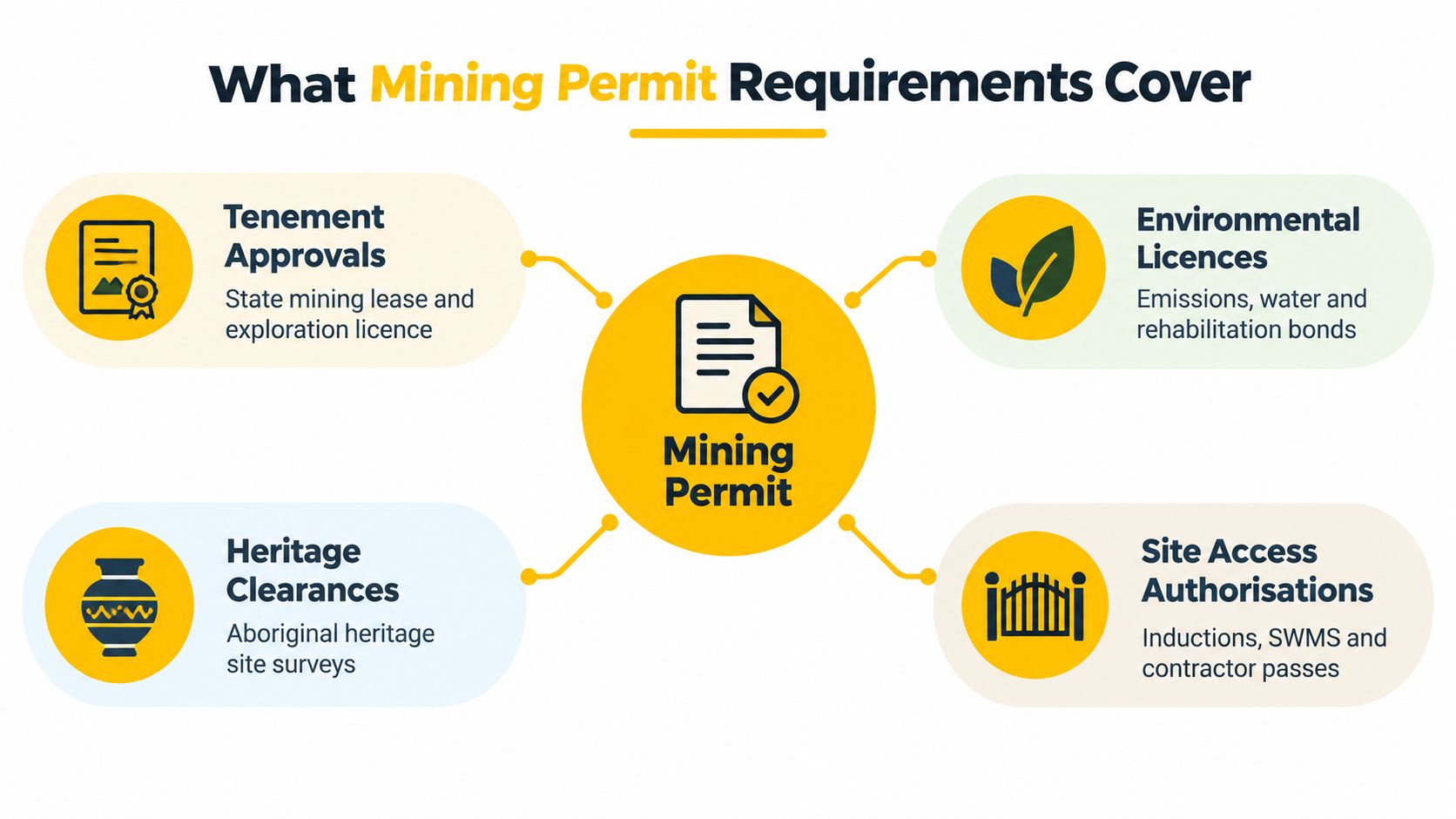
A mining drone mission can have an aviation-ready pilot and still lack permission to enter or operate on the project. Mining permit requirements connect the project's legal right to use an area with the approvals needed for its environmental effects, land access and site activities.
Australia has no single national mining permit covering every project. State and territory governments manage the main mining approvals, while a business may need separate authorities for exploration, production, infrastructure and surveying-related information gathering. The Australian Government mining industry overview explains this state-based structure.
The approval vocabulary
The same aerial survey may follow a different approval pathway depending on the project and jurisdiction:
- Exploration licences or permits authorise investigation within defined areas.
- Mining leases support production and related mining operations.
- General purpose or ancillary leases may cover facilities and infrastructure.
- Miscellaneous licences can cover access, roads, pipelines or other supporting works.
- Environmental authorities address clearing, water, rehabilitation and closure.
- Site access authorisations permit a named contractor and task to enter an operating site.
A drone pilot normally does not apply for the mining lease. The lease holder, mining company or project proponent manages that approval. The pilot still needs the correct tenement reference, written permission and scope of work. Together, these documents show that the proposed flight belongs to an authorised project rather than being an unauthorised activity over mining land.
Permit names can cause confusion. Resources that help operators understand permit types legal requirements do not make separate approvals interchangeable. Permission to access land does not replace environmental approval, and a mining lease does not replace a site induction or task authorisation.
CASA governs the aviation operation nationally. Mining regulators, environmental authorities, traditional owner engagement processes, landholders and mine operators control different parts of the ground-side permission chain. Operators can review drone laws in Australia, then confirm the project-specific mining approvals with the lease holder or site representative. The practical test is simple: the pilot must be authorised to fly, and the project must be authorised to host that flight.
The Layers of Approval a Drone Operator Must Clear
A pilot can arrive at a mine gate with a current licence and a compliant aircraft, yet still be refused entry. Mine-site work succeeds only when the project, land, environment, site and flight approvals fit together. The outer layers establish that the mine may operate in the area. The inner layers connect a named contractor and task to a specific shift.
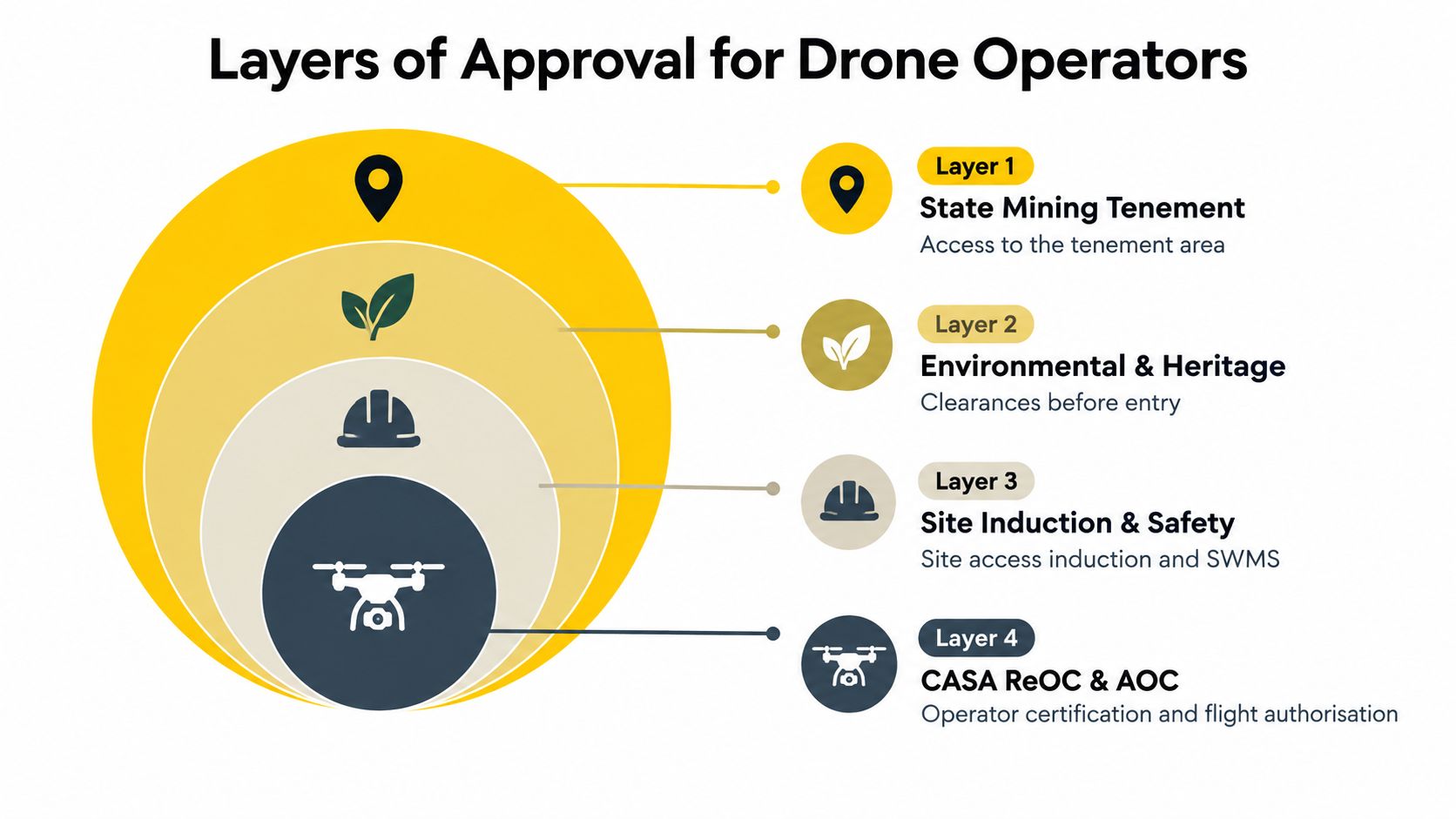
Layer one, state mining tenure
Start by identifying the relevant exploration permit, mining lease or other tenement. Confirm that it remains current and that aerial surveying, inspection or mapping falls within the project conditions. The tenement is the legal footprint for the work, much like checking the address before relying on a building permit.
Victoria shows why this check needs more than a quick form review. Applications are governed by the Mineral Resources (Sustainable Development) Act 1990 and the Mineral Resources (Sustainable Development) (Mineral Industries) Regulations 2019. The application must include the information required under Regulations 13 and 15, relevant Act provisions, supporting documents and the application fee. Victorian rules also restrict applications over existing licences, recently covered land within the applicable restriction period, exempt land such as national and state parks, and land subject to a tender process. Confirm the current details with the lease holder or the Victorian state regulator before relying on them.
Layer two, environmental and heritage permissions
Environmental approval can be a condition of project activity. In Queensland, a mining lease cannot be granted and the project cannot proceed unless the resource company holds a valid environmental authority, according to the Queensland mining environmental approval guidance.
The mission may also require evidence that it will not affect protected areas, native vegetation or Aboriginal heritage. A camera flight over an approved work zone may be treated differently from ground disturbance, but the mine's environmental and heritage teams decide whether the proposed task fits existing controls.
Layer three, site induction and safety
The mine controls access through its induction process, contractor system and task documentation. Depending on the operation, the pilot may need a SWMS, JSA, traffic management plan, exclusion zones, a communications procedure and supervisor approval. These controls connect the flight plan to the people, vehicles and hazards active on that shift.
Layer four, CASA and operational control
CASA credentials support the aviation operation, while the first three layers authorise the ground-side activity. Keep the RePL, ReOC evidence, aircraft registration, operating procedures and flight authorisation with the mine's documents. A structured guide to ReOC in Australia helps separate operator certification from site permission.
For operators pursuing a broader commercial pathway, ACE GOLD includes RePL, ReOC support, practical flight training, aviation compliance and business readiness for commercial drone operations.
Practical rule: If the lease holder cannot identify the tenement, site owner approval and task contact, the flight is not ready, even when the pilot and aircraft are CASA compliant.
How State Mining Permit Frameworks Differ
A drone contractor working across Australia can't assume that one state's terminology or lodgement sequence applies elsewhere. The underlying principle is consistent, but the evidence required for exploration, production, environmental clearance and closure varies by jurisdiction.
| State / Territory | Lead Authority | Key Permit Type for Drone Work | Typical Lodgement Portal | Notable Divergence |
|---|---|---|---|---|
| Queensland | Queensland resources and environmental authorities | Exploration permit or mineral mining lease | State resources systems | Exploration areas can be limited to defined sub-blocks, and environmental authority requirements depend on the activity and area. A mineral mining lease must include a mining program. |
| New South Wales | NSW Resources Regulator and planning authorities | Exploration title or mining lease | NSW resources and planning systems | A mining lease requires an economically mineable deposit, financial and technical resources, and development approval under the Environmental Planning and Assessment Act 1979. |
| Western Australia | WA mining resources authority | Exploration tenement or mining lease | WA mining resources systems | Ground-disturbing activity with mechanised equipment requires an approved Programme of Work. Mining leases require technical evidence, closure planning, security and an Affidavit of Compliance. |
| South Australia | South Australian mining and environmental authorities | Mining lease with approved PEPR | State mining systems | Production can't begin until the mining lease and approved PEPR are in place, following prior environmental impact assessment. |
| Victoria | Victorian minerals authority | Mining licence or extractive industry authority | RRAM portal | Applications require prescribed information and supporting documentation. Applicants may need a 1:25,000 geological map and five-year expenditure estimates for work and rehabilitation. |
| Tasmania | Tasmanian mining authority | Mining lease | Tasmanian mining systems | Applications can require a prescribed fee, six months' rent in advance, financial and technical evidence, a mining plan and public liability insurance determined by an inspector. |
Western Australia provides a clear example of milestone-based approval. A mining lease application must be supported by a Mining Development and Closure Proposal, or by a supporting statement with a qualified-person mineralisation report or JORC-compliant resource report. The applicant must also lodge a Form 32 security deposit of A$5,000 within 28 days and provide an Affidavit of Compliance, according to the WA mining lease requirements.
Queensland and South Australia demonstrate a different sequencing issue. Queensland requires a mining program for every mineral mining lease, while South Australian production requires an approved PEPR. The Queensland mining lease guide provides the relevant framework.
A pilot planning work in several regions should consult Beyond the Bitumen for industry context, then verify each job with the relevant lease holder. CASA compliance remains separate in every state.
Securing the Right Approvals Before Your First Flight
The safest sequence begins before travel. A contractor should identify who controls the site, what the task involves and which documents the mine expects before anyone loads a vehicle.
Start with the aviation file
The operator checks that the pilot's RePL, operator certificate, aircraft registration, aerial work certificate and any required area approval or flight authorisation remain current. The flight must also fit the operator's approved procedures and the aircraft's intended use.
The next call goes to the mining company or principal contractor. The pilot should obtain the legal entity's written engagement, the mine location, the tenement reference, the task description, the approved work area and the person responsible for accepting the flight.
Confirm ground-side permissions
The lease holder or project environmental team should determine whether the work triggers any mining notice, environmental referral or site-specific condition. The operator shouldn't decide independently that a low-altitude survey is exempt from every ground-side approval.
Heritage and Native Title checks belong with the project proponent and relevant representatives. The pilot should retain the clearance or written confirmation supplied by the project rather than relying on an informal verbal assurance.
The mine then sets its access requirements. These can include:
- Induction completion: The operator and any observer complete the required online and site-based induction.
- Risk documentation: The JSA, SWMS, task risk assessment and traffic plan are submitted for acceptance.
- Fitness and PPE: Drug and alcohol testing, medical requirements, high-visibility clothing, protective footwear, eye protection and hard-hat standards are followed.
- Emergency readiness: The crew learns evacuation routes, emergency contacts, radio channels and muster arrangements.
- Specialist permits: A radiation permit, hot work permit or confined-space authorisation may apply when the equipment, sensor or operating location creates that hazard.
A pre-flight meeting with the traffic coordinator should confirm active haul routes, exclusion areas, nearby cranes, manned aircraft activity and the approved launch and recovery point. The operator also checks aerodrome proximity, NOTAMs where relevant, weather, battery limitations and the accepted flight plan.
For beginners who need foundational preparation before advanced licensing, ACE READY covers drone fundamentals, aviation safety, CASA regulations, flight operations and preparation for RePL training. Operators who need advice on aligning training with a mining workflow can use the Ace consultation service.
A signed flight plan is not permission to improvise. If traffic, weather, people or environmental conditions change, the pilot pauses and asks the site contact to reassess the task.
A Realistic Mining Site Drone Operation Scenario
A commercial drone contractor is scheduled to complete a quarterly stockpile volumetric survey at a mid-tier coal operation in the Bowen Basin. The operator arrives at the gatehouse with CASA credentials, the state mining permit reference supplied by the client, contractor insurance evidence and confirmation that the mine induction has been completed.
The gate controller checks the contractor record and directs the operator to the survey contact. Before equipment leaves the vehicle, the geotechnical engineer confirms the stockpile boundaries, the approved launch point and the areas that must remain clear. The operator compares those boundaries with the day shift traffic plan, because haul trucks and light vehicles can change the risk picture even when the survey area hasn't moved.
The mapping drone is a multi-rotor aircraft configured for the survey. The operator completes the site pre-start, confirms communications and checks that the flight remains inside the accepted operating area. The geotechnical engineer stays available as the task contact, while the traffic coordinator monitors movements around the stockpiles.
A watering truck then approaches to control dust along an adjacent route. The pilot doesn't continue because the vehicle's movement changes the ground risk and may affect the agreed exclusion area. The flight is placed on hold until the traffic coordinator confirms a safe window and the geotechnical engineer accepts the revised timing.
The mission resumes only after the site team confirms that the route is clear. The operator captures the required imagery, lands, secures the aircraft and records the change in conditions in the job file.
After processing, the survey data is uploaded against the same mining tenement reference used in the work order. That reference links the contractor's aviation file, site access approval, task documents and final deliverable. The flight wasn't valid because the operator carried one powerful certificate. It was valid because every responsible party had approved the part under its control.
Documentation Checklist for Mining Site Drone Work
A mobilisation folder should let the mine's gatehouse, contractor manager, safety representative and flight supervisor answer the same question: who approved this operator to perform this task in this location today?
CASA credentials
The aviation section should contain:
- Remote Pilot Licence: RePL evidence for the pilot and any competency records required by the operator.
- Operator certificate: ReOC documentation where the operation is conducted under a certified operator.
- Aircraft records: Drone registration, maintenance information, equipment identification and operating limitations.
- Flight authority: Area approval, flight authorisation or other CASA documentation relevant to the proposed operation.
- Aviation coordination: Evidence of any required NOTAM coordination and the accepted flight plan.
Operators should distinguish between an individual pilot qualification and the organisation's operating authority. The drone licence information can help clarify the licensing pathway, but the mine still needs its own contractor and site records.
Mining and project approvals
The ground-side file should include:
- Tenement reference: The mining lease, exploration permit or other authority identified by the project.
- Written permission: A letter or work order from the lease holder, mine operator or principal contractor.
- Environmental evidence: Relevant environmental authority, referral outcome, clearing approval or project confirmation.
- Heritage evidence: Cultural heritage and Native Title clearance or written confirmation from the project team.
- Insurance certificates: Current certificates of currency required by the contractor system.
Site access and task controls
The final group covers:
- Induction record: Current site induction confirmation for every person entering the work area.
- JSA or SWMS: Accepted task risk documentation, including launch, recovery, vehicle and people controls.
- Contractor registration: Prequalification, principal contractor approval and site contact details.
- PPE confirmation: The clothing and protective equipment required by the mine.
- Emergency information: Muster points, emergency contacts, radio procedures and response arrangements.
Common mobilisation failures include an expired induction, a missing public liability certificate, an incorrect tenement number, an unsigned SWMS and a flight plan sent to the wrong site contact. A pre-departure document check catches those omissions before they become a gate delay.
Key Takeaways and Connecting Permits to Your Pilot Credentials
Mining permit requirements are layered, state-specific and separate from CASA licensing. The state or territory framework determines whether the project holds the relevant mining tenure and environmental permissions. The mine operator controls access, inductions, traffic arrangements and contractor acceptance. CASA credentials establish whether the pilot and operator can conduct the aviation activity.
The essential relationship looks like this:
- RePL: Demonstrates the pilot's remote piloting qualification.
- Drone registration: Identifies the aircraft within the aviation system.
- ReOC and operating procedures: Support the organisation's commercial operating framework.
- Mining tenement: Connects the task to an authorised area and project.
- Environmental and heritage clearances: Confirm that the work fits project and land controls.
- Site approval: Allows the contractor to enter, prepare and fly under local conditions.
The operator's most valuable habit is disciplined document matching. The task description, tenement reference, site contact, flight area, risk assessment and final data record should all describe the same job. That consistency gives the mine a clear audit trail and gives the pilot a practical basis for stopping when conditions change.
Mining companies are also formalising contractor verification as environmental, social and governance scrutiny increases. For compliant operators, accurate records aren't administrative decoration. They demonstrate that aviation law, mining tenure, environmental responsibility and site safety were considered together.
Aviation training can provide the foundation, but it doesn't replace project-specific permission. Commercial pilots should build the habit of asking for the tenement reference, environmental contact, induction status and accepted flight plan before committing to travel.
Ace Aviation Aerospace Academy provides CASA-compliant training relevant to commercial mine-site work, including the Remote Pilot Licence, aviation compliance education and ReOC consulting. Operators and businesses can review the available pathways and contact Ace Aviation Aerospace Academy to plan training around their mining operations.
Frequently asked questions
Does a RePL let a pilot fly on any Australian mine site?
No. A RePL supports the pilot's aviation qualification, but mine-site work also requires permission from the lease holder and compliance with state or territory mining, environmental, heritage and site-access controls.
Does an ReOC replace a mining lease or site access approval?
No. An ReOC concerns the operator's aviation framework. It doesn't grant land access, mining tenure, environmental approval or permission to enter a controlled work area.
Who manages mining permit requirements in Australia?
State and territory governments primarily manage mining permit requirements. The exact authority and documents depend on the jurisdiction, project type, land tenure and whether the activity involves exploration, production or supporting infrastructure.
Can a drone operator apply for the mine's environmental approval?
Usually, the mining company or project proponent manages the project approval. The drone contractor should provide task details and obtain written confirmation that the proposed survey or inspection fits the approved scope.
What documents should a pilot send before mobilisation?
The usual file includes CASA credentials, aircraft registration, operator approval, insurance, the mining tenement reference, written site permission, environmental and heritage confirmation, induction evidence, a JSA or SWMS and the accepted flight plan.
What should happen if site conditions change after approval?
The pilot should pause the operation and contact the designated site supervisor or traffic coordinator. A watering truck, changed haul route, people entering the exclusion area or altered weather can require a revised risk assessment or flight plan.