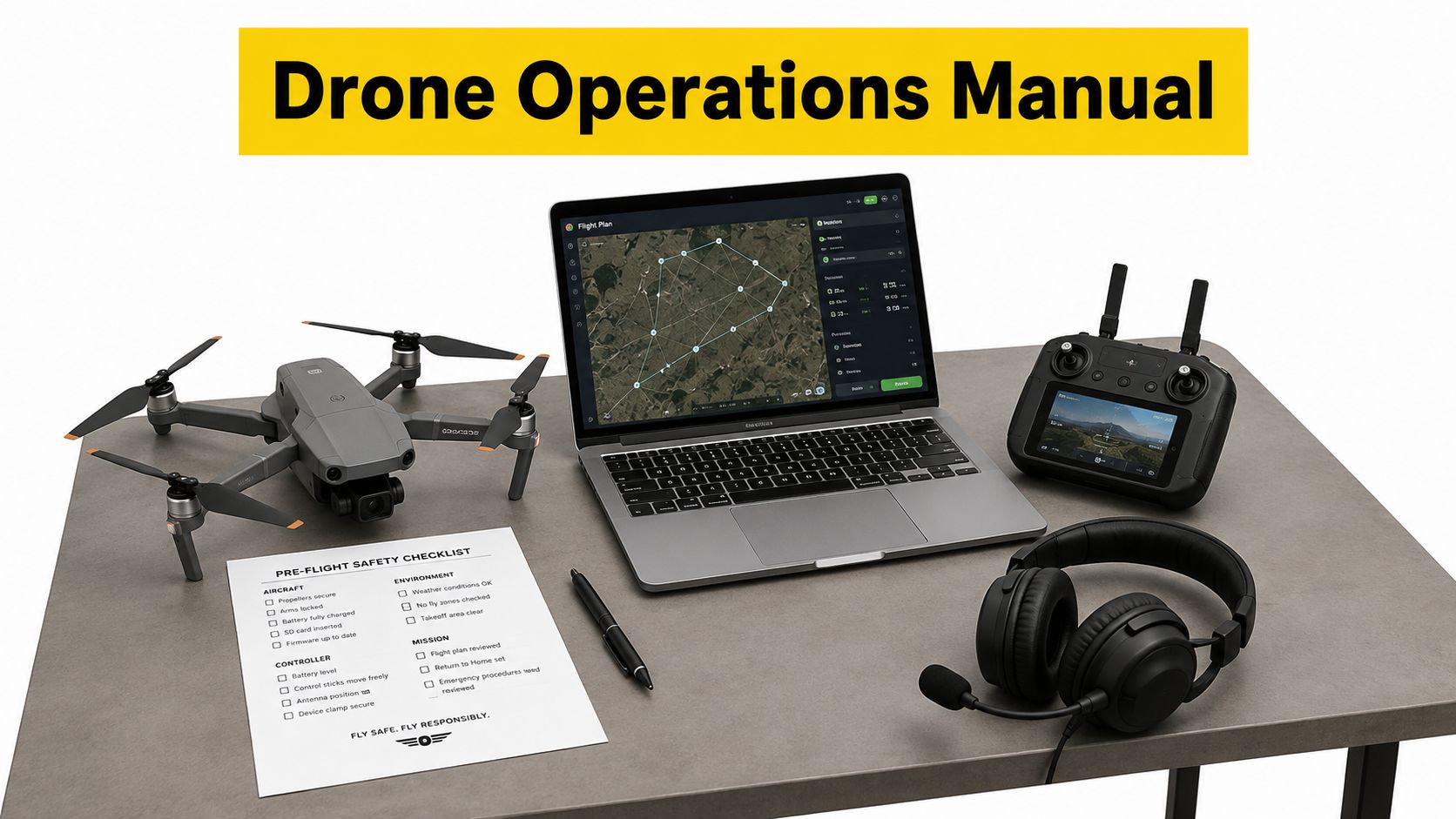
A borrowed template can look polished, include familiar CASA terminology and still fail to support an application. The problem usually appears when an assessor asks a simple question: who does what, under which conditions, and what evidence proves that the control was applied? A drone operations manual must answer that question consistently, from planning through to post-flight records.
For Australian operators, the manual is more than an attachment for a ReOC application. It's the operating system for the business, and it must reflect the aircraft, people, locations, clients and missions that the operator controls.
Table of Contents
- What a Drone Operations Manual Must Actually Prove
- CASA Requirements and Licensing Context
- Core Structure of a Compliant Manual
- Writing Risk Assessments and SOPs That Hold Up
- Operating Limitations Your Manual Must Address
- Radio and Communications Procedures for AROC Holders
- Keeping Your Manual Valid and Audit-Ready
What a Drone Operations Manual Must Actually Prove
A ReOC applicant can spend weeks adapting a manual copied from another operator, only to discover that the document describes aircraft, crew structures and missions that don't exist in the applicant's business. The resulting rejection isn't usually caused by a missing heading. It comes from a gap between the written procedure and the proposed operation.
In Australia, a drone operations manual is a central control document demonstrating that an operator's procedures align with CASR Part 101. CASA describes Part 101 as the framework that consolidates rules for remotely piloted aircraft and other unmanned aeronautical activities, including model aircraft, balloons, kites, rockets and fireworks. The CASA Part 101 regulatory framework also identifies Specific Operations Risk Assessment, or SORA, as CASA's default method for assessing complex operations such as flights near people and BVLOS activity.
The evidence behind the document
A useful manual demonstrates that the operator can:
- Define the operation: State what aircraft, payloads, pilots, observers, sites and mission types are within scope.
- Control foreseeable hazards: Show how the business manages airspace, people, weather, aircraft status, communications and emergencies.
- Assign responsibility: Name the person who performs each control, rather than referring vaguely to “the crew”.
- Produce records: Connect the procedure to flight records, job-safety assessments, maintenance evidence, training records and occurrence reports.
- Recognise boundaries: Identify when an activity needs additional approval, permission, mitigation or a separate risk assessment.
The documentation burden rises with operational exposure. Surveying over active worksites, agricultural operations near populated areas, infrastructure inspection beside roads, and emergency-service missions can involve changing people, airspace, access and environmental conditions. A manual for those activities needs more evidence than a generic document prepared for uncomplicated, repeatable flights.
A small operator doesn't need unnecessary bureaucracy, but it does need operational specificity. A risk control that works for a fenced survey site may be inadequate for a roadside inspection. A standard operating procedure for VLOS work can't silently become a BVLOS procedure because the pilot wants to extend the mission.
The core purpose: A drone operations manual must prove that the operator's written controls match the real operation and remain effective when conditions change.
Operators still building their qualifications can review the Remote Pilot Licence pathway, but licensing alone won't make a weak manual acceptable. CASA assesses the connection between competency, authorisation, procedures and evidence.
CASA Requirements and Licensing Context
A manual should be drafted only after the operator has identified the correct regulatory pathway. Otherwise, the document may promise capabilities the business isn't authorised or qualified to provide.
For Australian commercial operations, the usual compliance picture involves a registered aircraft, a Remote Pilot Licence, or RePL, for the relevant drone type and model, and an operator holding a Remotely Piloted Aircraft Operator's Certificate, or ReOC. The manual explains how that approved operation will be managed. It doesn't replace the licence, aircraft registration or operator certificate.
Matching the manual to the operation
The following distinctions prevent common drafting errors:
- RePL holder: The remote pilot must hold the relevant RePL privileges for the drone type and model being operated.
- ReOC operator: A business conducting commercial work generally operates under an ReOC, with the manual forming part of its operational control system.
- Registered aircraft: The aircraft must be registered where the applicable CASA requirements make registration necessary.
- Excluded pathway: A narrow private-landholder pathway may apply in specific circumstances, but it isn't a general commercial exemption.
CASA states that an RePL holder may fly an aircraft weighing more than 25 kg but not more than 150 kg over their own land without a ReOC only when the flight is for the person's own business or employment, no payment is accepted for the service, standard operating conditions are followed and required records are kept. The CASA RePL guidance makes the important boundary clear: accepting payment or operating outside those conditions changes the compliance position.
That pathway shouldn't be used to disguise paid aerial work. If a business is hired to map a neighbouring property, inspect a client's infrastructure or deliver an aerial service for consideration, the operator needs to assess the applicable commercial requirements rather than relying on land ownership.
Credentials that belong in the manual
The manual should identify each role, its required competency and its authority. Depending on the operation, that can include the chief remote pilot, remote pilots, visual observers, maintenance personnel, ground support staff and managers responsible for safety or records.
A RePL is directly relevant to pilot competency. An Aeronautical Radio Operator Certificate, or AROC, becomes relevant where the operation requires aeronautical radio knowledge and disciplined communications. Organisations planning a ReOC application can use this guide to ReOC requirements in Australia as a starting point, then confirm the current position with CASA before submitting an application.
The manual should never imply that a certificate grants permission for every mission. It must state which aircraft, operating conditions and personnel fall within the approved scope.
Core Structure of a Compliant Manual
CASA's RPAS Sample Operations Manual provides a practical minimum benchmark. It requires a risk register covering every operational profile, links each control to a manual procedure or legislative requirement, and requires a flight record with a job-safety assessment for every operation. CASA describes the sample manual as representing minimum acceptable risk-management processes, while complex operators may need additional controls or a complete safety-management system.
A manual works best when each chapter answers an operational question rather than merely repeating a regulatory heading.
The chapters assessors test
Operations management should identify the accountable structure, document control, approval authority and process for maintaining the manual. An organisation chart without decision rights doesn't tell the assessor who can stop a flight.
Personnel and crew responsibilities should define the chief remote pilot, remote pilot, visual observer and support roles. Each task needs an owner. “The crew monitors the area” is weaker than stating who establishes the exclusion zone, who briefs the team and who calls an abort.
Airspace assessment and flight planning should explain how the operator checks controlled airspace, restrictions, nearby aerodromes, site access, people, obstacles, weather and the planned operating area. A screenshot saved without a decision record isn't a complete assessment.
Aircraft systems and maintenance should cover aircraft selection, configuration, batteries, payloads, firmware or software controls, inspections, defect reporting and maintenance release decisions. The procedure needs to state what makes an aircraft unserviceable.
Emergency response should address lost link, fly-away, low battery, weather deterioration, collision risk, injury, property damage, unauthorised entry and communications failure. Emergency actions must be usable under pressure, not hidden in long narrative paragraphs.
Reporting and records should connect occurrence reporting, flight records, maintenance documents, training evidence and corrective actions. The operator needs to show what happened after a control failed or a procedure changed.
Operational limitations should state the boundaries for VLOS, people, airspace, altitude, weather, aircraft capability, communications and approvals. A limitation that isn't reflected in the go or no-go process is only a statement of intent.
A drafting checklist
| Manual Chapter | What It Must Cover | Common Weakness |
|---|---|---|
| Management and control | Accountabilities, document version, approval and amendment process | No owner for changes |
| People and competency | Roles, qualifications, briefings and supervision | Generic crew descriptions |
| Flight planning | Airspace, site, weather, people, aircraft and permissions | Map checks with no decision record |
| Aircraft and maintenance | Configuration, inspections, batteries, defects and release | Maintenance procedure detached from flight records |
| Emergency response | Lost link, fly-away, injury, collision and escalation | Actions written as broad principles |
| Reporting and records | Flight logs, job-safety assessments, incidents and corrective action | Records aren't linked to procedures |
| Limitations and approvals | VLOS, separation, altitude and advanced-operation boundaries | Manual implies wider privileges than approval |
The strongest manuals cross-reference controls. A risk-register entry should point to the relevant SOP, the SOP should identify the responsible role, and the flight record should provide evidence that the control was completed.
Writing Risk Assessments and SOPs That Hold Up
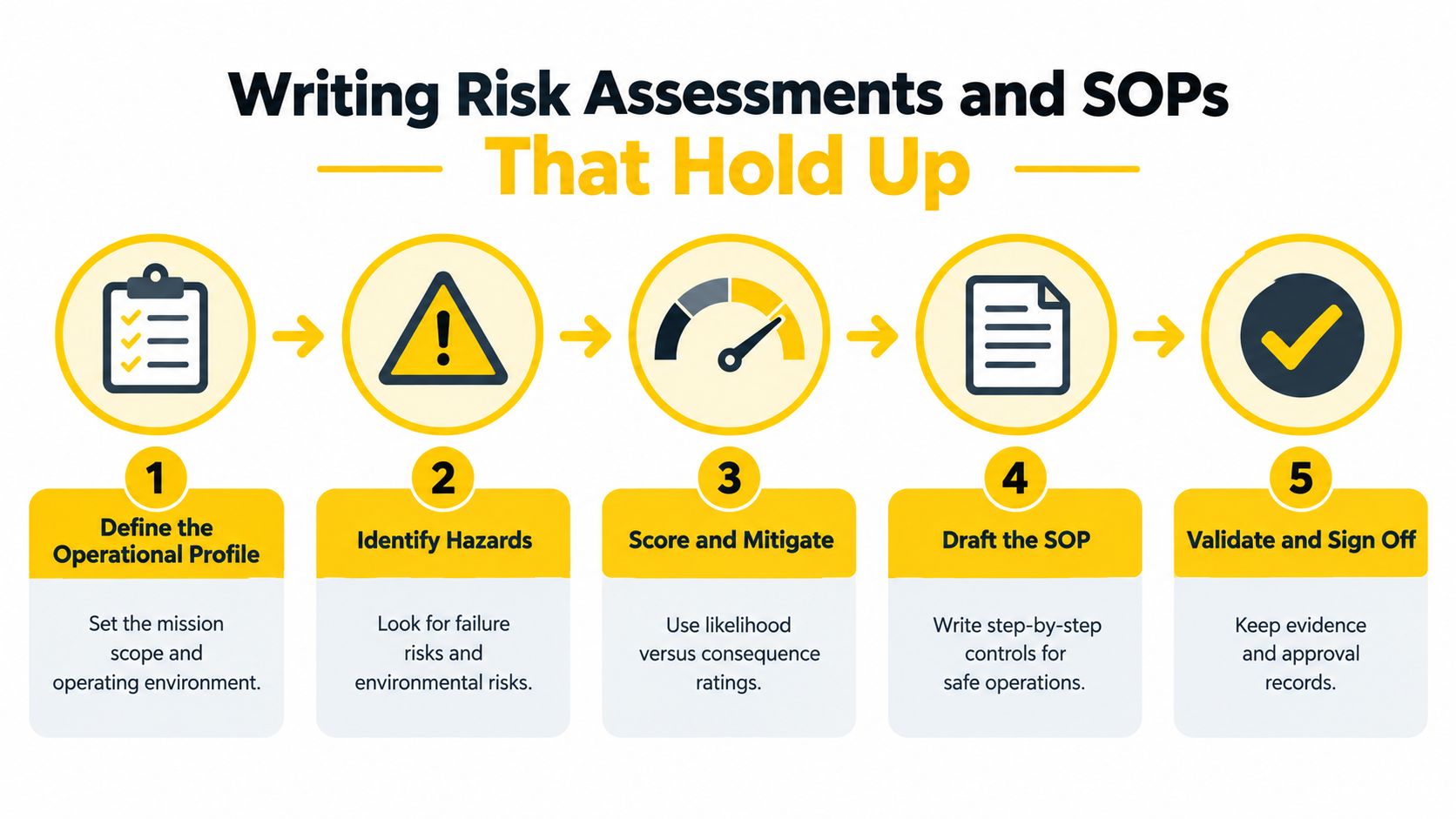
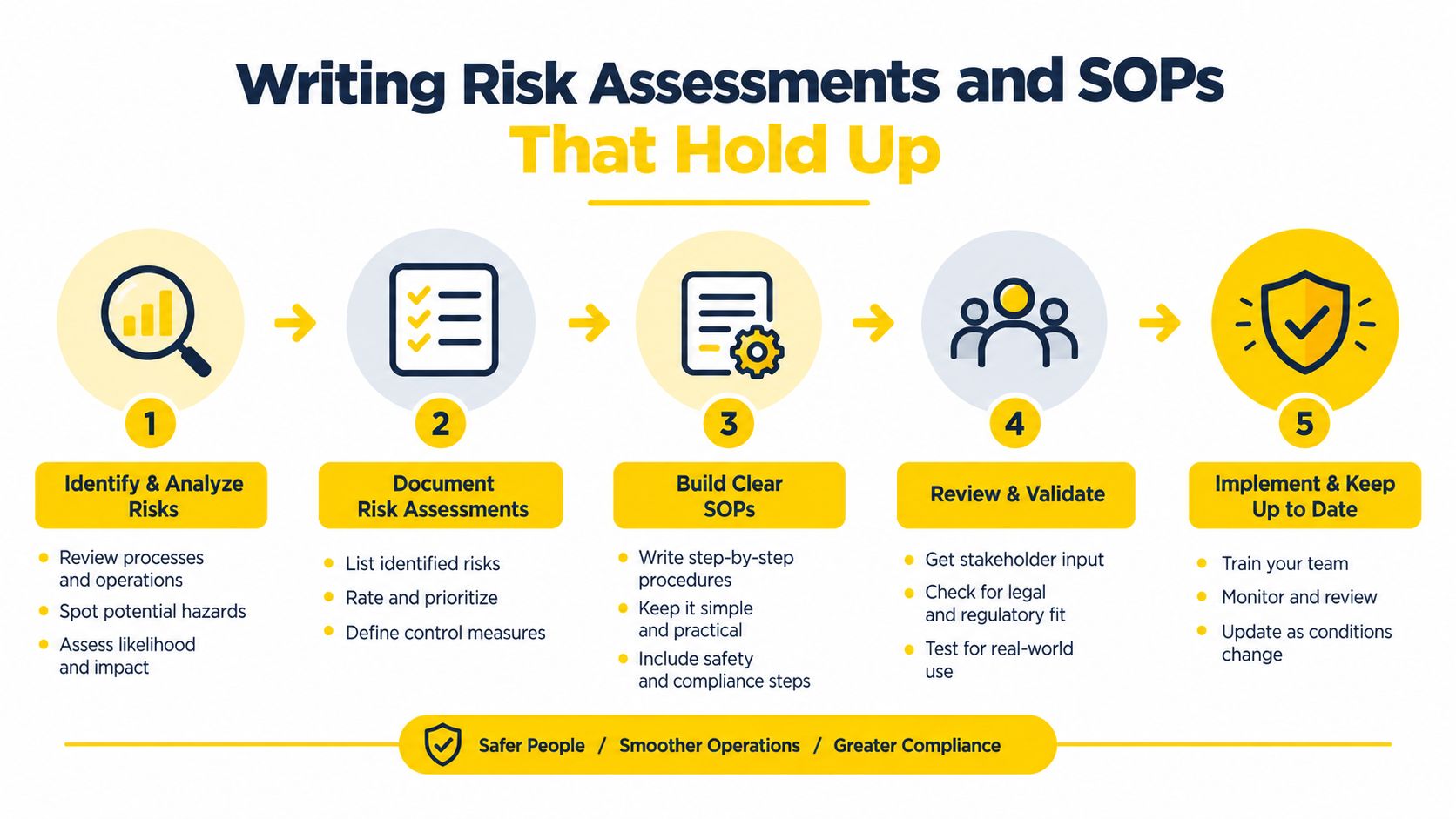
A risk register fails when it describes “drone operations” as one activity. A survey beside a quiet rural property, an inspection near a populated worksite and an emergency response flight have different hazards, controls and decision points. They need separate operational profiles or a clearly defined method for adapting the profile to the mission.
A practical workflow is:
- Define the operational profile. Record the aircraft, payload, location, airspace, people, altitude, route, crew, weather limits and mission objective.
- Identify hazards. Consider aircraft failure, people entering the area, controlled airspace, obstacles, poor visibility, battery degradation, lost link, radio interference and changing site conditions.
- Assess likelihood and consequence. Use the organisation's approved risk method consistently, and explain why the selected rating applies to the actual mission.
- Select controls. Choose controls that can be observed and checked, such as a defined exclusion zone, a named visual observer, a radio check or an abort trigger.
- Assign responsibility. Put a role or named person against each control.
- Brief the crew. Confirm that the people performing the controls understand them before launch.
- Fly and record outcomes. Capture deviations, incidents, weather changes, equipment defects and corrective actions.
Why airspace and separation controls need detail
Australian government safety material recorded 242 RPAS air-proximity events between January 2012 and June 2017, including 114 events during the 18 months from January 2016 to June 2017. The same material recorded 47 drone terrain collisions between January 2016 and June 2017. These historical figures are available in the Australian National Aviation Safety Plan, and they support explicit procedures for airspace awareness, separation, pre-flight checks and escalation.
Three weaknesses repeatedly undermine otherwise polished applications:
- Generic risk registers: The hazard list doesn't match the site, aircraft or mission.
- Unassigned controls: The manual says a check must happen but doesn't identify who performs it.
- Uncontrolled changes: A new aircraft, payload, location, automation mode or client requirement enters the operation without a documented review.
The go or no-go gate should be unambiguous. No launch should occur until the risk assessment, aircraft status, crew competency, airspace, weather, site permissions, emergency procedures and communications checks are documented. CASA's sample manual also requires a specific authorisation and additional risk assessment for operations above 400 feet AGL, so an altitude increase can't be treated as an informal field decision.
A useful drone pilot emergency handbook can support emergency planning, but the operator still needs to adapt the procedure to its own aircraft, locations and crew.
Operating Limitations Your Manual Must Address
A manual becomes credible when it describes the edge of the operation, not only the ideal centre of it. Assessors need to see what the pilot must do when visual contact weakens, a person enters the area or an emergency changes the planned flight path.
Visual line of sight
CASA's regulatory material describes visual line of sight, or VLOS, as the pilot's continuing ability to see, orient and steer the remotely piloted aircraft well enough to meet separation and collision-avoidance responsibilities. Corrective lenses may be used, but binoculars, telescopes and similar devices aren't a substitute for direct visual observation. Beyond visual line of sight, or BVLOS, generally requires CASA approval or an appropriate certified-operator authorisation.
The manual should turn that rule into observable actions:
- Before launch: Identify who maintains visual contact and where that person will stand.
- During flight: Define what counts as temporary loss of sight and the immediate response.
- If contact is lost: State the manoeuvre, landing or recovery action the pilot must take.
- For BVLOS proposals: Identify the approval, risk assessment and operating procedure required before the mission is accepted.
A camera feed isn't the same as the pilot maintaining VLOS. The procedure should distinguish aircraft orientation, collision awareness and navigation from viewing imagery on a screen.
Separation from people
Without CASA approval, an RPA must not normally operate within 30 metres of a person not directly associated with the operation. The applicable Australian legislation describes the 30-metre area as a cylinder extending vertically from the ground or water surface, with a constant horizontal radius of 30 metres. A limited reduction to 15 metres can apply to a very small, small or medium RPA where the person has consented.
The procedure must cover take-off, transit, worksite movement, landing and emergencies. A flight that begins outside the safety zone can still breach the separation requirement if a person walks into the aircraft's path or if an emergency landing area changes.
Operators can find related context in this guide to Australian drone laws, but the manual should state the organisation's own method for establishing, monitoring and restoring separation.
Radio and Communications Procedures for AROC Holders
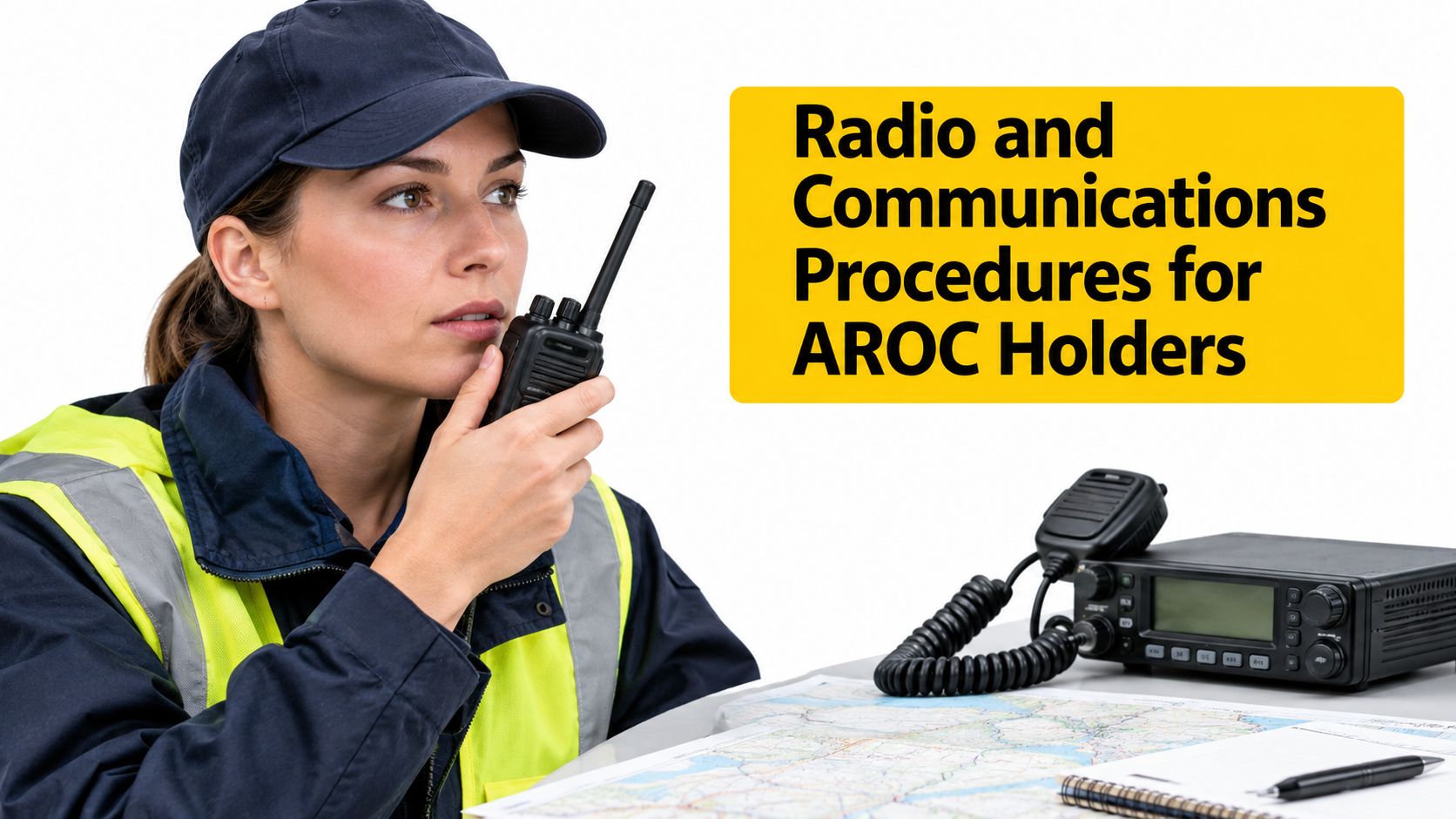
Radio use shouldn't be left to individual habit. A compliant procedure makes each important transmission predictable, identifiable and recoverable in the records.
A repeatable transmission sequence
Before transmitting, the operator should:
- Confirm the approved frequency and radio configuration.
- Listen for existing traffic before pressing transmit.
- Identify the aircraft or station correctly.
- Use concise, standard phraseology.
- Read back safety-critical instructions.
- Record significant communications in the flight record.
ACMA's aircraft and aeronautical mobile-station rules%20Class%20Licence%202026.pdf) require the station to transmit an aircraft marking, registration or another clear identifier during each transmission or series of transmissions. The rules also state that aircraft-station operation requires CASA certification and that operators must use a call sign, even though ACMA doesn't issue one for the class licence.
The manual should specify the exact call-sign format used by the organisation, how the frequency is selected, what constitutes an acceptable radio check, and which instruction takes effect if communications degrade. A phrase such as “maintain radio contact” isn't enough. The procedure should identify the lost-link communications plan, fallback channel or method, escalation route and landing or recovery decision.
Common failures
Transmitting without monitoring can block safety-critical traffic. Omitting the aircraft identifier makes the transmission harder to associate with the operation. Non-standard language creates ambiguity, while failing to preserve significant communications removes evidence that the crew received and understood an instruction.
These controls are especially relevant to RePL, AROC and ReOC operations conducted near controlled or high-traffic airspace. Operators pursuing an AROC qualification should ensure that radio knowledge becomes an auditable company procedure, not only an individual pilot skill.
Keeping Your Manual Valid and Audit-Ready
Possessing a CASA-style document doesn't prove that the operation is controlled. A manual stays valid only when the operator can show that changes are assessed, approved, communicated and reflected in field records.
CASA's advanced-operations material covers flights over or near people, experimental certificate protocols and the JARUS SORA framework, alongside sample manuals and exposition guidance. This CASA collection of manuals, handbooks and templates supports a living-document approach rather than treating the manual as a one-time application attachment.
Changes that should trigger review
The operator should define review triggers before a change occurs. Examples include:
- Aircraft or payload changes: A different aircraft, configuration or payload may alter performance, failure modes and emergency actions.
- Mission changes: A new industry task, route, altitude, automation level or operating environment may require a new operational profile.
- People changes: A new pilot, observer, subcontractor or client-side coordinator may affect competency and responsibility.
- Site changes: New obstacles, public access, nearby aviation activity or changing population exposure can invalidate an earlier assessment.
- Communication changes: Loss of mobile coverage, suspected interference or a different radio assumption should trigger a communications review.
- Occurrence trends: An incident, near encounter, defect or repeated procedural deviation should lead to corrective action.
Version control should show the document number, approval date, amendment description, affected procedures and person responsible for authorisation. The operator should remove obsolete copies from field use and brief affected personnel before the revised procedure becomes active.
Evidence that survives an audit
A practical maintenance system keeps the manual connected to operations:
- current pilot and competency records
- aircraft registration and configuration details
- maintenance and defect records
- operational-profile risk assessments
- completed flight records and job-safety assessments
- site permissions and airspace checks
- emergency exercises or briefings
- occurrence reports and corrective actions
- subcontractor responsibilities and client interfaces
- periodic review records
Responsibility often becomes unclear when the aircraft owner, remote pilot, landholder and contracting organisation are different entities. The contract and manual should state who controls the operation, who supplies site information, who briefs people, who can stop the flight and who retains the records.
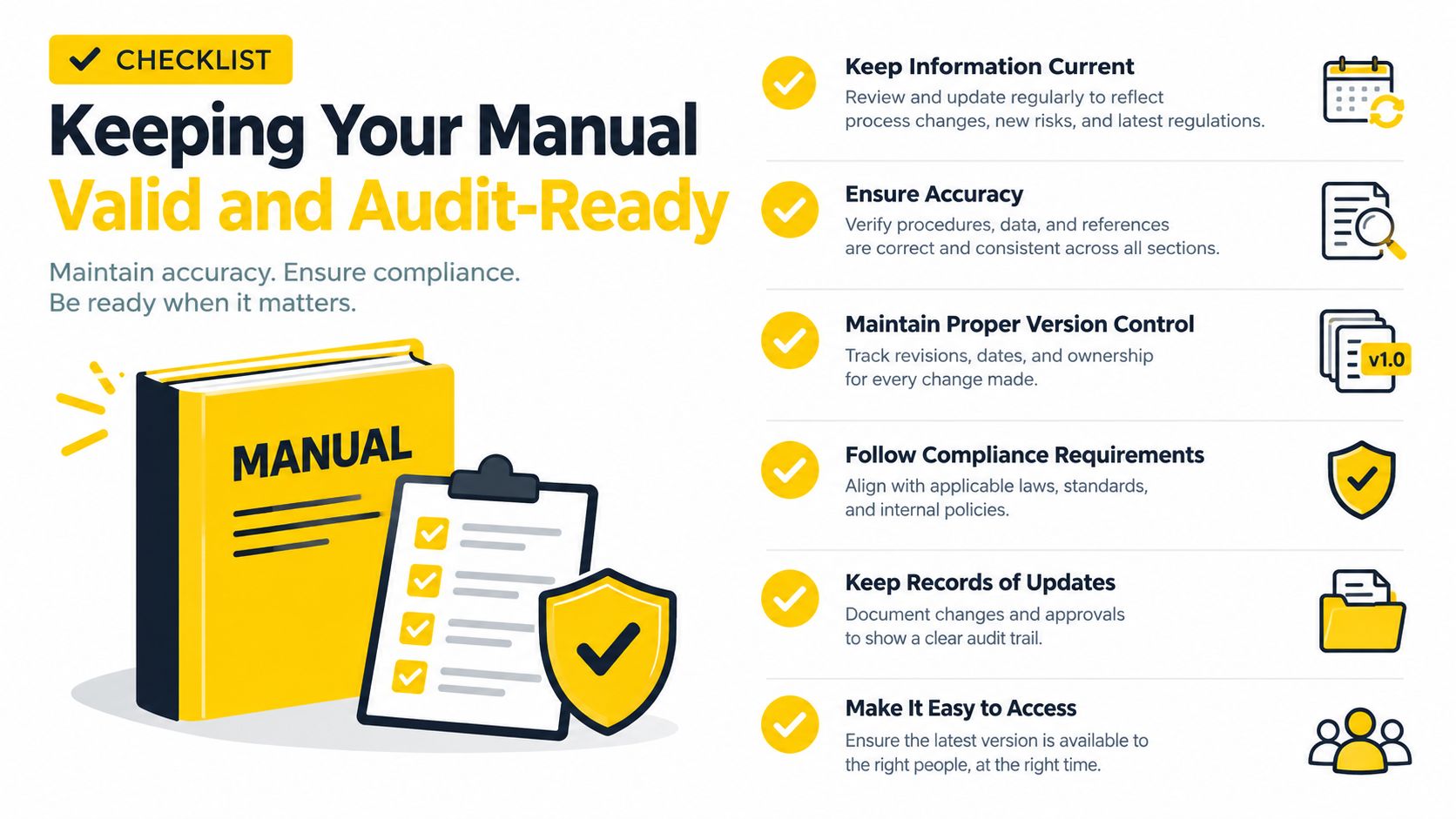
A compliant manual is therefore a controlled system, not a document stored in a shared folder. Ace Aviation Aerospace Academy provides ReOC Consulting and RePL training for operators that need support connecting qualifications, operational procedures and CASA-facing documentation.
Frequently asked questions
Does every drone operator need a drone operations manual?
Not every flight falls into the same approval or operating category. A business should determine its applicable CASA pathway, then prepare documentation that matches the actual operation and any certification or approval requirements.
Can an operator copy CASA's sample operations manual?
CASA's sample manual is a useful minimum benchmark, but copying it without adapting the operational profiles, aircraft, roles and controls creates weaknesses. The final document must describe the operator's real activities.
What should happen when a new drone is purchased?
The operator should assess the aircraft's configuration, payload, performance, maintenance requirements, emergency procedures and relevant operating limitations before using it under the existing manual. The change should be version-controlled and briefed to affected personnel.
Does an AROC replace a RePL?
No. An AROC addresses aeronautical radio competency, while an RePL relates to remote pilot competency for the relevant aircraft type and model. The manual should identify which qualifications each role requires.
What records should be kept after a flight?
The operator should retain the flight record, job-safety assessment, aircraft status, crew details, airspace and weather checks, site permissions, significant communications, defects, incidents and corrective actions relevant to the operation.
When should a SORA or additional approval be considered?
Complex operations, including BVLOS flights and operations near people, may require CASA approval, additional mitigation or a SORA-based assessment. The operator should define review thresholds rather than allowing the pilot to make an informal decision at the site.
Businesses preparing for CASA review can use Ace Aviation Aerospace Academy for relevant RePL and ReOC Consulting support, with procedures built around real operating profiles, assigned responsibilities and audit-ready records. Operators should review their current manual against the go or no-go process, communications controls and change-management triggers before submitting an application or accepting a new mission.