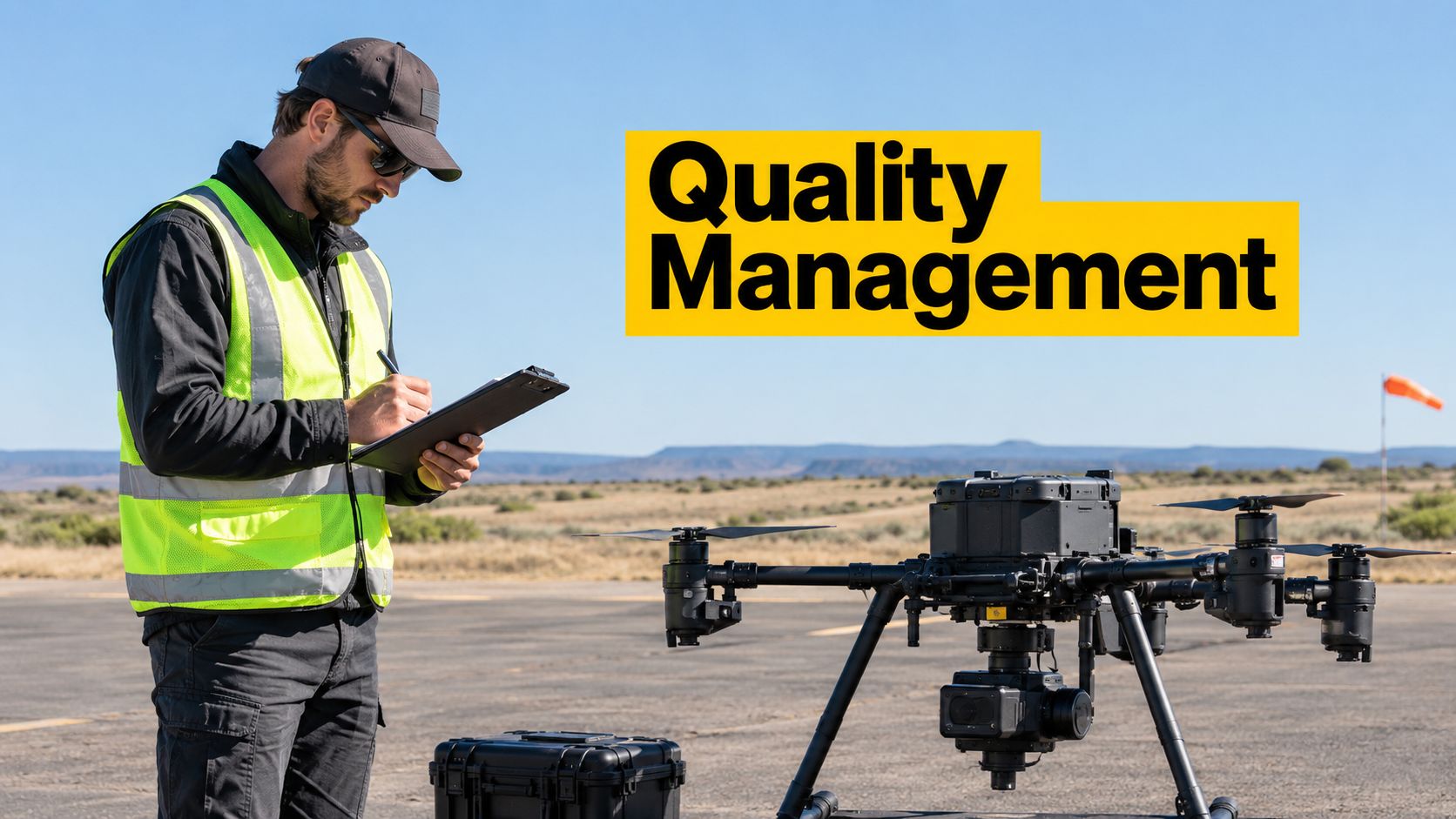
A regional survey contract is ready to start, but the ReOC holder discovers a problem during a final records check. The post-flight template contains the wrong proximity distance, the airspace assessment is saved under an unclear filename, and the pilot's debrief doesn't show who approved the operating area. Two days later, the client asks for the flight records. The team can explain what happened, but it can't prove that the operation followed its own procedures.
That situation is common in small drone businesses because quality often sits in the pilot's memory, scattered spreadsheets, and a manual that hasn't been reviewed since it was approved. Aviation quality management replaces that uncertainty with a practical system of procedures, evidence, review, and corrective action. For Australian ReOC operators, the aim isn't paperwork for its own sake. It's to make each operational decision repeatable and defensible when CASA, a client, an insurer, or an internal manager asks for evidence.
Table of Contents
- Why Aviation Quality Management Matters for Australian Drone Operators
- What Aviation Quality Management Actually Means
- The Regulatory Context in Australia
- Core Principles of an Effective Aviation Quality System
- Roles and Responsibilities Inside a Drone Operation
- Quality KPIs Worth Tracking Day to Day
- Common Pitfalls When the Rules Keep Moving
- Benefits, Risks, and Practical Next Steps
Why Aviation Quality Management Matters for Australian Drone Operators
A ReOC holder receives a request to inspect infrastructure near a populated area. The pilot knows the aircraft, checks the site, and completes the job safely. A week later, a client asks whether the operation met the approved conditions. The operator can describe the flight, but the evidence is spread across emails, an outdated checklist, and a file that does not show which rule set was applied.
That gap is an aviation quality problem. A flight can be conducted competently while the organisation still struggles to prove that its decisions were controlled. Aviation quality management closes that gap by linking operational decisions to current procedures, assigned approvals, usable records, and corrective action.
Quality makes changing rules manageable
Australian drone operations must account for aerodromes, populated areas, controlled airspace, roads, infrastructure, and other aircraft. CASA's standard operating conditions include a maximum height of 120 metres, or 400 feet, above ground level, visual line of sight, restrictions on flying over people or within 30 metres of people not involved in the operation, and limits involving cloud, fog, smoke, aerodromes, and approach or departure paths. These requirements are set out in CASA's drone safety rules.
The practical challenge is change. A procedure that works for a standard visual-line-of-sight mission may need revision when the operation involves different proximity conditions, a new approval pathway, or BVLOS planning. Quality management treats each regulatory or operational change like a configuration change in an aircraft system. Someone identifies it, assesses its effect, updates the relevant document or form, briefs affected people, and checks that the new process is being used.
That sequence prevents a familiar failure: the manual contains one requirement, the checklist contains another, and the pilot relies on memory. It also gives managers a way to find recurring weaknesses, such as incomplete site assessments, inconsistent battery records, or training gaps, before they become client findings or regulatory concerns.
Oversight depends on usable evidence
CASA reported 168 accidents in 2024–25, below the 10-year average of 198.1, and 28 commercial aviation accidents, below the 10-year average of 47.9. It also reported 97% completion of scheduled surveillance events, compared with 94% in 2023–24 and a 90% corporate plan target. These figures show how surveillance completion, targets, and trend monitoring support oversight and continuous improvement, as documented in the CASA Annual Report 2024–25.
For a drone operator, the lesson is practical. Quality management is not a checklist collected for an audit. It is the change-management discipline that keeps approved operating limits, pilot decisions, and supporting records aligned, so the system remains understandable and audit-ready as CASA requirements develop.
What Aviation Quality Management Actually Means
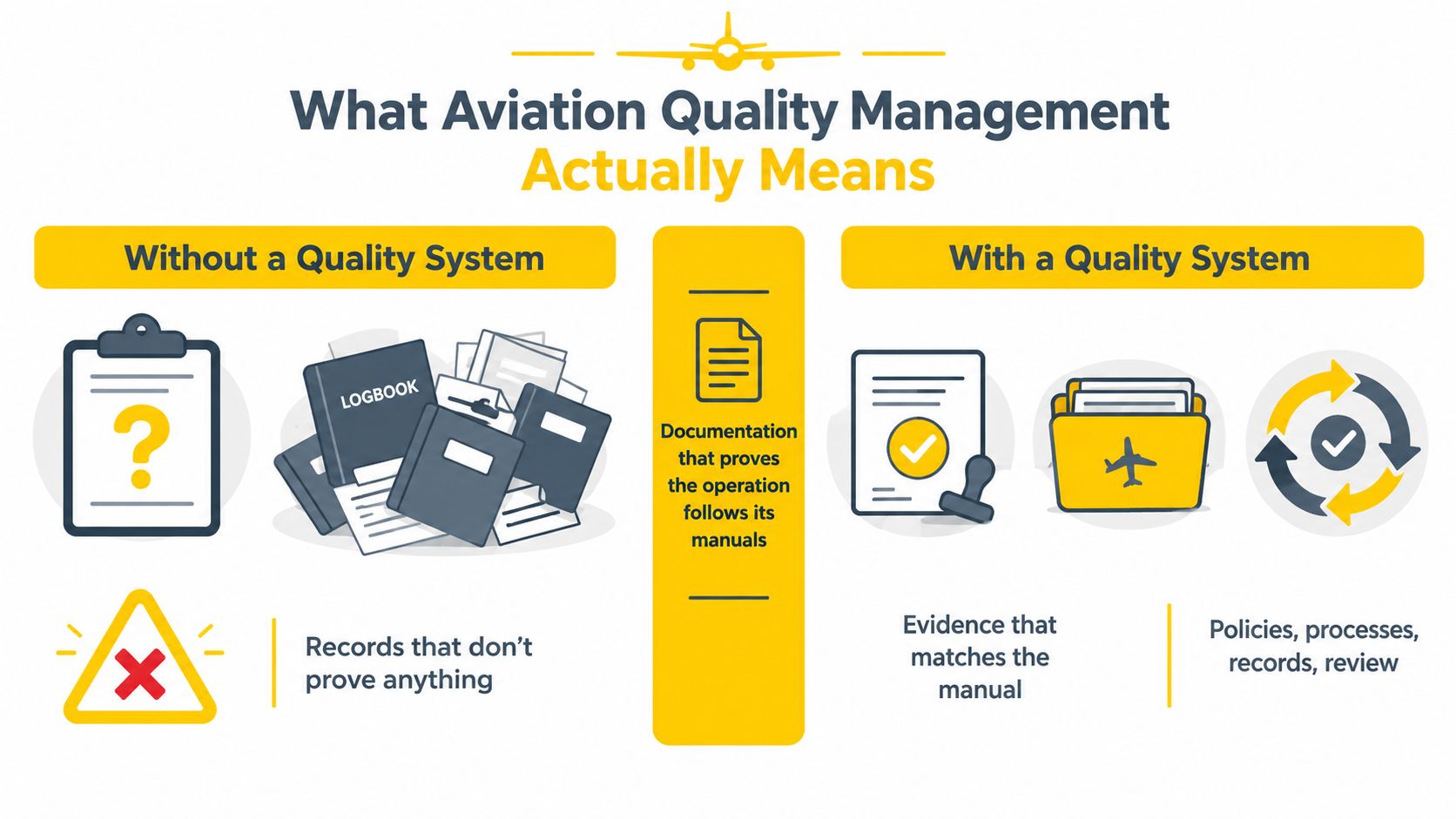
Aviation quality management is the organised set of policies, processes, records, and review loops that demonstrates an operation is performing work to its approved standard. For a small ReOC holder, the quality system may not be a large department or a complex software platform. It may consist of the operations manual, controlled forms, a training matrix, a hazard and corrective-action register, and scheduled reviews.
The important question is not whether the business has a polished manual. The question is whether the records show that the manual is being followed during real operations.
QMS and SMS answer different questions
CASA distinguishes a Quality Management System, or QMS, from a Safety Management System, or SMS. The SMS is risk-based and focuses on hazards, risk, and protection. The QMS focuses on products, services, and production. CASA also states that enhancing a QMS to meet SMS expectations can improve effectiveness and assurance of high safety performance standards, as explained in Safety Management System Basics.
The distinction becomes clearer through an example:
- QMS question: Was the pre-flight inspection completed using the current form, and is the completed record retrievable?
- SMS question: Did the inspection identify a battery condition that created an unacceptable operational risk?
- QMS question: Did the pilot complete the required training and competency check?
- SMS question: Was the pilot competent for the actual weather, airspace, aircraft, and mission profile?
The systems must communicate. A safety report may reveal that a procedure is unclear. A quality audit may reveal that a hazard-reporting process isn't being used. The QMS checks conformity and evidence, while the SMS examines operational risk.
The small-operator version
A ReOC holder can start by mapping each operation from preparation to close-out:
- The job is accepted against the operator's scope and capability.
- The site, airspace, people, weather, aircraft, and crew are assessed.
- The current procedure and forms are issued.
- The flight is conducted and deviations are recorded.
- Defects, hazards, and lessons are reviewed.
- Actions are assigned, completed, and verified.
That structure is compatible with the role of a ReOC. CASA describes a ReOC as an operating certificate, not a pilot licence. It permits a business to conduct approved RPA operations, employ remote pilots, and develop operational procedures and manuals under Part 101 MOS 2019, with business drones requiring registration under CASA's registration requirements.
For a person building both pilot capability and commercial operating readiness, ACE GOLD combines RePL training, ReOC support, practical flight training, aviation compliance, and business readiness. The quality principle remains the same regardless of training pathway: the operation must be able to prove that its approved system works in practice.
The Regulatory Context in Australia
Quality management sits within a broader regulatory expectation, not in a separate compliance category that can be added at the end of a ReOC application. CASA stated in its 2017–18 Corporate Plan that it was “adopting a thorough quality management systems approach to drive continuous improvement across all facets of the organisation”. Similar language appeared in later planning documents, including the 2022–23 and 2025–26 budget papers, as recorded in the CASA planning and audit material.
That continuity matters. It indicates that quality management has been treated as a sustained governance method rather than a one-off project. It also creates a useful standard for operators. A business seeking a ReOC should be prepared to show not only what its procedures say, but how the organisation checks whether those procedures remain effective.
Policy and practice must match
An Australian National Audit Office audit found in 2022 that CASA was “not regularly reviewing and updating its surveillance approach” and that “there is no quality assurance process in place for reviewing the quality of surveillance activities”. Those findings concern the regulator, not drone operators, but they illustrate a central aviation lesson: a documented policy can exist while operational assurance remains incomplete.
A ReOC holder faces the same structural risk at a smaller scale. A manual can describe a well-defined inspection process, but missing signatures, outdated forms, unclosed corrective actions, or inconsistent records may show that the process isn't embedded.
The Australian drone laws and regulatory framework guide should be used as a starting point for regulatory awareness, while the operator's controlled procedures must remain aligned with the applicable CASA requirements and the operation's approved scope.
What traceability looks like
A traceable system connects:
- Requirement: The applicable Part 101 MOS or operating condition.
- Procedure: The section of the operations manual that controls the activity.
- Person: The named pilot, reviewer, or manager responsible.
- Record: The completed assessment, checklist, log, or approval.
- Review: The finding, corrective action, and evidence of closure.
The process is particularly important for an operator applying for, renewing, or changing a ReOC. CASA's framework requires a business operating under a ReOC to use appropriately licensed personnel and approved procedures. A well-written manual supports the application, but controlled evidence demonstrates that the organisation can manage its approved operations consistently.
Quality management is therefore not an optional annex. It is part of demonstrating that the certificate holder is capable of controlling the operation it proposes to conduct.
Core Principles of an Effective Aviation Quality System
A practical drone quality system can be built around four connected principles: documented processes, risk identification, measurable performance, and continuous improvement. Each principle should produce evidence that a small operator can maintain without creating an unmanageable administrative burden.
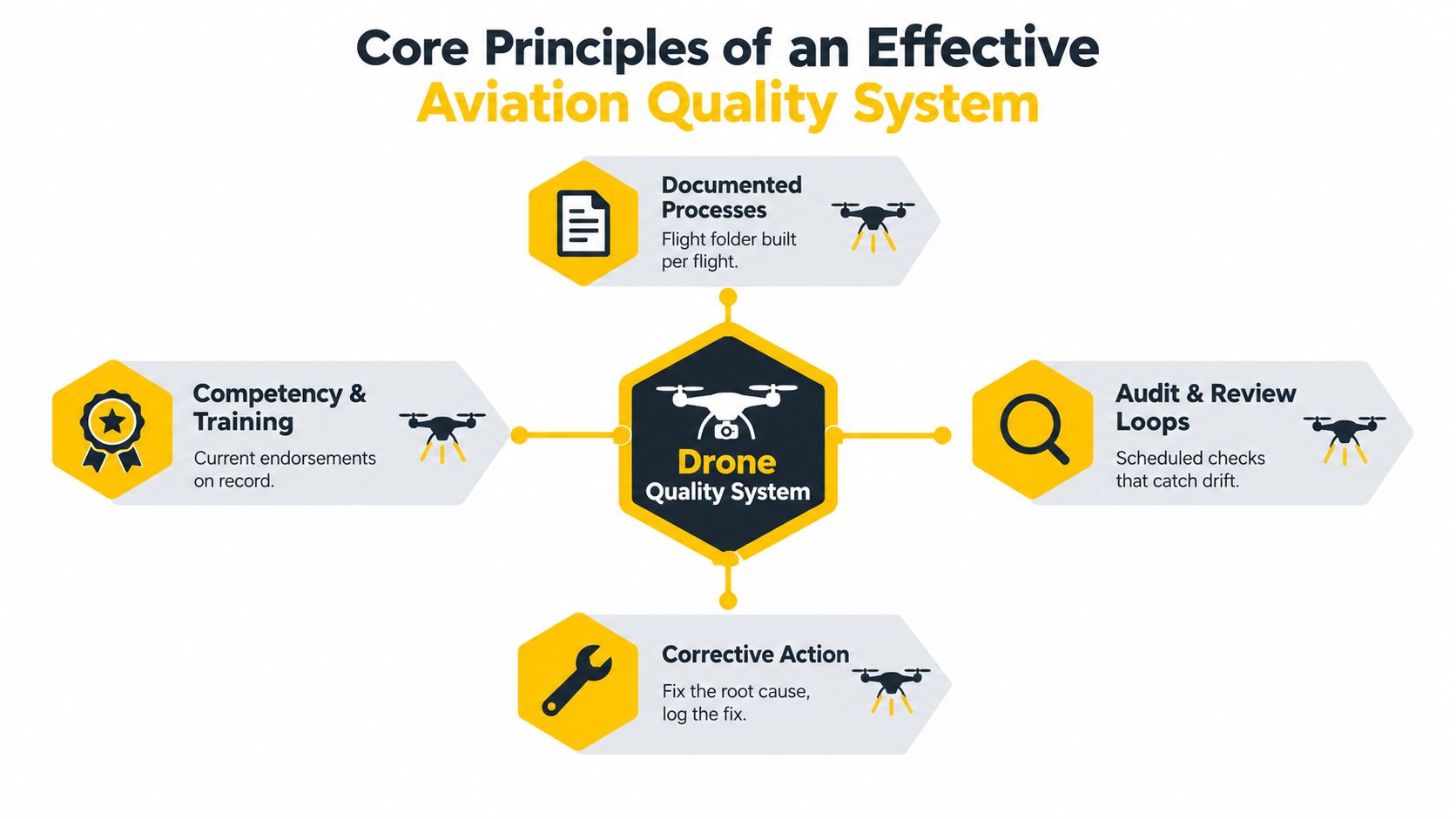
Documented processes create a traceable chain
A flight folder should tell the operational story from beginning to end. It might contain the client brief, site map, airspace check, landowner or site permissions, risk assessment, weather decision, aircraft and battery information, pilot competency record, pre-flight checklist, flight log, incident report if required, and post-flight review.
The folder doesn't need to be complicated. It needs consistent naming, controlled templates, clear responsibilities, and protection against accidental use of superseded forms. A reviewer should be able to distinguish a draft from an approved procedure and identify the version used for a particular operation.
Risk identification must capture changing conditions
A hazard register should go beyond generic entries such as “weather” or “people nearby”. It should identify how a hazard affects the mission and what control will be applied. Examples include a battery showing abnormal behaviour, a sudden change in wind, construction activity near the operating area, a temporary change to access, or a crew member who hasn't completed the task-specific briefing.
The SMS evaluates the risk. The QMS checks whether the operator used the required method, recorded the decision, and escalated the issue when the control wasn't sufficient.
Measurable performance reveals drift
Small operators can track useful indicators without building an elaborate analytics function. Suitable measures include recurring aircraft defects, overdue corrective actions, incomplete flight folders, reported hazards, and competency checks approaching expiry.
For an operator considering structured business controls, ReOC consulting and setup support can be relevant to the process of defining responsibilities, procedures, and evidence. The system still needs an owner inside the business.
Continuous improvement closes the loop
A near miss shouldn't disappear into an email inbox. The operator should record what happened, identify the underlying cause, assign an action, set a due date, and verify that the action worked. A quarterly review can then identify patterns, such as repeated errors in airspace checks or recurring confusion about who approves a site.
For pilot-focused training that includes RePL, practical flight training, AROC, aviation compliance, and aviation English proficiency, ACE SILVER is directly relevant to the competency side of an operating system. Training records become quality evidence when the operator links them to the aircraft, operation type, and currency requirements.
Roles and Responsibilities Inside a Drone Operation
Quality fails when everyone is assumed to be responsible but no one is named as accountable. A small drone business may combine several roles in one person, but the duties still need to be identified, documented, and understood by the crew.
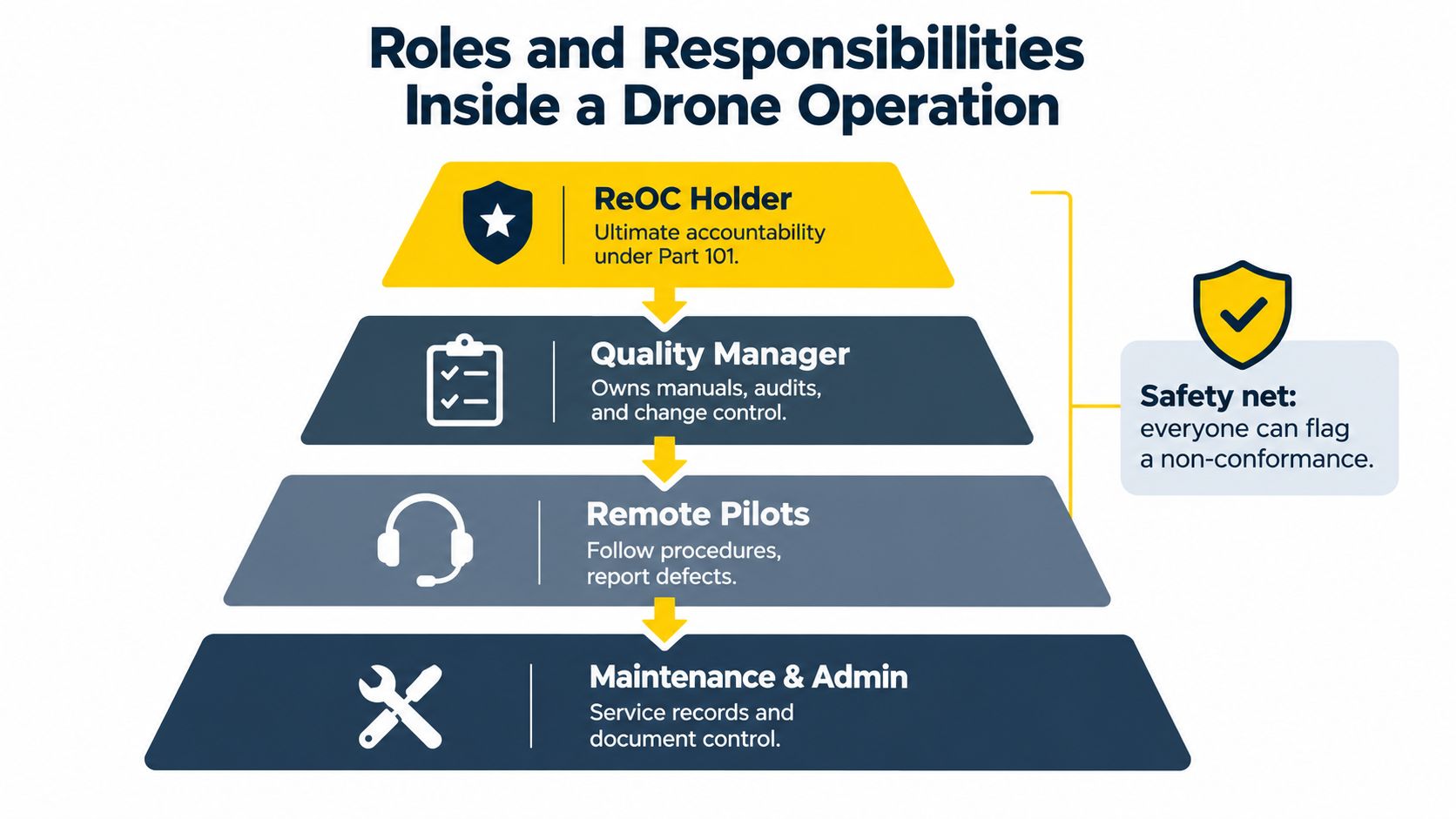
The ReOC holder owns the system
The ReOC holder carries the organisation's ultimate accountability for operating within its approved scope. That includes ensuring the operations manual reflects current requirements, the business has suitable personnel and resources, and significant changes receive proper review.
The holder doesn't need to perform every audit or sign every flight record. Delegation is acceptable only when the delegated authority, limits, and escalation path are clear. A contractor shouldn't be left to decide whether a new type of operation fits the approved system without a defined approval process.
The chief remote pilot normally sits close to day-to-day flight execution. That role should control pilot competency, operational briefings, aircraft suitability, and the handling of deviations from procedure. If a pilot reports a recurring battery defect, the chief remote pilot should ensure the issue reaches the person who can quarantine the aircraft, arrange maintenance, or amend the procedure.
Document control prevents silent change
The operations manual custodian controls revisions, approval dates, distribution, archived versions, and confirmation that affected people have been briefed. In a larger organisation, a quality manager may own the audit programme and corrective-action register. In a smaller operation, those duties may sit with the ReOC holder or another competent person.
This role is similar to governance work in other content-heavy environments. Resources on multi-site content governance rules can help explain the importance of ownership, version control, permissions, and escalation, although aviation procedures must remain specific to CASA requirements and the operator's scope.
Safety officers and remote pilots also have an active quality role. They should be able to report hazards, defects, and non-conformances without waiting for a scheduled meeting. Maintenance and administrative personnel protect service records, component information, and document integrity.
The chief remote pilot course is relevant to the competency and leadership responsibilities attached to that operational role. Regardless of the training pathway, CASA needs to see named people, defined duties, and records showing that those duties are being performed.
Quality KPIs Worth Tracking Day to Day
A quality KPI should help a manager decide whether a process needs attention. It should not decorate a monthly report. CASA monitors scheduled surveillance completion, accident rates, targets, and trends at regulator level. The CASA Annual Report 2024–25, discussed earlier, shows how surveillance performance can be compared with earlier results and an internal target.
A ReOC operator can apply the same logic at a smaller scale. Each measure needs a clear definition, an owner, a review trigger, and records that support the result. A KPI is useful when it prompts a change-management decision, such as revising a procedure, briefing pilots, or checking whether a control still fits an operation near an airport or controlled location.
| KPI Area | CASA-Level Indicator | ReOC-Scale Translation |
|---|---|---|
| Reporting culture | Accident and occurrence trends | Flights with hazards, near misses, or operational deviations recorded |
| Surveillance and review | Completion of scheduled surveillance events | Planned internal checks and management reviews completed |
| Defect control | Trend monitoring of aviation occurrences | Aircraft defects identified, repeated defects, and corrective actions closed |
| Competency | Oversight of regulated operational performance | Remote pilots with current competency evidence for assigned operations |
| Record retrieval | Evidence supporting regulatory oversight | Required flight, training, maintenance, and approval records retrieved within the defined response period |
Leading indicators matter
An operation that waits for an accident is relying on a lagging indicator. Hazard reports, incomplete checklists, repeated deviations, and overdue maintenance actions provide earlier warnings.
A practical dashboard can show whether pilots report hazards, whether corrective actions close on time, and whether the same problem appears across several jobs. A rise in reported hazards does not automatically mean performance has worsened. It may show that pilots are willing to report issues before they become incidents.
Teams building a structured scorecard can draw on guidance about analytics with PlotStudio AI for data quality and metric presentation. The operator must still define each measure in aviation terms, identify its evidence, and retain the underlying records.
For example, an operator may track whether each relevant job included the required airspace check and approval review. The drone safety guide for airports and controlled locations in Australia can support that operational awareness. The KPI should then test the operator's own process, not merely confirm that someone read external guidance.
A KPI is an inspection light, not a performance trophy. A sharp change should lead to an investigation of the process behind it, followed by documented action where the evidence requires it.
Common Pitfalls When the Rules Keep Moving
A manual reviewed once a year can still be out of date the next day. That weakness becomes more serious as CASA develops and consults on new operating environments, including proposals concerning operations above 400 feet in defined environments and a 2026 trial involving assisted visual line of sight with a spotter, as described in the verified regulatory context for Australian drone operations.
The issue isn't that an operator should predict every future rule. The issue is whether the quality system can detect a change, assess its impact, update the right documents, and confirm that affected people understand the change.
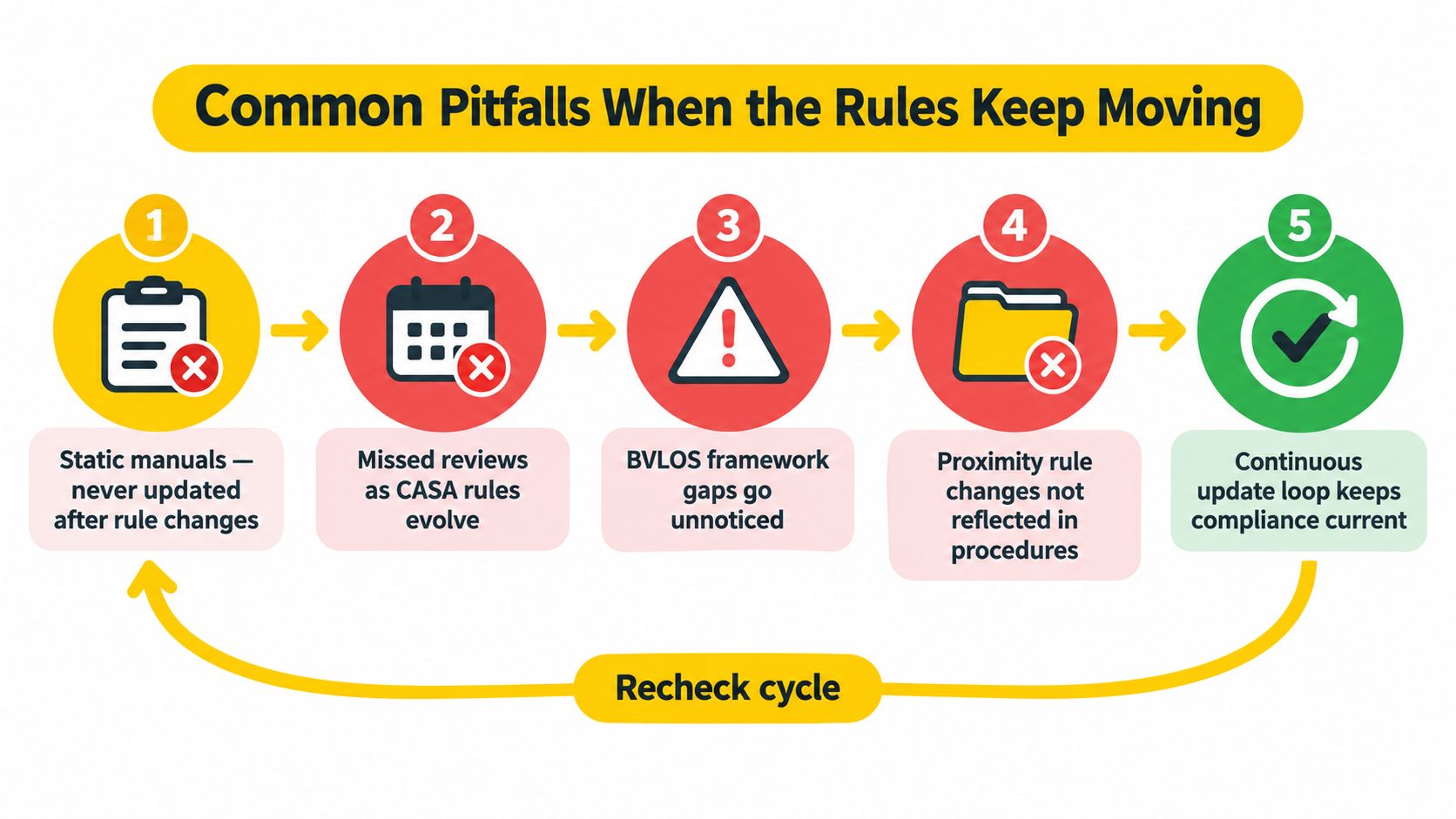
Static manuals create hidden exposure
Common failure patterns include:
- Uncontrolled amendments: A manager updates a procedure but field crews continue using an older downloaded copy.
- Unlinked training: The manual changes, but the training matrix doesn't identify which pilots need a briefing or competency check.
- Incomplete hazard review: The business changes its operating environment without revisiting the hazard register.
- Delayed corrective action: A non-conformance is recorded but remains open while the business continues similar work.
- Weak configuration control: New aircraft, software, sensors, or mission profiles are introduced without checking whether the approved procedures cover them.
These failures are especially relevant to operations involving altitude, proximity to people, controlled airports, urban restricted airspace, or more complex approvals. CASA's drone rules specify that drones over 250 grams can't be flown within 5.5 kilometres of a controlled airport, while standard operating conditions also require visual line of sight and restrict flight near people. Those requirements are set out in CASA's drone rules for operators.
Change control needs a trigger
A change register should record the source of the change, the affected procedure, the risk assessment, the responsible person, the training action, and the effective date. The trigger might be a CASA amendment, an approval condition, a new aircraft, a new client environment, a reported hazard, or an audit finding.
That approach becomes increasingly important for BVLOS proposals, new risk-assessment methods such as AusSORA, and operations in defined environments. The ultimate guide to ReOC operations in Australia can help operators frame their broader operating model, but the change register must connect each decision to the organisation's actual manuals and evidence.
A living quality system doesn't mean rewriting the manual constantly. It means the operator can show why a change was or wasn't incorporated.
Benefits, Risks, and Practical Next Steps
A disciplined quality system gives a ReOC business a clearer basis for operational decisions, client assurance, corrective action, and regulatory engagement. It can also support more orderly ReOC renewal work and future applications because the operator isn't reconstructing its history from scattered emails and personal memory.
The risks of a thin system are equally practical. An operator may face audit findings, interruptions to planned work, difficulty demonstrating compliance, or a gradual decline in reporting quality. A checklist can't repair a culture where pilots hide defects or managers leave corrective actions open.
A Monday morning starting point
A single-operator business can begin with a controlled review rather than a wholesale rewrite:
- List the approved operations: Compare the current work performed with the activities described in the ReOC and operations manual.
- Build the evidence map: For each operation, identify the required assessment, approval, training record, aircraft record, flight record, and post-flight review.
- Create the change register: Record regulatory updates, new aircraft, new software, new sites, new clients, and changes to operating conditions.
- Name the owners: Assign responsibility for manual control, pilot competency, maintenance records, hazard review, and corrective-action closure.
- Test retrieval: Select recent jobs and confirm that a reviewer can reconstruct each operation from the records.
- Review the weak links: Prioritise missing evidence, repeated defects, overdue actions, and procedures that pilots interpret differently.
Questions a ReOC operator should answer
How often should document reviews occur?
The review frequency should reflect operational risk, regulatory change, reported problems, and the operator's own governance arrangements. A fixed annual review alone may not be sufficient when a rule, aircraft, procedure, or operating environment changes. Each change should trigger an impact assessment rather than waiting for the next calendar review.
When is a third-party audit useful?
A third-party audit can be useful before a ReOC application or renewal, after a significant operational change, or when internal staff are too close to the process to challenge assumptions. The audit should examine records and implementation, not only the wording of the manual.
What records should be available during an inspection?
The operator should be able to retrieve the current operations manual, relevant approvals, pilot licences and competency evidence, aircraft and maintenance records, flight documentation, risk assessments, training records, hazard reports, audit findings, and corrective-action evidence applicable to the operation.
How should an operator map the manual against Part 101?
The operator should create a requirement-to-procedure matrix. Each relevant requirement should point to the manual section, responsible role, operational record, and review method. Any gap should receive an owner and corrective action, with the resolution recorded.
Aviation quality management is strongest when it becomes part of daily work rather than a preparation exercise before an audit. The operator that can explain its decisions, produce its evidence, and show how it responds to change is better placed to manage Australian drone operations responsibly.
Ace Aviation Aerospace Academy provides CASA compliant RePL and AROC training, aviation qualifications, ReOC consulting, and professional drone education relevant to building competent people and defensible operating systems. Businesses and aspiring operators can review the available training and compliance pathways at Ace Aviation Aerospace Academy.