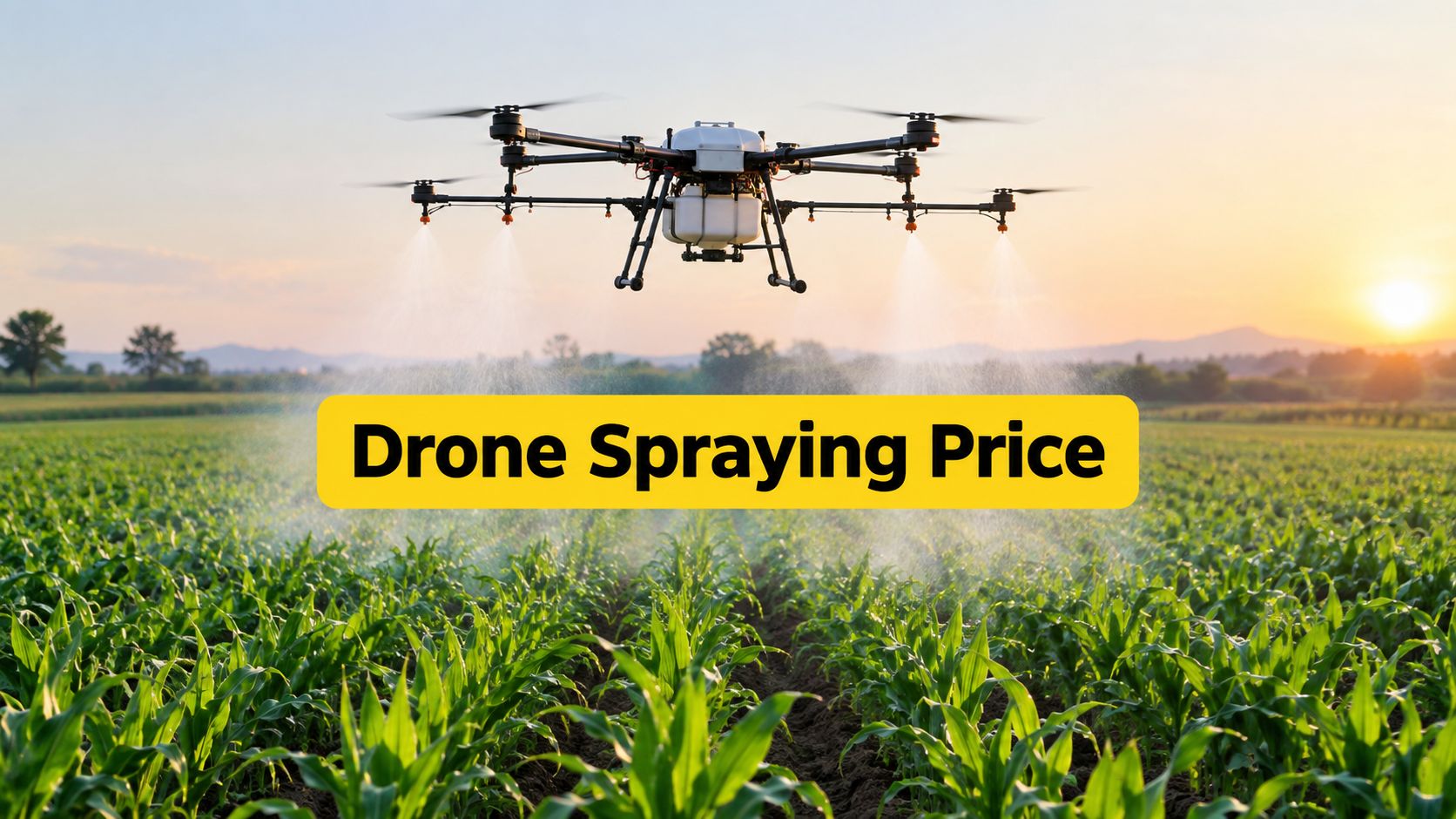
Agriculture drone spraying prices in Australia typically range from A$15 to A$35 per hectare for standard broadacre jobs, but high-volume liquid applications or complex terrain can push the cost above A$100 per hectare. The quoted rate only becomes meaningful after application volume, mobilisation, compliance, and site conditions are included.
A farm manager comparing contractor quotes may see three different prices for what appears to be the same paddock. One operator may charge by hectare, another by hour, and a third may add travel, setup, chemical handling, or a minimum mobilisation fee. The lowest headline rate isn't automatically the lowest cost.
The commercial question is simple: what does the final invoice represent, and how many productive hectares does the operator complete? That distinction determines whether drone spraying improves farm economics or merely shifts costs into less visible areas.
Table of Contents
- Understanding the Agriculture Drone Spraying Price in Australia
- Key Cost Drivers Influencing Drone Spraying Rates
- Hiring a Contractor Versus Buying Your Own Equipment
- Regulatory Compliance and Training Expenses
- Real-World Price Breakdowns and ROI Scenarios
- Making the Right Decision for Your Agricultural Operation
- Frequently Asked Questions About Drone Spraying Costs
Understanding the Agriculture Drone Spraying Price in Australia
The Australian baseline
A farm manager comparing drone contractors can encounter materially different prices for similar work. Public Australian rate cards place standard drone spraying at roughly A$15 to A$35 per hectare, while difficult access, terrain, or complex applications can push published rates to A$30 to A$60 per hectare. A broader Australian guide cites approximately A$30 to A$140 per hectare, so one national average cannot support a reliable budget. These market examples are discussed in Australian agricultural drone spraying service pricing.
Use the mid-double-digit per-hectare range as an initial benchmark for a straightforward broadacre job. Before approving the work, require the quote to identify:
- Application volume: Whether the charge is based on kilograms, litres, or a low-volume spray mix.
- Mobilisation: Whether travel, vehicle movement, loading, and setup are included.
- Minimum charge: Whether a small paddock attracts a fixed fee.
- Chemical handling: Whether mixing, loading, disposal, and related responsibilities sit with the operator or farm.
- Site access: Whether water, batteries, vehicle access, and safe take-off areas are available.
- Compliance responsibility: Which party manages required records, operating procedures, and chemical application documentation.
A low hectare rate can become expensive when these overheads sit outside the advertised price. Owner-operators face the same issue through equipment preparation, battery management, loading time, and compliance administration rather than a contractor's invoice.
Area pricing versus volume pricing
Application volume often has a greater effect on the final charge than hectares alone. One Australian rate card lists A$19/ha at 1 kg or near-zero liquid rate, A$31/ha at 4 kg/ha, A$38/ha at 7 kg/ha, A$44/ha at 30 L/ha, and A$71/ha at 50 L/ha, with the price reaching A$200/ha at 140 L/ha. The figures appear in the Australian drone spraying rate guidance.
Higher application rates demand more refills, mixing, loading, battery use, and flight time. A hectare-only quote hides those tank cycles and handling tasks. Farm managers assessing equipment capability and application economics can review XAG P150 Max agriculture operations in Australia. Require every quote to state the application rate and exactly what the per-hectare charge includes.
Key Cost Drivers Influencing Drone Spraying Rates
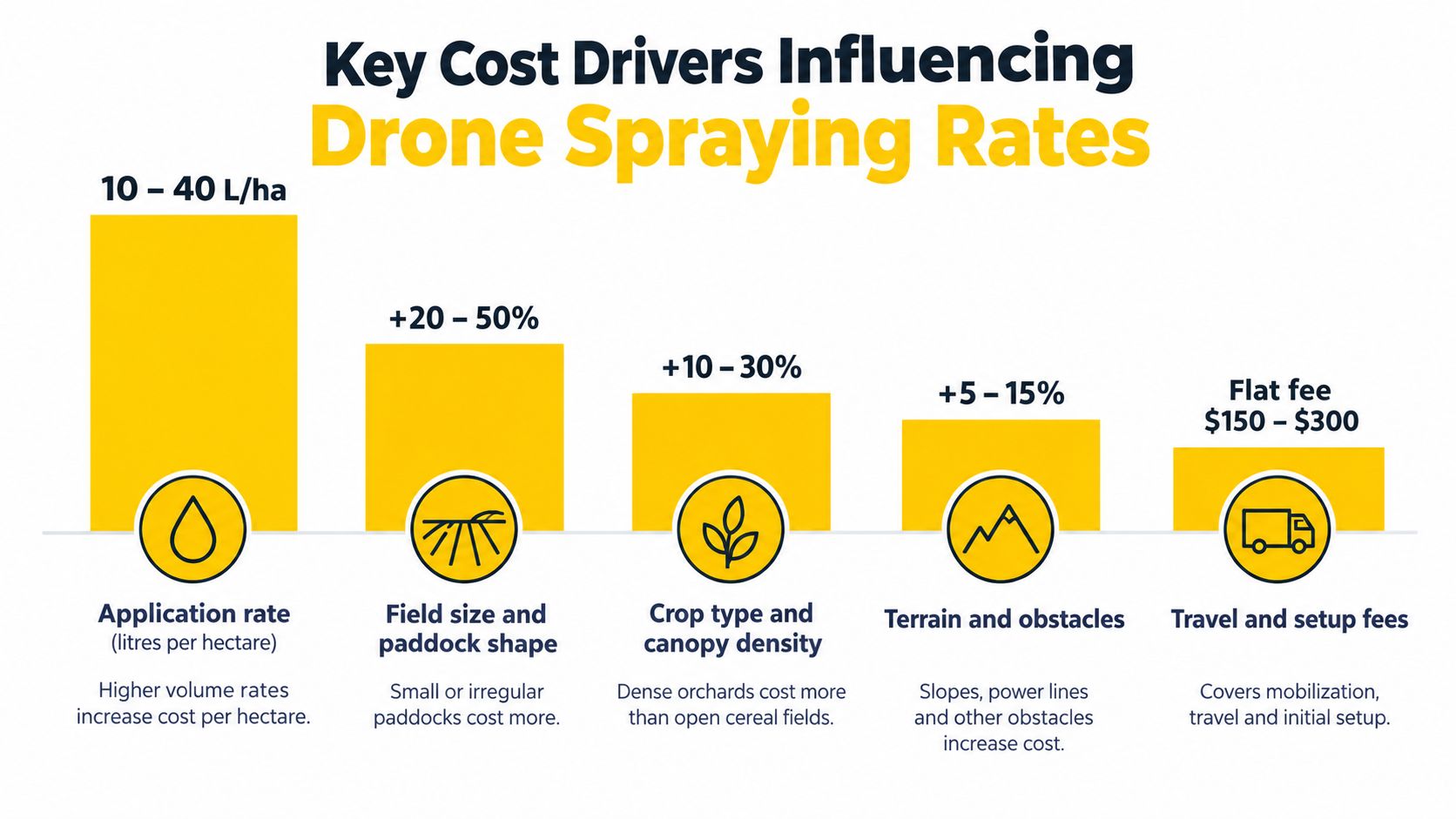
A contractor quoting A$40/ha for 40 L/ha may be applying a simple Australian benchmark of A$1.00 per litre per hectare. Spot spraying may instead be charged at A$300 per hour. These figures, outlined in Australian aerial application pricing guidance, show why a low-volume treatment cannot be compared directly with a high-volume application. The rate must reflect the work required to deliver each litre safely and efficiently.
What changes the quote
Check these variables before accepting a contractor's price:
- Application volume: More litres or kilograms per hectare create more refill cycles, loading time, and aircraft handling. This is usually the largest operational multiplier.
- Paddock size and shape: Compact, regular paddocks support repeated, efficient flight lines. Small blocks, narrow areas, and irregular boundaries add repositioning and non-spraying time.
- Crop structure: Dense canopy, orchards, and crops needing careful penetration can slow work compared with open cereal fields. They may also require different nozzle settings or flight plans.
- Terrain and obstacles: Slopes, trees, power lines, buildings, irrigation infrastructure, and restricted boundaries limit flight options. They can require more manual intervention and conservative paths.
- Travel and setup: Remote jobs consume time before the first hectare is treated. Confirm whether travel, water access, calibration, chemical loading, and battery preparation are included.
Australian pricing examples place broadacre work around A$18 to A$35 per hectare, higher bands around A$30 to A$60 per hectare, and one provider's base mobilisation at A$650 plus A$35 per hectare. The Australian drone spraying cost overview demonstrates how fixed overheads spread across fewer hectares on fragmented jobs.
How to read a contractor quote
Require the quote to specify paddock area, target application rate, which party supplies the product, expected operating conditions, minimum charge, travel treatment, and provisions for re-spraying or weather delays. Without these terms, an apparent per-hectare saving is not a reliable financial comparison. Owner-operators should calculate the same inputs as internal costs, including preparation, loading, battery use, and compliance administration.
A pilot moving into heavier payload work may need additional training rather than relying on experience with a smaller aircraft. The 25 kg drone upgrade course is relevant to operations involving aircraft above lower payload categories. Beginners can use ACE READY for drone fundamentals, aviation safety, CASA regulations, flight operations, and preparation for advanced RePL training.
Practical rule: A credible quote separates the cost of treating hectares from the overhead required to make those hectares operationally accessible.
Hiring a Contractor Versus Buying Your Own Equipment
Hiring a contractor offers predictable access to aircraft, batteries, pilots, compliance systems, and maintenance. Buying equipment provides schedule control and may reduce the service component at high utilisation, but the farm assumes every fixed and variable cost.
Australian sources place a working spray setup at roughly A$20,000 to A$40,000, while contract rates are commonly cited at about A$120 to A$200 per hour or potential grower-operator savings of A$15 to A$40 per hectare. Those figures are summarised in Australian farm drone ownership economics. They don't establish a universal payback point because annual hectares, downtime, training, insurance, and compliance differ between operations.
| Factor | Hiring a Contractor | Buying Equipment (Owner-Operator) |
|---|---|---|
| Capital outlay | No aircraft purchase for the farm | Equipment purchase and supporting infrastructure |
| Pilot capability | Supplied by the contractor | Farm must train and retain a suitably licensed pilot |
| Maintenance | Managed by the contractor | Batteries, pumps, nozzles, motors, software, and repairs become farm costs |
| Scheduling | Depends on contractor availability | Greater control, subject to weather, pilot capacity, and aircraft readiness |
| Compliance | Contractor carries operational licensing obligations | Farm carries aviation, chemical, insurance, and record-keeping obligations |
| Small paddocks | A minimum charge may apply | Fixed ownership costs can make each small job expensive |
| High utilisation | Easy to budget, but every hectare remains a service purchase | Fixed costs can be spread across more work if demand is dependable |
The utilisation test
Ownership only deserves consideration when the aircraft will be used consistently. A farm with occasional spot treatments may struggle to spread purchase, batteries, storage, insurance, training, and maintenance across enough productive hectares. A contractor can be financially stronger in that case, even when the per-hectare quote appears higher.
An owner-operator also needs a commercial plan if the aircraft will spray for neighbouring farms. That changes the business from an internal farm tool into a service operation, with additional scheduling, customer, chemical, and safety responsibilities. The XAG job-ready agriculture training pathway is relevant to operators assessing that operational model.
The recommended comparison is not purchase price against contractor rate. It is all-in annual ownership cost against the contractor's complete invoice, including mobilisation and the value of the farm labour required to operate the aircraft.
Regulatory Compliance and Training Expenses
A farm can own a capable spray drone and still lose money if the aircraft cannot be legally deployed when treatment is due. Budget for aviation approvals, chemical authorisations, operating procedures, insurance, records, and ongoing competency before comparing an owner-operated system with a contractor's per-hectare quote.
The compliance stack
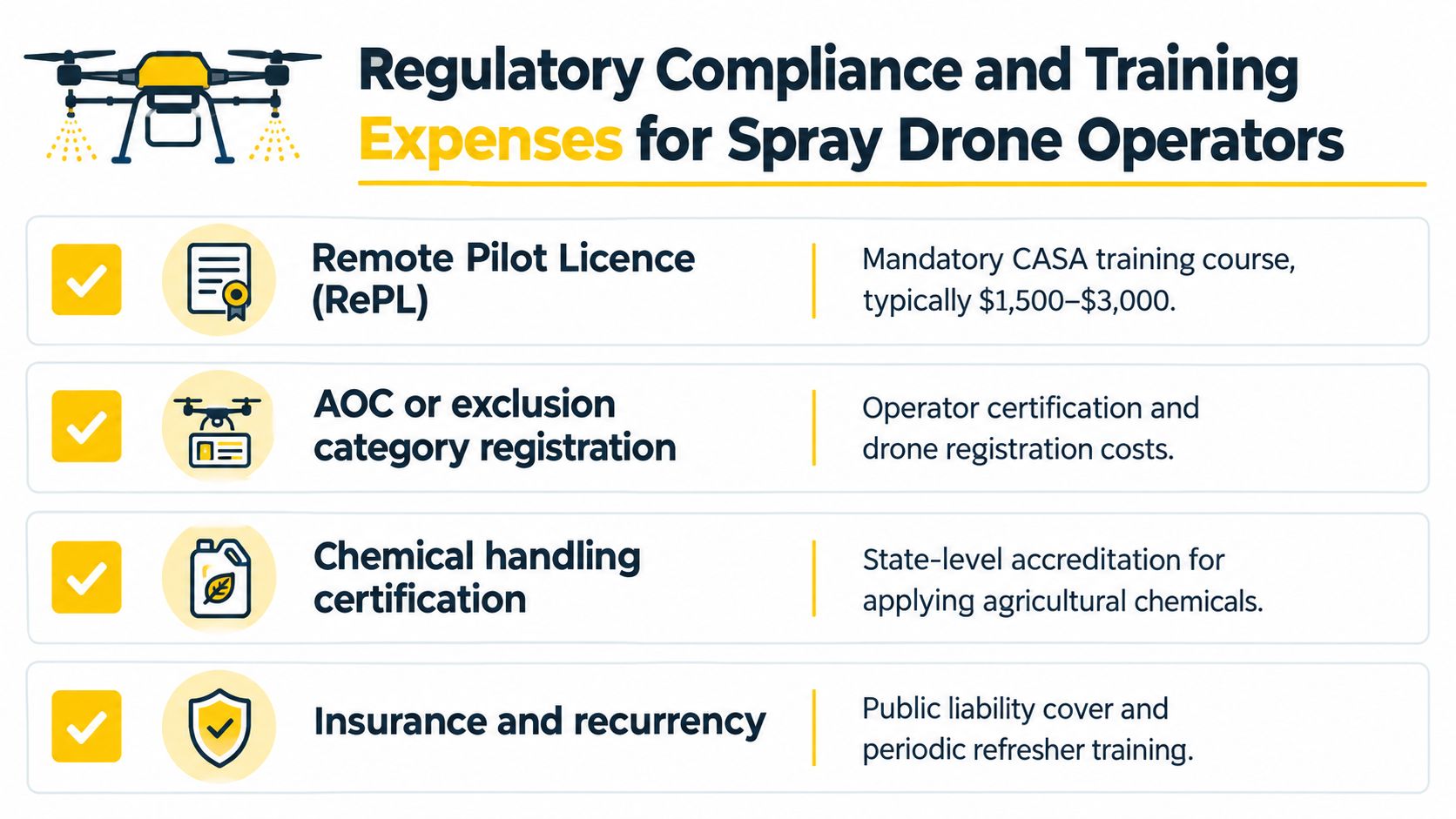
An owner-operator should verify and price each requirement:
- Remote Pilot Licence: The pilot needs the appropriate CASA RePL pathway for the proposed operation and aircraft category.
- Remote Operator Certificate: A business conducting commercial operations may need a ReOC, supported by an operating system for safe, repeatable work.
- Aeronautical radio training: An AROC may apply where the operation requires aviation radio use.
- Chemical authorisation: State and territory rules control pesticide application, qualifications, permits, records, and product directions.
- Insurance and records: Public liability, aircraft cover, chemical liability, maintenance records, flight records, and incident procedures all add to operating cost.
The licence is only the entry cost. Training, recurrent competence, manuals, administration, insurance, and equipment inspections continue throughout ownership. Review the drone laws in Australia 2026 before committing capital, then confirm the requirements with the relevant aviation and chemical authorities.
State rules affect the work plan
In New South Wales, anyone using a drone to aerially apply pesticides must hold both an RPA business licence and an RPA pilot licence issued by the NSW EPA. The business licence process requires the relevant CASA ReOC before application through the EPA eConnect system, as explained in the NSW EPA aerial pesticide licensing requirements.
Victoria requires drone spraying to operate under CASA Standard Operating Conditions. Autonomous operation is prohibited, and the pilot must be able to intervene at all times. The aircraft may be used only where the chemical label or permit allows aerial or spot spraying. Check the Victoria's drone spraying licence guidance before scheduling work.
Weather restrictions can create an unproductive visit or delay treatment. In Victoria, if the product label does not specify wind parameters, spraying must occur only when wind speed is greater than 3 km/h and less than 13 km/h at the application site. Wind must be observed immediately before and during spraying, as set out in the Victorian aerial spraying weather guidance.
The cheapest aircraft becomes an expensive asset when compliance, weather, and standby time prevent productive work.
Real-World Price Breakdowns and ROI Scenarios
A contractor's quote becomes easier to assess when fixed and variable costs are separated. Consider two illustrative jobs using a contractor rate of A$35 per hectare, a figure within the published Australian range described in Australian drone spraying market pricing.
Fragmented versus contiguous work
For a fragmented 50-hectare job, the area charge would be A$1,750 before any separately listed travel, setup, or minimum fees. If the contractor needs repeated vehicle movement between blocks, the effective cost per productive hectare rises because not all paid time produces treated area.
A 500-hectare contiguous broadacre job at the same illustrative rate would produce an area charge of A$17,500. The larger block gives the operator more opportunity to spread mobilisation, calibration, and setup across productive hectares, although application volume and weather can still change the final quote.
The comparison isn't a prediction of what either job should cost. It demonstrates why a farm manager should request the total price, the included services, and the assumptions behind the rate. A useful external explanation of how precision agriculture services are structured is New York precision ag services explained, although Australian aviation and chemical rules remain the controlling requirements for Australian work.
An owner-operator planning model
An illustrative A$35,000 equipment assumption can be tested against the contractor alternative, but it shouldn't be described as a guaranteed purchase price or payback result. The owner must add training, compliance, batteries, maintenance, insurance, vehicle arrangements, labour, finance or depreciation, and downtime before dividing the total by annual hectares.
For example, if a farm sprays only a small area, fixed costs dominate the calculation. If the farm also has dependable external work, the same fixed costs can be spread across more productive hectares. The break-even result therefore depends on confirmed utilisation, not optimism about future bookings.
The drone spraying quote calculator can support a structured comparison, provided the farm enters its actual area, application rate, access conditions, and ownership overheads. The calculation should be reviewed with the farm accountant before capital is committed.
Making the Right Decision for Your Agricultural Operation
The correct choice follows operational reality, not the cheapest advertised rate.
Contractor-only operation
A contractor is the sensible default when annual spraying demand is limited, paddocks are widely dispersed, or the farm doesn't already have a trained aviation operator and compliant chemical system. This approach converts ownership risk into a service invoice and avoids carrying an aircraft between application windows.
The contract should specify:
- Application method: Target rate, product responsibility, and mixing arrangements.
- Commercial terms: Minimum charge, mobilisation, travel, waiting time, and weather rescheduling.
- Quality controls: Calibration, records, coverage expectations, and treatment boundaries.
- Compliance evidence: Relevant licences, ReOC arrangements, insurance, and chemical credentials.
Hybrid operation
A hybrid model suits farms that need rapid spot treatment but don't have enough work to justify a full spray fleet. Contractors can handle larger or regulated applications while farm staff manage mapping, scouting, and treatment decisions. This preserves flexibility without forcing the farm to absorb every aviation overhead.
Full insourcing
Full ownership makes sense only when the farm can demonstrate sustained utilisation, provide compliant storage and vehicle support, retain a qualified pilot, and manage chemical and aviation records. External work can improve utilisation, but it also creates customer and liability obligations that should be priced into the business plan.
Decision standard: If the operation can't prove legal authority, qualified staff, insurance, and dependable utilisation, hiring remains the financially responsible choice.
Frequently Asked Questions About Drone Spraying Costs
Is drone spraying cheaper than tractor spraying?
It depends on the task. Drones can suit wet ground, steep areas, irregular paddocks, and targeted treatment where moving a large ground rig would be inefficient. Large, accessible areas may favour another application method after total mobilisation, volume, and turnaround requirements are compared.
Does the chemical usually come with the spraying price?
Not necessarily. The quote should state whether the farmer supplies the chemical and who is responsible for mixing, loading, storage, containers, and disposal. Chemical cost and application cost should be shown as separate lines.
Who pays if a hired drone crashes?
The contract and insurance policy determine responsibility, but the farm shouldn't assume that hiring removes every risk. The farm should confirm public liability, aircraft cover, chemical liability, damage to crops or property, and any requirement to name the farm as an insured party.
Can weather delays increase the invoice?
They can, depending on the agreed terms. Victorian spraying requirements include wind conditions between greater than 3 km/h and less than 13 km/h where the product label doesn't specify another range, so a contractor may need to pause work when conditions aren't compliant. The quote should explain whether waiting time, remobilisation, or rescheduling attracts a charge.
What should a farm manager request before accepting a quote?
The manager should request the operator's relevant licences, insurance confirmation, application rate, total fee, minimum charge, travel treatment, chemical responsibilities, weather policy, and treatment records. A per-hectare figure without those details isn't a complete commercial offer.
Ace Aviation Aerospace Academy provides training relevant to agricultural drone operations, including the Remote Pilot Licence, Aeronautical Radio Operator Certificate, ReOC consulting, and enterprise or corporate drone training. Farm managers and operators assessing compliant spray operations can visit Ace Aviation Aerospace Academy to review the available aviation education and operational support.