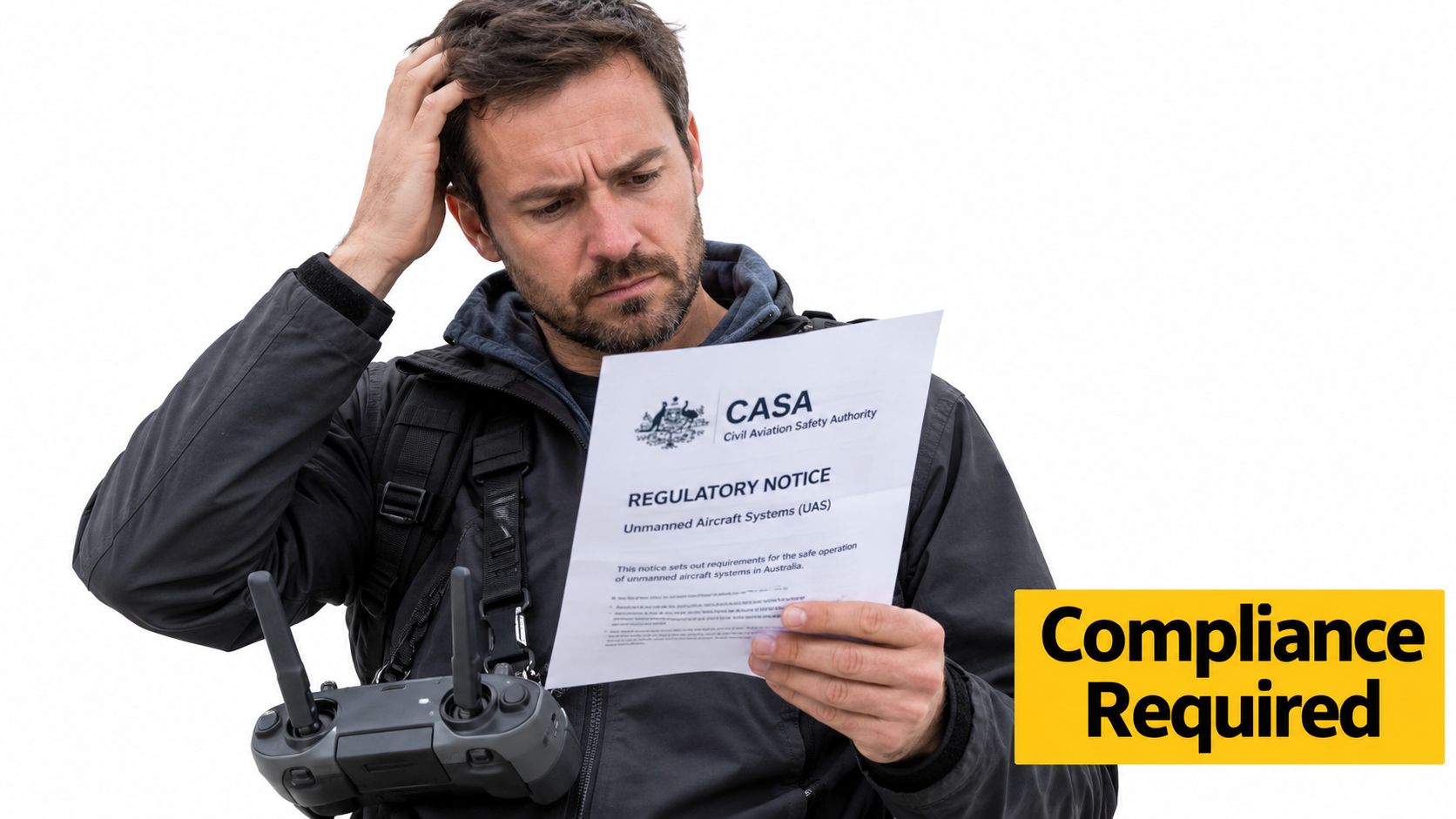
A commercial drone operator may receive a CASA notice requesting evidence of systematic safety controls, then discover that flight logs sit in one folder, maintenance records in another, and pilot competency evidence exists only in email threads. The operation may be safe in practice, but without a clear system, proving that safety becomes slow, stressful and incomplete.
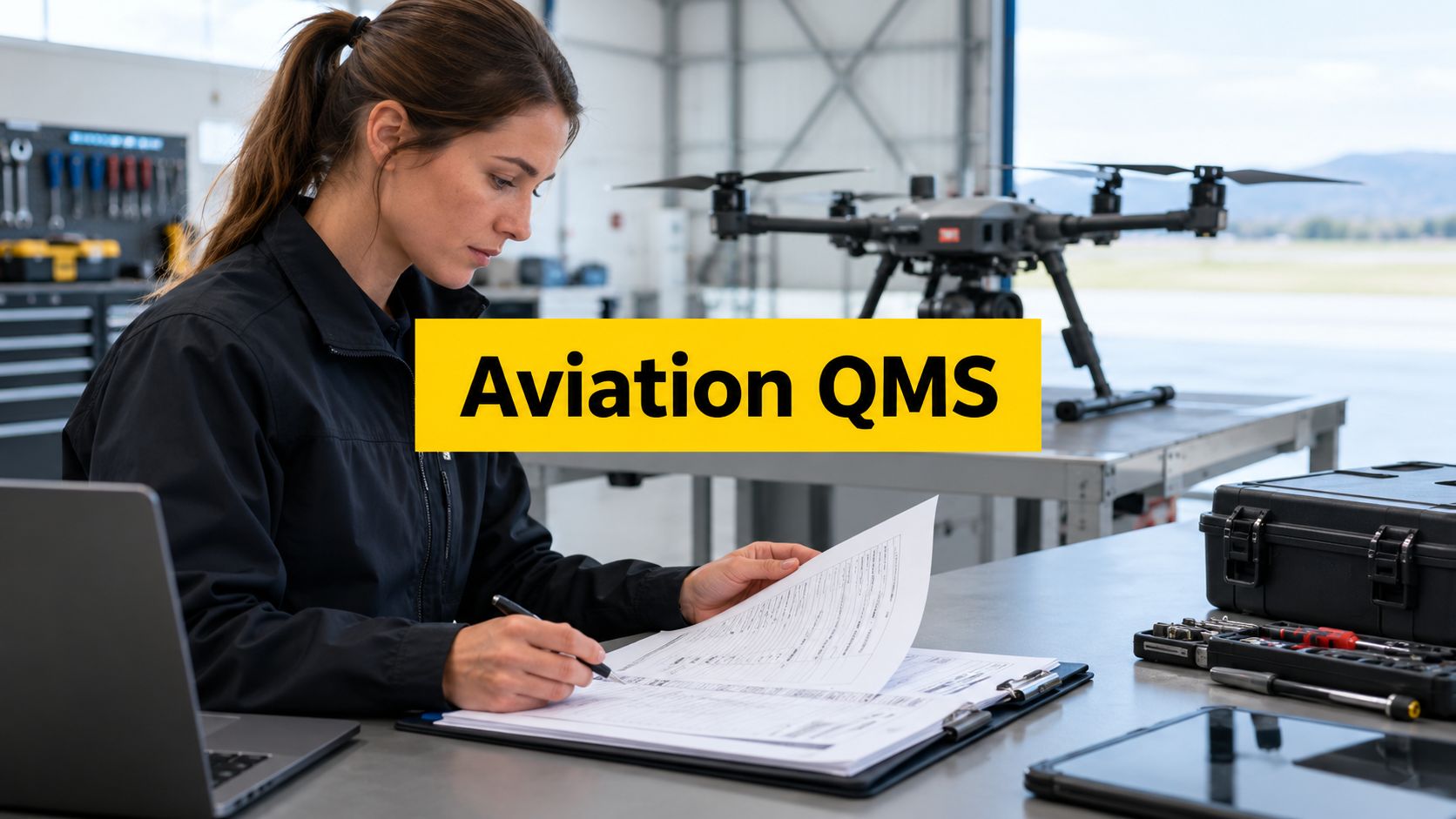
An aviation quality management system gives the operator a controlled way to manage risk, demonstrate compliance and improve daily operations. For an RPAS business, the system must reflect real work, including aircraft preparation, crew coordination, airspace checks, data handling, maintenance, incident reporting and client requirements. It shouldn't become a document library that nobody uses.
Table of Contents
- Why Your Drone Operation Needs a Quality Management System
- Core Components of an Aviation Quality Management System for RPAS
- Designing Your AQMS A Step-by-Step Approach
- Implementing Procedures and Documentation
- Auditing and Monitoring Your Quality System
- Common Pitfalls and How to Avoid Them
- Integrating Your AQMS with CASA Requirements
- Frequently Asked Questions
Why Your Drone Operation Needs a Quality Management System
A quality management system matters because consistent evidence is part of operational control. CASA oversight isn't limited to whether a pilot can fly an aircraft safely on one day. A commercial operator must be able to show that its people follow approved processes, that hazards are assessed, that corrective actions are tracked and that records remain reliable.
Australia's aviation safety governance developed substantially during the 1990s. A major ATSB review of Australia's aviation safety system records the development of formal safety management standards and regulations during that decade, including CASA's direction to build a structured system-safety programme after accidents in the mid-1990s. CASA later mandated functioning and effective safety management systems for regular public transport operators under Civil Aviation Orders CAO 82.3 and 82.5. RPAS operators work in a different operational environment, but the underlying lesson remains relevant: safety controls need to function as a system, not as isolated paperwork.
What a QMS protects
A practical aviation quality management system helps protect:
- The ReOC operating framework: Procedures, records and responsibilities support the organisation's approved way of operating.
- Operational consistency: Different pilots can apply the same preparation, briefing, emergency and reporting processes.
- Regulatory readiness: CASA requests can be answered with controlled records rather than reconstructed evidence.
- Client confidence: Government departments, infrastructure owners and commercial clients can see how the operator controls safety and quality.
- Organisational learning: Incidents, near misses, defects and audit findings produce actions instead of disappearing into individual inboxes.
The system also creates a useful distinction between doing the right thing and being able to demonstrate that it was done. A verbal pre-flight briefing may be effective, but a controlled briefing record provides stronger evidence of what was considered, who participated and whether unresolved issues were accepted or escalated.
Operators should begin with the hazards and workflows that exist. A surveying company needs controls for flight planning, terrain, people, property, data capture and client deliverables. An agricultural operator needs additional attention to chemical handling, loading, application boundaries, weather, contamination and landholder coordination. The current Australian drone laws and operating requirements should inform the system, but the QMS must translate rules into usable actions.
Practical rule: If a procedure can't be followed by a pilot under operational pressure, it isn't finished. Simplify it, test it and make the required evidence obvious.
Core Components of an Aviation Quality Management System for RPAS
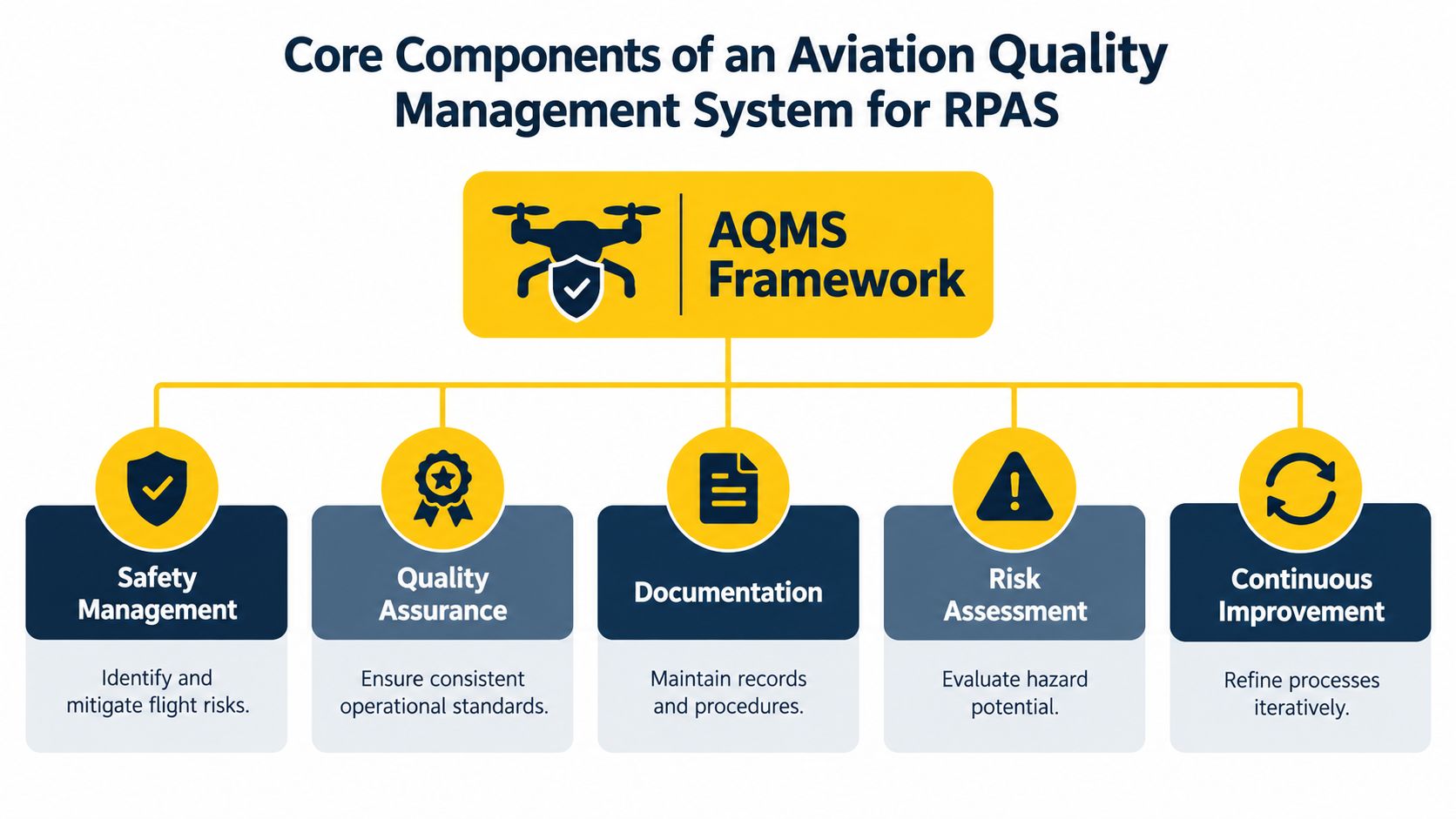
An RPAS aviation quality management system should connect safety management, quality assurance, documentation, risk assessment, competency and continuous improvement. These controls don't need to be elaborate, but each one needs an owner, a defined output and a review method.
Safety and operational risk
Safety management starts with identifying hazards before the flight. The operator should assess the operating area, aircraft, payload, people, weather, airspace, communications, ground conditions and task-specific consequences. The assessment should lead to controls, not just a risk score.
For example, a mapping mission near public access areas may require exclusion zones, a visual observer, additional briefing points or a revised launch location. A spraying operation may need controls covering product storage, loading, drift, emergency release and post-flight cleaning. The risk register should show who accepted the residual risk and what would trigger a reassessment.
Quality assurance and documentation
Quality assurance checks whether the approved process is being followed and whether it produces a reliable result. Useful evidence can include:
- Flight records: Mission date, crew, aircraft, location, purpose, weather and operational outcome.
- Maintenance records: Defects, inspections, component changes and return-to-service decisions.
- Training files: Licence or certificate evidence, aircraft-type competency, recurrent training and supervision records.
- Occurrence records: Incidents, near misses, hazards, complaints and corrective actions.
- Document registers: Current procedures, revision status, approval date and withdrawal of obsolete versions.
A well-controlled system also covers digital aviation data. CASA guidance for aeronautical information service providers describes QMS coverage across the data chain from origination to distribution, including traceability, error correction and ISO 9001 evidence. The same principle applies to RPAS businesses that produce survey, inspection, mapping or infrastructure data. A flight can be safe while the deliverable remains unreliable if source files, processing steps, quality checks and final approvals aren't traceable.
Competency and improvement
Competency management should show more than a pilot's licence. It should establish whether the person is competent for the aircraft, payload, operating environment and assigned duties. The Chief Remote Pilot course information is relevant to operators formalising responsibility for operational control and compliance.
For beginners, ACE READY covers drone fundamentals, aviation safety, CASA regulations, flight operations and preparation for advanced RePL training in Australia. Training is only one part of the QMS. The operator still needs a process for authorisation, supervision, observation of performance and recording any limitations.
A system's improvement loop should turn findings into assigned actions with due dates, evidence of completion and an effectiveness review. For teams designing digital workflows or documenting operational systems, case studies for MVP and SaaS launch can provide general product-structure ideas, but the aviation operator must retain control of the compliance logic and operational approvals.
Designing Your AQMS A Step-by-Step Approach
A small RPAS operator shouldn't attempt to reproduce the documentation structure of a large airline. The better approach is to build a system around the operator's actual activities, then add controls when risk, complexity or regulatory obligations require them.
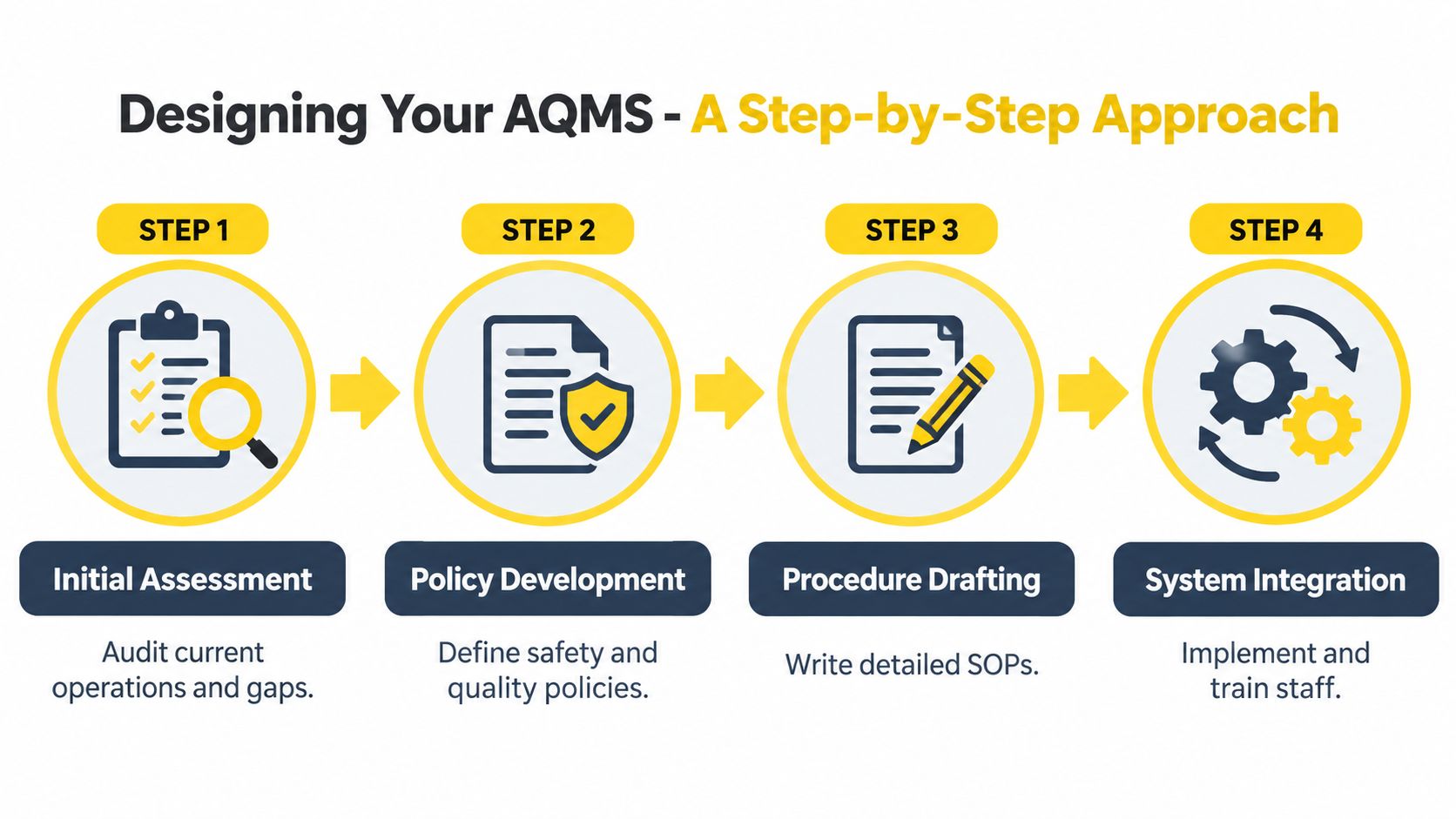
Start with an operational assessment
The first task is to map what happens before, during and after a flight. The assessment should follow a real job from enquiry to delivery rather than reviewing documents in isolation.
Record:
- The aircraft and payloads used.
- The people who plan, approve, conduct and review missions.
- The licences, certificates and internal authorisations required.
- The hazards that change between operating locations.
- The records already created and where they are stored.
- The points where errors, delays or conflicting instructions occur.
A gap may be as simple as a checklist that doesn't match the aircraft currently in use. It may also involve unclear authority to cancel a flight, inconsistent defect reporting or missing evidence that a client-specific restriction was communicated to the crew.
Write a policy that reflects the work
The quality and safety policy should state what the operator controls, who has authority and how the organisation responds when production pressure conflicts with safe operation. It should be specific enough to guide decisions without becoming a list of slogans.
Aerial surveying, construction inspection and agricultural operations don't have identical risk profiles. A policy for agricultural work should address chemical and environmental controls, while a policy for inspection work may place greater emphasis on proximity to structures, data integrity and client communication. The policy should also explain how the operator reports hazards without discouraging honest reporting.
Build procedures around decisions
Standard operating procedures should answer practical questions:
- What must be checked before a mission is accepted?
- Who reviews the site and operating limitations?
- What conditions require a revised risk assessment?
- Who can approve the flight?
- What happens when the aircraft, payload or communications system develops a defect?
- What records must be completed before the job is closed?
Each procedure should identify its owner, required inputs, decision points, records and escalation path. A short procedure supported by a well-designed form is usually stronger than a lengthy manual that pilots interpret differently.
Integrate the system into daily work
A QMS fails when it sits outside the operation. Flight planning software, maintenance registers, training records and incident forms should use consistent identifiers so that a mission can be traced from approval through completion.
The operator should introduce the system through practical training. Staff need to know not only where a form is located, but why a particular field matters and what happens after a hazard or defect is reported. Operators working through ReOC setup and compliance requirements can use that process to identify the evidence their operating model must maintain.
Start with the controls that manage the highest operational risk. Expand the system after pilots have used it, reported friction and shown where the process doesn't match the work.
Implementing Procedures and Documentation
Documentation should make the safe action easier to recognise. It shouldn't force a pilot to search through a large manual while preparing an aircraft, nor should it ask for information that nobody reviews.
A useful document set normally includes an operations manual, aircraft and equipment registers, mission risk assessments, pre-flight and post-flight checklists, maintenance records, training and competency records, occurrence forms, corrective-action logs and document-control records. The exact structure depends on the operator's activities, approvals and risk profile.
Write for the person using the document
A procedure should use plain language and active instructions. “Confirm the aircraft battery is suitable for the planned mission and record any defect” is more useful than a broad statement that batteries must be maintained appropriately.
Each form should have a clear purpose. A pre-flight checklist should support a decision to proceed, delay or cancel. An occurrence form should capture what happened, what was affected, immediate controls and who needs to investigate. A corrective-action record should identify the cause, action owner, due date, completion evidence and effectiveness check.
Resources on how to boost team efficiency with SOPs may help teams structure general procedures, but aviation documents need additional controls for authorisation, revision, operational applicability and evidence retention.
Control revisions and records
The document register should identify the current revision, approval authority, effective date and affected personnel. Obsolete copies need to be removed from operational locations, especially where pilots use printed checklists or locally saved files.
A controlled review doesn't mean changing documents for the sake of activity. It means reviewing them after an incident, equipment change, regulatory change, new operating location, client requirement or identified weakness. The review should confirm whether the procedure still reflects the aircraft, software, payload and actual working environment.
The drone pilot emergency handbook covering ANCA, CANCA and ATSB considerations can support emergency-procedure development, but the operator must adapt emergency actions to its aircraft, crew roles, communication methods and approved operating conditions.
Link records to the mission
A mature record system lets a reviewer connect the mission approval, risk assessment, crew, aircraft, maintenance status, flight record, occurrence report and final quality check. That traceability is valuable during an audit and during an internal investigation.
Cloud storage alone doesn't create control. The operator needs permissions, naming conventions, backup arrangements, retention decisions and a method for preventing uncontrolled edits. A digital form is useful only when someone reviews the result and takes action where the record identifies a problem.
Auditing and Monitoring Your Quality System
A small RPAS operator needs the same audit discipline as a larger organisation, but not the same machinery. A focused review of selected missions can work for a small team. Larger ReOC operators may need a scheduled programme covering locations, aircraft, crews and operating activities. The method should match the operation's risk, complexity and available competence.
Compliance audit versus safety audit
A compliance audit checks whether the operator followed approved procedures and regulatory obligations. Evidence may include authorisations, training records, flight logs, maintenance entries and controlled documents.
A safety audit tests whether those controls work in real operating conditions. It may show that pilots complete a risk assessment but repeatedly miss one hazard, or that a technically correct checklist does not address a recurring field problem. Use both methods. Compliance findings show where requirements were missed. Safety findings show where the system fails to control risk, even when paperwork appears complete.
Operators planning an audit can also use these compliance audit preparation tips to organise evidence and define the review scope.
| Approach | Strength | Limitation |
|---|---|---|
| Small operator review | Fast, practical and close to daily work | Independence is difficult when the same person planned the mission |
| Independent internal audit | More objective and suitable for comparing trends | Requires time, preparation and a competent reviewer |
| External review | Adds an outside perspective and can expose normalised workarounds | Does not replace management ownership or routine monitoring |
CASA's state safety programme describes an integrated model covering governance, reporting, assurance, risk management, auditing, quality assurance and managed oversight. It also refers to planned and unplanned audits, inspections and workflow analysis. The ANAO audit material concerning CASA surveillance assurance highlights a practical lesson for RPAS operators: the surveillance process itself needs quality checks.
Select useful indicators
Track measures that support decisions, including recurring defects, overdue corrective actions, repeat findings, incomplete records, incident patterns and the time required to close safety actions. CASA's planning documents describe performance monitoring, KPI reporting and continuous improvement, with safety outcomes assessed against operational activity. The CASA corporate plan supports placing trend monitoring inside the quality cycle rather than waiting for an audit.
A small operator can sample completed missions and test whether the evidence supports the decisions made. Reviewers should examine the risk assessment, crew records, aircraft status, flight data and any follow-up actions. Larger operators should compare results across crews, aircraft and work types, then investigate recurring patterns without treating individual blame as the main corrective action.
Common Pitfalls and How to Avoid Them
Most weak QMS implementations fail through poor fit, not lack of effort. Operators under commercial pressure often copy a template, add signatures and assume the system is complete.
Avoid these failure patterns
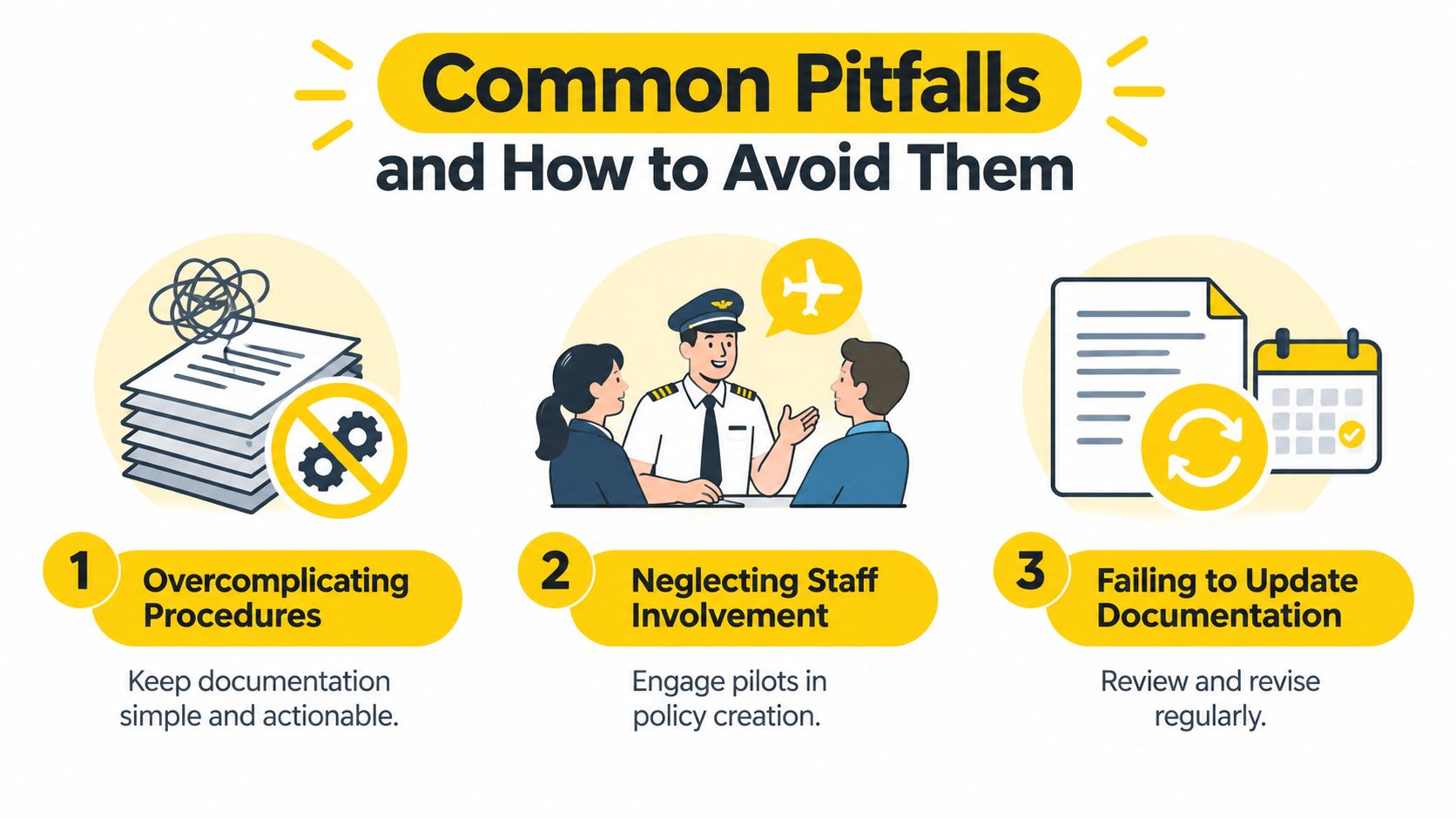
- Overcomplicating procedures: Keep instructions short, task-specific and available where the work occurs. Remove duplicate forms and unused approval steps.
- Neglecting staff involvement: Ask pilots and ground crew where procedures conflict with field conditions. Their feedback can identify hidden workarounds before an audit does.
- Failing to update documentation: Trigger reviews after equipment changes, incidents, regulatory changes and new operating environments. A procedure that describes retired equipment is a control failure.
- Treating records as an archive: Assign someone to review findings, incomplete forms and recurring defects. A record that never informs a decision adds little quality value.
- Ignoring corrective-action effectiveness: Confirm that the action fixed the underlying issue. Closing a task because a document was edited doesn't prove that the operational risk changed.
At minimum, the system should make it easy to locate the current operations manual, risk assessments, flight records, maintenance evidence, competency files, occurrence reports, corrective actions and document approvals. If a pilot can't find the right document or doesn't know how to report a problem, the system needs redesign rather than more pages.
Integrating Your AQMS with CASA Requirements
An RPAS operator should map each CASA obligation to an accountable process and an evidence record. The map might connect flight approvals to authorisation procedures, pilot qualifications to competency files, operational limits to planning checklists and occurrences to investigation and corrective-action records.
CASA's published rules set a maximum operating height of 120 m, or 400 ft, above ground level for drones flown under the standard recreational and educational rules. The same CASA drone rules state that drones over 250 g must remain at least 5.5 km from a controlled airport, while drones of 250 g or less may operate within that distance only up to 45 m and must still avoid the airport boundary and flight paths. A commercial operator's QMS should convert these limits into planning checks, escalation rules and evidence.
A RePL is required for a person flying for a ReOC holder or operating an RPA over 25 kg but under 150 kg on their own land. CASA's Remote Pilot Licence requirements include obtaining an ARN, completing approved theory training and passing the practical skills component for the intended RPA type and category.
Extra permission is required for operations above 120 m AGL, within 5.5 km of a controlled aerodrome, over a controlled aerodrome movement area, or in runway approach and departure paths. CASA's flight approvals framework indicates that many of these approvals require a ReOC and a RePL.
The operating category also matters. CASA guidance says small RPA over 2 kg and not more than 25 kg in the landholder-excluded category don't require a ReOC or RePL, while medium RPA over 25 kg and not more than 150 kg in that category don't require a ReOC but do require a RePL for the intended type and model. The CASA RPAS licensing and operations guidance should be checked when the aircraft, activity or operating location changes.
A defensible implementation example is a commercial operator that discovers during an internal review that pilots record flight completion but not the reason a mission was delayed. The operator can revise the mission form, brief the crew, sample later records and check whether the revised process captures the decision consistently. That is a practical quality improvement, unlike just adding another policy to the manual.
For a broader review of approvals, responsibilities and evidence, operators can use the ultimate guide to ReOC requirements in Australia. CASA planning documents also show why a regulator-level quality system needs performance measures, monitoring and continuous improvement rather than static compliance documents. The same discipline gives an RPAS operator a clearer basis for preparing for CASA scrutiny and maintaining operational control.
Frequently Asked Questions
What is an aviation quality management system?
It is a controlled framework for managing safety, quality, competency, documentation, risk, audits and corrective actions across aviation operations. For an RPAS operator, it should connect flight planning, aircraft control, crew competency, maintenance, data quality and regulatory evidence.
Does every drone operator need the same QMS?
No. The system should match the operator's aircraft, approvals, activities, crew structure, operating environment and risk profile. A small operator can use a lean system, while a multi-site or higher-risk organisation needs broader assurance and monitoring.
Is a QMS the same as an operations manual?
No. The operations manual describes approved operating methods and responsibilities. The QMS controls how those methods are documented, reviewed, audited, improved and supported by evidence.
What records should a commercial RPAS operator keep?
The operator should control records such as risk assessments, flight logs, maintenance evidence, competency files, occurrence reports, corrective actions, approvals and current document revisions. The exact record set depends on the operation and its obligations.
How often should an RPAS QMS be audited?
The audit frequency should reflect risk, operational change, previous findings and the scale of the business. Reviews should also be triggered by incidents, new aircraft, new work types, regulatory changes or recurring defects.
Ace Aviation Aerospace Academy offers relevant aviation training, including Remote Pilot Licence education, ReOC consulting and enterprise or corporate drone training, to help operators build competent teams and workable compliance systems. Visit Ace Aviation Aerospace Academy to review training options for safer, better-controlled RPAS operations.