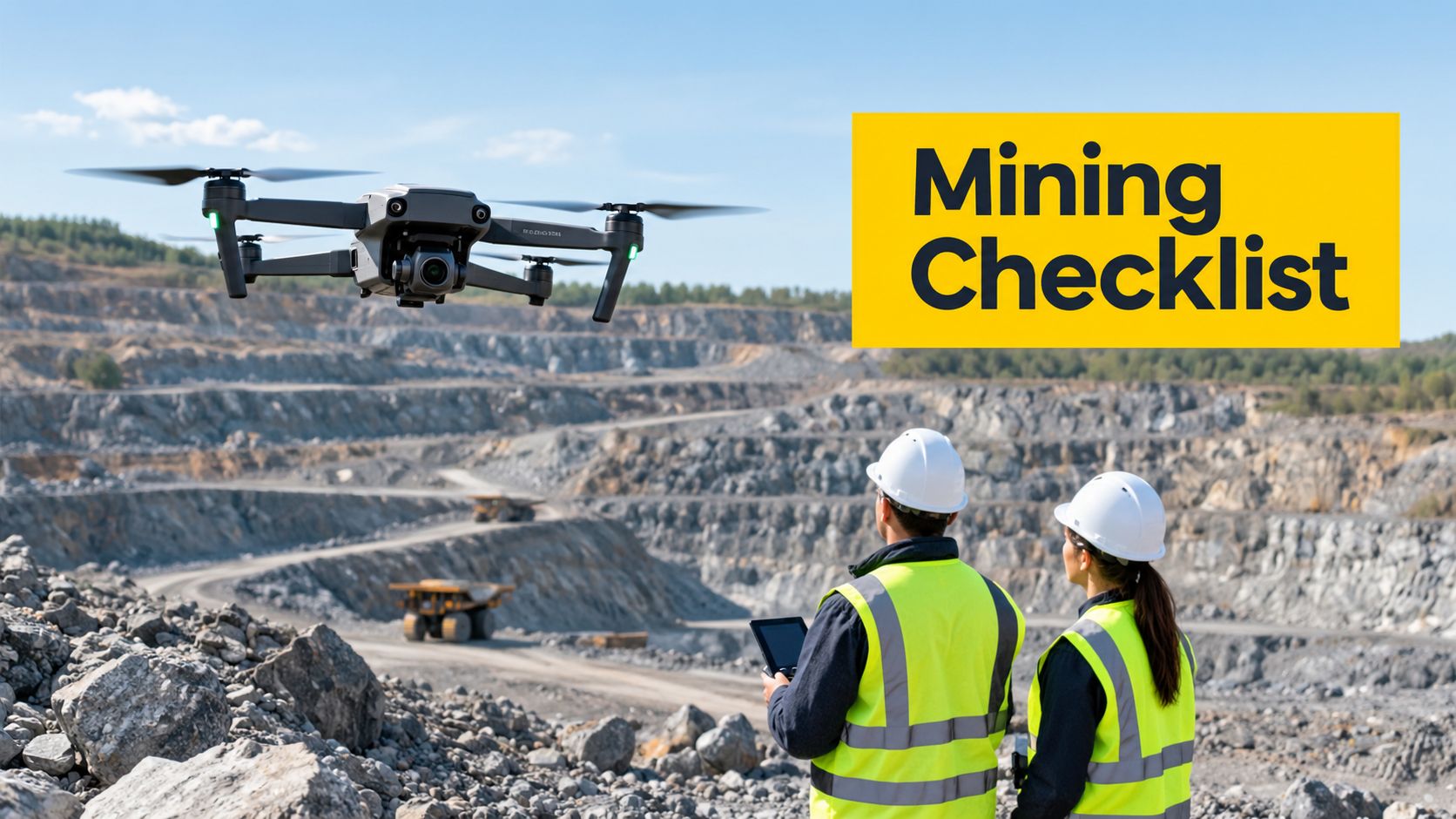
A remote mine site can have a technically capable drone team, a capable aircraft and a clear inspection objective, yet still carry preventable risk. The aircraft records may not be current, the pilot's competency may not match the mission, terrain hazards may have changed, and the flight crew may not have confirmed how radio calls, exclusion zones or incident reporting will work. Checking each issue separately creates gaps between aviation controls and mine-site controls.
A practical mining inspection checklist should be adapted to the aircraft, site, operation and applicable Civil Aviation Safety Authority (CASA) requirements. It should support decisions before launch, during the flight and after landing, rather than become a form that records activity without driving action.
The eight checks below follow the complete mining drone inspection lifecycle. They cover aircraft readiness, pilot competency, safety procedures, terrain, records, airspace, communications, and incident learning. They also show where a flight team should capture evidence, assign responsibility and stop or modify an operation when a control isn't ready.
Relevant capability development may include the Remote Pilot Licence (RePL), Aeronautical Radio Operator Certificate (AROC), Enterprise Drone Training or ReOC Consulting, depending on the operator's role and approval structure. A team researching airframe design and manufacturing may also find this overview of additive manufacturing for UAV manufacturers useful when assessing aircraft construction and component considerations.
Table of Contents
- 1. Equipment and Aircraft Airworthiness Inspection
- 2. Operator and Pilot Competency Assessment
- 3. Safety Management Systems and Procedures Audit
- 4. Operational Environment and Terrain Assessment
- 5. Maintenance Records and Documentation Compliance
- 6. Airspace and Regulatory Compliance Verification
- 7. Communication Systems and Radio Operator Certification
- 8. Incident, Accident, and Safety Event Management
- 8-Point Mining Inspection Checklist Comparison
- Turn Inspection Findings Into Safer Operations
1. Equipment and Aircraft Airworthiness Inspection
A pit-wall imaging flight can be compromised before the aircraft leaves the workshop. The pilot or nominated crew member should release the aircraft only after checking that the airframe, batteries, payloads, controller and support equipment match the planned mission and site conditions.
The checklist must be model-specific. A multi-rotor working close to a highwall has different exposure points from a fixed-wing aircraft mapping a broad lease area. Record the aircraft registration or fleet identifier, payload, battery identifiers, relevant software status, defect history and the person who completed the inspection. At a remote Australian mine, these records also make handover between the flight crew, maintenance team and site supervisor clearer.
Inspect the aircraft before launch
Use a documented sequence that covers:
- Airframe condition: Check arms, landing gear, fasteners, covers, guards and attachment points for cracks, distortion, looseness or impact damage.
- Propellers and motors: Look for chips, deformation and contamination, then confirm that motors rotate normally without unusual resistance or noise.
- Battery condition: Check for swelling, physical damage, connector problems, charge state and suitable storage. Confirm the battery can support the planned flight in the expected conditions.
- Sensors and payloads: Ensure cameras, thermal sensors, lidar and other payloads are secure, clean, configured and calibrated for the inspection task.
- Flight controls: Test controller links, positioning functions, return-to-home settings, geofencing behaviour and other relevant diagnostics according to the manufacturer's procedures.
Check the supporting kit as well. Spare batteries, charging systems, landing pads, tablets, cables, field cases and lighting can determine whether a mission is completed safely at an isolated pit or stockpile.
Treat defects as operational decisions
Review maintenance records before release. A successful earlier flight does not establish airworthiness for the next one. Record every anomaly, have an authorised person assess it where required, and repair or control the defect before returning the aircraft to service. Specialist support such as Forge Reliability condition assessment can help teams evaluate equipment condition beyond the drone itself.
Practical rule: A checklist is incomplete when a defect is merely recorded. It is complete when the defect has an owner, a disposition and evidence supporting release or withdrawal.
Digital inspection records should connect the aircraft check with maintenance history and audit evidence. Personnel responsible for airframe servicing may need maintenance capability such as the RPAS Engineering and Maintenance course. For beginners, ACE READY covers drone fundamentals, aviation safety, CASA regulations and flight operations.
2. Operator and Pilot Competency Assessment
A mining drone can pass its aircraft checks and still be unsuitable for release if the assigned crew cannot manage the mission. Confirm that the pilot's qualifications, currency, site induction, aircraft experience and emergency skills match the planned inspection before the aircraft reaches the launch point.
A RePL supports commercial remotely piloted aircraft operations, but checking the licence is only one part of the assessment. The pilot may still need local familiarisation, payload training, terrain briefing or supervision for work around an active pit, stockpile, haul road or exploration area.
Assess the person against the task
Use an observed assessment tied to the actual mission:
- Aircraft proficiency: Verify control of the specific multi-rotor or fixed-wing platform, payload and control system. Include launch, recovery and normal flight tasks.
- Operational judgement: Ask the pilot to identify conditions that should delay or stop the flight, including poor visibility, wind, battery degradation, terrain constraints and nearby site activity.
- Emergency response: Test the response to lost link, low battery, navigation faults, flyaway risk, unexpected crew movement and an unplanned landing. Record whether the pilot follows the site procedure rather than relying on memory.
- Mining controls: Confirm understanding of traffic management, exclusion zones, ground-control hazards, blasting restrictions, access rules and stop-work authority.
- Communication: Check that the pilot can make required radio calls, repeat instructions accurately and use the terminology expected by the control room and field crews.
A remote exploration assignment may require different evidence from a stockpile survey beside mobile equipment. A fixed-wing pilot should demonstrate the relevant launch, recovery and abnormal-procedure skills before working at an unfamiliar Australian site.
Turn competency into usable evidence
Record the task assessed, assessor, date, aircraft and payload, operating limitations, and any follow-up training. Refresher activity should reflect operational risk and organisational requirements, not an arbitrary calendar entry. Peer review can expose weak mission planning, emergency decisions or crew coordination before a flight creates an incident.
A chief remote pilot or nominated operational leader can set consistent standards across contractors and sites. Personnel responsible for that oversight can refer to the Chief Remote Pilot course when building their operational knowledge and assessment process. Release the crew only when the record shows both competence and authority to stop the mission.
3. Safety Management Systems and Procedures Audit
A mine's drone procedure must work under production pressure. Review the written safety management system against an actual mission, then confirm that pilots, spotters, supervisors and control-room staff apply the same steps.
Start with one recent or planned flight and trace its approval, briefing, launch, operation, recovery and close-out. Record where the procedure depends on site rules, such as access permissions, traffic controls or blasting exclusions, and where it reflects aviation requirements. The audit should show who makes each decision and what evidence remains afterward.
Use the following checks during interviews, document reviews and field observations:
- Task controls: Confirm that the risk assessment covers aircraft failure, people on the ground, terrain, weather, dust, electromagnetic interference, batteries and recovery. Link each hazard to an owner and a control that crews can verify.
- Flight procedures: Check that launch, landing, lost-link, low-battery and abnormal-event steps match the aircraft, payload and operating area. A generic procedure may omit a fixed-wing recovery requirement or a multirotor battery limit.
- Authority: Name the person who approves the mission, establishes the exclusion zone, coordinates with mine operations and can stop the flight. The stop-work decision should not depend on production approval.
- Operational changes: Trigger a review when the team introduces an aircraft, payload, contractor, flight profile or work area. Keep the old version controlled so crews cannot use obsolete instructions.
- Reporting and learning: Verify that personnel can report hazards, near misses and procedural weaknesses promptly. Assign actions, due dates and owners, then confirm that the next briefing reflects completed changes.
A mountainous exploration program may require controls for ridge effects, shifting wind, limited recovery areas and unreliable communications. An open-pit survey may instead centre on haul roads, blasting schedules, highwalls and active loading areas. The procedure should fit the worksite rather than force both operations into one template.
Make the audit observable
Ask a pilot and site representative to walk through a mission without launching. Have them identify the approval record, current procedure, emergency contacts, exclusion-zone method, communication path and post-flight reporting location. Compare their answers with the controlled documents and note any mismatch.
A team formalising its aviation approval structure can review ReOC setup guidance where that service applies. Close the audit only when personnel can demonstrate the process and the records show that identified weaknesses received action.
4. Operational Environment and Terrain Assessment
A flight plan can become unsafe within a single shift. A haul road may move, a stockpile may expand, water may collect, or equipment may occupy an approved recovery area. In Australian open-pit and quarry operations, current site conditions must be confirmed before launch, even when aircraft checks and airspace approvals remain valid.
Start with the worksite, not the drone. Compare mine plans, topographical information and satellite imagery with ground observations from the pilot and site representative. Record changes affecting terrain, highwalls, faces, water, drainage, bunding, stockpiles, roads, conveyors, buildings, cables, cranes, towers, dust sources and active work areas.
Use a short pre-flight walk-through to confirm:
- Terrain and obstacles: Mark highwalls, overhead structures, cables, towers, plant, buildings and mobile equipment routes. Note altitude limits relative to changing ground levels.
- Weather exposure: Check wind, visibility, temperature, precipitation and dust. Record conditions that may reduce battery performance, sensor quality or control reliability.
- Ground activity: Confirm blasting, haulage, lifting, drilling, loading, maintenance and access restrictions. Coordinate the launch window with the responsible site contact.
- Emergency recovery: Identify landing or recovery areas away from people, vehicles, water, unstable ground and operating plant. Define the response if the aircraft cannot return to the launch point.
- Inspection relevance: Check whether the terrain or activity could conceal, alter or create the condition being assessed.
The NSW quarry and pit inspection material highlights physical conditions including faces, water seepage, bunding, drainage, dump design, signage, stockpiles, roadways and restricted access. These conditions affect both the inspection target and drone safety. Use NSW Resources quarry and pit inspection guidance to adapt prompts for the Australian site.
A ground survey is often the safer first action in an unfamiliar area. If a reconnaissance flight is approved, set conservative boundaries and a defined objective. The completed checklist should identify the operating area, terrain-based altitude limit, hazards found, controls applied and the person who confirmed current conditions.
5. Maintenance Records and Documentation Compliance
A drone inspection record should let a supervisor reconstruct the work without relying on memory. Capture the aircraft, inspection objective, pilot and crew, location, approvals, weather, operating conditions, findings, media references and corrective actions. This evidence connects aircraft readiness, site controls and post-flight decisions across the inspection lifecycle.
Use paper forms where remote connectivity makes digital systems unreliable. For multi-site operations involving several aircraft or contractors, a searchable digital record usually reduces reconciliation work. Confirm that the field system works offline, preserves timestamps and prevents unauthorised changes. Export a backup before closing the inspection.
Link maintenance to the mission
Review the aircraft log before deployment, then connect that history to the flight record. Retain:
- Aircraft status: Scheduled maintenance, defects, repairs, component changes and return-to-service approval.
- Mission details: Date, location, purpose, aircraft, pilot, crew and relevant flight information.
- Inspection evidence: Photographs, thermal imagery, mapping outputs, annotations and the location of each observed condition.
- Corrective action: Finding, risk priority, nominated owner, due date, completion evidence and verification.
- Approval record: Site permission, risk assessment, airspace checks and operating limits.
A defect found during pre-flight should show who assessed it, what decision was made and whether the aircraft was released or grounded. That link matters when a later image is used to assess a change in a pit wall, stockpile or haul road.
Keep observations separate from professional conclusions. A photograph can document water seepage, cracking or an obstruction. A suitably qualified person must determine whether the condition indicates a geotechnical or operational risk.
Build an audit trail
NSW Resources states that inspections should be planned, involve experienced employees and be recorded for comparison and trend analysis under the historical Mines Inspection General Rule 2000. Its opal mining guidance also stresses recording findings, hazards and controls in a logbook, with daily, weekly and monthly inspection expectations. The NSW legislation and inspection framework supports retaining drone records for trend analysis, rather than recording only that a flight occurred.
Use a consistent logbook format, retain backups and close defects formally. A separate 10-step hydraulic maintenance guide offers a useful comparison for wider mine equipment documentation, while drone records must still follow manufacturer instructions and applicable aviation controls.
6. Airspace and Regulatory Compliance Verification
A drone can be airworthy and its pilot competent, yet the flight can still breach aviation or mine-site controls. Before launch, the flight planner must confirm the relevant airspace, restrictions, approvals, operating limits and coordination requirements.
Australian requirements differ by jurisdiction. Safe Work Australia identifies the Work Health and Safety Act 2020 (WA) and Work Health and Safety (Mines) Regulations 2022 for Western Australia, while South Australia applies its own WHS and mining inspection legislation. Safe Work Australia's mining overview provides a starting point for identifying the applicable framework. The operator must then confirm current requirements with the relevant regulator and document the organisation's approval to conduct the flight.
Separate aviation approval from site permission
A mine manager's permission does not replace CASA authorisation. Record both decisions, including who approved them, which airspace information was checked, what limits apply and which records must be retained.
The planning record should confirm:
- Airspace classification: Check the operating area and restrictions against current official information.
- Approvals and permissions: Record authorisations, notifications, exemptions and site permissions before deployment.
- NOTAM review: Check current notices, particularly near aviation activity or temporary restrictions, and retain evidence of the review.
- Flight limits: Confirm that the route, altitude, launch point and recovery area remain inside approved boundaries.
- Coordination: Set contact arrangements with air traffic services, mine control and other airspace users where required.
Use two verification stages. Desktop planning covers permits, previous non-compliances, current notices and reporting status. Onsite checks confirm that observable controls still match the plan, including launch and recovery boundaries, temporary work zones and active mine traffic.
Document any change before the aircraft moves. If blasting, cranes, haulage or another aircraft changes the risk picture, pause the flight, reassess the approval and record the decision. WA's DMPE reported 674 compliance activities, including 107 onsite inspections and 238 desktop compliance assessments, in 2024–25, with a 66 per cent exploration compliance rate from targeted inspections. The DMPE annual compliance snapshot illustrates why documentary review and field verification should remain separate.
7. Communication Systems and Radio Operator Certification
A haul truck enters the inspection area while the pilot is flying and the crane crew is using the same radio network. Without agreed channels, call signs and stop-work authority, a routine change can become an uncontrolled conflict. Set communication arrangements before launch, then test them at the actual launch, flight and recovery locations.
The check covers equipment, coverage and operator capability:
- Equipment function: Test radios, headsets, batteries, antennas, call signs and channel settings before entering the operating area.
- Coverage: Confirm usable communication coverage across the planned route, launch point and recovery area. Record any dead zone and the agreed alternative.
- Phraseology: Confirm that personnel performing aviation radio duties understand standard aviation phraseology and local mine procedures.
- Redundancy: Record a backup method for dead zones, battery failure or network interruption.
- Emergency calls: Rehearse the words, recipients and sequence for a lost-link event, flyaway, crash, injury or unexpected aircraft conflict.
Personnel performing aviation radio duties should hold the relevant Aeronautical Radio Operator Certificate where the operation requires it. The drone licence and aviation radio pathway can help identify training relevant to commercial drone work. The site operator must still confirm the competency and authorisation required for each role, separating regulatory requirements from mine-specific procedures.
Build communication into the flight plan
The pre-flight briefing should name the pilot in command, the person controlling the exclusion zone and the authority who can stop the flight. It should also set a clear rule for mine vehicles and lifting operations. For example, suspend the flight when a mobile crane enters the defined area. Restart only after the responsible site contact confirms that the controls are restored.
Record the check, not just the instruction. The form should identify the equipment tested, channel or method used, backup arrangement, coverage limitation and supervisor who accepted the arrangement. If a radio fails, coverage changes or another crew cannot confirm the instruction, pause the operation, document the decision and revise the flight plan before relaunching.
8. Incident, Accident, and Safety Event Management
A haul truck enters the drone work area while the pilot is dealing with a lost controller link. The event may end without damage, but it still exposes weaknesses in exclusion-zone control, communications or emergency authority. Treat near misses, unexpected personnel entry, incorrect radio instructions and sensor failures as reportable learning opportunities, not only crashes.
The incident process should make reporting straightforward while distinguishing honest mistakes from reckless or deliberately unsafe conduct. Punishing every error discourages reporting and hides the operating conditions that supervisors need to correct. A structured response to in-flight emergencies is covered in the drone pilot emergency handbook, which pairs with the reporting steps below.
Capture facts before opinions
Immediately after an event, preserve:
- Flight information: Aircraft, pilot, location, time, mission objective and relevant flight data.
- Physical evidence: Aircraft condition, batteries, payloads, controller status and photographs of the scene.
- Operational context: Weather, visibility, dust, mine activity, traffic, communications and personnel involved.
- Witness information: Prompt, firsthand accounts, without asking people to speculate.
- Initial controls: Aircraft grounding, area isolation, medical response, notification and evidence preservation.
The investigation should examine system factors alongside pilot actions. Weak briefing content, unclear authority, poor radio coverage, an outdated map, production pressure or an unsuitable recovery area may have contributed. Record which controls were available, which failed and who had authority to change them.
Close the learning loop
Every corrective action needs an owner, a completion date and a verification step. A revised SOP requires a crew briefing and an acknowledgement record. A new exclusion zone also needs signs, map updates and traffic-controller awareness, or it may exist only on paper.
NSW's regulator uses self-audit checklists to help miners and explorers identify statutory requirements applicable to an authorisation. Its 2024–25 annual report records 2,071 Mining Act assessments and findings from 19 full compliance audits (NSW Resources' auditing information). Apply the same evidence standard to drone events: link the observation to the obligation, assigned control and verified completion. Recheck the change during the next relevant flight briefing or site audit.
8-Point Mining Inspection Checklist Comparison
| Item | Implementation Complexity 🔄 | Resource Requirements ⚡ | Expected Outcomes ⭐ | Ideal Use Cases 📊 | Key Advantages & Tip 💡 |
|---|---|---|---|---|---|
| Equipment and Aircraft Airworthiness Inspection | High, technical inspections, compliance verification | Specialist technicians, diagnostic tools, spare parts, downtime | ⭐⭐⭐ Prevents failures; documented airworthiness | Daily pre-flight checks; fleet maintenance; remote site deployments | Prevents incidents & extends lifespan. Tip: use standardised digital checklists. |
| Operator and Pilot Competency Assessment | Moderate, structured assessments and practical checks | Qualified assessors, simulators/training time, record-keeping | ⭐⭐ Ensures qualified operators; identifies training gaps | RePL currency checks; high-risk or restricted-site operations | Reduces human-error risk. Tip: schedule annual competency refreshers. |
| Safety Management Systems and Procedures Audit | High, system-wide review and culture assessment | Cross-functional team, management commitment, audit tools | ⭐⭐⭐ Systematic risk reduction and continuous improvement | Multi-site operations; organisations building formal SMS | Establishes accountability and continuous improvement. Tip: involve frontline staff in SOP design. |
| Operational Environment and Terrain Assessment | Moderate, data collection and analysis | Topographic/satellite data, weather services, experienced surveyors | ⭐⭐ Informed flight planning; reduced CFIT/obstacle risk | Mountainous or remote exploration; seasonal planning | Identifies terrain hazards before flight. Tip: document alternative landing sites. |
| Maintenance Records and Documentation Compliance | Low–Moderate, record audits and verification | Administrative systems, digital logbooks, trained clerks | ⭐⭐ Demonstrates airworthiness; reveals maintenance trends | Fleet with scheduled maintenance; insurance/regulatory audits | Enables trend analysis and rapid readiness checks. Tip: implement digital records with backups. |
| Airspace and Regulatory Compliance Verification | Moderate, regulatory checks and coordination | Regulatory knowledge, NOTAM monitoring, flight planners | ⭐⭐⭐ Ensures legal operations and prevents conflicts | Operations near controlled airspace or SAA; recurring site flights | Prevents airspace conflicts. Tip: maintain documented authorisations and NOTAM logs. |
| Communication Systems and Radio Operator Certification | Moderate, equipment checks and competency verification | Radio equipment, AROC-trained personnel, redundancy systems | ⭐⭐ Reliable ATS coordination and emergency comms | Operations requiring ATS coordination or remote comms | Ensures clear comms and emergency response. Tip: run regular radio drills and backups. |
| Incident, Accident, and Safety Event Management | High, investigations, root-cause analysis, culture change | Investigation expertise, reporting systems, time for follow-up | ⭐⭐⭐ Organizational learning and recurrence prevention | After near-misses or accidents; SMS maturity building | Drives systemic improvements. Tip: adopt non‑punitive reporting and verify corrective action effectiveness. |
Turn Inspection Findings Into Safer Operations
The eight checks work best as one operating system rather than eight disconnected forms. A pilot can complete an aircraft check perfectly while the mine control room remains unaware of the flight. A supervisor can approve a site task while the aircraft has an unresolved battery defect. A survey team can collect excellent imagery while failing to preserve the records needed to explain how the inspection was conducted.
A repeatable programme assigns ownership before the mission. The remote pilot should own flight readiness and immediate operational decisions. The chief remote pilot or nominated aviation manager should control competency, procedures and records. Mine operations should confirm site activity, exclusion zones, traffic and emergency arrangements. Maintenance personnel should control defects and return-to-service decisions. A survey, geotechnical or engineering lead should own interpretation of inspection evidence within their professional scope.
Use a clear evidence chain
Every inspection should leave a traceable record from planning to closure. At minimum, the record should identify:
- The mission: What the aircraft was inspecting and why.
- The people: Pilot, observer, site contact, controller and approver.
- The aircraft: Platform, payload, batteries and relevant configuration.
- The environment: Location, terrain, weather, obstacles, traffic and airspace.
- The controls: Risk assessment, permissions, exclusion zone, communications and emergency plan.
- The outcome: Findings, evidence, assigned actions, completion and verification.
Photographs and mapping outputs should carry enough context to locate and understand the finding. A close image of a crack, loose material, damaged bund or water seepage may be useful, but a wider reference image and location information often make the evidence more actionable. The drone operator should avoid presenting visual data as a technical determination unless appropriately qualified to make that assessment.
Apply stop and modify criteria
A checklist should contain decision points, not only tick boxes. The operation should stop or change when a critical aircraft defect is unresolved, the pilot lacks the required competency, airspace status is uncertain, communications are inadequate, the exclusion zone isn't controlled, weather exceeds the approved limits or mine activity creates an unacceptable conflict.
Some findings can be controlled without cancelling the mission. The team may move the launch point, reduce the operating area, use a different payload, wait for a haulage window, add a spotter, change the route or conduct a ground inspection instead. The decision and reason should be recorded so that later reviewers can distinguish a controlled modification from an undocumented deviation.
Connect Australian inspection practice to drone work
Australian mining regulators provide useful models for structured inspection and recordkeeping. NSW guidance requires planned inspections involving experienced employees, with records retained for comparison and trend analysis under the historical framework. NSW quarry and pit prompts cover faces, water management, bunding, roads, drainage, dumps, stockpiles, signage, overhead structures and access restrictions. Those prompts should be translated into drone mission planning where aerial imagery can support observation, while ground personnel remain responsible for controls that aerial imagery can't verify.
The NSW coal mine schedule shows why frequency must come from the applicable regulation and site risk profile. Each production area at a coal mine other than an underground coal mine must be inspected at least once every shift. Underground coal mines have additional intervals, including gas inspection before connecting power to plant, inspection at least once every 2 hours of each face area where coal or mineral is extracted, inspection at least once every 5 hours of other places where people work, and inspection at least once every 8 hours of safely accessible places in the production area. The NSW regulation provision should be checked against current official material and the mine's own obligations before a drone workflow is designed around it.
A drone may support an inspection cycle, but it doesn't automatically satisfy every legal inspection duty. The checklist should state which observations require a competent ground inspection, which evidence can be collected remotely and who makes the final safety or engineering decision.
Review the checklist as conditions change
A mining drone inspection programme should be reviewed after an incident, near miss, aircraft change, payload change, site redesign, new contractor, altered airspace condition or change in mine activity. The review should remove prompts that no longer help, add hazards that appeared in practice and test whether personnel can complete the process without creating unsafe delays.
The most effective checklist is specific enough to guide action but short enough to be used under field conditions. It should be available offline where required, support photographs and annotations, preserve a reliable history and route corrective actions to the people who can close them. A form that produces neat records but doesn't change a decision is administrative comfort, not operational control.
Frequently asked questions
Is a RePL relevant to mining drone inspections?
A RePL is relevant to commercial remotely piloted aircraft operations, but the pilot also needs competency appropriate to the aircraft, payload, site and mission. Site induction, local procedures, emergency response and operational approvals remain separate requirements.
Is an AROC needed for a mining drone operation?
The need depends on the aviation communication duties and applicable operational requirements. Personnel responsible for aviation radio operations should hold the relevant AROC where required, and the team should verify radio equipment, phraseology, coverage and emergency communication procedures.
What airspace checks should occur before a mine flight?
The flight planner should confirm airspace classification, restrictions, approvals, notifications, NOTAMs, operating limits and coordination requirements using current official information. Mine-site permission doesn't replace CASA or other aviation requirements.
Should PPE and mine hazards appear on the drone checklist?
Yes. The team should follow the site's PPE and access rules and assess hazards including highwalls, roads, bunds, water, dust, overhead structures, mobile equipment, blasting and restricted areas. PPE protects the crew, while the flight plan controls aviation and ground interaction risks.
How should a team choose drone sensors?
The sensor should match the inspection question. Standard imaging may support visual condition evidence, while thermal, lidar or other payloads may be appropriate for specific tasks. The team should confirm calibration, data quality, weather limitations and the qualifications needed to interpret the output.
What should happen after the flight?
The team should secure the aircraft, record defects, preserve relevant flight and inspection evidence, upload or back up files, report hazards and assign corrective actions. Each action should have an owner and verification step, and the checklist should be reviewed when the finding exposes a wider procedural weakness.
Ace Aviation Aerospace Academy offers directly relevant pathways including RePL, AROC, Enterprise Drone Training and ReOC Consulting. Training should be selected according to the operator's role, aircraft, business structure and mine-site operating requirements.
Ace Aviation Aerospace Academy provides drone and aviation training relevant to mining operations, including RePL, AROC, Enterprise Drone Training and ReOC Consulting. Operators can review the available pathways and discuss training needs by visiting Ace Aviation Aerospace Academy.