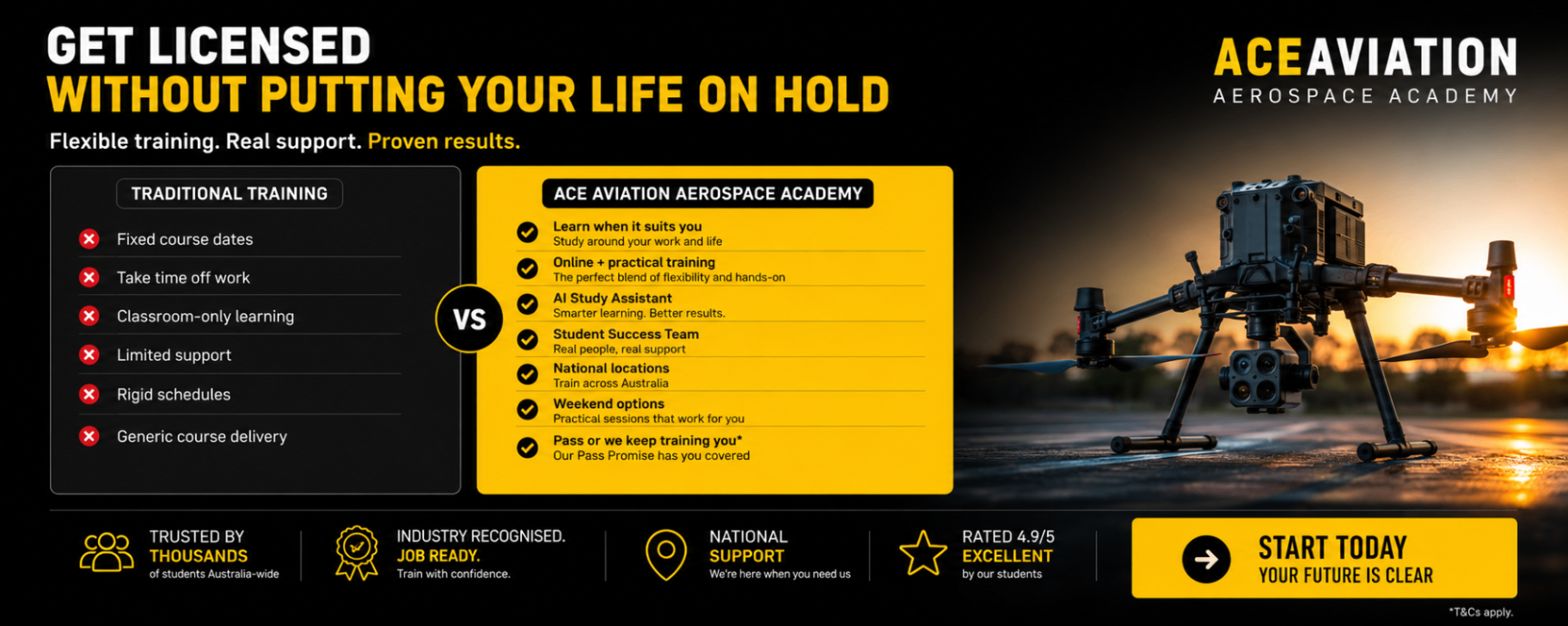
To earn a CASA Remote Pilot Licence (RePL) in 2026 without disrupting your schedule, you can complete theory training online and attend a condensed 2-day practical session. This flexible pathway meets Australian regulatory standards under CASA Part 101 while allowing you to study around work, family, or FIFO commitments in roughly 4–6 weeks.
Why More Australians Are Choosing Flexible Drone Training
The drone industry in Australia is no longer a niche hobbyist market; it is a serious commercial capability used across agriculture, mining, construction, utilities, surveying, emergency response, media, and infrastructure maintenance. From precision agriculture in the Darling Downs to bridge inspections in Melbourne, stockpile analysis in Perth, and roof condition surveys in suburban Brisbane, the demand for qualified Remotely Piloted Aircraft System (RPAS) operators keeps rising.
The biggest barrier for many people is not motivation. It is logistics. Traditional drone courses often assume students can disappear for a full work week, sit in a classroom from morning to afternoon, and absorb aviation law, meteorology, navigation, human factors, and practical operations at a fixed pace. That can work for some people. It does not work for everyone.
For a shift worker in Melbourne, a project manager in Sydney, a tradie in Adelaide, a parent in Brisbane, or a FIFO professional in Perth, losing five straight days of income and family time can make even a high-value career move feel unrealistic. That is why the market has shifted toward flexible, blended delivery.
The modern pathway, led by Ace Aviation Aerospace Academy, gives students a way to complete theory training online, at their own pace, before attending a focused practical flight block. This matters because people learn differently. Some want to rewatch air law modules twice. Others already understand maps and meteorology from adjacent industries and want to move faster. A self-paced structure respects both groups.
Just as importantly, flexible training is not a shortcut. It is simply a better delivery model. You still need to demonstrate competence. You still need to understand CASA Part 101, standard operating conditions, airspace, human factors, emergency procedures, and practical aircraft handling. The difference is that you can build those skills in a way that fits real life.
For anyone researching commercial drone pilot training, this is the practical takeaway: the best course is not the one that sounds the most intense. It is the one that gives you a compliant pathway, real support, relevant equipment, and enough flexibility to actually finish.
Train Anywhere in Australia
Ace Aviation’s Train Anywhere in Australia promise is straightforward: complete your theory online from wherever you are, then attend local practical training sessions in supported locations around the country. In 2026, that national reach has expanded further, with Hobart, Perth, and Canberra now fully supported as part of our flexible delivery model.
That means students no longer need to assume quality drone training is limited to the east coast capitals. Whether you are based in Tasmania, Western Australia, or the ACT, you can now complete Ace Aviation’s online theory at your own pace and then attend local practical training sessions starting from 2026.
This expansion matters for students who want:
- less interstate travel
- lower accommodation costs
- less disruption to work and family life
- access to CASA-aligned training without relocating
- a more realistic path into professional RPAS operations
For busy professionals, this is exactly what flexible aviation education should look like: study anywhere, then fly locally.
What Is a Drone Licence in Australia?
In Australia, the phrase “drone licence” usually refers to a Remote Pilot Licence (RePL) issued under the Civil Aviation Safety Authority (CASA) framework. It is the nationally recognised qualification that shows you have been trained to conduct commercial RPAS operations safely and legally. If you want to work professionally with drones, the RePL is the benchmark qualification.
A lot of people also hear terms like UAV licence, drone certification, commercial drone licence, or RPAS licence. In practical terms, most of these conversations are about the RePL. The formal CASA language is Remote Pilot Licence, and that is the term employers, insurers, and serious operators look for.
There is also an important distinction between:
- your personal licence as a pilot, and
- the approvals needed by a business or operator.
That leads directly to the next point.
In the Australian regulatory context, governed by the Civil Aviation Safety Authority (CASA), there are two primary levels of certification that individuals and businesses must understand: the RePL and the ReOC.
- Remote Pilot Licence (RePL): This is your personal qualification. It is similar to a driver’s licence. It proves that you, as an individual, have the competency to operate a drone for commercial purposes within the aircraft category and weight rating you have been trained in.
- Remote Operator Certificate (ReOC): This is an organisational approval. If a business wants to conduct commercial drone operations beyond very limited pathways, or apply for more advanced approvals, the operating entity typically needs a ReOC.
To be a professional in 2026, many pilots also need an Aeronautical Radio Operator Certificate (AROC) alongside the RePL. This allows lawful, competent radio communication when operating in or near controlled airspace and is especially relevant around major metropolitan environments such as Sydney, Melbourne, and Brisbane.
Deep Dive: CASA Part 101 and the Legal Framework in Australia
If you want to understand commercial drone pilot training properly, you need to understand CASA Part 101. This is the main section of the Australian aviation regulations that governs unmanned aircraft and remotely piloted aircraft operations. It sets the rules for how drones can be flown, who can fly them, when approvals are needed, and what conditions apply.
In simple terms, CASA Part 101 exists to answer a few core questions:
- What type of drone operation is being conducted?
- Is it recreational, excluded, or licensed?
- What training and approvals are required?
- What operating conditions must the pilot follow?
- When does a business need a ReOC?
- When are extra approvals required for things like controlled airspace, operations near people, or advanced missions?
Why CASA Part 101 Matters
A drone is still an aircraft in the eyes of the regulator. That means even relatively small RPAS operations sit inside a formal aviation safety framework. For hobby flying, people often only encounter the basic rules: stay below 120 metres, keep the drone in visual line of sight, stay away from emergency operations, and don’t fly where it creates a hazard.
Commercial work is different. Once there is business use, contractual risk, client expectations, liability exposure, and often more complex locations, the legal standard gets higher. That is why serious operators do not rely on “I watched a few videos online” knowledge. They train properly.
Excluded Category vs Licensed Operations
One of the most misunderstood parts of Australian drone regulation is the difference between the excluded category and licensed operations.
Excluded Category
The excluded category is a limited pathway that may allow certain commercial operations without a RePL or ReOC, depending on the aircraft and use case. Historically, this has commonly been associated with very small drones used under strict standard operating conditions.
That sounds attractive at first, but there are real limitations:
- operations must remain within tighter conditions
- the pathway is not suitable for many higher-risk jobs
- many corporate clients prefer or require licensed pilots anyway
- insurer expectations can be stricter than the minimum regulation
- career progression is limited if you stay in the excluded category
If you are doing simple imaging on private property with a small aircraft, the excluded pathway may appear sufficient. But if your goal is a long-term career, government work, infrastructure inspection, mining support, construction monitoring, or higher-value contract work, excluded category operations are usually too restrictive.
Licensed Operations
Licensed operations involve a RePL, and often a ReOC for the operating business. This is the professional standard. It tells clients, principal contractors, and safety teams that the pilot has completed formal training and understands Australian aviation law, risk management, practical operations, and operational limitations.
Licensed operations give you a much stronger platform for:
- commercial employability
- contract eligibility
- insurance confidence
- access to more complex operational approvals
- progression into enterprise and regulated industry environments
Why the RePL Is the Gold Standard for a Career
For career-focused operators, the Remote Pilot Licence (RePL) is the gold standard because it does three things at once.
First, it validates competence. A proper RePL course covers air law, aeronautical knowledge, meteorology, navigation concepts, human factors, and practical flying. That matters because commercial drone work is not just about moving a joystick. It is about making safe operational decisions.
Second, it improves credibility. When an employer in mining, construction, utilities, or agriculture compares two candidates, the licensed pilot usually has the advantage. The same applies when a client is choosing between providers.
Third, it creates a pathway into more advanced operations. If the future of your work includes larger aircraft, controlled airspace, EVLOS, BVLOS-adjacent workflows, or integration with enterprise safety systems, the RePL is the right starting point.
For anyone building a profession, not just a side hustle, the message is simple: the excluded category may let you start small, but the RePL is what positions you to grow.
Key Facts: The Modern Drone Licence at a Glance
Key Facts: The Modern Drone Licence at a Glance
| Feature | Details |
|---|---|
| Primary Qualification | Remote Pilot Licence (RePL) |
| Regulatory Body | Civil Aviation Safety Authority (CASA) |
| Typical Cost | $1,500 – $2,800+ depending on RePL type, AROC inclusion, delivery model, and support |
| Study Time | 15–20+ hours theory (Online/Self-paced for many students) |
| Practical Training | Often 2 days in person for condensed pathways |
| Medical Requirements | No formal Class 2 aviation medical for standard RePL; self-assessment and safe fitness required |
| Weight Categories | <7kg, <25kg (common commercial standard), and higher categories in some pathways |
| Valid For | RePL itself does not usually expire, but operators must remain compliant and competent |
| Major Hubs | Brisbane, Sydney, Melbourne, Perth, Adelaide, Darwin, Hobart, Canberra |
The Traditional vs. Modern Training Model
The evolution of drone training mirrors the broader digital transformation of the Australian workforce.
The Traditional Model (Legacy Training)
- Time Intensive: Often requires 5 full days of attendance.
- Fixed Location: Students must travel to a specific training centre for the entire duration.
- Rigid Pace: The instructor moves at the speed of the average student; if you’re fast, you’re waiting, and if you’re slower on technical topics, you’re trying to catch up.
- High Opportunity Cost: Lost wages, extra travel, accommodation, and family disruption.
The Modern Model (Ace Aviation Way)
- High Flexibility: Theory is completed online through a structured learning portal.
- Reduced On-Site Time: Practical flight training and assessment are condensed into a focused in-person block.
- Personalised Pace: Spend more time on difficult subjects like meteorology, air law, or airspace interpretation, and move quickly through what you already know.
- Career-Focused Delivery: The course is designed for real commercial outcomes, not just test completion.
- Cost-Efficient Logistics: Students often save money on travel, leave, and accommodation.
The “Train Your Way” Philosophy
At Ace Aviation, flexible delivery is not just an operations decision. It is a learning philosophy.
People come into drone training from very different backgrounds. Some have years of experience in construction, surveying, emergency services, media, or agriculture. Others are totally new to aviation. Some are confident in technology but nervous about regulations. Others are excellent with compliance and paperwork but need more time with practical flying.
A one-speed classroom assumes everyone learns the same way. They do not.
Why Self-Paced Learning Works
Self-paced learning has genuine psychological benefits, especially for adult learners.
- Lower cognitive overload: Aviation theory involves a lot of new terminology. When students can pause, replay, and revisit content, retention improves.
- Less performance pressure: Not everyone wants to ask a question in a room full of strangers. Online modules remove that friction.
- Better confidence building: Students can master one topic before moving to the next rather than feeling dragged forward.
- Higher completion rates for busy adults: If you can study after work, on weekends, or between roster cycles, you are far more likely to finish.
- Stronger long-term recall: Repetition and learner control usually improve memory and real-world application.
This matters because the goal is not to create students who can barely pass a theory exam. The goal is to create safe, employable pilots who can interpret a job properly, assess risk, and make good operational decisions.
How Altitude+ Supports Students
Ace Aviation’s Altitude+ program adds value after enrolment instead of disappearing once the invoice is paid. While many providers focus only on getting you through the minimum requirement, Altitude+ is designed to support your development beyond the initial licence issue.
Depending on the pathway, student support can include:
- ongoing guidance on training and next steps
- access to relevant operational insights and resources
- help understanding where an AROC or ReOC pathway fits
- support as you choose equipment for your intended work
- a stronger bridge between training and real commercial use
For many students, this is one of the biggest differences between a basic course and professional training. They do not just want a certificate. They want direction.
How the Pass Promise Reduces Risk
The biggest fear many students have is simple: “What if I pay for training and fail?”
That fear stops people from enrolling, especially people returning to study after years away from formal education. Ace Aviation’s Pass Promise approach helps reduce that anxiety. It signals that the academy is invested in student success, not just enrolment volume.
Psychologically, this matters because confidence affects performance. Students learn better when they know the provider has built a support structure around them. Instead of cramming or panicking, they can focus on genuine understanding.
In plain language, the Train Your Way model works because it respects how adults actually learn:
- they need flexibility
- they need clarity
- they need support
- they need confidence that the training leads somewhere useful
That combination is a major reason Ace Aviation continues to stand out in commercial drone pilot training across Australia.
Step-by-Step: How to Get Licensed in 2026
The path to becoming a professional drone pilot in Australia is a structured process designed to ensure safety and competency.
Step 1: Apply for an Aviation Reference Number (ARN)
Before you can hold any CASA qualification, you need an ARN. This is your unique ID in the CASA system. You can apply for this online via the myCASA portal.
Step 2: Choose Your Course Pathway
Decide if you want a basic RePL (<7kg) or if you want to future-proof your career with the <25kg category. We recommend the <25kg rating, as many enterprise drones, mapping platforms, and some agricultural systems require a more capable operational pathway. You should also consider enrolling in a Certificate III in Aviation to gain a formal VET qualification that strengthens employability, supports funding opportunities in some cases, and gives you a stronger long-term career platform.
Step 3: Complete Theory Online
At Ace Aviation, our online theory covers:
- Air Law: Understanding where and when you can fly under CASA Part 101.
- Airspace: Learning to read VTC and VNC maps (essential for flying in Sydney or Melbourne).
- Meteorology: Interpreting TAFs and ARFORs to ensure safe flight conditions.
- Human Factors: Understanding how fatigue and stress affect pilot performance.
Step 4: Practical Flight Training
Join our instructors at one of our national training sites. In Brisbane, Sydney, Melbourne, Perth, Hobart, and Canberra, you can now access local practical training sessions starting from 2026 while still completing theory online at your own pace. You’ll get hands-on experience with commercial-grade hardware and learn hover stability, landing procedures, and, most importantly, emergency fail-safe maneuvers.
Step 5: Final Assessment
Once your flight hours are logged, you will undergo a flight proficiency test. Don’t worry; our training is designed to ensure you are over-prepared for this moment.
Step 6: Licence Issuance
Upon successful completion, Ace Aviation submits your paperwork directly to CASA. Your digital RePL will typically appear in your myCASA account within a few business days.
Industry-Specific Use Cases for Commercial Drone Pilots
The RePL is a practical commercial qualification. It opens the door to real jobs, safer workflows, and measurable business outcomes. Below are the sectors where commercial drone pilot training has become especially valuable in 2026.
1. Agriculture: Spraying, Mapping, and Farm Intelligence
Agriculture is one of the strongest growth sectors for drone operations in Australia, especially across regional Queensland, New South Wales, Victoria, South Australia, and Western Australia. Farms are using drones for:
- crop health monitoring
- NDVI and multispectral mapping
- irrigation assessment
- livestock monitoring
- weed detection
- targeted spraying and spot treatment
- pre-harvest planning
A licensed pilot working in agriculture needs more than basic flying skill. They need to understand:
- mission planning
- weather interpretation
- terrain awareness
- battery management in remote areas
- chemical handling interfaces where relevant
- safe take-off and landing environments around workers, vehicles, and infrastructure
For spraying applications, the regulatory and operational standard rises again. Agricultural clients want reliability, traceability, and professional process. A licensed pilot with proper commercial drone pilot training is far better placed to meet those expectations than an excluded-category operator flying a consumer drone.
Real-world example: a grower near Toowoomba may use drones first for orthomosaic mapping, then for identifying poor-performing zones, then for targeted intervention. A trained pilot can support that entire chain with compliant operations and repeatable data capture.
2. Mining: Stockpile Volume, Pit Mapping, and Environmental Monitoring
Mining is a natural fit for professional drone operations because the work is data-heavy, safety-sensitive, and often conducted across large, remote, or difficult terrain. In mining regions around Perth, the Pilbara, Kalgoorlie, Mackay, and Central Queensland, drones are now used for:
- stockpile volumetrics
- pit mapping
- haul road inspection
- change detection
- blast zone observation
- drainage assessment
- tailings and environmental monitoring
- progress reporting for engineering teams
Mining clients do not just want someone who can fly. They want pilots who can operate inside a safety management culture. That means understanding pre-start processes, exclusion zones, site induction expectations, risk controls, and client reporting requirements.
A RePL matters here because it signals formal training and aviation discipline. A mining contractor hiring a pilot for stockpile volume work wants confidence that the operator can:
- manage a safe mission
- capture consistent data
- work near plant and vehicles
- understand local airspace or site constraints
- integrate into broader site compliance systems
This is one reason mining remains a major driver for commercial drone pilot training in Australia.
3. Construction: Site Monitoring, Safety, and Stakeholder Reporting
Construction teams in Brisbane, Sydney, Melbourne, Adelaide, and Perth now use drones routinely across residential, civil, and major infrastructure projects. Typical use cases include:
- weekly site progress updates
- earthworks measurement
- roof and facade inspections
- marketing imagery for developments
- safety observations
- contractor coordination visuals
- dispute documentation
- client and investor reporting
Drones help project managers see more, document more, and communicate more clearly. Instead of relying only on ground photos and manual walk-throughs, a drone pilot can provide structured visual records from repeatable positions.
For construction, compliance matters because sites are dynamic. There are workers, cranes, changing hazards, temporary structures, public boundaries, and nearby roads. A trained pilot needs to understand how to maintain separation, manage launch and recovery zones, and avoid creating a new risk while trying to document an existing one.
A RePL-backed operator is more attractive to builders, principal contractors, and consultants because they bring regulated aviation training into an environment that already has strong WHS expectations.
4. Infrastructure: Bridge, Tower, and Asset Inspections
Infrastructure inspections are one of the clearest examples of drones solving real operational problems. Bridges, towers, solar farms, powerline corridors, roofs, facades, tanks, and telecom structures all require regular condition assessment. Traditionally, that often meant:
- scaffolding
- rope access
- elevated work platforms
- traffic management
- shutdowns
- higher labour cost
- more exposure to working-at-height risk
Drones can reduce time on task and improve safety by capturing high-resolution stills, zoom imagery, thermal data, or repeatable inspection angles from the air.
A licensed pilot conducting bridge or tower inspections must be especially competent in:
- proximity flying
- obstacle awareness
- wind effects around structures
- emergency planning
- controlled airspace considerations in urban zones
- client reporting discipline
In cities like Melbourne and Sydney, infrastructure work can also involve more complicated airspace and stakeholder coordination. That makes the combination of RePL, AROC, and quality commercial drone pilot training especially valuable.
Regional Focus: RePL Training Across Australia
Location matters in search, but it also matters operationally. Students want to know whether they can complete training close to home, and employers often search for pilots with local context. Ace Aviation supports students nationally, and from 2026 that support now includes expanded local practical training access in Hobart, Perth, and Canberra alongside flexible online theory delivery. This is a core part of our Train Anywhere in Australia promise.
RePL Brisbane
RePL Brisbane demand is driven by construction, property, infrastructure, civil works, and nearby regional agriculture. Brisbane operators often need to understand urban airspace constraints, weather variability, and the realities of flying near busy development corridors. A flexible RePL Brisbane pathway is especially useful for tradespeople, consultants, and small business owners who cannot step away for a full week.
RePL Sydney
RePL Sydney enquiries are commonly tied to media, property, infrastructure, corporate inspection, and high-compliance work. Sydney’s controlled and complex surrounding airspace means students benefit from strong training in airspace awareness and radio procedures. For serious metro work, combining a RePL with an AROC is often the smart move.
RePL Melbourne
RePL Melbourne remains one of the strongest search and training markets because Melbourne has a broad mix of construction, utilities, engineering, surveying, and government-related drone applications. Students here often want a course that fits around full-time work. The blended online-plus-practical model is particularly relevant for that audience.
RePL Perth
RePL Perth demand is heavily influenced by mining, resources, utilities, engineering, and remote operations support. Perth students are often looking beyond basic imaging and into commercial use cases such as stockpile volume measurement, pit mapping, asset inspection, and industrial surveying. That makes a career-focused <25kg pathway especially relevant.
From 2026, RePL Perth students are now fully supported through Ace Aviation’s expanded national model. That means flexible online theory combined with local practical training sessions in Perth, reducing the need for interstate travel while giving WA students access to the same CASA-aligned training standard available across the rest of the country.
RePL Adelaide
RePL Adelaide has strong potential across infrastructure, utilities, viticulture, construction, and regional operations throughout South Australia. Students based in Adelaide often want nationally recognised training with flexibility and a clear pathway into commercial work rather than hobby-level flying.
Drone Training Hobart
Searches for drone training Hobart usually reflect a mix of local business use, government interest, tourism media, land management, and inspection work. In Tasmania, weather judgment and safe operational planning are especially important. Hobart students benefit from training that covers both the regulatory basics and the practical realities of varied terrain and conditions.
From 2026, drone training Hobart is now fully supported by Ace Aviation through self-paced online theory and local practical training sessions in Hobart. This gives Tasmanian students a more direct pathway into commercial RPAS training without relying on mainland-only delivery models.
Drone Training Canberra
Searches for drone training Canberra often come from professionals working in government, infrastructure, consulting, surveying, land management, emergency planning, and contractor environments. Canberra operators often need a strong understanding of compliance, documentation, and professional operating standards, especially when working around sensitive sites or more structured organisational environments.
From 2026, drone training Canberra is now fully supported through Ace Aviation’s flexible national delivery model. Students can complete online theory from anywhere in the ACT or surrounding NSW regions, then attend local practical training sessions in Canberra as part of our Train Anywhere in Australia promise.
Drone Training Darwin
Searches for drone training Darwin often come from operators working in infrastructure, government, emergency response, land management, and remote area logistics. Northern conditions can create unique planning challenges, including heat, humidity, and remote recovery considerations. Darwin-based students are usually best served by a provider that understands both compliance and practical field realities.
Certificate III in Aviation: Why It Gives You a Competitive Edge
The Certificate III in Aviation (Remote Pilot), delivered in partnership with Reach Community College, gives students something more than a regulatory licence. It adds a formal vocational qualification to their profile.
That distinction matters.
A RePL is the CASA licence that allows you to operate commercially within the relevant permissions and operational framework. The Certificate III in Aviation is a nationally recognised education outcome that can strengthen your résumé, improve your standing with employers, and support broader career development.
Why the Certificate III Matters
A formal qualification can provide advantages in several areas:
- stronger employability for entry-level candidates
- better alignment with structured recruitment processes
- potential access to eligible funding pathways depending on circumstances
- evidence of broader vocational commitment
- a more competitive profile for government, civil, and enterprise roles
For students entering the industry without previous aviation experience, the Certificate III can be especially useful because it shows a more complete training journey rather than a single compliance credential.
Career Pathway Benefits
In practical terms, the Certificate III can help if you want to move toward:
- surveying support roles
- construction and engineering support
- public sector or contractor positions
- infrastructure inspection pathways
- agricultural operations support
- internal drone team roles within larger companies
It can also help students who are trying to justify training investment through workforce development, formal study, or potential grant-supported opportunities where available.
In short, the RePL gets you licensed. The Certificate III can make you more employable.
RePL Licence Cost and ROI in 2026
One of the most common search terms in Australia is “repl license cost”. That makes sense. People want a straight answer before they commit.
What Does a RePL Cost?
In 2026, the RePL licence cost typically falls somewhere between $1,500 and $2,800+, depending on:
- whether the course is <7kg or <25kg
- whether AROC training is included
- the delivery model
- student support and inclusions
- equipment access
- location and practical scheduling
- whether the training is bundled with additional qualifications
The cheapest option is not always the best value. A low advertised price can exclude critical components such as:
- radio training
- practical support
- resit support
- post-course mentoring
- up-to-date enterprise equipment exposure
ROI: Why the Cost Can Pay Back Quickly
For many students, the question is not just “What does it cost?” but “What does it return?”
A RePL can create return on investment through:
- direct employment opportunities
- internal upskilling in an existing role
- new service offerings for a business
- reduced subcontractor spend
- safer and faster inspections
- improved project reporting capability
Examples:
- A construction business owner who currently outsources monthly drone reporting may recover training cost quickly by handling routine site updates internally.
- A survey technician who adds drone capability may increase billable value and employability.
- A property media operator who upgrades into compliant commercial work can charge more confidently and work with larger clients.
- A mining or infrastructure worker who gains licensed RPAS capability may become more competitive for promotion or specialist project roles.
Cost vs Risk
There is also a risk management angle. Operating without proper training can cost more than training itself if it leads to:
- regulatory breaches
- rejected client work
- insurance issues
- poor data capture
- unsafe site interaction
- reputational damage
That is why serious operators usually view the RePL licence cost as a professional investment, not an expense to be minimised at all costs.
Common Mistakes When Getting a Drone Licence
Avoiding these pitfalls can save you thousands of dollars and months of frustration:
- Choosing a Non-CASA Training Provider: Only training from a CASA-approved provider with the right authority is valid for a RePL pathway. Always check credentials carefully. Ace Aviation is CASA.ReOC.1421.
- Skipping the AROC: While you can get a RePL without an Aeronautical Radio Operator Certificate, you may be limiting your usefulness in controlled or more complex airspace environments, especially near major cities.
- Training on the Wrong Weight Class: If you train only for a small aircraft category, you may not be ready when an employer or client needs a more capable platform.
- Treating Drone Work Like Hobby Flying: Commercial operations involve contracts, risk, insurance, and compliance. Mindset matters.
- Buying Hardware Too Early: Many students buy the wrong drone before understanding their actual market. Training first often saves money.
- Ignoring Data Workflow: In mapping, mining, and inspection work, the deliverable matters as much as the flight.
- Assuming Excluded Category Is Enough Forever: It may be enough for some small jobs, but it is rarely the strongest long-term career path.
- Ignoring Insurance: Many new pilots believe their home insurance covers their commercial drone. It usually does not. You need appropriate aviation and public liability cover for the work you are doing.
CASA Considerations: The Regulatory Landscape in 2026
Flying a drone commercially in Australia is not just about stick skills; it is about regulatory compliance. CASA maintains strict oversight to support safety across the national airspace system.
- Standard Operating Conditions (SOCs): Even with a RePL, many operations are still conducted under standard conditions unless specific approvals apply. These generally include staying below 120m (400ft), keeping the drone in Visual Line of Sight (VLOS), and maintaining safe separation from people.
- RePL vs ReOC responsibilities: The pilot licence and the operator approval are different things. A skilled pilot still needs to operate within the permissions of the relevant business or operational framework.
- Controlled airspace: Operations near major airports or within controlled airspace often require stronger planning, radio competency, and approvals.
- BVLOS and EVLOS: The next frontier of drone work is Beyond Visual Line of Sight (BVLOS) and more scalable EVLOS (Extended Visual Line of Sight) models. These are advanced operations and require far more than basic course completion.
- Documentation and planning: Increasingly, commercial clients expect formal risk assessments, site documentation, procedures, and evidence of pilot competence.
- Technology-assisted compliance: Modern workflows are moving toward digital planning tools, airspace validation, automated checklists, and integrated mission documentation.
Future of Flight: UAMP, AI-Driven Compliance, and Smarter RPAS Operations
The drone industry is moving away from manual, fragmented planning and toward integrated digital workflows. One of the most important developments in that shift is the rise of tools like UAMP (Unmanned Aircraft Mission Planner).
UAMP reflects where professional RPAS operations are heading: more automation, more documentation, better risk visibility, and easier compliance management.
What UAMP Represents
UAMP is part of a broader category of mission planning and compliance systems that help operators:
- map missions
- assess locations
- structure operational documents
- improve consistency
- support safer decision-making
- reduce admin friction around commercial operations
For operators working across construction, infrastructure, mining, and inspection environments, this matters because the paperwork load can become substantial. Good pilots already know that a safe mission starts long before take-off. AI-assisted mission planning simply makes that process faster and more consistent.
Why Modern Training Must Prepare Pilots for Automation
The future commercial drone pilot is not just a flyer. They are a mission manager, compliance thinker, and data operator.
That means good training should prepare students to work with:
- digital pre-flight planning tools
- automated checklists
- airspace review systems
- client documentation requirements
- repeatable risk assessment processes
- data capture workflows
- increasingly intelligent aircraft ecosystems
Ace Aviation’s approach is aligned with that reality. The point of modern training is not only to help students pass an assessment. It is to prepare them for an industry where AI-assisted compliance, automated mission planning, and integrated operational workflows are becoming normal.
In other words, the future of flight belongs to pilots who understand both regulation and systems.
Frequently Asked Questions (FAQ)
1. How much does a drone licence cost in Australia in 2026?
The typical RePL licence cost in Australia is around $1,500 to $2,800+, depending on the provider, aircraft category, whether the AROC is included, and how much support is built into the course. If you are comparing providers, ask what is actually included rather than just looking at the headline price.
2. Is a RePL the same as a commercial drone licence?
Yes, in most everyday conversations, when someone says “commercial drone licence,” they mean a Remote Pilot Licence (RePL). That is the CASA-recognised pilot qualification used for professional RPAS operations.
3. What is the difference between excluded category and licensed operations?
The excluded category may allow limited commercial use with a small drone under strict conditions, but it is not the same as being a fully trained, licensed pilot. Licensed operations involve formal training and the issue of a RePL, which is the stronger option for employability, insurance confidence, and long-term career growth.
4. Do I need a medical to get a drone licence?
For a standard RePL, you generally do not need a formal CASA Class 2 aviation medical. However, you still need to be fit to operate safely and must not fly if a medical condition, medication, fatigue, or impairment would affect safe performance.
5. Is the theory difficult for beginners?
It is technical, but it is manageable with the right support. New students usually find air law, airspace, and meteorology the most unfamiliar topics. Self-paced learning helps because you can pause, replay, and review until the concepts click.
6. Can I study while working full-time?
Yes. That is one of the biggest advantages of a modern blended course. You can complete theory after work, on weekends, or around shift patterns, then attend the practical component when ready.
7. Do I need to own a drone before I start training?
No. In fact, many students are better off waiting. Training first helps you choose hardware based on your actual goals, whether that is mapping, inspections, media, construction, mining, or agriculture.
8. What drone should I buy after I get licensed?
That depends on the work you want to do. A pilot focused on property marketing may choose very different hardware from someone doing stockpile volume surveys or bridge inspections. The right answer depends on camera needs, payloads, mapping accuracy, flight time, software ecosystem, and budget.
9. Is the <25kg RePL better than <7kg?
For most career-focused students, yes. The <25kg pathway usually provides a stronger commercial platform because many professional jobs involve aircraft and operational expectations beyond the smallest consumer category.
10. Do I need an AROC as well as a RePL?
Not always for every operation, but in many metro and controlled-airspace scenarios, the AROC becomes highly valuable. If you expect to work near major urban areas, airports, or more complex airspace, it is smart to consider it early.
11. Can I fly in Brisbane, Sydney, Melbourne, Perth, Adelaide, Hobart, Canberra, or Darwin with a RePL?
A RePL is the correct starting point, but each job still depends on local airspace, site constraints, operator approvals, and mission specifics. Flying legally in a major city is about more than simply holding the licence.
12. What insurance do commercial drone pilots need?
At minimum, many operators look at appropriate public liability insurance for RPAS work. Depending on the business model, hull cover, professional indemnity, and other protections may also be relevant. Insurance needs vary by operation type and client expectations.
13. Is the Certificate III in Aviation worth it?
For many students, yes. The Certificate III in Aviation (Remote Pilot) adds a nationally recognised vocational qualification alongside the CASA licence. That can improve employability and strengthen formal career pathways.
14. Can I get funded for drone training?
Funding depends on eligibility, course structure, and current programs. Because Ace Aviation delivers the Certificate III in partnership with Reach Community College, some students may have access to funding or subsidised pathways depending on their circumstances. It is worth checking current availability.
15. What jobs can I do after commercial drone pilot training?
Common pathways include agriculture mapping, construction site reporting, infrastructure inspection, surveying support, mining data capture, public safety support, environmental monitoring, and media production. The strongest opportunities usually go to pilots who combine compliance knowledge with a clear industry use case.
16. Can I start a drone business with just a RePL?
You can start with the RePL as your pilot qualification, but the business side may also require a ReOC depending on the structure and type of operations. If your goal is to build a commercial service, it is important to understand the operator-certificate side early.
17. Can I fly at night or beyond visual line of sight?
Not under simple standard conditions. Night operations, EVLOS, and BVLOS are advanced areas that require additional approvals, stronger risk controls, and more sophisticated operational planning.
18. What happens if I fly commercially without proper licensing?
You risk regulatory action, insurance complications, client contract issues, and reputational damage. Even if someone gets away with it once, it is not a professional foundation for a business or career.
Summary: Your Future in Flight
If you want to build a serious future in drones, the clearest path in Australia is still the same: understand CASA Part 101, complete proper commercial drone pilot training, earn your RePL, and train with a provider that prepares you for real operations, not just a checkbox result.
The flexible model matters because people have jobs, families, rosters, and competing priorities. The regulatory model matters because aviation is still aviation, even when the aircraft is unmanned. And the career model matters because clients in agriculture, mining, construction, and infrastructure increasingly want trained, compliant, professional operators.
That is where Ace Aviation Aerospace Academy stands apart. With national reach, CASA-approved delivery, a strong reputation across Australia, support through Altitude+, confidence through the Pass Promise, and pathways including the Certificate III in Aviation delivered with Reach Community College, Ace Aviation gives students more than a licence. It gives them a credible launch point.
Whether you are searching for RePL Brisbane, RePL Sydney, RePL Melbourne, RePL Perth, RePL Adelaide, drone training Hobart, drone training Canberra, or drone training Darwin, the core principle is the same: train properly now, and you will have more options later. And from 2026, Ace Aviation’s Train Anywhere in Australia model means Hobart, Perth, and Canberra are now fully supported with flexible online theory and local practical training sessions.
Ready to get started? Explore our courses and join over 4,000 successful graduates today.