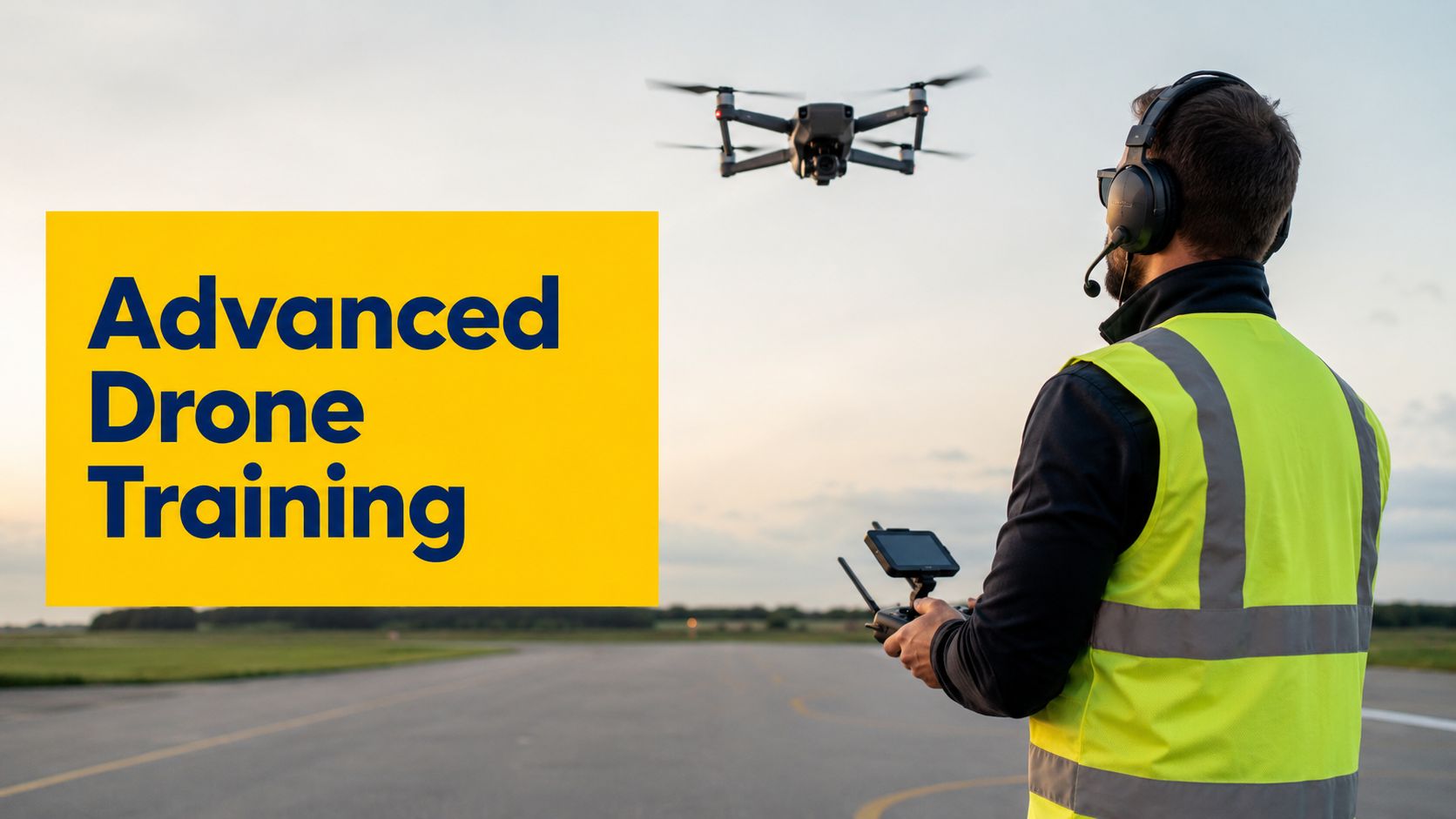
A newly licensed drone pilot often reaches the same point after completing initial training. The certificate is in hand, the aircraft is familiar, and a client asks for work near a busy transport corridor, over a large agricultural site, or during an emergency response. The pilot then discovers that holding a licence and being ready to manage a commercial mission aren't the same thing.
Australia's advanced aviation training pathway exists in that space between basic certification and dependable operational capability. It combines aircraft handling with airspace awareness, radio communication, mission planning, risk management, documentation, and the discipline needed to work within CASA requirements. For aspiring pilots, businesses, and government teams, the important question isn't just which certificate comes next. It's whether the training prepares an operator to make sound decisions when the mission becomes complex.
Table of Contents
- Why Basic Certification Is Not Enough for Commercial Operations
- What Advanced Aviation Training Covers
- Prerequisites and Entry Requirements
- Choosing Your Advanced Training Pathway
- Learning Outcomes and Career Applications
- How Ace Aviation Meets CASA and Industry Standards
- Next Steps and Decision Criteria
- Frequently Asked Questions
Why Basic Certification Is Not Enough for Commercial Operations
A newly qualified remote pilot may be comfortable conducting a controlled flight in an open area. That confidence can change quickly when a first commercial assignment involves an active worksite, nearby people, changing weather, restricted airspace, or a payload that affects aircraft performance.
A basic RePL provides an important foundation, but it doesn't automatically prepare a pilot to design and supervise a complete operation. Agricultural mapping, infrastructure inspection, and emergency response each introduce different hazards. The operator must understand the site, the aircraft, the task, the people affected, the applicable operating conditions, and the records required to demonstrate that the mission was conducted responsibly.
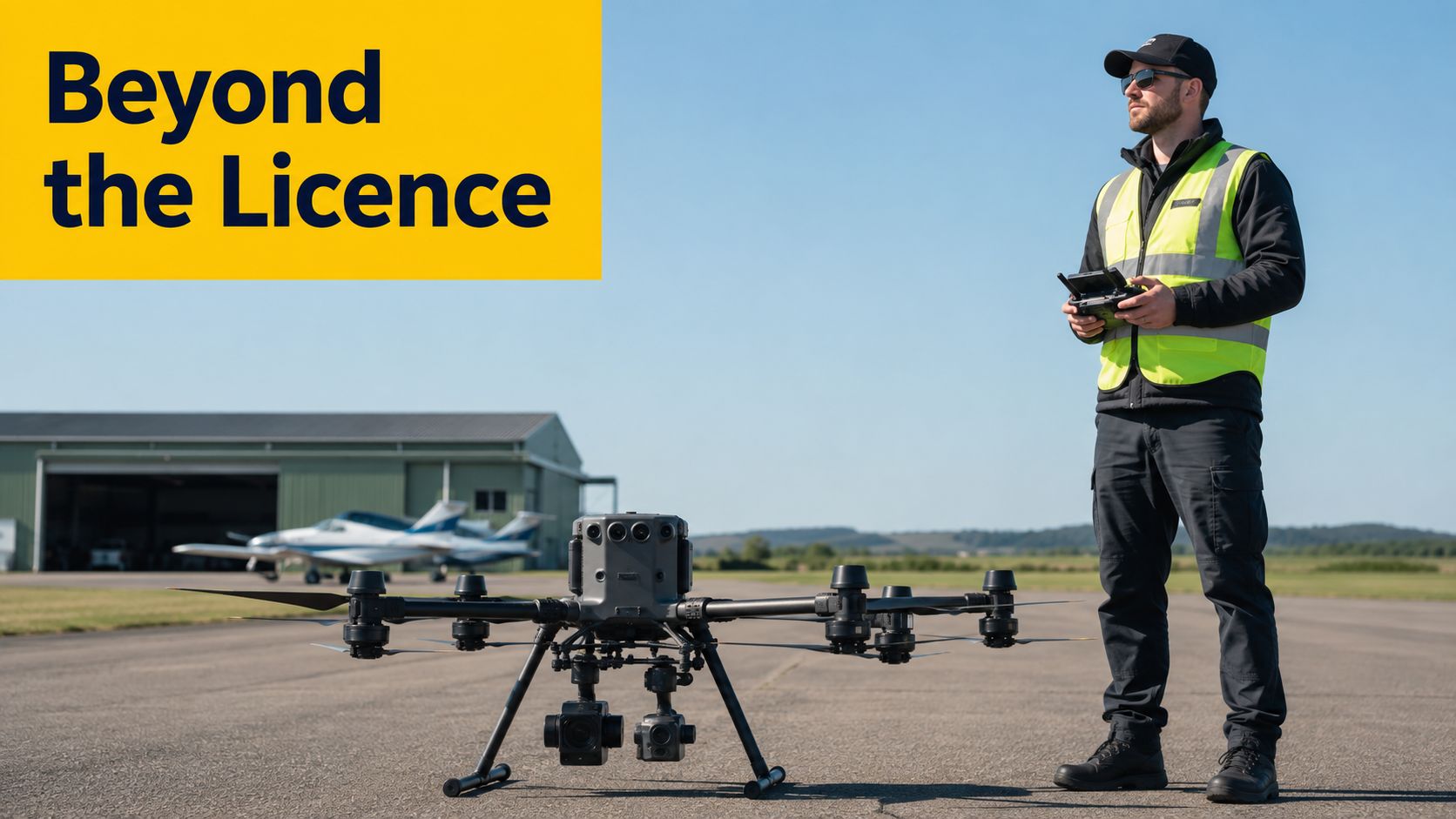
The certificate to capability gap
CASA's student guide says RePL training is usually about 5 days, and more than 50 CASA-approved providers exist, according to the CASA student drone guide. That makes the initial licence accessible, but the short course should be treated as a starting point rather than proof of readiness for every commercial scenario.
Consider an infrastructure inspection. A pilot may know how to launch, manoeuvre, land, and capture imagery, yet still need further preparation for:
- Site risk assessment: Identifying overhead lines, access restrictions, workers, vehicles, structures, and changing hazards.
- Airspace coordination: Determining whether nearby aerodromes, controlled airspace, or other aircraft create additional requirements.
- Mission planning: Selecting routes, altitudes, contingency areas, battery arrangements, payload settings, and lost-link procedures.
- Evidence management: Producing records and imagery that a client can use without compromising safety or operational traceability.
A similar gap appears in agriculture. A pilot working around farm machinery must coordinate with people on the ground, account for terrain and weather, and understand whether the task involves mapping, spraying, spreading, or another activity with its own operational controls. Emergency services add pressure, limited information, radio discipline, and the need to operate within a structured incident-management environment.
Practical rule: A remote pilot should be able to explain not only how the aircraft will fly, but also why the mission is permitted, how the risks are controlled, and what happens when the plan changes.
Entry-level work versus advanced operations
Some operations can fall within the excluded category, but that doesn't mean every business flight is automatically simple. CASA's excluded-category drone operations guidance should be read alongside the aircraft weight, operator status, registration obligations, and standard operating conditions that apply to the proposed activity.
An entry-level course such as ACE READY can introduce beginners to drone fundamentals, aviation safety, CASA regulations, and flight operations while preparing them for later RePL training. Advanced aviation training then builds the operational judgement that employers and clients look for when a task involves higher consequence, greater coordination, or more demanding compliance.
What Advanced Aviation Training Covers
After the initial RePL course, the difficult questions begin. Can the operator plan, conduct, supervise, and document a higher-risk mission under the conditions that apply? Advanced aviation training connects those responsibilities instead of treating each endorsement as an isolated skill.
CASA's Chapter 2 framework in the Part 101 Manual of Standards requires relevant training organisations to address aeronautical knowledge standards, practical competency standards, an aeronautical knowledge exam, flight testing, and administrative requirements, as set out in CASA's drone safety rules. The framework connects classroom knowledge with demonstrated performance and formal records, much like a driving test links road rules with controlled practical assessment.
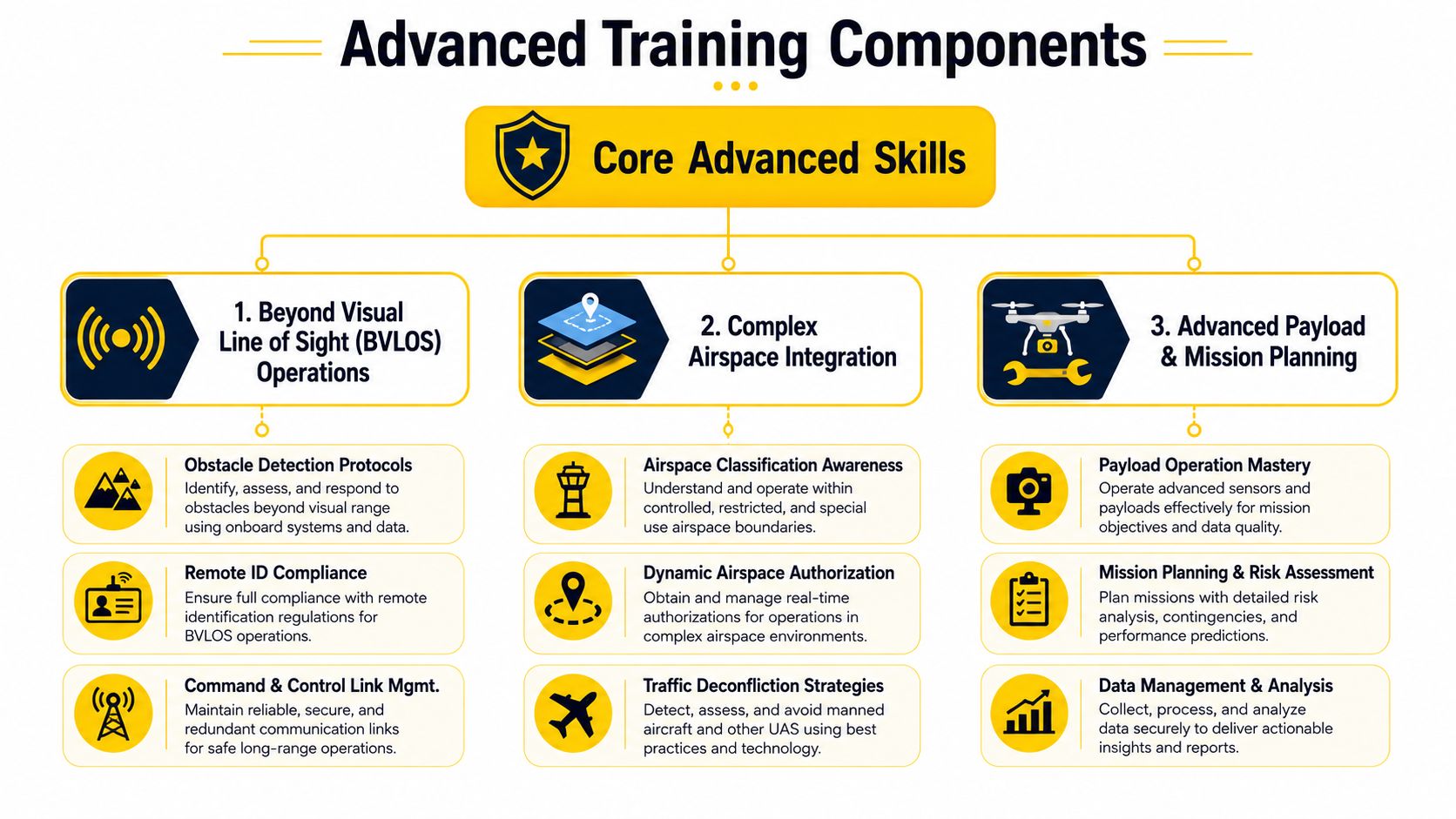
Beyond visual line of sight
BVLOS changes how an operation is supervised and how risk is demonstrated. The operator must understand how the aircraft remains observable through approved systems, how obstacles and other traffic are managed, and which procedures apply if communications, navigation, or command links fail.
Training should cover:
- Contingency planning: Defining responses to lost link, unexpected traffic, weather changes, and navigation problems.
- System awareness: Understanding the limitations of detection, tracking, communications, and remote identification systems.
- Operational approval thinking: Recognising when a higher-risk mission may need additional approvals and a defensible safety case rather than a standard flight plan.
The comparison with basic visual operations is important. Flying beyond visual range changes the chain of supervision, the evidence required to support the operation, and the way failures are managed.
Airspace and radio integration
An operator working near aerodromes or other aviation activity needs more than a map application. Airspace classification, local procedures, communication requirements, and coordination with relevant parties must form part of the mission plan.
CASA states that an Aeronautical Radio Operator Certificate is required for anyone who needs to communicate on an aviation air-band radio frequency and is not already licensed or qualified, including remote pilot licence holders, as explained in the AROC requirements. An AROC course is relevant when the role requires aviation radio communication. Flying a drone alone does not create that requirement.
Mission planning and industry application
Payload selection, route design, data quality, battery management, and site procedures determine whether a flight produces useful results. The operator must also understand the client's workflow. A mining survey, crop assessment, infrastructure inspection, and emergency search may use similar aircraft, yet each task demands different planning assumptions and operational controls.
Ace Aviation's specialised drone training helps connect flight skills with a defined industry task. For businesses, ReOC consulting addresses the organisational side of compliant operations, including systems that support pilots and missions. For broader aviation capability, Certificate III in Aviation follows a defined unit structure. The AVI training package mapping notes 20 units of competency for AVI30319, including at least 2 elective units from Group A and at least 1 elective unit from Group B, according to the AVI training package documentation.
Prerequisites and Entry Requirements
The correct starting point depends on the proposed operation, the aircraft, and the organisation conducting the work. A pilot shouldn't enrol in an advanced course based only on the aircraft's marketing description or the client's job title.
Start with the operation
CASA states that a drone weighing more than 250 g but no more than 2 kg may be flown for business or as part of a job in the sub-2 kg excluded category without a RePL or ReOC, provided the operator obtains an ARN, holds RPA operator accreditation, registers the drone, and follows the standard operating conditions. The CASA weight category requirements should be checked before relying on that pathway.
A RePL becomes relevant when the operation sits outside the excluded category or when the pilot is flying for a business that holds a ReOC. CASA also states that a RePL is required for drones over 25 kg up to 150 kg flown over the pilot's own land, while a RePL isn't needed for micro RPAs of 250 g or less or for excluded-category RPAs. The CASA RePL guidance explains these distinctions.
Requirements by weight category
The table gives a practical starting comparison. It doesn't replace an operation-specific assessment, because the mission profile and operator structure can add requirements beyond weight.
| Weight Category | RePL Required | ReOC Required | AROC Required | Registration Required |
|---|---|---|---|---|
| Micro RPA, 250 g or less | Not generally required under the cited CASA pathway | Not automatically required | Only where aviation air-band communication is needed | Check the applicable CASA registration rules |
| More than 250 g to 2 kg, excluded category | Not required if all excluded-category conditions are met | Not required for the excluded-category pathway | Only where aviation air-band communication is needed | Required |
| More than 2 kg or operations outside excluded conditions | May be required, depending on the operation | May be required, depending on the operator and activity | Required where aviation air-band communication is needed | Required where CASA rules require it |
| More than 25 kg to 150 kg over the operator's own land | Required | The operating structure must be assessed | Required where aviation air-band communication is needed | Required where CASA rules require it |
A pilot who already holds an RPL with a Flight Radio Endorsement, or a PPL, CPL, MPL, or ATPL, may be authorised to transmit without applying for an AROC under CASA's stated pathway. Operators unsure about their position can use the licence and training pathway finder before committing to a course.
Choosing Your Advanced Training Pathway
The right pathway follows the work, not the other way around. A pilot supporting an internal asset-inspection team needs a different development plan from a contractor pursuing agricultural work or an operations manager building a company-wide drone system.
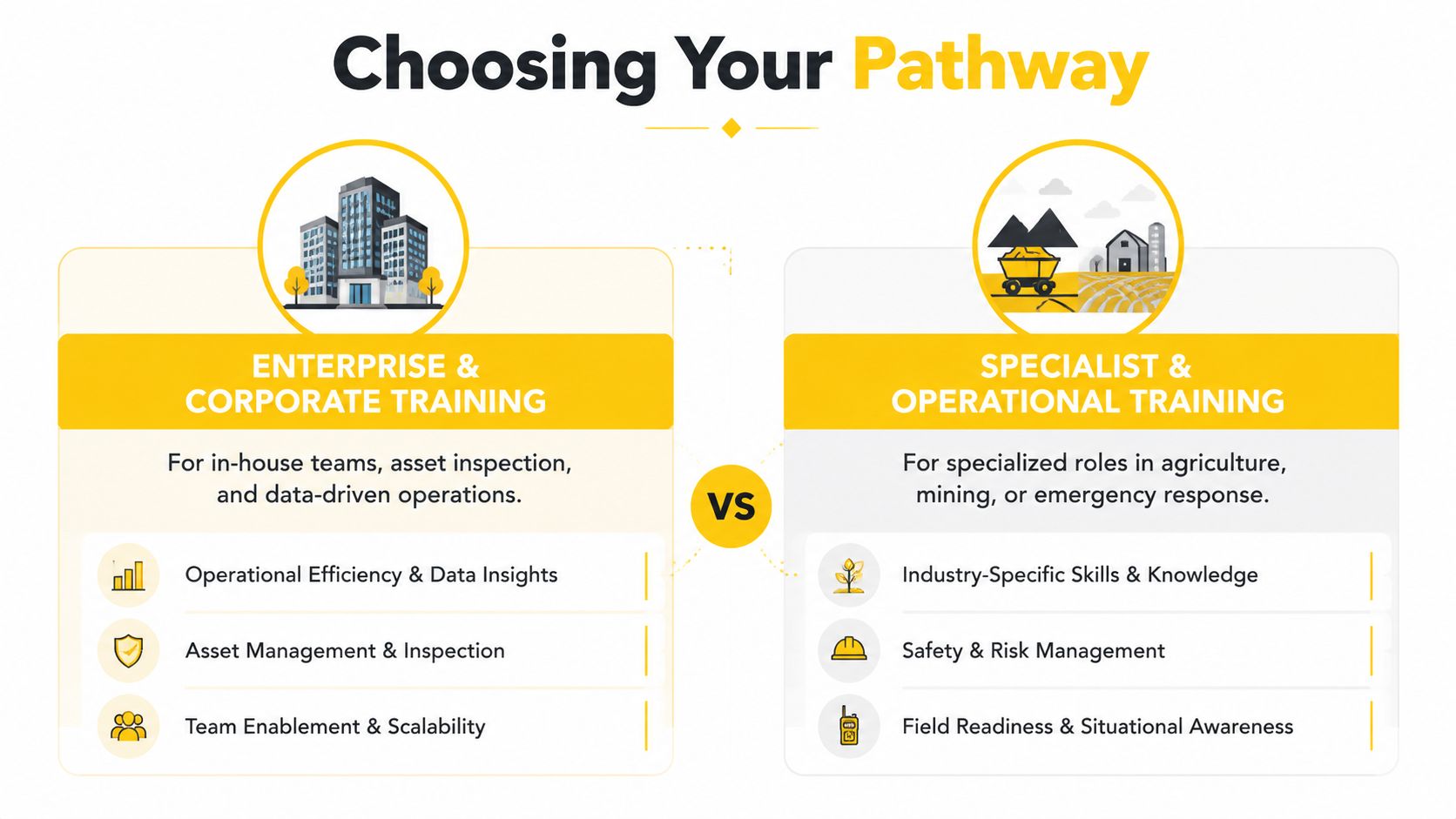
Enterprise and corporate training
Enterprise Drone Training and Corporate Drone Training suit organisations that want several people to work within a consistent operating model. The focus may include internal procedures, site access, risk controls, data handling, aircraft-specific workflows, and coordination between pilots, supervisors, and managers.
This pathway is useful when:
- A utilities team needs repeatable inspection procedures across multiple sites.
- A construction business wants staff to capture progress data within an organised project workflow.
- A government agency needs pilots who understand reporting, radio communication, and operational accountability.
The organisation should ask whether the programme addresses its actual standard operating procedures. A generic course may teach sound principles, but it won't automatically reflect a company's aircraft, locations, payloads, emergency contacts, or approval structure.
Specialist and operational training
Specialist training makes sense when the mission has sector-specific hazards or technical expectations. Agriculture may involve mapping, spraying, or spreading. Mining can involve large sites, terrain changes, exclusion zones, and coordination with heavy equipment. Emergency services may require disciplined communications, dynamic risk assessment, and integration with an incident command structure.
This pathway often needs scenario work rather than classroom theory alone. The provider should explain how students will practise planning, abnormal situations, documentation, and decision-making under realistic constraints.
Aviation management and compliance
A pilot who wants to supervise people, manage an operation, or establish a compliant drone business may need more than flight training. ReOC Consulting can help a business understand the organisational and documentation requirements associated with its proposed operation, while a qualification such as Certificate III in Aviation can provide a broader aviation framework.
A programme such as ACE Aviation's professional training pathway should be evaluated against the learner's intended role. The key question is whether the training develops a capability that the workplace needs, rather than adding another certificate without a defined operational purpose.
Learning Outcomes and Career Applications
The value of advanced aviation training becomes clear when the learning outcome is connected to a real task. A pilot who understands airspace interaction can plan an infrastructure inspection more responsibly near an aerodrome. A pilot with radio competency can communicate appropriately when the operation requires aviation air-band use. A pilot trained in risk documentation can give a client or supervisor a clear basis for approving the mission.
From knowledge to demonstrated performance
The difference between theoretical knowledge and operational readiness appears in the quality of decisions made before take-off. A capable operator can identify hazards, select controls, brief the team, define limits, and record the reasoning behind the plan.
Practical assessment should test more than smooth aircraft handling. It should examine whether the pilot can:
- Build a mission plan: Link the task, aircraft, payload, airspace, weather, people, and contingencies.
- Apply risk controls: Identify hazards and choose controls that remain workable at the actual site.
- Communicate clearly: Brief observers, clients, site managers, and other aviation participants using appropriate terminology.
- Manage change: Reassess the operation when the weather, site activity, aircraft status, or mission objective changes.
- Complete records: Maintain the documentation needed to demonstrate that the operation followed its procedures.
A job-ready operator can stop a mission for a sound reason and explain that decision clearly.
Where the skills apply
In agriculture, mission planning supports safer work around people, vehicles, crops, terrain, and changing conditions. In mining, an operator may need to coordinate with site control, maintain separation from work areas, and deliver consistent data without allowing production pressure to override aviation controls.
Infrastructure inspection places emphasis on proximity operations, repeatable imagery, asset access, and coordination with workers or traffic. Emergency services require calm decision-making, radio discipline where applicable, and documentation that remains useful when the situation develops quickly.
For learners considering a wider aviation role, the Certificate III in Aviation and drone career pathway can help frame the relationship between a qualification, practical capability, and employment direction. Employers generally need operators who can contribute to a complete workflow, not only manipulate an aircraft.
How Ace Aviation Meets CASA and Industry Standards
A training provider should show how its programme maps to the compliance framework rather than describing advanced aviation training in broad terms. CASA's Part 101 Manual of Standards provides a useful benchmark because it connects knowledge, practical competency, assessment, flight testing, and administration within one controlled pathway.
CASA's national drone training framework requires training organisations to cover the relevant aeronautical knowledge standards, practical competency standards, aeronautical knowledge exam, flight testing, and administrative requirements. That combination matters because a commercial operator must demonstrate both understanding and performance, then complete the records that support the permission structure.
Programmes aligned with operational roles
Ace Aviation Aerospace Academy offers training and advisory services relevant to different stages of the pathway, including the Remote Pilot Licence, Aeronautical Radio Operator Certificate, Certificate III in Aviation, ReOC Consulting, Enterprise Drone Training, and Corporate Drone Training. The appropriate choice depends on whether the learner needs pilot certification, radio capability, broader aviation education, or organisational compliance support.
The ACE GOLD advanced commercial pilot programme is positioned for learners moving beyond basic certification into more demanding commercial capability. Enterprise and corporate programmes can be considered where an organisation needs consistent procedures across an internal team. AROC training applies where aviation radio communication is part of the role, while Certificate III in Aviation suits learners seeking a structured qualification with defined competency units.
Why mapping matters
A mapped programme gives instructors a basis for assessing what the student knows and can do. It also gives the student a clearer way to identify remaining gaps. For a business preparing a ReOC application, that same discipline helps connect pilot training with manuals, supervision, risk controls, records, and the operation's actual scope.
CASA's 2024–25 annual report recorded 318 Part 141 flight training certificate applications, compared with 222 in 2023–24 and 175 in 2022–23, and reported 324 current Part 141 certificates by 30 June 2025. The report also included Part 142 certificate activity, showing that formal training approval remains an active national compliance pathway. In the remotely piloted aircraft sector, CASA reported 33,388 registered RPAs, while its drone factsheet identified 1,106 ReOC holders employing more than 5,870 remote pilots. These figures are documented in CASA's 2024–25 annual report.
Next Steps and Decision Criteria
The next course should be selected after the learner defines the intended operation. A pilot pursuing basic commercial work may need a RePL. A business establishing its own operating structure may need ReOC consulting. A team working near aviation activity may need AROC capability, while an aviation professional moving into supervision may benefit from broader qualification-based training.
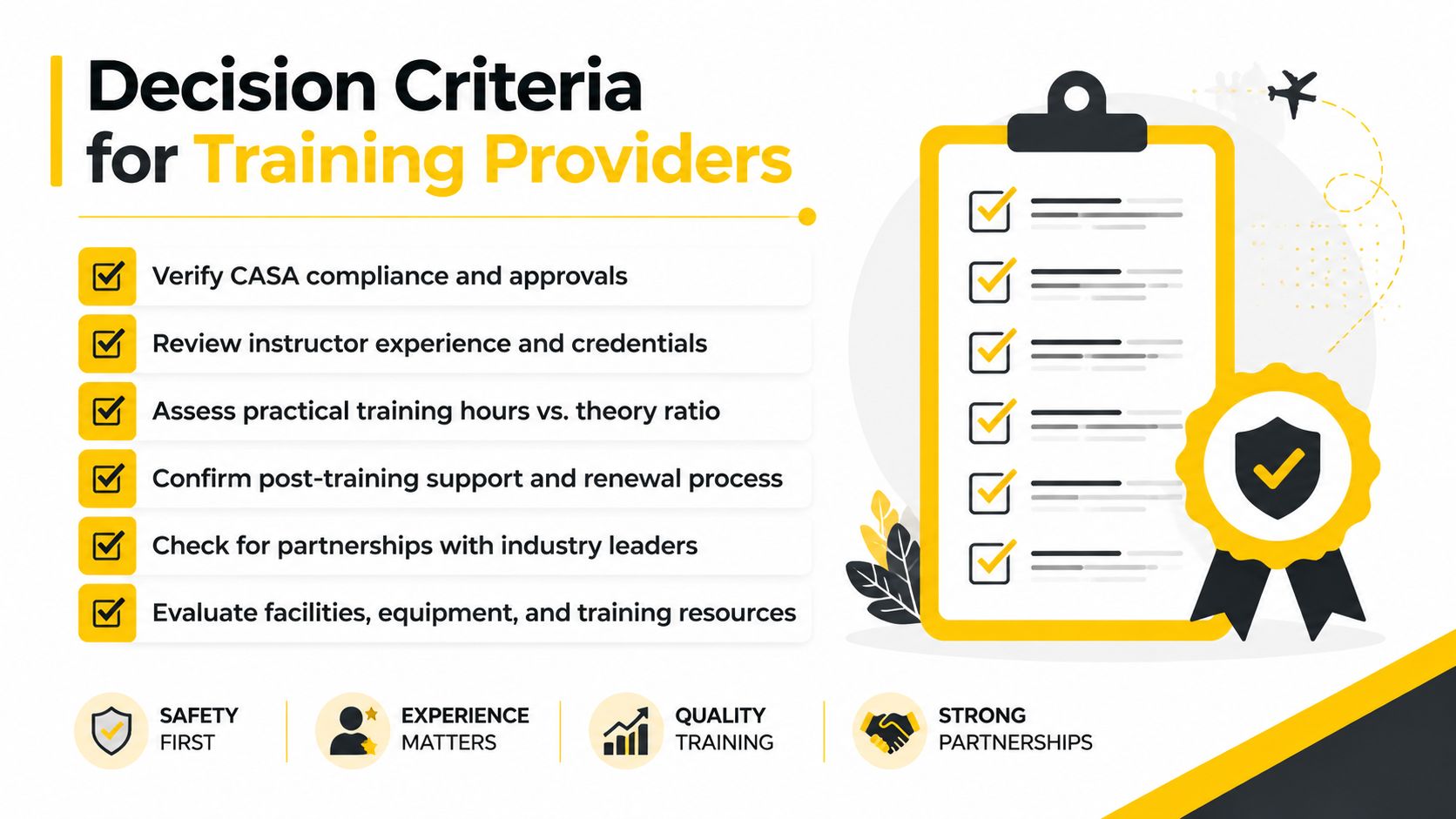
Questions for providers
Before enrolment, a prospective student or organisation should ask:
- CASA alignment: Which Part 101 Manual of Standards competencies are covered and assessed?
- Practical assessment: How are flight testing, abnormal situations, and mission planning evaluated?
- Instructor capability: What operational and instructional experience do the trainers bring?
- Workplace relevance: Can the scenarios be adapted to agriculture, mining, inspection, construction, or emergency services?
- Documentation: Does training include the administrative and record-keeping requirements used in real operations?
- Post-training support: What guidance exists for refresher training, operational questions, and progression?
A provider that promises rapid certification without explaining assessment and documentation deserves careful scrutiny. A stronger sign is a programme that makes students plan, brief, operate, reassess, and record the mission in a structured way.
Self-paced learning can suit a learner who already has operational exposure and needs theory revision. Intensive training may suit someone with a defined job requirement and limited time. Enterprise training is more appropriate when an organisation needs common procedures across a team. The decision should follow the operation's risk, the learner's existing qualifications, and the capability the employer or client requires.
Ace Aviation Aerospace Academy offers RePL, AROC, Certificate III in Aviation, specialist, enterprise, corporate, and ReOC consulting pathways for learners and organisations building compliant drone capability. Readers can review the available options and contact Ace Aviation Aerospace Academy to identify training that matches the intended operation, role, and next stage of professional development.
Frequently Asked Questions
Is a RePL enough to start commercial drone work?
A RePL may meet the pilot licensing requirement for operations that require one, but it doesn't by itself demonstrate readiness for every commercial mission. Higher-risk work may require additional competencies, approvals, procedures, radio capability, risk controls, and operational documentation.
How long does RePL training usually take?
CASA's student guide states that RePL training is usually about 5 days. The time needed for advanced capability depends on the learner's existing experience, the aircraft and mission type, and the competencies required by the intended role. CASA's student guide should be checked for the current pathway.
Is a RePL required for every business drone flight?
No. CASA provides an excluded-category pathway for certain operations, including relevant flights involving drones weighing more than 250 g but no more than 2 kg, provided the operator meets the specified requirements and standard operating conditions. The aircraft, operation, and operator structure must be assessed together.
When is an AROC required?
An AROC is required when a person needs to communicate on an aviation air-band radio frequency and isn't already licensed or qualified under CASA's stated alternatives. Remote pilot licence holders may need the certificate where the role requires aviation radio communication.
What should advanced training include?
A strong programme should connect aeronautical knowledge, practical competency, examination, flight testing, and administration. Depending on the role, it may also include airspace integration, BVLOS concepts, mission planning, risk management, industry scenarios, radio procedures, and organisational compliance.
Does ReOC consulting replace pilot training?
No. ReOC consulting addresses the organisation's operating structure and compliance systems. Pilots still need the qualifications and competencies required for the missions they conduct, and the organisation must ensure its procedures support safe, lawful operations.