In Australia, Remote Pilot Licence training typically costs AUD 8,000 to 15,000, while a fixed-wing Private Pilot Licence often ranges from AUD 25,000 to 40,000. Once commercial ratings and compliance steps enter the picture, the total can climb sharply.
A first-time student often starts with a simple question and quickly runs into conflicting answers. One school quotes a tuition number, another leaves out medicals, and a third bundles equipment, assessments, and approvals into the headline price. The aviation license cost depends on the licence type, the training pace, and the extra compliance that sits around the licence itself.
Table of Contents
- Introduction to Aviation Training Costs
- Understanding Australian Aviation Licence Types
- Cost Breakdown by Licence Type
- Key Cost Drivers and Hidden Expenses
- Sample Budgets for Different Career Paths
- How to Choose and Fund Your Training
- Conclusion and Next Steps
- Frequently Asked Questions
Introduction to Aviation Training Costs
A student can feel close to signing up after a few searches, then realise that every website seems to define the price differently. One quote might cover only tuition, another might include flight time, and a third may leave out medicals and assessment fees entirely. That is why the first mistake in aviation budgeting is treating the headline price as the whole bill.
For Australian drone and pilot candidates, the safest way to read any quote is to separate training costs, regulatory fees, medicals, and ongoing compliance. CASA's current schedule shows small government charges compared with the training bill, including a RePL application fee of A$155, a ReOC competency assessment of A$155, a ReOC application fee of A$260, and an AROC exam fee of A$90 (CASA fee schedule summary). That matters because the biggest cost is usually not the card or certificate, it's the training and operational pathway around it.
A practical example helps. Someone entering drone work for inspection, mapping, or commercial operations often needs far more than a single licence card. Someone aiming for passenger flying faces an entirely different financial path, with much higher training intensity and more expensive medical requirements.
Practical rule: If a provider's quote sounds cheap, check what it leaves out before comparing it with another school's price.
The rest of this guide breaks the costs into plain language so a student can see where money goes, what can be planned for early, and what should never be a surprise. That includes the hidden items that often catch people after they've already committed.
Understanding Australian Aviation Licence Types
What each licence is for
Australian aviation training starts with the goal, not the price tag. A student who wants to fly drones commercially needs a different pathway from someone who wants to fly a private aircraft for personal travel, and that difference changes the budget from the beginning.
For drone work, the main credentials are the Remote Pilot Licence (RePL) and, for many commercial jobs, the Aeronautical Radio Operator Certificate (AROC). The RePL is the operating credential, while the AROC matters when radio communication is part of the job. For business use, a Remote Operator's Certificate (ReOC) may also be part of the compliance stack, because commercial drone operations often need documented procedures and operator approvals (CASA-related licence cost overview).
For fixed-wing flying, the usual pathway is broader. Students often start with a recreational or basic entry point, move into a Private Pilot Licence (PPL) for personal flying, and later progress to a Commercial Pilot Licence (CPL) if they want to fly for hire. An Air Transport Pilot Licence (ATPL) sits at the top of the ladder for airline operations.
How CASA fits into the pathway
CASA regulates the licence, but the expensive part is the training delivery that gets a student ready for that licence. That includes theory, flight practice, competency sign-off, and sometimes extra approvals or operating documents. The practical cost also rises when a student needs controlled-environment training, operational manuals, or follow-on compliance work for commercial use (AOPA training cost explanation).
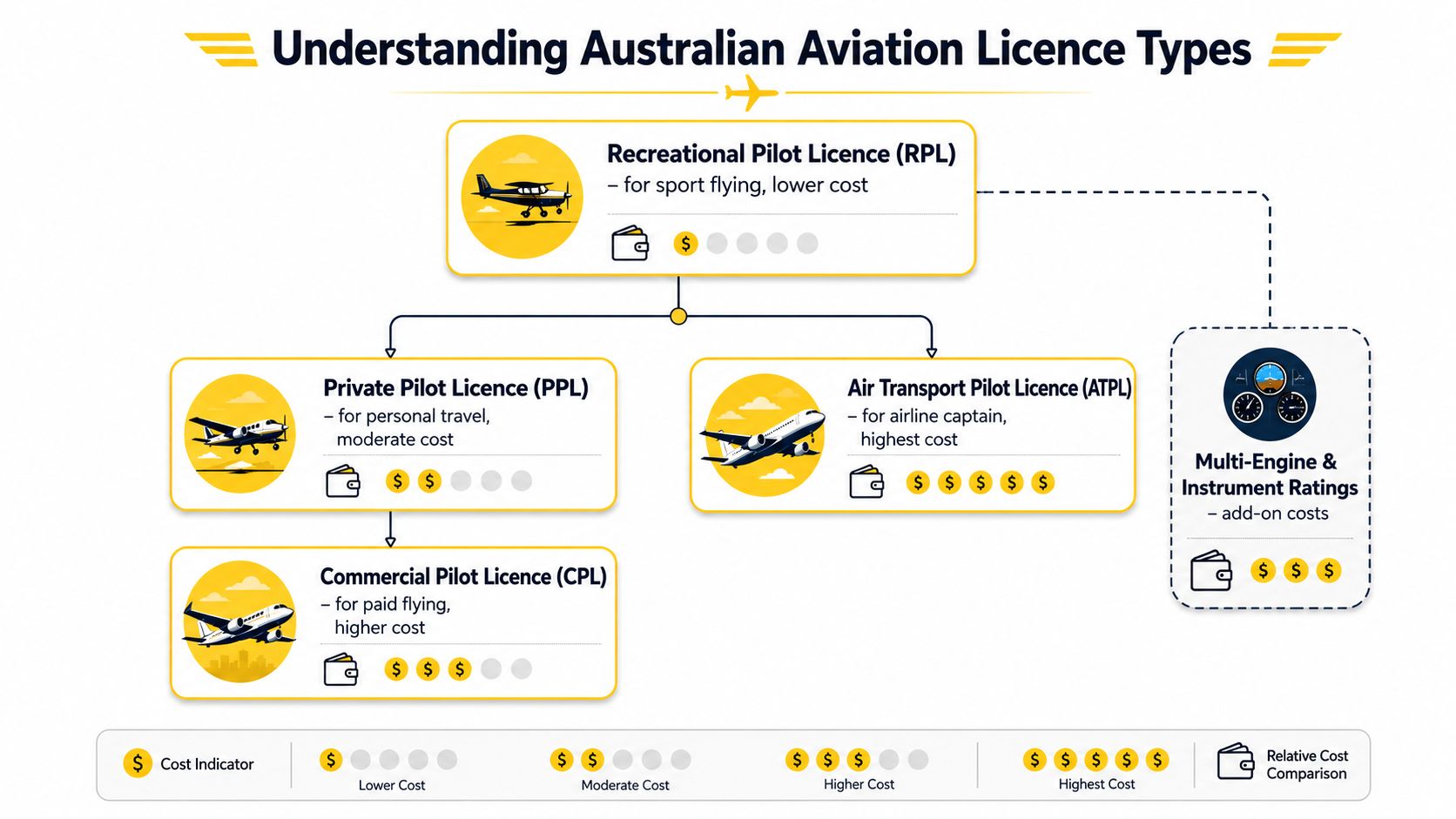
A good first filter is to ask, “What job is this licence supposed to enable?” A recreational flyer, a drone operator in agriculture, and an airline trainee do not need the same training stack, so they shouldn't be priced as if they do.
One useful planning tool is a licence-finder approach that maps the student's goal to the correct pathway. For readers comparing entry points, ACE READY is an entry-level drone training course for beginners that covers drone fundamentals, aviation safety, CASA regulations, flight operations, and preparation for advanced RePL training.
Cost Breakdown by Licence Type
What the main pathways usually cost
The easiest way to understand the aviation license cost is to look at the pathway, not just the licence name. A RePL path is generally far cheaper than a full fixed-wing flying career because the training volume, aircraft use, and hour-building requirements are completely different.
For Australian drone candidates, the total training cost for a RePL pathway typically sits around AUD 8,000 to 15,000, depending on whether the program includes extra commercial endorsements, specialist modules, and radio certification. The government charge itself is only a small part of that total, because the bigger cost comes from instruction, practical competency assessment, and commercial compliance work (CASA fee schedule summary).
Fixed-wing training is a different financial category. A PPL usually sits around AUD 25,000 to 40,000, while a CPL often moves into the much higher range associated with extensive flight hours and hour-building. Those figures rise because the student is paying for more aircraft time, more instructor time, and more assessments.
A foundation course can help students decide whether they're ready to commit to the commercial path. ACE BRONZE is a foundation commercial drone course covering drone operations, flight safety, aviation theory, and practical skills for students beginning toward licensed drone pilot training.
Australian Aviation Licence Cost Ranges 2026
| Licence Type | Typical Cost Range (AUD) | Key Cost Drivers |
|---|---|---|
| Remote Pilot Licence pathway | 8,000 to 15,000 | Training delivery, competency sign-off, radio certification, commercial compliance |
| Private Pilot Licence | 25,000 to 40,000 | Flight hours, aircraft hire, instructor time, theory and assessments |
| Commercial Pilot Licence | 60,000 to 100,000 or more | Hour-building, aircraft rental, instructor time, exam load |
| Professional multi-rating pathway | 80,000 to 150,000 or more | CPL, instrument rating, multi-engine training, extended training time |
How to read a quote properly
A low quote can still be expensive if it excludes the items that matter most. One provider may quote only tuition, while another includes flight hours, assessments, and administrative support. The better question is not “What does the licence cost?” but “What does this pathway cost from first lesson to job-ready status?”
For students who want a calculator-style way to compare options, the quote comparison tool at https://aaa.edu.au/tools/quote-calculator can help organise the full cost stack before enrolment. Where a course is relevant, ACE SILVER combines commercial RePL training, practical flight training, CASA-compliant certification, AROC, and aviation English proficiency for professional drone pilots.
Key Cost Drivers and Hidden Expenses
The costs students miss first
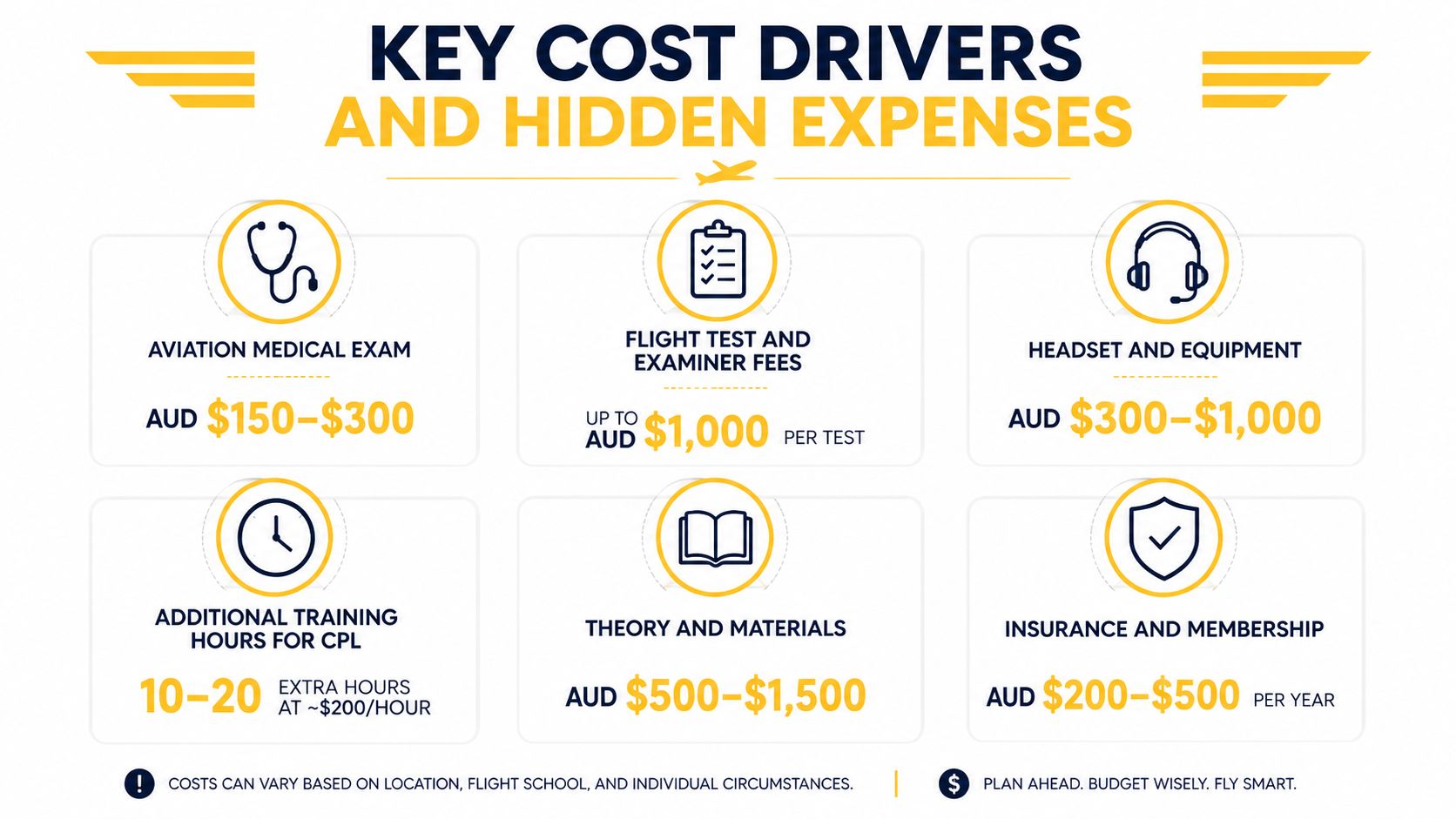
Aviation budgets usually get blown by the pieces people forget to price in. Medicals are a clear example. The Aviation Medicine fee schedule lists a Class 1 initial medical at AUD 707 and a Class 2 initial medical at AUD 234, with lower renewal fees later on (Angle of Attack cost overview). For many students, that is the first surprise because the medical is not part of the school's tuition quote.
Equipment is another common gap. Headsets, flight bags, charts, and tablet-based tools are not always included, and they can add a meaningful amount before training even begins. Commercial students also need to think about insurance, especially once operations move beyond training flights and into actual work.
The cheapest quote is not always the cheapest pathway, because the hidden items appear later and usually arrive when the student is already committed.
Why the total keeps moving
Recurrent training and currency maintenance also affect the overall cost. A student who trains inconsistently may need extra review flights, more instructor time, and repeat practice to stay current. That is not a penalty, it is how aviation works. Skills fade when time gaps grow.
The same pattern appears in commercial drone operations. A RePL alone does not finish the story for business use. Depending on the role, a learner may also need AROC, ReOC-related procedures, or compliance documents that sit beyond the licence itself (AOPA on cost structure).
There's also a business-side cost to think about. One source on Australian sector guidance notes that commercial drone work is moving toward higher-compliance operations rather than simple credential collection (sector guidance video). That means the “job-ready” budget can be higher than the “licence-only” budget.
For students who want to understand the business compliance side more clearly, this ReOC guide is a useful next step because it explains how the operator approval piece fits into commercial drone work.
Sample Budgets for Different Career Paths
Three common budgets side by side
The best way to stop guessing is to match the budget to the actual career path. A drone operator, a private flyer, and a commercial pilot all face different cost stacks, so lumping them together obscures the core decision.
An entry-level commercial drone candidate often starts with RePL and AROC, then adds compliance setup if the job requires business use. A realistic budget for that route is often AUD 12,000 to 20,000 once medicals, equipment, and initial compliance are included. That range reflects the fact that commercial drone work usually needs more than training alone.
A serious hobbyist or career-transition pilot aiming for a PPL often needs a broader budget. AUD 30,000 to 45,000 is a practical planning figure once recurrent training and personal expenses are included. The extra buffer matters because flying consistently is what keeps training efficient.
A professional commercial pilot route is in a different league altogether. The path that includes PPL, CPL, instrument rating, and sometimes multi-engine training can require AUD 80,000 to 150,000 or more, depending on training speed and how the student funds the journey. That spread is exactly why “cheap” and “affordable” are not always the same thing.
How the routes differ in real life
The drone route tends to be shorter and more compliance-heavy. The private pilot route is more personal and flexibility-driven. The commercial pilot route is longer, more expensive, and more sensitive to training cadence.
For businesses building internal capability, ACE PLATINUM is a complete enterprise drone training package that includes RePL, AROC, Aviation English, Express ReOC, Certificate III in Aviation, advanced operations training, and preparation to operate and manage a commercial drone business.
A budget should reflect not just the licence goal, but the speed at which that qualification needs to turn into usable work.
When a student compares these pathways, the right choice becomes clearer. A route that looks cheaper on paper may be slower to produce income, while a higher-cost program may align better with the intended job.
How to Choose and Fund Your Training
Questions to ask before enrolling
A training provider should be able to explain the full bill without hesitation. Ask whether aircraft hire, instructor time, assessments, and administrative support are included or billed separately. Ask how many flight hours are bundled, what happens if extra training is needed, and whether the course includes support through the licensing process.
Low-price quotes deserve extra scrutiny. If a school leaves out medicals, equipment, theory exams, or recurrent training, the final cost can be far higher than the first number suggests. The practical rule is simple, compare the full pathway cost, not the brochure price.
The provider's facilities and student support matter too. Schools that explain regulatory requirements clearly usually make budgeting easier because the student can see the whole pathway in advance. A good fit is one that matches the learner's goals, not one that only looks cheap on a spreadsheet.
A practical way to compare options
Funding options in Australia vary, but most students still pay privately. Personal savings are common, and some learners use employer sponsorship, veteran education benefits, or training programs where applicable. Payment plans can also help spread the cost, especially when a course is staged across several qualifications.
A sensible comparison process looks like this:
- Compare the pathway, not the headline price. A lower tuition number can still be more expensive if it excludes assessments or equipment.
- Confirm what's included in writing. Tuition, instructor time, aircraft hire, and exam support should all be clear before enrolment.
- Budget for the extras first. Medicals, radio certification, and compliance steps are not optional add-ons when they're required for the job.
- Check the school's operational focus. A commercial drone student needs different support from a private pilot candidate.
- Choose a training pace that you can sustain. Irregular training often costs more because skills need rebuilding.
The course directory at https://aaa.edu.au/courses can help students compare options by pathway instead of relying on a single quote.
Conclusion and Next Steps
The aviation license cost in Australia is bigger than the licence card, and smaller than many first-time students fear once the pathway is mapped properly. The answer depends on whether the student is aiming for RePL, PPL, CPL, or a more advanced commercial route, because each one has its own training load, regulatory cost, and compliance burden.
The most useful budgeting habit is to ask for the full stack upfront. That means tuition, medicals, equipment, assessments, and any post-licence compliance work that turns training into paid work. Once those pieces are visible, the decision becomes much easier.
Students who want clarity should speak with accredited providers, compare itemised quotes, and choose the pathway that fits the actual job goal, not just the lowest price. The right plan is the one a student can complete safely, confidently, and without financial surprises.
Frequently Asked Questions
How much does a RePL usually cost in Australia?
A typical RePL training pathway usually costs AUD 8,000 to 15,000 when the full training stack is included, not just the licence fee.
Is the CASA licence fee the main expense?
No. CASA's fees are relatively small compared with training, medicals, and compliance. The licence fee is only one part of the total bill (CASA fee schedule summary).
Why do drone business costs rise above basic training?
Commercial drone work often needs more than a licence. ReOC-related compliance, procedures, and operating support can add cost and time.
What medical costs should a pilot budget for?
A commercial student should plan for a Class 1 initial medical at AUD 707 or a Class 2 initial medical at AUD 234, depending on the pathway (medical fee overview).
How should a student compare flight schools?
The best comparison is the full pathway cost, what's included, how many training hours are covered, and whether the provider supports the student through the next regulatory step.
Does a lower price always mean better value?
No. A lower quote can leave out key costs and create a more expensive total outcome. Value comes from completeness, safety, and training efficiency.
Ace Aviation Aerospace Academy helps students compare drone and aviation pathways with a clear view of training, compliance, and career readiness. If the next step is to understand which course fits a goal, visit Ace Aviation Aerospace Academy and review the training options against the full cost stack before enrolling.