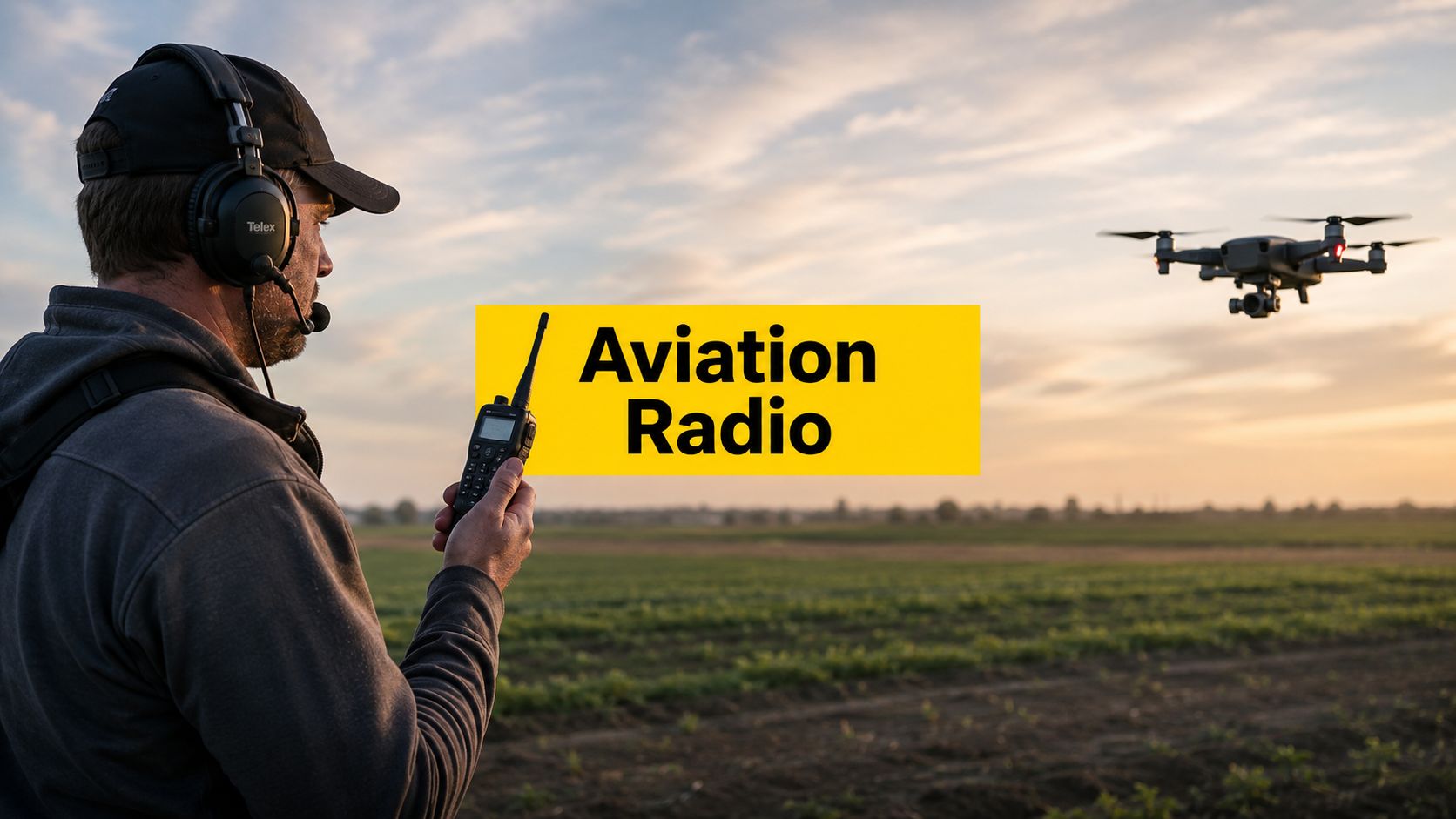
A commercial drone operator is preparing to work near a controlled aerodrome. The aircraft, risk assessment and flight plan are ready, but one question remains: who needs to be contacted, on which frequency, and what should be said? Aviation radio can feel intimidating at first, particularly for operators whose early drone work involved visual observation and no airband communication.
In Australia, radio competence is part of operating professionally in shared airspace. The operator needs to understand the relevant frequency, hold the right qualification where required, use concise phraseology and keep records that demonstrate compliance. The technology is only one part of the task. Good radio work depends on preparation, listening and disciplined communication.
Table of Contents
- Why Aviation Radio Matters for Drone Operations
- Understanding the VHF Airband and Frequency Allocation
- AROC Requirements and Who Needs Certification
- Standard Radio Phraseology and Communication Procedures
- Radio Equipment Options for Drone Operations
- Getting Your AROC Certification Online
- Real-World Applications Across Industries
- Frequently asked questions
Why Aviation Radio Matters for Drone Operations
A drone crew arrives near an aerodrome to conduct an infrastructure inspection. The pilot has checked the operating area and can see the drone throughout the flight, but a visual-only approach doesn't reveal every aircraft that may enter the area. A manned aircraft could be approaching from a direction the crew hasn't been watching, or an air traffic service could need the drone operation paused while traffic is managed.
Aviation radio gives the crew a structured way to receive relevant information and communicate its intentions. It doesn't replace the operator's responsibility to assess the flight, follow CASA requirements or maintain situational awareness. Instead, it adds a recognised communication layer when the drone operates in an environment shared with crewed aircraft.
Australia's aviation radio history shows why this discipline matters. By 1935, the Australian Government had sent a technical mission overseas to examine radio-navigation beacon technology. In 1938, Australia became the first country to operate a network of en route radio navigation beacons in what is now the VHF band, marking a move from ad hoc ground communication towards structured navigation and operational control across a continent-sized airspace. Airservices Australia's history of air traffic services places aviation radio within that broader development.
Communication changes the operational picture
A drone pilot who understands radio procedure can:
- Coordinate deliberately: Contact the appropriate service or traffic environment before launching, rather than relying only on what the crew can see.
- Respond to changing traffic: Listen for information that may affect the operation and acknowledge instructions accurately.
- Reduce ambiguity: State the aircraft's location, operating area and intentions in a recognised format.
- Support controlled operations: Work within an approved communication process where the relevant aviation environment requires it.
A radio call won't automatically grant permission to fly. It also won't make an unsafe operation acceptable. The operator still needs the required authorisations, airspace knowledge and risk controls. The radio supports those controls by allowing the crew to communicate with the people managing or using the surrounding airspace.
For new pilots, the practical starting point is preparation. A drone safety guide for airports and HLS operations can help establish the wider operating context before a pilot focuses on the wording of a call.
Practical rule: A radio is only useful when the operator knows the correct frequency, listens before transmitting and can describe the operation without hesitation.
The difference between a casual operator and a professional pilot often appears in these small behaviours. Professional radio users don't fill the frequency with unnecessary conversation. They arrive prepared, use standard language and treat every transmission as part of the safety system.
Understanding the VHF Airband and Frequency Allocation
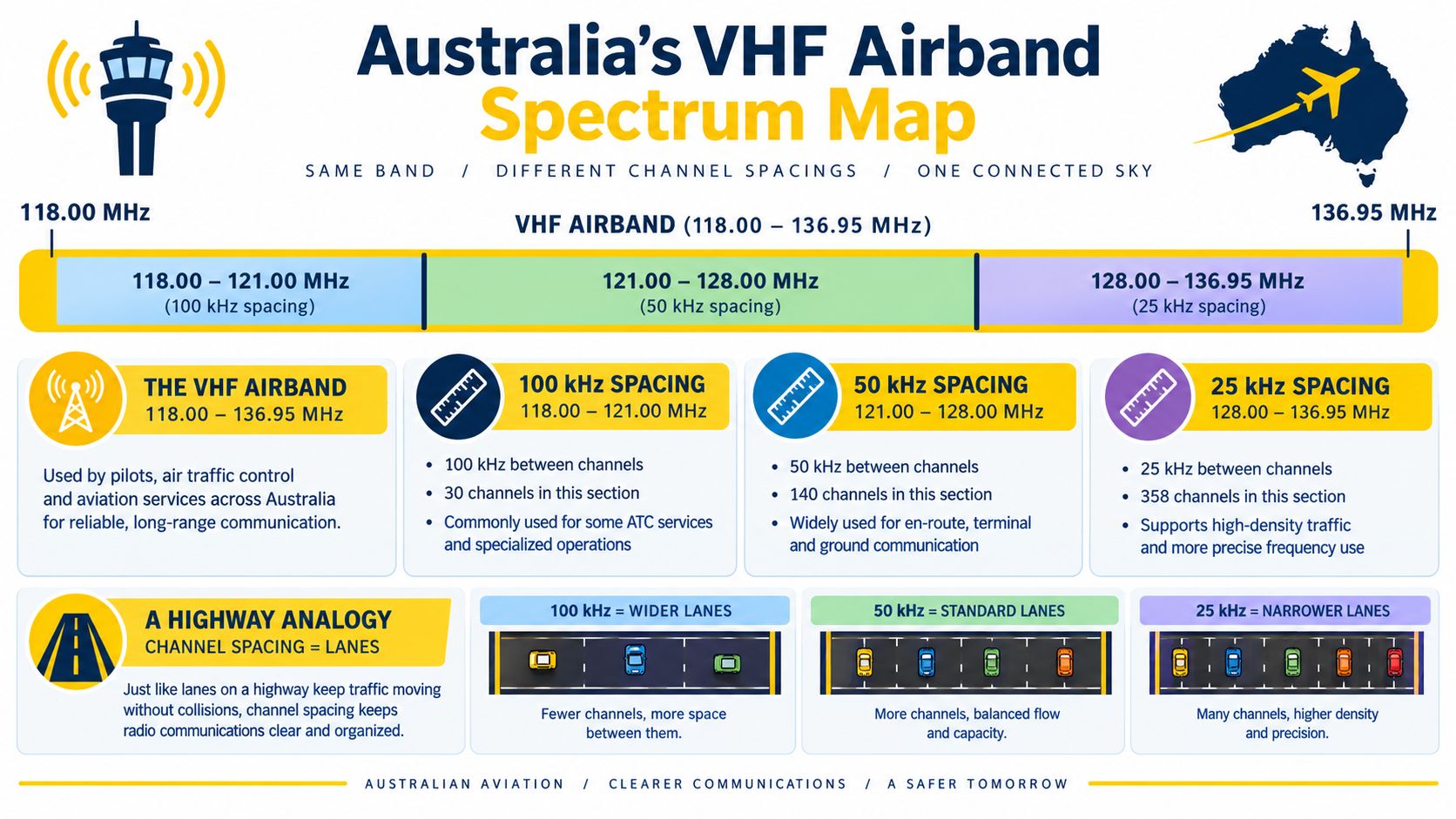
Australia's aeronautical VHF airband runs from 118.00 MHz to 136.95 MHz, according to the ACMA Radiocommunications Class Licence%20Class%20Licence%202026.pdf). A new operator can think of this range as a national road network. The full band is the road system, each assigned frequency is a lane or route, and the published channel plan tells aircraft and ground stations where to travel.
Channel spacing is the distance between lanes
Australia uses 100 kHz, 50 kHz and 25 kHz channel spacing in the VHF airband. Spacing describes how closely assigned channels sit beside each other. It isn't a measure of radio range or signal strength.
A radio must be configured for the channel plan used in the relevant operating environment. Selecting a frequency that looks close to the published one, or entering the wrong spacing mode, can place the transmission on an unsuitable channel. The result may be an inability to contact the intended service, unwanted interference or both.
The emergency frequency 121.5 MHz is reserved for emergency communications only. It isn't a general-purpose channel for testing a radio, asking routine questions or checking whether the equipment transmits. Operators should know this restriction before switching on an unfamiliar radio.
Frequency choice follows the operation
Airservices Australia had 1,025 VHF frequencies assigned, illustrating the scale of frequency management across Australian aviation. That figure doesn't mean a drone operator can choose any available channel. The applicable frequency depends on location, airspace, aerodrome procedures and the service being contacted.
A practical pre-flight process looks like this:
- Identify the operating environment. Determine whether the area is associated with controlled airspace, an uncontrolled aerodrome, a common traffic advisory environment or another published arrangement.
- Check authoritative information. Use current operational information and the instructions provided by the relevant aviation authority or service.
- Confirm the radio setup. Verify the frequency, channel spacing, antenna connection and battery before arriving at the launch site.
- Listen first. A quiet frequency doesn't necessarily mean the correct frequency, and a busy frequency may contain information relevant to the flight.
Operators building basic aviation knowledge may also consult drone emergency procedures and aviation safety guidance. For beginners, ACE READY covers drone fundamentals, aviation safety, CASA regulations and flight operations, while preparing students for advanced RePL training in Australia.
AROC Requirements and Who Needs Certification
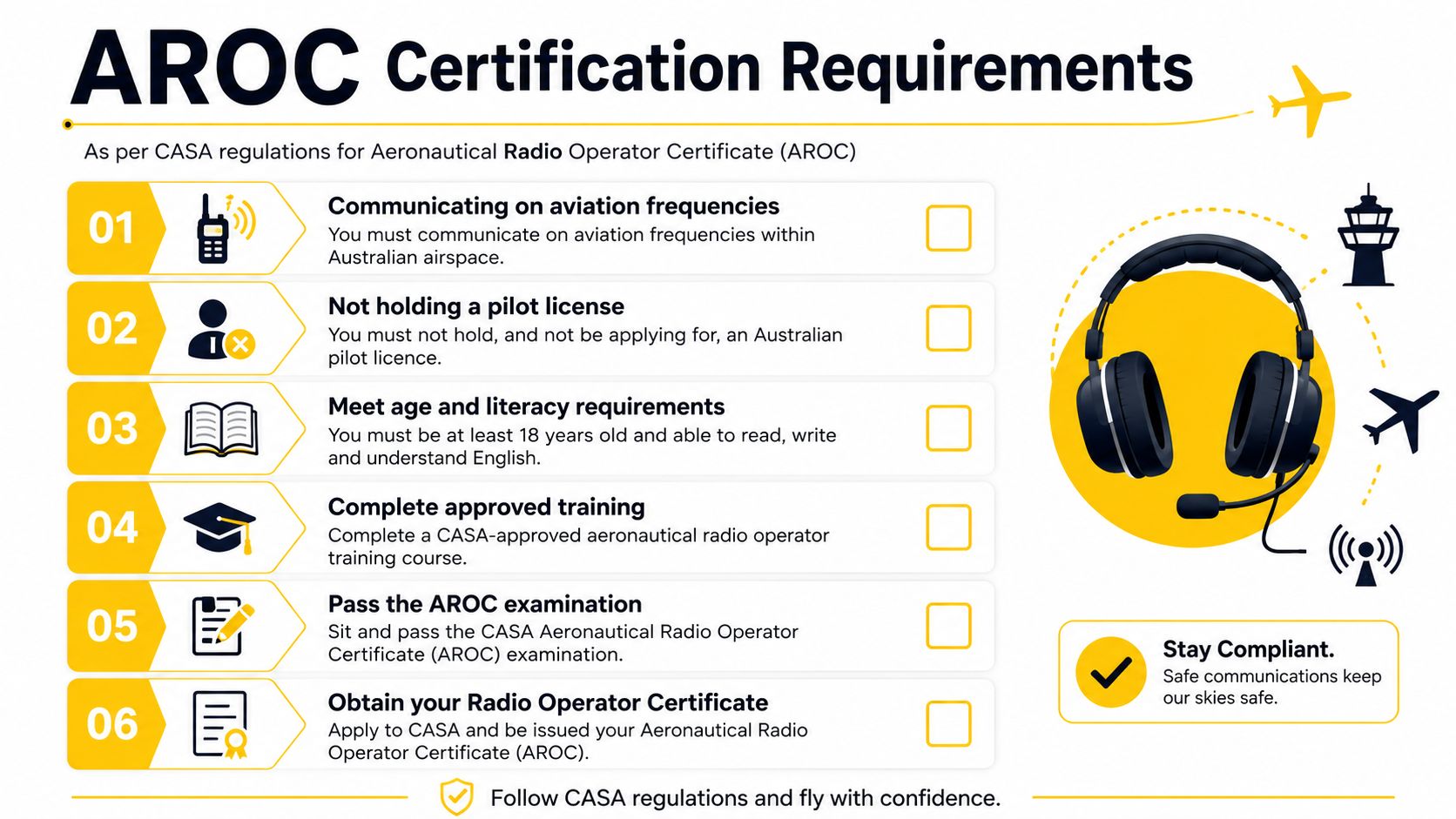
The Aeronautical Radio Operator Certificate, or AROC, applies to a specific activity: communicating on an aviation air-band radio frequency. A person doesn't become radio-qualified merely by owning a transceiver, completing general drone familiarisation or holding a RePL.
CASA states that an AROC is required for anyone who needs to communicate on an aviation air-band frequency and isn't already licensed or qualified. CASA specifically includes Remote Pilot Licence holders in this group. The CASA radio operator guidance makes the distinction important for commercial drone teams, where a RePL and radio qualification may be separate compliance requirements.
The Australian Government's business licensing information also states that an AROC is needed by a person who doesn't hold a pilot licence but intends to operate a radiocommunication system installed in or carried on an aircraft. It identifies the operator of an unmanned aircraft as requiring the certificate in that circumstance. The Australian Business Licence and Information Service entry for AROC provides that additional description.
A simple self-assessment
The following questions help separate the common situations:
- Will the operator transmit or communicate on an aviation air-band frequency? If no, an airband radio qualification may not be relevant to that task.
- Does the operator already hold an applicable pilot licence or qualification? Existing qualifications may affect the requirement, so the operator should confirm the position with CASA.
- Is the person operating an unmanned aircraft as part of the work? The Australian Government licensing information directly identifies unmanned aircraft operators in its AROC description.
- Does the operation involve coordination with aviation services or traffic? If the work requires airband communication, the person transmitting needs the appropriate qualification.
A RePL demonstrates capability to operate remotely piloted aircraft within its scope. It shouldn't be treated as a substitute for an AROC when the operator must communicate on an aviation frequency. Businesses can use CASA's licence finder tool as an initial way to identify relevant licensing pathways, then verify the final position through current CASA information.
The safest compliance record identifies each staff member's role, the communication task performed and the qualification relied upon. If a business changes its operating model, it should reassess radio responsibilities rather than assuming an existing RePL covers every aviation communication requirement.
Standard Radio Phraseology and Communication Procedures
Aviation phraseology works because it reduces interpretation. A good transmission tells the other party who is being called, who is calling, where the operation is located and what is required. The message should be brief enough to understand on the first listen.
The phonetic alphabet helps speakers identify letters clearly. For example, a callsign containing the letter “B” should be spoken as “Bravo”, while “C” is “Charlie”. Numbers also have standard aviation pronunciations, and operators should practise them rather than reverting to rushed conversational speech.
Build every call from the same information
A drone operator preparing to contact an aviation service can organise the message in this order:
- Station called: Identify the service or station.
- Calling party: State the drone operator or aircraft callsign.
- Position: Give the operating location in terms the aviation service can recognise.
- Request or intention: Explain whether the call is a request, position report or operational update.
- Readback: Repeat any instruction that requires confirmation, using the wording received.
A generic training example might sound like: “Airport traffic, drone operator [callsign], operating north of the aerodrome boundary, conducting a planned inspection, requesting traffic information.” The exact station name, location and request must come from the actual operation. A training example isn't a clearance and shouldn't be copied without checking the applicable procedure.
| Phrase | Meaning | Example usage |
|---|---|---|
| “Say again” | The previous transmission wasn't understood | “Station called, drone operator Delta Echo, say again.” |
| “Stand by” | The caller should wait for a response | “Drone operator Delta Echo, stand by.” |
| “Roger” | The transmission was received | “Roger, drone operator Delta Echo.” |
| “Wilco” | The instruction was received and will be followed | “Wilco, returning to the launch point.” |
| “Read back” | Repeat the instruction accurately | “Read back: hold position and await further advice.” |
| “Unable” | The operator can't comply with the instruction | “Unable, drone is in an automated return sequence.” |
The table uses common operational meanings, but phraseology must match the local procedure and the operator's training. “Roger” confirms receipt. It doesn't mean the operator has understood every detail or accepted an instruction that requires a specific readback.
Practise before transmitting
A trainee can rehearse three situations without pressing transmit:
- Initial contact: State the station, callsign, position and purpose.
- Position report: Describe where the drone is, what it is doing and whether the operation has changed.
- Instruction acknowledgement: Write down the instruction, read it back and identify any part that can't be completed.
ACE GOLD is an advanced commercial drone pilot programme covering RePL, ReOC support, practical flight training, aviation compliance and business readiness. Those areas provide useful context for pilots whose radio work forms part of broader commercial operations.
Before transmitting, ask: Is the message necessary, accurate and short enough for another person to understand immediately?
Radio Equipment Options for Drone Operations
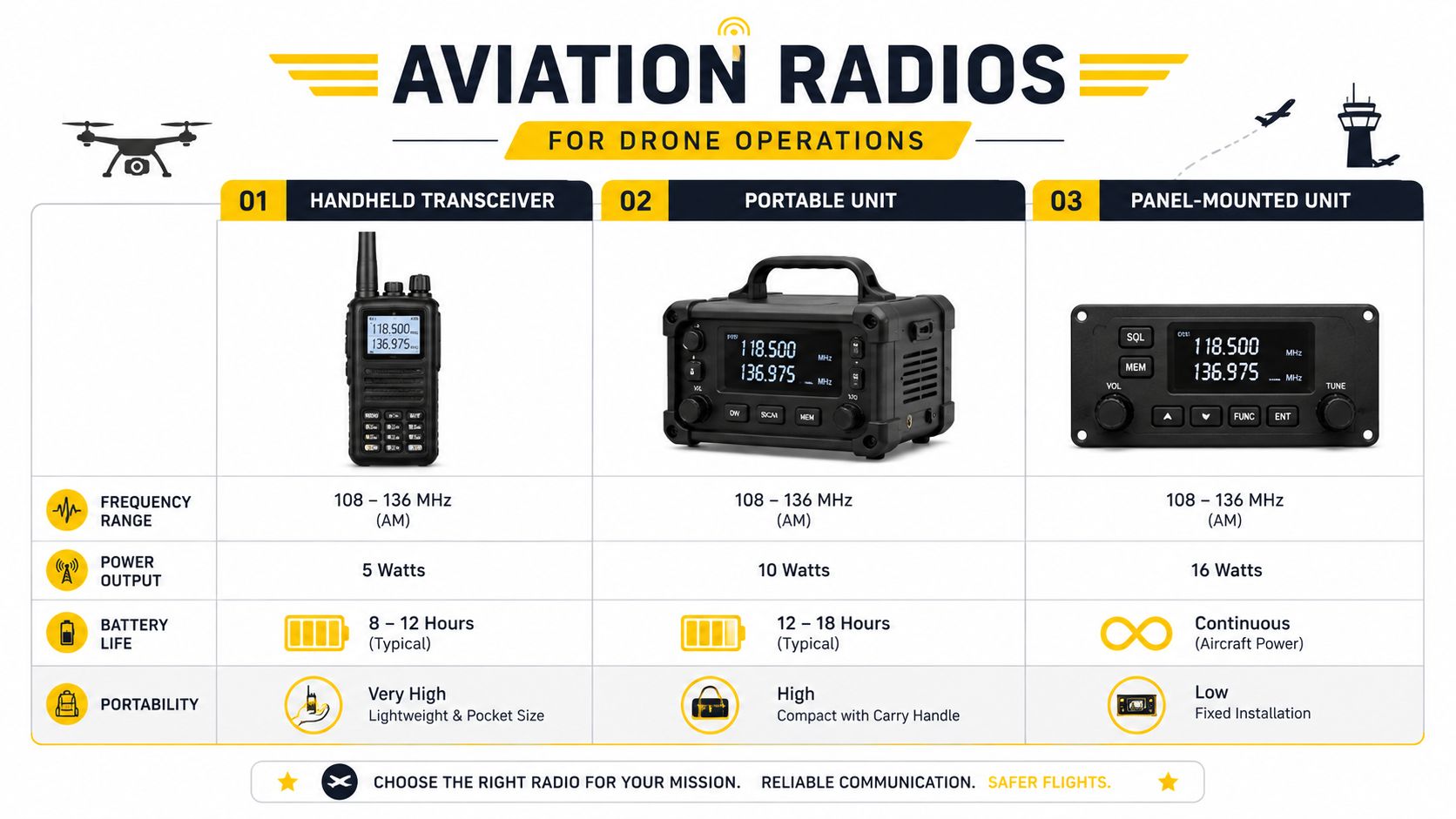
Radio selection starts with the operation, not the product brochure. A drone pilot working from a vehicle near an aerodrome may need a different setup from a crew conducting a long inspection across uneven terrain. The radio must support the permitted frequency range and channel plan, but it also needs to remain usable when the operator is wearing safety equipment, moving between launch points or managing the aircraft at the same time.
Comparing the main equipment types
| Radio type | Useful characteristics | Operational limitations |
|---|---|---|
| Handheld transceiver | Portable, quick to deploy and suitable for mobile crews | Battery condition, antenna position and terrain can limit performance |
| Portable or vehicle-based unit | Easier to use from a fixed field position and can support a more stable antenna arrangement | Less convenient when the crew moves frequently |
| Panel-mounted unit | Integrated installation for an aircraft or suitably equipped platform | Requires appropriate installation, power and operational planning |
A handheld aviation radio often suits a crew that needs to move around a worksite. A portable or vehicle-based arrangement can be more practical when the pilot remains at a defined launch position. A panel-mounted unit belongs in a properly designed and approved installation, not as an improvised upgrade.
Features that deserve close attention
The relevant questions include:
- Frequency capability: Does the equipment cover the required aviation band and channel spacing?
- Power supply: Can the battery or aircraft electrical system support the planned duty cycle?
- Antenna arrangement: Is the antenna connected correctly, positioned sensibly and protected from damage?
- Durability: Can the unit tolerate dust, moisture, vibration and field handling?
- Controls: Can the operator change channels and adjust volume without losing attention from the aircraft?
Airband-only equipment may be suitable when the task is limited to aviation communication. Multi-band equipment can create confusion if users select the wrong mode or assume that access to other services gives permission to transmit on them. The operator should follow the equipment's approval, licence and training requirements rather than treating extra functions as an advantage by default.
Terrain affects radio performance. Buildings, ridgelines, vegetation and the operator's body position can obstruct or weaken a signal. A radio that performs well in an open test area may behave differently beside a hangar or within a quarry. Operators should test equipment before the operation, carry a reliable power plan and have a non-radio contingency for safety-critical communication.
For agricultural teams considering specialist aircraft and field workflows, information about XAG Australia operations may help frame the equipment discussion, but it doesn't replace an operation-specific radio assessment.
Getting Your AROC Certification Online
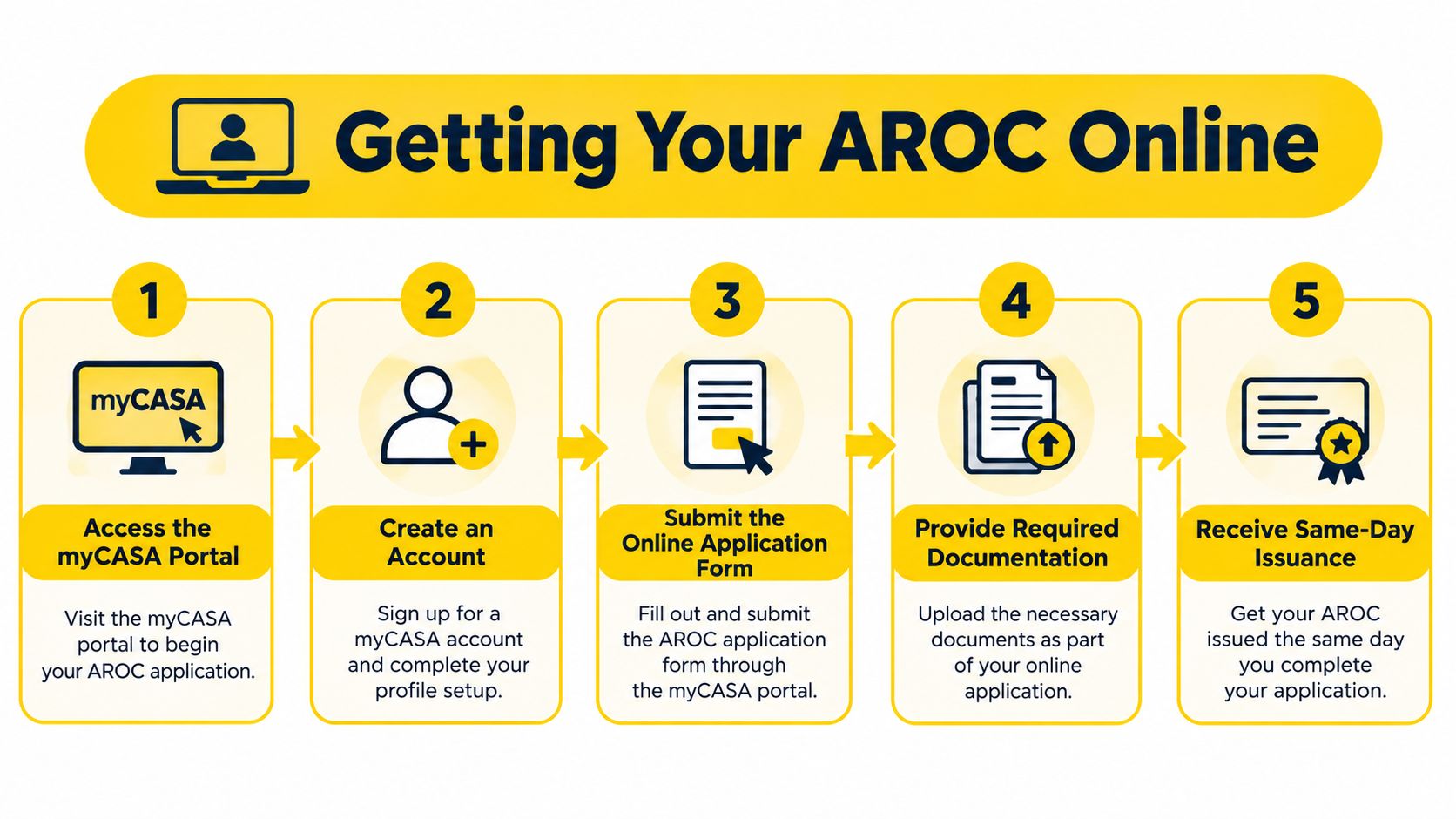
CASA now allows AROC applications to be submitted and issued online through myCASA. CASA says the certificate can be issued in minutes after submission and payment, with the certificate emailed to the applicant. That changes the practical question from whether an applicant can wait for a paper process to whether the applicant has prepared the correct information and can retain evidence of completion.
The CASA AROC certificate page describes the current online pathway. Older guidance and some third-party training pages may still refer to email or postal workflows, which can create conflicting expectations. Applicants should rely on the current CASA process rather than assuming that an older administrative description remains accurate.
Prepare for a clean application
A practical sequence is:
- Access myCASA: Use the current CASA online portal and confirm the correct service.
- Create or use an account: Ensure the applicant's identity and contact details are accurate.
- Complete the application: Enter the requested information carefully and check spelling before submission.
- Provide documentation and payment: Follow CASA's current prompts, upload or provide the required details and complete payment.
- Save the outcome: Keep the emailed certificate and application evidence in an organised compliance record.
Same-day readiness still depends on the applicant. An incomplete application, incorrect personal details, unavailable documentation or a payment problem can delay the process even when the online system is functioning as intended.
Record the qualification for operational assurance
The emailed certificate should be stored where the operator and responsible manager can retrieve it. A business onboarding several pilots can maintain a register containing each person's name, certificate evidence, role, training records and review reminders. The register should support internal checks and client assurance without replacing the original CASA documentation.
Operators should also keep a copy of the relevant application correspondence and avoid relying only on a screenshot of an account page. When a client asks for evidence before mobilisation, a clearly named certificate file and controlled register can prevent last-minute confusion.
Compliance habit: Treat the emailed AROC as an operational record, not as an inbox message that can be deleted after the first flight.
Real-World Applications Across Industries
Aviation radio becomes particularly valuable when a drone operation sits beside other aviation activity. An agricultural crew may work near an aerodrome while planning a mapping or application task. A construction team may inspect a tall structure in an area where aircraft movements need to be monitored. A survey operator may need to coordinate a launch and recovery window rather than treating the worksite as isolated.
The same principle applies across mining, emergency services and infrastructure inspection. Radio discipline helps the crew communicate where the drone is operating, recognise changing traffic information and respond promptly when the aviation environment changes. It supports integration, but it doesn't remove the need for airspace approval, site controls, visual observers where applicable or a documented emergency plan.
Where radio skills create practical value
Agriculture often involves large work areas, mobile crews and equipment operating away from offices. A pilot who can manage aviation communication as part of a pre-flight routine is better positioned to coordinate the operation around relevant aerodrome or traffic procedures. Guidance on XAG P150 Max agricultural operations in Australia can be considered alongside the communication and compliance requirements of the specific worksite.
Construction and surveying demand accurate position descriptions. A vague statement such as “the drone is over the site” may not help an aviation service understand the risk. The pilot needs a prepared description using the aerodrome, boundary, landmark or other recognised reference relevant to that operation.
Mining and infrastructure inspection can expose crews to terrain, structures and radio shadows. The team should identify where the radio may be unreliable and decide how the pilot will receive urgent information if a signal is blocked.
Emergency services require especially disciplined communication. Drone crews may be supporting a response where helicopters, fixed-wing aircraft and ground teams operate together. Short, standardised transmissions and clear acknowledgements help reduce avoidable confusion during a fast-moving event.
The career and business perspective
Employers and clients increasingly look beyond aircraft handling. They want operators who understand aviation communication, regulatory boundaries, documentation and the limits of a radio call. An AROC can therefore form part of a broader professional capability, particularly for work near controlled or shared aviation environments.
Businesses should map the qualification to the role rather than issuing a radio to every employee without assessment. The responsible manager can identify which staff communicate on airband, confirm the required credentials and keep evidence available for audits and client reviews. This approach turns radio from an afterthought into a defined part of the operation's safety management system.
Ace Aviation Aerospace Academy offers training relevant to this pathway, including RePL and AROC education, along with ReOC consulting and enterprise or corporate drone training. Teams can review the available programmes through Ace Aviation Aerospace Academy and select training that matches their aircraft, personnel and operating environment.
Frequently asked questions
Is an AROC the same as a RePL?
No. A RePL relates to remote piloting privileges and competency within its scope. An AROC addresses communication on aviation air-band frequencies for people who aren't already appropriately licensed or qualified.
Does every drone flight require aviation radio?
No. The requirement depends on the operation and whether the operator needs to communicate on an aviation air-band frequency. The operator should assess the airspace, procedure and role before deciding whether an AROC is required.
Can a Remote Pilot Licence holder need an AROC?
Yes. CASA explicitly includes RePL holders among people who need an AROC when they must communicate on an aviation air-band frequency.
How is an AROC issued now?
CASA says applicants can submit and receive an AROC online through myCASA in minutes after completing the application and payment. The certificate is emailed after submission and payment.
What should a business keep after an AROC is issued?
The business should retain the emailed certificate and relevant application evidence in an organised compliance register. It should also link the qualification to the person's operational role and make the record available for appropriate client assurance or audit activity.
Can a radio call replace airspace approval?
No. Radio communication supports coordination, but it doesn't replace required approvals, operating conditions, risk controls or the operator's responsibility to comply with CASA requirements.