
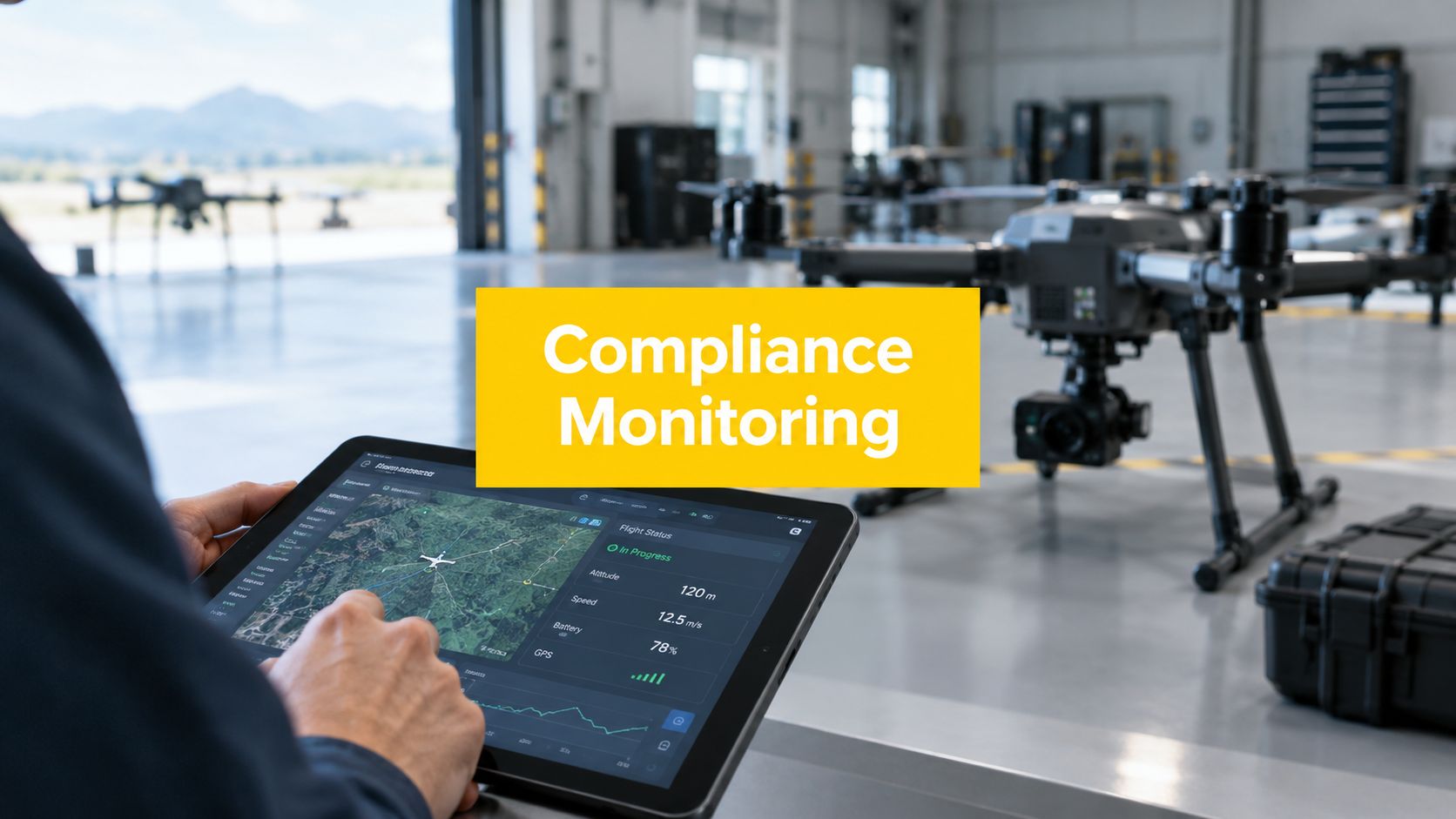
A commercial drone operator may be able to explain every flight rule from memory, yet still struggle when asked to produce the evidence behind those decisions. A CASA surveillance visit can require manuals, pilot competency records, maintenance history, aircraft configuration details, flight logs, authorisations, and corrective-action records to line up clearly.
That pressure is why compliance monitoring systems matter. They turn regulatory obligations into repeatable checks, assigned responsibilities, alerts, and evidence that an operator can retrieve when required. For Australian drone businesses, the issue is becoming more urgent as airspace authorisation workflows move towards CASA and Airservices' FIMS digital platform.
Table of Contents
- Why Drone Operators Need Compliance Monitoring Systems
- Core Components of Effective Compliance Monitoring
- Operational Rules Your System Must Track
- Choosing Between Manual and Integrated Solutions
- Preparing for the FIMS Digital Platform Transition
- Implementation Steps for Your Operation
- Common Misconceptions About CASA Surveillance
- Building Sustainable Compliance Practices
Why Drone Operators Need Compliance Monitoring Systems
A ReOC holder receives notice that CASA will review the operation. The chief remote pilot checks the exposition, then asks staff for recent flight records. One pilot has stored authorisations in email, another has kept screenshots on a phone, and maintenance documents sit in a shared folder with inconsistent file names. The manuals are current, but nobody can quickly show which version applied to a particular flight.
That operation may still have competent people and sound procedures. The weakness is the evidence trail. A compliance monitoring system provides the structured process needed to collect, verify, organise, and present proof that the operation follows its approved procedures and applicable rules. It can be a purpose-built platform, a carefully controlled set of digital registers, or a combination of software and documented review routines.
Surveillance examines the operation behind the flight
CASA describes surveillance as a way to ensure aviation authorisation holders manage safety risks and comply with regulations through oversight activities such as audits and inspections (CASA's surveillance framework). CASA's RPAS model also includes audits of ReOC facilities, remotely piloted aircraft, procedures, and on-site checks of flying operations, particularly for higher-risk operators such as BVLOS operators and training providers (the ATSB report describing RPAS surveillance).
The practical meaning is important. A pilot's licence is only one part of the compliance picture. CASA may need to see how the operator controls aircraft configuration, maintains competency, manages authorisations, records flights, reports incidents, and verifies corrective actions.
Ad hoc records create avoidable risk
Australia's aviation oversight history shows the value of scheduled audits, on-site presence, and repeated review cycles. An Australian National Audit Office report described regular monitoring of airports and airlines against approved programs, with audits conducted at least annually at the time covered by that report (the ANAO aviation security report).
A drone operator doesn't need to copy an airline's system. The principle still applies. A documented cycle helps the accountable manager identify missing evidence before CASA does, while a controlled record system protects operational continuity and supports the operator's ReOC compliance obligations.
Practical rule: If a safety control matters during a flight, the operation should be able to show who checked it, when it was checked, what evidence supports the check, and how a failure was handled.
A reliable system therefore protects more than audit readiness. It helps preserve the operator's authorisation, supports client confidence, and reduces the chance that a preventable recordkeeping failure interrupts commercial work.
Core Components of Effective Compliance Monitoring
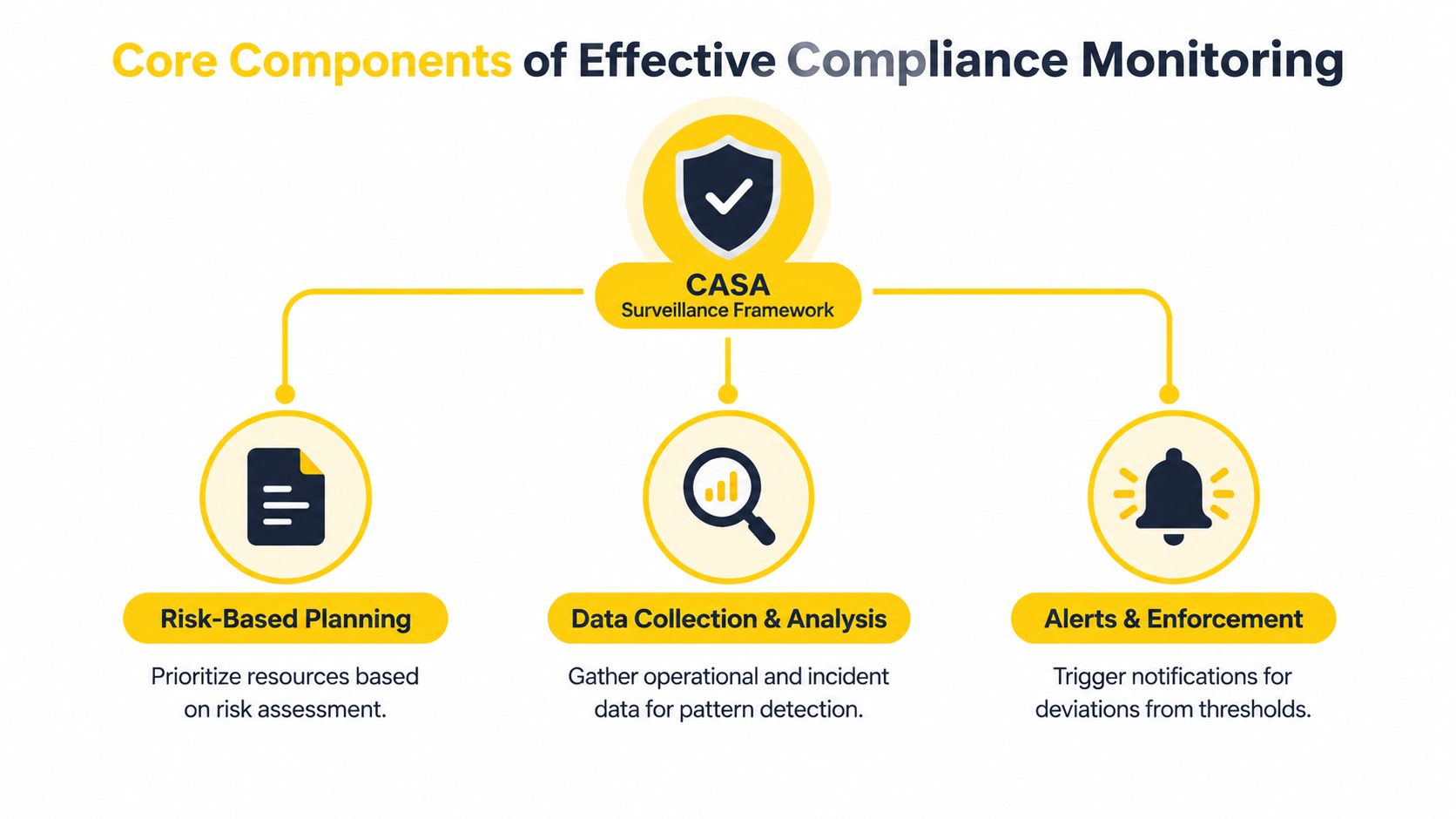
Effective monitoring starts with a simple principle, evidence must follow risk. CASA identified Sky Sentinel as its key information technology system for managing surveillance activities, showing why large-scale oversight depends on structured case management rather than scattered inspection notes (the ANAO report on CASA's regulatory performance).
Five evidence layers
A drone operator can build the system around five connected layers:
Policy documentation
The exposition, operations manual, safety policies, and approval conditions should have clear version control. The record should identify the effective date, approving person, affected procedure, and documents that replaced earlier versions.Operational procedures
Pre-flight planning, airspace checks, weather assessment, site surveys, emergency actions, and post-flight closeout should produce usable records. A procedure that exists only in a manual but leaves no operational evidence is difficult to verify.Personnel competency
The system should track RePL status where relevant, internal training, competency checks, role authorisations, currency requirements, and any restrictions placed on a pilot. It should also show which pilot performed the work and under whose operational control.Equipment maintenance and configuration
Each RPA should have an identifiable record covering inspections, defects, repairs, battery condition, software or firmware changes where relevant, and configuration status. The operator should be able to connect the aircraft record to the flight record.Incident and occurrence reporting
Reports should capture what happened, the immediate control, the investigation, the finding, the responsible person, the due date, and evidence that the corrective action was completed and effective.
Connecting checks to decisions
These layers become useful when the system connects them. A failed maintenance check should prevent an aircraft from appearing as available. An expired competency record should trigger a review before a pilot is assigned. A change to an operating procedure should identify affected personnel and require acknowledgement.
Risk-based prioritisation determines where review effort goes first. Data collection provides the operational facts. Finding management records the deviation and assigns ownership. Corrective-action verification confirms that the response solved the identified problem. Trend analysis then helps managers detect repeated weaknesses, such as incomplete flight records or recurring airspace-planning errors.
ACE GOLD includes RePL, ReOC support, practical flight training, aviation compliance, and business readiness elements relevant to operators building this foundation. Operators should also connect their monitoring design to practical drone safety requirements around airports and helicopter landing sites, rather than treating compliance as a document-only exercise.
Operational Rules Your System Must Track
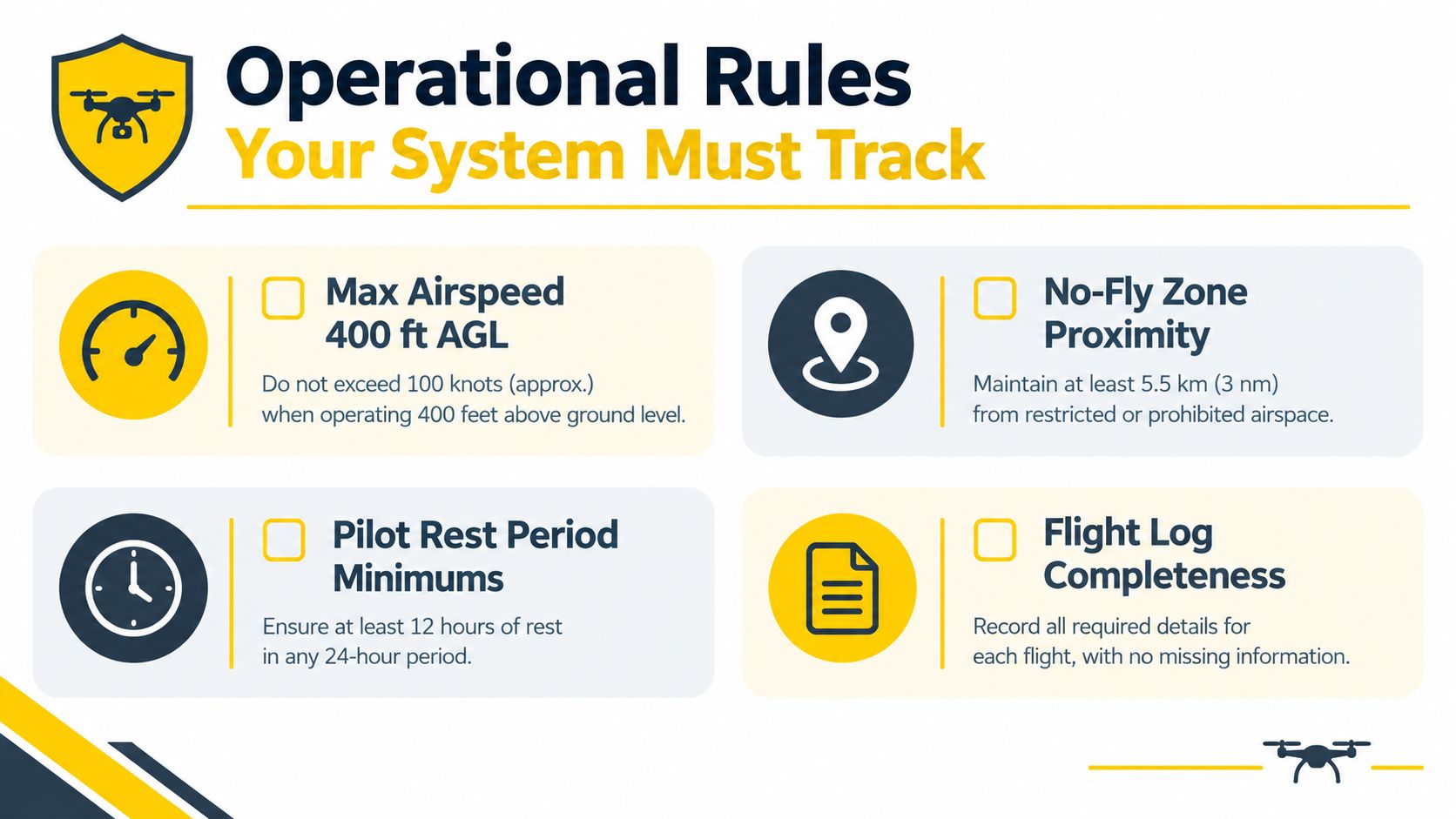
A compliance monitoring system should turn CASA operating rules into checks that pilots and managers can complete before, during, and after a flight. Training material explains the rule, but a monitoring system tests whether the operation followed it. It should show whether the flight plan used current airspace information, the pilot maintained visual line of sight, and the aircraft stayed clear of restricted areas.
Convert rules into system checks
Before configuring these checks, operators should review the current Australian drone laws for 2026. For unlicensed operators, CASA's published rules require the drone to remain within visual line of sight, avoid creating a hazard for other aircraft, and stay outside 5.5 km of a controlled airport. The drone must also land immediately if an aircraft or helicopter is taking off or landing nearby, including at a helicopter landing site (the Australian drone safety rules).
The system should record:
- Airspace validation: the source checked, time of checking, result, and any approval or authorisation linked to the flight.
- Geospatial boundaries: the planned and recorded operating area against airport, helicopter, emergency, and populated-area restrictions.
- Pilot confirmation: the person responsible for the flight and the competency or operational approval required.
- Flight traceability: the aircraft, pilot, location, purpose, authorisation, launch and recovery details, and post-flight record.
These checks work like gates on a runway. A missing approval or failed boundary check should stop the flight record from being treated as ready.
Record restrictions that are easy to overlook
CASA rules prohibit flying over people or within 30 m of people, and above populated beaches, parks, houses, sports ovals, or public venues. They also restrict operations at night or in low visibility, including cloud or fog. Flights near emergencies attended by police, fire, or ambulance services require the same attention (CASA's published drone rules).
A practical workflow asks the pilot to confirm site conditions before launch. Where an approved exception exists, the system should require supporting evidence. If the recorded conditions differ from the planned operation, it should create an escalation for review instead of relying on memory after a busy flight.
CASA advises drone users to check a CASA-verified safety app before each flight, because these apps display airspace restrictions and local rules (CASA's drone safety guidance). The monitoring record should therefore capture the check and its result, not merely a statement that the pilot completed training.
Operators building their fundamentals may consider ACE READY, an entry-level course covering drone fundamentals, aviation safety, CASA regulations, flight operations, and preparation for advanced RePL training in Australia. The monitoring system then places those rules into the daily flight process, while leaving room to update checks as CASA transitions to the FIMS digital platform in 2026.
Choosing Between Manual and Integrated Solutions
A spreadsheet can be a reasonable starting point for a small operation. It can hold aircraft registers, pilot records, inspection dates, finding numbers, and review status. The problem begins when the spreadsheet becomes the only control for several pilots, multiple RPAs, changing authorisations, and flight activity across different locations.
Manual systems depend heavily on disciplined data entry. Integrated platforms can connect records, automate reminders, apply validation rules, and provide a clearer audit trail. Neither approach automatically creates compliance. The better choice depends on whether the system can produce complete, reliable evidence for the operation's actual risks.
| Criteria | Manual Systems | Integrated Digital Platforms |
|---|---|---|
| Evidence capture automation | Staff enter records and attach files manually. | Forms, workflows, and linked records can reduce repeated entry. |
| Real-time alerting capability | Reminders may depend on calendar entries or spreadsheet review. | Rules can flag expiry dates, missing fields, overdue actions, and operational deviations. |
| Audit trail completeness | Version history and user changes may be inconsistent. | Controlled permissions and event histories can create a more consistent record. |
| Integration with airspace data sources | Staff may record checks separately from the flight file. | Airspace checks and authorisations may be linked to the operational workflow, subject to the platform's capabilities. |
| Reporting flexibility | Staff can create custom reports, but results depend on clean data. | Dashboards and filters can support recurring management reviews and finding analysis. |
Match the tool to the operating model
Manual tracking may suit an operator with limited activity, one accountable manager, a small aircraft register, and straightforward operations. Even then, the operator should control access, back up records, use consistent naming, lock completed records, and review the register at planned intervals.
An integrated solution becomes more appropriate when the operation manages multiple pilots, training activities, BVLOS work, diverse aircraft, or authorisations that change by location and task. The key question isn't whether software looks modern. It is whether the platform can connect the obligation, the person responsible, the evidence collected, the finding raised, and the corrective action completed.
Operators comparing monitoring products can also review broader material on business monitoring for data-driven decisions, while keeping the selection criteria grounded in CASA's aviation-specific evidence needs.
Preparing for the FIMS Digital Platform Transition
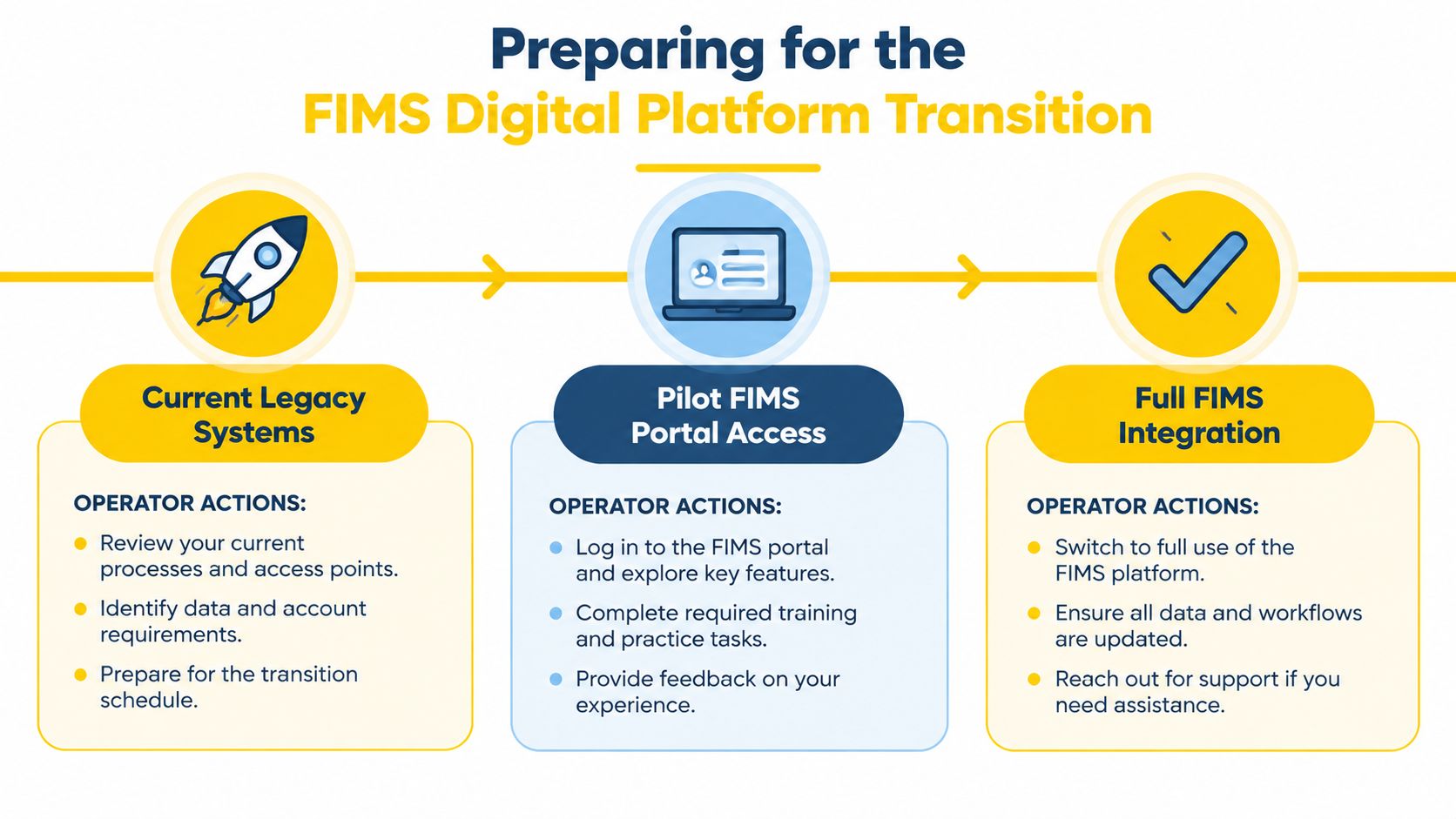
CASA says the transition of automated airspace authorisation at civil-controlled aerodromes will begin in the second half of 2026 and run for about 12 months. CASA also says some services from 2026 may require data sourced from FIMS instead of data.airservices (CASA's digital platform information).
Treat the change as a data-source change
Many operators focus on whether a flight remains legal. The overlooked issue is whether their records continue to prove how legality was established. If an existing workflow stores an approval reference, airspace screenshot, or authorisation status from one source, the transition may affect the meaning, availability, or retrieval of that evidence.
A ReOC holder should map each workflow that uses airspace information:
- Pre-flight planning and site approval
- Automated authorisation requests
- Pilot notifications and operational briefings
- Flight release decisions
- Post-flight evidence packages
- Escalation when an authorisation cannot be obtained or verified
The system should distinguish between a planned request, an approved authorisation, a rejected request, and an operational cancellation. Those states shouldn't be collapsed into a single “checked” field.
Protect continuity during the transition
During the transition, operators should identify the authoritative source for each workflow, record when that source changed, and preserve the evidence needed to explain decisions made under the previous process. Staff should know what to do when a FIMS-based service is unavailable, produces an unexpected result, or doesn't match information held elsewhere.
A useful transition test asks four questions:
- Can the operator retrieve the airspace information used before the flight?
- Can the operator identify the source and time of that information?
- Can the operator show the approval or authorisation connected to the operation?
- Can the operator escalate a mismatch without allowing an unverified flight to proceed?
The transition is therefore not just a technology upgrade. It is a change-management task involving procedures, training, data retention, permissions, and review controls. Operators that update these elements early will have a clearer compliance position while the digital ecosystem changes.
Implementation Steps for Your Operation
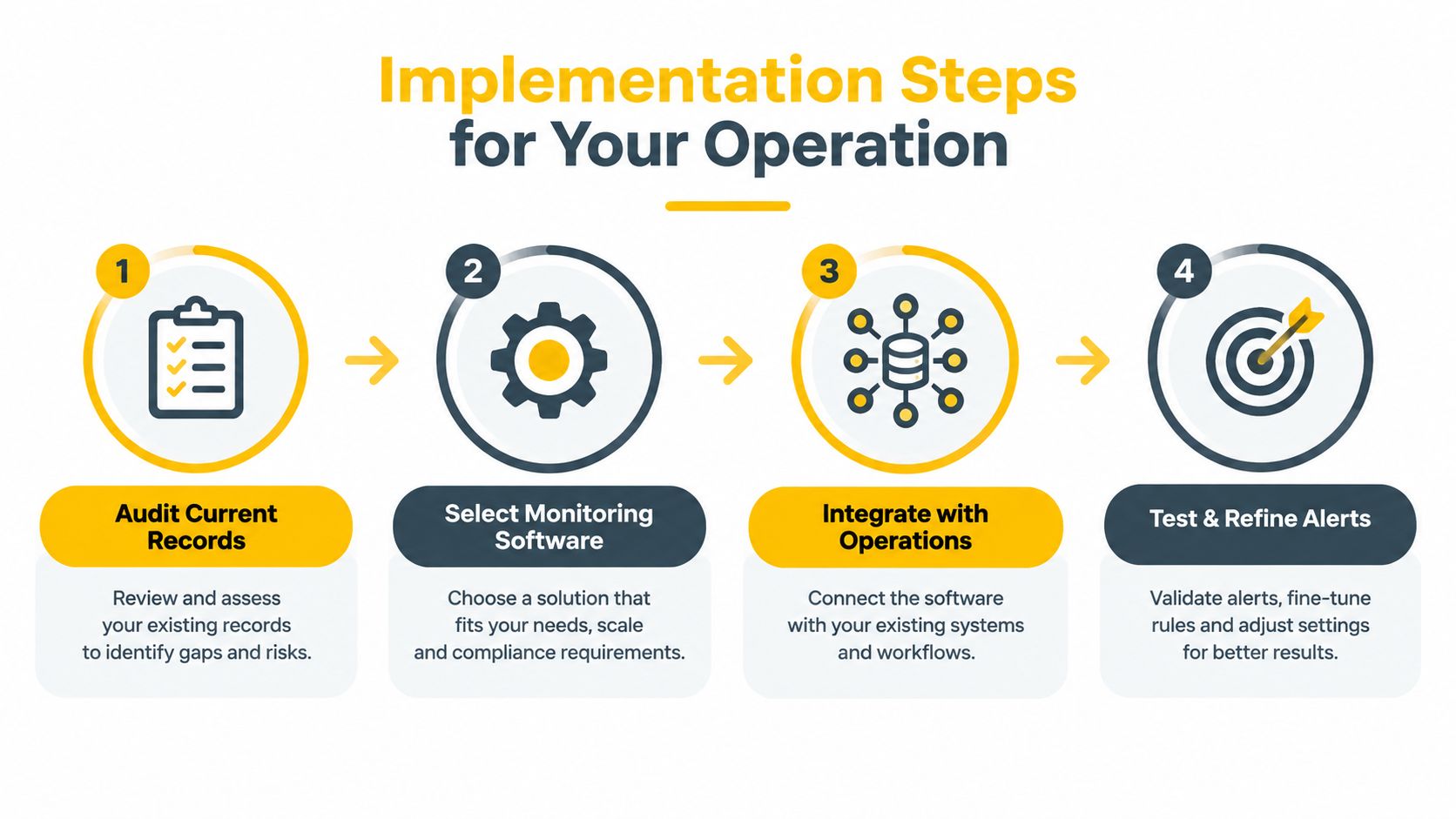
A workable compliance monitoring system doesn't begin with software procurement. It begins with a clear map of what the operation must control and what evidence proves that each control worked.
Start with the current record
The first task is a records audit. The accountable manager should sample completed operations and trace each one from planning to closeout. The review should identify missing authorisations, unclear aircraft identity, incomplete maintenance evidence, unsupported competency claims, unclosed findings, and documents that lack version control.
The result should be a gap register, not a general impression. Each gap needs an owner, a priority, a proposed control, and a source of evidence.
Build the control map
The operation can then map each obligation to a practical record:
- Airspace obligations: Pre-flight check, source, time, location, and authorisation status.
- Pilot obligations: Identity, competency, role, training, and assignment approval.
- Aircraft obligations: Registration or identifier, configuration, maintenance status, defects, and release decision.
- Operational obligations: Site assessment, weather decision, people and hazard controls, flight record, and post-flight review.
- Management obligations: Finding, corrective action, responsible person, completion evidence, and effectiveness review.
A system should make the compliant action easier than the non-compliant shortcut. If pilots must duplicate information across several forms, they may create inconsistent records. Controlled templates, required fields, and linked records reduce that risk.
Integrate and test
The operation should connect monitoring to daily work. A flight request can create a checklist, assign a reviewer, capture the airspace result, and require a release decision. A failed check can create a finding and notify the person authorised to assess the risk.
For comparison, guidance on how UK fleet software streamlines audits can help operators think about workflow design, although Australian operators still need to test every feature against CASA requirements and local operating procedures.
The final stage is alert testing. Staff should deliberately enter an expired competency record, incomplete flight log, unavailable aircraft, and mismatched authorisation to confirm that the system responds as intended. Emergency processes should sit alongside routine monitoring, with relevant operational preparation informed by resources such as the drone pilot emergency handbook.
Common Misconceptions About CASA Surveillance
Surveillance isn't random
CASA's RPAS compliance monitoring uses scheduled and ad hoc surveillance, with attention to higher-risk operators such as BVLOS operators and training providers (the ATSB account of RPAS surveillance activity). That doesn't mean every operator receives the same level or type of attention. It means operators should expect oversight to reflect operational risk, authorisation scope, and the maturity of the management system.
A training provider, for example, needs evidence that facilities, aircraft, procedures, instructors, student competency, and flying operations remain controlled. A business conducting complex operations needs a system capable of demonstrating equivalent control across its own approved activities.
A licence isn't the whole control system
A pilot may hold the required qualification and still operate under an outdated procedure, use an aircraft with an unresolved defect, or fail to preserve an authorisation record. CASA's surveillance model evaluates the physical operation and the management system behind it, so a licence register alone cannot demonstrate organisational control.
This is why operators should separate three questions:
- Can the person operate?
- Was the operation authorised and planned correctly?
- Did the organisation control the aircraft, records, risks, and follow-up?
The answers need to agree in the evidence.
Initial approval doesn't create permanent compliance
Passing an initial ReOC assessment demonstrates that the applicant met the relevant requirements at that point in the approval process. It doesn't remove the need for continued monitoring, internal review, updated procedures, or corrective action.
Operators should also distinguish approved commercial operations from activities that fall within an excluded category. The Australian excluded category drone operations guidance can help clarify that operating category, but it doesn't replace the need to record actual operational decisions and safety controls.
A mature operator doesn't prepare for surveillance only when a visit is announced. The operator keeps evidence organised because every flight depends on controlled decisions.
Building Sustainable Compliance Practices
A sustainable system links risk, responsibility, evidence, and corrective action. It tracks the operational rules that matter, uses current airspace information, and preserves a clear record when a decision changes. It also treats the FIMS transition as a workflow and recordkeeping issue, not merely a new portal login.
Each operator should assess current maturity, identify the three highest-priority gaps, implement controls for those gaps within 30 days, and establish a quarterly review cycle. Those timeframes are an editorial action framework, not CASA deadlines.
Compliance monitoring is ongoing operational discipline. It protects safety assurance, supports ReOC obligations, and gives a commercial drone business stronger control over continuity as systems and authorisation processes evolve.
Ace Aviation Aerospace Academy provides professional drone education covering the Remote Pilot Licence, aviation compliance, ReOC consulting, and related operational training. Operators and training managers can visit Ace Aviation Aerospace Academy to review relevant pathways and strengthen the knowledge behind their compliance monitoring systems.