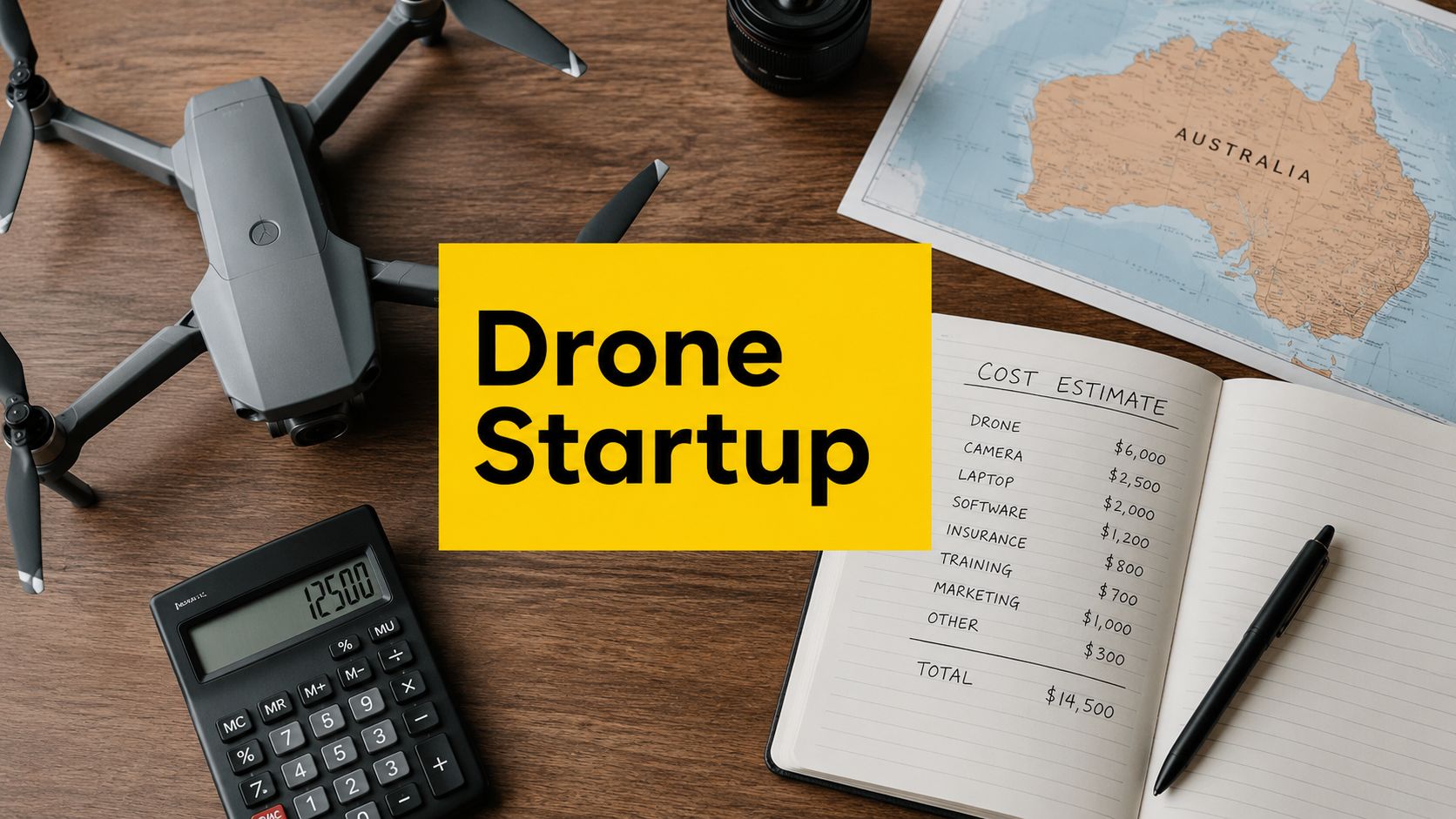
A realistic Australian drone business startup budget lands between roughly A$20,000 and A$100,000 in year one, with the aircraft often being only 30–50% of the total once licensing, insurance, software and a cashflow buffer are included. The aircraft may be the most visible purchase, but compliance and operational readiness decide whether the business can legally accept work.
A new operator often starts with a familiar plan: buy a capable drone, create a website, and begin quoting jobs. Then the less obvious barriers appear. The drone needs registration, the pilot needs the right qualification, the business may need a Remote Operator Certificate (ReOC), and clients may require insurance and formal operating documents before they approve a contractor.
Australian startup guidance puts a fully equipped first-year operation anywhere from A$89,000 to A$291,000, depending heavily on aircraft choice, insurance, training and business setup, according to this Australia-focused drone business budget. That broader range suits professional platforms and specialised work. A lean operator can spend less, but only by limiting the service model and avoiding premature investment in enterprise equipment.
The right question isn't “How much does a drone cost?” It's “What must be paid for before a compliant, insured and sellable service can operate?” The answer sits across four layers: licensing, equipment, running costs and cashflow.
Table of Contents
- Why the Drone Is the Cheapest Part of Starting an AU Drone Business
- Mapping CASA Licensing to Your Business Model
- Three Operator Archetypes and What Each Costs
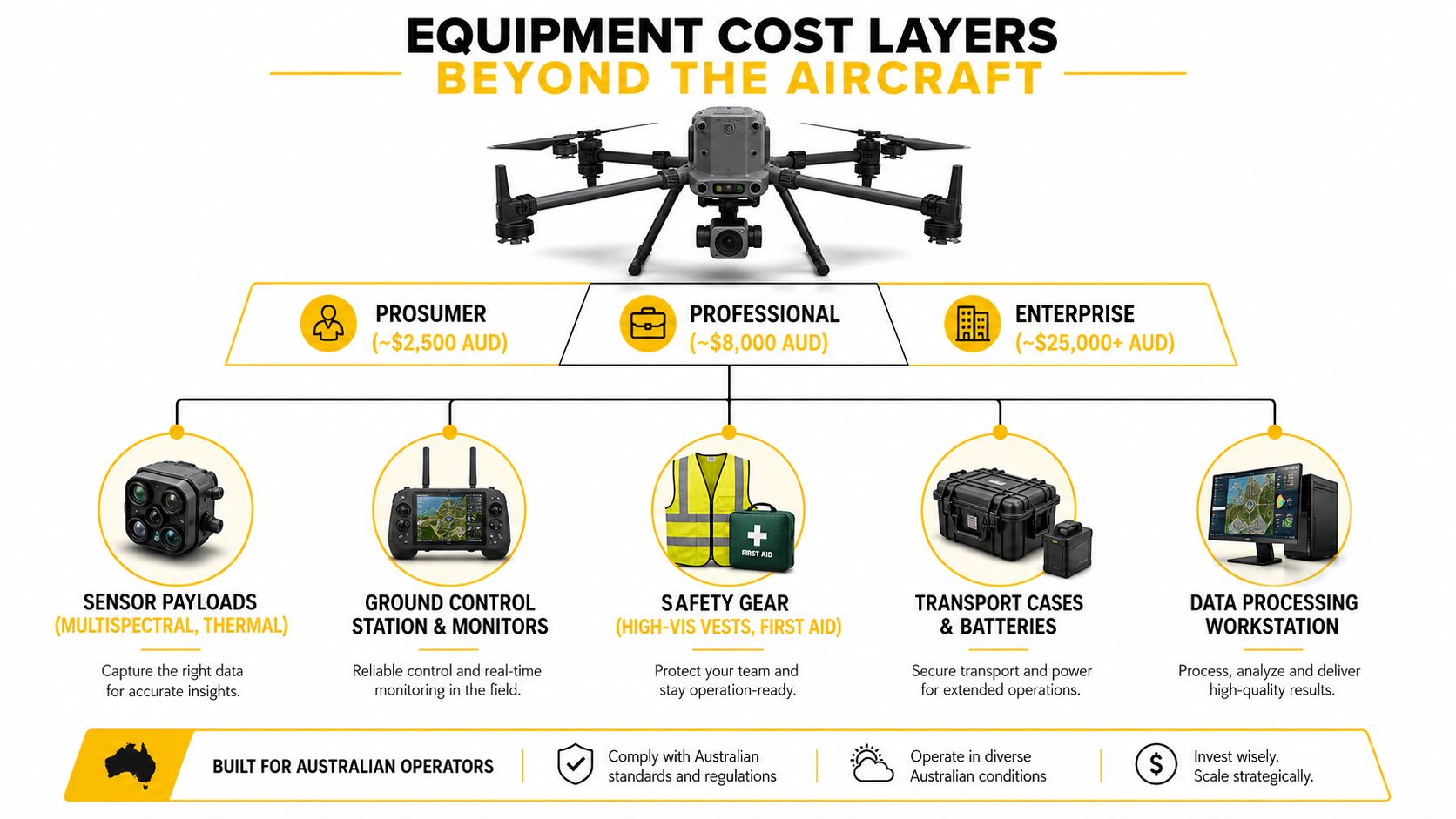
- Equipment Cost Layers Beyond the Aircraft
- Insurance, Software, Maintenance and Compliance Running Costs
- Building Your 12-Month Cashflow and Break-Even Model
- Your Launch Checklist and Common Cost Questions
Why the Drone Is the Cheapest Part of Starting an AU Drone Business
A new operator can spend heavily on a capable aircraft, then lose the first client because the business cannot show registration, pilot qualifications, public liability cover, documented risk controls or dependable data delivery. The drone purchase is complete, but trading has not started. The budget covered flying, not the operating system around it.
That is the central mistake in drone business startup costs. The aircraft is only one layer. A compliant operation also needs the right pilot pathway, organisational approval where required, insurance, software, maintenance planning and enough cash to remain available during quiet periods. CASA rules apply to small aircraft too. Paid work with a drone, including a micro drone under 250 grams, requires registration and operator accreditation or a RePL, as explained in CASA's drone safety rules.
Practical rule: A drone becomes an earning asset only when the operator can legally deploy it, produce useful deliverables and keep it serviceable between jobs.
The aircraft price can also mislead buyers planning an enterprise operation. One Australian guide estimates A$50,000–A$150,000 for a professional platform such as a DJI M300 RTK, compared with A$2,500 for a ReOC application, A$5,000–A$20,000 for insurance bonds and A$1,000–A$5,000 for business registration and legal setup. It places RePL pricing at A$500–A$1,000. Those figures show where money goes after the aircraft is selected: approval, risk transfer and a business structure can determine whether the platform is commercially usable. The figures are drawn from Australian startup cost guidance.
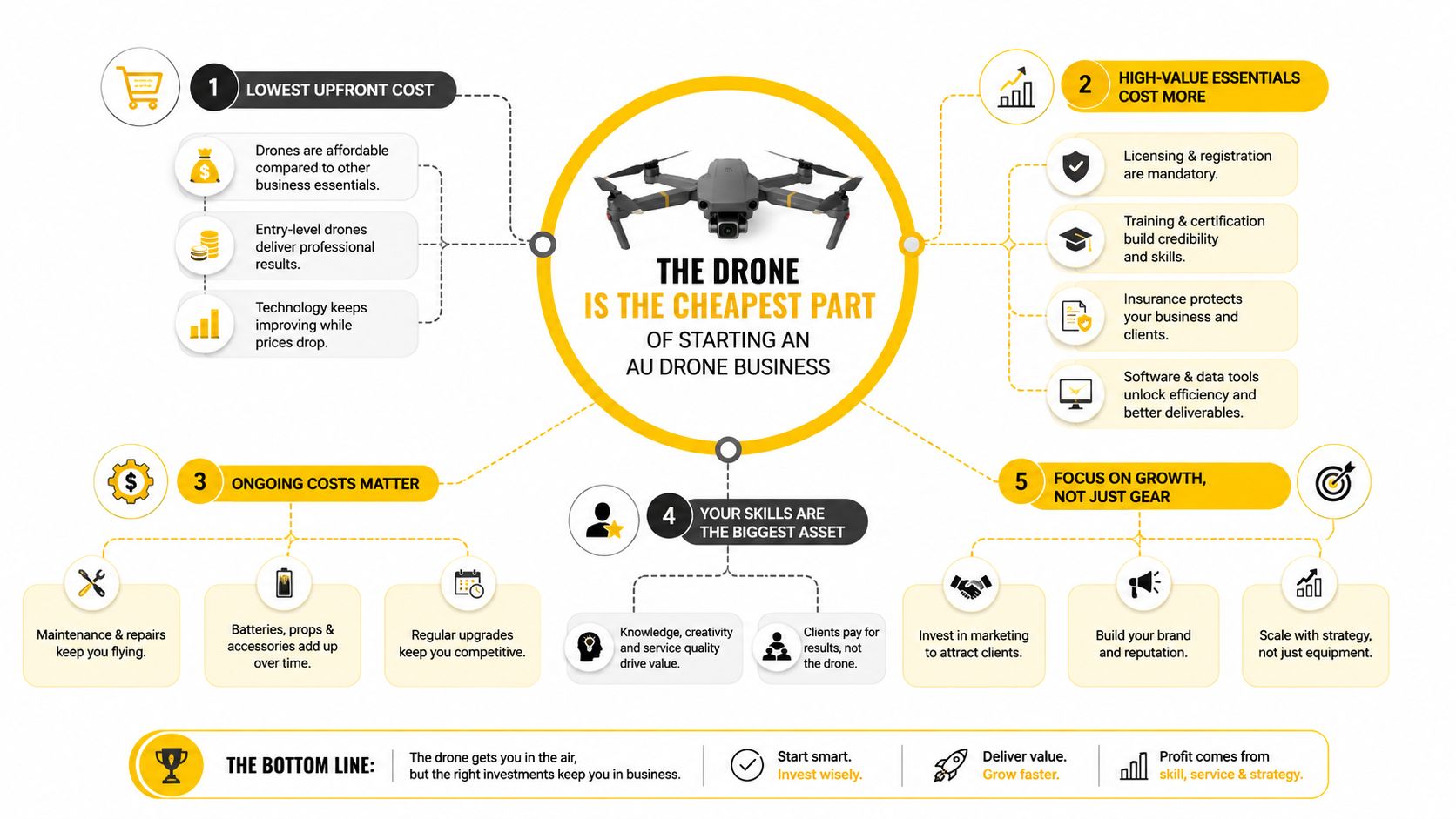
Choose the service before choosing the aircraft. Real estate imagery, basic media work and simple visual documentation may fit a lean RePL-led operation. Agriculture, inspection, surveying and enterprise contracts generally require more documentation, specialised payloads, higher insurance cover and an organisational approval pathway.
The cost profile follows that choice. Licensing determines whether the work can be conducted legally. Equipment determines what jobs the operator can deliver. Running costs keep the aircraft, software and compliance records ready. Cashflow prevents a slow sales period or delayed invoice from stopping the operation before it has a reliable client base.
Mapping CASA Licensing to Your Business Model
Australian commercial operators need to separate the pilot's qualification from the organisation's approval. CASA describes the Remote Pilot Licence (RePL) as the personal licence held by the pilot, while the Remote Operator Certificate (ReOC) is the business certificate held by the organisation conducting operations. CASA explains that, under a ReOC, the pilot must hold a RePL and the drone must be registered in the relevant circumstances, as set out in CASA's RePL guidance.
The three building blocks
Drone registration applies to commercial use, including paid work with a micro drone under 250 grams. Registration is attached to the aircraft and forms part of the basic compliance record.
Operator accreditation or a RePL applies to the person conducting the flight. For commercial work, the pilot needs the appropriate CASA pathway. A RePL is the professional pilot credential and should be matched to the aircraft category and intended operation.
A ReOC applies to the organisation. It becomes particularly important where the business conducts higher-risk work, operates a more complex model or uses multiple pilots. It also brings an organisational system, including documented procedures and operational responsibilities, rather than adding another card to a wallet.
The proposed CASA fee schedule illustrates why a business shouldn't budget for “the licence” as if it were one purchase. The proposed initial issue fee for a RePL was A$17, while the proposed initial issue fee for a ReOC was A$1,175. Proposed renewal and variation fees were A$114 and A$409 respectively. CASA also indicated that those proposed fixed fees were below historical hourly-rate averages, including a historical average of A$1,229 for an initial ReOC issue and A$40 for an average RePL charge. The figures and qualifications are set out in CASA's proposed RPA regulatory fee schedule.
Match the approval to the work
A solo operator completing low-risk assignments may begin with a RePL-led model, provided the operation meets its applicable rules and the business has the required registration and insurance. A small company intending to send several pilots to agricultural, inspection or mapping sites should plan around a ReOC rather than trying to stretch a personal licence across an organisation.
New entrants who need foundational preparation can review ACE READY, an entry level drone training course covering drone fundamentals, aviation safety, CASA regulations, flight operations and preparation for advanced RePL training in Australia. Operators considering organisational approval should also understand the documentation and responsibilities described in this guide to ReOC requirements.
The cost consequence is straightforward: the intended operating model must be decided before equipment is ordered. Buying a drone first can leave a founder with the wrong aircraft, inadequate documentation and a costly approval process still ahead.
Three Operator Archetypes and What Each Costs
Three broad profiles cover most early Australian commercial plans. They aren't rigid categories, but they help a founder avoid comparing a property photographer's budget with an agricultural operator's budget.
| Cost layer | Solo RePL freelancer | Small ReOC business | Enterprise operator |
|---|---|---|---|
| Regulatory foundation | Registration and RePL, with accreditation where applicable | Registered aircraft, RePL pilots and ReOC | Multiple RePL pilots, ReOC, formal operational governance and specialist approvals where required |
| Typical work | Real estate, media and simple visual capture | Agriculture, surveying and inspections | Enterprise infrastructure, specialised payloads and multi-crew operations |
| Aircraft approach | Prosumer platform matched to low-risk work | Professional platform, potentially with RTK or specialist payloads | Enterprise aircraft, payloads, spares and redundant ground equipment |
| Insurance profile | Basic commercial cover suited to the work | Higher cover reflecting aircraft, sites and client contracts | Substantial cover shaped by fleet value, personnel and operational risk |
| Year-one budget view | Lean plans may fit within the lower end of the overall A$20,000–A$100,000 planning range | Often moves towards the middle or upper end once ReOC, equipment and working capital are included | Can exceed the general range when aircraft and payloads are capital intensive |
| Main financial risk | Underpricing time and buying too much equipment | Underestimating documentation, approvals and utilisation | Tying up capital in specialised equipment before contracts are secured |
The solo freelancer has the simplest structure, but “simple” doesn't mean casual. A RePL alone doesn't remove the need for registration, insurance, safe operating procedures and professional deliverables. Real estate and basic mapping can be sensible entry niches because the aircraft and payload requirements may be less demanding than industrial inspection.
A small ReOC business has better scope for repeat work, but it carries organisational overhead. Agriculture, surveying and inspection clients may expect stronger safety systems, radio capability, data handling and evidence that the company can manage more than one pilot.
Enterprise work is a different commercial proposition. Multiple crews, thermal, multispectral or LiDAR payloads, formal safety management and specialised data processing can create significant fixed costs. The ACE PLATINUM package is described as including RePL, AROC, Aviation English, Express ReOC, Certificate III in Aviation, advanced operations training and preparation to operate and manage a commercial drone business.
The correct profile depends on the service mix. A founder selling occasional property imagery shouldn't finance an enterprise fleet. A company targeting utilities, agriculture or government contracts shouldn't pretend that a prosumer drone and a personal licence provide the same capability.
Equipment Cost Layers Beyond the Aircraft
The aircraft is only the first hardware decision. A commercial kit must survive transport, weather, repeated battery cycles and the demands of producing reliable outputs at the end of a job.
Build the kit around the deliverable
A prosumer aircraft may suit RGB photography and straightforward visual work. A professional platform can add stronger positioning, endurance and payload options. An enterprise system becomes relevant when the job requires specialised sensors, greater redundancy, more demanding field conditions or larger operational teams.
Sensor choice changes the economics sharply:
- RGB cameras suit photography, video, visual records and many basic inspections.
- Thermal payloads support heat-signature work, but the operator also needs the knowledge to interpret and report the data responsibly.
- Multispectral systems serve agricultural analysis and vegetation assessment.
- LiDAR supports demanding terrain, vegetation and three-dimensional mapping workflows, with substantial processing requirements.
The aircraft isn't the only item that leaves the workshop. Batteries, charging hubs, cases, controllers, monitors, memory media, high-visibility clothing, first aid equipment and a suitable vehicle all affect whether the operator can complete a day's work without improvising.
Two batteries may be adequate for practice flights, but commercial work introduces setup time, travel, weather windows and retakes. A rugged transport case protects the aircraft and payload from Australian roads, dust and handling. A workstation capable of processing mapping or inspection datasets can also become a major purchase, even when the aircraft itself is already operational.
The Australian market data identifies high initial equipment and maintenance costs as a barrier to entry, while the market itself generated about USD 915.2 million in 2024 and is forecast to reach USD 2,148.4 million by 2030, according to Grand View Research's Australia commercial drone market outlook. The opportunity is real, but expensive equipment doesn't create demand by itself.
Decide what to own
A sensible first-year purchasing rule is simple:
- Buy the core platform when it supports the service already being sold.
- Rent or hire specialist payloads until demand justifies ownership.
- Lease or finance expensive aircraft only when contracted work can support the repayment.
- Use subcontractors for capabilities that require infrequent, high-cost equipment.
- Protect the ground kit, because replacing cases, batteries and computing hardware can interrupt work as effectively as an aircraft fault.
Agricultural founders assessing specialised platforms can also review this Australian agriculture drone resource. The decision should follow booked work and repeatable demand, not enthusiasm for a particular model.
Insurance, Software, Maintenance and Compliance Running Costs
The most dangerous budget is the one that covers launch day and ignores every month afterwards. Insurance renewals, software, repairs, battery management, accounting and compliance administration continue whether the calendar is full or empty.
Public liability cover should match the work, sites and client contracts. Aviation hull cover protects the aircraft and payload investment, but the premium depends on the value and risk profile of the equipment. A founder should obtain written quotes before committing to a platform, especially for thermal, multispectral or LiDAR systems.
Software also belongs in the operating budget. Flight planning, airspace checks, logging, photogrammetry, thermal analysis, cloud storage, editing and client delivery can each sit in separate products. Mapping operators need processing capacity. Media operators need editing tools. Inspection providers need a repeatable reporting workflow. The right software isn't a luxury if the client is paying for usable information rather than raw files.
Recurring costs that deserve a reserve
- Insurance: Public liability and hull cover should be quoted against the actual operation, not a generic online estimate.
- Software: Flight planning, mapping, data processing and storage costs recur through subscriptions or licences.
- Maintenance: Batteries, propellers, repairs, calibration and firmware-related support need planned attention.
- Compliance: Manuals, risk assessments, operational records, renewals and ReOC variations consume time and may require external assistance.
- Administration: Bookkeeping, accounting, contracts, document control and client reporting are operating expenses, not optional extras.
CASA's cost comparison infographic shows example first-year commercial compliance totals of $4,800, $5,700 and $8,160 across typical operator scenarios. Those examples reinforce the point that legal setup, documentation and approval work can form a significant fixed-cost block before aircraft spend, as shown in CASA's commercial RPA cost comparison infographic.
No universal revenue percentage works for every niche. A low-risk media operator and a multi-crew inspection company face different exposure. The practical test is whether the forecast includes a separate annual reserve for insurance, maintenance, software and compliance, rather than treating those costs as surprises. Operators can use a drone business quote calculator to pressure-test the assumptions.
People beginning with foundation commercial training may consider ACE BRONZE, described as covering drone operations, flight safety, aviation theory and practical skills for students beginning their journey towards becoming licensed drone pilots in Australia.
Building Your 12-Month Cashflow and Break-Even Model
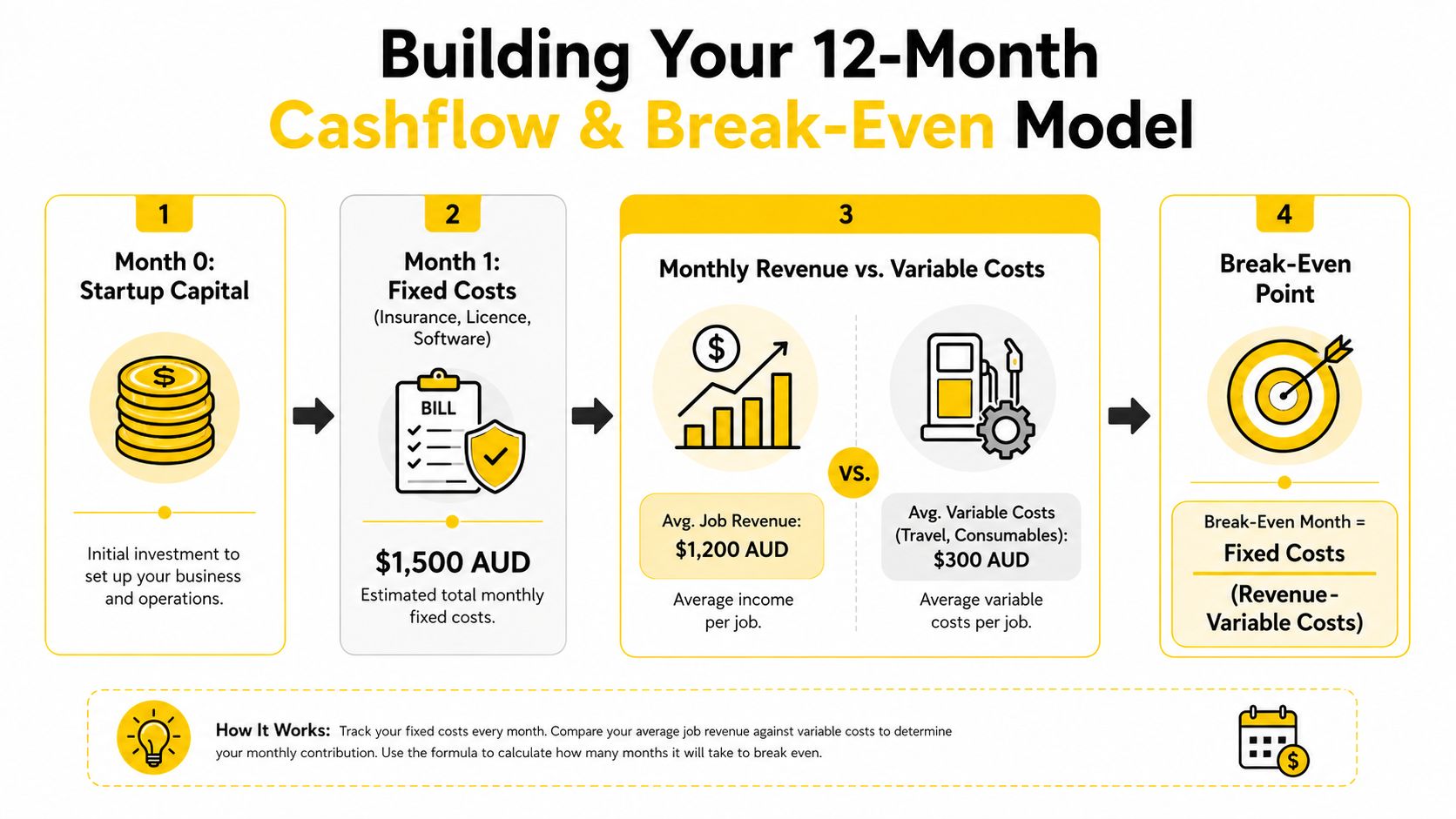
A drone business can be profitable on paper and still run out of cash. The cure is a monthly forecast that separates fixed costs, variable job costs and money received.
Start with a spreadsheet containing twelve monthly columns. Add the following:
- Fixed commitments: Insurance, software, vehicle costs, accounting, finance repayments and office expenses.
- Variable job costs: Fuel, travel, subcontractors, sensor hire, accommodation, consumables and data delivery.
- Revenue assumptions: Number of jobs, average project value, payment timing and realistic billable availability.
- Cash position: Opening balance, cash received, cash paid and closing balance.
The break-even calculation is:
Break-even revenue = fixed costs plus variable costs
For job planning, the more useful version is:
Break-even jobs = fixed costs divided by revenue per job minus variable cost per job
A solo mapping or inspection freelancer should enter conservative assumptions rather than filling every available day. The forecast needs room for weather, travel, quoting, editing, maintenance and unpaid administration. If the average job produces A$1,200 in revenue and incurs A$300 in variable costs, the contribution before fixed costs is A$900. The figures shown in this example are also used in the accompanying visual, not presented as a market rate.
A two-pilot ReOC operation needs another layer. It should model pilot wages or subcontractor payments, additional insurance exposure, equipment availability and the time required to supervise documentation. The business may generate more revenue, but it also needs enough booked work to keep both pilots productive.
Pricing should reflect the deliverable, not only flight time. Agriculture may suit per-hectare pricing, inspection can suit per-asset or per-site pricing, and mapping often works better as a project quote. Media work may use a day rate, but editing, travel, revisions and licensing still need to appear in the quote.
Underpricing doesn't just reduce profit. It attracts work that consumes the operator's limited time without building the cash reserve needed for safer equipment and better systems.
A credible forecast also separates funding from revenue. Equipment finance and asset leasing may suit a professional platform tied to signed work. A small business loan can support a broader setup, but repayments become fixed overhead. Grants and accelerator programs may suit data or agricultural applications, while a lean freelancer should avoid funding equipment that has no confirmed workload.
For a practical explanation of forecasting disciplines, the Nanak Accountants cash flow guide provides useful context for building and reviewing a cashflow model. Operators considering seasonal opportunities can also examine this EOFY drone business opportunity guide, then test any proposed purchase against the twelve-month forecast rather than a single busy period.
Your Launch Checklist and Common Cost Questions
A workable launch sequence looks like this:
- Define the niche: Choose a service with identifiable clients and repeatable demand.
- Map the CASA pathway: Confirm registration, operator accreditation or RePL, and whether the business needs a ReOC.
- Build four cost layers: Separate licensing, equipment, running costs and cashflow buffer.
- Secure insurance quotes: Obtain cover estimates before selecting the aircraft and payload.
- Model twelve months: Include quiet periods, travel, maintenance, software and payment delays.
- Choose ownership carefully: Buy proven core equipment, then rent, lease or subcontract specialist capability.
Frequently asked questions
Can a drone business start under A$10,000?
A very limited operation may keep initial equipment spending low, but a compliant Australian commercial business still needs registration, pilot qualification, insurance, operating readiness and cashflow. The broader first-year planning range in this guide is A$20,000–A$100,000, while professional startup guidance places more complete setups at A$89,000–A$291,000. The lower figure is possible only with a narrow service model and disciplined spending.
Is a RePL alone enough to invoice clients?
No. The pilot needs the appropriate qualification, but commercial work also involves aircraft registration and business compliance. CASA distinguishes the personal RePL from the organisational ReOC, so a RePL doesn't automatically authorise every business operating model.
How long does a ReOC take to approve?
Approval timing varies with the application, documentation and assessment process. CASA advises applicants to contact delegates about fees and application processes, so operators shouldn't promise a fixed approval period or schedule client work before the approval pathway is confirmed.
What insurance is genuinely mandatory?
The required cover depends on the operation, contract and risk environment. Commercial clients commonly require public liability and may require hull or other specialised cover. Insurance should be confirmed in writing against the actual aircraft, payload, location and service.
Where do hidden costs appear?
They usually appear in documentation, ReOC assistance, manual updates, software, batteries, repairs, travel, data processing and the cash gap between completing a job and receiving payment. CASA's example first-year compliance totals of $4,800, $5,700 and $8,160 show why non-aircraft costs deserve their own budget line.
For additional Australian compliance questions, operators can consult the Ace Aviation Aerospace Academy FAQ.
Ace Aviation Aerospace Academy provides training relevant to Australian commercial drone operations, including RePL, AROC, aviation qualifications, ReOC consulting, enterprise drone training and corporate drone training. Review the available pathways and contact Ace Aviation Aerospace Academy before committing capital, so the training and compliance plan matches the business model.