
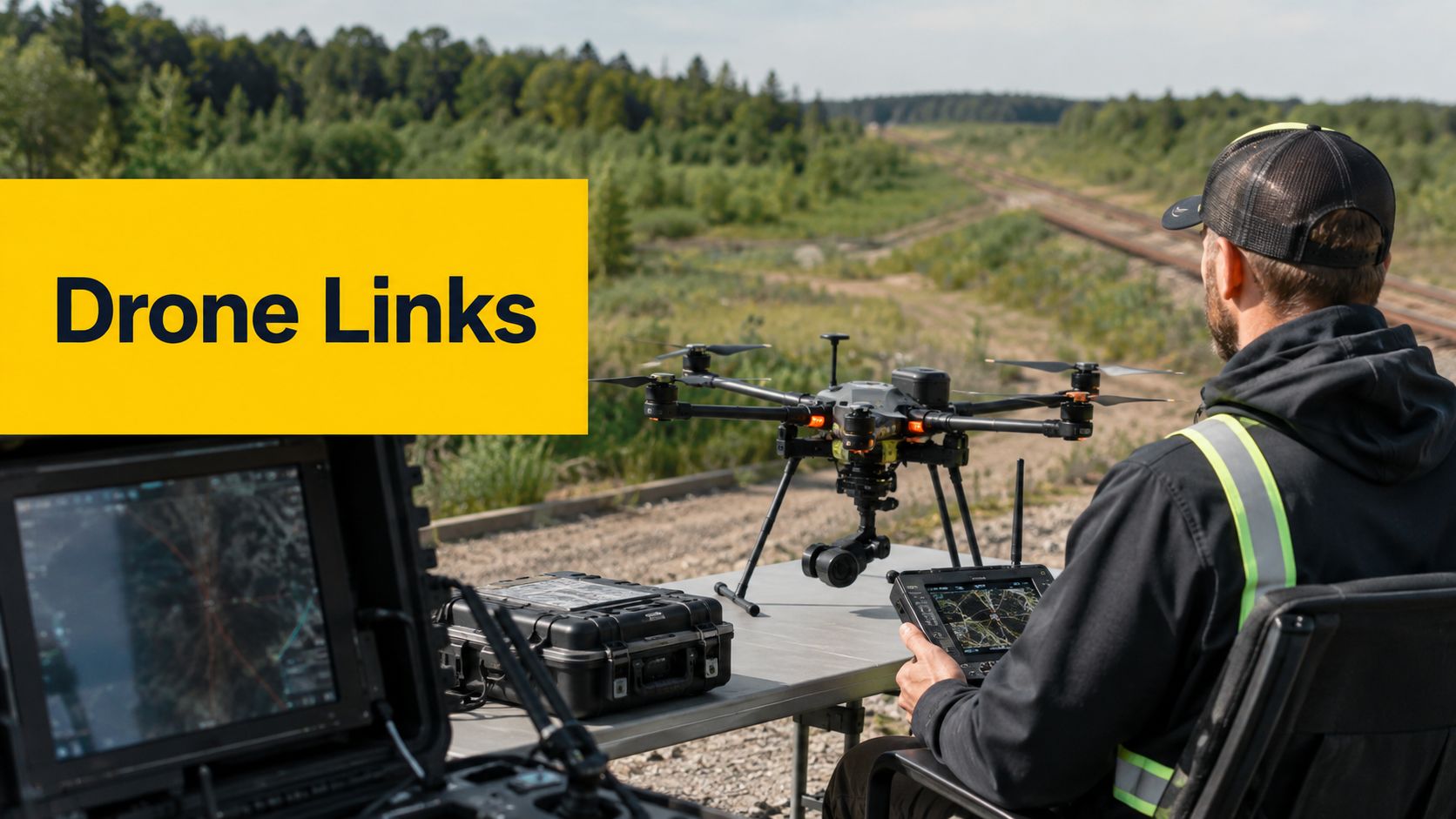
A survey crew lifts off at first light over a regional rail corridor, and the aircraft looks fine on paper. Then the video begins to stutter, telemetry drops in and out, and the pilot has to decide whether the problem is a brief fade, a mission-stopper, or the first sign of a lost-link event that will trigger the procedure in the operations manual. That moment is where drone communication systems stop being a technical buzzword and become the part of the job that keeps the mission legal, safe, and worth continuing.
A commercial pilot in Australia usually feels this pressure in the field, not in a classroom. The radios, antennas, ground station, and fall-back links all look similar until terrain, interference, or a compliance requirement forces a decision. In practical terms, the question is never just, “Can the aircraft talk?” It's, “Can it keep talking in the way CASA expects, in the environment the job creates?”
Table of Contents
- Why Drone Communication Systems Matter on a Real Australian Job
- The Three Jobs a Drone Link Must Do at the Same Time
- Communication Mediums and the Australian Operating Environment
- Frequency Bands, Range, and the Latency Trade-Off
- CASA Expectations and the AROC Link in the Safety Case
- Beyond Line of Sight, Power, and the Hybrid Link Question
- Redundancy, Security, and an Operator's Pre-Flight Checklist
- Frequently Asked Questions About Drone Communication Systems
Why Drone Communication Systems Matter on a Real Australian Job
A rail-inspection team can have the right aircraft, the right pilot, and the right visual observers, yet still lose the mission because the link can't survive the site. Vegetation, cuttings, infrastructure, and local RF congestion can turn a straightforward flight into a chain of decisions about return-to-home, repositioning the ground station, or changing to a relay aircraft. That is why drone communication systems belong in the same conversation as weather, airspace, and procedures, not in a separate technical silo.
For Australian operators, the link is carrying three jobs at once, and a failure in any one of them has a different consequence. The command path keeps the aircraft responsive. Telemetry tells the crew what the aircraft is doing. Payload data carries the job output, such as video or sensor readings. A mission can sometimes continue if payload data drops, but a degraded command link is a different matter entirely.
Practical rule: if the radio link can't support the safest decision on the ground, it isn't ready for the job, even if the aircraft still appears flyable.
That is why operations managers and pilots should think in terms of the whole communications architecture, not just “range.” The architecture has to suit the site, the task, and the approval pathway. On a routine job, a good link might only need to support local flight, but on a complex enterprise operation the same system may need to support contingency procedures, documentation, and handover between crew roles as well.
For operators mapping out their own safety framework, it helps to compare communication planning with the wider safety picture already expected around airports and controlled environments, such as the guidance in Ace Aviation's airport safety guide. The point is simple. A radio link is not an accessory. It is part of the operational decision-making chain.
The Three Jobs a Drone Link Must Do at the Same Time
A drone radio link is doing three separate tasks, and pilots often confuse them because they travel together. The first is command-and-control, or C2, the pilot's instructions to the aircraft. The second is telemetry, the aircraft's status report back to the ground. The third is payload data, which is the mission content, such as video, LiDAR, or multispectral imagery.
Command-and-control is the flight-critical stream
C2 is the equivalent of the aircraft reacting to the cockpit crew. In airline terms, it's closest to the essential instructions that keep the aircraft under positive control. If this path degrades, the crew no longer has the same authority over the mission. That is why operators treat command reliability differently from video quality or sensor throughput.
Telemetry tells the crew what the aircraft knows
Telemetry is the health and situational picture. It usually includes battery state, position, heading, and other flight-status information. Without it, the crew loses confidence in what the aircraft is doing, even if the aircraft still responds to control inputs. Poor design causes confusion on the ground, because pilots may still see a feed and assume the link is healthy when the flight data is already marginal.
Payload data is the job output
Payload data carries the work product. A mapping mission wants clean sensor data. An inspection mission wants usable video. Emergency response may need live situational awareness. These streams often need more bandwidth than C2 or telemetry, which is why link design becomes a trade-off. The radio can be optimised for crisp flight control, for rich video, or for both, but rarely at full performance on every dimension at once.
For anyone starting out, ACE READY is an entry level drone training course for beginners that covers drone fundamentals, aviation safety, CASA regulations, flight operations, and preparation for advanced Remote Pilot Licence training in Australia. That kind of foundation matters because pilots need to recognise which part of the link has failed before they can choose the right response.
A clean mental model helps on the ground. Treat C2 as the steering wheel, telemetry as the instrument panel, and payload data as the camera or sensor feed. If the system design makes those three functions compete too hard on one path, the pilot will feel it the moment the environment becomes difficult.
Communication Mediums and the Australian Operating Environment
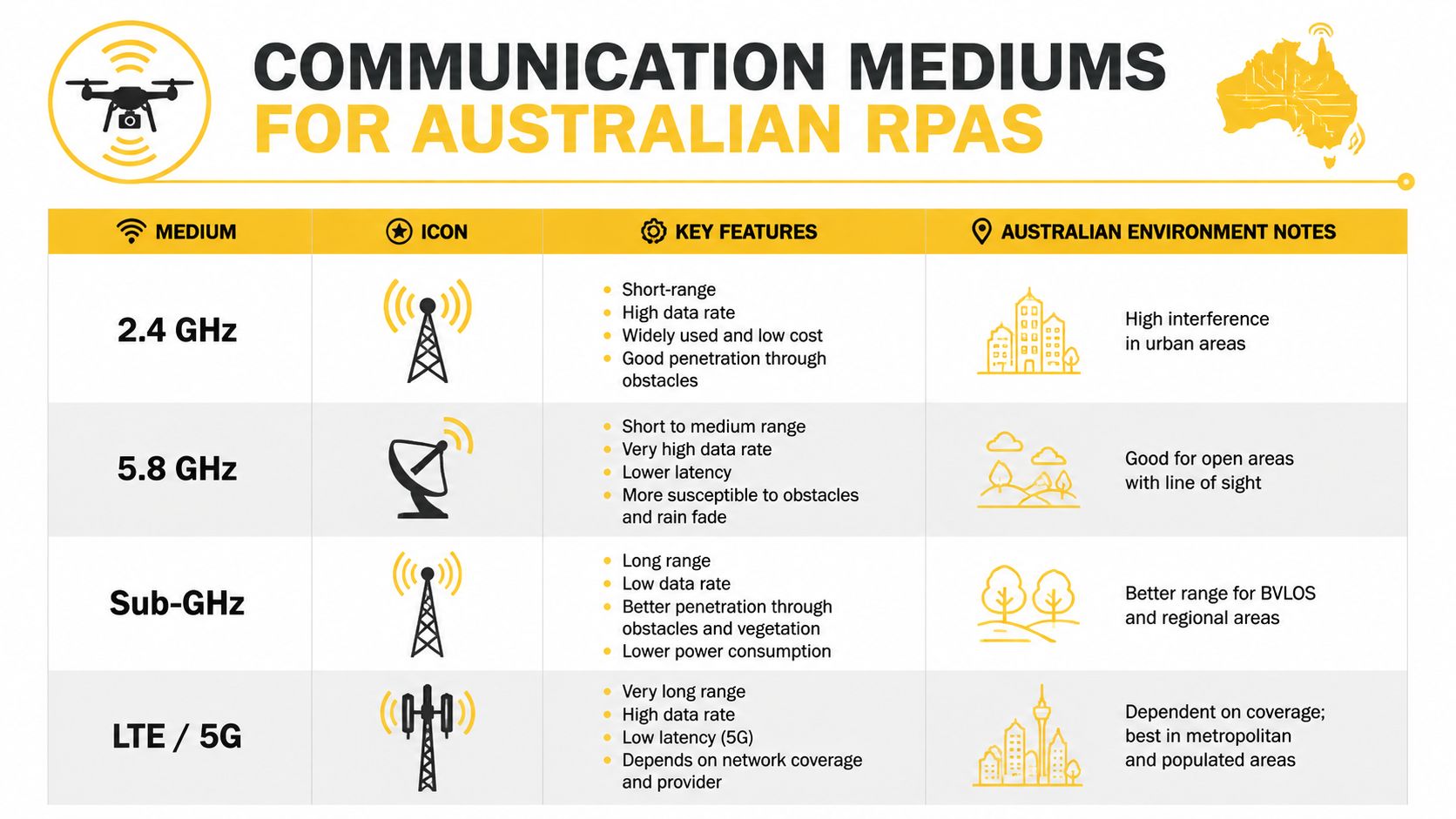
Australian operators have several communication mediums available, but the right choice depends on the site, not the brochure. A link that works well over open land may struggle in an industrial yard. A system that performs well in city airspace may be the wrong choice for a regional corridor or a remote inspection job. That is why the operating environment should drive the design.
Short-range RF links suit local work
2.4 GHz and 5.8 GHz links are common in civil RPAS use because they support short-range control and decent data rates. In Australian urban and industrial settings, though, they sit in congestion-prone bands where interference can cut into effective range and link quality. That is why operators often lean towards adaptive-spectrum or frequency-hopping behaviour in crowded RF conditions, especially around dense infrastructure or multiple active devices. The broader cellular context is worth reading through Waymap's connectivity guide, because the same basic idea applies, shared spectrum performs differently once many devices compete for it.
Sub-GHz links push further, but not faster
Sub-GHz systems are a different tool. They are used where propagation matters more than throughput, and where the pilot would rather keep a stable low-latency link than chase high-bandwidth video. Australian commercial systems commonly use 868/915 MHz-class spectrum, and that family of links is important when the mission needs better penetration through terrain or structures. The trade-off is simple. Better reach usually means less data rate.
Cellular, satellite, mesh, and tethered links each solve a different problem
LTE and 5G are useful where terrestrial coverage exists and the mission needs broad connectivity. Satellite links are relevant when terrestrial coverage isn't reliable enough for the job. Mesh or relay networking can help extend reach in obstructed areas. Tethered systems suit specialist use cases where persistent power and link stability matter more than movement. No single medium is universal, which is why enterprise operators often compare them instead of treating them as interchangeable.
An example from agriculture makes the point clearly. A regional spraying or mapping workflow may be better served by a coverage-aware architecture than by a purely local RF setup, which is why operators planning crop work often study mission fit alongside the aircraft itself, such as the discussion in Ace Aviation's agriculture drone article.
| Link Type | Typical Range | Latency | Best Suited For |
|---|---|---|---|
| 2.4 GHz | Short-range | Low | Local control, general-purpose flights |
| 5.8 GHz | Short-range | Low | Higher-data missions in cleaner RF spaces |
| Sub-GHz | Longer-range | Low | Control links where penetration matters more than payload volume |
| LTE/5G | Variable by coverage | Variable | Urban and regional jobs with usable mobile coverage |
The key judgment is environmental fit. A radio that looks strong in the office may be the wrong answer once buildings, terrain, and RF load show up on site. Australian operators get better outcomes when they choose the medium to match the mission, then test it in the actual work area.
Frequency Bands, Range, and the Latency Trade-Off
Frequency choice is one of the easiest places to oversimplify a drone link. Higher frequencies can carry more data, but they are easier to block. Lower frequencies travel better through clutter and terrain, but they usually sacrifice throughput. That is the trade-off pilots need to understand before they quote a job or approve a mission profile.
What the band choice really means
In practical terms, 2.4 GHz and 5.8 GHz are often used where the pilot wants ordinary short-range operations and a decent data experience. Sub-GHz systems are more attractive when the path is longer or the terrain is less forgiving. AU-relevant systems in the 868/915 MHz class can report ranges up to 40 km for ExpressLRS and up to 60 km for CUAV P9-class radios. Sensitivity around -110 dBm at about 115 kbps shows the core compromise, better propagation and obstacle penetration in exchange for lower throughput. Source
Measured links don't always look like marketing claims
Real-world performance can be asymmetric. One independent study reported an average round-trip delay of 94 ms, an uplink rate of 1,303 kbps from drone to ground station, and a downlink rate of 20 kbps in the reverse direction. Source That kind of spread matters because a link can be adequate for one task and still fail another. A control-heavy mission may tolerate different constraints from a live inspection stream.
A simple comparison view helps during planning
| Link Type | Typical Range | Latency | Best Suited For |
|---|---|---|---|
| 2.4 GHz | Local to short | Low | Everyday RPAS control and simple payloads |
| 5.8 GHz | Local to short | Low | Higher-bandwidth payloads in cleaner spectrum |
| Sub-GHz | Longer | Low | Better penetration, longer command links |
| LTE/5G | Coverage-dependent | Variable | Connected operations where coverage is stable |
Antenna choice affects the result as much as frequency choice. Pilots planning longer missions often review antenna geometry, gain, and placement alongside the radio itself, and a useful reference point is DigiDevice's UAV telemetry antenna choices. The practical lesson is that range is not only a number on a spec sheet. It is a relationship between frequency, terrain, antenna setup, and the data the mission needs to move.
A link that can move video doesn't automatically make a mission manageable. The pilot still has to know whether the same link can preserve control when the aircraft turns behind a ridge or a building.
The safest planning habit is to match the link to the mission, then assume the mission will expose its weakest point. That mindset avoids the common mistake of assuming a high-data radio is also a high-resilience radio.
CASA Expectations and the AROC Link in the Safety Case
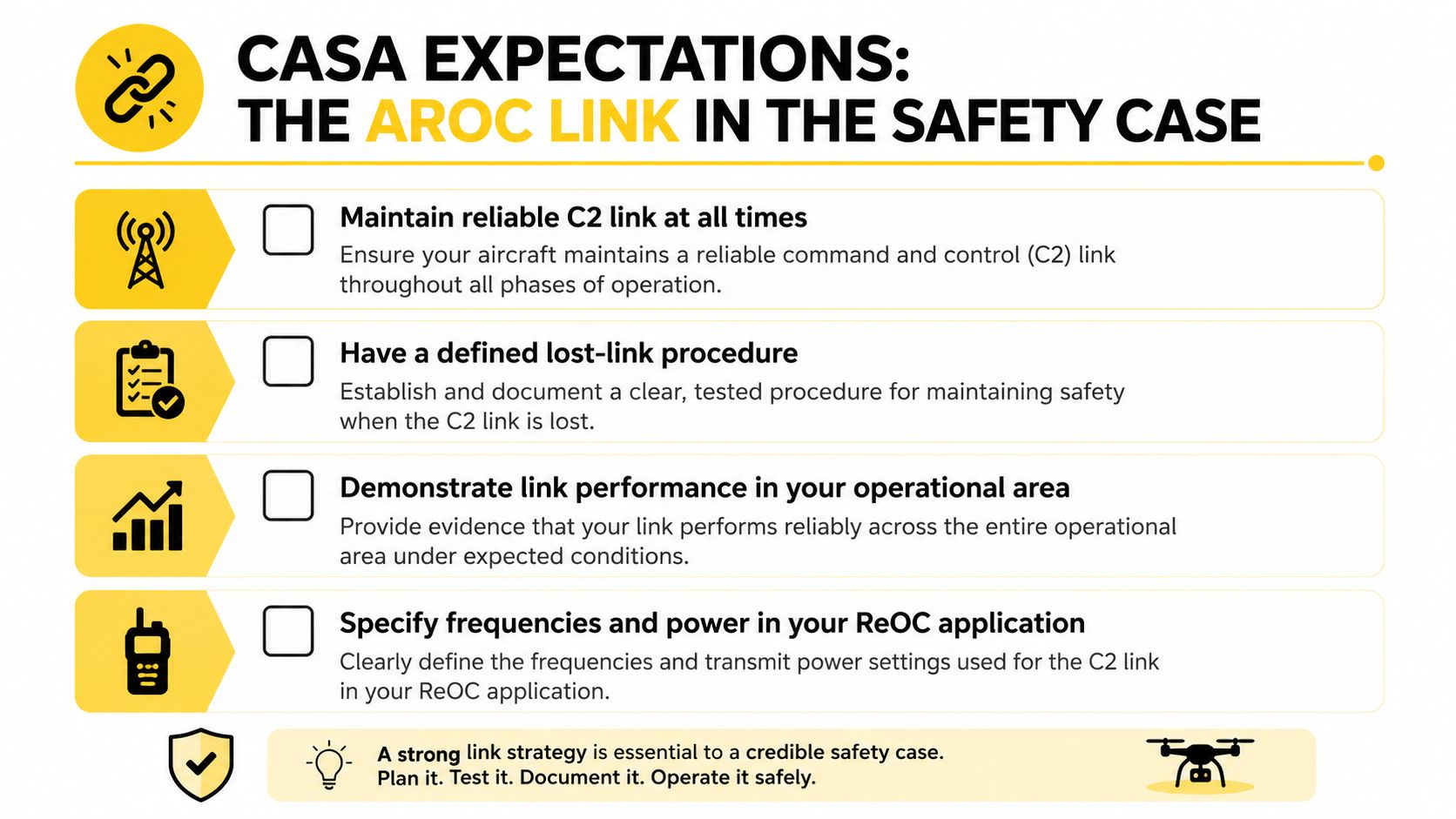
CASA's focus is not “which radio looks modern.” The regulator's focus is whether the operation can be conducted safely and in line with the approved operating framework. For remotely piloted aircraft operations, communication reliability sits inside the safety case, especially when the mission moves into controlled airspace proximity or BVLOS territory. In those scenarios, the operator has to show that the link is fit for purpose, not just technically active. Source
Why the AROC matters when radio communication is required
When a remote pilot needs to use radio communication outside standard operating conditions, an Aeronautical Radio Operator Certificate (AROC) becomes relevant because the communication itself has to follow aviation-grade voice procedures and radio discipline. That distinction matters. Consumer-style radio habits are not enough when the operation depends on clear, standardised, aviation communication. The same discipline is expected in the way crews talk to one another on the ground station and in the way they report and manage link status.
What CASA-aligned documentation usually needs to show
The communication architecture should be described in plain language in the ReOC safety case and operations manual. That means naming the frequencies, describing the intended control path, and showing how the operator will deal with lost-link events. It also means explaining how communication reliability is demonstrated in the actual operating area, not only in a lab or a demonstration flight.
For operators preparing that documentation, Ace Aviation's ReOC guide is a practical reference point because it places communications inside the wider approval picture rather than treating it as an afterthought.
The language operators should be ready to use
Operators do better when they talk about C2 reliability, telemetry continuity, lost-link procedures, and operational area testing. Those phrases help a client or regulator understand that the team has thought through failure modes. A vague promise of “strong signal” does not do the same job.
If the operations manual cannot describe what the aircraft will do when the link degrades, the communications plan is not finished yet.
For teams building competence around radio operations and compliance, courses such as AROC, Remote Pilot Licence, and related enterprise training sit naturally alongside the technical planning work. The point is not to add paperwork. It is to make sure the communications plan can stand up inside the approval process that governs real Australian jobs.
Beyond Line of Sight, Power, and the Hybrid Link Question
BVLOS is where communication planning gets harder, because the terrain stops being a clean diagram. Hills, buildings, and vegetation create shadowing that simple line-of-sight drawings do not fully capture. Recent measurements showed off-the-shelf mmWave drone links reaching only about 30 m, with throughput falling to zero by 33 m vertical distance in one campaign. Source That is a sobering reminder that high-bandwidth communications can be far less reliable than many overviews suggest.
Why real terrain changes the answer
Australian BVLOS and enterprise work often happens where the network challenge is not raw speed, but link continuity across obstructed paths. In sparse regional areas, the pilot may have plenty of open sky and still face a poor control path because the aircraft is moving behind terrain or losing the best RF geometry. The practical issue is maintaining command-and-control while preserving enough payload capacity to complete the task. For a deeper CASA and operational context, the BVLOS overview at Ace Aviation's BVLOS page sits in the right place in the planning chain.
Power is part of link design
More capable datalinks cost energy. Compact SDR-style mesh or video systems in the market operate at roughly 3 to 7 W typical, with about 6 W at the airborne end for 20 MHz-class links. Source That matters because every increase in bitrate or spectral bandwidth raises onboard power draw and thermal burden, which directly affects endurance on small multirotors. The link is never just “better.” It also asks more from the aircraft.
Why hybrid architectures make sense
The strongest operational answer is usually a hybrid communication architecture, not a single link. Cellular can handle one part of the mission, relay or mesh can help in obstructed areas, and satellite can fill coverage gaps when terrestrial options disappear. Research on drone-assisted and satellite-enabled communications points in the same direction, different layers solve different problems, and handover remains a technical challenge in mobile networks. Source
A hybrid design also forces better priority planning. The aircraft should know which stream gets protected first, which stream can be compressed, and which stream can pause during degradation. That is the difference between a mission that degrades gracefully and one that drops away when the environment changes.
Redundancy, Security, and an Operator's Pre-Flight Checklist
A real RPAS mission can look fine on the bench and still fail in the air if the communications plan only has one way to talk, one way to fail, and one person assuming the other link will save the day. A safer setup gives the aircraft more than one path, so a single fault does not end the job. That is the same logic a flight operations team uses in an airline cockpit, where the radio, the data link, and the crew calls all have defined roles and no one confuses convenience with assurance.
What a good redundancy plan looks like
A good plan separates the critical path from the optional one. Control gets priority first, because if the pilot cannot command the aircraft, the rest of the mission stops being meaningful. Telemetry follows, because altitude, battery state, and link health help the pilot make decisions, and payload data can often be reduced, delayed, or rerouted if the procedure allows it.
That separation matters in a CASA safety case because it shows how the operation remains controllable if one service degrades. Dual datalinks, automatic failover, and a secondary command channel do not make a mission immune to failure, but they lower the chance that one fault becomes a lost aircraft or an unapproved procedure. For a full breakdown of emergency procedures, see the drone pilot emergency handbook.
Security is part of the radio plan
Encryption and authentication help protect the link from spoofing, accidental interference, and simple operator error. In Australian conditions that means checking what the system does if another device is nearby, if the channel is crowded, or if the wrong controller is paired before launch. A radio link is like a cockpit intercom, it only helps if the right people hear the right instructions, and the wrong voice never gets a turn.
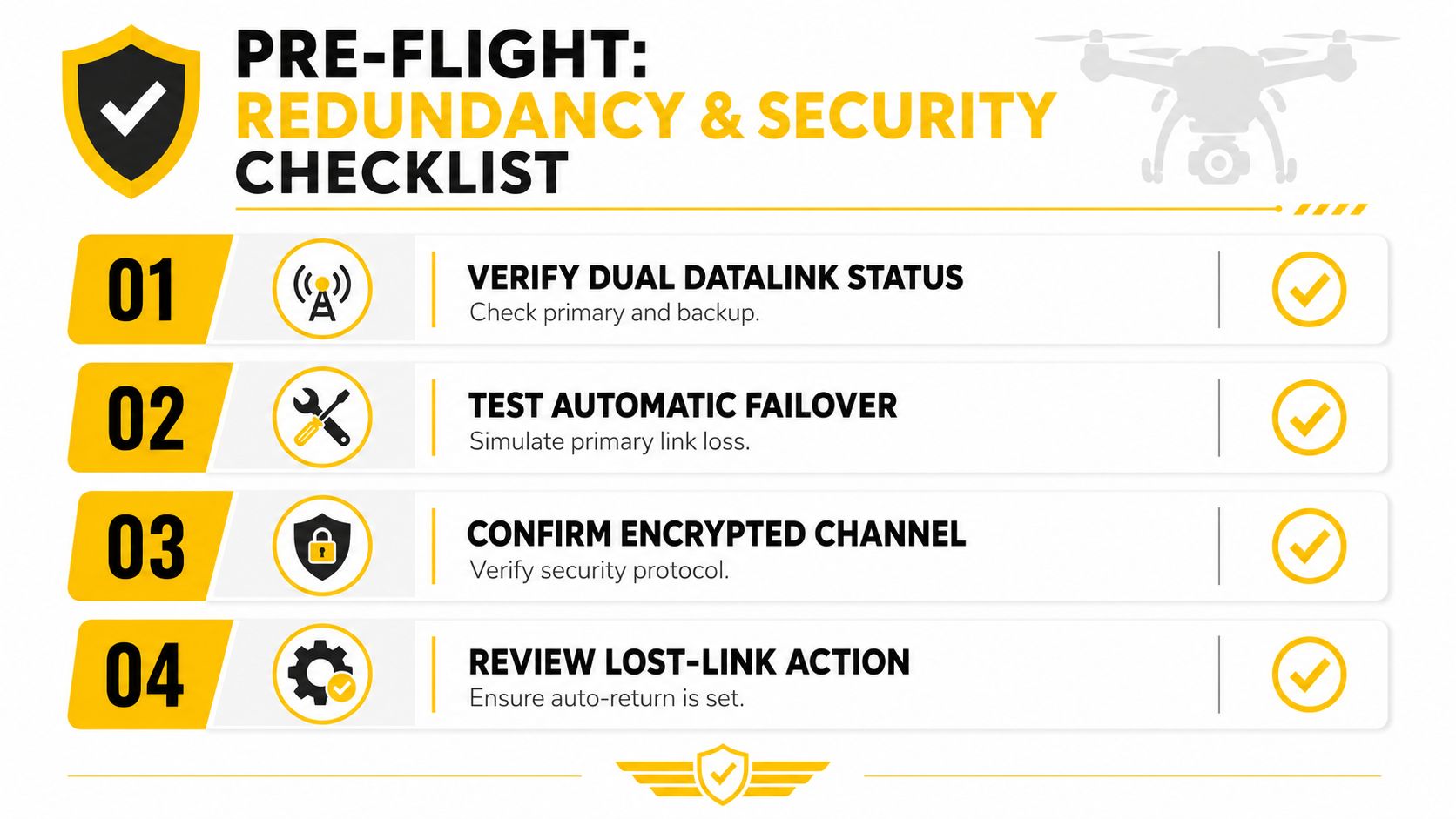
A pre-flight radio routine worth standardising
- Verify dual link status. Check that the primary and backup paths are both live before power-up.
- Test automatic failover. Simulate a primary link loss and confirm the aircraft responds in the expected way.
- Confirm encryption settings. Make sure the channel security matches the approved operating setup.
- Review lost-link action. Confirm return, loiter, or landing logic before the aircraft leaves the ground.
The same discipline shows up in network operations. The complete guide to device observability at UTMStack is useful here because it reinforces a simple habit, watch link health before the failure becomes visible to the pilot. The point is not software preference. The point is to make drift, packet loss, or a weak backup path visible early enough for the crew to act.
What the crew should be ready to call out
The best crews speak the handover points before launch. They know which link is primary, who is watching the backup, and what event tells the pilot to stop pushing the mission. That is not paperwork theatre. It is how a remote operation avoids the dangerous gap between technical capability and actual crew awareness.
If a team wants that structure built into training and SOPs, Enterprise Drone Training, Corporate Drone Training, and ReOC Consulting are the kinds of services that fit the job because they focus on operational structure, not just aircraft handling. The value is in making sure the radio architecture and the safety case line up before the first flight.
Frequently Asked Questions About Drone Communication Systems
When is an AROC required?
When radio communication is needed for operations outside standard conditions, especially where aviation voice procedures matter. It is the right credential for the communication side of a regulated mission.
Are consumer drone links good enough for commercial work?
Sometimes for short, simple jobs. They are usually not enough on their own when the operation depends on reliable command, telemetry, and payload data in difficult terrain.
Does satellite communication solve BVLOS by itself?
No. Satellite can fill coverage gaps, but most Australian BVLOS planning is stronger when it uses a hybrid architecture with clear handover rules.
What should be written into a ReOC safety case?
The frequencies, the link type, the lost-link action, the testing method, and the way reliability will be demonstrated in the operating area.
Where should a new pilot start?
A beginner should build a foundation in drone safety, CASA rules, and flight operations before moving into advanced radio and enterprise planning.
Ace Aviation Aerospace Academy teaches the radio, compliance, and operational thinking that sit behind commercial RPAS work in Australia. If this topic matters to a flight team, a business, or a ReOC pathway, visit Ace Aviation Aerospace Academy to review training that connects drone communication systems, aviation safety, and CASA-aligned operations.