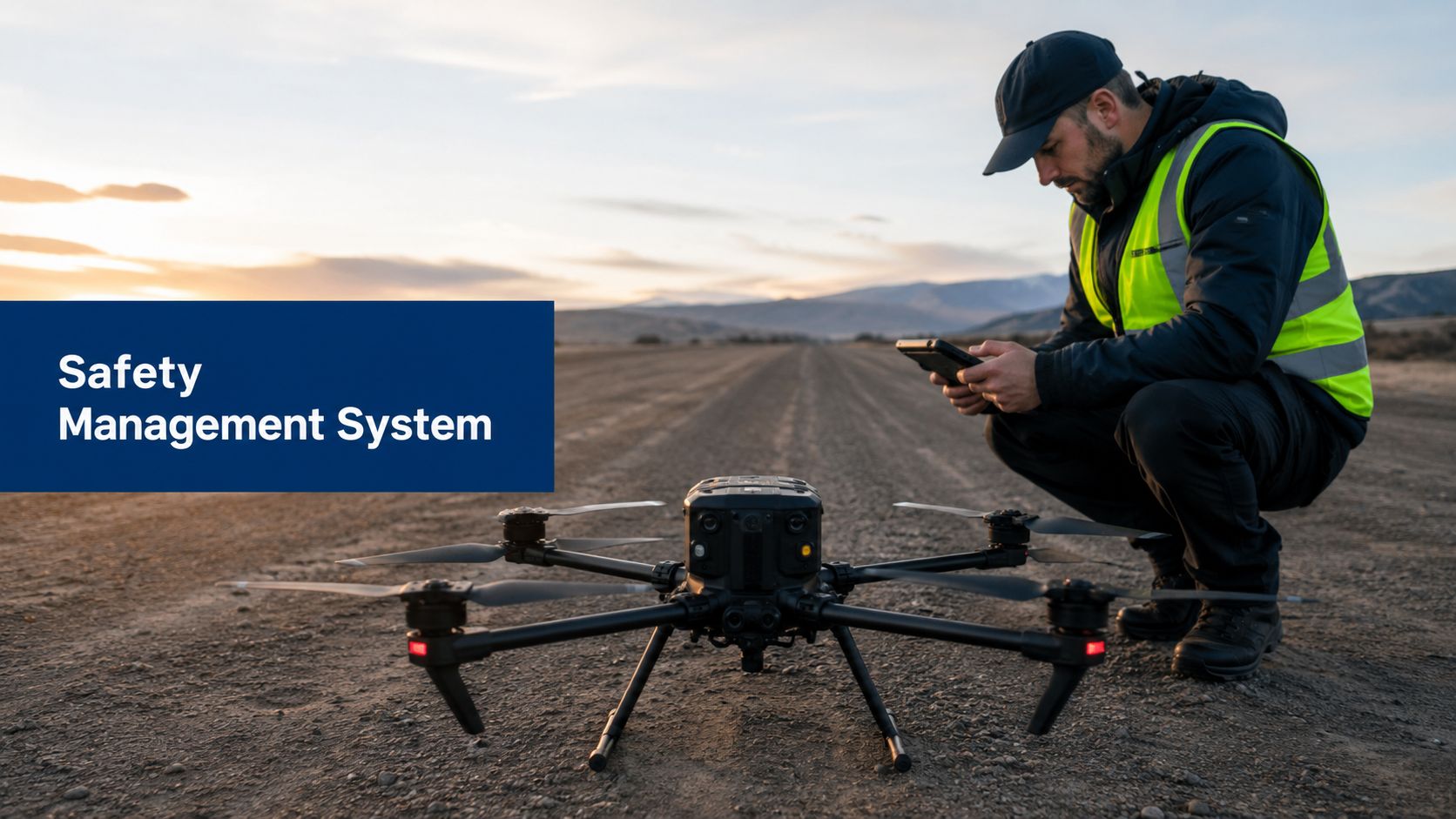
A new commercial job lands in the inbox, and the client asks for a safety plan before the aircraft leaves the ground. The graduate with a fresh RePL quickly realises that a tidy checklist is useful, but it's not enough when the job has changing sites, contractor crews, a tight turnaround, and a client who wants proof that safety is being managed properly. That's where a safety management system becomes more than paperwork, it becomes the operating discipline that holds the job together.
For small Australian drone businesses, the confusion usually starts here. A flight manual explains how to operate the aircraft, a safety plan covers the immediate job, but an SMS ties the whole business together, so hazards are found, controls are tested, lessons are recorded, and the next mission starts from a better position than the last one. CASA's safety language, ICAO's model, and day-to-day ReOC operations all point to the same truth, safety has to be built into the business, not added after something goes wrong.
Table of Contents
- Why Every Commercial Drone Operator Needs an SMS
- How CASA Defines a Safety Management System
- The Four Core Components of an SMS Explained
- What CASA Expects Inside a ReOC Safety Management System
- From Paper SMS to Working SMS in a Small Drone Business
- Training, Audits, and Incident Reporting in Practice
- Adapting Your SMS for Emerging Drone Operations
- Getting Started and Frequently Asked Questions
Why Every Commercial Drone Operator Needs an SMS
A RePL holder can get through a lot with good habits, a pre-flight checklist, and a calm crew. Then the first serious commercial job arrives, and the client wants evidence, not reassurance. They want to know who owns the risk, how hazards are recorded, what happens after a near-miss, and how the operation will prove it is learning from each job.
That's the gap a safety management system closes. It turns safety from a personal habit into a repeatable business process, so decisions don't depend on whoever happens to be on site that day. For a small drone business, that matters because work changes quickly, subcontractors come and go, and mission profiles can shift from a simple roof inspection to a live site with workers, vehicles, and public exposure.
Why a checklist isn't the same as an SMS
A checklist confirms that a task got done. An SMS asks whether the task was safe in the first place, whether the control worked, and whether the result needs to change next time. That distinction matters when a business is trying to show clients, insurers, and regulators that safety is being managed as a system, not as a set of one-off reactions.
The practical difference is easy to see. A flight manual can tell a pilot how to arm the aircraft, but it won't tell the business how to record a repeated battery issue, update a contractor briefing, or review whether a site access process is failing. A working SMS does all of that because it links hazard identification, risk controls, reporting, review, and improvement.
Practical rule: if the same problem can happen twice, it needs a system response, not just a verbal reminder.
For readers who are still building the basics, an entry-level pathway such as Tutorbase can help with drone operations, flight safety, aviation theory, and practical skills for students beginning the journey toward becoming licensed drone pilots in Australia. That foundation matters, but the operational test comes when a business has to manage safety across multiple jobs, not just one training flight.
A useful next step is to check how the operation fits the rules for excluded category drone operations. The same aircraft can create very different safety questions depending on the job, the site, and who else is in the area.
How CASA Defines a Safety Management System
A small drone business usually feels the need for an SMS when the work starts changing from job to job. One day it is a suburban roof inspection, the next it is a contractor crew working near power lines, and then it is a site with traffic, bystanders, or weather pressure. CASA treats a Safety Management System as the framework that keeps those risks visible, managed, and checked, so the operation is not relying on memory, habit, or a few good pilots.
For a ReOC holder, that matters because CASA is looking for more than a folder of procedures. The regulator wants to see how the business identifies hazards, assigns responsibilities, records issues, reviews controls, and improves the way it operates. A working SMS shows the organisation's safety thinking in daily work, not just in a manual sitting on a shelf.
The regulatory shift became formal on 1 January 2020, when CASA made Safety Management Systems a requirement for major Australian aviation operators, including commercial aeroplane and helicopter operators conducting regular public transport services, plus certain charter and aerodrome operators. That date matters because it shows how safety management moved from best practice into a compliance expectation for many aviation businesses in Australia. CASA's SMS overview explains that shift in plain regulatory terms.
How ICAO's model fits underneath CASA's framing
CASA's approach sits on top of the ICAO model, which is where the structure comes from. ICAO's Safety Management Manual sets out four functional components, Safety Policy, Safety Risk Management, Safety Assurance, and Safety Promotion. ICAO's Safety Management Manual and Chapter 9 show how those pieces fit together, from leadership commitment through to hazard reporting, monitoring, and training.
For a small Australian drone business, that structure only becomes useful when it is tied to real work. A chief pilot, director, or lead contractor may wear several hats, so the SMS has to work even when there is no dedicated safety officer. One person might approve the job, another might brief the crew, and a contractor might be the one who spots a risk on site. The system has to catch that information and turn it into action.
That is why many operators build SMS habits before they are formally required to do so. Businesses working with councils, infrastructure clients, insurers, or higher-risk missions often need a clear way to show that safety is being managed across changing crews and shifting task profiles. A training pathway such as Tutorbase can help new operators understand the language, records, and behaviours that support that kind of system in practice.
For ReOC holders trying to line up SMS ideas with Australian operating obligations, the guide on ReOC in Australia is a useful reference point. It helps separate the formal rule set from the practical work of keeping a small drone business safe and auditable.
The Four Core Components of an SMS Explained
A small drone business usually meets the four core components of an SMS through everyday decisions, not through theory on a page. The system has to show who is making the safety commitment, how hazards are being handled on the job, how the controls are checked after the work is done, and how pilots, observers, and contractors keep speaking up when something looks wrong.
A new RePL graduate often expects an SMS to feel like a formal manual. In practice, it works more like the job folder, the pre-flight brief, the incident register, and the follow-up conversation all tied together. That is the gap ReOC holders need to close, especially when crews change from job to job and the safety lead may also be the person quoting the work, briefing the team, and reviewing the risk paperwork. For a practical view of that operator setup, the guide to ReOC in Australia helps place the SMS inside the operating structure.
What each component looks like in the field
Safety Policy is the commitment layer. In a small business, that can be a signed one-page statement from the chief pilot or director that sets expectations for reporting, training, and stop-work authority. It tells staff and contractors that safety sits inside the operating model, not beside it as an optional extra.
Safety Risk Management is the hazard log and the control process behind it. For drone operators, that can cover battery fires, geofence failures, bystander proximity, radio interference, launch and recovery hazards, and site-specific issues like power lines or livestock. If the job changes, the control has to change with it.
Safety Assurance is how the business checks whether the controls still work. That means audits, incident reviews, trend checks, and follow-up on corrective actions. A mitigation that only exists in a document and never gets tested against actual flights is not doing its job.
Safety Promotion covers toolbox talks, pre-flight briefings, reporting culture, and the reminder material that keeps the system active. Safety gets stronger when crews can raise issues early without fear that a small mistake will be treated like a personal failure. It also helps when contractor crews hear the same message as full-time staff, since mixed teams can otherwise drift into different habits on the same site.
| Component | What It Does | Drone Operation Example | Key Output |
|---|---|---|---|
| Safety Policy | Sets direction and responsibility | Chief pilot signs a short safety commitment | Clear accountability |
| Safety Risk Management | Identifies and controls hazards | Hazard log includes battery, airspace, and bystander risks | Documented controls |
| Safety Assurance | Checks whether controls work | Internal audit reviews logs and corrective actions | Evidence of effectiveness |
| Safety Promotion | Builds awareness and reporting | Pre-flight briefing and crew feedback loop | Shared safety culture |
A business that is still building these habits may first come across the topic through ACE BRONZE, which introduces flight safety and practical drone skills. The SMS task is to turn those habits into repeatable business controls that still hold up when the job is rushed, the crew changes, or a contractor arrives on site for the first time.
A useful benchmark is whether a new contractor can follow the system without being coached through every step. If they cannot, the SMS is still too vague. That same test applies in other regulated work too, including the top DOT compliance solutions for trucking, where procedures only help when the people doing the work can use them under pressure.
What CASA Expects Inside a ReOC Safety Management System
For Australian regulated operators, the SMS has to follow a risk management approach. The guidance says operators must identify, assess, control, monitor, review and revise controls, which is the part many people skip when they only build a static document. That cycle matters because a drone operation changes with the site, the weather, the client, the team, and the equipment.
The same guidance also identifies six mandatory requirements that the SMS must contain: managing interface agreements, security management, emergency management, health and fitness, drug and alcohol, and another prescribed matter under the national regulations. For a ReOC holder, that list is a reminder that the SMS is not just about flight safety. It also has to deal with how the operation interfaces with other parties, how emergencies are handled, and how fitness for duty is managed. CASA-aligned safety management guidance sets out that framework.
How the risk cycle maps to a drone job
A site survey is the starting point for identify. The operator checks obstacles, airspace constraints, access points, people on site, comms, and likely failure modes. Assess means deciding which hazards are most serious and which are most likely to happen on that specific job.
Control is where the operation chooses what to do about the risk, such as changing launch position, assigning a spotter, revising the flight path, or pausing the job if the site changes. Monitor means checking whether those controls are being used. Review and revise happen after the mission, when the team looks at what worked, what didn't, and what needs to change for the next flight.
A broader compliance mindset is useful here, and external systems in other sectors can be helpful as a contrast. For instance, top DOT compliance solutions for trucking are built around structured records, checks, and accountability, which is a similar logic to aviation SMS even though the operating environment is different.
For businesses using formal training pathways, ACE GOLD combines RePL training, ReOC support, practical flight training, aviation compliance, and business readiness for commercial drone operations. That kind of program can align well with operators who need their training, operations, and compliance thinking to sit inside one framework.
From Paper SMS to Working SMS in a Small Drone Business
A thick SMS binder can look impressive and still fall apart on the first real job. The problem is usually not the policy document, it is the gap between what the business has written and what the crew does when the phone rings, a contractor turns up late, or the site manager changes the scope halfway through the day. A working SMS is the one people can use, without hunting through folders for the right form every time.
What a usable system looks like
In a small Australian drone business with no dedicated safety manager, the system has to stay simple enough to hold up during busy weeks. That often means a shared hazard register, short weekly safety stand-ups, a clear escalation path, and a routine for closing out actions. The useful point is that an SMS is a control structure, not just a stack of documents. The paperwork matters, but only because it supports the feedback loop that keeps the operation honest.
A crew can make that loop visible with ordinary habits. Contractor-heavy teams need a reporting channel that works even when the roster changes, so a missed callout, a battery fault, or a near-miss can be raised quickly and reviewed before the next job. More forms do not automatically make the business safer. The core question is whether frontline reporting, feedback, and corrective action all happen in daily operations, not just after something goes wrong.
A practical training rhythm helps those habits stick. For businesses building team learning around induction, refreshers, and role-specific development, an employee training plan 2026 can give structure outside aviation, and the same idea carries into SMS practice. New people need to know how to report hazards, who can stop a job, and where the current controls are kept. A good training process makes that knowledge part of the work, rather than something people try to remember under pressure.
A small operation can keep this manageable with a few repeating habits.
- Weekly stand-up: the crew checks recent hazards, open actions, and any site changes.
- Shared hazard register: one live document records issues, controls, and close-out status.
- Monthly trend review: the operator looks for repeat issues, not just isolated incidents.
- Escalation path: the team knows who halts work, who signs off changes, and who reviews the follow-up.
For operators who want a structured entry pathway into professional drone work, ACE SILVER covers RePL training, classroom instruction, practical flight training, CASA compliant certification, AROC, and aviation English proficiency. That kind of training matters because a working SMS depends on people who can carry the rules into the job, speak clearly when conditions change, and feed what they see back into the system.
Training, Audits, and Incident Reporting in Practice
A spraying operator working across multiple farms rarely has the luxury of a perfect schedule. Staff change from job to job, weather shifts quickly, and a mission can move from routine mapping to a live field operation with equipment, workers, and access issues all in the same day. Training, audits, and reporting need to work as a cycle, not as a once-a-year compliance event.
A realistic operating rhythm
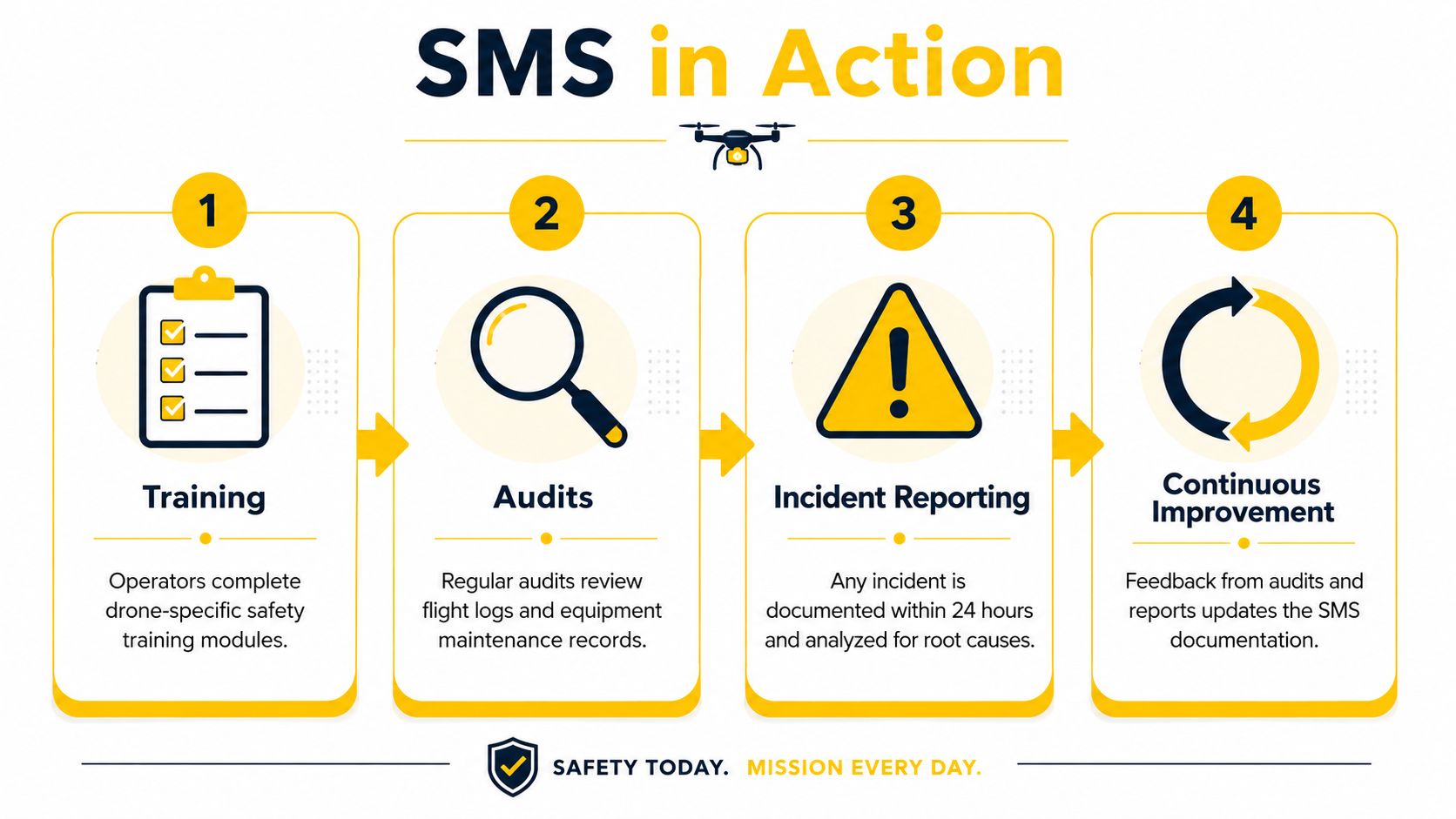
A new team member should receive SMS induction on day one, not after the first incident. That induction covers who can stop a job, how hazards are reported, what counts as a near-miss, and where the site-specific controls live. The operational briefing before each mission then narrows that down to the actual job, so the crew is talking about the hazards in front of them, not a generic checklist.
Audits are the next piece. In a small drone business, an audit does not need to be bureaucratic to be useful. It can check whether logs are complete, maintenance records are current, briefing notes are being used, and corrective actions are closed. If the same issue keeps appearing in audit findings, the business should treat that as a weak control, not a paperwork problem.
Incident reporting works best when people can report without guessing how they will be judged. Accountability still matters, but so does a channel that lets a crew member raise a near-miss before it becomes a repeat event. Safety review meetings turn those reports into decisions, not just records, and they help the operator see whether the control worked in the field.
A practical training pathway for this is ACE SILVER, which includes RePL training, classroom instruction, practical flight training, CASA compliant certification, AROC, and aviation English proficiency. The larger lesson is broader, training has to match role, task, and risk. The same applies whether the crew is on a spraying contract, an infrastructure inspection, or a rural mapping job.
The internal emergency resource on drone pilot emergency handbook for ANCA, CANCA, ATSB also fits here, because incident readiness and reporting only work when the crew knows what to do in the first minutes after something goes wrong.
The link between training and improvement is straightforward. Training tells people what good looks like. Audits show whether the process is staying on track. Incident reporting shows what the documents missed. Corrective action closes the loop so the same weakness does not keep returning.
Adapting Your SMS for Emerging Drone Operations
Drone operations are changing faster than a lot of generic SMS templates. Beyond visual line of sight work, agricultural spraying, mixed manned-unmanned environments, and autonomous or digital workflows bring a different hazard profile to the table. The risk is no longer just conventional workplace injury, it can also include airspace integration, geofencing failures, battery and payload issues, radio communication problems, and contingency planning for remote or rural sites.
Why the evidence needs to change with the mission
A static SMS struggles when the operation becomes more technical. A business that once flew simple visual jobs over predictable sites may now need new safety performance indicators, different reporting fields, and fresh controls for remote command links or automated functions. The important question is not whether the business has an SMS, but whether the evidence inside it matches the actual operation.
That is why management review has to ask whether the operation has changed faster than the SMS. If the crew is flying new missions, working in different airspace, or relying on more digital systems, the hazard log and assurance process need to change with it. The same principle applies whether the shift is into spraying, long-range missions, or work near helicopters, airports, or other sensitive operating environments.
An example of a practical airspace-aware resource is drone safety guide for airports and HLS in Australia, which helps frame how site risk can change when manned aviation is nearby. That's exactly the kind of change that an SMS needs to capture before the job begins.
Management review question: has the operation changed faster than the SMS?
For operators dealing with emerging mission types, the useful habit is to treat every new profile as a test of the system. If the business can't explain how it will manage changed comms, altered launch sites, or new emergency pathways, the SMS is still too generic. The goal is not more complexity, it's better fit.
Getting Started and Frequently Asked Questions
A small drone business can begin with five practical steps. Write the policy, build the hazard register, set up reporting, schedule the first audit, and plan the first management review. That sequence gives the business a working backbone before it tries to polish the document set.
For operators choosing the right training or compliance pathway, Ace Aviation Aerospace Academy offers RePL training, AROC, ReOC consulting, and corporate drone training that can sit alongside SMS development. A licence pathway tool such as licence finder can help match the operator's role to the right starting point.
A few rules keep the process realistic. Keep reporting simple, make responsibilities visible, and review the system after actual missions rather than waiting for a major incident. If the crew cannot use the SMS on a busy Friday, it will not protect the business on a difficult Monday.
A ReOC holder often needs a practical answer, not a theory lesson. A contractor crew can change from week to week, the mission profile can shift, and the same paperwork still has to support the actual job. That is why the first SMS draft should read like an operations manual, not a compliance brochure.
FAQ
Is a safety management system legally required for every drone operator in Australia?
Different operators face different obligations, but regulated aviation operations have clear SMS requirements. CASA made SMS mandatory for major aviation operators from 1 January 2020 in the sectors described earlier, and many ReOC holders still adopt SMS principles because clients and risk profiles often demand them.
Can a small drone business use a template and still be compliant?
A template can be a starting point, but it only works if it matches the actual operation. If it does not reflect the crew, missions, hazards, and review cycle, it is just paperwork.
How does SMS interact with WHS obligations?
SMS supports WHS by turning hazards, controls, and review into a formal process. The systems overlap, but SMS is the aviation-style method for keeping safety controls active and checked.
What's the fastest way to tell if an SMS is working?
If staff report hazards, supervisors close actions, and mission briefings change when the risk changes, the system is probably functioning. If the documents are tidy but the same issues keep coming back, it is a paper SMS.
Should a RePL graduate build an SMS alone?
A graduate can start one, but a practical ReOC operation usually needs input from the chief pilot, contractor leads, and the people doing the jobs. Safety systems work best when the people closest to the risk help shape them.
Does training come before SMS, or after it?
Training and SMS should develop together. The operator needs enough structure to manage risk, and the crew needs enough training to use the system properly.
For a simple way to match the right starting point to the operation, use the licence finder as a first check before building the rest of the compliance pathway.
Ace Aviation Aerospace Academy supports Australian drone operators who need more than flight skills, it helps them build the compliance habits that sit behind a working safety management system. For RePL, AROC, ReOC consulting, and corporate drone training, visit Ace Aviation Aerospace Academy and choose the pathway that matches the operation's risk and regulatory needs.