Meta description: Explore drone licence australia pathways for solar cleaning, costs and commercial skills. Train with Ace Aviation and start today.
Short direct answer
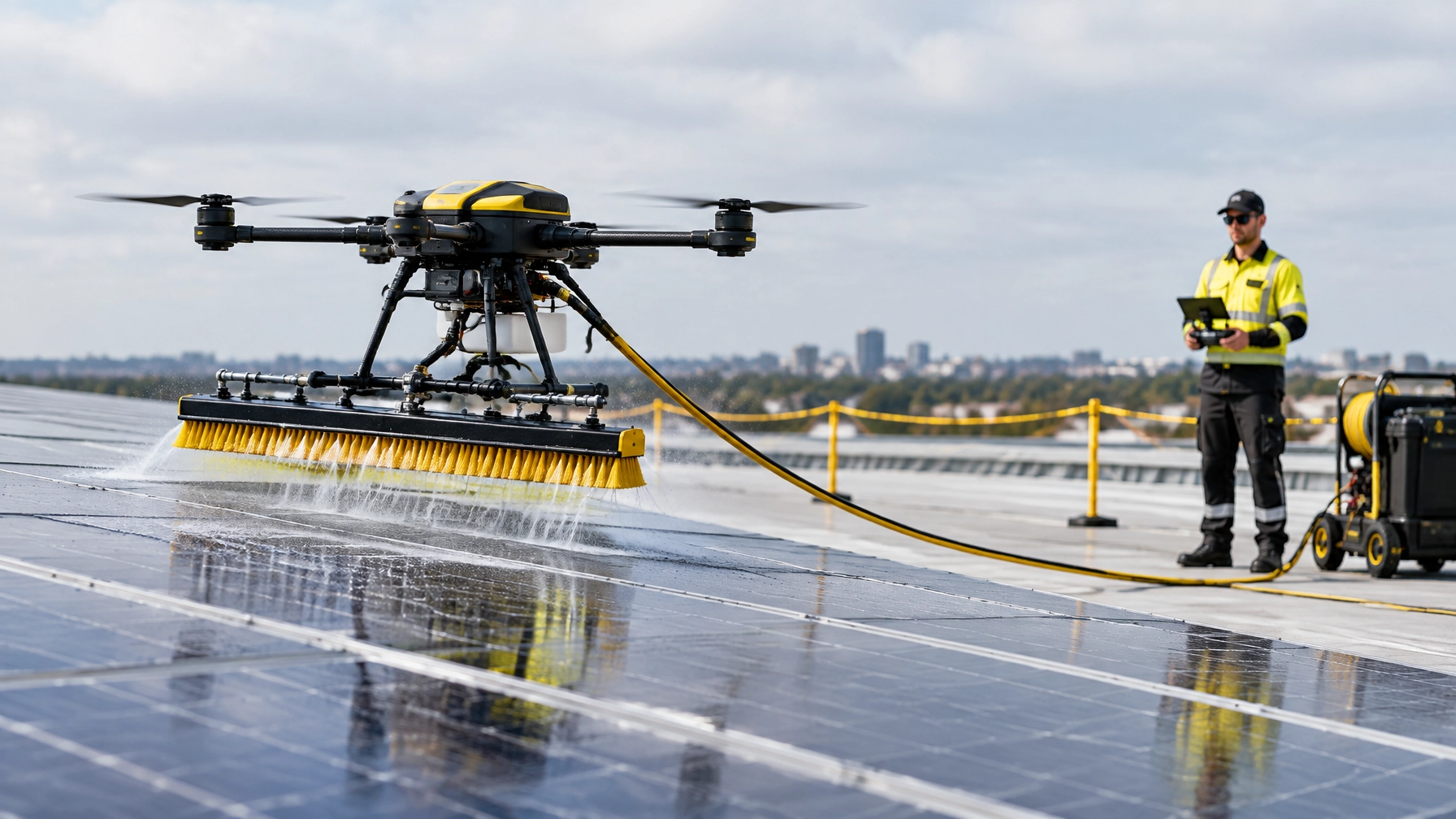
A solar panel cleaning drone can spray filtered water, use soft-contact brushes, map an array and capture visual or thermal data. However, commercial work needs more than aircraft control. A RePL, suitable aircraft category training, site risk management, insurance and an approved operating framework are essential.
Why solar panel cleaning is becoming a serious drone industry
Solar panels collect dust, pollen, bird droppings, salt and industrial residue. Over time, this soiling blocks light and reduces energy production.
The effect is not the same at every site. A clean coastal rooftop may perform well for months. A dusty agricultural or mining-adjacent site may lose useful output much sooner. Hot weather, dry winds and spring pollen can also create a short cleaning window.
That is why solar cleaning is moving from occasional maintenance to a data-led service. Asset owners now want three things:
- Safe and efficient cleaning.
- Evidence that the work was completed.
- Information about faults, hotspots and underperforming strings.
A solar panel cleaning drone can support all three. It may also work alongside ground robots, soft-brush systems and traditional access crews.
The opportunity extends beyond solar. The same commercial cleaning drone market includes:
- Commercial rooftop solar arrays.
- Utility-scale solar farms.
- High-rise glass and façade cleaning.
- Warehouses and industrial buildings.
- Stadium roofs and transport infrastructure.
- Mining and remote-energy assets.
For a new operator, the key question is not simply, “Can I fly a drone?” It is, “Can I deliver a compliant, repeatable maintenance outcome?”
What a solar panel cleaning drone actually does
A cleaning drone is an aircraft and payload system. It is not simply a camera drone with a hose attached.
The aircraft must manage weight, water pressure, hose drag, wind, battery use and surface distance. It must also keep the operator, workers and the property safe.
Pressurised water-fed nozzles
Many systems use one or more nozzles to distribute water across the panel surface. The spray pattern must be controlled. Excessive pressure can damage seals, frames or coatings.
Panel cleaning is different from façade pressure washing. A method suitable for concrete or brick may be unsuitable for photovoltaic modules. Professional operators should follow panel manufacturer guidance and use the lowest effective pressure.
Soft-brush contact systems
Some cleaning aircraft use a soft brush or contact head. This can help remove bonded dust, pollen and bird residue that a light spray may not shift.
Contact systems create additional risks. The operator must control:
- Contact pressure.
- Brush material.
- Aircraft attitude.
- Travel speed.
- Hose and tether position.
- Panel edge and frame clearance.
A soft brush is not automatically safe. The surface, coating and cleaning chemistry still matter.
Tethered and hose-fed systems
A tether or hose can supply water from the ground. This reduces the amount of water carried by the aircraft and can support longer operations.
However, the hose introduces its own hazards. It can snag on roof plant, parapets, vents and access equipment. It can also pull the aircraft away from its planned path.
A commercial crew therefore needs a hose-management plan. That plan should include a ground operator or hose tender where needed, clear exclusion zones and an emergency procedure for loss of pressure or entanglement.

Filtration and de-ionised water
Water quality affects both the result and the panels. Hard water can leave mineral spots after drying. Salts and dissolved solids may also reduce the quality of the finish.
Commercial operators may use:
- Sediment filtration.
- Carbon filtration.
- Reverse osmosis.
- Water softening.
- De-ionisation or polishing.
- On-site conductivity checks.
There is no single system for every job. The right treatment depends on the local water supply, panel type, weather and client specification.
Chemical use also requires care. Many solar cleaning programs use purified or softened water without detergents. If a chemical is proposed, the operator must confirm compatibility, handling requirements, runoff controls and manufacturer guidance.
Obstacle avoidance and mapping
A cleaning drone works close to a surface. This makes obstacle awareness critical.
A rooftop may contain:
- Air-conditioning units.
- Cable trays.
- Skylights.
- Parapets.
- Antennas.
- Lightning protection.
- Signage.
- Roof access structures.
Modern aircraft may use visual sensors, radar, LiDAR or other positioning aids. These systems can help detect obstacles, but they do not replace a trained remote pilot.
Before cleaning, the operator should create a site map. The map can divide the array into zones and record:
- Panel rows.
- Exclusion areas.
- Launch and recovery points.
- Water and power locations.
- Wind exposure.
- Nearby people and traffic.
- Emergency landing areas.
GPS, RTK and stable flight
GPS supports navigation. RTK, or real-time kinematic positioning, can improve positional accuracy when a compatible correction service is available.
Accurate positioning helps the aircraft repeat a planned line over long panel rows. Yet RTK does not prevent every error. Signal obstruction, multipath effects and correction loss can affect the flight.
Stability also matters. Wind can move the aircraft, flex the hose and change the spray angle. A professional operator must understand the aircraft’s wind limits and stop when conditions exceed the approved operating envelope.
Visual inspection during cleaning
The cleaning payload may include a standard camera. This allows the pilot to monitor:
- Streaking.
- Missed sections.
- Bird droppings.
- Cracked glass.
- Frame damage.
- Loose components.
- Surface contamination.
The camera can also support before-and-after reporting. It should not be treated as a substitute for a full electrical inspection unless the operator has the right sensor, process and technical capability.
Thermal inspection turns cleaning into a data service
A thermal camera can show temperature differences across modules and strings. These differences may indicate:
- Hotspots.
- Failed or bypassed cells.
- Connector problems.
- Underperforming strings.
- Shading.
- Diode faults.
- Damaged modules.
Thermal data needs the right conditions. Irradiance, wind, cloud, module temperature, flight height, camera angle and inspection timing all affect results.
A drone pilot should never present a thermal image as a confirmed electrical fault without appropriate interpretation. Instead, the report can flag an area for qualified solar technicians to investigate.
The strongest offer is often a combined service:
- Inspect the array before cleaning.
- Clean the agreed zones.
- Inspect again under suitable conditions.
- Compare visual and thermal results.
- Deliver a marked-up report.
- Recommend further electrical or maintenance checks.
That changes the commercial conversation. The client is no longer buying water on panels. They are buying asset information and reduced maintenance uncertainty.
Key facts table: technology, economics and training
The figures below are planning ranges only. Actual outcomes depend on aircraft, panel layout, water quality, weather, labour, access and client requirements.
| Area | Solar cleaning drone | Manual cleaning | Rope access or elevated access |
|---|---|---|---|
| Main strength | Low ground footprint and repeatable coverage | Flexible and familiar | Direct access for cleaning and repairs |
| Typical water approach | Low-pressure spray, soft brush or both | Hose, pole, brush or pressure-controlled system | Hose, pole or hand tools |
| Indicative water planning band | About 0.3–1.5 litres per panel for some low-water systems | About 1–5 litres per panel, depending on method | Highly variable |
| Labour model | Pilot plus ground crew or hose tender | Multiple cleaners on the roof or ground | Trained height-access crew |
| Height exposure | Can reduce worker exposure when planned correctly | Workers may work on roofs or near edges | Higher work-at-height exposure |
| Rooftop productivity | Strong on repetitive, open arrays | Strong on small or complex areas | Often slower to mobilise |
| Solar-farm suitability | Best for selected zones, inspection or specialist access | Labour-intensive at scale | Usually unsuitable for broad open arrays |
| Indicative commercial pricing | Often quoted per panel, area or site | Per panel, hour or site | Per hour, area or project |
| Data deliverable | Visual, thermal, GPS-tagged and completion records | Usually limited unless separately inspected | Manual records and photographs |
| Main limitation | Wind, hose management, regulation and aircraft capability | Labour, heat, roof access and fatigue | Cost, setup time and OH&S exposure |
These figures should not be used as a guaranteed production claim. A tender should be based on a site test, equipment specification and written scope.
How to compare drone, manual and rope-access economics
Water usage
A drone may use less water because the nozzle targets a defined surface. A soft-brush system may also reduce the need for repeated rinsing.
However, a low-water claim is only useful when measured. Ask the equipment supplier for:
- Litres per minute.
- Operating pressure.
- Cleaning width.
- Expected travel speed.
- Recovery and rinse requirements.
- Water quality requirements.
Manual systems may use more water but can be efficient on a small rooftop. A large hose-fed brush system may also outperform a drone in some conditions.
Labour hours
A drone service may need a remote pilot, safety observer, hose tender and site supervisor. The crew size depends on aircraft weight, tether design, risk level and client rules.
Manual work may need several cleaners. It also creates fatigue concerns during hot weather. Rope access adds specialist height-access skills, rescue planning and equipment inspection.
The correct comparison is not pilot versus cleaner. It is total crew hours, mobilisation and risk controls against the required outcome.
OH&S risk
A drone can reduce the need for people to work at height. It does not remove all safety risks.
The team still needs to manage:
- Aircraft impact.
- Falling objects.
- Water and electricity.
- Slippery surfaces.
- Hose movement.
- Public access.
- Roof edges.
- Electrical infrastructure.
- Battery and charging hazards.
For high-rise façade work, read our façade cleaning drones vs scaffolding analysis alongside the project’s access and safety requirements.
Downtime
Cleaning may need to occur when the system is producing less power. Many sites prefer early morning, late afternoon or an agreed outage window.
A drone can reduce access setup. It may also allow a small section to be cleaned without occupying the whole roof. Still, the operator must coordinate with the asset owner, electrical contractor and building manager.
Where the opportunity sits across Australia
Queensland and Brisbane
Brisbane and wider Queensland have strong rooftop solar demand. Heat, dust, pollen and intense sunlight can make soiling a practical maintenance issue.
Commercial operators may target warehouses, schools, retail centres and industrial roofs. They need to account for thunderstorms, gusts, roof access and the presence of workers below.
Sydney and New South Wales
Sydney and New South Wales offer work across commercial buildings, logistics sites and high-rise properties. The market also connects solar cleaning with façade washing and inspection.
Urban operations bring extra constraints. These include pedestrians, roads, neighbouring buildings, controlled airspace and tight launch areas. A strong site assessment often matters more than the aircraft’s headline specification.
Melbourne and Victoria
Melbourne has a large portfolio of commercial buildings and variable weather. Wind, rain and sudden weather changes can affect scheduling.
Operators should build weather allowances into contracts. They should also offer a clear rescheduling policy rather than promising fixed completion dates in all conditions.
Perth and Western Australia
Perth provides opportunities in rooftop solar, solar farms and mining-related infrastructure. Dust, long distances and coastal salt can influence cleaning intervals.
Remote work also increases the value of logistics planning. Fuel, water, spare parts, communications and emergency support may affect the quote.
Hobart and Tasmania
Hobart and Tasmania may have a shorter practical cleaning window. Rain can reduce immediate soiling, while agricultural, coastal and utility sites still require planned maintenance.
A seasonal contract can work well when it aligns cleaning with site output data, weather and asset-owner budgets.
The licence and business stack
A drone licence is only one part of the commercial system. The correct pathway depends on the aircraft, payload, location and operation.
RePL for the aircraft category
A Remote Pilot Licence gives an individual the knowledge and practical foundation to operate within the relevant category.
Sub-25 kilogram aircraft are common in commercial work. However, a cleaning system with water, hose equipment or a heavier payload may move into a different category.
The aircraft’s operating mass matters. So does the specific training and endorsement pathway. Training on a small camera drone does not automatically authorise a pilot to operate a heavy-lift cleaning platform.
AROC where relevant
An Aeronautical Radio Operator Certificate may be required where the operation involves aviation radio procedures.
It can be particularly relevant to work around controlled airspace, aerodromes or other aviation environments. The requirement depends on the operation and airspace. A course adviser can help identify whether AROC belongs in the pathway.
Operator accreditation or ReOC
A business conducting commercial drone operations may need operator accreditation for simpler work or a Remotely Piloted Aircraft Operator’s Certificate for more complex operations.
Ace Aviation operates under CASA.ReOC.1421 and provides pathways for pilots and businesses. The scope of an operator certificate is important. It must match the aircraft, task and operating conditions.
BVLOS, EVLOS and AusSORA
Most rooftop cleaning will be planned as visual line of sight work. Large solar farms may create pressure for extended visual line of sight or beyond visual line of sight operations.
BVLOS is not simply “flying farther.” It requires an appropriate approval, operational procedures and risk controls. Depending on the operation, the pathway may involve:
- A RePL-qualified pilot.
- A ReOC holder.
- Aircraft registration.
- CASA approval.
- A concept of operations.
- Air-risk and ground-risk assessment.
- Detect-and-avoid or other mitigations.
- Communications and contingency procedures.
- Appropriate pilot knowledge, including any required BVLOS examination pathway.
Read the BVLOS training and approval pathway before promising autonomous or extended-range services to a solar-farm client.
Site safety and operational documents
Commercial clients may ask for:
- Safe Work Method Statement.
- Job Safety Analysis.
- Site-specific risk assessment.
- Emergency response plan.
- Exclusion-zone diagram.
- Battery and charging procedure.
- Water and chemical handling plan.
- Public liability insurance.
- Aviation insurance.
- Pilot qualifications.
- Aircraft registration details.
- Maintenance records.
- Flight and cleaning logs.
This documentation often decides whether a new operator wins the contract.
Step-by-step process for quoting and winning a solar cleaning contract
1. Qualify the asset
Ask for the site address, panel count, capacity, roof plan and access details. Confirm whether the client wants cleaning, inspection or both.
2. Inspect the operating environment
Review airspace, people, roads, nearby buildings, roof edges and electrical equipment. Identify the launch area and the proposed exclusion zone.
3. Select the correct cleaning method
A drone may suit open and repetitive work. Manual or robotic ground equipment may suit large solar farms. Rope access may still be appropriate for difficult façade repairs.
Do not force one technology onto every site.
4. Define the output
Write down what the client receives. Possible deliverables include:
- Cleaned panel count.
- Before-and-after photographs.
- GPS-tagged coverage map.
- Water-use record.
- Defect photographs.
- Thermal inspection.
- Hotspot register.
- Underperforming-string observations.
- Maintenance recommendations.
5. Build the cost model
Include:
- Crew time.
- Travel and mobilisation.
- Site induction.
- Water treatment.
- Water supply.
- Equipment depreciation.
- Batteries and charging.
- Insurance.
- Reporting.
- Weather allowance.
- Rework or access contingencies.
You can quote per panel, per square metre, per kilowatt, per megawatt or per site. Use the unit that best matches the client’s asset data.
6. Price risk, not just flight time
A rooftop beside a busy road is not equivalent to a rural array. A tethered operation is not equivalent to a small camera flight.
Your price should reflect the approval pathway, supervision, safety controls and reporting standard.
7. Offer a pilot project
A paid trial on one roof zone can establish production rates, water use and reporting quality. It also gives the client evidence before a portfolio-wide agreement.
8. Convert the trial into a maintenance contract
Offer scheduled cleaning based on output data and site conditions. Include a defined inspection interval and a clear process for urgent faults.
Worked examples
Example 1: Brisbane warehouse rooftop
A warehouse has 1,800 panels. The client wants a clean before summer and a visual completion report.
An illustrative quote may use:
- Per-panel cleaning rate.
- One mobilisation fee.
- Water treatment and supply.
- Two-person operating crew.
- Before-and-after visual report.
- Weather contingency.
If the quote uses $0.70 to $1.40 per panel for planning, the cleaning component would be $1,260 to $2,520 before additional inspection or unusual access costs.
This is not a market promise. The final price depends on roof layout, panel condition, obstacles and the aircraft system.
Example 2: Sydney commercial building portfolio
A property manager has six buildings with different roof designs. The client wants recurring cleaning and selected thermal inspection.
A per-site model may be clearer than a single per-panel price. The quote could separate:
- Base mobilisation per building.
- Cleaning by panel count.
- Thermal inspection by roof zone.
- Reporting per site.
- Travel between buildings.
- Out-of-hours access.
The operator can then show the portfolio manager where scale reduces repeated setup costs.
Example 3: Western Australian solar farm
A solar farm has millions of panels and an established ground-cleaning contractor. The drone operator should not assume that a cleaning drone will replace the existing fleet.
A better offer may be:
- Thermal inspection before and after cleaning.
- Drone inspection of inaccessible rows.
- Visual checks of damaged panels.
- Data integration with the O&M team.
- Targeted cleaning of difficult areas.
- A repeatable fault register.
This hybrid model may deliver more value than competing only on cents per panel.
Common mistakes new operators make
Buying the aircraft before defining the work
A heavy-lift cleaning platform can be a major investment. First confirm the target market, aircraft category, water system, insurance and approval pathway.
Treating RePL as a universal permission
A RePL does not authorise every aircraft or operation. The aircraft category, endorsements, ReOC scope and CASA approvals still matter.
Ignoring the hose and water system
The hose can create drag, trip hazards and snag risks. Water quality can affect the finish. Both must appear in the operational plan.
Promising a fixed yield improvement
Cleaning may improve output, but the result depends on soiling, weather, shading, equipment faults and grid conditions. Report observed changes carefully.
Using high pressure without checking the panel requirements
Solar modules are not building walls. Follow manufacturer guidance and test the cleaning method before full deployment.
Offering thermal reports without technical boundaries
A thermal image can identify an area for investigation. It does not always prove the cause of a fault.
Forgetting the client’s reporting system
Large asset owners may require naming conventions, GPS records, block references and digital handover formats. Ask before the first job.
CASA and compliance considerations
CASA rules change as technology and approval pathways develop. Always check the latest requirements through the Civil Aviation Safety Authority.
For solar cleaning and inspection, consider the following:
- Confirm whether the operation is recreational, excluded-category commercial or within a ReOC system.
- Register aircraft where required.
- Use a pilot trained for the aircraft category and payload.
- Maintain visual line of sight unless an approved pathway permits otherwise.
- Assess operations near people, roads, buildings and aerodromes.
- Establish a site-specific exclusion zone.
- Protect workers from aircraft, hose, water and electrical hazards.
- Keep batteries, charging equipment and spares under a documented process.
- Document water, chemical and runoff controls.
- Confirm public liability and aviation insurance.
- Use approved procedures for BVLOS or EVLOS operations.
- Do not describe a trial capability as a standing CASA approval.
- Keep flight, maintenance, incident and training records.
The regulatory hurdle is manageable when it is addressed before equipment purchase. It becomes expensive when a business discovers the gap after winning a contract.
18 frequently asked questions
1. Can drones clean solar panels in Australia?
Yes, suitable drones and cleaning systems can clean some solar panels. The aircraft, payload and operation must comply with applicable CASA and site requirements.
2. Is a RePL required for a solar panel cleaning drone?
A RePL is generally required for commercial operations involving aircraft categories and operating conditions outside the basic excluded framework. The exact requirement depends on the aircraft and operation.
3. Can a sub-25 kg drone carry a cleaning system?
Some systems are designed around the sub-25 kg category. The operator must calculate the aircraft’s actual operating mass, including water, hose equipment and payload.
4. Does a RePL allow me to fly any cleaning drone?
No. Training and permissions must match the aircraft category and operation. Heavy-lift or specialist aircraft may require additional training.
5. Do I need an AROC?
You may need an AROC where the operation uses aviation radio services or involves relevant controlled-airspace procedures. Confirm the requirement for the planned work.
6. Can I clean panels BVLOS?
Only with an appropriate approved pathway. BVLOS work generally requires a ReOC framework, qualified pilots, risk assessment and CASA authorisation.
7. What is AusSORA?
AusSORA is CASA’s risk-assessment framework for certain higher-risk drone operations. It considers ground risk, air risk, mitigations and operational safety objectives.
8. Does solar cleaning always improve energy output?
Cleaning can recover output lost to soiling. The improvement varies with dust, pollen, salt, bird droppings, shading, weather and existing equipment faults.
9. How often should solar panels be cleaned?
There is no universal schedule. Use site conditions, performance data, soiling measurements and the asset owner’s maintenance plan.
10. Is de-ionised water necessary?
Not always, but purified or de-ionised water can reduce mineral spotting. The correct treatment depends on local water quality and the panel manufacturer’s requirements.
11. Can I use detergent on solar panels?
Only when the product and panel manufacturer permit it. Many commercial programs use treated water without detergent.
12. Are cleaning drones cheaper than manual cleaning?
They can reduce labour-at-height exposure and setup time. They are not automatically cheaper on small or complex sites. Compare the total delivered cost.
13. Are cleaning drones safer than rope access?
They can reduce the need for workers to operate at height. However, aircraft, hose, water, electrical and public-safety risks still require careful controls.
14. Can thermal cameras find all panel faults?
No. Thermal cameras can identify temperature anomalies for investigation. Electrical technicians may need to confirm the fault.
15. What should a client receive after cleaning?
At minimum, provide a completion record and photographs. Higher-value reports may include coverage maps, thermal findings, defect registers and recommendations.
16. How should I quote solar cleaning work?
Use per-panel, per-kilowatt, per-site or hybrid pricing. Include mobilisation, crew time, water treatment, insurance, reporting and weather allowances.
17. Is solar cleaning a good first commercial drone niche?
It can be a strong niche for operators who understand cleaning, aviation, safety and client reporting. It is not a simple camera-drone service.
18. Where can I find drone industry opportunities?
Ace students can explore the DroneWork jobs and services network. It is also useful to build relationships with solar installers, O&M providers, facilities managers and cleaning contractors.
Summary: the commercial skill set matters most
Solar panel cleaning drones are part of a wider shift in commercial maintenance. They can reduce work-at-height exposure, support lower-water methods and produce useful inspection data.
However, the aircraft is only one part of the offer. Clients pay for safe planning, reliable production, clear reporting and compliant delivery.
A serious operator should build the right stack:
- RePL training for the intended aircraft category.
- AROC where relevant.
- Specialist cleaning and tethered-operation knowledge.
- BVLOS or EVLOS planning when the job requires it.
- ReOC support for the business model.
- Insurance and site safety systems.
- Thermal and visual reporting capability.
- A repeatable quoting and maintenance process.
Ace Aviation is a CASA-approved training provider operating under CASA.ReOC.1421. More than 4,000 students have trained with Ace across Australia, Singapore, Dubai, Korea and Malaysia. The full course range includes RePL, AROC, BVLOS and specialised training for emerging applications such as drone cleaning.
Students also receive support through the Altitude+ program and can connect with opportunities through DroneWork. When comparing Ace with providers such as National Drones, iDrone Train, Aviassist or Global Drone Solutions, compare the full business pathway, not just the advertised licence price.
For businesses ready to plan an operational pathway, you can request a commercial training quote or review the drone cleaning training pathway.
Ready to start? Book your training at aaa.edu.au or call 1300 336 366.
{“@graph”:[{“@id”:”https://aaa.edu.au/#organization”,”url”:”https://aaa.edu.au/”,”name”:”Ace Aviation Aerospace Academy”,”@type”:”Organization”,”sameAs”:[“https://aaa.edu.au/”],”telephone”:”+61 1300 336 366″,”description”:”CASA-approved aviation training provider delivering professional drone pilot training, RePL, AROC, BVLOS and specialist aviation courses.”},{“@id”:”https://aaa.edu.au/blog/drone-licence-australia-2026-solar-panel-cleaning-drones/#article”,”@type”:”Article”,”author”:{“name”:”Ace Aviation Aerospace Academy”,”@type”:”Organization”},”headline”:”Drone Licence Australia 2026: Solar Panel Cleaning Drones — The Technology, the Real Costs and the Commercial Skills Clients Pay For”,”keywords”:[“drone licence australia”,”solar panel cleaning drone”,”commercial cleaning drone”,”commercial drone licence australia”,”BVLOS drone operations”,”solar farm drone inspection”],”publisher”:{“@id”:”https://aaa.edu.au/#organization”},”inLanguage”:”en-AU”,”description”:”Explore drone licence australia pathways for solar cleaning, costs and commercial skills. Train with Ace Aviation and start today.”,”articleSection”:”Industry and Technology”,”mainEntityOfPage”:”https://aaa.edu.au/”},{“@id”:”https://aaa.edu.au/blog/drone-licence-australia-2026-solar-panel-cleaning-drones/#faq”,”@type”:”FAQPage”,”mainEntity”:[{“name”:”Can drones clean solar panels in Australia?”,”@type”:”Question”,”acceptedAnswer”:{“text”:”Yes, suitable drones and cleaning systems can clean some solar panels. The aircraft, payload and operation must comply with applicable CASA and site requirements.”,”@type”:”Answer”}},{“name”:”Is a RePL required for a solar panel cleaning drone?”,”@type”:”Question”,”acceptedAnswer”:{“text”:”A RePL is generally required for commercial operations involving aircraft categories and operating conditions outside the basic excluded framework. The exact requirement depends on the aircraft and operation.”,”@type”:”Answer”}},{“name”:”Can a sub-25 kg drone carry a cleaning system?”,”@type”:”Question”,”acceptedAnswer”:{“text”:”Some systems are designed around the sub-25 kg category. The operator must calculate the aircraft’s actual operating mass, including water, hose equipment and payload.”,”@type”:”Answer”}},{“name”:”Does a RePL allow me to fly any cleaning drone?”,”@type”:”Question”,”acceptedAnswer”:{“text”:”No. Training and permissions must match the aircraft category and operation. Heavy-lift or specialist aircraft may require additional training.”,”@type”:”Answer”}},{“name”:”Do I need an AROC?”,”@type”:”Question”,”acceptedAnswer”:{“text”:”You may need an AROC where the operation uses aviation radio services or involves relevant controlled-airspace procedures. Confirm the requirement for the planned work.”,”@type”:”Answer”}},{“name”:”Can I clean panels BVLOS?”,”@type”:”Question”,”acceptedAnswer”:{“text”:”Only with an appropriate approved pathway. BVLOS work generally requires a ReOC framework, qualified pilots, risk assessment and CASA authorisation.”,”@type”:”Answer”}},{“name”:”What is AusSORA?”,”@type”:”Question”,”acceptedAnswer”:{“text”:”AusSORA is CASA’s risk-assessment framework for certain higher-risk drone operations. It considers ground risk, air risk, mitigations and operational safety objectives.”,”@type”:”Answer”}},{“name”:”Does solar cleaning always improve energy output?”,”@type”:”Question”,”acceptedAnswer”:{“text”:”Cleaning can recover output lost to soiling. The improvement varies with dust, pollen, salt, bird droppings, shading, weather and existing equipment faults.”,”@type”:”Answer”}},{“name”:”How often should solar panels be cleaned?”,”@type”:”Question”,”acceptedAnswer”:{“text”:”There is no universal schedule. Use site conditions, performance data, soiling measurements and the asset owner’s maintenance plan.”,”@type”:”Answer”}},{“name”:”Is de-ionised water necessary?”,”@type”:”Question”,”acceptedAnswer”:{“text”:”Not always, but purified or de-ionised water can reduce mineral spotting. The correct treatment depends on local water quality and the panel manufacturer’s requirements.”,”@type”:”Answer”}},{“name”:”Can I use detergent on solar panels?”,”@type”:”Question”,”acceptedAnswer”:{“text”:”Only when the product and panel manufacturer permit it. Many commercial programs use treated water without detergent.”,”@type”:”Answer”}},{“name”:”Are cleaning drones cheaper than manual cleaning?”,”@type”:”Question”,”acceptedAnswer”:{“text”:”They can reduce labour-at-height exposure and setup time. They are not automatically cheaper on small or complex sites. Compare the total delivered cost.”,”@type”:”Answer”}},{“name”:”Are cleaning drones safer than rope access?”,”@type”:”Question”,”acceptedAnswer”:{“text”:”They can reduce the need for workers to operate at height. However, aircraft, hose, water, electrical and public-safety risks still require careful controls.”,”@type”:”Answer”}},{“name”:”Can thermal cameras find all panel faults?”,”@type”:”Question”,”acceptedAnswer”:{“text”:”No. Thermal cameras can identify temperature anomalies for investigation. Electrical technicians may need to confirm the fault.”,”@type”:”Answer”}},{“name”:”What should a client receive after cleaning?”,”@type”:”Question”,”acceptedAnswer”:{“text”:”At minimum, provide a completion record and photographs. Higher-value reports may include coverage maps, thermal findings, defect registers and recommendations.”,”@type”:”Answer”}},{“name”:”How should I quote solar cleaning work?”,”@type”:”Question”,”acceptedAnswer”:{“text”:”Use per-panel, per-kilowatt, per-site or hybrid pricing. Include mobilisation, crew time, water treatment, insurance, reporting and weather allowances.”,”@type”:”Answer”}},{“name”:”Is solar cleaning a good first commercial drone niche?”,”@type”:”Question”,”acceptedAnswer”:{“text”:”It can be a strong niche for operators who understand cleaning, aviation, safety and client reporting. It is not a simple camera-drone service.”,”@type”:”Answer”}},{“name”:”Where can I find drone industry opportunities?”,”@type”:”Question”,”acceptedAnswer”:{“text”:”Ace students can explore the DroneWork jobs and services network. Operators can also build relationships with solar installers, O&M providers, facilities managers and cleaning contractors.”,”@type”:”Answer”}}]}],”@context”:”https://schema.org”}