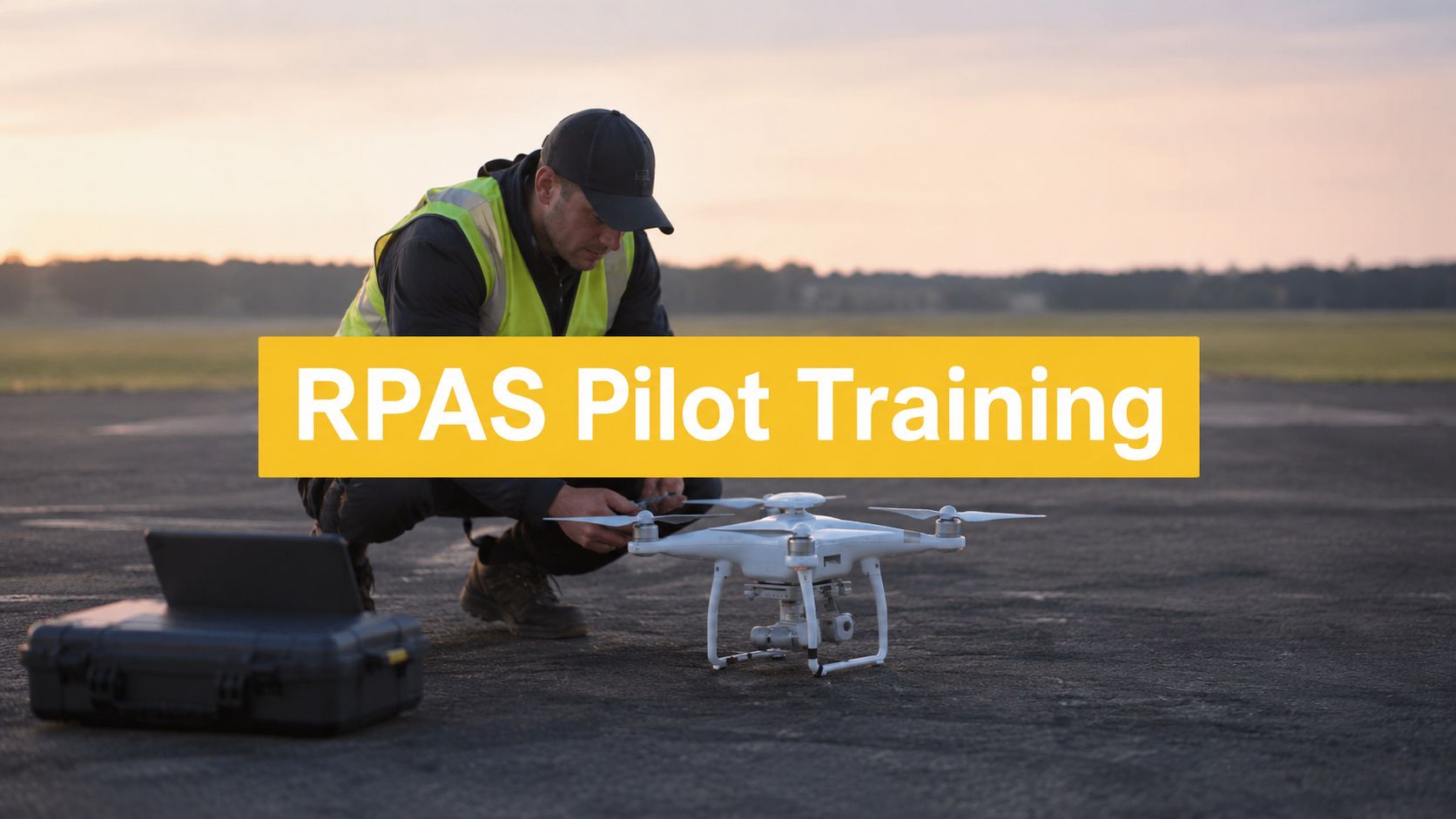
A new drone pilot usually starts in the same place. The aircraft is in hand, the job adverts look promising, and the next question is practical, not theoretical, because the core issue is whether that drone can be turned into lawful, dependable work in Australia.
That is where RPAS pilot training earns its place. It is not just about learning to hover, turn, and land, it is about understanding how Australian aviation rules separate simple excluded-category flying from regulated commercial operations, and how training turns a capable hobbyist into a pilot businesses can trust. For anyone aiming at agriculture, surveying, inspection, media, or government work, the path matters as much as the aircraft.
Table of Contents
- Why RPAS Pilot Training Matters for a Real Career
- How RPAS Training Fits Inside Australia's Aviation System
- What an RPAS Course Actually Covers
- RePL, ReOC and AROC Compared
- A Typical Training Journey from Classroom to Commercial Flight
- Choosing a Training Provider You Can Trust
- Career Pathways After Your RePL
- Your Next Steps Toward Becoming an RPAS Pilot
- FAQ
Why RPAS Pilot Training Matters for a Real Career
A person can buy a drone, charge a battery, and launch in an afternoon. That does not mean they can turn up on a client site, complete a job safely, and stay within Australian rules when the work becomes commercial. The gap between casual flying and paid operations is where professional training starts to matter.
In Australia, regulated training is the bridge between a machine and a career. CASA's framework distinguishes excluded-category operations, Remote Pilot Licence pathways, and higher-level operational approvals, so a pilot's legal room to work depends on more than confidence with the controls. For commercial clients, that distinction affects trust, documentation, and whether the operator can perform the task under the right approval structure.
Practical rule: if the work involves a business outcome, not just a recreational flight, training has to match the operation, not the drone's price tag.
That is why “just buy a drone and fly” rarely survives the first paying job. A business wants a pilot who can understand airspace, manage risk, and explain how the operation fits the legal framework. That is also why professional drone training is not a single skill, it's a stack of competencies that supports lawful work, repeatable standards, and better day-one decision-making.
For new entrants, the key question is not whether flying looks simple. It's whether the pilot can do the work safely, document it properly, and recognise when the job demands more than basic exclusion rules. The rest of this guide maps that pathway clearly, from the regulatory structure to training content, credential choices, and the practical next steps that turn interest into capability.
How RPAS Training Fits Inside Australia's Aviation System
Australia's RPAS system makes more sense when it is seen as a ladder rather than a single licence. At the bottom are excluded-category operations, where some small RPA use can sit outside the full commercial training pathway. Above that sits the Remote Pilot Licence (RePL), which supports regulated commercial work. Higher still are the approvals an organisation needs when it wants to run drone operations as part of a business framework.
The simplest way to think about it is this. Excluded-category flying answers, “Can this operation be done with limited regulatory burden?” RePL answers, “Has the pilot been trained to operate commercially under the rules?” Operational approvals answer, “Has the business built the structure to run these flights properly?” That three-part model helps explain why two pilots with similar flying skills may still have very different legal authority to work.
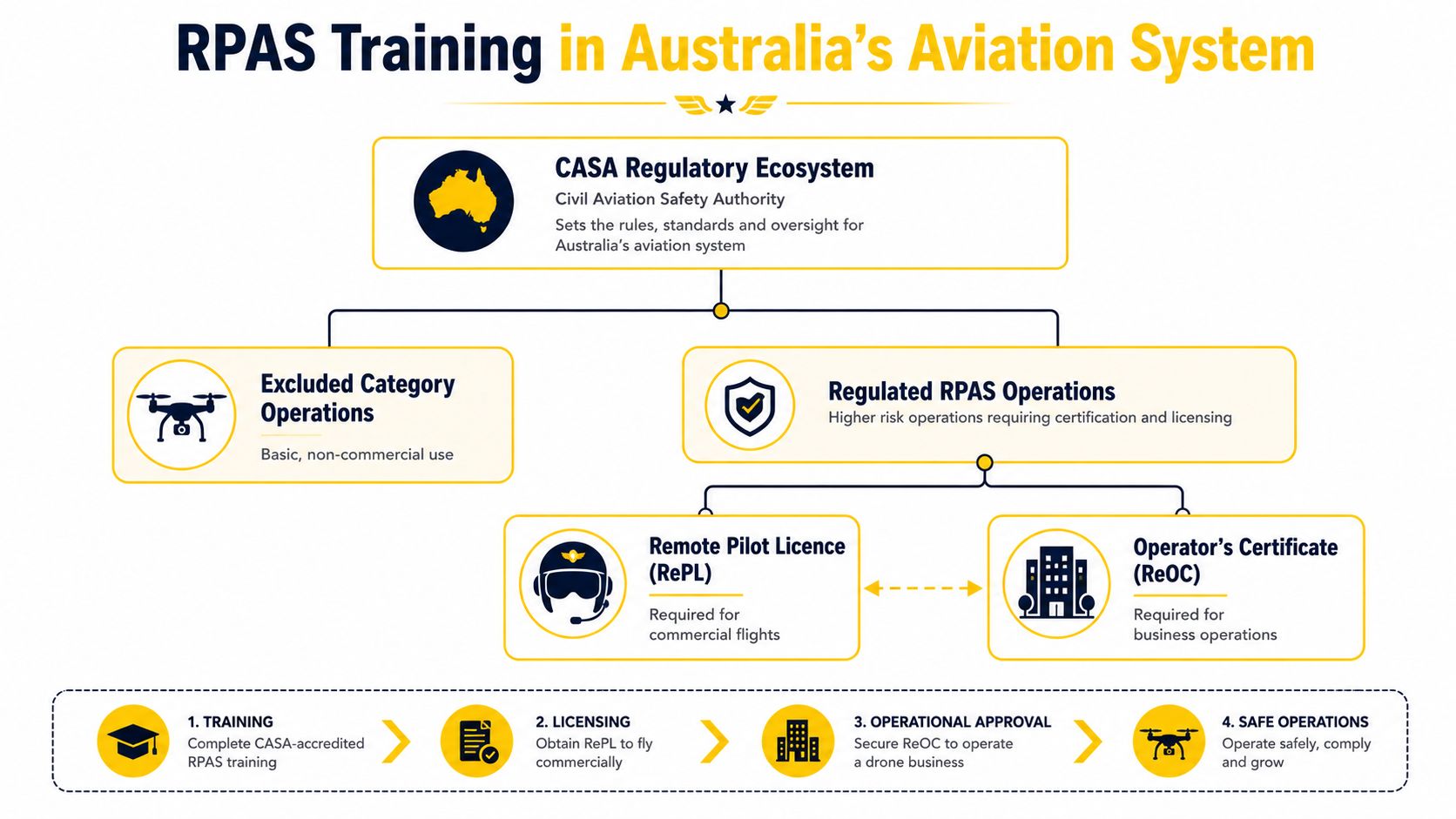
CASA's excluded-category instrument applies to RPA under 2 kg and also sets limits for certain classes up to 25 kg. That matters because the legal pathway changes with aircraft size and operating context, not just with how experienced the pilot feels. The broader CASA framework then requires remote pilot certification for many commercial uses, especially when the work moves into agriculture, surveying, or inspection where business customers expect formal compliance.
For readers comparing courses or job ads, the useful question is simple. Is this operation basic and restricted, or does it need a trained pilot and a more formal business approval path? That distinction is also why readers can use drone laws in Australia 2026 as a practical reference point when checking whether a role sits inside exclusion, RePL, or a more complete operational structure.
The cleanest career mistake to avoid is assuming every drone job sits under the same rule set.
What an RPAS Course Actually Covers
A proper course is not a flying lesson with a certificate stapled on top. CASA guidance says the theoretical side of RePL training should provide at least 15 hours of instructor contact time for the first RPA category, plus 4 additional hours for each extra category included in the course, and the practical component requires at least 5 hours of live flight time on the relevant category. Those numbers are not arbitrary. They are the minimum structure that connects knowledge, judgement, and hands-on control.
Why the theory hours matter
The classroom time is where a student learns the rules that sit behind each decision in the air. Airspace, weather, separation, emergency procedures, and operating discipline all live here, because a pilot who does not understand them cannot make safe choices when conditions change. The extra category hours matter as well, because different aircraft and mission profiles bring different procedures, payloads, and handling expectations.
Why live flight is mandatory
The 5 hours of live flight is the point where theory has to survive real controls, real wind, and real mistakes. That is the bridge from “I understand the process” to “I can execute it under supervision.” For commercial operators, this live component is what turns abstract knowledge into a usable skill set when the aircraft is carrying a payload or supporting a client job.
A good course also treats aviation skills as linked, not separate. Students need to show operational judgment, not just stick movement, because a competent pilot has to assess the site, manage the mission, and respond to problems without freezing. That is why a training package such as ACE READY makes sense as entry-level preparation, since it covers drone fundamentals, aviation safety, CASA regulations, flight operations, and preparation for advanced RePL training in Australia.
The practical result is straightforward. A graduate should not just know how to take off and land, they should understand the operating context that makes those actions lawful and useful. In that sense, RPAS training is an integrated aviation skill set, not a box-ticking exercise.
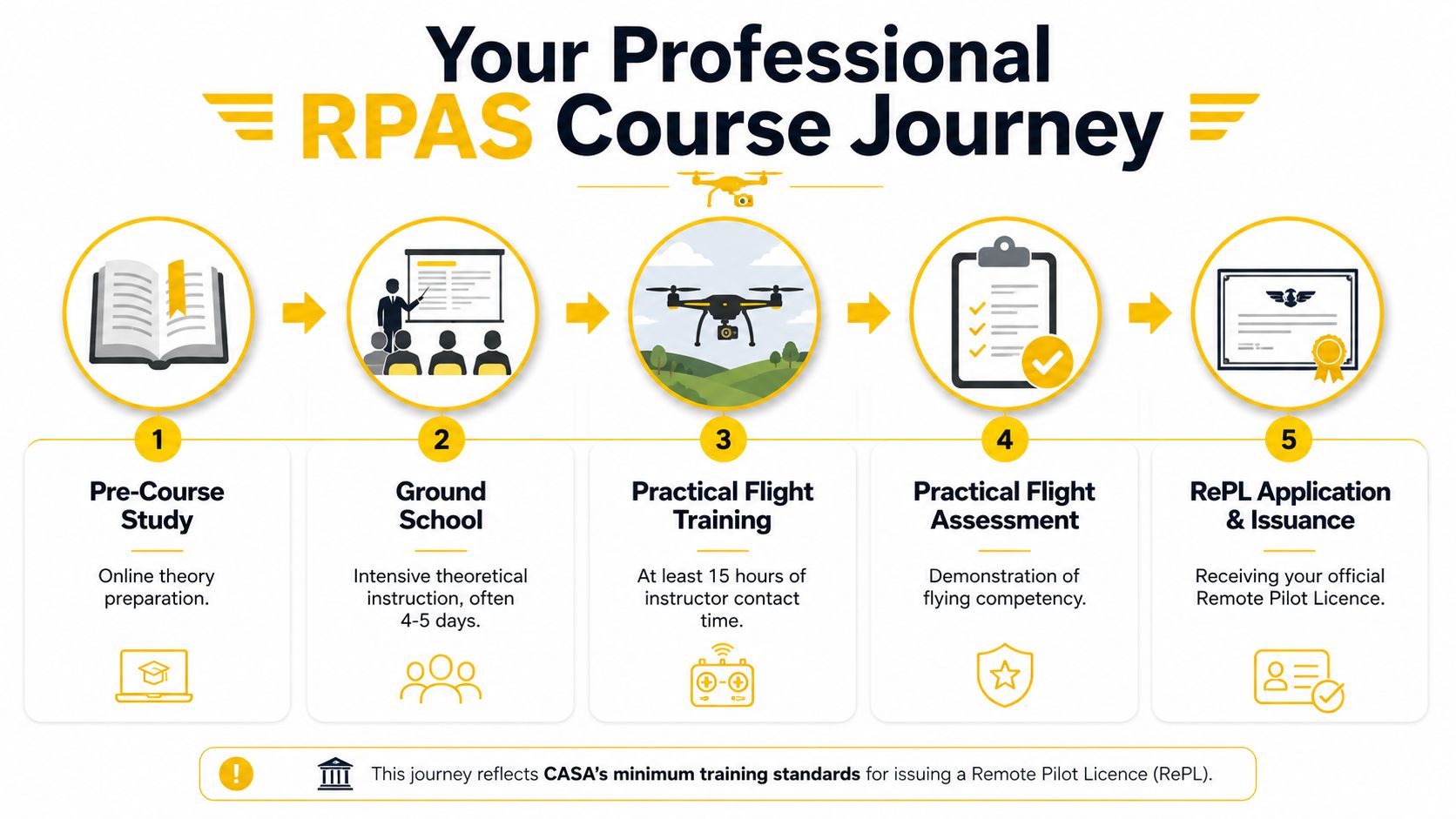
The course journey in order
- Pre-course study. Builds baseline familiarity before instructor time begins.
- Ground school. Turns rules into operating decisions.
- Practical flight training. Applies those decisions to live aircraft handling.
- Practical assessment. Checks whether the pilot can perform consistently.
- Licence issuance. Confirms the candidate has met the pathway requirements.
RePL, ReOC and AROC Compared
These three credentials are often mentioned together, but they do different jobs. A pilot can hold a licence and still not have the authority needed for a business operation, and a business can have an operating certificate without every staff member being ready for complex radio work. The right choice depends on what the person or organisation intends to do.
| Credential | Issued To | What It Authorises | Typical Use Case |
|---|---|---|---|
| RePL | Individual pilot | Commercial remote piloting within the pilot's scope of training and operating context | A solo pilot conducting lawful commercial drone work |
| ReOC | Business or organisation | Organisational authority to conduct RPAS operations under a formal framework | A company running drone services across multiple pilots |
| AROC | Individual operator | Aviation radio communication capability | Work that requires clear, controlled airspace radio use |
A useful decision rule is this. A sole operator usually starts with the RePL because it gives the person the pilot qualification needed for commercial work. Once the operation grows into a business structure with staff, procedures, and wider compliance responsibility, the ReOC becomes central because it supports the organisation's authority to run those flights legally. AROC sits alongside the pilot pathway when radio communication becomes part of the mission environment.
The relationship between these credentials is practical, not abstract. A pilot may need the RePL to fly, the AROC to communicate properly, and the ReOC framework to work inside an employer's approved operation. That is why training conversations should always begin with the intended use case, not the badge name.
For a deeper look at the organisation side, this ReOC guide is a useful companion for readers comparing personal licensing with business approvals.
A Typical Training Journey from Classroom to Commercial Flight
A cohort often starts with people who want the same end result, but different jobs. One student wants to inspect farm infrastructure, another is aiming at mapping work, and another expects to fly for a construction or utilities contractor. The syllabus has to serve all three, which is why RPAS training usually moves from common aviation foundations into application-specific scenarios.
How the weeks usually unfold
The first phase is theory-heavy because students need the same safety language before they touch a practical job. Then the course shifts into supervised flight work, where the pilot practises site checks, take-off discipline, mission flow, and recovery procedures. By the time the assessment arrives, the student should be responding to conditions rather than reciting notes.
Agriculture, surveying, and infrastructure inspection each change the flavour of the training. Agricultural missions demand attention to payload and repeatability, surveying work leans on accurate flight paths and consistency, and inspection tasks reward careful positioning and site awareness. The aircraft may be different, but the habits are the same, which is why competency-based assessment matters more than a one-off flying test.
A strong graduate can explain not only what the aircraft did, but why the operation was set up that way.
Radio training also fits here when controlled airspace or operational coordination is part of the job. The point is not to add a separate hurdle for no reason. It is to make sure a pilot can communicate clearly, follow procedures, and work alongside other aviation users without confusion.
For employers, course design matters. A provider should show how theory, flight practice, and industry context connect rather than treating them as disconnected modules. That is the difference between a pilot who can pass a test and a pilot who can contribute on day one.
Choosing a Training Provider You Can Trust
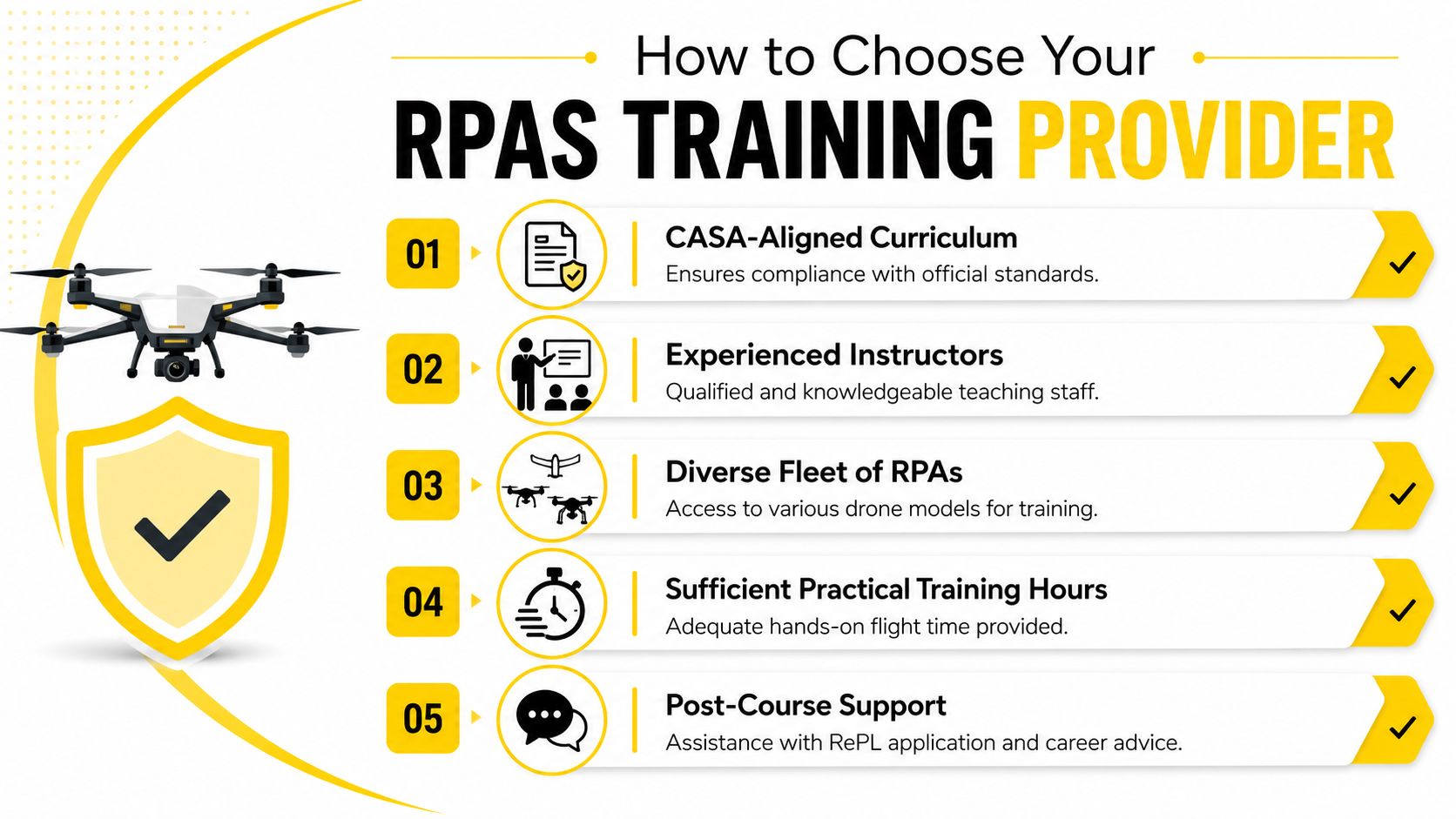
A good provider is easy to talk about and harder to fake. Begin by checking if the curriculum is aligned with CASA expectations, because that sets the structure of the whole course and shows whether the training is built around the rules students will work under. Then look at the parts that shape day-one competence, instructor quality, practical exposure, and whether the provider helps students move from training into real commercial work.
Questions worth asking before enrolment
- CASA-aligned curriculum. Ask how the course maps to the current regulatory pathway and which parts prepare you for RePL readiness.
- Instructor depth. Ask who teaches the course and what aviation or operational experience they bring.
- Fleet variety. Ask what aircraft are used for training and whether the student sees more than one RPAS type.
- Flight exposure. Ask how much supervised practical work is included and how assessment is handled.
- Post-course support. Ask whether help is available for RePL application, refresher training, or career planning.
Those questions matter because they push the provider to explain substance, not slogans. A course that gives students room to practise, ask questions, and apply the rules usually prepares them better than one that looks polished but stays thin on actual operating skill. That matters whether the student is entering a first role or a business is building an internal drone capability.
A provider can also be judged by how it prepares students before they enrol. ACE BRONZE is one example of a foundation commercial drone course that covers drone operations, flight safety, aviation theory, and practical skills for students beginning the journey toward becoming licensed drone pilots in Australia. For a broader view of what a training organisation should demonstrate, this overview of Ace Aviation gives a useful reference point for readers comparing course structures and support.
Career Pathways After Your RePL
A RePL is not the finish line. It is the point where a pilot becomes employable in a regulated commercial setting, and the next stage depends on the sector, the aircraft, and the business structure. Different industries value different combinations of flying skill, radio competence, and operational discipline.
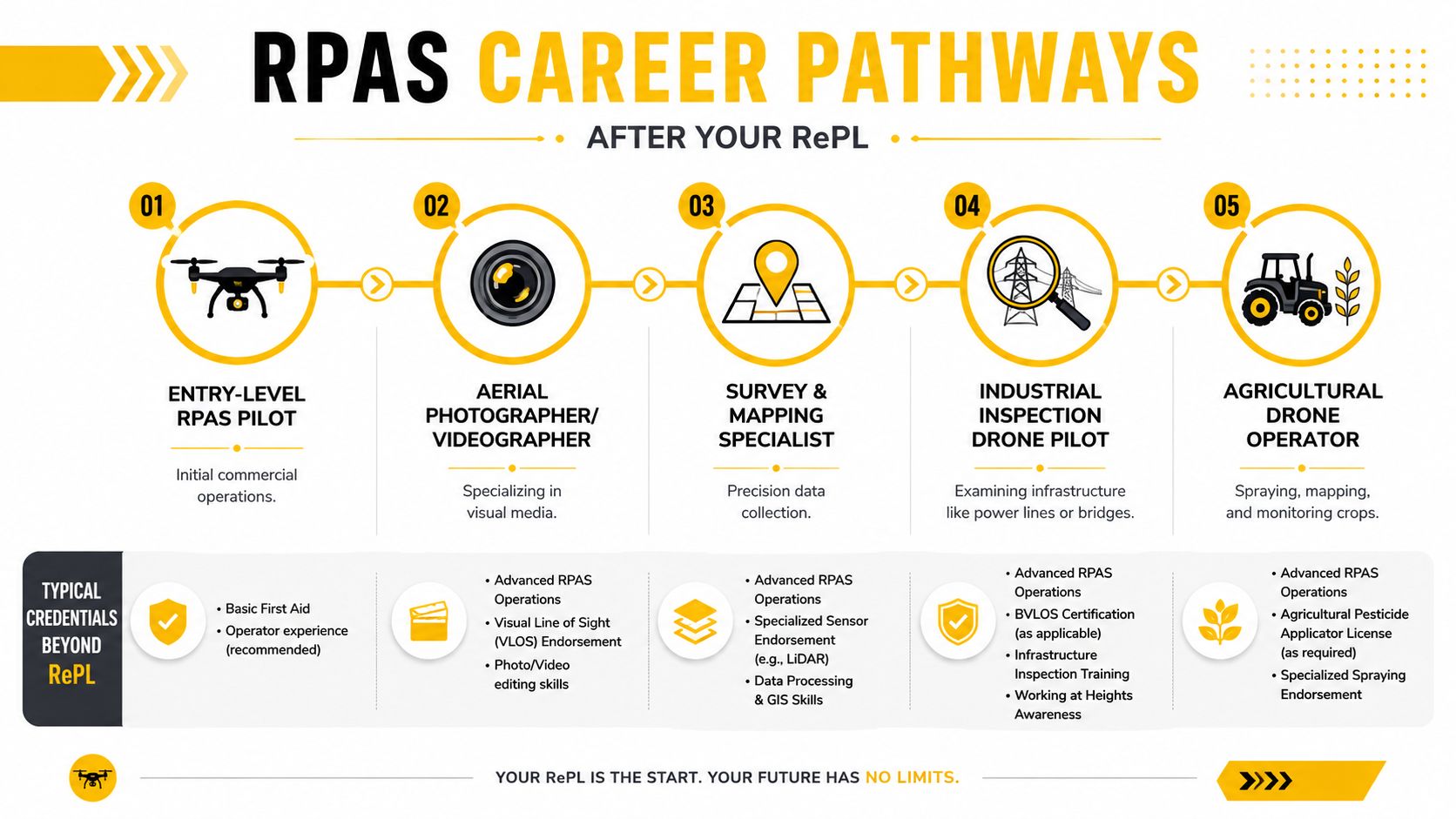
Common pathways and what they tend to require
- Entry-level RPAS pilot. Usually starts with a RePL and supervised commercial work.
- Aerial photographer or videographer. Often needs strong visual flying skill and client-ready site discipline.
- Survey and mapping specialist. Typically relies on precise mission planning and repeatable flight performance.
- Industrial inspection pilot. Often works inside stricter operational procedures and site controls.
- Agricultural drone operator. May need additional operational approvals depending on the task and aircraft.
These pathways are not fixed ladders, they're branches. A pilot who starts in media can move into infrastructure work if the operational habits are solid, and someone who begins in agriculture may later build a business around specialist inspection or enterprise training. For readers thinking about long-term progression, transferable skills in 2026 is a useful reminder that communication, planning, and judgement carry across roles, not just flying hours.
The broader career logic is simple. The more complex the operation, the more the pilot needs formal training, operational discipline, and sometimes organisational approval. That is why many pilots continue into business-focused learning, including Certificate III in Aviation pathways, when they want a stronger operational base for commercial growth.
Your Next Steps Toward Becoming an RPAS Pilot
The first 30 days should be about clarity, not speed. Start by matching the target job to the likely credential path, then shortlist providers, request course outlines, and check whether aviation English or medical considerations are relevant to the role. Good record-keeping also matters once training begins, and tools such as Odoo training record software can help organisations keep that side of compliance organised.
A simple action list
- Define the job goal. Decide whether the target is recreational flying, solo commercial work, or a business pathway.
- Compare course outlines. Check whether the training covers theory, live flight, and the credential you need.
- Ask for support details. Confirm what help exists for applications, assessment, and follow-up guidance.
- Check your baseline readiness. Make sure English communication and any relevant aviation health considerations are sorted early.
For a quick way to match course direction to career intent, this licence finder is a practical starting point before a student books the wrong pathway. The goal is to choose a course that fits the operation, not the other way around.
Ace Aviation Aerospace Academy delivers CASA-compliant drone training, RePL pathways, AROC support, and ReOC consulting for students and organisations across Australia. If the next step is to move from interest to a structured training plan, visit Ace Aviation Aerospace Academy and review the courses against the kind of RPAS work the pilot wants to do.
FAQ
What is RPAS pilot training?
It is the structured education that prepares a pilot to operate remotely piloted aircraft safely and legally, especially for commercial work under CASA's framework.
Do all drone pilots need a RePL?
No. Some operations can fall under excluded-category rules, but commercial work often requires a RePL and, in some cases, additional organisational approvals.
How much live flight time is included in RePL training?
CASA guidance says the practical component requires at least 5 hours of live flight time on the relevant category.
Is radio training always part of RPAS training?
Not always, but it becomes important when the operation involves controlled airspace or clear aviation communication requirements.
Can a solo operator work with only a RePL?
A solo operator can often begin there, but the exact legal scope depends on the operation, the aircraft, and whether the work fits within the relevant regulatory pathway.
What should a beginner look for in a provider?
A CASA-aligned curriculum, experienced instructors, real flight exposure, and support that helps translate training into a commercial pathway.