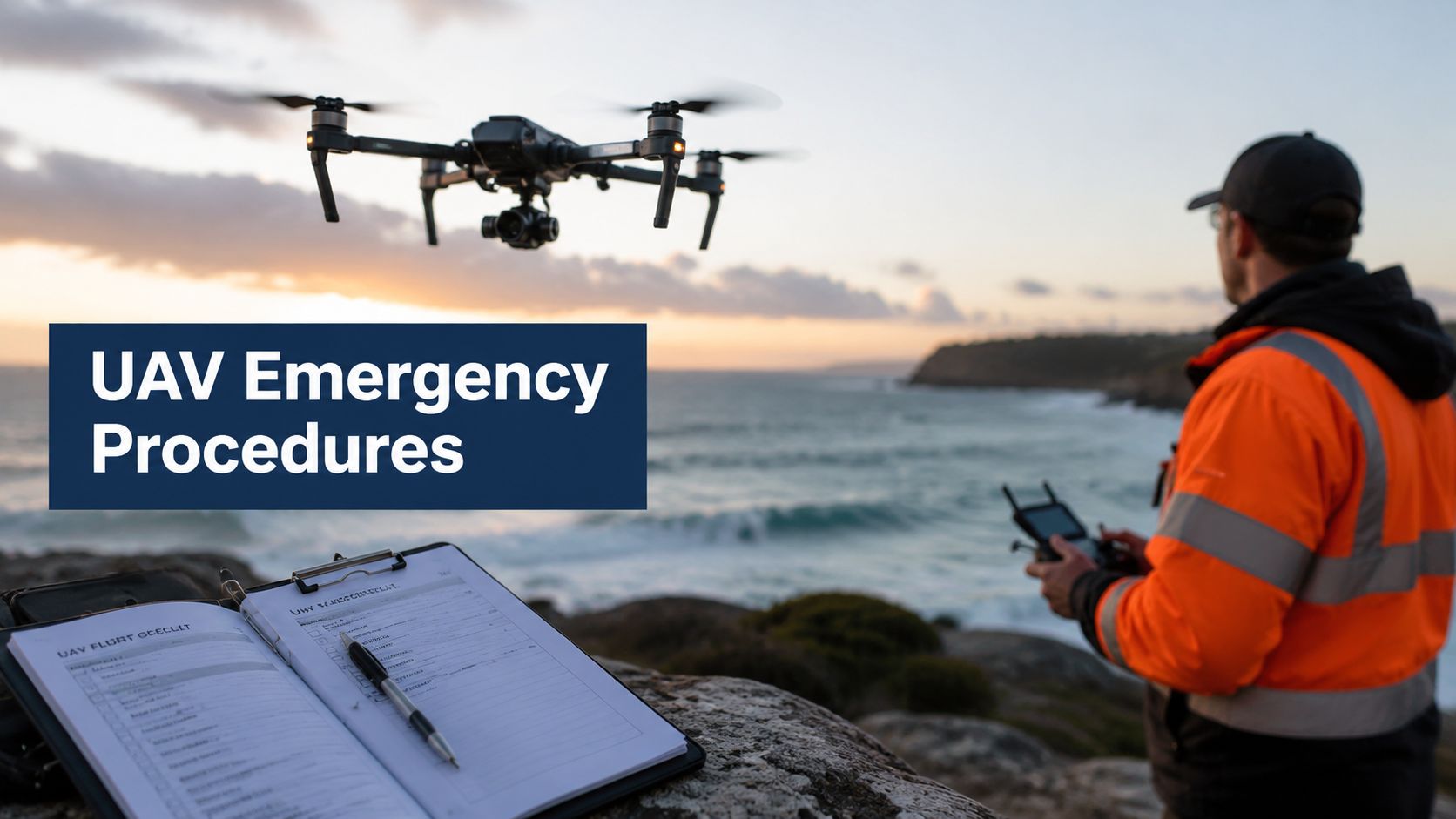
A drone that starts drifting, blinking, or dropping telemetry in the middle of a paid job changes the whole tone of the day. The operator who stays calm, keeps the aircraft flying, and treats the emergency as a full lifecycle event usually ends up with a recoverable incident, not a career problem.
In Australia, uav emergency procedures are not just about getting the aircraft back. CASA treats them as part of the operational manual, the emergency response plan, the scene response, and the reporting chain, and that is the right way to think about them. The pilot who only rehearses “what if it falls out of the sky” is missing the harder part, what to do while it is still airborne, what to do once it is on the ground, and what to report before the paperwork becomes the next failure.
Table of Contents
- What Happens When a Drone Goes Wrong
- The Core Emergency Scenarios CASA Expects You to Handle
- In-Flight Response Actions for Link, Power, and Control Failures
- After the Drone Comes Down Scene Control and Radio Calls
- Reporting to CASA and the ATSB Without Getting It Wrong
- Emergency Procedure Drills and Checklists for RePL Operators
- FAQ
- What is the first action in a drone emergency?
- Which RPAS faults should be treated as emergency scenarios?
- When does a drone incident need ATSB notification?
- Should a crashed drone be moved straight away?
- What should be included in an emergency response plan?
- Do RePL operators need to rehearse emergency procedures?
What Happens When a Drone Goes Wrong
A coastal survey is under way, the wind is steady, and the screen suddenly shows a telemetry dropout. The wrong response is to stare at the tablet and hope the link comes back. The right response is to protect the aircraft first, because CASA's solo RPAS priority sequence is Aviate, Navigate, Communicate, Administrate once the immediate emergency action is completed, and that hierarchy is what keeps a bad event from turning worse.
The first job is to keep the aircraft honest
The pilot's hands should already be on the controls, eyes outside the screen, and the automation judged with suspicion until it proves itself. That sounds simple, but surprise faults narrow attention fast. Tunnel vision, stick freeze, and radio lockout are common human failures in an emergency, and they can do more damage than the original malfunction.
Practical rule: If the pilot has stopped looking outside and has started “arguing” with the display, the emergency is already bigger than the fault.
Emergency procedures start before the fault is named
CASA's RPAS safety material expects emergency procedures in both the operational manual and the emergency response plan, and it explicitly lists the kinds of faults that matter most, including engine or propeller failure, loss of data link, loss of control, navigation equipment failure, and airframe damage. That list matters because each fault changes the correct first move. A propeller problem near people is not the same problem as a navigation failure near structures, and neither behaves like a simple screen dropout.
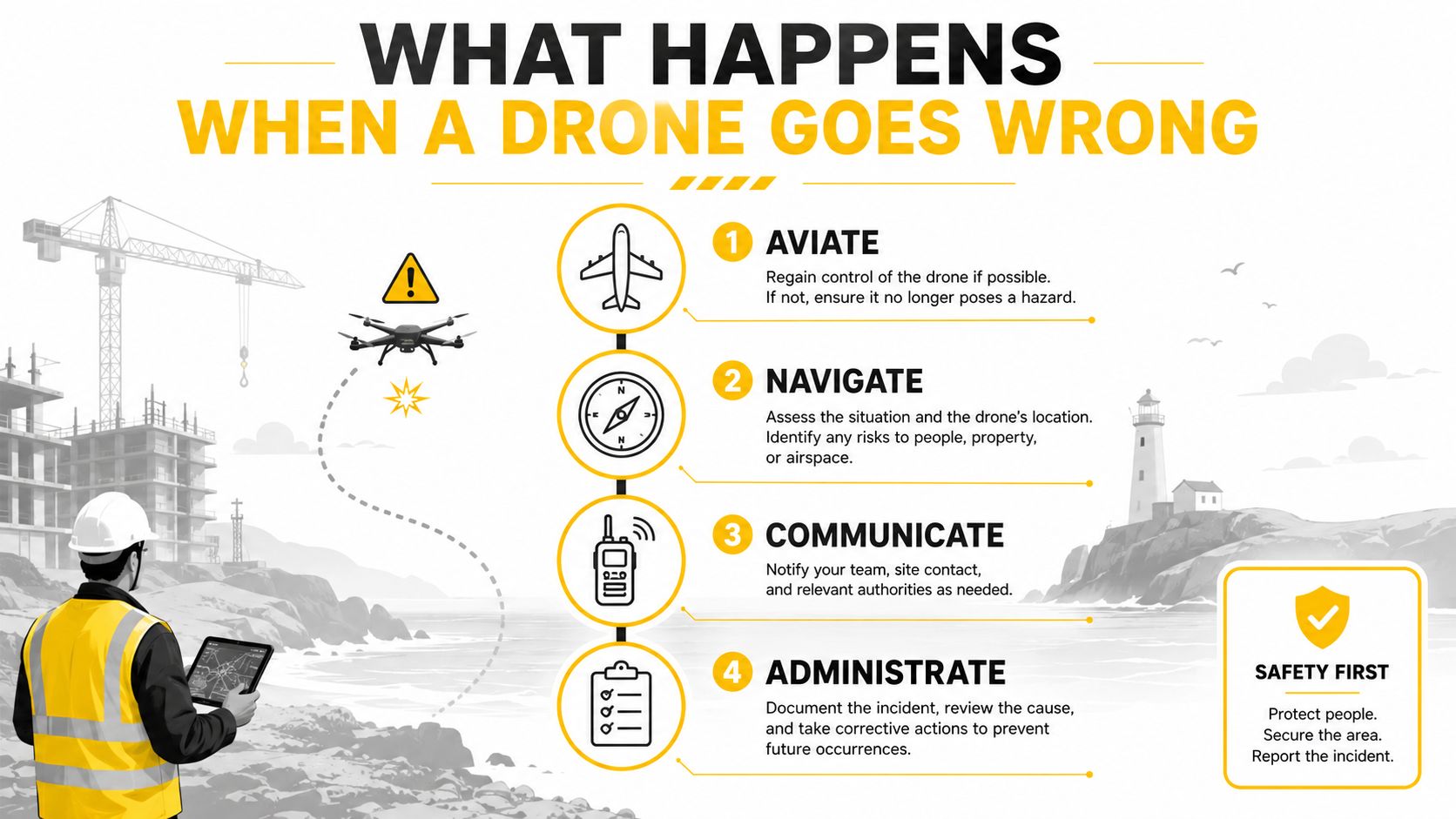
The operator who has rehearsed the sequence does not have to invent it under pressure. That is the value of uav emergency procedures, they keep the pilot from spending precious seconds deciding whether the problem is “serious enough” while the aircraft is already moving toward the wrong place. The screen can fail, the radio can chatter, and the flight can still be saved if the first priority is protected correctly.
The Core Emergency Scenarios CASA Expects You to Handle
CASA does not treat every malfunction as one generic emergency. It names the failure categories for a reason, because the wrong diagnosis creates the wrong response. A pilot who reads all faults as “loss of link” may trigger unnecessary return-to-home, while a pilot who assumes everything is a sensor glitch may miss a genuine control failure.
Why each failure behaves differently
A broken propeller, for example, often changes the aircraft's balance immediately, so the main question becomes whether it can still be stabilised and landed without endangering people below. A navigation equipment failure can look less dramatic on the screen but still produce a drifting or inaccurate aircraft, especially near obstacles or in constrained airspace. Loss of control is the most serious because it can take the aircraft outside the pilot's normal correction envelope very quickly.
The same logic applies to data-link failures. CASA expects the remote pilot to execute recovery procedures if control data link is lost, which means the issue is not whether the link came back eventually, but whether the pilot understood the aircraft's fail-safe behaviour fast enough to keep it away from risk.
The consequence depends on the scene, not just the fault
A prop-out over a crowd, a compass error beside a structure, and degraded positioning near controlled airspace all demand different judgment. That judgment is what AROC theory and RPAS training are really testing, the pilot's ability to recognise which system failed first and what danger came with it.
| Scenario | Typical Aircraft Behaviour | Worst-Case If Mishandled |
|---|---|---|
| Engine or propeller failure | Reduced lift, yaw, vibration, or immediate imbalance | Hard landing, loss of control, or impact with people or property |
| Loss of data link | Holds, returns, lands, or continues on programmed failsafe depending on setup | Unplanned flight path over people, traffic, or obstacles |
| Loss of control | Inputs stop producing expected movement or the aircraft responds erratically | Flyaway, impact, or descent into an unsafe area |
| Navigation equipment failure | Wrong heading, drift, or unstable position hold | Collision with structures, restricted areas, or overflight of crowds |
| Airframe damage | Reduced structural integrity or visible deformation | Break-up, secondary system failure, or worsening damage on landing |
The table is useful because it forces the operator to think in behaviour, not labels. That is how real emergencies are won, by reading what the aircraft is doing and matching the response to the threat in front of it.
For broader operating context, the current Australian drone law environment is worth keeping alongside emergency planning, especially for commercial teams, and the internal reference on drone laws in Australia for 2026 fits naturally with that review.
In-Flight Response Actions for Link, Power, and Control Failures
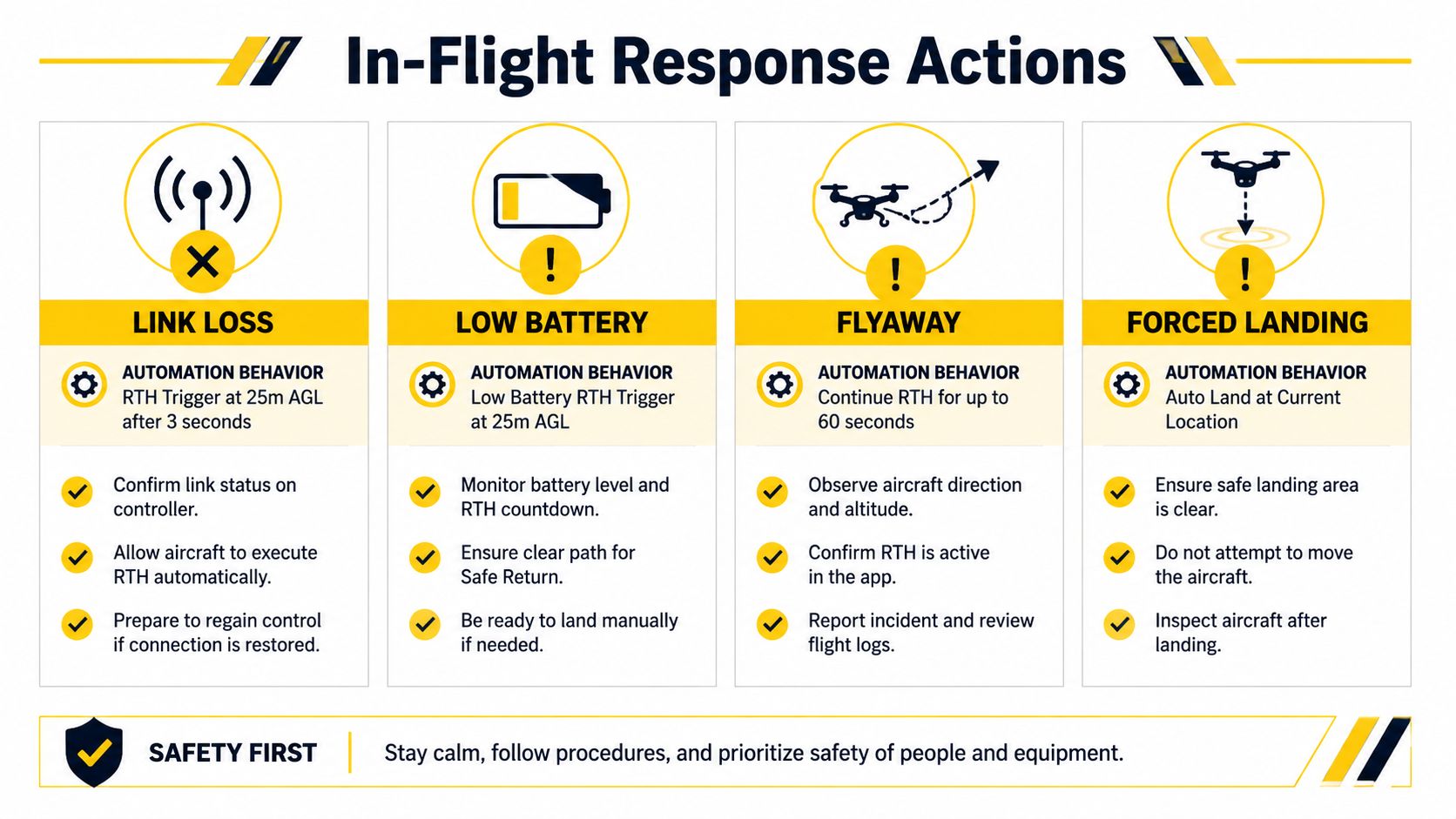
Loss of link, low battery, flyaway, and forced landing are not the same emergency wearing different clothes. Treating them the same is how pilots end up cancelling the wrong automation, choosing the wrong landing zone, or letting the aircraft run itself into a public area.
Loss of link
A brief telemetry dropout is not always a full command-and-control failure, but the pilot has to treat it seriously until the aircraft's actual behaviour is clear. If the aircraft is programmed to return-to-home, the pilot must know the trigger height, the route home, and whether that path crosses people or property before deciding to let the automation continue. If the return track will put the drone over a populated area, the pilot may need to regain link and cancel or change the recovery, but only if that can be done safely and without creating a worse situation.
The key distinction is between a momentary screen issue and a genuine C2 failure. The aircraft may keep flying normally during a brief dropout, but the operator still needs a plan for what happens if the signal does not recover.
Low battery
Low battery warnings are a decision point, not an invitation to squeeze in one more shot. Smart batteries usually move through warning stages, and at some point the system will protect itself with landing or return logic that overrides the pilot's preference. By then, the operator should already be thinking about the cleanest place to come down, not the most ambitious one.
If the battery warning arrives early enough, the correct move is to shorten the mission and head for a safe landing. If the aircraft is already close to its automatic landing threshold, the pilot should stop trying to “win back” time with aggressive manoeuvres.
Flyaway
A flyaway is where training shows up or disappears. If the aircraft is on a system that allows an attitude mode or similar degraded control mode, the pilot may still have a chance to stabilise it, but only if the aircraft remains responsive and the operator can keep it pointed away from risk. Recalibration attempts are rarely the first response in the air, because the emergency is happening now, not after the tablet menu opens.
A flyaway is usually not fixed by more button presses. It is managed by keeping the aircraft away from people, obstacles, and airspace conflicts while the pilot decides whether control is still recoverable.
Forced landing
A forced landing call is about choosing the least bad place quickly. If a clear zone is available, the aircraft should be diverted there early, because waiting until the last second often removes every good option. If the aircraft is descending unpredictably, the pilot's job is to keep it as stable as possible and avoid tempting turns that could push it toward bystanders or vehicles.
For operators building deeper emergency-readiness around more advanced missions, the BVLOS training pathway becomes relevant because beyond visual line of sight operations raise the stakes on failsafe behaviour, planning, and supervision.
For beginners, a structured entry course like ACE READY can be a sensible starting point because it covers drone fundamentals, aviation safety, CASA regulations, flight operations, and preparation for later RePL training in Australia.
After the Drone Comes Down Scene Control and Radio Calls
The first sixty seconds after a hard landing decide whether the incident stays manageable. One scenario is a flyaway that drops onto a public oval, the other is a lithium battery crash in a suburban street. Both need quick thinking, but the priorities are different.
Public oval impact
A public-area impact starts with people, not wreckage. The pilot scans for injury, stops the operation, and keeps bystanders back while the scene is assessed. If there is any sign of fire, smoke, or risk to people, 000 is the right emergency call for immediate danger, because that is a life-safety issue first.
Once the area is stable, the pilot should preserve the scene. Photograph the wreckage where it sits, record the last known position, and avoid moving the RPAS until the investigator or authority releases it. If an AROC-qualified operator is present and the situation requires a radio call, the transmission should be short and factual, with the aircraft registration, last known position, and the nature of the emergency.
Lithium battery crash
A battery crash can be more dangerous than the impact itself because thermal runaway and venting change the scene fast. Keep bystanders at a safe distance, isolate ignition sources if that can be done without exposure, and treat damaged lithium batteries as hazardous until they cool and are assessed. If the battery is venting or fire is developing, crowd control is not optional, and neither is protecting yourself with suitable personal protective equipment.
The practical difference between the two scenarios is simple. A public oval impact is mainly a crowd and access problem, while a battery crash is a heat and contamination problem. The operator who handles both with the same script is guessing.
If radio coordination is needed, 112 can be used as an emergency number on mobile networks, but the operator still needs to make the right local notifications and preserve evidence. The training focus on airspace awareness and emergency response also aligns with guidance used in airport and helicopter-lane environments, which is why the material at drone safety near airports and HLS in Australia remains relevant to incident response near sensitive sites.
Hard rule: Do not move a crashed RPAS until the site is released by the relevant investigator or authority, unless leaving it in place creates a live danger to people.
Reporting to CASA and the ATSB Without Getting It Wrong
Australian notification duties are where a lot of good pilots get slow. The reason is usually simple, they wait until the scene feels “fully understood” before making a report. That delay creates a second failure, because evidence ages, logs get edited, and the story gets harder to reconstruct.
Which report goes where
For accidents and serious incidents involving drones, CASA's reporting guidance says the ATSB must be notified immediately by phone on 1800 011 034, followed by a written report within 72 hours. CASA's safety reporting pathway also exists for the operator's broader compliance record, while airworthiness issues can require separate notification through the appropriate CASA channel. The important point is that these reports serve different purposes, so the same event may trigger more than one notification.
| Report Type | Trigger | Deadline | Channel |
|---|---|---|---|
| ATSB immediate notification | Accident or serious incident | Immediately | Phone 1800 011 034 |
| ATSB written report | Follow-up after the initial call | Within 72 hours | Written submission |
| CASA self-report | Compliance or operational concern | As soon as practicable | CASA reporting pathway |
| Airworthiness notification | Damage or defect relevant to airworthiness | As required by the issue | CASA airworthiness channel |
What the report should contain
The report needs the registration, the RePL or ReOC reference where relevant, the flight location, the battery state, and the sequence of attempted recoveries. It should be factual, not defensive. The ATSB is focused on safety learning, while CASA is interested in compliance and operational control, so separate those voices in the paperwork.
A useful structure sounds like this. The aircraft was operating at a named location, the failure occurred at a specific point in the mission, the pilot attempted a stated recovery, the battery condition was known at the time, and the aircraft came to rest in a described position. That is enough to start an investigation without contaminating the record.
Common delays are predictable, and all of them are avoidable. Log tampering, late calls, and missing the 72-hour report window create avoidable regulatory exposure. A solid operator response plan should already include a clause that assigns who notifies whom, when the site is preserved, and how records are retained for audit.
The Australian incident-reporting obligations are also covered in the broader incident handbook at ANCA, CANA, and ATSB reporting guidance for drone pilots, which is worth reading alongside the operator manual.
Emergency Procedure Drills and Checklists for RePL Operators
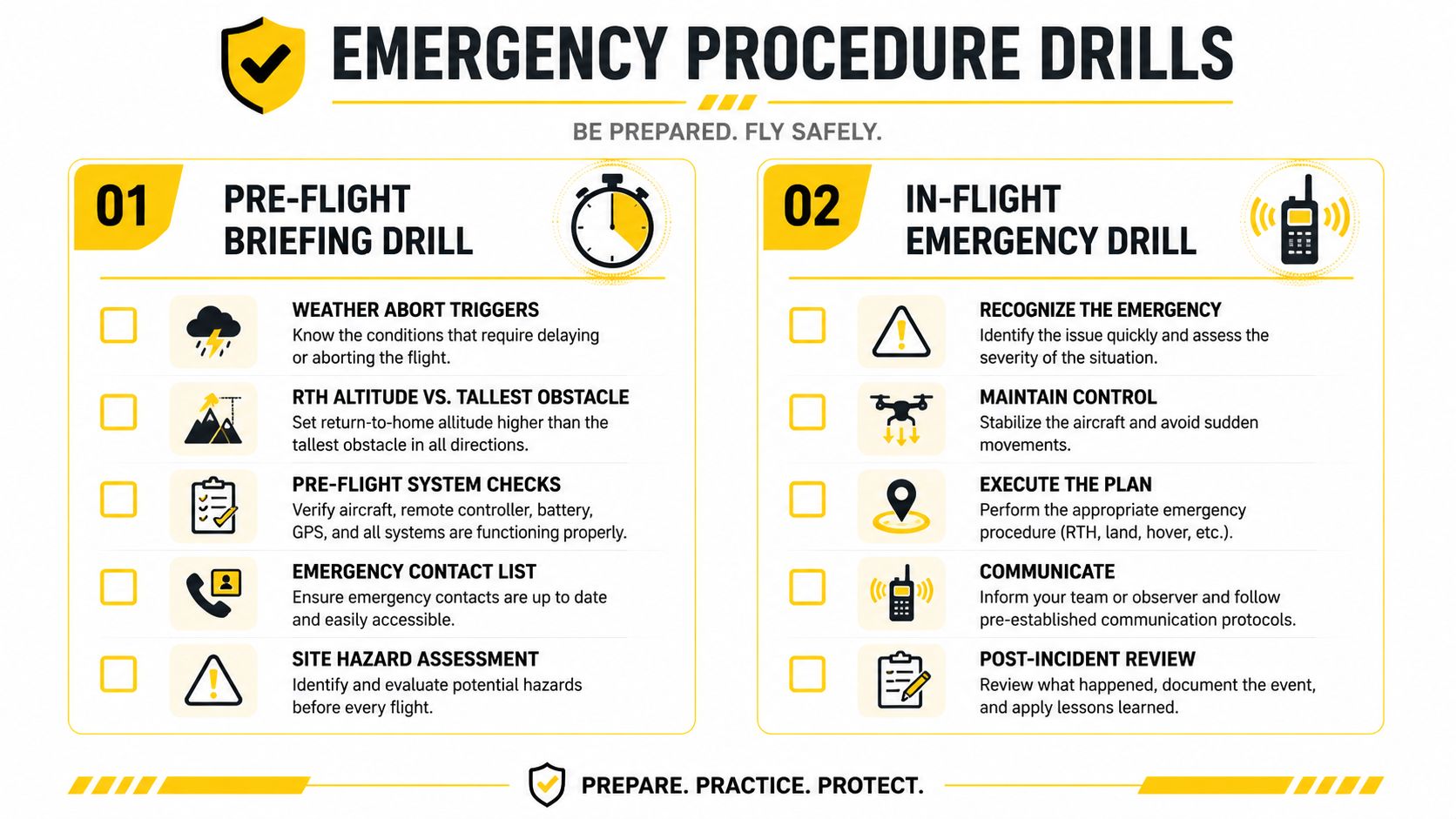
A good emergency procedure is one that survives a bad day, and the only way to know that is to rehearse it. A checklist in a folder is not enough if the controller freezes the first time the aircraft misbehaves.
Two drills that should be on every commercial roster
The first drill is a five-minute pre-flight briefing. It should cover weather abort triggers, RTH altitude versus the tallest obstacle in the buffer, battery state at first warning, and the verbal handover of the emergency procedure card. That briefing is short on purpose, because the goal is not to recite a handbook, it is to make sure the crew has already agreed on what “stop” means before the mission starts.
The second drill is a quarterly simulator session using the actual ground control system. Rehearse loss of link, flyaway, and forced landing with a controller-injected failure timed to catch the pilot mid-mission. That timing matters, because emergencies rarely happen at the cleanest moment.
What gets logged
Each drill should record the date, drill type, scenario, response time, deviations, and instructor sign-off for RePL currency. That record does two jobs. It proves the training happened, and it shows whether the pilot improved or only performed the drill when the outcome was easy.
A basic log line can be simple and still useful:
- Date and location: Identify when and where the drill occurred.
- Scenario used: Loss of link, flyaway, or forced landing.
- Observed response: Note what the pilot did first.
- Deviation from procedure: Record any step that was missed or delayed.
- Instructor sign-off: Confirm the drill counted towards currency.
Battery handling deserves its own attention. Damaged packs should be isolated, stored in a fire-safe way, and never treated as routine post-flight clutter. The visual observer also needs a clear role in the first ten seconds of a declared emergency, because the controller should not be the only person tracking people, hazards, and the landing zone at once.
For operators building a broader compliance system, ReOC support and documentation discipline matter as much as flight skill. The consulting pathway at ReOC consulting is relevant where organisations need written procedures that match field practice.
Ace Aviation Aerospace Academy provides Australian drone training that fits this kind of operational discipline, including RePL pathways, AROC, and supporting aviation qualifications for commercial crews. For operators who need emergency procedures that hold up in real work, not just in a classroom, visit Ace Aviation Aerospace Academy and review the courses and support options that align with your operation.
FAQ
What is the first action in a drone emergency?
Protect the aircraft first. For solo RPAS operations, CASA's priority sequence is Aviate, Fly, Communicate, Administrate once the immediate emergency action is complete.
Which RPAS faults should be treated as emergency scenarios?
CASA's published scenarios include engine or propeller failure, loss of data link, loss of control, navigation equipment failure, and airframe damage.
When does a drone incident need ATSB notification?
CASA's safety reporting guidance says accidents and serious incidents involving drones must be reported to the ATSB immediately by phone on 1800 011 034, with a written report due within 72 hours.
Should a crashed drone be moved straight away?
No, not unless leaving it in place creates an immediate danger. Preserve the scene and do not move the RPAS until the site is released by the investigator or authority.
What should be included in an emergency response plan?
It should cover in-flight action, scene control, reporting responsibilities, battery handling, evidence preservation, and who makes the ATSB and CASA notifications.
Do RePL operators need to rehearse emergency procedures?
Yes. CASA expects emergency procedures to be planned and rehearsed, not just written down, and regular drills help keep the operation audit-ready.