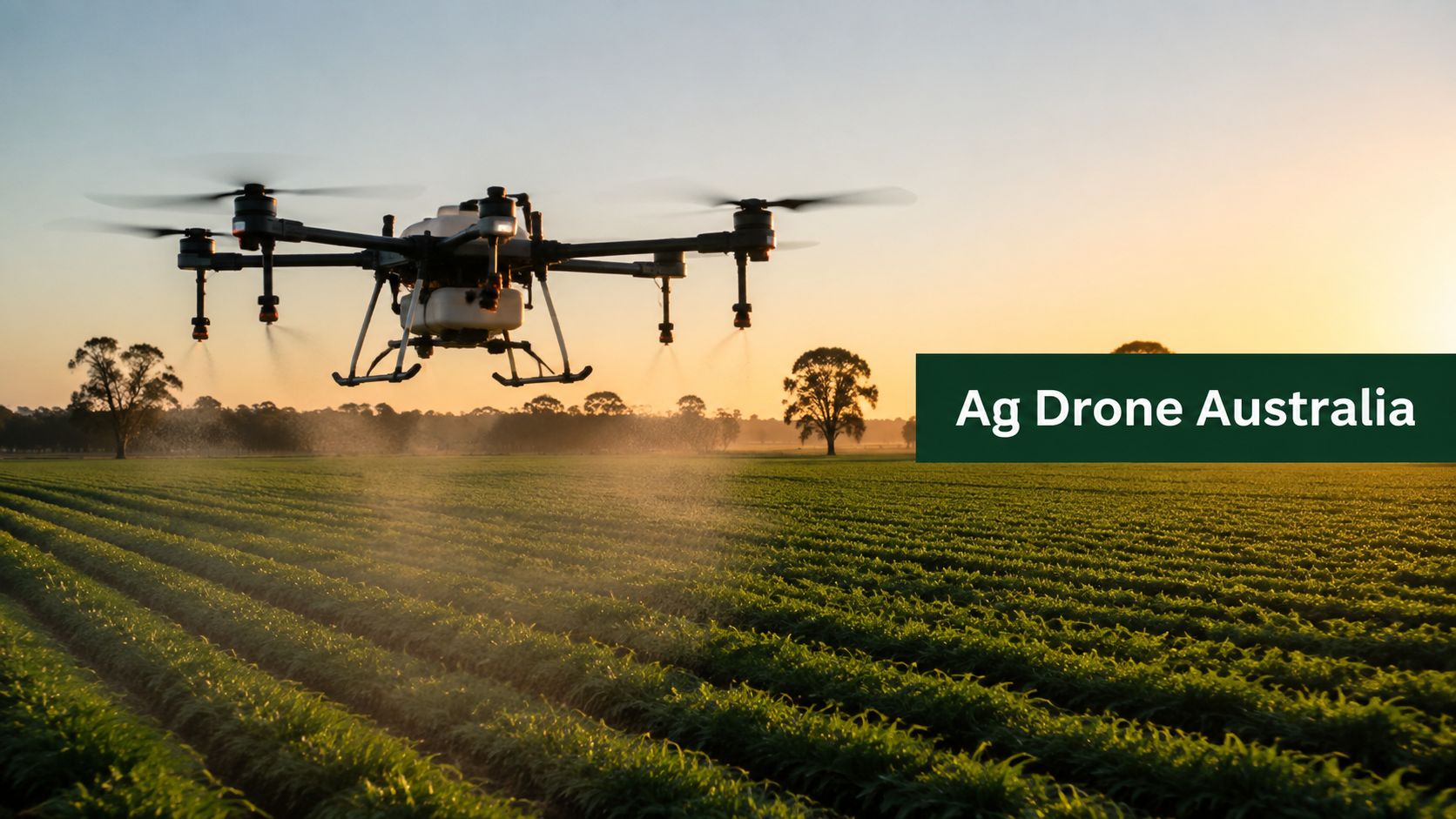
A wet-weather spray window is closing, the paddock is too soft for a boom sprayer, and the contractor's aircraft is committed elsewhere. For an Australian grower, an agricultural drone can look like a practical answer to a narrow operational problem, but buying one is only the beginning. The aircraft, pilot qualifications, chemical approvals, operating procedures, insurance and data workflow must work together.
The phrase agriculture drone Australia covers several different businesses, from an owner applying an approved product on the owner's land to a contractor running repeatable missions across multiple properties. The legal pathway, training burden and commercial return change significantly between those models. The most important question is no longer whether a drone can fly over a crop. It's whether the proposed capability can operate safely, legally and profitably at the required scale.
Table of Contents
- Why Australian Farms Are Looking to the Skies
- What Counts as an Agriculture Drone in Australia
- Spraying, Spreading, Mapping and Sensing Compared
- How CASA Rules Apply to Farm Drone Operations
- Pilot Training and Qualifications for Ag Operators
- Market Growth and the Actual Adoption Question
- Building the Business Case on an Australian Farm
- Next Steps and Common Questions for Operators
Why Australian Farms Are Looking to the Skies
A mixed-cropping operator in regional New South Wales might watch rain move across the forecast while a wheat paddock approaches the point where ground access becomes impractical. A horticulture manager in Queensland can face a similar decision when a narrow treatment window collides with labour shortages, saturated rows and rising input costs. A drone doesn't remove those pressures, but it can give the farm another way to reach selected areas without sending heavy machinery across fragile ground.
The attraction is usually operational rather than technological:
- Timeliness: A farm team can prepare a drone mission around the available weather and crop window.
- Access: Aerial application can reach wet, steep, uneven or tightly planted areas where ground equipment may cause damage.
- Labour allocation: One trained operator can collect targeted information or complete a defined task without sending multiple people through every paddock.
- Input control: Mapping can help identify where a treatment or inspection is needed.
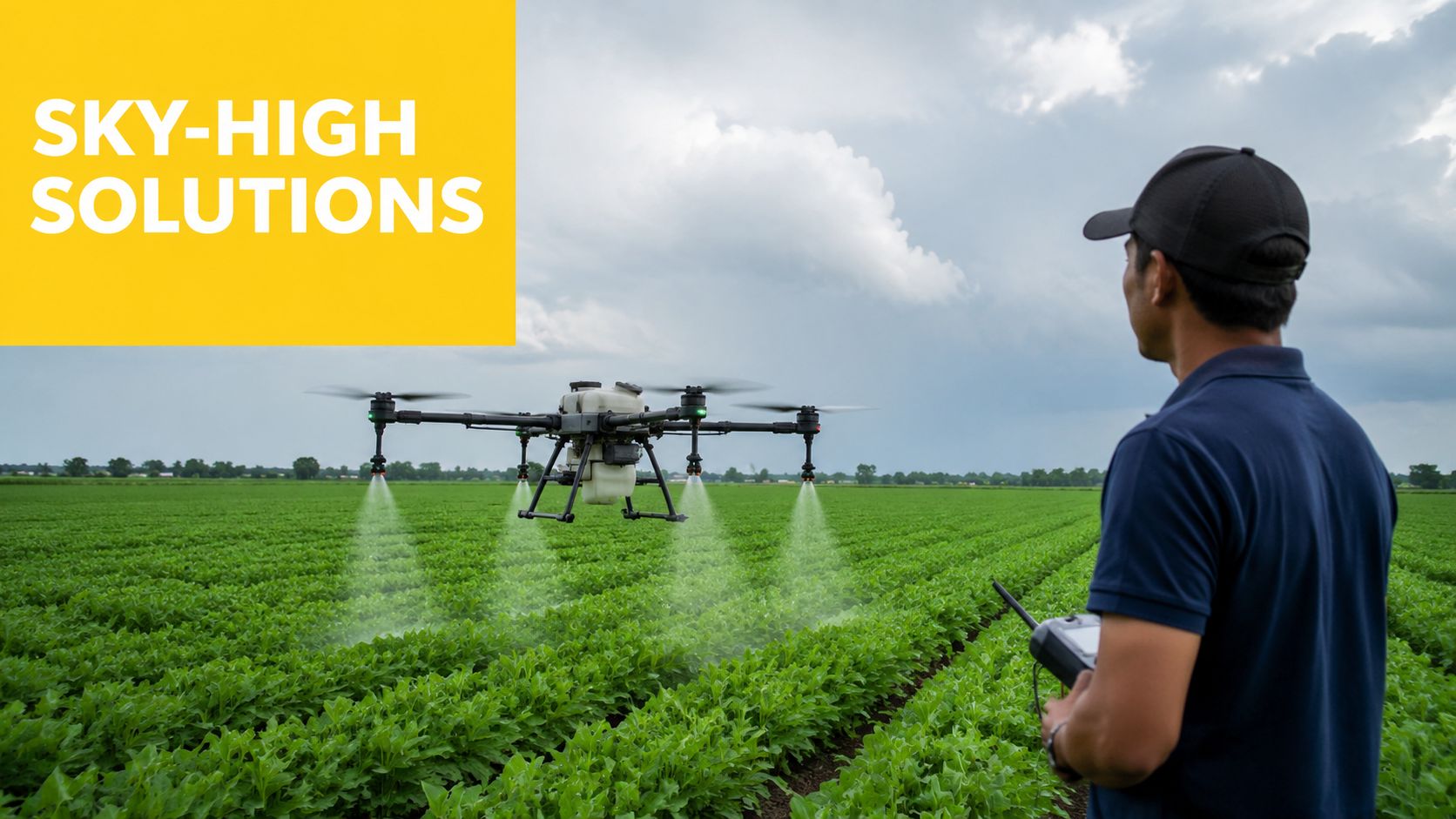
Traditional agricultural aviation remains valuable for large-area work, particularly where a qualified manned operator and suitable aircraft are available. A spray drone offers a different proposition. It can be positioned close to the task, used for selected zones and integrated with mapping or field records, although its area coverage, payload and regulatory permissions must match the job.
Australia's farm sector provides a substantial base for this technology. Federal analysis recorded 89,400 agricultural businesses operating across 384 million hectares in 2018–19 and used an assumption that one in ten businesses were already using drones, implying about 8,940 agricultural businesses at that time. The same analysis projected agricultural drone use could reach market saturation by 2030, with a maximum potential of 38,000 units, and estimated more than $18 billion in present-value output benefits across Australia from 2020 to 2040, including $3.488 billion for agriculture, forestry and fishing. Those figures are set out in the Australian Government's economic analysis of drones in Australia.
The adoption decision therefore comes down to three Australian questions: what CASA allows, what training the operation needs, and whether the economics fit the farm model.
What Counts as an Agriculture Drone in Australia
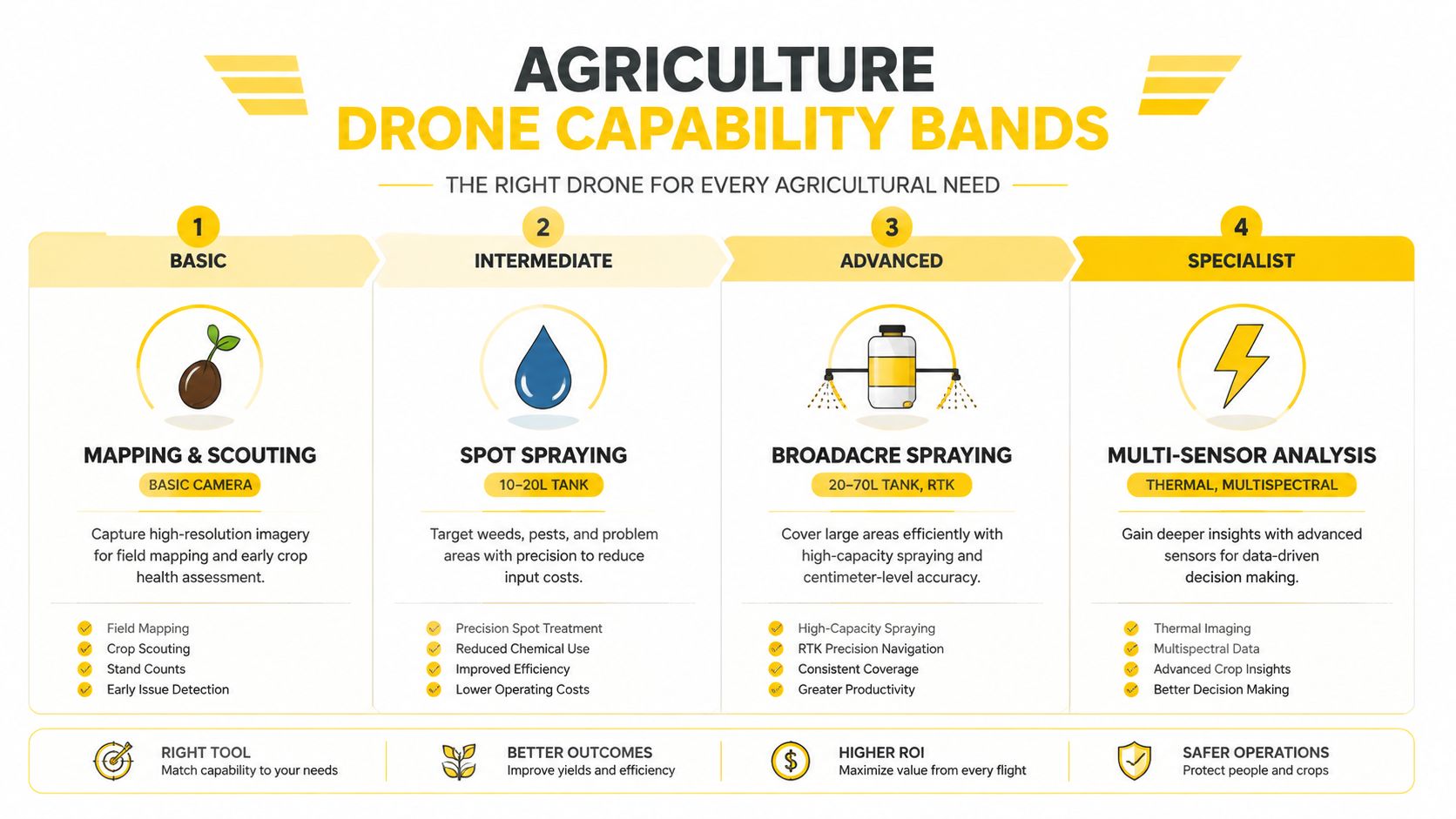
An agricultural drone is best defined by its job, not its brand or colour. The main capability bands are spraying, spreading, mapping and sensing. Each produces a different operational result and replaces a different part of farm work.
Four capability bands
Spraying drones carry liquid and apply it through pumps and nozzles. Farm teams use them for selected crop treatments, difficult-to-access areas and tasks where ground machinery could cause compaction or crop damage. The relevant comparison is a ground boom sprayer or manned aerial application, not a small camera drone.
Spreading drones distribute granular fertiliser, seed or bait. Their usefulness depends on calibrated flow, swath consistency and the material being applied. They can support targeted work that would otherwise require a spreader, aircraft or manual access.
Mapping drones carry an RGB camera and create survey outputs such as orthomosaics and elevation models. They complement crop walks, vehicle inspections and satellite imagery by providing detailed, repeatable views of a defined area at a chosen time.
Multispectral and thermal platforms capture information beyond ordinary visible imagery. Crop teams can use vegetation indices such as NDVI or NDRE to investigate stress, variability or irrigation faults, provided the data is interpreted within the agronomic context.
For a beginner, ACE BRONZE provides foundation commercial drone education covering drone operations, flight safety, aviation theory and practical skills.
CASA's plain-English guidance recognises that small RPA used as excluded RPA over the owner's land may support aerial spotting, surveying, agricultural operations, infrastructure inspections or cargo carriage. The controller still needs valid accreditation, the aircraft must be registered before its first flight, and standard operating conditions must be followed, as explained in CASA's plain-English guide to excluded RPA operations.
The aircraft category matters because heavier spray and spreading platforms can trigger aircraft-specific qualification requirements. A farm should identify the aircraft's maximum take-off weight, intended payload, operating area and mission type before selecting training or assuming an exemption applies.
Spraying, Spreading, Mapping and Sensing Compared
The correct capability depends on the farm decision. A spray drone isn't a substitute for a mapping drone, and a detailed map has no value unless someone can turn it into an agronomic action.
Spraying suits spot treatment, difficult terrain and selected crop zones. Operators must manage droplet size, wind, buffer areas and drift, especially near sensitive locations such as schools, waterways, residences or beekeeping sites. The product must also be approved for the proposed aerial application. Claimed coverage rates vary by aircraft, payload, speed, terrain and application volume, so a quoted hectare rate should be treated as an operational test result, not a universal promise.
Spreading requires calibration rather than just pressing “start”. Granule size, density, moisture, gate setting, flight speed and swath width affect distribution. Uses can include urea top-dressing, rice seeding and wild dog baiting, but each material and state environment creates its own safety and approval questions.
Mapping produces a visual and measurable record. An orthomosaic can support crop inspection, while a digital surface model can assist drainage planning in flood-prone paddocks. The output is most useful when the survey is repeatable and aligned with a farm-management decision.
Sensing adds another layer. Multispectral imagery can help create NDVI or NDRE zones, while thermal imagery can highlight temperature differences associated with irrigation faults or crop stress. These outputs support investigation and prioritisation, but they don't replace ground verification or agronomic judgement.
| Capability | Typical use on Australian farms | Coverage / output | Key equipment |
|---|---|---|---|
| Spraying | Targeted crop treatment and access to sensitive ground | Application coverage depends on tank, rate, weather and mission design | Liquid tank, pump, calibrated nozzles, positioning system |
| Spreading | Fertiliser, seed and bait distribution | Output depends on material flow and swath calibration | Hopper, metering gate, spreader mechanism |
| Mapping | Crop records, drainage planning and field measurement | Orthomosaics and elevation outputs at survey-defined resolution | RGB camera, RTK or PPK workflow where required |
| Sensing | Crop stress investigation and irrigation diagnosis | Vegetation or thermal maps for zone analysis | Multispectral or thermal sensor, processing software |
The XAG P150 Max agricultural drone overview illustrates why aircraft selection must follow the job. A high-capacity spray platform, a lightweight mapping aircraft and a multisensor survey system create different training, maintenance and compliance requirements.
How CASA Rules Apply to Farm Drone Operations
CASA's rules become easier to understand when the operation is described precisely. The key questions are who owns the land, who controls the aircraft, whether payment is involved, how heavy the RPA is, whether the pilot can maintain visual line of sight, and whether chemicals are being applied.
CASA clarified in May 2024 that no CASA authorisation is required for spraying operations using one drone on the operator's own land, subject to the applicable conditions. That clarification followed agricultural-use material released by CASA and drones.gov.au in September 2022. It doesn't mean the operator can ignore aviation obligations, aircraft registration, accreditation, operating limits or chemical rules.
The excluded pathway is limited. A farm owner using an eligible aircraft on owned or leased land for the owner's agricultural work may avoid a ReOC when all conditions are satisfied. A paid contractor working on a customer's property generally sits outside that landholder pathway and needs an organisation-level operating structure.
Rules that affect the paddock
A compliant operation must account for standard conditions such as daylight operations, visual line of sight, height limits, separation from people and property, airspace restrictions and safe aircraft operation. The exact requirement depends on the aircraft and operation, so a general “farm use” assumption isn't enough.
A spray task can also involve two separate regulatory systems. Victoria states explicitly that agricultural chemical spraying by drone is jointly regulated by Agriculture Victoria and CASA, meaning the operator must satisfy aviation requirements and chemical-use licensing requirements. The operator also needs to check the APVMA label and relevant state directions before applying a product by drone.
Practical rule: A CASA qualification permits aviation activity within its scope. It doesn't automatically authorise chemical handling or application.
| Pathway | Pilot requirement | BVLOS allowed | Best fit |
|---|---|---|---|
| Own-land excluded operation | Valid accreditation or qualification appropriate to the aircraft and operation | Not under the ordinary excluded conditions | Owner's agricultural work on owned or leased land |
| Commercial operator under a ReOC | RePL and organisation authorisation under documented procedures | Possible only with the required approval and conditions | Contractors, multi-pilot teams and paid services |
| Approved BVLOS operation | Relevant RePL, competency, procedures and CASA approval pathway | Yes, when specifically approved | Repeatable area operations and scalable enterprise work |
CASA's drone laws in Australia guidance can help operators organise the questions, but the final decision should be based on current CASA requirements and the actual operation. Businesses should also document responsibilities for safe work, supervision and incident response. Guidance on PCBU duties for flight handling can help connect aviation procedures with broader workplace safety duties.
Pilot Training and Qualifications for Ag Operators
Agricultural drone training works as a layered system. The pilot needs aviation competence, the aircraft may require a category or aircraft-specific qualification, radio training may be relevant, and chemical application sits under state or territory rules.
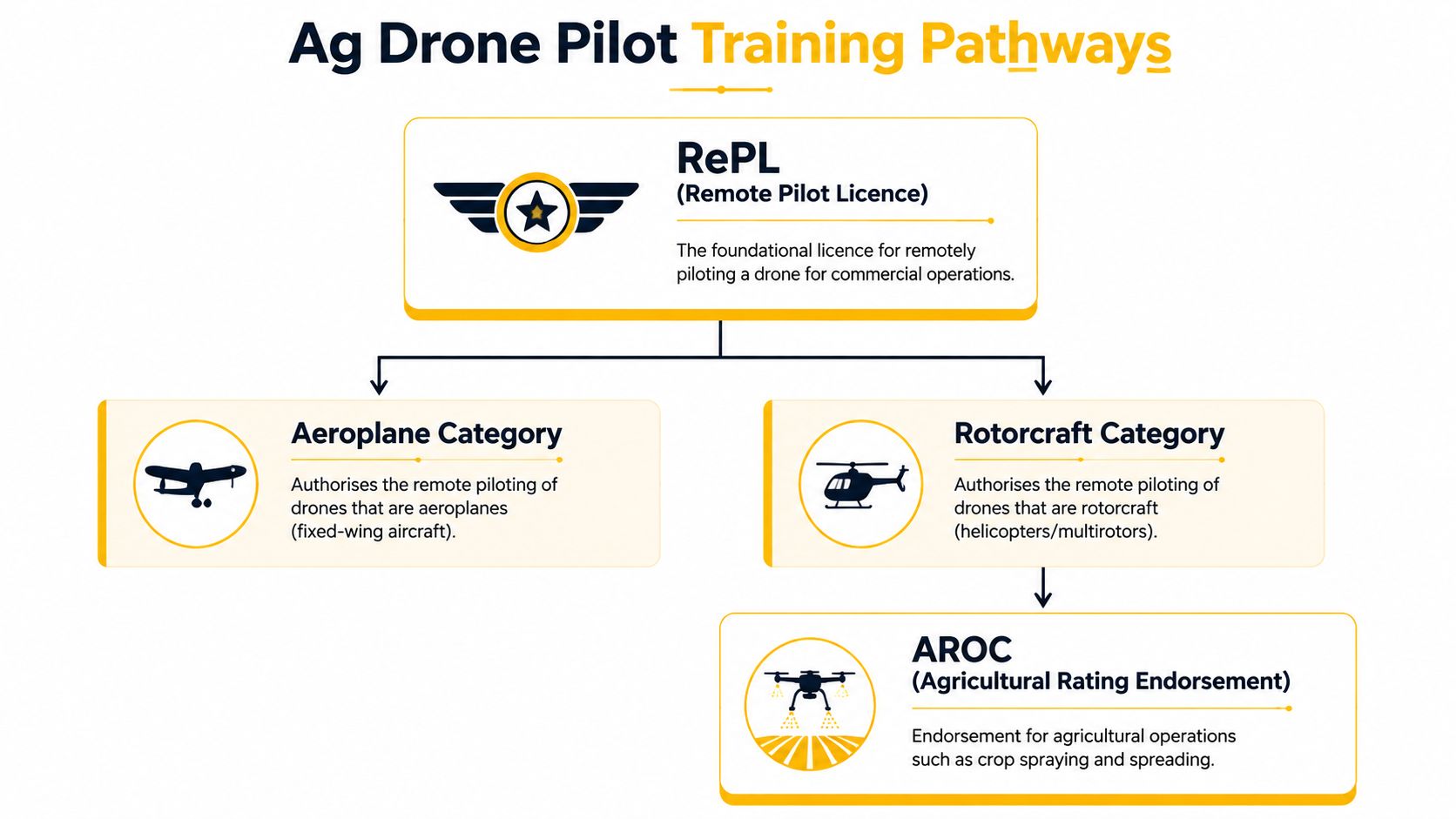
The Remote Pilot Licence, or RePL, forms the aviation foundation for commercial drone work. The licence scope must match the aircraft category and operating conditions. A pilot trained on a smaller multirotor shouldn't assume that qualification automatically covers a heavier spray platform.
Matching the pathway to the business
An owner-operator may need a suitable RePL, aircraft registration, operational records and the relevant chemical credentials, while relying on the own-land pathway if every excluded-operation condition is met. That pathway doesn't remove the need for safe operation or make paid work on another farm automatically permissible.
An AROC is relevant when the operation requires transmission on an aeronautical radio frequency. It can also form part of a broader aviation communication capability for operators working near aerodromes or in busier airspace. The requirement depends on the operation, not on the word “agriculture”.
A contractor operating for payment across multiple farms generally needs a ReOC structure. The certificate holder manages procedures, pilot authorisation, risk controls, maintenance, records and reporting. An enterprise may use a corporate ReOC and build an internal training pipeline so several staff can operate consistently under the same procedures.
State chemical training must sit alongside aviation credentials. A Queensland operator might need to investigate the ACDC pathway, while a New South Wales operator checks the equivalent state requirements. The chemical, property, product and business model determine the precise obligations.
The Certificate III in Aviation and drone pilot careers can be relevant to people seeking a broader aviation pathway rather than a single agricultural task.
Training principle: The aircraft, mission and business model should be defined before enrolment. Training selected without those details can leave a farm with a certificate that doesn't match the intended work.
CASA's regulatory direction is increasingly focused on scalable operations. In June 2025, CASA said it had introduced a specific aviation theory exam for BVLOS work, and in October 2025 it launched four broad area approval pathways under TMI 2025-03. These developments point to a future in which operational design and approval management matter as much as stick skills, as documented in CASA's 2025 RPAS Australian skies conference update.
Market Growth and the Actual Adoption Question
An Australian farm can legally fly a drone over its own land for some work, yet still face a very different question when it wants repeatable service across several properties. Market growth shows rising interest, but the practical adoption test is whether the operation can connect suitable aircraft, trained people, compliant procedures and a workable return.
Federal analysis links drone uptake with the size of Australia's farm sector. CASA consultation material reported that about 10% of Australian agricultural businesses use drones, with adoption expected to rise further by 2040 as farmers pursue cost savings and productivity gains. The consultation summary appears in CASA's regional BVLOS consultation material.
A separate estimate places the Australian agriculture drones market at USD 69.3 million in 2025 and projects USD 578.4 million by 2034, with a 25.79% CAGR from 2026 to 2034, according to IMARC's Australia agriculture drones market analysis. Another 2026 estimate says agriculture represents 24.5% of Australia's broader drone end-use demand. These figures describe market activity, not guaranteed farm returns. They explain why agribusinesses are assessing a complete operating capability rather than asking only whether a drone is legal.
Selecting the capability stack
A horticulture business may gain more from a smaller spot-spraying platform combined with thermal or multispectral inspection. A broadacre operation may assess a higher-capacity spraying or spreading aircraft for selected tasks. An agronomy contractor might begin with mapping and processed outputs instead of owning every application platform.
The decision should test:
- Task frequency: Repeated seasonal work gives a stronger basis for internal capability than an occasional flight.
- Area and access: Block size, terrain, canopy and wet-ground conditions influence aircraft choice.
- Compliance complexity: Spraying, night work, multiple sites and BVLOS planning add approval requirements.
- Data workflow: Mapping creates value only when someone can interpret and act on the results.
- Service model: Hiring, contracting or owning may suit different stages of adoption.
Farm managers should also include drone work in the wider risk program. Guidance on managing farm risk with precision agriculture helps frame questions about insurance, data, equipment failure, chemical exposure and operational continuity.
For larger operations, the constraint is increasingly scalable approval and BVLOS capability. A drone used over one paddock within visual line of sight is not automatically ready for repeatable missions across multiple properties. The aircraft may be capable, but the business also needs an approval pathway, trained operators and procedures that can support the intended scale.
Building the Business Case on an Australian Farm
A farm drone investment should be assessed as a stack of costs and decisions, not as a single aircraft purchase. The financial model needs to separate the aircraft from training, registration, chemical licensing, insurance, batteries, replacement parts, software, maintenance and the labour required to operate and interpret the system.
The savings side needs equal discipline. Potential levers include reduced labour travel, faster response to pest or disease issues, less ground compaction, targeted chemical application and better irrigation investigation. Those benefits should be measured against the farm's own baseline, such as hectares completed in a spray window, litres used per defined treatment, time spent scouting or the value of avoiding a delayed intervention.
Three investment models
| Capability | Own-land spot spraying | Contractor hire | Enterprise BVLOS stack |
|---|---|---|---|
| Aircraft ownership | Farm owns and maintains a suitable platform | Contractor supplies aircraft and operator | Business owns or manages a fleet and supporting systems |
| Training burden | Internal pilot needs appropriate aviation and chemical qualifications | Contractor carries primary pilot responsibility, while the farm still manages site coordination | Multiple pilots need consistent training, authorisation and currency |
| Regulatory focus | Excluded-operation conditions, registration and safe operating limits | ReOC structure and customer-site procedures | ReOC, documented systems, site approvals and BVLOS pathways |
| Best fit | Regular work on the owner's land | Occasional, specialist or seasonal demand | Repeated work across large areas or multiple properties |
| Main commercial question | Can utilisation justify ownership and maintenance? | Is the service cost lower than internal capability? | Can the organisation sustain compliance and operational scale? |
A useful model compares the cost per completed farm decision, not only the cost per flight. Mapping that changes an irrigation action, a spot treatment that avoids unnecessary application or a rapid inspection after weather damage may have different values even when the flight time is similar.
The drone quote calculator can help organise an initial training or service estimate, but it shouldn't replace a farm-specific budget. A serious assessment includes downtime, battery charging, weather cancellations, data processing, chemical compliance, record keeping and the cost of a trained person being unavailable for other work.
Payback periods vary widely across cotton, viticulture, horticulture and broadacre operations. No universal payback window should be assumed without the farm's area, task frequency, labour rates, application requirements and regulatory pathway.
Next Steps and Common Questions for Operators
A practical decision path starts with the intended operation rather than the aircraft brochure.
A hobby or small farm operator should define whether the work is mapping, inspection, spreading or spraying, then confirm registration, accreditation and operating conditions before flying.
An established grower should document the land ownership, aircraft weight, chemical products, flight areas, available pilot and seasonal workload. The next step may be RePL enrolment, state chemical licensing confirmation or a comparison between contractor hire and internal capability.
An aspiring commercial operator should scope the RePL, aircraft category, ReOC requirements, operating procedures, insurance and customer-site controls before accepting paid work. BVLOS ambitions should be included at the beginning, not added after the business has built a VLOS-only workflow.
The Ace Aviation FAQ provides a further starting point for questions about drone training and aviation qualifications.
Frequently asked questions
Can a farmer spray their own land without a RePL?
CASA clarified that no CASA authorisation is required for spraying with one drone on the operator's own land, when the relevant conditions apply. That statement shouldn't be read as a blanket exemption from every qualification or operating requirement. Aircraft type, accreditation, registration, operating conditions and state chemical rules still need to be checked.
Is BVLOS approval available for agricultural work?
CASA has been developing pathways intended to support scalable BVLOS operations. The June 2025 BVLOS theory exam and four broad area approval pathways launched in October 2025 indicate regulatory development, but approval remains conditional on the operation, procedures, aircraft and risk controls.
What insurance should an operator arrange?
Insurance requirements depend on the business, aircraft, activity and contract. Commercial operators should discuss aviation liability, equipment, chemical and workplace exposures with a qualified insurance adviser, and ensure the policy reflects actual operations rather than only basic recreational flying.
Do chemical rules differ between Australian states?
Yes. Chemical application requirements are administered through state and territory systems, and the applicable rules can depend on the product, location, operator and whether services are provided for payment. The APVMA label and the relevant state regulator should be checked before application.
How often must a RePL be renewed?
RePL currency and ongoing competency requirements should be confirmed with CASA or the approved training organisation because obligations can depend on the licence scope, aircraft category and operational role. Operators should maintain training and competency records rather than treating the original qualification as permanent permission for every future mission.
Ace Aviation Aerospace Academy provides relevant pathways including Remote Pilot Licence training, Aeronautical Radio Operator Certificate training, ReOC consulting and enterprise or corporate drone training for Australian operations. Visit Ace Aviation Aerospace Academy to discuss the aircraft, farm task and operating model before selecting training.