
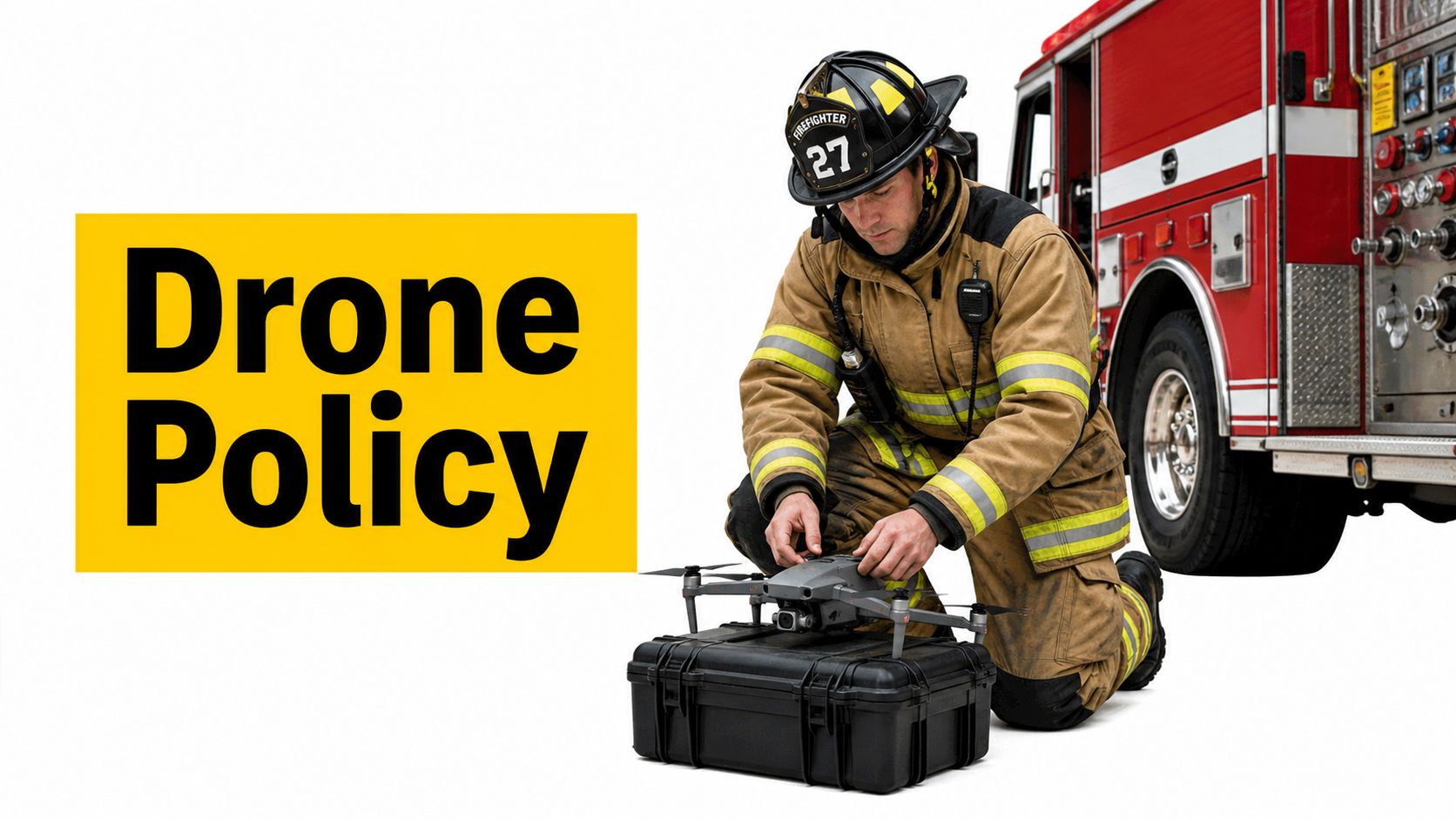
A drone policy can look straightforward until a thermal camera finds a smouldering hotspot beside a recently contained fire, while a separate unauthorised drone appears in the same airspace and forces firefighting aircraft to stand down. The aircraft may be small, but the operational consequences are not. A clear fire department drone policy gives crews a lawful way to use aerial intelligence without creating another aviation hazard.
For Australian agencies, the central issue is not whether drones are useful. They already support reconnaissance, search and rescue, fire investigation, hotspot identification and damage assessment. The difficult question is how an agency moves from CASA's public warning to stay clear of bushfires to a controlled, authorised mission that supports firefighters. The answer lies in command authority, pilot competence, airspace coordination, privacy controls and reliable records.
Table of Contents
- Why Fire Department Drone Policy Matters Now
- The CASA Regulatory Layer Explained
- Core Pillars of a Strong Drone Policy
- Matching Controls to Mission Risk
- Privacy, Data and Evidence Handling
- Training, Certification and Recurrent Practice
- Implementation Checklist and Sample Policy Clauses
- Frequently Asked Questions
- How can CASA prohibit flying near bushfires while authorised agencies use drones at fires?
- Are BVLOS and night operations automatically allowed for emergency services?
- Who owns fire-response drone footage?
- How can a small rural service begin?
- What should happen when a firefighting aircraft arrives unexpectedly?
Why Fire Department Drone Policy Matters Now
A thermal-imaging drone can reveal residual heat after the visible fire front has passed. That information can help crews locate hotspots that aren't obvious from the ground and decide where resources are needed. The NSW Rural Fire Service reports using thermal-imaging aircraft to provide live fireground information and locate residual hotspots, with more than 50 trained drone pilots positioned across the state. NSW Rural Fire Service reporting on drone operations illustrates how remotely piloted aircraft have become part of organised emergency capability.
The contrasting risk is equally practical. CASA warns that firefighting helicopters and aeroplanes often operate at very low altitudes around bushfires. When an unauthorised drone is detected, firefighting aircraft may be grounded for the safety of pilots and responders, potentially hampering the response. CASA's bushfire drone safety flyer makes the operational consequence clear: an uncoordinated launch can interrupt essential aviation activity.
From isolated trials to governed capability
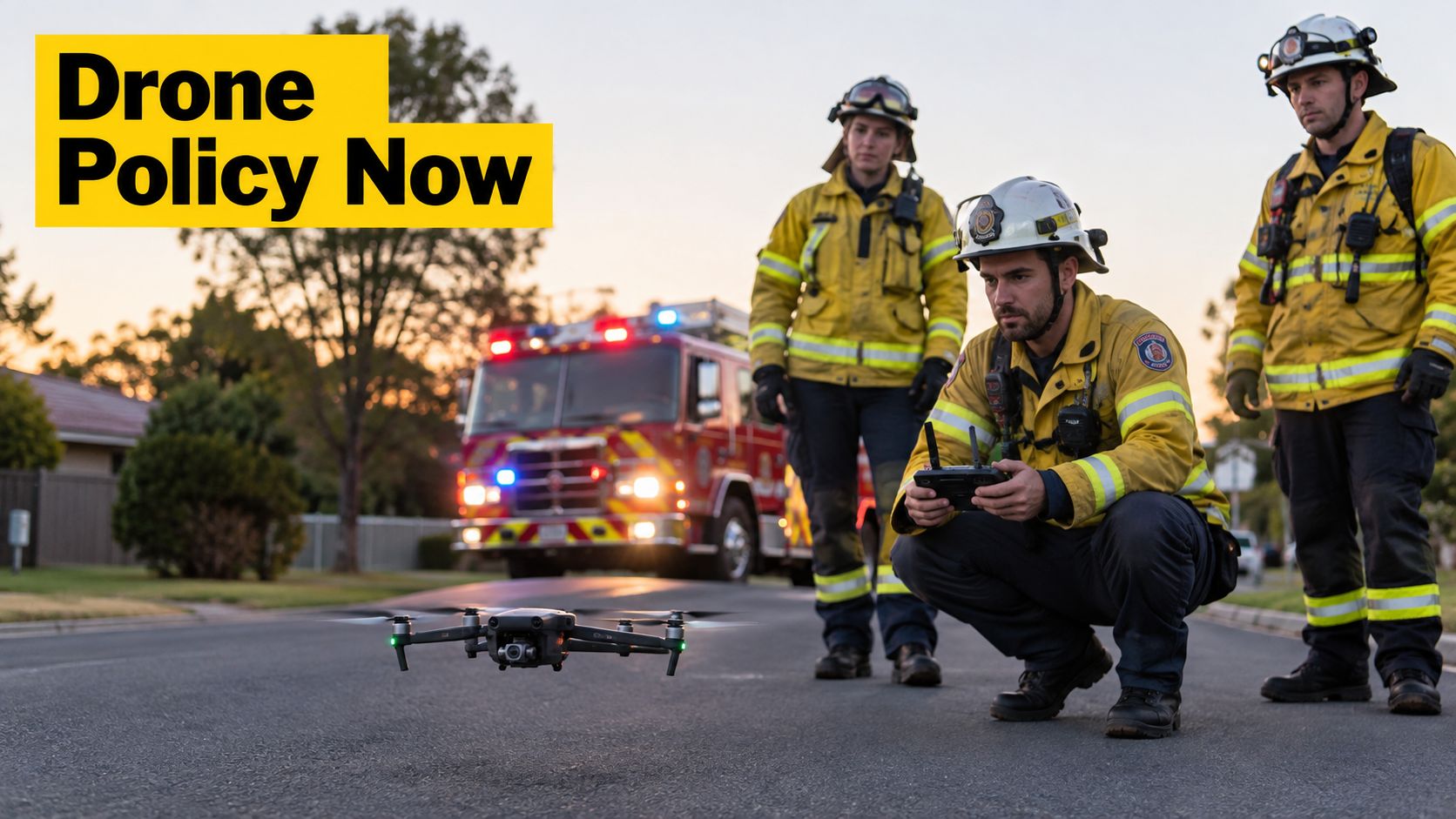
Queensland's Drones Strategy records that Queensland Fire and Emergency Services obtained a department-wide CASA Remote Operator's Certificate, or ReOC, in 2017. The strategy also describes a Brisbane-based, 12-month trial examining remotely piloted aircraft for firefighting, hazardous-material management, fire investigation, search and rescue and improved operational intelligence. Australia's bushfire drone capability overview shows the shift from ad hoc experimentation to accountable organisational governance.
A written policy should therefore define who may fly, who approves a mission, how aircraft are checked, how other aircraft are notified, how footage is protected and how incidents are reported. Readers assessing the broader legal framework can also review Australian drone laws and operating requirements.
Operational principle: A drone must be treated as part of the incident aviation system, not as an independent camera that happens to fly.
The CASA Regulatory Layer Explained
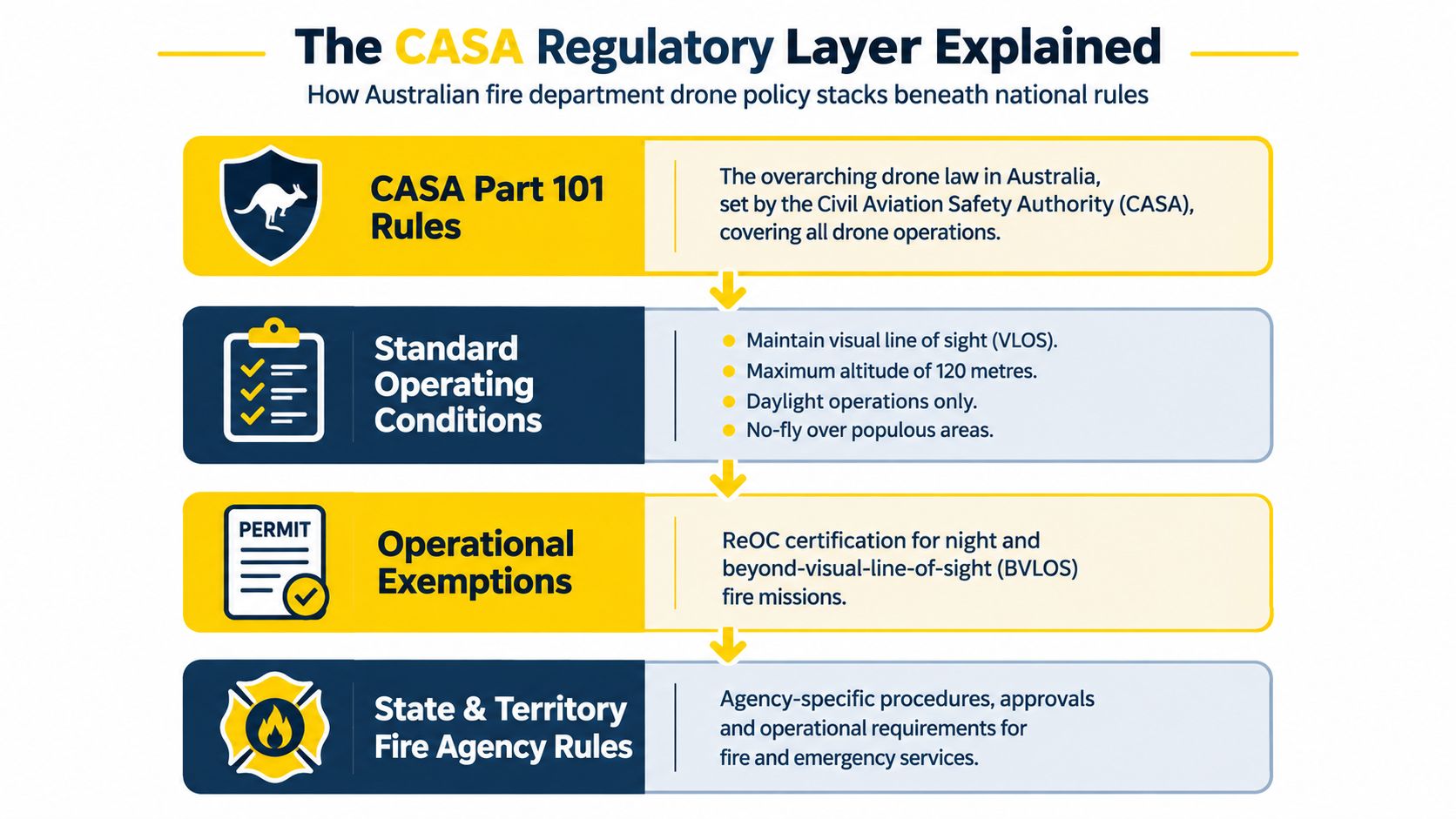
A useful way to understand Australian fire agency drone operations is to separate three regulatory layers. The first is the ordinary CASA operating framework. The second is organisation-level approval and capability management. The third is incident-level command and airspace coordination.
Under standard CASA guidance, drone operations generally require visual line of sight, daylight operation, a maximum height of 120 metres above ground level, separation from people and avoidance of controlled airports and populous areas. CASA's published baseline also identifies a 30-metre separation requirement from other people. These are starting conditions, not a complete emergency-services approval.
Organisation-level authorisation
An agency-wide ReOC provides a governance foundation for routine operations. It requires documented procedures, trained personnel, operational controls and safety-management arrangements. Those controls give a policy writer a place to define pilot authorisation, mission approval, aircraft maintenance, privacy, evidence handling and reporting.
Emergency-service operations can require approvals or exceptional-circumstances arrangements for missions involving night operations, operations over or near people, or beyond visual line of sight. CASA has supported emergency agencies through specific approvals, including BVLOS capability, but an exemption doesn't turn a high-risk mission into a low-risk one. A risk assessment, trained crew and incident-command control remain necessary.
The third layer is the incident itself. AFAC guidance states that non-agency remotely piloted aircraft should operate in an emergency area only with the incident controller's knowledge and approval. CASA also warns that drones must not be flown during emergency operations without permission from the emergency agency. Agencies developing organisational governance can use the ReOC framework for Australian operators as a reference point, while still obtaining advice suited to their own approval conditions.
Core Pillars of a Strong Drone Policy
A strong policy works like a chain of custody for aviation decisions. Each link should show who was authorised, what aircraft was used, why the mission was approved, how the flight was controlled and what happened afterwards. If one link is missing, an agency may struggle to explain its actions during an audit or investigation.
Six controls that should connect
Pilot authorisation: Maintain a register of approved remote pilots, their qualifications, currency, operational permissions and any limitations. A licence alone doesn't establish that a pilot is competent for smoke, thermal imaging or emergency-airspace work.
Aircraft and payload standards: Record each aircraft, camera, thermal sensor, battery and relevant software configuration. The register should identify inspection status, defects and maintenance history.
Mission approval: Treat tasking like a flight plan that needs sign-off before launch. The record should state the operational purpose, location, altitude, operating area, remote pilot, observer arrangements and approval authority.
Airspace and communications: Define how the crew checks for helicopters, fixed-wing aircraft, temporary restrictions and nearby incident activity. The crew also needs a reliable way to communicate with incident command and an immediate recall or landing instruction.
Maintenance and records: Keep pre-flight checks, battery records, firmware decisions, defects, repairs and flight logs together. A drone that isn't logged shouldn't be dispatched, even if it appears serviceable.
Incident reporting: Require reports for flyaways, lost links, unplanned landings, airspace conflicts, privacy concerns, equipment failures and near misses. Reporting should support learning rather than encourage crews to hide weak signals.
Why the pillars must interlock
Mission approval without a pilot register leaves the agency unable to verify competence. A qualified pilot without an approved aircraft creates the opposite gap. The policy should make every launch traceable from operational need through to final record storage.
For agencies planning missions that may require BVLOS capability, CASA-aligned BVLOS training and operational guidance can help identify the additional competency and approval questions. The policy itself must still reflect the agency's authorisations and local incident arrangements.
Matching Controls to Mission Risk
A routine training flight and an active-fire reconnaissance mission may use the same aircraft, but they don't present the same hazards. A practical policy should increase controls as the drone moves closer to crewed aircraft, smoke, crowds, unstable terrain and rapidly changing incident boundaries.
| Mission category | Approval level | Comms and airspace | Documentation |
|---|---|---|---|
| Routine training | Training supervisor or delegated aviation manager | Published training area, standard airspace check and normal crew communications | Training plan, pilot attendance, pre-flight check and flight log |
| Pre-incident intelligence | Agency operations authority | Airspace review, defined operating area and notification of affected teams | Tasking record, risk assessment, imagery purpose and flight log |
| Active-fire reconnaissance | Incident controller before launch | Direct incident-command communications, crewed-aircraft coordination and immediate landing procedure | Mission approval, pilot identity, altitude, operating area, hazards and post-flight report |
| Post-fire hotspot assessment | Incident or recovery authority, based on conditions | Thermal mission coordination, weather review, lookout duties and lost-link plan | Survey area, sensor used, battery and weather records, imagery storage and findings |
The active-fire threshold
For active fires, the default should be no launch unless the mission is formally tasked and approved. The incident controller should know the drone's operating area and altitude, the identity of the remote pilot, the communications method and the procedure for an immediate recall or landing.
AFAC's coordination approach is important because a drone may be difficult for a helicopter crew to detect against smoke, terrain or glare. CASA guidance on flying near emergencies supports the need for emergency-agency permission and coordination.
Post-fire does not mean risk-free
A survey after the main fire front has passed may still involve residual crews, smoke, degraded visibility, unstable ground and aircraft returning to the area. Thermal imaging creates strong operational value, but it also creates a temptation to treat the mission as routine. Agencies considering the boundary between ordinary and excluded operations can review guidance on excluded-category drone operations, then apply the controls required by their own authorisation.
Privacy, Data and Evidence Handling
A fire department drone may capture identifiable people, homes, vehicles, neighbouring properties and the activities of other agencies. Privacy controls shouldn't be added after a public complaint. They belong in the mission design, just like airspace checks and battery planning.
The Privacy Act 1988 and Australian Privacy Principles apply to covered entities, including Australian Government agencies, organisations with annual turnover above $3 million, and certain other bodies. The Office of the Australian Information Commissioner's drone guidance says covered entities must notify people that their image may be captured before recording them, protect recorded personal information and destroy or de-identify it when it's no longer needed.
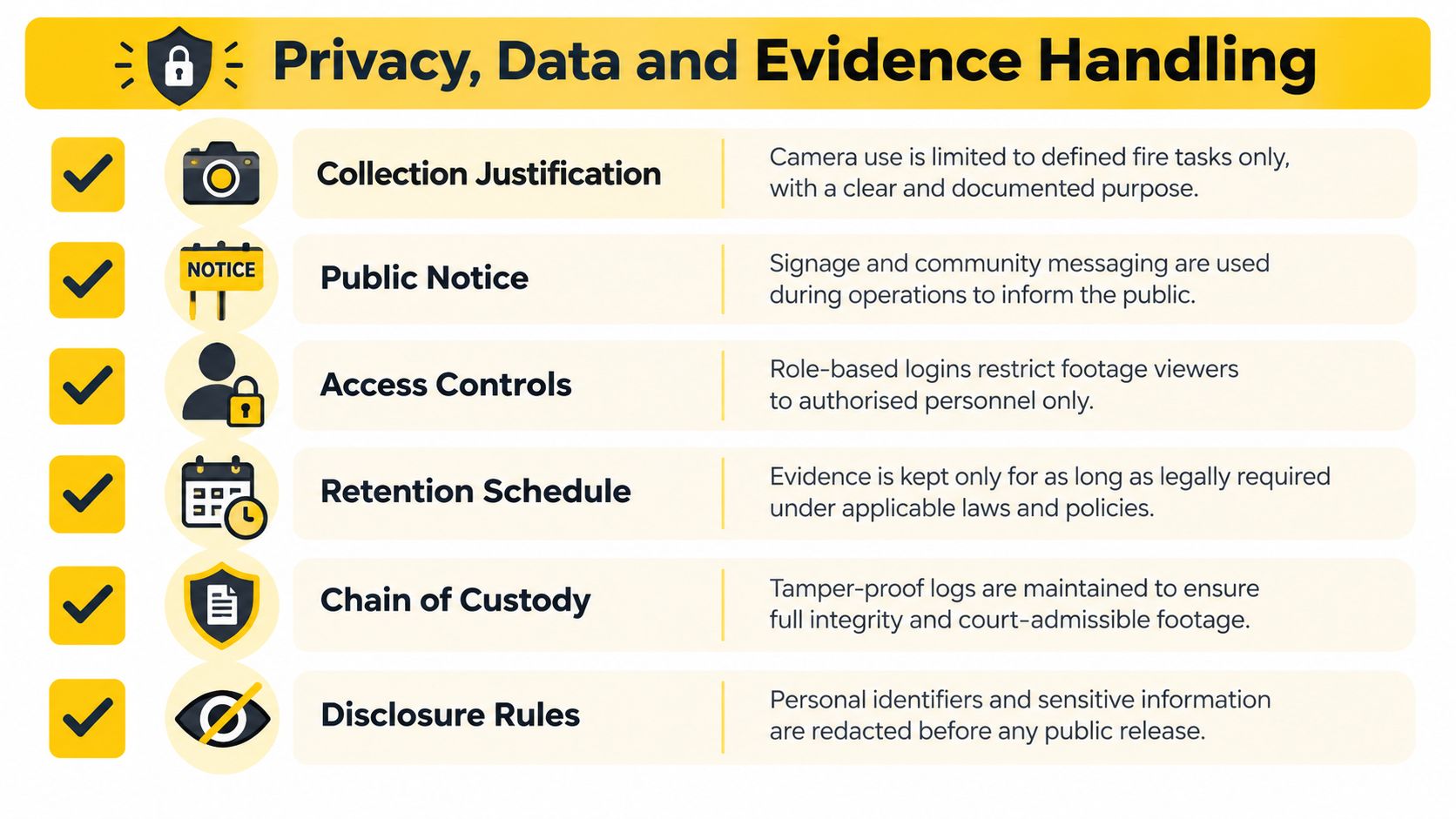
Operational privacy controls
A policy should specify:
- Collection purpose: Use cameras and thermal sensors for defined emergency, safety, investigation or recovery tasks.
- Public notice: Provide signage, verbal notice or community messaging where practicable, while recognising that urgent life-saving operations may limit advance notice.
- Access controls: Restrict live feeds and stored footage to personnel with an operational, investigative or legal need.
- Retention: Set retention periods according to operational, legal, evidentiary and archival requirements.
- Disclosure: Define when footage may be provided to investigators, insurers, coroners, courts or partner agencies.
- Destruction or de-identification: Remove or de-identify information when the authorised retention period ends.
The same discipline applies to digital systems used for training and incident management. Administrators responsible for learning platforms may find MEDIAL's Article 32 guide for LMS administrators useful for broader information-security thinking, although Australian agencies must apply Australian privacy obligations to their own operations.
Preserving evidentiary value
If footage may support an arson investigation, coronial inquiry or insurance assessment, the original file should remain distinguishable from edited copies. The flight log should identify the pilot, aircraft, sensor, date, time, location, mission authority and transfer history. Each handover should be recorded so an investigator can explain where the file came from and who controlled it.
Agencies can also review privacy considerations for drone operations when drafting notices, access rules and retention procedures.
Training, Certification and Recurrent Practice
A policy only works when the agency has people who can carry it out under pressure. Emergency drone operations combine aviation decisions with incident management, radio discipline, sensor interpretation, privacy awareness and rapid changes in risk.
The Remote Pilot Licence, or RePL, is the relevant CASA qualification for commercial drone operations. A pilot who operates for a fire agency should also receive aircraft-specific training, local procedures and scenario practice. Where the crew needs to communicate with incident aircraft or use aviation radio procedures, the Aeronautical Radio Operator Certificate, or AROC, may be directly relevant.
A practical competency pathway
- Entry and foundation: New personnel should learn aviation safety, CASA operating rules, aircraft limitations, weather assessment, pre-flight checks and emergency procedures.
- RePL capability: Remote pilots should hold the RePL appropriate to the aircraft and operation, then demonstrate competence on the department's systems and payloads.
- Radio communication: Personnel using aviation radio should hold the relevant AROC and practise concise, standard communications.
- Organisational governance: Agencies seeking broader operational authorisations should establish and maintain the systems required for their ReOC and approved procedures.
- Recurrent practice: Training should include lost-link drills, crewed-aircraft conflict responses, smoke and visibility scenarios, thermal interpretation, controlled-airspace familiarisation and post-incident debriefs.
Training should map to mission categories. Routine training can build basic handling and emergency responses. Pre-incident intelligence can add mapping and information-management tasks. Active-fire reconnaissance requires incident-command integration and aviation communications. Post-fire assessment should test thermal operations, data handling and decisions around residual hazards.
Ace Aviation Aerospace Academy provides relevant options including RePL and AROC training, ReOC consulting, and enterprise or corporate drone training that can be adapted to an agency's standard operating procedures. Any provider selected by an agency should be assessed against the aircraft, mission types, authorisations and competency evidence the policy requires.
Implementation Checklist and Sample Policy Clauses
A small, usable policy is safer than a lengthy document that crews can't apply during an incident. The agency should start with the decisions that control launch authority, airspace separation, pilot competence, aircraft readiness, data handling and review.
Implementation checklist
- Nominate governance: Assign an accountable executive, operational owner, safety contact and privacy contact.
- Confirm authorisations: Map ordinary CASA conditions, existing approvals and any ReOC obligations.
- Create registers: Record pilots, aircraft, payloads, batteries, maintenance status and competency evidence.
- Build tasking workflow: Provide a standard mission request and an incident-controller approval record.
- Set airspace controls: Define checks, notifications, communications, visual observers and immediate landing procedures.
- Complete privacy assessment: Identify collection purposes, notices, access rights, retention and disclosure rules.
- Schedule practice: Test normal missions, lost links, crewed-aircraft arrivals, degraded visibility and data transfer.
- Audit the system: Review flight logs, incidents, defects, approvals and training records on a planned cycle.
Sample clauses for adaptation
Launch authority: A remotely piloted aircraft must not launch over or near an emergency, fire or prescribed burn unless the mission has been tasked and approved by the incident controller or a formally delegated authority.
Approval record: The approval record must identify the operational purpose, remote pilot, aircraft, operating area, altitude, communications method, airspace check and landing or recall procedure.
Crewed-aircraft conflict: The remote pilot must immediately land or follow the incident controller's recall instruction when crewed aircraft enter the operating area or when the controller identifies an unacceptable aviation conflict.
Night operations: Night operations are prohibited unless the agency holds specific authorisation and the mission meets the required risk, equipment, crew and command controls.
The policy owner should review the document after significant incidents, changes to CASA guidance, changes in agency structure and lessons from exercises. Review should test whether crews can understand the launch decision quickly, not merely whether the document contains the correct headings.
Frequently Asked Questions
How can CASA prohibit flying near bushfires while authorised agencies use drones at fires?
The public prohibition addresses unauthorised activity that can conflict with firefighting aircraft. An agency-operated mission is different when it has emergency-agency permission, incident-controller approval, trained personnel, airspace coordination and documented controls. The distinction is authorisation and integration, not the physical size of the drone.
Are BVLOS and night operations automatically allowed for emergency services?
No. Emergency operations may be supported by exemptions or customized CASA approvals, but the permission applies within defined conditions. The agency still needs competent crew, a risk assessment, airspace coordination and command control.
Who owns fire-response drone footage?
Ownership and control depend on the agency's legal structure, contracts, records obligations and applicable privacy rules. The policy should identify the responsible records custodian and establish controlled disclosure processes for investigators, insurers, coroners and other authorised agencies.
How can a small rural service begin?
It can start with a limited mission set, a pilot and aircraft register, a written launch-approval process, basic privacy controls, flight logs and an agreement with incident command. The service should expand only as training, authorisations, equipment and communications capability mature.
What should happen when a firefighting aircraft arrives unexpectedly?
The drone crew should follow the immediate landing or recall procedure and notify incident command. A flight must never continue just because the drone is already airborne.
Ace Aviation Aerospace Academy supports Australian agencies and operators with relevant RePL and AROC training, ReOC consulting, and enterprise or corporate drone training customised to their needs. Visit Ace Aviation Aerospace Academy to discuss a training pathway that reflects the agency's aircraft, emergency missions and CASA compliance responsibilities.