Short direct answer
A façade cleaning drone carries water or cleaning equipment to wash building exteriors from the air. In Australia, commercial pilots generally need a RePL for the aircraft and operation, and businesses often need a ReOC. The exact pathway depends on the drone, site and CASA operating conditions.
Detailed explanation: what commercial cleaning drones do
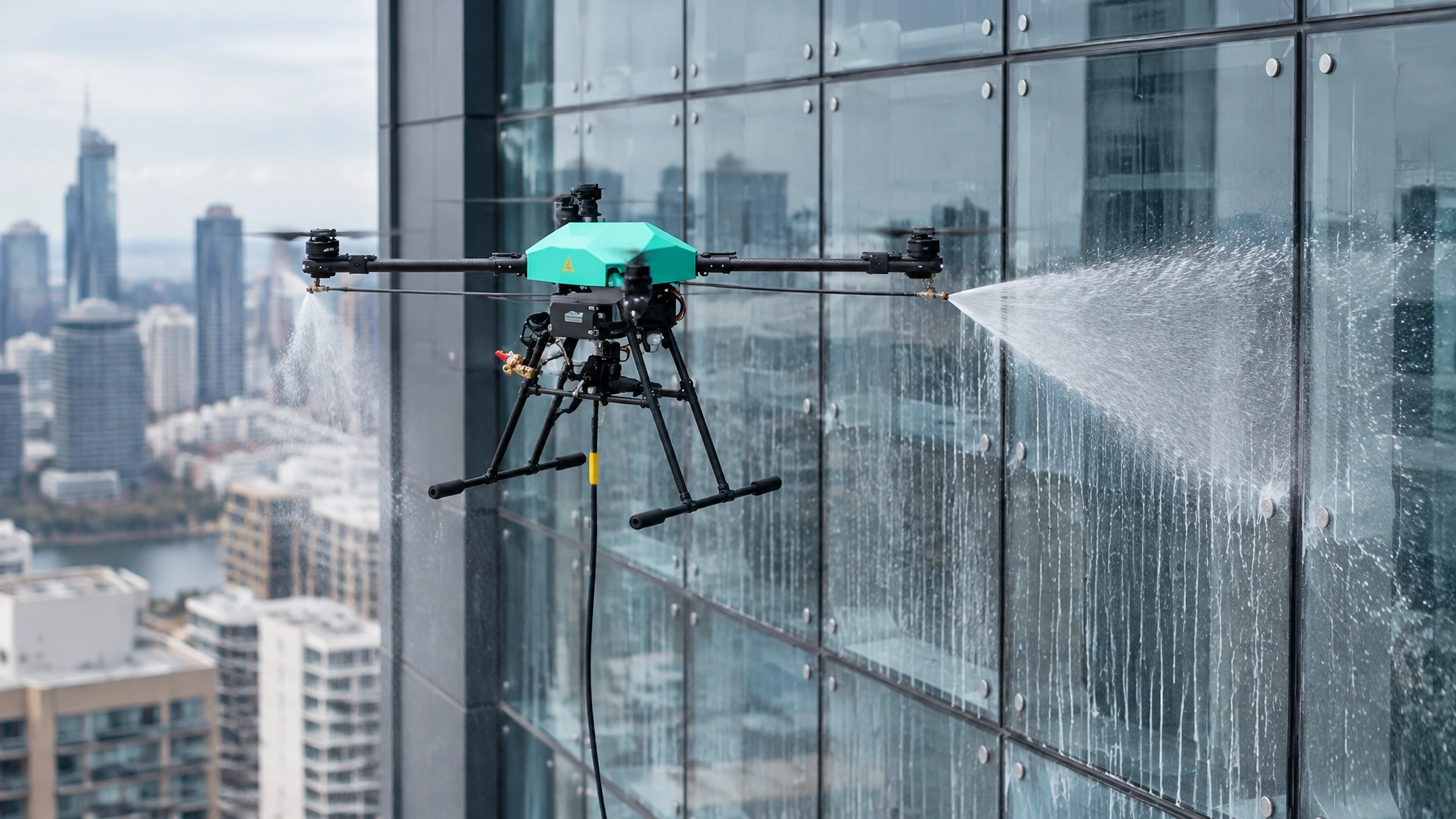
A commercial cleaning drone uses a remotely piloted aircraft to apply water or approved cleaning solutions to building surfaces. A ground system may feed water through a hose, so the aircraft does not need to carry a large tank. Some systems also use a brush or other cleaning attachment.
These aircraft can support work on:
- High-rise façades and glass curtain walls
- Building cladding, roofs and exterior features
- Solar arrays and industrial roofs
- Cooling towers and other hard-to-reach assets
However, a drone does not clean every surface in the same way. Glass, coatings, seals and metal finishes can react differently to pressure, chemicals and brush contact. Before work starts, the operator should confirm the right cleaning method with the building owner or asset manager. A small test area can help reveal surface risks.
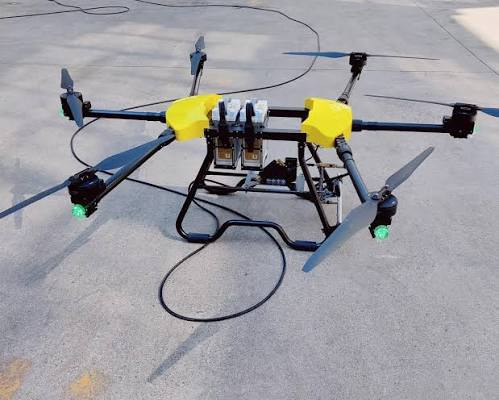
Aircraft choice, hoses, pumps and cleaning attachments must suit the task and approved operating scope.
A façade cleaning drone is a specialised work system, not just a standard camera drone with a spray nozzle. The operator must manage aircraft control and cleaning quality, while the ground crew monitors the hose, pump, work zone and public access.
Drone licence Australia: which qualifications apply?
The phrase “drone licence Australia” can refer to different requirements. A Remote Pilot Licence (RePL) qualifies a person to pilot within the licence’s scope. A Remotely Piloted Aircraft Operator’s Certificate (ReOC) authorises an organisation to conduct operations under its approved operating system. The two are not interchangeable.
For many commercial façade jobs, a RePL and a ReOC are the practical starting point. The aircraft category and task matter. For example, a heavier cleaning aircraft may need aircraft-specific training and an appropriate RePL category. ACE’s cleaning pathway describes pilot training and a business operator pathway; CASA decides whether to approve a ReOC and its operating scope.
Some operations may fit CASA’s excluded category if the aircraft and flight meet every applicable condition. That is not a broad exemption for commercial cleaning. A crowded CBD site, a large aircraft, a hose-fed system or a flight close to uninvolved people can change the requirements. Therefore, confirm the exact pathway before buying equipment or accepting work.
For an overview of training options, see Ace Aviation’s drone course pathways.
Technology, crews and the skills clients value
A typical cleaning setup may include a purpose-built aircraft, a ground-based pump, water filtration, hoses, nozzles or brushes, and a remote control system. Some systems use a tether to supply water. That can reduce the need to carry water aloft, but it adds hose management and coordination tasks.
In practice, clients pay for reliable work, not simply flight time. Employers and contract clients often value pilots who can:
- Operate the aircraft within their approved category and scope
- Assess surfaces and choose a suitable cleaning approach
- Coordinate safely with a hose operator and site controller
- Explain risks, work zones and stop-work limits
- Prepare a clear site plan, SWMS and job report
- Communicate professionally with building managers and tenants
A cleaning job also involves more than aviation rules. The team needs a plan for water runoff, cleaning products, falling debris, windows, nearby electrical services and access below the work area. The aircraft and ground team must be able to stop promptly if conditions change.
ACE Aviation has trained more than 4,000 students and supports training in Australia and internationally, including Singapore, Dubai, Korea and Malaysia. Its student support includes the Altitude+ program, while the DroneWork job board helps pilots explore work opportunities. These services do not guarantee a contract or employment. Learn more about Ace Aviation’s training and industry support.
Key facts table
| Topic | What operators should know |
|---|---|
| Main rule set | Part 101 of the Civil Aviation Safety Regulations (CASR) applies to many drone operations. |
| Pilot qualification | A RePL may be required, depending on the aircraft and operation. Confirm the category and scope. |
| Operator approval | A ReOC is commonly relevant to commercial operations that need an operator certificate and approved procedures. |
| Excluded category | Only applies when the aircraft and operation meet all relevant conditions. It is not a blanket approval for façade cleaning. |
| People and public areas | Standard operating conditions include a 30-metre separation from people not involved in the operation. Do not treat this as permission to fly over people. |
| Worksite safety | A site-specific risk assessment and suitable controls are essential. A SWMS is required when work meets the definition of high-risk construction work. |
| Insurance | Confirm in writing that cover applies to the aircraft, cleaning method, site and work being proposed. |
| Training and equipment | Aircraft-specific training, equipment suitability and the approved operating scope all matter. |
The 30-metre rule needs particular care. Under standard operating conditions, an aircraft must stay at least 30 metres from people who are not directly involved in the operation. That distance is not measured as a simple gap between the drone and the façade. A footpath, entrance or public area beneath the aircraft may make the job unsuitable for those conditions.
Step-by-step process: planning a cleaning drone job
- Inspect the site. Record building height, access, surface type, nearby people, public areas, airspace and possible work zones.
- Confirm the cleaning method. Ask the building owner or asset manager about coatings, seals, approved products and surface limits. Plan a test patch where needed.
- Match the aircraft to the job. Check aircraft category, payload or hose arrangement, training requirements, maintenance and the operator’s approved scope.
- Check CASA requirements. Review the applicable Part 101 rules and conditions. Check whether the job needs a RePL, ReOC, registration, authorisation or other approval.
- Prepare site documents. Build a risk assessment and method statement. Where the task is high-risk construction work, prepare a SWMS before work starts.
- Plan public and building access. Coordinate with the building manager, tenants, traffic controllers and ground crew. Keep uninvolved people outside the required separation zone.
- Confirm insurance and responsibilities. Make sure the contract, certificates of currency and policy wording cover the actual aircraft and cleaning operation.
- Brief the team and set stop-work triggers. Discuss wind, hose behaviour, water runoff, communications, emergency actions and changing site conditions.
- Complete the work and report it. Record the areas cleaned, any limitations, incidents, follow-up work and agreed completion evidence.
For the current regulatory framework, check CASA’s drone rules and guidance. Rules and permissions can vary with the aircraft, airspace and site, so check the current requirements before each operation.
Real-world examples: sites and pricing
High-rise façades in major cities
Demand can come from commercial towers, hotels, apartment buildings and institutional facilities. For example, Sydney has dense CBD and harbour-side buildings where access and pedestrian controls can shape a job. In Melbourne, mixed façades and busy streets can make site coordination just as important as the cleaning method.
A Brisbane cleaning contract may involve commercial towers, riverfront properties or large rooftop assets. Meanwhile, Perth has opportunities across commercial and industrial sites. In Hobart, smaller commercial buildings and rooftop assets may offer different access and scheduling needs.
These are examples of potential work types, not claims about specific contracts. Local building access, airspace and site rules still decide whether a job is practical.
Solar arrays and industrial assets
Solar panel work can involve rooftop arrays where access is difficult or the asset owner wants a planned cleaning service. A solar panel cleaning drone must use a method suitable for the panel and its warranty conditions. This article does not replace a surface-specific assessment. For a deeper look at that separate topic, see Ace Aviation’s solar panel cleaning drone guide.
Cooling towers and industrial façades bring their own concerns. Operators should consider restricted access, overspray, nearby equipment, cleaning products and runoff controls before quoting.
How to price and win a contract
There is no universal rate for a commercial cleaning drone job. Build the quote around the scope and actual cost of delivery. Include:
- Site inspection and mobilisation
- Crew time, aircraft and ground equipment
- Public access and traffic controls
- Water, approved products and runoff management
- Documentation, site inductions and reporting
- A clear allowance for test areas, exclusions and rework
For a simple example, suppose the cleaning work is quoted at $3,900, mobilisation at $850 and extra site controls at $600. The total would be $5,350 before any agreed taxes or contract adjustments. This is an illustration only, not a market rate or price recommendation.
To win work, explain what the client receives. A clear proposal can set out the areas included, cleaning method, access requirements, work dates, safety controls, exclusions and completion evidence. Ask the client to confirm surface suitability and building access before you lock in the price.
A related service can inspect, clean and then report on completed areas. That may help an asset manager compare condition over time. Do not promise results that depend on surface condition, weather or factors outside your control.
Common mistakes
- Assuming a RePL covers every job. It does not replace an operator certificate or site-specific approval where required.
- Buying the aircraft before checking the pathway. Confirm training, category, support and operating scope first.
- Treating the 30-metre rule as a simple façade clearance. People below or beside the aircraft can affect the operation.
- Assuming a tether removes aviation risk. A hose can add hazards and does not, by itself, change CASA requirements.
- Choosing pressure or chemicals without checking the surface. Incorrect methods can damage glass, coatings, seals or nearby property.
- Using generic paperwork. Site risks, public access, runoff and emergency steps should reflect the actual job.
- Pricing only the cleaning time. Include mobilisation, crew, controls, insurance, water and documentation.
CASA considerations, SWMS and insurance
Part 101 sets the regulatory framework for many Australian drone flights. The operation must fit the aircraft’s category, the pilot’s qualifications, the operator’s approvals and the site conditions. A ReOC does not automatically authorise every flight near people or in every location. Likewise, the 30-metre separation under standard operating conditions does not mean a pilot can clean above a busy footpath.
Before accepting a high-rise contract, check airspace and the exact operating area. Some locations or operation profiles may need further CASA approval. A tether or commercial purpose does not create an exemption.
A SWMS is required when the job involves high-risk construction work as defined by the relevant WHS rules. Even when that requirement does not apply, the business still needs to manage work health and safety risks. The plan should cover aircraft or hose failure, falling material, public access, water and chemicals, weather, communications, emergency actions and stop-work triggers.
Insurance needs the same site-specific review. Confirm that the policy covers the actual drone operation, aircraft, cleaning method and potential property damage. Do not assume a general business policy covers aviation or water-related damage.
ACE Aviation operates under CASA.ReOC.1421 and offers cleaning-focused pilot and operator pathways. The published operator pathway includes support with a ReOC application; CASA decides approval and the authorised scope. For more complex missions, do not assume that a standard licence makes flight beyond visual line of sight legal. Read the separate guide to BVLOS and AusSORA operations.
FAQ
1. What is a façade cleaning drone?
It is a remotely piloted aircraft set up to apply water or cleaning equipment to building exteriors. Some systems use a ground-fed hose or tether.
2. Can I clean high-rise windows with a drone in Australia?
Potentially, but the operation must meet CASA rules and site safety requirements. Busy public areas, airspace and aircraft category can affect whether a job can proceed.
3. What drone licence do I need for commercial cleaning?
It depends on the aircraft and operation. Many commercial jobs need a RePL-qualified pilot and a ReOC holder. Check whether the operation fits an excluded category or needs further approval.
4. Do I need a ReOC for a commercial cleaning drone?
Often, a ReOC is part of the commercial pathway, particularly when the operation does not fit excluded-category conditions. CASA determines approval and scope.
5. Which CASA rules apply to façade cleaning drones?
Part 101 applies to many drone operations. The exact requirements depend on the aircraft, pilot, operator, airspace, people nearby and proposed work.
6. Can a cleaning drone fly over public footpaths?
Do not assume it can. Standard operating conditions include a 30-metre separation from uninvolved people and prohibit flying over people. A footpath may need to be closed or managed, or a different approval pathway may apply.
7. Does the 30-metre rule mean 30 metres from the building?
No. It concerns separation from people who are not directly involved in the operation. It is not a general permission to fly 30 metres from a façade.
8. How much does a commercial cleaning drone cost?
Prices vary by aircraft, hose or tether system, pump, training, support and import arrangements. Ace Aviation lists aircraft supply separately from its cleaning training packages, so request a current written quote.
9. How much does cleaning drone training cost?
At the time of writing, Ace Aviation lists a cleaning pilot package at $3,299 and a business operator package at $5,299. Confirm current inclusions, eligibility and pricing directly with the provider.
10. How much can drone cleaning operators earn?
Income varies with experience, operating costs, demand, contract size and compliance capability. No job or income level is guaranteed.
11. Is drone cleaning worth it compared with rope access?
It can suit some buildings where access methods make a drone practical. However, the right method depends on façade type, site exposure, quality needs, regulations and total cost. Compare options for each building.
12. What is a SWMS, and do I need one?
A Safe Work Method Statement describes how a team will manage risks. It is required for high-risk construction work, and site-specific safety planning remains important for other jobs.
13. What equipment does a cleaning drone crew need?
The setup may include an aircraft, controller, pump, hose or tether, cleaning attachments, water supply, communications equipment and site barriers. The exact list depends on the aircraft and contract.
14. Can one pilot clean a building alone?
A crew may need more than one person to monitor the aircraft, hose, site and public access. Staffing should match the risk assessment and operator procedures.
15. Can a drone clean solar panels as well as façades?
Some systems are designed for both tasks, but the cleaning method must suit the panels and warranty conditions. Assess each asset before work begins.
16. Where can I take a drone course in Brisbane, Sydney or Melbourne?
Ace Aviation lists training locations and courses online. Check the current schedule for a drone course in Brisbane, drone course in Sydney or drone course in Melbourne.
17. Are there drone training options in Perth and Hobart?
Check current course dates and availability for a drone pilot course in Perth or drone training in Hobart.
Summary
Commercial cleaning drones can help teams reach façades and other assets, but a drone alone does not make a job safe or legal. Match the aircraft, pilot qualifications, operator approvals, site plan and cleaning method before quoting. Then price for the full work scope, including crew, access controls and reporting.
Ace Aviation combines RePL training with cleaning-specific pathways, CASA.ReOC.1421 experience, the Altitude+ student benefits program and DroneWork opportunities. For a suitable pathway, request a tailored course quote.
Ready to start? Book your training at aaa.edu.au or call 1300 336 366.
Meta description: Explore drone licence australia rules for façade and commercial cleaning drones, safety and contracts. Compare pathways and book training today.
{“@graph”:[{“@id”:”https://aaa.edu.au/#organization”,”url”:”https://aaa.edu.au/”,”logo”:”https://aaa.edu.au/assets/ace-logo-transparent.png”,”name”:”Ace Aviation Aerospace Academy”,”@type”:”Organization”,”telephone”:”1300 336 366″},{“@id”:”https://aaa.edu.au/#drone-licence-australia-cleaning-drones-2026″,”@type”:”Article”,”author”:{“@id”:”https://aaa.edu.au/#organization”},”headline”:”Drone Licence Australia 2026: Commercial Cleaning Drones and Façade Cleaning Drones Explained”,”publisher”:{“@id”:”https://aaa.edu.au/#organization”},”description”:”A practical guide to commercial façade cleaning drones, Australian drone licence pathways, CASA Part 101 considerations, site safety and pricing.”,”dateModified”:”2026-10-10″,”datePublished”:”2026-10-10″,”mainEntityOfPage”:”https://aaa.edu.au/”},{“@type”:”FAQPage”,”mainEntity”:[{“name”:”What is a façade cleaning drone?”,”@type”:”Question”,”acceptedAnswer”:{“text”:”It is a remotely piloted aircraft set up to apply water or cleaning equipment to building exteriors. Some systems use a ground-fed hose or tether.”,”@type”:”Answer”}},{“name”:”Can I clean high-rise windows with a drone in Australia?”,”@type”:”Question”,”acceptedAnswer”:{“text”:”Potentially, but the operation must meet CASA rules and site safety requirements. Busy public areas, airspace and aircraft category can affect whether a job can proceed.”,”@type”:”Answer”}},{“name”:”What drone licence do I need for commercial cleaning?”,”@type”:”Question”,”acceptedAnswer”:{“text”:”It depends on the aircraft and operation. Many commercial jobs need a RePL-qualified pilot and a ReOC holder. Check whether the operation fits an excluded category or needs further approval.”,”@type”:”Answer”}},{“name”:”Do I need a ReOC for a commercial cleaning drone?”,”@type”:”Question”,”acceptedAnswer”:{“text”:”Often, a ReOC is part of the commercial pathway, particularly when the operation does not fit excluded-category conditions. CASA determines approval and scope.”,”@type”:”Answer”}},{“name”:”Which CASA rules apply to façade cleaning drones?”,”@type”:”Question”,”acceptedAnswer”:{“text”:”Part 101 applies to many drone operations. The exact requirements depend on the aircraft, pilot, operator, airspace, people nearby and proposed work.”,”@type”:”Answer”}},{“name”:”Can a cleaning drone fly over public footpaths?”,”@type”:”Question”,”acceptedAnswer”:{“text”:”Do not assume it can. Standard operating conditions include a 30-metre separation from uninvolved people and prohibit flying over people. A footpath may need to be closed or managed, or a different approval pathway may apply.”,”@type”:”Answer”}},{“name”:”Does the 30-metre rule mean 30 metres from the building?”,”@type”:”Question”,”acceptedAnswer”:{“text”:”No. It concerns separation from people who are not directly involved in the operation. It is not a general permission to fly 30 metres from a façade.”,”@type”:”Answer”}},{“name”:”How much does a commercial cleaning drone cost?”,”@type”:”Question”,”acceptedAnswer”:{“text”:”Prices vary by aircraft, hose or tether system, pump, training, support and import arrangements. Ace Aviation lists aircraft supply separately from its cleaning training packages, so request a current written quote.”,”@type”:”Answer”}},{“name”:”How much does cleaning drone training cost?”,”@type”:”Question”,”acceptedAnswer”:{“text”:”At the time of writing, Ace Aviation lists a cleaning pilot package at $3,299 and a business operator package at $5,299. Confirm current inclusions, eligibility and pricing directly with the provider.”,”@type”:”Answer”}},{“name”:”How much can drone cleaning operators earn?”,”@type”:”Question”,”acceptedAnswer”:{“text”:”Income varies with experience, operating costs, demand, contract size and compliance capability. No job or income level is guaranteed.”,”@type”:”Answer”}},{“name”:”Is drone cleaning worth it compared with rope access?”,”@type”:”Question”,”acceptedAnswer”:{“text”:”It can suit some buildings where access methods make a drone practical. However, the right method depends on façade type, site exposure, quality needs, regulations and total cost. Compare options for each building.”,”@type”:”Answer”}},{“name”:”What is a SWMS, and do I need one?”,”@type”:”Question”,”acceptedAnswer”:{“text”:”A Safe Work Method Statement describes how a team will manage risks. It is required for high-risk construction work, and site-specific safety planning remains important for other jobs.”,”@type”:”Answer”}},{“name”:”What equipment does a cleaning drone crew need?”,”@type”:”Question”,”acceptedAnswer”:{“text”:”The setup may include an aircraft, controller, pump, hose or tether, cleaning attachments, water supply, communications equipment and site barriers. The exact list depends on the aircraft and contract.”,”@type”:”Answer”}},{“name”:”Can one pilot clean a building alone?”,”@type”:”Question”,”acceptedAnswer”:{“text”:”A crew may need more than one person to monitor the aircraft, hose, site and public access. Staffing should match the risk assessment and operator procedures.”,”@type”:”Answer”}},{“name”:”Can a drone clean solar panels as well as façades?”,”@type”:”Question”,”acceptedAnswer”:{“text”:”Some systems are designed for both tasks, but the cleaning method must suit the panels and warranty conditions. Assess each asset before work begins.”,”@type”:”Answer”}},{“name”:”Where can I take a drone course in Brisbane, Sydney or Melbourne?”,”@type”:”Question”,”acceptedAnswer”:{“text”:”Ace Aviation lists training locations and courses online. Check the current schedule for Brisbane, Sydney or Melbourne.”,”@type”:”Answer”}},{“name”:”Are there drone training options in Perth and Hobart?”,”@type”:”Question”,”acceptedAnswer”:{“text”:”Check current course dates and availability for Perth or Hobart.”,”@type”:”Answer”}}]}],”@context”:”https://schema.org”}