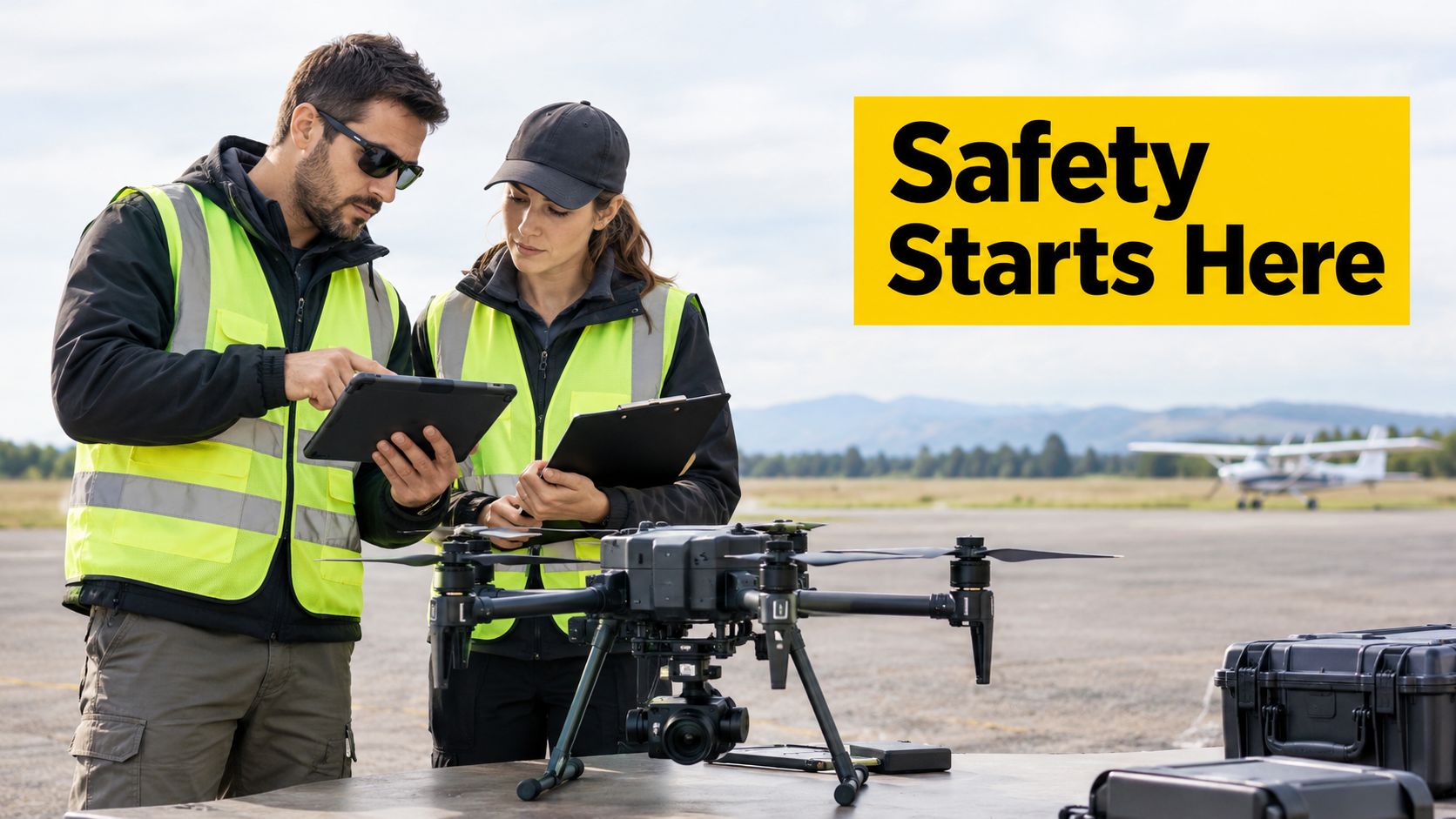
A survey flight is almost finished when a remote pilot spots a light aircraft crossing closer than expected. The drone descends, the aircraft passes, and nobody is hurt. The client's data is usable, the equipment is undamaged, and the easiest option is to pack up without recording an event that could invite awkward questions. The harder option is to write down the time, location, altitude, separation estimate and radio calls, then notify the chief remote pilot before the memory fades.
Table of Contents
- Introduction
- What Is Aviation Safety Culture
- Reporting Culture and Just Culture
- Leadership Behaviours That Matter
- Practical Steps to Build Safety Culture
- Measuring Safety Culture in Your Organisation
- Conclusion
- Frequently Asked Questions
Introduction
That choice reveals more about aviation safety culture than any policy statement, poster or completed checklist. It shows whether the pilot trusts the organisation to treat an honest report as useful safety information. It also shows whether supervisors value learning more than avoiding embarrassment and whether operational pressure overrides formal procedures.
Many Australian drone operators know the basic rules but haven't been taught how safe behaviour is sustained when weather deteriorates, a client is waiting or a battery behaves unexpectedly. Understanding the regulatory baseline matters, and operators should keep current with Australian drone laws and operating requirements. Rules alone, however, don't explain why one team reports weak signals early while another hides them until they become incidents.
What a Practical Understanding Includes
A useful understanding of culture connects four ideas. First, culture describes shared beliefs in action, not management intention on paper. Second, reporting culture and just culture give people reasons to speak up without removing accountability. Third, leadership turns priorities into resources, training and decisions. Fourth, measurement shows whether controls work during real operations rather than only during audits.
Australian examples from the Civil Aviation Safety Authority (CASA) and the Australian Transport Safety Bureau (ATSB) make those ideas concrete. They apply to a solo Remote Pilot Licence holder, an agricultural spraying business, a council inspection team and a large enterprise operating under a Remote Operator's Certificate. Scale changes the paperwork, but the underlying behaviours stay remarkably similar.
The central lesson is straightforward. A strong culture isn't built by demanding perfection. It's built by making hazards visible, responding fairly, closing the loop and checking that the resulting controls change the next flight.
What Is Aviation Safety Culture
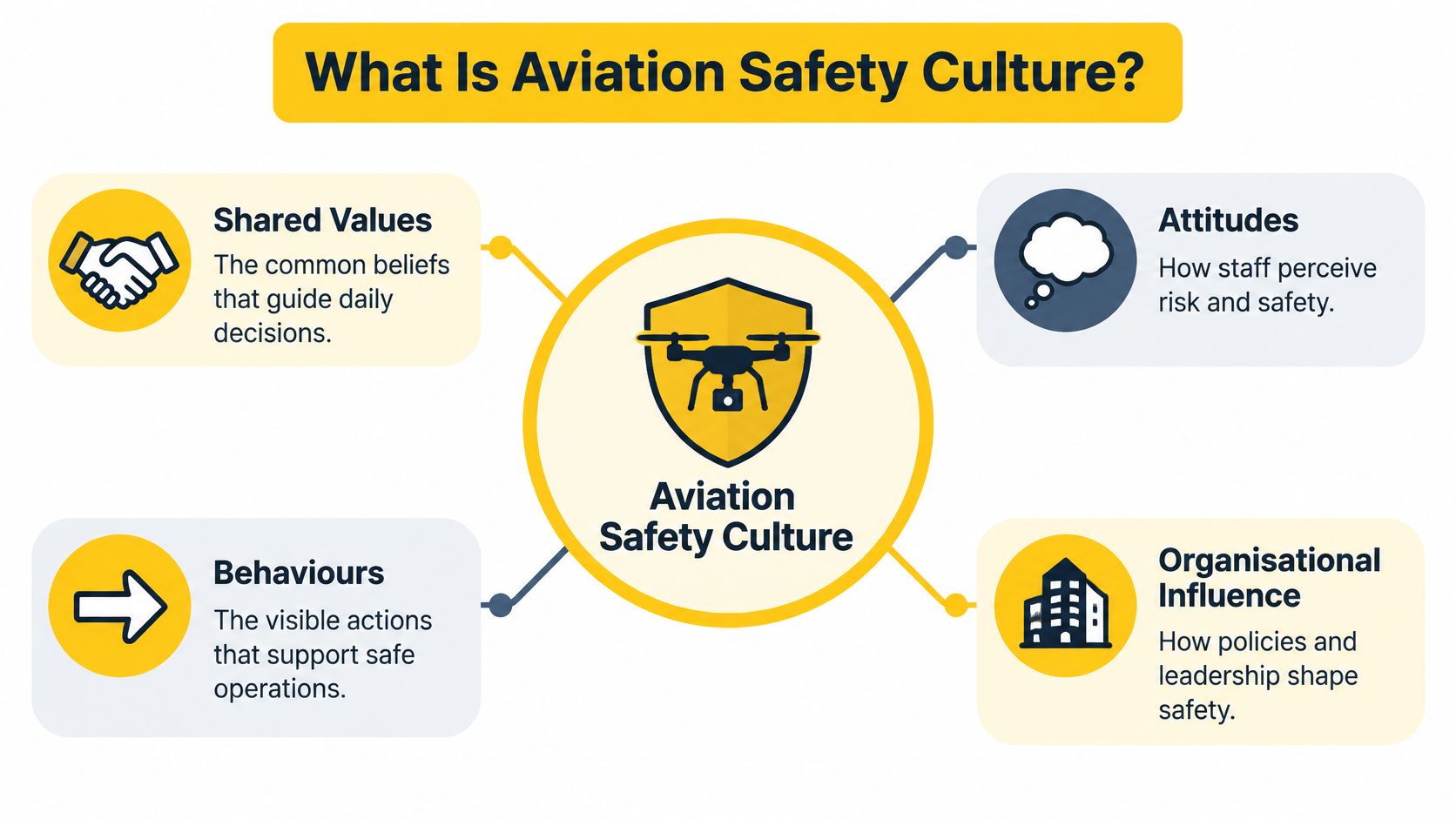
CASA defines a positive safety culture as the shared values, attitudes, beliefs and behaviours that influence how an organisation manages safety, as set out in CASA's aerodrome safety management system guidance. That guidance identifies four practical characteristics. They are genuine management commitment, communication based on mutual trust, shared perceptions that safety matters, and confidence that preventive measures work.
Those four characteristics are easier to grasp when culture is compared with an immune system. A healthy immune system detects a threat, signals other parts of the body, responds and remembers the encounter. A healthy drone organisation does something similar. A pilot notices link instability, the team shares the information, a control is changed and future crews benefit from the lesson.
The analogy has one limit. An immune system works automatically, whereas an aviation team must deliberately create pathways for detection and response. Briefings, hazard registers, debriefs, maintenance records and management review are those pathways. When any pathway is missing, information may exist in someone's memory but never reach the people who can act on it.
Culture Is More Than Individual Carefulness
A common misunderstanding is that safety culture means careful pilots. Individual competence matters, including airmanship, radio discipline and knowledge of aircraft limitations. Yet an organisation can employ skilled pilots and still create unsafe conditions through unrealistic schedules, ambiguous authority, poor fatigue management or delayed maintenance decisions.
Consider a mapping crew working near an uncontrolled aerodrome. The pilot holds the right qualifications and completes the site assessment. The client then asks for extra passes as light fades, and the supervisor hints that another contractor could finish the job. The formal rule hasn't changed, but the social pressure has. Culture is what the crew believes will happen if the flight is stopped and the job is rescheduled.
Culture is tested at the point where safety competes with time, cost and reputation.
A blame culture produces the opposite pattern. Errors are treated mainly as personal failures, reports are met with criticism and personnel learn to disclose only what can't be hidden. Management then sees a falsely clean record. The absence of reports looks reassuring until an unreported pattern contributes to a serious occurrence.
Lessons from other transport settings can be useful when they focus on habits rather than slogans. The discussion of developing overnight box-truck safety culture offers a useful parallel because road freight also involves fatigue, time pressure and dispersed operators. The vehicle differs, but the management question remains familiar. Do people believe reporting a problem will lead to fair action, or do they expect blame and delay?
What Culture Is Not
Culture isn't a signed policy, a logo on a safety vest or a statement that safety comes first. Those artefacts can support culture, but they don't prove it. Evidence appears in ordinary decisions, such as whether a launch is delayed for uncertain weather, whether a damaged propeller is removed from service and whether a new pilot can question a senior operator.
For drone businesses, the concept reaches beyond flight conduct. It includes operational approvals, hazard controls, reporting routes, maintenance escalation, contractor supervision and management review. A positive culture aligns those activities so safety information moves quickly and decisions remain traceable.
Reporting Culture and Just Culture
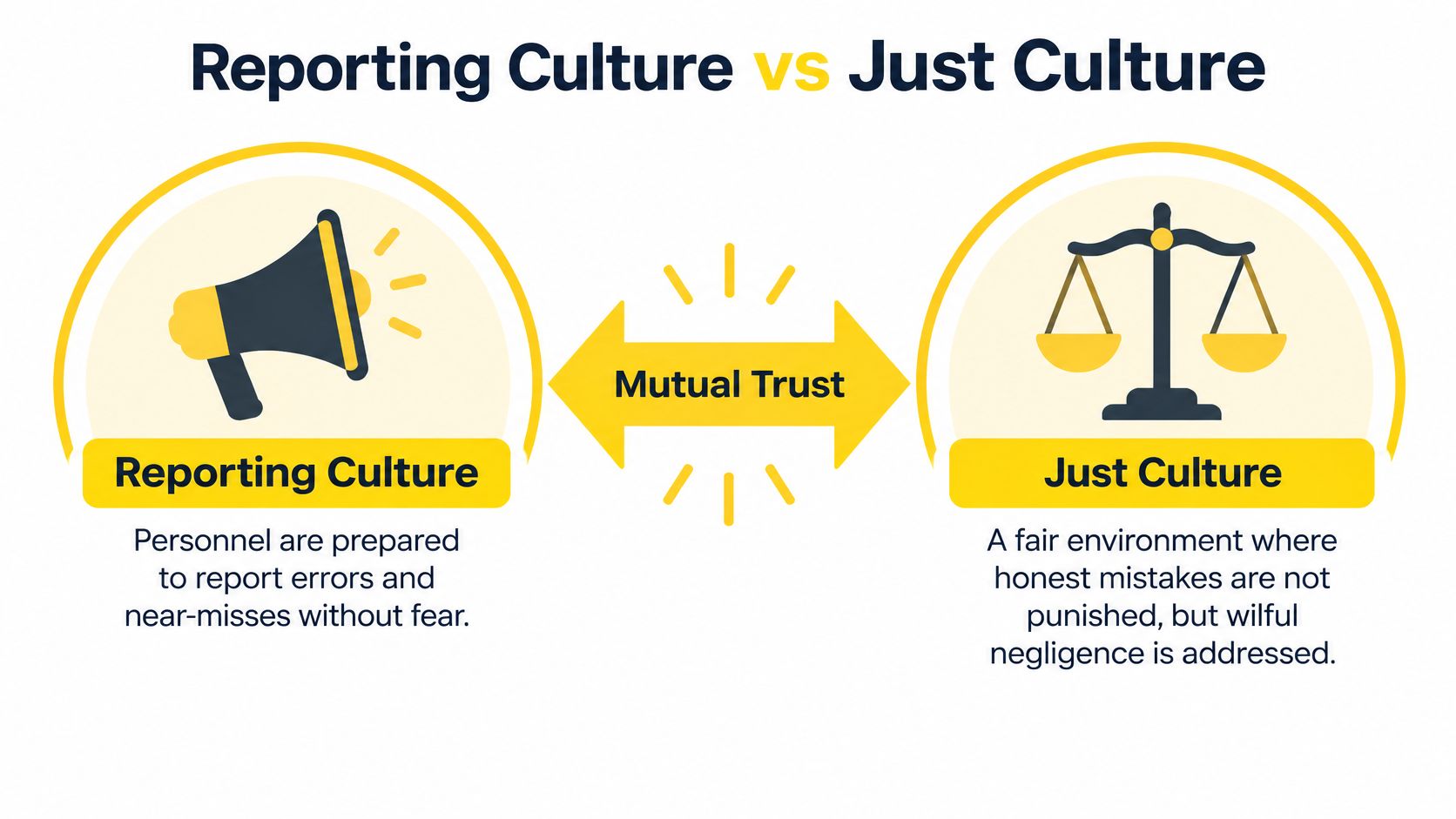
Reporting culture and just culture are related, but they're not interchangeable. CASA describes a reporting culture as one in which personnel are prepared to report errors and near misses. A just culture creates trust to provide safety information while maintaining a clear boundary between acceptable human error and unacceptable conduct, a distinction explained in CASA's safety management system basics guide.
That boundary answers a frequent concern. Just culture doesn't mean excuse culture. A pilot who makes a genuine altitude error in confusing conditions gives the organisation information about procedure design, workload or training. A pilot who deliberately disables a safeguard, falsifies a record or conceals damage has crossed into conduct that requires formal accountability.
Australia's broader system is built around learning from lower-level occurrences, not waiting for accidents. The ATSB receives approximately 17,000 aviation occurrence reports each year from pilots and flight crew, and under the Transport Safety Investigation Act 2003, reportable information is recorded primarily to improve safety rather than assign blame, according to ATSB aviation incident reporting summary information. High reporting volume therefore shouldn't automatically be read as organisational failure. It may indicate that people notice hazards and trust the system enough to document them.
Two Events That Deserve Different Responses
A lost command and control link during an inspection is a good test. If the pilot reports the event promptly, preserves logs and describes the operating environment, the organisation can investigate antenna placement, interference, procedures and training. Other crews can then apply the lesson before experiencing the same failure.
Concealment changes the analysis. If the same pilot deletes the log and flies the aircraft again without inspection, the technical event has become a conduct issue. The response should still be fair and evidence based, but it shouldn't be treated as an ordinary slip. Just culture protects honest disclosure, not deliberate deception.
A strict zero deviation message can unintentionally suppress disclosure. Personnel hear that any departure from procedure will be punished, so marginal events disappear from view. Managers lose the weak signals that reveal impractical checklists, ambiguous maps, fatigue problems or recurring equipment faults. Compliance administration increases while safety intelligence decreases.
Good disclosure also depends on form design. Reports should ask what happened, what conditions contributed, what barriers worked and what could prevent recurrence. Operators reviewing wider disclosure practices may find Lighthouse Consultants safety disclosures useful context for separating factual reporting from moral judgement. Within an RPAS business, concise fields and a clear escalation path usually produce better information than a long narrative written under stress.
Emergency decisions still come first. Crews need immediate priorities for aircraft control, communication and notification before they complete internal analysis, which is why a rehearsed drone pilot emergency handbook covering ANCA, CANCA and ATSB actions supports the reporting process. After people and aircraft are safe, prompt documentation preserves details that later become unreliable.
Instructor's distinction: Reporting culture gets safety information into the open. Just culture determines whether people feel safe putting it there.
Leadership Behaviours That Matter
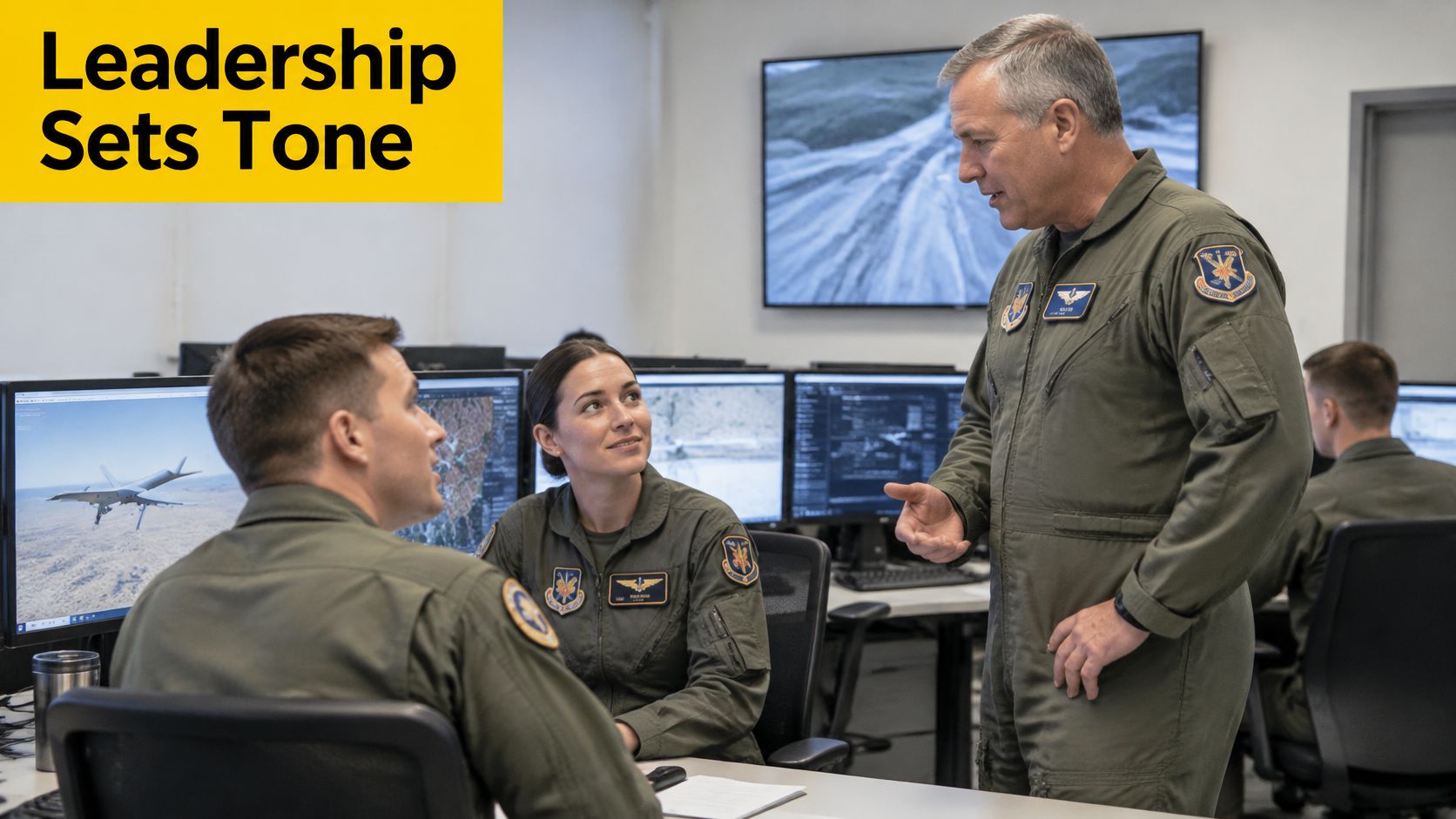
Leadership becomes visible when a leader allocates time, accepts delay or changes a plan because a hazard has been identified. Speeches have limited effect if pilots see reports ignored or unsafe shortcuts rewarded. In a small drone business, that signal may come from an owner who is also pilot, scheduler, maintenance coordinator and client contact.
CASA describes safety culture as closely connected to the organisation's safety management system (SMS) and identifies four components, namely safety policy and objectives, safety risk management, safety assurance and safety promotion, in CASA's safety management systems guidance. Safety promotion consists of communication plus training and education. Effective promotion builds organisation wide understanding of the SMS rather than leaving it with one compliance specialist.
The cause and effect chain is practical. Leadership priorities shape communication and training. Better communication improves hazard awareness and reporting. Reported information supports risk assessment, and assurance then checks whether controls work in actual operations. Break any link and the system weakens. For example, excellent reporting achieves little when corrective actions have no owner or review date.
Behaviours Pilots Notice
- Model disclosure: Senior pilots describe their own errors and explain what changed afterward.
- Respond constructively: The first management question focuses on conditions and barriers, not personal fault.
- Resource the control: Training, spare equipment, travel time and suitable launch areas are funded rather than assumed.
- Protect stop work authority: A pilot who rejects a mission for a credible hazard isn't penalised through scheduling or ridicule.
- Close the loop visibly: Crews are told what changed, why it changed and how the result will be checked.
A chief remote pilot carries particular influence because operational standards and pilot authorisation decisions become daily evidence of priorities. Structured preparation for that responsibility, such as a chief remote pilot course, can support consistent oversight. Foundational training also shapes habits early. ACE BRONZE is a foundation commercial drone course covering drone operations, flight safety, aviation theory and practical skills for students beginning the path toward licensed operations in Australia.
Small operators need a guard against self pressure. The person deciding whether weather is acceptable may also carry the financial cost of cancellation. Written limits, a second person escalation contact and pre agreed client wording reduce that conflict. They turn a difficult personal judgement into an organisational decision made before commercial pressure peaks.
Leaders should also audit behaviour, not attendance alone. During scenario training, pilots can be asked when they'd stop, whom they'd call and which records they'd preserve. Confident answers indicate that promotion has reached operational decision making. Hesitation reveals where procedures or trust need work.
Practical Steps to Build Safety Culture
A small RPAS operation doesn't need a large safety department to act systematically. It needs a small number of routines that are easy to use under field conditions and reviewed often enough to stay credible. The starting point is a clear link between each significant hazard, its control, an accountable owner, a review trigger and evidence that the control remains effective.
CASA describes an SMS as more than a compliance document because it connects policy, risk management, assurance and training, and an effective system helps organisations identify hazards, learn from events, use clear risk processes and share responsibility, as explained in CASA's introduction to safety management systems. That framing prevents a common trap. A polished manual that crews never use isn't a functioning SMS.
Build the Reporting Loop
- Use one short report form: Capture event type, location, aircraft, phase of flight, conditions, immediate action and suggested control.
- Debrief before leaving site: Spend a few minutes identifying surprises, weak signals and equipment concerns while details remain fresh.
- Triage quickly: Assign an owner, decide whether flying can continue and record any regulatory notification requirement.
- Feed back the outcome: Tell the reporter and affected crews what changed or why no change was made.
- Review trends: Look for repeated locations, clients, aircraft, weather conditions or mission types rather than treating every report in isolation.
Psychological safety needs design, not encouragement alone. Confidential reporting may help in a larger team, while a two person business may rely on a shared near miss log reviewed without blame. Reports should cover fatigue, maintenance defects, battery anomalies, procedural confusion, unauthorised people entering the operating area and pressure to continue in marginal weather. Those topics can feel personal, so leaders must separate the safety issue from judgement about competence.
Airspace discipline belongs in the same loop. Current authorisations, aerodrome information and launch site controls should be checked as part of normal work, supported by practical guidance such as the Australian drone safety guide for airports and helicopter landing sites. If a crew discovers that a map, app output or client supplied boundary is confusing, that discovery is a reportable weak signal. The corrective action might be a clearer briefing aid rather than another reminder to be careful.
Operators wanting a broader explanation of system mechanics can compare internal procedures with aviation SMS systems explained, then adapt the concepts to RPAS scale. Adaptation matters. An airline style committee may be excessive for three pilots, but hazard ownership, assurance checks and lesson sharing remain relevant.
Training should reinforce those routines before commercial pressure appears. ACE READY is an entry level drone training course covering drone fundamentals, aviation safety, CASA regulations and flight operations, and it prepares beginners for advanced Remote Pilot Licence training in Australia. For established teams, recurrent briefings can use anonymised internal events to practise escalation, radio communication and stop work decisions.
Field test: If a report produces no feedback, personnel eventually conclude that reporting has no operational value.
Measuring Safety Culture in Your Organisation
Accident counts are lagging indicators. By the time they change, people may already have been exposed to avoidable risk. Leading indicators are more useful for culture because they show whether hazards are being identified, acted on and reviewed before harm occurs.
An ATSB survey of aerial firefighting pilots found safety culture and reporting culture were rated less positively than tasking and communication, reporting culture was the weakest dimension, and only just under 60% agreed or strongly agreed that external tasking agencies encouraged pilots to prioritise safety over task completion during 2017 to 2022, as reported in ATSB investigation 2021-015B. For drone operators, the warning is clear. Procedures can look sound while operational pressure still discourages disclosure.
Leading Indicators for Drone Safety Culture
| Indicator | What It Measures | Healthy Pattern |
|---|---|---|
| Hazard and near miss reports | Willingness to disclose weak signals | Varied reports across crews and mission types |
| Rejected or stopped missions | Use of stop work authority | Decisions recorded without penalty and reviewed respectfully |
| Corrective action closure | Whether learning becomes change | Actions have owners, dates and effectiveness checks |
| Repeat findings | Quality of controls and assurance | Recurrence declines after controls are introduced |
| Debrief participation | Engagement beyond formal compliance | Junior and contract pilots contribute observations |
A low reporting rate shouldn't be celebrated without investigation. It may reflect stable operations, but it may also signal fear, cumbersome forms or previous reports being ignored. Comparing report rates by supervisor, client, location and time pressure can expose local barriers that a company average hides.
Surveys can supplement operational data, provided questions ask about lived experience. Useful prompts include whether pilots can stop a task, whether reports receive feedback and whether schedule pressure affects decisions. Results should then be discussed with crews and converted into actions. For organisations formalising oversight, the ultimate guide to obtaining a ReOC in Australia provides relevant context on documented systems and accountable roles.
Conclusion
Aviation safety culture is a working system, not a slogan. It appears when pilots report, leaders respond fairly, controls receive owners and assurance confirms that change worked in the field.
Reporting and just culture form the foundation because unseen hazards can't be managed. Leadership determines whether those foundations survive commercial pressure. Leading indicators then reveal whether an organisation is learning or merely maintaining tidy documents.
Australian drone operations will continue to expand into agriculture, surveying, construction, inspection and public safety. Organisations that embed reporting, fair accountability and review early will find those habits easier to sustain as fleets and mission complexity grow. A single drone business can start with a short debrief and a closed feedback loop. An enterprise fleet can add trend analysis and formal assurance. Both are building the same capability, namely the ability to notice risk early and act before it becomes harm.
Frequently Asked Questions
What Is the Difference Between Safety Culture and an SMS
Safety culture is the shared values and behaviours that shape decisions. An SMS is the structured framework of policy, risk management, assurance and promotion that supports those behaviours. A complete manual without trust or feedback doesn't demonstrate a healthy culture.
Can a Small Drone Business Build Culture Without a Safety Manager
Yes, provided responsibilities are explicit. The owner or chief remote pilot can manage a simple hazard log, regular debriefs, written operating limits and corrective action reviews. Simplicity and consistency matter more than department size.
What Should an Operator Report Internally
Near misses, airspace conflicts, lost link events, equipment defects, battery anomalies, fatigue concerns, weather pressure and procedural deviations are useful internal reports. Mandatory external occurrence reporting is a separate legal obligation and shouldn't be confused with voluntary organisational learning reports.
Does Just Culture Excuse Deliberate Rule Breaking
No. Honest errors are examined for system contributors and learning. Reckless or intentional conduct, falsification and concealment remain accountable behaviours. The distinction protects disclosure without removing professional responsibility.
Operators ready to turn sound safety habits into recognised Australian qualifications can explore RePL, AROC, Certificate III in Aviation, ReOC consulting and enterprise drone training through Ace Aviation Aerospace Academy. Prospective students and organisations can review the available pathways and choose training that matches their operational responsibilities.