
A lot of people start with the same question, usually after a search late at night or a conversation with someone already inside the industry. They know they want aviation, but they're not sure whether that means a cockpit, a drone controller screen, a hangar, an airport desk, or a training pathway that hasn't even been considered yet.
In Australia, that confusion is normal. Aviation careers sit inside a broad labour market with pilots, drone operators, air traffic controllers, maintenance engineers, ground crews, cabin crew, and managers all pulling in the same direction, and the sector's scale makes that clear. The International Air Transport Association estimates 162,600 direct aviation jobs in Australia and USD 68.4 billion in total GDP impact when wider effects are included, which is a strong sign that this is a serious industry, not a narrow niche (IATA's Australia aviation value report).
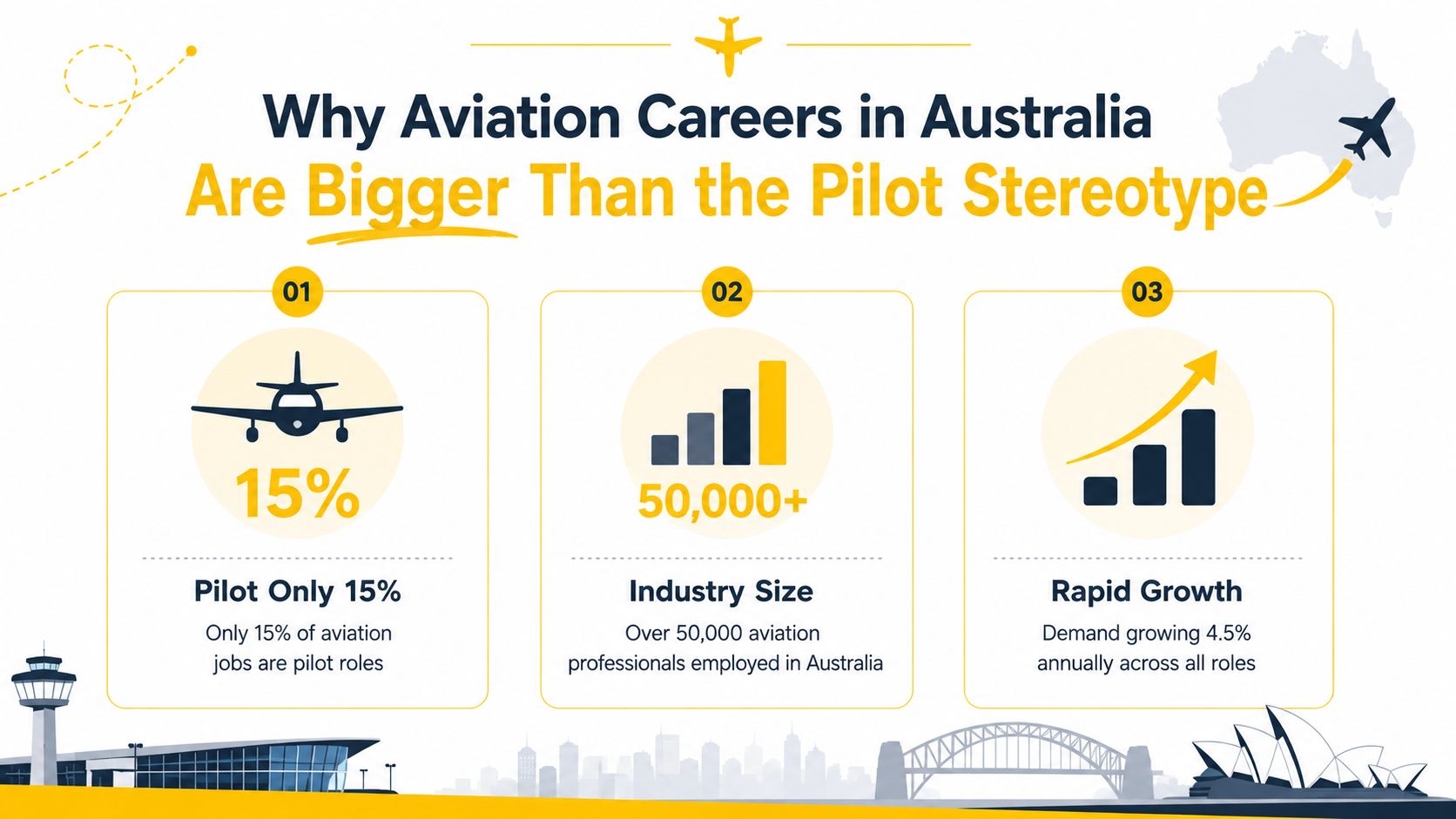
That broader view matters because the training decision gets much easier once the structure is visible. The Australian aviation workforce is also expanding, with more than 71,000 people employed by aviation companies in 2025 and a projected 74,318 by 2030 in the latest workforce planning update (2026 Aviation Workforce Planning Update). For anyone weighing aviation careers Australia, the question isn't whether the sector exists. The question is which part of it matches the person, the budget, and the timeline.
Table of Contents
- Why Aviation Careers in Australia Are Bigger Than the Pilot Stereotype
- Major Aviation Roles You Can Build a Career In
- CASA Qualifications and Licences That Open Each Door
- Where the Demand Is in 2026
- A Practical Starting Path for Aspiring Aviation Professionals
- Salary Ranges and Regional Considerations
- Common Misconceptions About Working in Australian Aviation
- Choosing Your Track and Taking the First Step
Why Aviation Careers in Australia Are Bigger Than the Pilot Stereotype
A student can spend months thinking aviation means one thing, a uniform, a runway, and a jet cockpit. That's a narrow view, and it leaves out the jobs that keep aircraft moving, airspace organised, and commercial operations compliant. CASA's 2025 careers guide groups drone operations alongside air traffic control, engineering, maintenance, cabin crew, airport operations, and emergency services, which is a much better reflection of how the industry works (CASA aviation careers guide).
The industry is large enough to support many entry points
The size of the Australian aviation ecosystem explains why so many different roles exist. IATA's figures show USD 13.1 billion in direct economic output from aviation and USD 24.6 billion in GDP from aviation-supported tourism alone, with 603,500 jobs supported across aviation-enabled tourism and spending (IATA's Australia aviation value report). That scale creates work for pilots, but it also creates demand for people who keep fleets safe, schedules running, radios clear, and aircraft available.
The workforce is not evenly spread either. Jobs and Skills Australia says Air Transport Professionals are concentrated in New South Wales (28.4%), Queensland (24.6%), and Victoria (19.7%) (Jobs and Skills Australia occupation profile). That matters for students because location shapes access to training, employers, and early experience.
Practical rule: if a training page only talks about airline pilots, it's leaving out a big part of the sector.
Why the stereotype breaks down fast
Aviation isn't a single ladder. It's a set of ladders that cross over in places and split apart in others. A drone operator may start with remote pilot training and radio competency, while an air traffic controller needs a very different pathway and working environment. A maintenance engineer spends their career in hangars and line maintenance, not flight decks.
That's why the question, “What aviation careers in Australia suit a beginner?” is more useful than “How does someone become an airline pilot?” The answer depends on whether the person wants airside work, technical work, compliance work, customer-facing work, or flight operations. The guide below keeps those tracks separate so the options are easier to compare, and Ace Aviation Aerospace Academy's blog sits in that same practical space for readers who want more pathway detail.
Major Aviation Roles You Can Build a Career In
A student who walks into aviation training with only “pilot” in mind can miss half the industry. The sector is broader than one cockpit, and the first paid job depends on whether you want to fly, control, maintain, inspect, support, or manage operations. A good starting point is to match the job to the kind of work you can do well day after day, because aviation rewards steady judgement more than glossy ambition.

Pilot pathways
A pilot career usually begins with the CASA Commercial Pilot Licence (CPL), and the Air Transport Pilot Licence (ATPL) matters later for senior airline progression. CASA's pilot career guide says a commercial pilot must hold a CPL, and the standard route includes theory exams, flight training, a flight test, and minimum flying hours (CASA pilot career guide). Students who are comfortable with procedures, constant decision-making, and long stretches of concentration often suit this path.
A regional charter pilot is a useful example. That person may start in training aircraft, build hours gradually, and move into multi-engine flying as experience grows. The work asks for patience, discipline with money, and a habit of following checklists without cutting corners. It is a career built on repetition and reliability, not quick wins.
Drone operations
Drone careers now sit inside mainstream aviation. For commercial work, the main credentials are RePL and, if a business needs its own operating authority or employs other pilots, ReOC. Students who are comfortable with technology, mapping, inspection work, and structured flight planning often fit this pathway well. ACE SILVER is one example of training that combines RePL, classroom instruction, practical flight training, CASA compliant certification, AROC, and aviation English proficiency for professional drone pilots.
A practical case is an operator supporting infrastructure inspections. The job can involve weather checks, controlled airspace awareness, site safety, and client reporting. It suits people who want aviation work without the length and cost of the flight-deck route. For students comparing entry points, the current aviation jobs board can also help show how drone roles sit alongside other openings in the sector.
Air traffic control and maintenance
Air traffic controllers work in one of the most responsibility-heavy operational roles in aviation. The environment is screen-based, procedural, and tightly coordinated, so the right person is calm under pressure and precise with communication. Aircraft maintenance engineers work in a different part of the system. They deal with systems, faults, inspections, and repair standards, usually in hangars or on the ramp.
These pathways suit different temperaments, but both reward discipline. A controller who is comfortable with spoken precision and a maintenance apprentice who enjoys mechanical troubleshooting can build stable careers without chasing the airline pilot route. Airport and engineering careers deserve more space on careers pages, because they are central to how the industry keeps moving.
Cabin crew, ground operations and management
Cabin crew roles suit people who can balance customer care, safety procedures, and interpersonal pressure at the same time. Airport ground operations suit those who like logistics, baggage handling, turnaround timing, and airside coordination. Aviation management is the path for people who want to move between operations, compliance, rostering, and commercial decisions.
The first job in aviation is not always the one with the highest profile. It is the one that gives the right repetition, feedback, and access to the next step.
For someone still deciding, the shortlist is usually two or three tracks, not ten. A student may compare pilot, drone, and ground operations, then rule out the paths that demand too much capital, relocation, or a temperament that does not fit. That is a more realistic way to choose than trying to force every aviation career into the same mould.
CASA Qualifications and Licences That Open Each Door
Aviation credentials are not badges for the shelf. They define what work a person can legally perform, which responsibilities sit inside their authority, and how much further a pathway can go before another licence, certificate, or approval is needed. In Australia, that structure sits closely with CASA rules, so the order of each step matters as much as the step itself.
| Credential | Role it enables | Typical entry point |
|---|---|---|
| CPL | Commercial pilot work | Flight training pathway after theory, medical, and hours |
| ATPL | Senior airline pilot progression | After substantial experience and further exams |
| RePL | Commercial drone pilot work | Entry-level commercial RPAS pathway |
| ReOC | Commercial drone business operations | When a business needs its own operating authority |
| AROC | Radio-equipped drone and aviation operations | Common add-on for professional drone work |
How the pilot pathway works
CASA states that a commercial pilot must hold a CPL, and that the route includes theory exams, flying training, a flight test, and the required minimum hours. A formal tertiary qualification is not required for licensing, but English proficiency and a current medical certificate are required for operational privileges. A degree can still help with structured study or later management work, yet it is separate from the licence itself.
ATPL sits further along the ladder. It is not where a new entrant starts, and it usually becomes relevant only after a pilot has built significant operational experience. New students often miss that sequence, because airline careers are sometimes presented as if the highest level comes first and everything else can be skipped.
How drone credentials fit into the broader system
The drone pathway is more flexible, but it is still regulated. A commercial operator generally needs a RePL, and a business that wants to operate under its own authorisation usually needs a ReOC. Radio use adds another layer, which is why AROC is commonly paired with commercial RPAS training.
The choice between these credentials depends on the work a person wants to do, not just the aircraft they want to fly. For readers who are comparing the starting points, this licence-finder tool can help narrow the right pathway, whether the goal is solo flying, commercial drone work, or a business-side compliance role.
Where the Demand Is in 2026
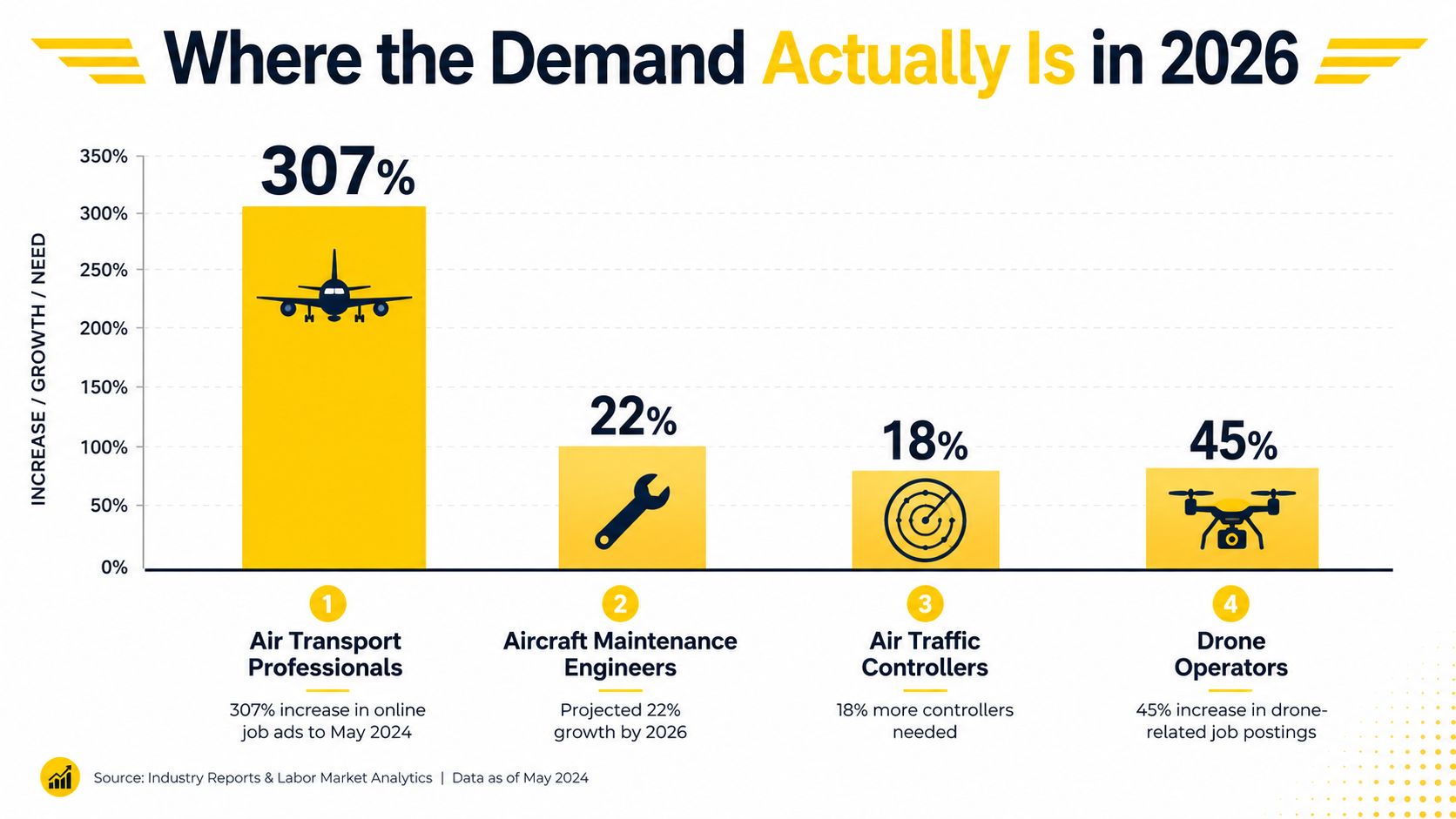
National demand matters, but the local picture usually decides where a newcomer can start. The strongest signal in the Australian market is vacancy pressure. Jobs and Skills Australia reports online job advertisements for Air Transport Professionals rose 307% over the five years to May 2024, while the occupation's headcount stayed broadly stable, falling only 0.2% over the year to February 2024 to just over 15,000 workers (Jobs and Skills Australia demand report).
Why that demand looks structural, not temporary
Vacancy growth on that scale usually points to replacement demand, not just a short hiring burst. The Australian Government's Aviation White Paper says aviation employment averaged about 55,000 before COVID-19, fell to around 35,000 during lockdowns and travel restrictions, then recovered to 50,900 by May 2024. It also says job vacancies for air transport professionals have more than tripled since 2019.
Flight activity is recovering too. Australian owned and operated aircraft logged 3.63 million hours in 2024, including 1.44 million scheduled commercial air transport hours and 437,458 instructional flying hours (Jobs and Skills Australia demand report). That matters because flight hours are where training demand, instructor demand, and aircraft utilisation connect.
What this means for the main pathways
The strongest near-term openings tend to sit in the roles that are hardest to replace quickly. That includes flying instructors, maintenance engineers, ground operations, and commercial drone work tied to inspection, mapping, and compliance-heavy projects. The labour market is also ageing at 1.4 times the national rate, with an average worker aged 45 years and older, which adds turnover pressure (Jobs and Skills Australia demand report).
For regional students, that is useful news. A person willing to train near major aviation centres in New South Wales, Queensland, or Victoria, or to work in remote drone assignments later, is entering a market where the bottleneck is usually skills, not interest. For readers comparing commercial drone pathways, this guide to ReOC in Australia is a practical place to understand the business side of regulated operations.
A Practical Starting Path for Aspiring Aviation Professionals
A good starting path avoids costly detours. Many new entrants lose time by enrolling before they check fitness, eligibility, or whether the role they want is still the role they would want after six months of real work. The stronger approach is to match the pathway to the work first, then pay for the training second.
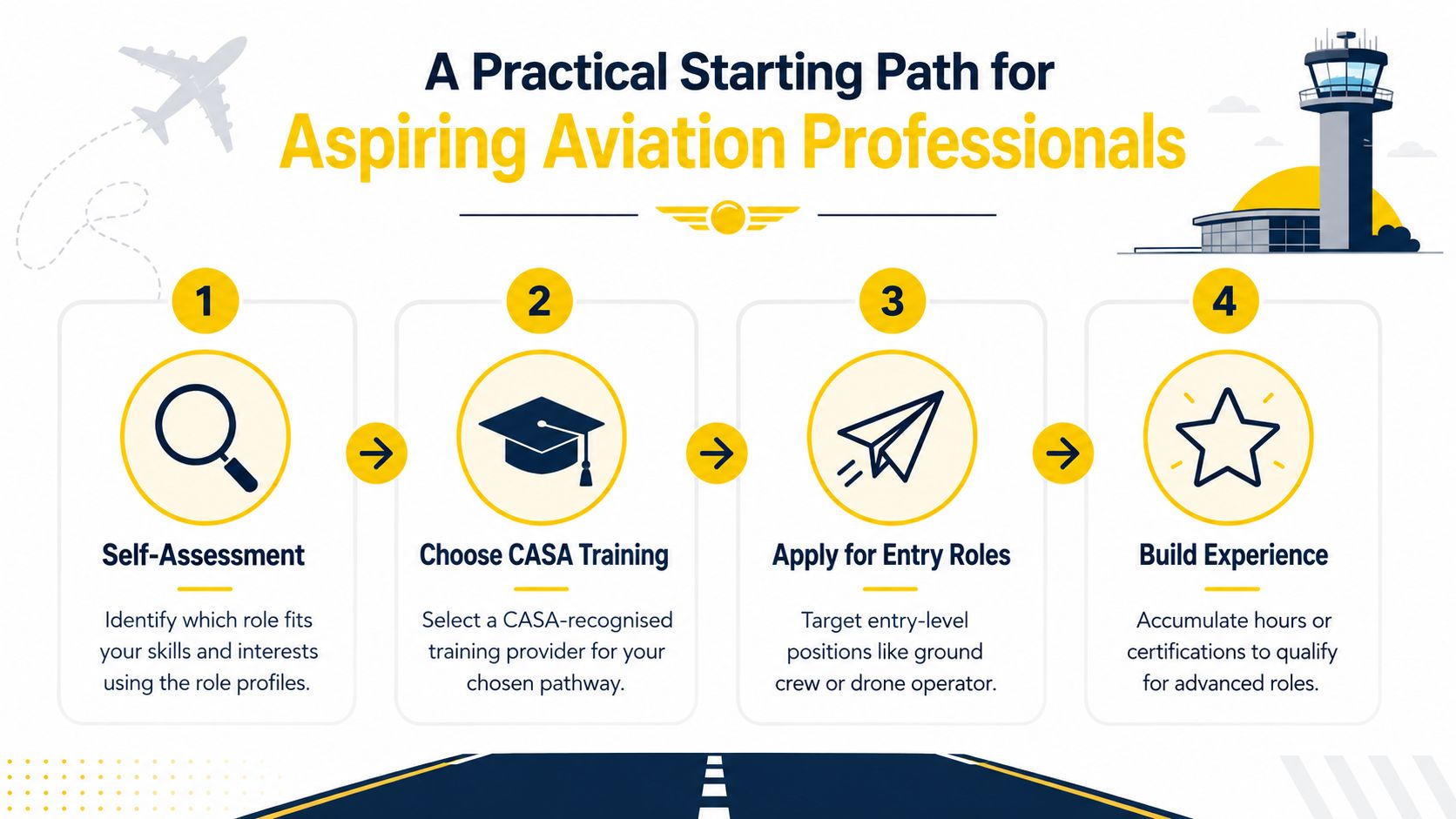
Start with the work, not the brochure
The first filter is simple. If a person wants flight-deck work, the CPL pathway and medical requirements belong at the top of the list. If they want commercial drone operations, then RePL, AROC, and later ReOC are the practical sequence, not a general aviation degree. For readers comparing regulated drone business steps, the guide to ReOC in Australia helps explain the commercial side of that pathway.
The second filter is cost and commitment. A prospective pilot should confirm medical eligibility before locking in training, because the licence pathway is front-loaded and expensive in time as well as money. A prospective drone operator should avoid assuming an introductory course alone makes them commercially ready, because the business and compliance layer still matters.
Build the evidence employers want
Training is only one part of readiness. Employers and clients also look for safe habits, repeatable procedures, logbooks, supervised hours, and the ability to work under Australian rules without being reminded at every step. For drone students, that can mean real project work, site planning, radio practice, and compliance documentation. For pilots, it means structured flying hours and instructor feedback.
A useful option for people entering the drone pathway is ACE's readiness and foundation-style training where it fits, including ACE READY and ACE BRONZE for early-stage capability building, plus RePL, AROC, and ReOC consulting support for commercial readiness. Those should be treated as pathway tools, not shortcuts.
Practical rule: if a course does not help a student produce evidence, hours, or compliance confidence, it is probably too early in the pathway or too generic for commercial work.
A person with transferable experience from another field can also use a practical framing tool. A resource like reframe experience from another field can help identify which previous skills map well to aviation work, such as safety habits, team coordination, reporting, or technical discipline.
Salary Ranges and Regional Considerations
Pay in aviation shifts by role, responsibility, and location, so simple headlines can hide the full picture. A cleaner benchmark is the Jobs and Skills Australia profile for Air Transport Professionals, which lists median weekly earnings of $2,651, 16,700 employed, a 26% part-time share, and annual employment growth of 500 (Jobs and Skills Australia occupation profile). That profile covers pilots, air traffic controllers, and flying instructors, so it works as a useful snapshot, not a full map of every aviation job.
Pay rises as the role becomes more demanding. Senior flying jobs usually attract higher pay because they require more hours, greater responsibility, and deeper regulatory knowledge. Shift work, night work, regional postings, and specialist endorsements also affect pay. In drone work, the pay mix can change quickly if the work involves remote projects, emergency response, infrastructure inspection, or client-facing compliance.
Geography matters too.
Employment is concentrated in the eastern states, especially New South Wales, Queensland, and Victoria (IATA's Australia aviation value report). That concentration usually means stronger employer networks, more training access, and more competition for first roles. Regional work can offer different conditions, but it often brings travel, rostering, or FIFO-style arrangements that change the overall value of the job.
For students comparing a specific city, local training access matters as much as the headline pay. A Perth-based reader may want to compare the local aviation ecosystem with the eastern seaboard before deciding whether to stay close to home or complete the first qualification elsewhere. Ace Aviation Aerospace Academy in Perth is one local starting point for that kind of planning.
Common Misconceptions About Working in Australian Aviation
Aviation careers in Australia often get reduced to one image, a pilot in a cockpit. That picture is too narrow. A school leaver, a career changer, or a mature-age student can build a place in the sector through flying, drones, air traffic services, maintenance, operations, or management, and each path has its own entry rules and training steps.
One common misconception is that a university aviation degree is required for every aviation job. CASA sets the pilot pathway around training, exams, flying hours, English proficiency, and medical fitness, and that is the point prospective students need to understand first. A degree may suit some people, but it is not the single route into the industry.
Another myth is that drone work becomes unregulated once a machine is below a certain weight. Commercial drone work still sits inside a regulatory framework, so RePL, ReOC, and often AROC matter for professional operations. The same goes for the wider job market. The industry's own workforce material points to shortages in maintenance engineers, baggage handlers, and ground crew, which shows that aviation employment is broader than the airline-pilot narrative.
The pay and representation picture is more complicated too. The Department of Infrastructure says women make up only 4% of technicians and trade workers, 26% of professionals, 24% of key management personnel, 10% of CEOs, and 23% of governing bodies and boards in the Air and Space Transport sector, with an average total remuneration gender pay gap midpoint of 27.8% (Industry insights on women in aviation). That data is a reminder that aviation careers are shaped by structural barriers as well as personal interest and training choices.
People changing careers often assume their previous work does not count. It usually does. Customer service, safety routines, field work, technical troubleshooting, and office discipline can all transfer if you reframe experience from another field. In aviation, the question is not whether past experience looks like flying hours. The question is whether it supports the role you are aiming for and the standard of compliance that role demands.
Choosing Your Track and Taking the First Step
The simplest decision framework is this. First, decide whether the person wants to fly aircraft, operate drones, manage airside activity, or build technical expertise. Second, check the licence or qualification that enables that role. Third, compare the local demand and the likely entry route, then choose a training provider that matches the pathway instead of overselling it.
A sensible next-thirty-days checklist
- Confirm eligibility: Check medical requirements for pilot pathways and confirm English proficiency expectations where relevant.
- Shortlist approved training: Look for a CASA-recognised provider that teaches the exact credential needed, not a generic aviation overview.
- Choose the first credential: For drone work, that may be RePL and AROC. For pilots, it starts with the CPL pathway.
- Match training to the job: Consider whether the immediate goal is commercial flying, drone operations, or an operations role that builds experience first.
- Book a discovery conversation: Ask how the provider handles compliance, logbooks, practical assessments, and post-course support.
For people who are changing careers, the transition is often easier when earlier skills are named clearly. Office discipline, field work, customer service, technical troubleshooting, and safety-focused roles can all transfer into aviation if they're framed properly. That's why the next step should be a pathway conversation, not a random course purchase.
FAQ
How long does a CPL pathway usually take in Australia?
CASA defines the licence requirements and training components, but the time taken depends on training pace, weather, aircraft access, and how quickly the theory and flying milestones are completed. A full-time student will usually move differently from someone training around work.
Does drone operation count as a long-term aviation career?
Yes. CASA now groups drone operations with other aviation career areas, and commercial drone work can lead into broader operational, compliance, and business roles.
What is the best starting credential for someone who is undecided?
That depends on the preferred working environment. RePL is often a practical entry point for commercial drone work, while a pilot-minded student should first confirm the CPL pathway and medical fit.
Do aviation jobs still need ongoing compliance after the licence is earned?
They do. Aviation is a regulated environment, so logbooks, medical fitness where relevant, operational procedures, and refresher training remain part of the job.
Are maintenance and ground roles a real entry into aviation?
Yes. Industry shortages in maintenance and ground operations show those roles are central to the sector, not second-tier alternatives.
Ace Aviation Aerospace Academy supports students and organisations that want a practical route into Australian aviation, including drone training, compliance-focused qualifications, and commercial readiness services. For readers ready to choose a pathway, Ace Aviation Aerospace Academy is a useful place to compare RePL, AROC, ReOC consulting, Enterprise Drone Training, and Corporate Drone Training against the role they want.