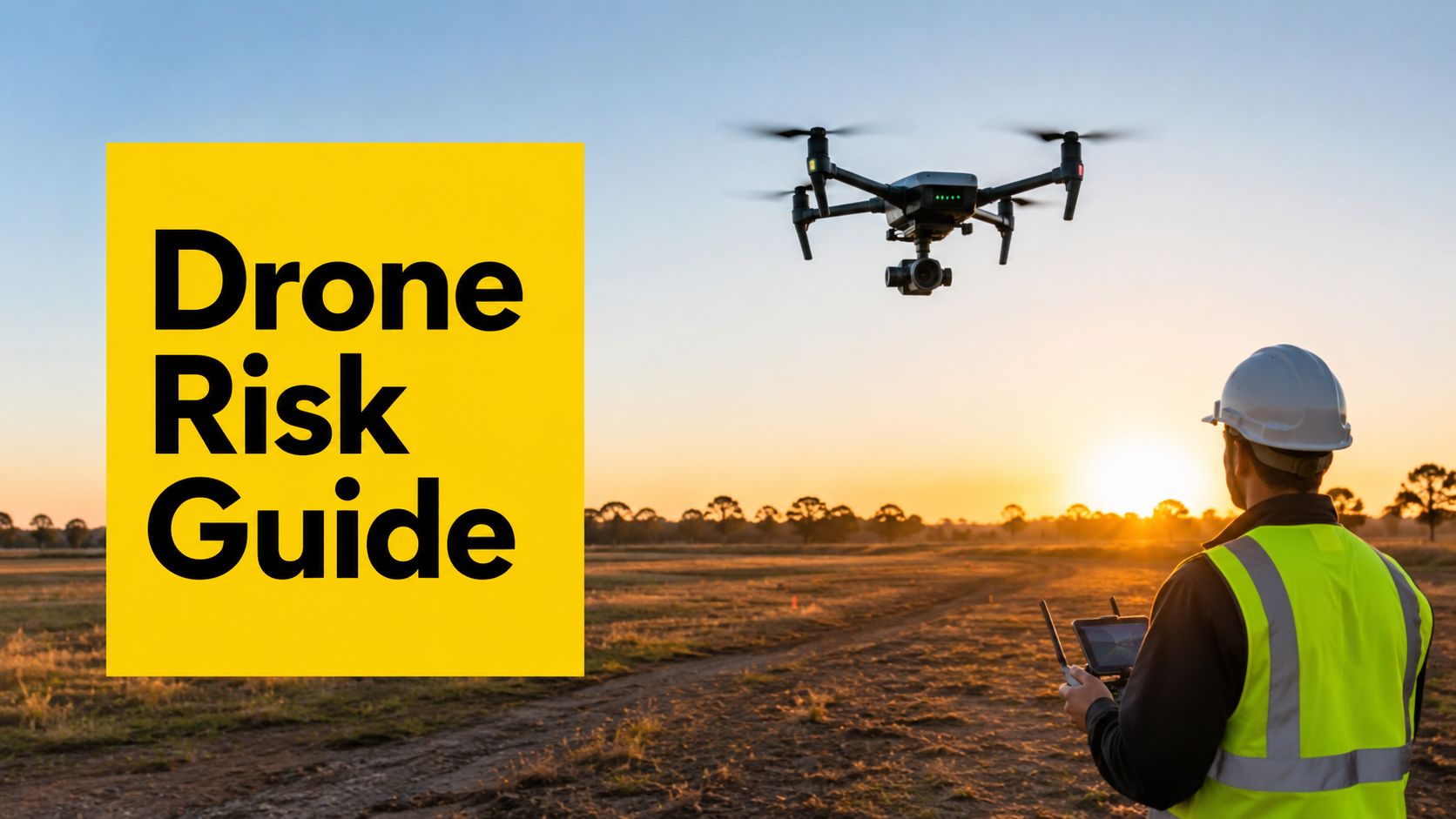
A routine drone job can turn awkward fast. A pilot lines up a mapping flight near a regional airfield, checks the weather, confirms the padock boundary, then watches the aircraft start to drift after a sudden GNSS dropout. The flight may still end safely, but only because the operator had already thought through link loss, return-to-home behaviour, and where the drone would go if the plan stopped working.
That gap between following CASA rules and designing a flight that survives failure is where drone risk management earns its keep. In Australia, the modern compliance environment for commercial operators took shape with CASA's RPAS and drone framework in September 2016, and the job now is to build decisions, records, and contingencies that match the mission's real risk. For a practical overview of how the wider Australian drone ecosystem fits together, see the dronework Australia drone ecosystem.
Table of Contents
- Why Drone Risk Management Matters on Australian Worksites
- The CASA Risk Framework That Underpins Every Operation
- Core Hazard Families Every Drone Risk Plan Must Address
- A Five-Step Risk Assessment Flow You Can Document
- Turning Risk Outputs Into SOPs, Checklists and Records
- Two Australian Operations Compared at Different Risk Levels
- Training, Competency and Continuous Improvement
- Frequently Asked Questions About Drone Risk Management
Why Drone Risk Management Matters on Australian Worksites
A mapping pilot can do everything "right" on paper and still get caught out by actual operational conditions. The airfield is clear, the crew is briefed, and the job is routine until the aircraft loses GNSS integrity and the pilot sees the return-to-home path crossing a populated strip beside the access road. At that point, the issue is no longer whether the pilot remembers a rule. It's whether the operation was built with enough margin to handle a failure without creating a second problem on the ground.
That is the true purpose of drone risk management. It protects people, property, the aircraft, and the operator's approval structure, but it also protects the credibility of commercial drone work in Australia. The Australian Government's 2024–25 aviation safety reporting says the yearly aviation fatality count was well below the 10-year annual average of 190 in the Australian National Aviation Safety Plan annual report, which is a reminder that safety is managed against long-run risk, not a single incident.
What weak risk thinking looks like on site
Weak risk thinking usually shows up as overconfidence in the pre-flight checklist. The pilot confirms battery levels, skips the deeper questions, and assumes the drone will behave as expected because the last ten flights were uneventful.
That's where problems grow. A mission near people, infrastructure, or controlled airspace needs more than a clean launch. It needs a plan for what happens if the aircraft loses position, the link degrades, or the area below becomes unsafe.
Practical rule: if the operation can't explain what happens after the first failure, it isn't ready.
Why the industry feels the impact
Poor risk decisions don't stay local. They can trigger incident reports, regulatory attention, delays for the client, and unnecessary tension around future approvals. They also create a bad habit across the sector, where other operators inherit stricter scrutiny because one crew treated planning as a formality.
Commercial operators who want to avoid that pattern usually move beyond “tick-box compliance” and build mission-by-mission judgement. That means matching the controls to the mission, not forcing every job into the same template. It also means recognising that the safest flight is often the one that was declined, reshaped, or delayed before the propellers ever turned.
Why this matters for ReOC holders
For a ReOC holder, the issue is more than one pilot on one day. CASA expects the organisation to show that hazards are identified, mitigations are documented, and staff can explain why a flight was approved. That's why insurance, manuals, crew roles, and mission records all matter together, not separately.
For organisations comparing training pathways, ACE GOLD is an advanced commercial drone pilot program that includes Remote Pilot Licence (RePL), ReOC support, practical flight training, aviation compliance, and business readiness for commercial drone operations. Those elements only help if the operator can translate them into safer mission planning.
The CASA Risk Framework That Underpins Every Operation
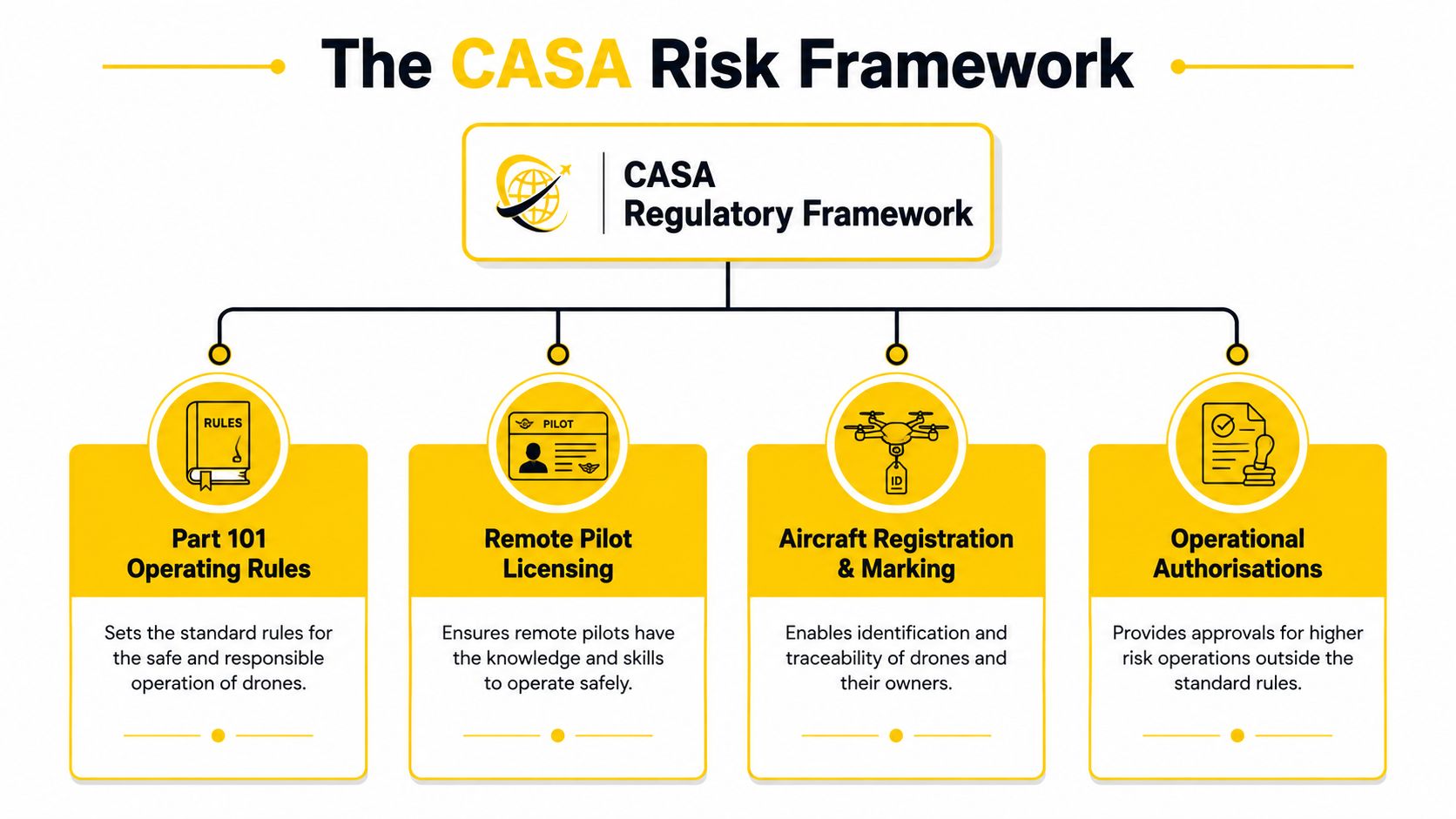
CASA's framework isn't just a set of rules sitting in the background. It works as a layered system where the operating rules, the pilot's RePL, the organisation's ReOC, and the standard operating conditions all have to line up before a commercial flight makes sense. A pilot can't treat those parts as separate boxes, because each one feeds the next decision.
The simplest way to think about it is this. The rules define what is allowed, the licence defines who can fly, the certificate defines what the organisation can approve, and the operational conditions define how the mission must be carried out. That hierarchy is why documentation matters so much in Australia, because CASA isn't only checking whether a drone flew. It's checking whether the flight was managed by a system.
The four pillars in plain English
- Part 101 operating rules: these are the operating boundaries. They shape the mission before the pilot even gets to the site.
- Remote Pilot Licence (RePL): this shows the individual pilot has the competence to operate commercially within the relevant scope.
- Aircraft registration and marking: this ties the aircraft back to an accountable operator, which matters when records and compliance evidence are reviewed.
- Operational authorisations: these are the approvals that let an operation go beyond standard conditions when needed.
That structure is why a flight plan should always connect back to a named person, a documented process, and a clear approval path.
Where SORA-style thinking fits
SORA-style thinking adds another layer of discipline. It asks what the mission is, what the surrounding risk looks like, and what mitigations bring the residual risk down to something defensible. Australia hasn't formally adopted SORA as the whole system, but the logic fits neatly with a well-run ReOC operation.
A team that already uses CASA compliance properly is halfway there. The missing piece is often the explicit risk classification, the documented reasoning, and the evidence trail that shows why one job was low consequence and another needed tighter controls. That is where a modern risk workflow becomes useful rather than bureaucratic.
Why insurance and internal systems matter together
Insurance can't replace operational discipline, but it sits in the same conversation. Operators who are reviewing their risk structure often look at secured aviation insurance with ISU as part of the broader control environment, because a serious incident is easier to manage when the organisation has already documented what it did and why.
The same logic applies to course selection and internal development. A framework only works if the crew understands it, so training, manuals, and operational approvals need to reinforce the same decision standard. For operators comparing compliance support pathways, ultimate guide ReOC Australia is useful because it sits close to the organisational side of the framework rather than just the pilot side.
Core Hazard Families Every Drone Risk Plan Must Address
Drone hazards usually arrive in families, not as isolated surprises. A pilot might notice a signal issue first, but the problem may be link failure interacting with terrain, nearby aircraft, and a crowded ground area. That's why a workable plan should group hazards in a way that helps the crew recognise patterns quickly.
The five families that matter most
Command and control link failure is the first family. It covers radio-frequency interference, degraded control links, and the kind of failure that can push the drone into an uncontrolled descent or fly-away. Independent technical reviews describe the control link as vulnerable to electronic attack and explicitly flag geofencing, no-fly zones, and kill switches as core mitigations, which is why pre-flight spectrum checks and failsafe behaviour should be built into the plan, not added later Technical Aspects Concerning the Safe and Secure Use of Drones.
System malfunction or battery loss is the next family. A pilot doesn't need a dramatic failure to create risk, because a tired battery, poor maintenance history, or overlooked fault can still produce a landing problem at the wrong moment.
Loss of situational awareness follows close behind. Once the pilot can't confidently track the drone, the airspace, or the people below, the rest of the plan starts to degrade.
Airspace intrusion or conflict is the family that matters most around other aircraft. A systematic review of drone operations notes that security and privacy concerns are being overtaken by interactions with other airspace users, including disruption around airports and emergency services, with Tasmania cited as a real-world case of service interference systematic review of drone operations.
Environmental and weather factors cover wind, low visibility, terrain, and the way a site can amplify small errors. Poor weather isn't just inconvenient. It changes the likelihood that the pilot loses control or that the drone drifts into a different risk category.
If the site has wind, people, buildings, or nearby aircraft, the hazard list is already bigger than the aircraft itself.
How those hazards show up in real jobs
A tower inspection might look simple until the building creates turbulence and the crew realises the drone is working in a narrow corridor. A survey job over a mine site may look open and empty, but the hazard is the interaction of terrain, machinery, and a fast-changing exclusion area.
For pilots starting out, ACE BRONZE is a foundation commercial drone course covering drone operations, flight safety, aviation theory, and practical skills. It suits students beginning the path toward becoming licensed drone pilots in Australia.
The decision habit that changes everything
The important habit is to name the dominant hazard family before launch. That single judgement helps the crew decide whether the day is mostly about link integrity, ground risk, airspace separation, or weather restraint. Once that habit is embedded, pre-flight briefings become sharper and the SOP stops being a generic document.
A Five-Step Risk Assessment Flow You Can Document
A useful risk assessment does not need to be complicated. It needs to be explicit, repeatable, and written in a way that another competent person can understand later. That is the difference between a good judgement and a defensible one.
Step 1 define the operation
Start by describing the mission in plain language. State where the drone will fly, what it will do, who is involved, what airspace or ground features matter, and what the expected outcome is.
A tower inspection, for example, needs a different definition from a broad-acre survey. The crew should identify the operating area, the likely flight profile, and the reason the task exists, because those details shape the rest of the analysis.
Step 2 identify the hazards
Use the hazard families already identified. Link failure, airspace conflict, environmental pressure, and third-party risk should all be named in the assessment, even if some are low on the day.
Step 3 assess severity and likelihood
SORA-style logic is useful even without formal adoption. The operator asks how bad the outcome could be, how likely it is to occur, and whether the current controls are enough for the specific mission.
Step 4 apply mitigations
Mitigations should be practical, not decorative. That may mean clearer exclusion zones, stronger crew briefings, tighter weather limits, spectrum checks, revised abort criteria, or a safer launch point.
Step 5 document and monitor
Write the decision down, sign it off, and keep enough information to defend it later. Research on UAV service operations recommends documenting the operating environment, the disturbance or undesirable event, the number and frequency of disruptions across missions, the cause, and the consequence, because those records support incident investigation and future mitigation planning UAV service operations research.
For teams comparing practical frameworks, the Logical Commander risk assessment method is a useful example of how a structured assessment can move from hazard recognition into documented decisions.
What should be recorded
- Operational context: site, mission type, nearby hazards, and who was involved.
- Hazards and triggers: what could go wrong, and what made it plausible on that day.
- Mitigations used: what changed because of the assessment.
- Residual risk decision: why the crew accepted, delayed, or cancelled the mission.
- Post-flight note: what happened, even if nothing went wrong.
A ReOC holder can then tie that material back to the manual, the SOP, and the sign-off process. That's what turns the assessment into evidence rather than a one-off worksheet.
Turning Risk Outputs Into SOPs, Checklists and Records
A risk assessment only matters if it changes the way the flight is run. If the conclusions stay in a spreadsheet, the crew will forget them the moment the weather shifts or a client starts asking for a faster launch. The operational artefacts have to carry the decision into the field.
From assessment to SOP
A mission-specific SOP should say how the job will be flown. It should name the crew roles, the communication method, the launch and recovery plan, the abort criteria, and what happens if the aircraft, weather, or airspace picture changes.
That document does not need to be long, but it does need to be specific. A good outline usually includes crew responsibilities, operating area description, setup and shutdown sequence, emergency response, and post-flight reporting. For organisations that want a practical reference point on document structure, prevent doc rot with SOPs is a useful external guide on keeping procedures current and usable.
From SOP to checklist and log
The checklist operationalises the SOP. It turns the risk decision into actions the pilot can confirm before, during, and after the flight. Weather notes, airspace checks, battery status, radio checks, and equipment condition all belong there if they affect the mission.
The flight log closes the loop. It captures what was done, what was observed, and whether anything deviated from the plan.
Audit-safe rule: if it affected the decision, it belongs in the record.
What strong records usually include
- Before flight: weather snapshot, site notes, crew briefing, and any airspace or exclusion-zone checks.
- During flight: pauses, deviations, loss of visibility, link warnings, and any change in the operating plan.
- After flight: anomalies, shutdown issues, maintenance notes, and anything that should alter the next risk review.
That recordkeeping discipline matters for all operators, but it becomes critical for teams dealing with clients, regulators, or multiple jobs a day. A separate emergency response resource, the drone pilot emergency handbook ANCA CANCA ATSB, sits well beside this material because flight planning and incident response should use the same evidence habit.
Why this matters in practice
A strong SOP and a strong checklist make the operation repeatable. A strong log makes it reviewable. Together, they show that the crew didn't just know the risks, they acted on them.
Two Australian Operations Compared at Different Risk Levels
A low-risk job and a high-risk job can use the same risk system without producing the same controls. The difference is not in the paperwork format. It's in how much separation, oversight, and contingency planning the mission needs.
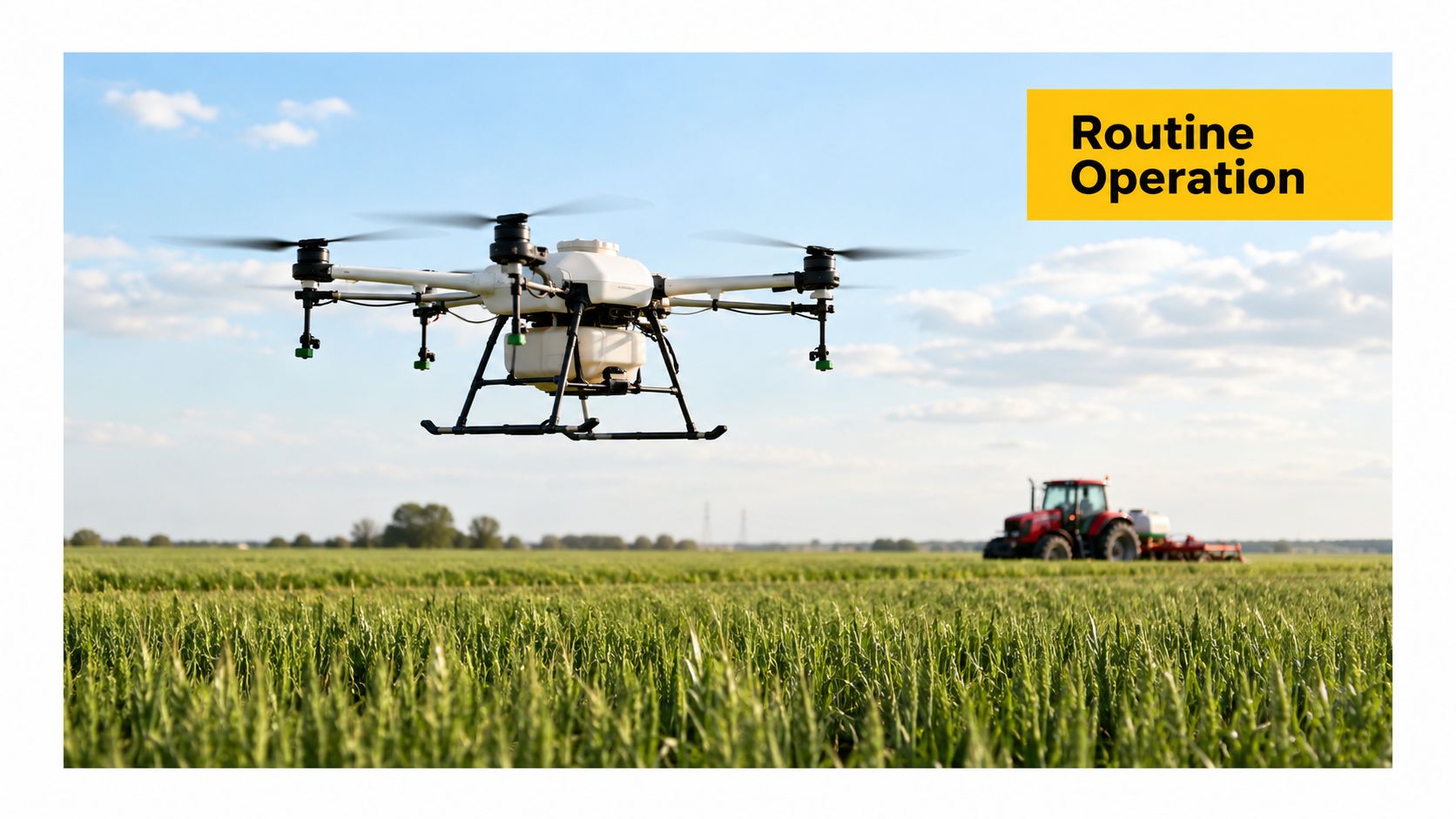
Routine agricultural spreading job
A spreading job over a known paddock with a briefed ground crew and predictable wind can often sit in a lower risk class. The operator still needs the assessment, but the mitigations may be straightforward, such as site briefing, boundary control, weather monitoring, and clear recovery points.
The key difference is that the hazard picture is stable. The crew usually knows the terrain, the vehicle movement, and the area where people should not enter. If the controls match the site, the SOP can stay relatively lean.
Complex urban infrastructure inspection
An urban inspection near a controlled airfield changes the picture fast. Nearby manned aircraft, pedestrian traffic, tighter airspace boundaries, and the possibility of BVLOS considerations all increase the pressure on the plan.
A systematic review of drone operations reports that security and privacy concerns are being overtaken by operational hazards involving interactions with other airspace users, including disruption around airports and emergency services, with Tasmania cited as a real-world example of service interference systematic review of drone operations. That is why a higher-risk job needs more detailed documentation, tighter separation logic, and, in some cases, closer CASA engagement.
How the outputs change
For the agricultural task, the assessment may lead to standard SOPs, a routine checklist, and a simple post-flight log. For the urban inspection, the output usually needs more layers, including explicit abort triggers, stronger crew coordination, and a much clearer record of why the flight was considered acceptable.
The same framework is being used in both cases. Only the depth of control changes. That's the value of structured risk management, it scales without becoming arbitrary.
Training, Competency and Continuous Improvement
Risk management only works when people can use it under pressure. A RePL holder still needs currency and judgement, and teams working near controlled airspace often benefit from the extra operational discipline that comes with radio competency and tighter communication habits. AROC training supports that side of the job, especially when the operation sits close to other aviation traffic.
Build the habit, not just the certificate
A one-off course won't protect a team that never practises its procedures. ReOC holders should run regular exercises so the crew can test abort calls, communication lines, incident reporting, and handover discipline before a real problem exposes the gaps.
Formal risk frameworks recommend a safety database, monitoring procedures, and voluntary or mandatory reporting, yet those controls are rarely explained in practical AU terms for ReOC holders, enterprise teams, or agricultural operators using drones at scale FAA risk framework attachment. That makes internal training even more important, because the organisation has to turn the framework into daily habits.
Feed lessons back into the system
Every mission should leave something behind, even if it was uneventful. Near misses, unusual weather, maintenance issues, and small deviations should be reviewed and folded back into the SOP, the checklist, or the next training drill.
For operators mapping their next step, the licence finder can help match the pathway to the role, whether the need is RePL, AROC, ReOC consulting, enterprise drone training, or a broader aviation qualification. Ace Aviation Aerospace Academy also supports commercial drone training pathways that align with this kind of operational discipline.
The practical takeaway
The strongest teams treat competence as a cycle. They train, document, review, and adjust, then repeat the process with better evidence the next time.
Frequently Asked Questions About Drone Risk Management
How often should a risk assessment be reviewed?
It should be reviewed before every mission, and again whenever the site, airspace, weather, crew, or payload changes. A saved assessment from last week is only useful if today's operation is the same.
What records matter most in a CASA audit?
The most useful records are the ones that show what was planned, what was checked, what was approved, and what happened. That usually means the SOP, checklist, flight log, crew briefing notes, weather evidence, and any post-flight anomaly report.
What should happen after a near miss?
A near miss should be recorded, reviewed, and used to update the risk assessment if needed. It doesn't have to become a major regulatory event, but it should never be ignored, because small warnings often point to a bigger system gap.
How should multi-crew operations divide responsibility?
The assessment should name who owns the mission, who checks the airspace, who controls the aircraft, and who has authority to stop the job. Shared responsibility works only when the roles are written down and briefed before launch.
Does every operation need the same level of detail?
No. The detail should match the risk. A routine paddock job can use a leaner set of controls, while a complex urban or near-airfield flight needs deeper documentation, tighter mitigation, and clearer sign-off.
Ace Aviation Aerospace Academy helps Australian operators build that discipline through practical drone and aviation training, including RePL, AROC, and ReOC-related support. For pilots and teams who want their paperwork to match their flight decisions, visit Ace Aviation Aerospace Academy and review the training pathways that fit their operation.