

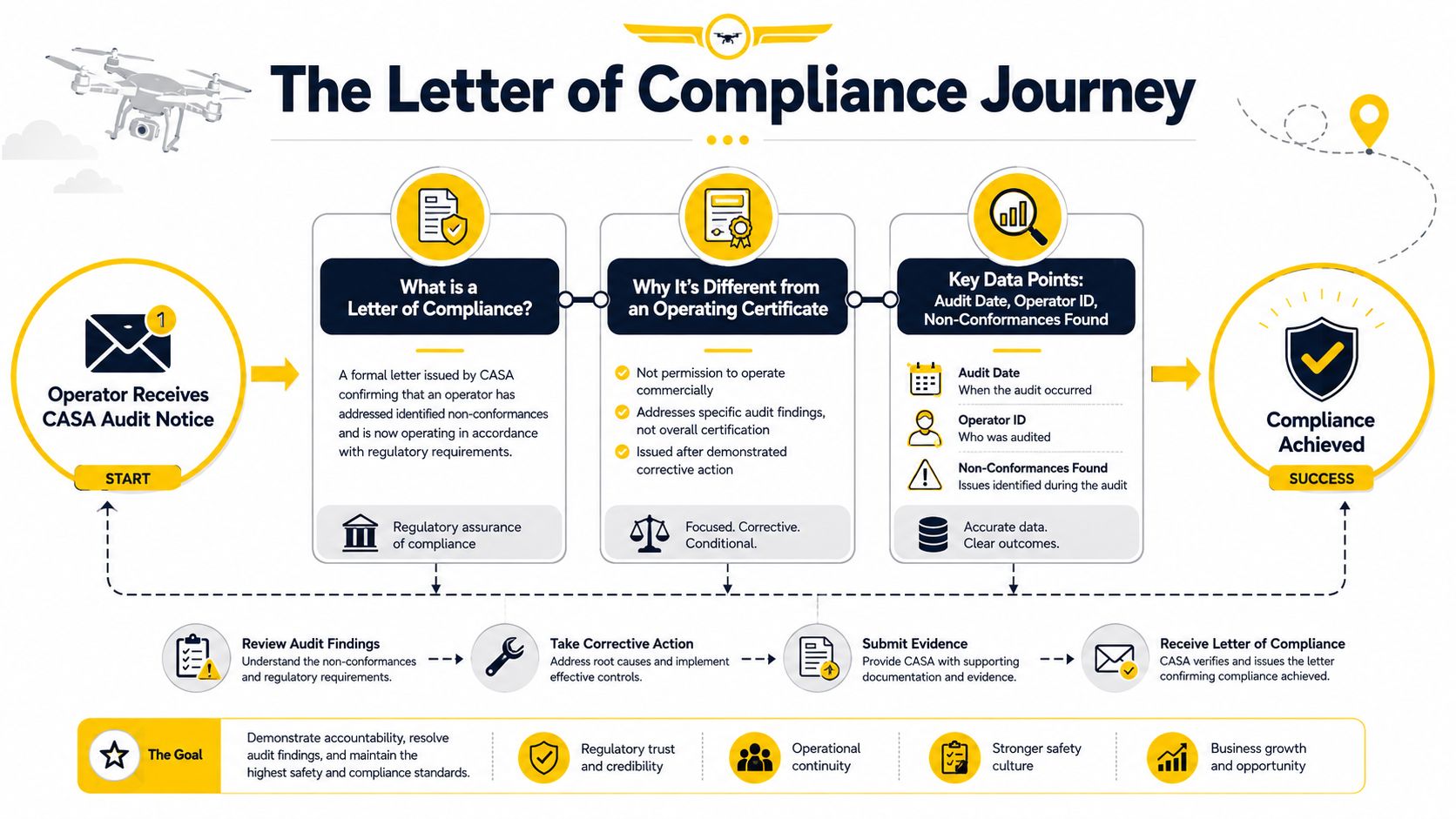
A client asks for written proof that the drone program, radio training, or operational paperwork really matches CASA expectations, and the problem usually isn't the flying. It's the paperwork trail. A letter of compliance is the document that turns scattered evidence into a clear written record, so a reviewer can see what rule was met, what proof supports it, and who is responsible for the declaration.
For a new commercial operator, that sounds more formal than it first appears. In practice, it's less like a casual email saying “we're compliant” and more like a controlled file note that ties each requirement to a dated record, procedure, certificate, or log. That distinction matters in aviation, because auditors and clients don't just want confidence, they want traceability.
Searchers also get tripped up because the same phrase is used outside aviation, including in superannuation. AustralianSuper's Letter of compliance is an employer-facing document linked to the ATO Standard Choice form, not a general aviation clearance, which is why the term causes so much confusion for first-time readers. For a broader compliance mindset, protect your business data is a useful reminder that regulated paperwork is really about controlled evidence, not just polished wording. For operators working through excluded or specialised drone scenarios, this internal guide on excluded category drone operations is a helpful companion.
Table of Contents
- What a Letter of Compliance Means for Australian Drone Operators
- Why CASA Treats a Letter of Compliance as Documentary Evidence
- Core Components Every Aviation Letter of Compliance Must Include
- How the Letter Is Used in RePL and ReOC Pathways
- Preparing and Submitting Your Letter of Compliance
- Common Mistakes That Cause Letters of Compliance to Be Rejected
- How Ace Aviation Aerospace Academy Supports Compliance Preparation
What a Letter of Compliance Means for Australian Drone Operators
A commercial drone operator is often asked for a letter of compliance at the exact moment a project moves from “training done” to “prove it in writing.” A client might want it before site access, a procurement panel might want it with a submission, or a regulator might want documentary proof that a stated requirement has really been met. That's the point where a casual assurance stops being enough.
A compliance letter is a mapped declaration
A proper letter of compliance is not a one-line promise. It is a written declaration that maps a requirement to evidence, so the reader can follow the trail from the rule to the supporting document. In aviation terms, that means the letter should show what standard, procedure, qualification, or operational control is being addressed, then point to the record that proves it.
That is why the document feels more like a checklist with a signature than a normal business letter. It exists to make a claim testable. If the evidence is missing, the claim is weak.
Practical rule: if the sentence cannot be traced to a dated record, it doesn't belong in a compliance letter.
Many new operators get confused here. A capability statement describes what a business can do, while a compliance letter declares that a specific requirement has been met. One sells confidence, the other supports verification. The distinction matters in CASA-related work because the letter may sit inside an audit file or approval trail.
For context, the document also appears in other regulated settings. The Hong Kong Lands Department's compliance records show that certificates are part of a recurring regulatory milestone, not a one-off formality, and the Hong Kong Fire Services Department's guide shows a formal application pathway for a letter of compliance in a safety-regulated process. That broader pattern is the same one Australian drone operators need to understand, even when the local wording differs.
Why first-time readers misread the term
The phrase “letter of compliance” sounds plain, which makes it easy to underestimate. New operators often treat it as an informal note, then discover that the requesting party expects structured evidence, named responsibilities, and a clean audit trail. In that sense, the letter is closer to a controlled declaration than a memo.
For an operator building paperwork around CASA, the safest mindset is simple. The letter should answer three questions, what requirement applies, what evidence proves it, and who is accountable for the statement. That framing keeps the document useful whether it supports training, radio, or operational approval.
Why CASA Treats a Letter of Compliance as Documentary Evidence
CASA-driven paperwork works best when each document has a distinct job. A Certificate III transcript shows course completion, an AROC shows radio competency, an SOP shows the operating method, and a letter of compliance ties those pieces together when someone needs written proof that a specific requirement has been satisfied. The letter is the bridge, not the whole building.
How it differs from other documents
A certificate proves achievement. An SOP proves process. A submission proves that information was sent. A letter of compliance proves that a requirement has been matched to evidence in a form a reviewer can audit.
The FAA's sample Letter of Compliance for Part 147 shows the control logic clearly, because it asks the applicant to address each regulatory section in sequence and either describe the method of compliance or point directly to the controlling document. That requirement-by-requirement structure is the same reason compliance letters work in safety systems, auditors need traceability, not general reassurance.
For Australian drone operators, the lesson is straightforward. A RePL holder can't rely on a training certificate alone if the question is whether a particular operational condition has been met. A ReOC organisation can't rely on a general policy statement if the issue is whether the procedure is documented and governed. The letter translates those internal records into external proof.
Why the government workflow model matters
The Hong Kong Fire Services Department's “Guide to Application of Letter of Compliance” is useful because it shows how regulators treat the document as part of a controlled approval pathway. The guide names formal contact channels and refers to a government web system, which reinforces the idea that the letter sits inside a managed process, not an afterthought. That is the same logic CASA-aligned operators should assume when preparing evidence for review, especially when the reviewer wants a clear path from claim to proof.
Compliance letters work best when they read like evidence maps, not sales copy.
A commercial drone team can file a flight plan with the right attachments. The plan itself is concise, but the attached information is what gives it operational value. In the same way, the letter becomes credible when it links directly to the underlying training file, competency record, maintenance log, or procedure set.
AAA's FAQ page is a sensible place to send staff who keep mixing up certificates, approvals, and declarations, because those categories often get blurred in early-stage compliance work. Once the categories are separate, the letter's job becomes much clearer.
Core Components Every Aviation Letter of Compliance Must Include
A useful compliance letter follows a predictable structure. The order matters because reviewers read from identification to scope to proof, and any gap in that sequence slows the review or weakens the declaration. The safest approach is to build the document as a controlled record, not as a free-form explanation.
Start with the document controls
The header should carry the date, a reference number, the recipient, and a subject line that names the compliance issue in plain language. The recipient matters because the letter needs to be addressed to the person or organisation responsible for reviewing it, not to a vague office address. The subject line should tell the reader exactly what requirement is being addressed.
Next comes operator identification. That usually means the legal entity name, the relevant contact person, and the scope of the business or operation covered by the letter. If the letter is for a training pathway, the scope might be a candidate or cohort. If it is for an organisation, the scope might be the ReOC operation, a site, or a defined activity.
Then map the requirement to the evidence
The middle of the letter should be a requirement-by-requirement compliance table. That is the part many leave too vague, yet it is the heart of the document. The FAA sample compliance letter shows why, because each regulatory clause is handled one by one, with either a short method narrative or a direct reference to the controlling document.
The table below shows a practical structure an Australian operator can adapt.
| Component | Purpose | Typical CASA-Linked Evidence |
|---|---|---|
| Date and reference | Creates document control | Version history, issue date |
| Recipient details | Directs the letter to the right reviewer | Client, CASA, insurer, or procurement contact |
| Subject line | States the exact compliance issue | RePL, AROC, ReOC, or operational requirement |
| Operator identification | Identifies the legal entity and scope | ABN details, business name, operational scope |
| Requirement register | Maps each clause to proof | SOP, competency record, syllabus, maintenance log |
| Evidence attachments | Supports the declaration | Dated records, certificates, procedure extracts |
| Declaration and signature | Confirms authority | Authorised signatory, role, date |
| Version control | Shows the latest controlled issue | Revision number, approval record |
After that, the letter needs declarations, signature, and version control. A signature without authority is just handwriting. A version without control can create confusion about which draft was submitted.
This internal licence-finder tool is useful for operators who need to sort the right training or pathway before writing the letter, because the evidence attached to the letter has to match the underlying qualification or operational need.
How the Letter Is Used in RePL and ReOC Pathways
The same letter template behaves differently depending on whether the operator is an individual candidate or a regulated organisation. That's where many people overcomplicate things. The structure stays the same, but the evidence trail changes to suit the pathway.
A RePL candidate's version
A RePL candidate's letter of compliance usually supports a training or assessment outcome. The evidence trail points to the registered training organisation, the competency record, and any radio evidence if operational communications are part of the role. If the candidate also needs radio capability for the work environment, the AROC record becomes part of the package because the reviewer needs to see that the radio component is supported by a real qualification trail.
The language stays tight. It shouldn't claim that the candidate can do every operation in every environment. It should only confirm what has been trained, assessed, and documented. That discipline keeps the letter honest.
A ReOC organisation's version
A ReOC pathway is broader because it involves an organisation, not just a person. The letter needs to point to operational procedures, maintenance logs, crew competency, and the person responsible for oversight, such as a nominated chief remote pilot. The declaration then covers the controlled system around the operation, not just an individual achievement.
That is why the same words cannot be directly copied from a candidate file into an organisational submission. The scope changes, the evidence changes, and the signatory usually changes too. A ReOC applicant should think in terms of controlled governance, not just course completion.
A strong compliance letter doesn't broaden the claim, it narrows it until the evidence can carry the weight.
A practical example is ACE GOLD, which is described as an advanced commercial drone pilot program including RePL, ReOC support, practical flight training, aviation compliance, and business readiness for commercial drone operations. That kind of pathway can help organise the records an operator later needs to reference, but the letter itself still has to be built from the operator's own evidence.
For a deeper look at organisation-level paperwork, AAA's ReOC guide is the natural companion reading. The key point is simple. A RePL letter is usually about verified competence. A ReOC letter is usually about verified control.
Preparing and Submitting Your Letter of Compliance
The cleanest letters are built from evidence first and prose second. That sequence matters because a well-written sentence can't rescue a missing log, undated record, or uncontrolled draft. The operator should start by auditing the file, not by opening a blank page.
A practical workflow
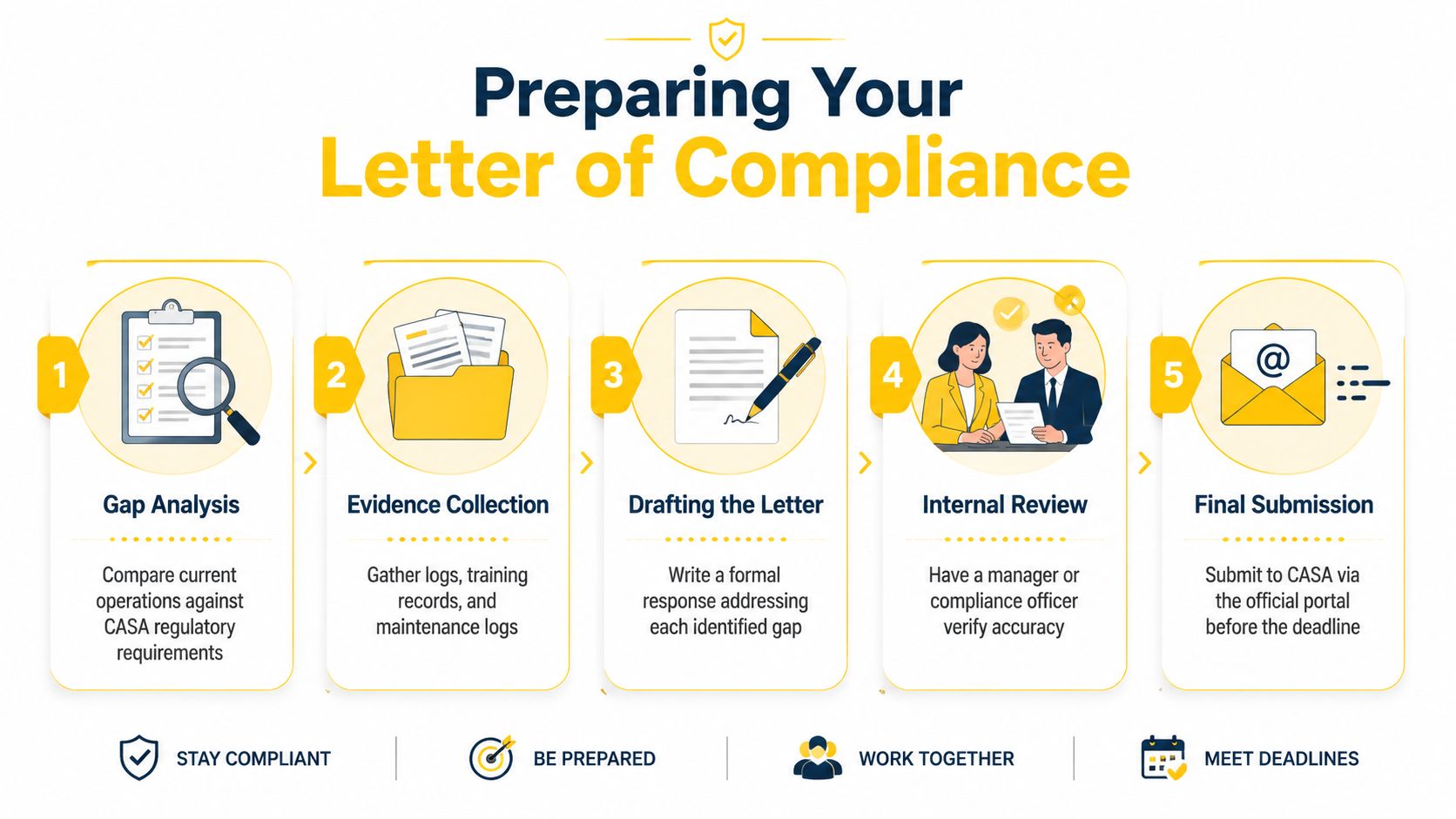
Run a gap analysis. Compare the requirement, whether it's training, radio, or operational governance, against the actual records available. If the evidence doesn't exist, the letter can't claim compliance yet.
Collect the supporting material. Pull together dated SOPs, assessment records, maintenance logs, syllabi, competency notes, or any other controlling documents that prove the point being made. Keep them named and versioned.
Draft the letter around the evidence. Write each statement so it leads to a specific attachment or record. That keeps the letter readable and defensible.
Get internal review. A manager, compliance lead, or authorised signatory should check that the scope matches the authority to sign, and that the wording doesn't overstate the evidence.
Submit to the right party. The recipient might be CASA, a client, an insurer, or a procurement panel. The exact pathway depends on who asked for the document and what they need from it.
Timelines depend on the receiving party and the completeness of the file. A complete, traceable package usually moves more smoothly than a letter built around assumptions, because the reviewer doesn't need to chase missing proof.
A condensed checklist for the planning file
- Scope clarity: state exactly which requirement the letter covers.
- Evidence traceability: link every statement to a dated source document.
- Signatory authority: confirm the person signing can speak for that scope.
- Version control: mark the current draft and keep the obsolete one out of circulation.
- Supporting attachments: include the records a reviewer would ask for next.
That checklist is short on purpose. If a line can't be ticked cleanly, the letter probably needs more evidence before it goes out.
Common Mistakes That Cause Letters of Compliance to Be Rejected
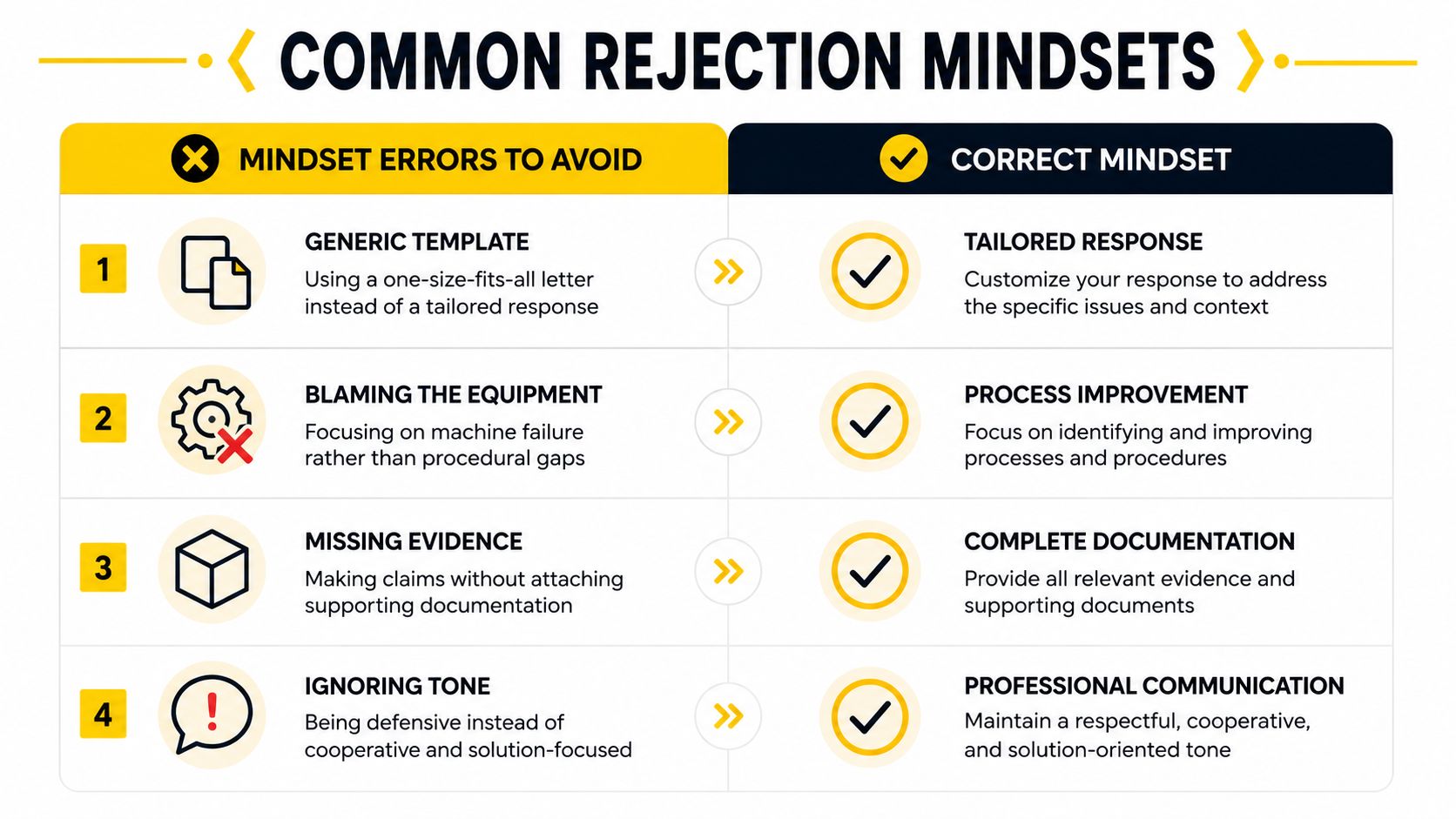
Rejected letters usually fail for the same four reasons, and all four begin with a mindset problem. The document is treated like a formality instead of a controlled declaration, then the reviewer is left to guess what the operator proved.
The four errors that cause trouble
A generic letter is the first problem. It says something broad like “the business is compliant” without mapping each requirement to evidence. That fails because reviewers assess compliance clause by clause, not by vibe.
Undated or uncontrolled evidence is the second problem. A letter can mention logs, certificates, or procedures, but if those records don't show when they were issued or which version was current, the declaration loses force. Document control is part of the proof.
The third problem is signing outside scope. A manager can't authorise a statement they don't have authority to make, especially when the letter covers a wider operation than their role. The signature needs to match the scope.
The fourth problem is confusing compliance with promotional language. A capability statement, brochure, or marketing summary is not a compliance letter. One describes the business, the other records a verified condition.
There's also a common Australian search confusion around the superannuation version of the phrase. AustralianSuper's Letter of compliance is an employer-facing form linked to the ATO Standard Choice process, so it's not the same thing as a regulated aviation declaration. That distinction matters because a copied template from the wrong context can create more confusion than clarity.
For teams trying to lower regulatory risk with automation, the lesson is straightforward. Automation can help track evidence and version control, but it still needs human review to make sure the right rule is being addressed and the signatory is authorised. If those controls are weak, the system just produces faster mistakes.
How Ace Aviation Aerospace Academy Supports Compliance Preparation
The strongest compliance letters usually come from operators who already have their paperwork habits under control. That starts with training records that are dated, clear, and easy to trace back to the requirement being claimed. It also depends on having a document backbone before the letter is drafted.
A CASA-aligned Remote Pilot Licence (RePL) pathway creates the kind of competency records a letter often needs to reference. An AROC course helps produce the radio-procedure evidence that matters where voice communication is part of the operation. For organisations, ReOC consulting helps build the controlled documentation set that a letter of compliance rests on, including the kind of governance records reviewers expect to see.
Why Ace Aviation is a useful reference point for operators trying to understand the training and advisory side of that process, because the paperwork only stays strong when the underlying records are organised properly. The same logic applies whether the operator is preparing for a client submission or a CASA-related review.
ACE GOLD is relevant where an operator wants a single commercial pathway that combines RePL, ReOC support, practical flight training, aviation compliance, and business readiness for commercial drone operations. That kind of structure can make the evidence trail easier to assemble, but it doesn't replace the operator's own responsibility to write the letter accurately and sign it only when the file is ready.
The core idea is simple. Better training doesn't write the letter for the operator, but it does make the letter shorter, cleaner, and easier to defend if someone asks for the underlying proof.
If a drone operation needs clearer paperwork, stronger training records, or help organising RePL, AROC, and ReOC evidence, Ace Aviation Aerospace Academy can help build the foundation before the letter is drafted. Operators who want their compliance file to stand up under review should contact the team, review the relevant pathway, and put the evidence trail in order before the next submission goes out.
FAQ
What is a letter of compliance in drone operations?
It is a formal written declaration that links a specific requirement to supporting evidence, so a reviewer can verify the claim.
Is a letter of compliance the same as a certificate?
No. A certificate proves completion or achievement, while a letter of compliance ties a requirement to evidence in a controlled document.
Does a RePL holder need a different letter from a ReOC organisation?
Usually, yes. A RePL letter tends to focus on individual competency, while a ReOC letter usually covers organisational controls and governance.
Can a normal business letter be used as a compliance letter?
Only if it includes the right scope, evidence trail, version control, and authorised signature. A generic business letter usually isn't enough.
Why do people confuse compliance letters with superannuation forms?
Because the same phrase is used in different contexts. In Australian superannuation, the term refers to a specific employer-facing document, not an aviation compliance declaration.
What should be checked before submitting one?
The scope, the evidence trail, the signatory authority, the document version, and every attachment that supports the declaration.