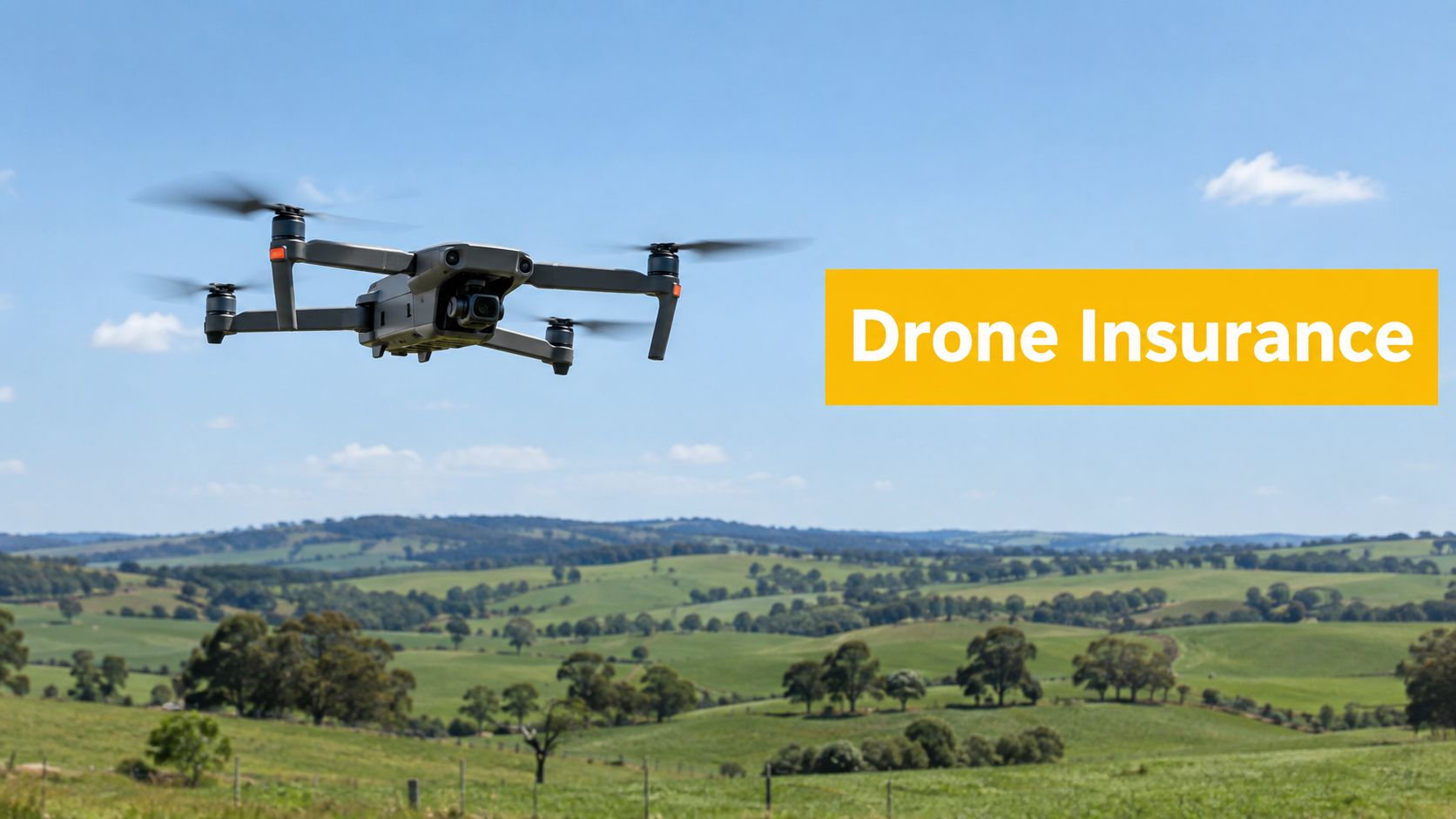
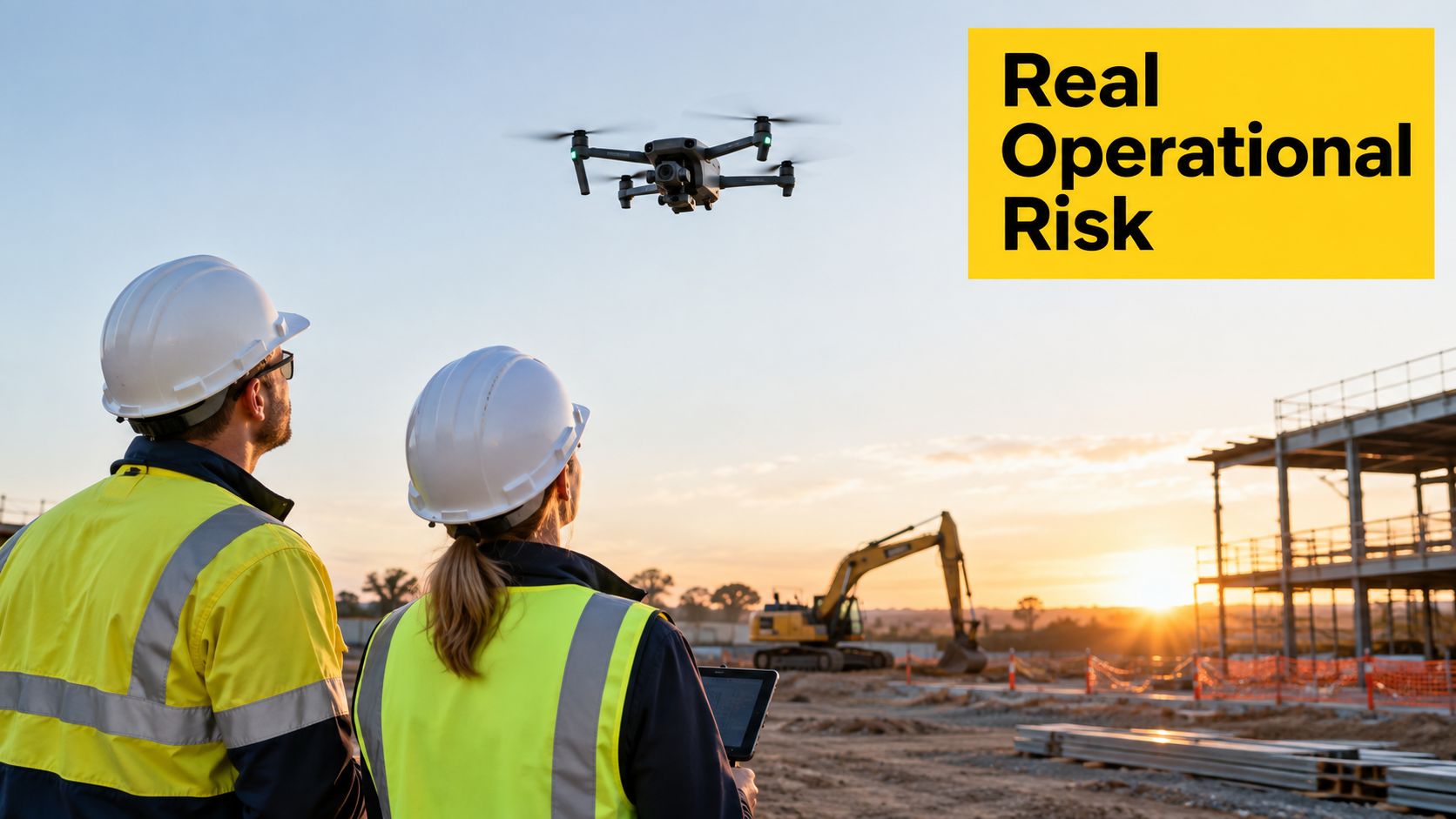
A construction company has booked a drone operator to inspect a work site. The flight looks routine until a gust pushes the aircraft beyond the planned path, damaging property and creating a potential injury claim. The operator now has to manage the incident, protect the client relationship, preserve flight records and determine whether the policy responds.
That is why commercial drone insurance deserves treatment as an operational control, not merely an expense on an annual business budget. The right cover protects more than an aircraft. It supports contract access, helps address third-party liabilities and must align with the operator's CASA approvals, documented procedures and actual services.
Table of Contents
- Understanding the Real Risks of Commercial Drone Operations
- Mandatory Versus Recommended Insurance Cover in Australia
- Breaking Down Commercial Drone Insurance Policy Types
- Aligning Insurance with CASA Licensing and ReOC Requirements
- Evaluating Cost Drivers and Typical Policy Limits
- Selecting the Right Cover for Specific Australian Industries
- Navigating the Claim Process and Common Exclusions
- Frequently Asked Questions
Understanding the Real Risks of Commercial Drone Operations
A commercial flight can produce several types of exposure at the same time. A drone might be damaged, a payload could be lost, a person might be injured, or property on the ground could be affected. A surveying or inspection business may also face a claim about the accuracy or handling of the information delivered to the client.
A useful Australian market signal comes from QBE's cited drone claims data. It indicated that one in fifty drones would be involved in an accident, which the report equated to approximately one crash every 2,000 hours of operation (ABS Aviation's summary of drone insurance). The figure shouldn't be used as a prediction for an individual pilot, but it illustrates why operators must plan for low-frequency events with potentially serious consequences.
How a routine mission can escalate
Consider a roof inspection near an active construction area. The aircraft itself might be worth less than the machinery, vehicles or structures around it. A collision with a temporary structure could therefore create a third-party property claim that bears little relationship to the drone's purchase price. If a person is struck or injured, bodily injury exposure adds legal, medical and business consequences.
A separate problem can arise after a seemingly successful flight. If an operator supplies a survey, inspection report or photographic deliverable that a client later considers defective, the dispute may concern professional services rather than physical aviation damage. That risk sits outside the simple assumption that a “drone policy” automatically covers every part of a commercial engagement.
Practical rule: The policy should be assessed against the complete mission, including the aircraft, payload, people, property, data and final deliverable.
Operators also need a broader safety system around the flight. A documented risk assessment, a competent person overseeing workplace hazards and clear incident procedures can reduce confusion after an event. Businesses that need additional workplace risk support may find outsourced health and safety useful when integrating drone operations into a wider site safety framework.
Before accepting a job near airports, helipads, roads or other sensitive locations, operators should review the relevant operational controls in the drone safety guide for airports and HLS in Australia. Insurance can provide financial protection after an incident, but it doesn't authorise a flight or replace safe aviation decision-making.
Mandatory Versus Recommended Insurance Cover in Australia
Australia doesn't impose a blanket requirement for every RPAS operator to purchase insurance. The Australian Senate committee report on drones noted, however, that commercial RPAS operators are typically expected to hold public liability cover because of state and territory business obligations. Industry and government sources also commonly recommend specialist aviation cover.
That distinction creates a frequent misunderstanding. Not being subject to a universal federal insurance mandate doesn't mean an operator can conduct commercial work without meaningful financial protection. The legal position, the business environment and the client contract operate together.
Three different thresholds
Operators should separate the following questions:
- Is insurance expressly required for the proposed aviation activity? CASA rules and approvals determine the operating permissions, but insurance isn't a substitute for those permissions.
- Does the business need to demonstrate financial capacity or cover? ReOC holders have obligations connected with potential liabilities, and an insurer or regulator may require evidence of the operator's arrangements.
- Will a client permit the work without a certificate of currency? Commercial clients, project owners and public-sector organisations often make proof of cover a condition of engagement.
The third threshold is often decisive. A construction, infrastructure or government project may specify a liability limit, require the client to be noted on the policy or demand evidence before the operator enters the site. The operator might be legally able to own and fly an aircraft without that particular policy, but still be unable to win or perform the contract.
Why federal legality isn't the whole answer
A business carries responsibility for the consequences of its operations whether or not a policy responds. An uninsured operator may have to fund legal defence, repairs, compensation or settlement costs directly. That exposure can affect cash flow, equipment replacement and the ability to continue trading.
The Australian guide to drone laws in 2026 should be treated as a regulatory reference, not an insurance document. Operators should also ask clients for their precise insurance requirements before quoting. A policy selected after the contract is signed may not meet the required limit, territory, activity description or endorsement wording.
Breaking Down Commercial Drone Insurance Policy Types
Most Australian commercial drone policies begin with two distinct forms of protection, public liability and hull or equipment insurance. Australian insurance summaries describe public liability as protection against third-party bodily injury and property damage, while hull cover addresses physical loss or damage to the aircraft. Public liability commonly provides up to AU$20 million for third-party bodily injury and property damage arising from drone operations (Finder's Australian drone insurance overview).
The two covers respond to different losses. If a drone crashes into a client's vehicle, public liability may be relevant. If the aircraft is damaged during the same event, hull cover may be relevant. One policy component shouldn't be assumed to replace the other.
Core Commercial Drone Insurance Cover Types
| Cover Type | Primary Protection | Commercial Necessity |
|---|---|---|
| Public liability | Third-party bodily injury and property damage arising from operations | Often necessary to satisfy client, site and project conditions |
| Hull and equipment | Physical loss or damage to the aircraft and insured operating equipment | Important where replacement or repair would disrupt the business |
| Professional indemnity | Claims connected with surveying, inspection reporting or other professional deliverables | Relevant when the client relies on the operator's work product |
| Cyber cover | Certain risks associated with commercial data handling | Relevant where operations collect, store or transfer sensitive information |
| Workers compensation | Workplace injury protection for eligible staff | A separate business obligation that shouldn't be confused with aircraft cover |
Read the policy beyond the aircraft
A specialist policy may need to address cameras, sensors, spray systems, batteries and other payloads. Operators should confirm whether those items are automatically included, separately scheduled or excluded. The same question applies to hired or borrowed equipment.
Professional indemnity deserves particular attention for survey and inspection businesses. The client may suffer loss because of an alleged error in the report, not because the aircraft hit something. Cyber cover can also matter where aerial work involves commercially sensitive imagery, infrastructure information or personal data.
A practical overview of drone insurance essentials for PIA members can help operators identify questions for a broker. The final wording still needs to match the operator's actual aircraft, payloads, locations, staff and services.
Operators comparing training and business setup costs can also use the drone training quote calculator as part of their broader planning. For readers considering a defined training pathway, ACE SILVER includes Commercial Remote Pilot Licence training with classroom instruction, practical flight training, CASA compliant certification, AROC, and aviation English proficiency for professional drone pilots.
Aligning Insurance with CASA Licensing and ReOC Requirements
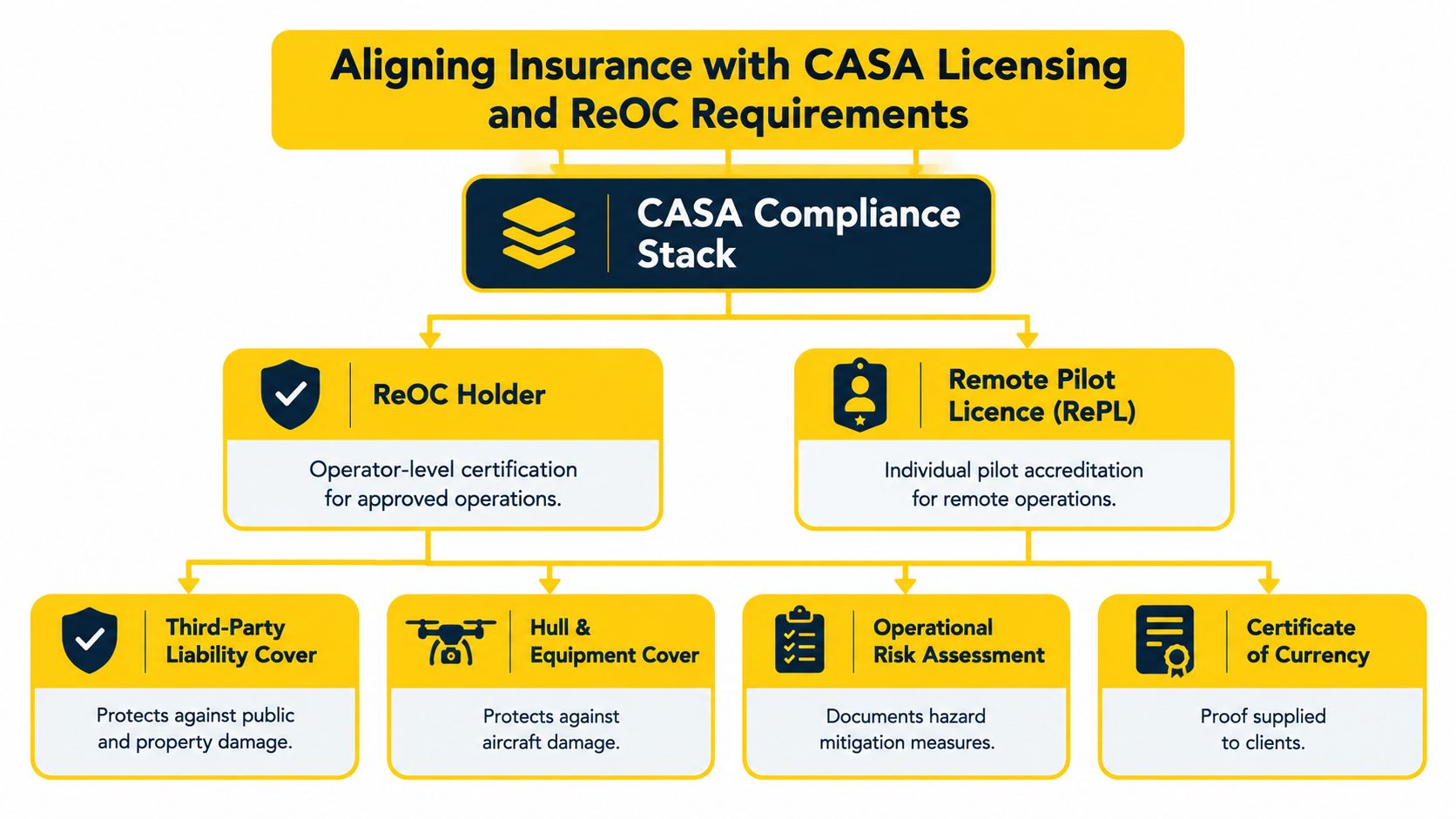
A Remote Pilot Licence, or RePL, establishes an individual pilot's competency. A Remote Operator Certificate, or ReOC, gives an organisation authority and capability to conduct approved commercial operations. They serve separate but complementary purposes, much like a driver's qualification and a company's operating licence.
The operator must align its people, aircraft, procedures, approvals and insurance with the proposed work. A RePL does not certify the business's systems, while a ReOC does not make an unqualified person competent to fly. Insurance adds another compliance layer because clients, brokers and regulators may need evidence that foreseeable liabilities have been considered.
The excluded category still requires discipline
Under CASA rules, commercial RPAs under 2 kg may operate in the excluded category without a RePL or ReOC if the operator notifies CASA before flight and follows CASA's Standard Operating Conditions. Work outside those conditions requires a RePL and a ReOC holder, as explained in QBE's explanation of RPAS cover and CASA categories.
This pathway still requires careful insurance review. A client may require public liability cover, and an insurer may ask about the pilot, aircraft, location, payload and operating method. The operator must describe the flight accurately and avoid presenting an excluded-category operation as if it carried permissions beyond its actual conditions.
Evidence matters to insurers and clients
A broker may request operational manuals, training records, maintenance arrangements, risk assessments and a clear description of the services. A ReOC holder must demonstrate adequate insurance or financial capacity for potential liabilities, making cover part of the operator's governance framework and access to commercial work.
Training supports documented competence and safer planning. Ace Aviation Aerospace Academy's ACE PLATINUM course information includes RePL, AROC, Aviation English, Express ReOC, Certificate III in Aviation, advanced operations training and preparation for operating and managing a commercial drone business. These qualifications do not guarantee insurance or determine an underwriter's decision, but they can support a well-organised compliance record.
Operators can review the ultimate guide to ReOC requirements in Australia for further regulatory context. The insurance application should describe the actual operation, because differences between the proposal and delivered work can create uncertainty when a claim is assessed.
Evaluating Cost Drivers and Typical Policy Limits
Premiums reflect the risk the insurer is being asked to accept. Equipment value matters for hull cover, while operational scope affects liability exposure. A survey flight over an isolated site presents a different risk profile from construction inspection near workers, vehicles and valuable infrastructure.
Australian market information places full UAV hull and liability premiums for professional operators in an annual range of $3,000 to $10,000 or more, depending on equipment value and operational scope (Australian drone insurance market summary). The same source identifies common client contract minimums of $5 million to $20 million in liability limits.
Compare the policy variables
| Decision area | Lower exposure approach | Higher exposure approach |
|---|---|---|
| Liability limit | Suitable for work with modest site and contract requirements | Needed where project owners specify higher limits |
| Hull value | Covers a basic aircraft configuration | Includes higher-value aircraft, sensors and payloads |
| Deductible | Lower out-of-pocket cost after a covered loss | Potentially greater loss retained by the operator |
| Operational scope | Limited, clearly defined activities | Multiple industries, complex sites or specialised applications |
The liability limit should follow the contract and the site, not the purchase price of the drone. A relatively inexpensive aircraft can still cause a costly injury or property claim. Conversely, a high-value aircraft may justify hull protection even where a client doesn't require it.
Australian specialist policies may attach liability to individual UAS, and hull deductibles can range from 10% to 50% (One Underwriting's drone aviation product information). A higher deductible reduces the insurer's share of a covered physical loss, so the operator needs sufficient reserves to absorb it.
Before requesting quotes, the business should prepare an equipment schedule, list each service, identify typical sites and collect client contract requirements. The broker can then compare like-for-like cover instead of pricing an incomplete description of the operation.
Selecting the Right Cover for Specific Australian Industries
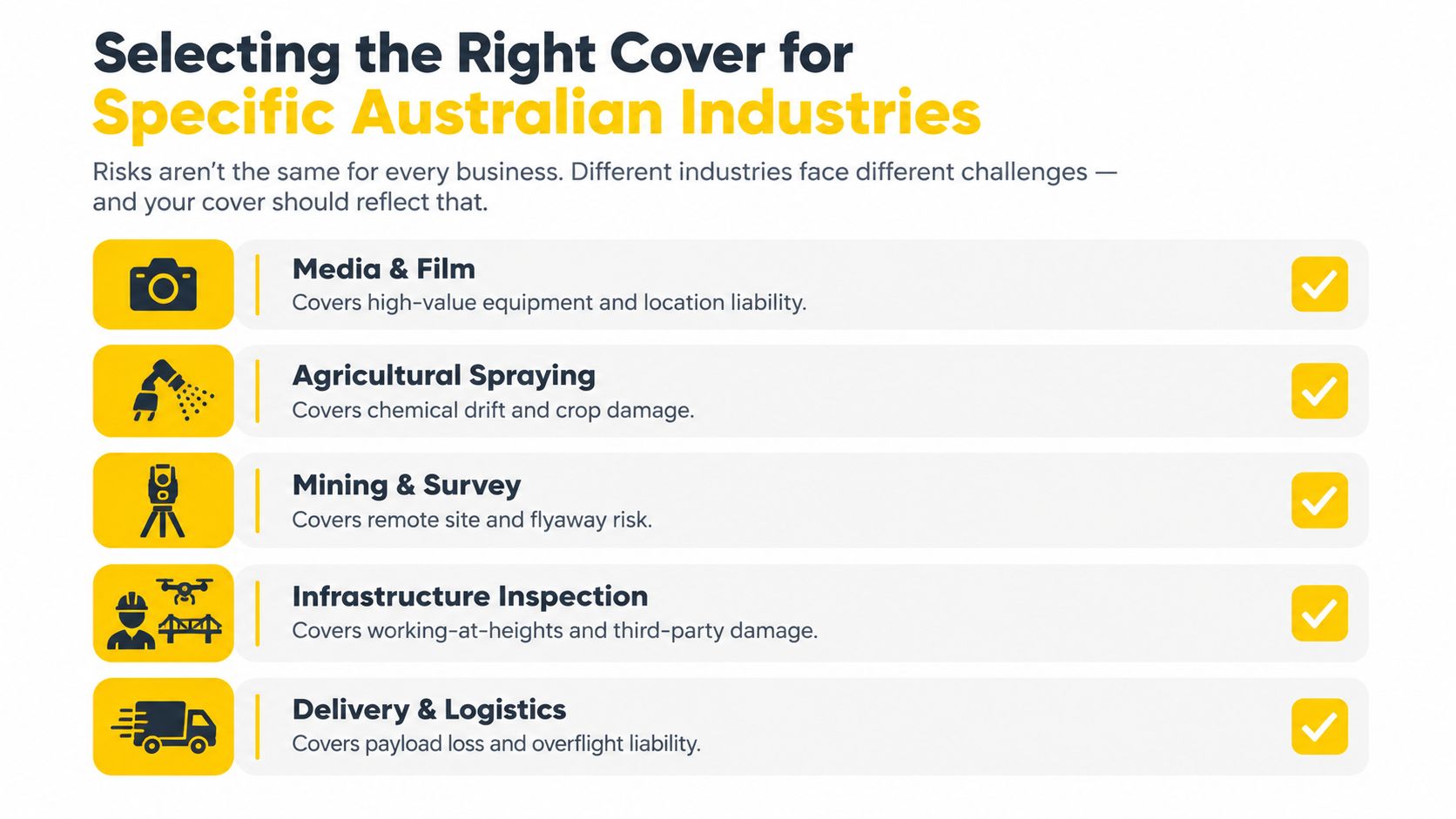
A drone may complete the flight without incident, yet the business can still face an uninsured loss through chemical drift, an inaccurate report or damage during transport. Insurance therefore acts as both a financial safety net and a commercial access requirement. Clients, site owners and contractors may require evidence of cover before approving work, while the policy must match the operation described under the business's CASA ReOC arrangements.
Agriculture and chemical application
Agricultural spraying introduces hazards that aerial imaging does not. Chemical drift can affect neighbouring crops, land, people or property. Spray operators should seek cover for chemical drift claims and endorsements that describe aerial application, rather than relying on a generic drone policy.
The application should identify the substances used, aircraft, spray equipment, operating environment and drift controls. A policy that covers mapping while excluding chemical application leaves the main business risk outside the insured scope. The wording should also align with the operator's documented procedures and approved operating conditions.
Surveying and inspection
Survey and inspection businesses provide information that clients may use for engineering, maintenance, planning or compliance decisions. Public liability addresses injury or property damage at the site, while professional indemnity may respond to allegations about the survey, inspection report or photographic deliverable.
Ask whether the policy covers the professional service, not only the aircraft in flight. An incorrect output can create a dispute even when the drone caused no physical damage. The deliverable is part of the risk, much like the measurement instrument and the person operating it.
Media, construction and infrastructure
Media assignments can involve crowds, valuable equipment, restricted locations and fixed production schedules. Check that the policy reflects payload protection, transit and location-specific liability requirements. Construction and infrastructure clients may also request evidence of cover before mobilisation, particularly where work occurs near assets, roads or active sites.
Training flights, ground handling and storage deserve the same review. An incident can happen before take-off or after landing, so the insured workflow must extend beyond the flight itself.
Navigating the Claim Process and Common Exclusions
A chemical drift incident, damaged client property or unusable data deliverable can expose gaps between the work performed and the cover purchased. Insurance supports commercial access only when the policy matches the operator's authorised activities, equipment and responsibilities.
Cover may be restricted if a flight falls outside approved conditions, uses an unapproved payload or involves someone without the required authorisation or competency. Check transit, training flights, payloads and ground handling, since these activities may be assessed separately from the flight itself.
The excluded category guide for Australian drone operations explains why the operating category must match the proposed mission. Review the policy schedule when adding an aircraft, changing payloads, entering a new industry or accepting work at a site with different conditions.
A disciplined response after an incident
- Make the scene safe: Address injuries, control hazards and follow the client's incident procedure.
- Preserve evidence: Secure the aircraft, payload, batteries, controller and relevant records.
- Record the operation: Keep flight logs, pre-flight checks, weather details, approvals and maintenance records.
- Notify promptly: Contact the broker or insurer according to the policy's notification requirements.
- Avoid assumptions: Do not admit liability, alter equipment or discard damaged components before receiving claims guidance.
A well-maintained flight record cannot prevent every incident, but it gives the operator and insurer a reliable account of what happened.
Commercial drone insurance forms part of a controlled aviation system. Accurate declarations, suitable training, current records and CASA-aligned procedures help keep cover consistent with the actual business.
Ace Aviation Aerospace Academy provides CASA-aligned training, including RePL, AROC, aviation qualifications and ReOC consulting. Businesses and pilots can review relevant pathways at Ace Aviation Aerospace Academy.
Frequently Asked Questions
Is commercial drone insurance legally required in Australia?
Australia doesn't have a blanket legal requirement for every RPAS operator to buy insurance. Commercial operators are nevertheless commonly expected to hold public liability cover because of state and territory business obligations, client contracts and project conditions.
What are the main types of commercial drone insurance?
The two core covers are public liability and hull or equipment insurance. Operators may also need professional indemnity, cyber cover or workers compensation, depending on the services, data and workforce involved.
How much public liability cover might a client require?
Australian commercial clients and project owners commonly specify liability limits from $5 million to $20 million (Australian drone insurance market summary). The required limit should be checked in the contract before work begins.
Does an aircraft under 2 kg need a RePL or ReOC?
An RPAS under 2 kg may operate in the excluded category without a RePL or ReOC if CASA is notified before the flight and the operation stays within Standard Operating Conditions (QBE's RPAS cover guidance). Operations outside those conditions require the relevant RePL and ReOC arrangements.
Does hull insurance cover a survey report?
Hull cover generally addresses physical loss or damage to the aircraft and equipment. A dispute about the accuracy or quality of a survey or inspection deliverable may instead require professional indemnity cover, subject to the policy wording.