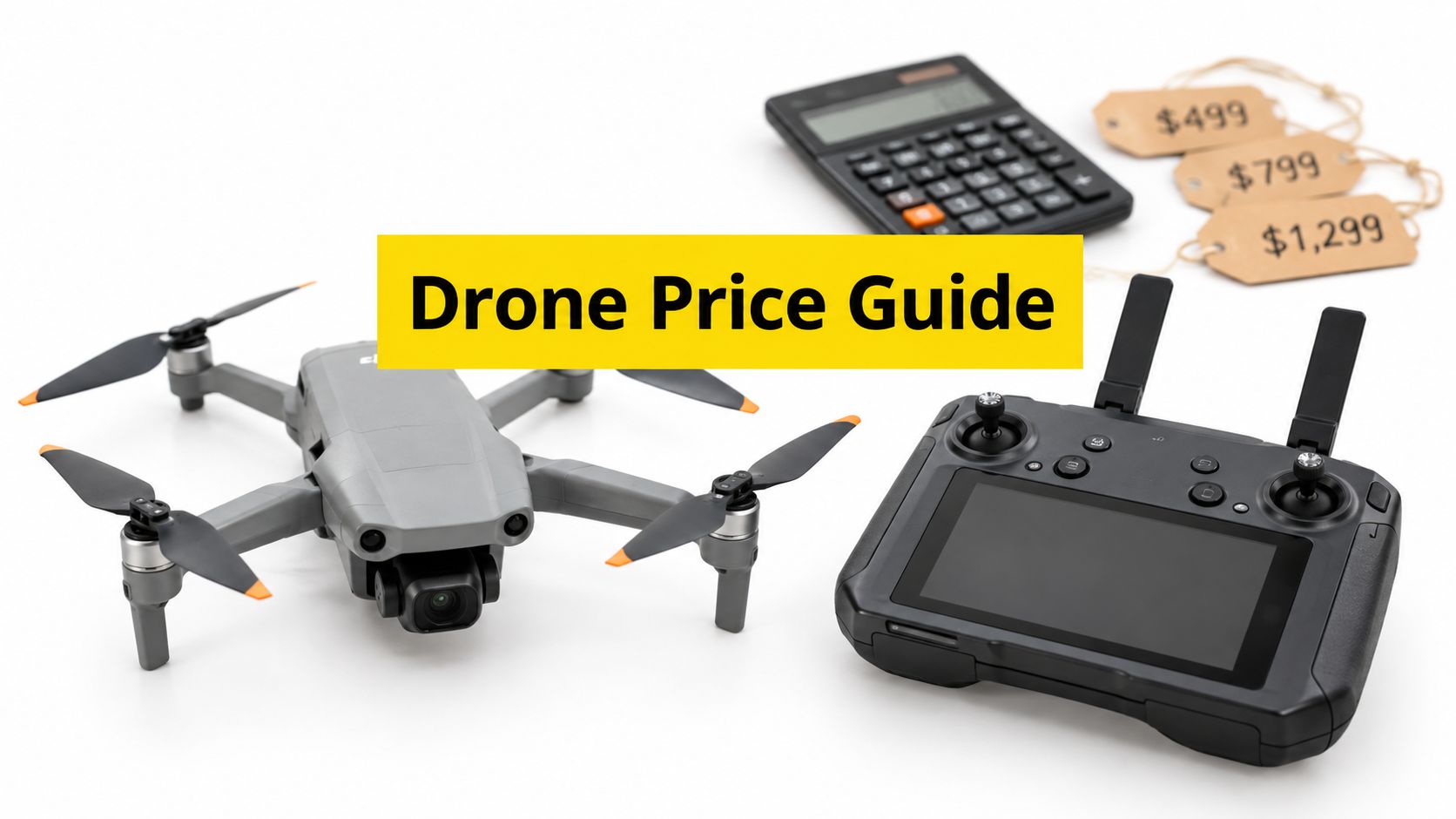
Australian drone prices in Australia start at AUD 58.20 and run to AUD 2,429 in current retail comparisons, while professional and agricultural systems begin around AUD 15,000 and climb far beyond that. A single sticker price never tells the full story, because the cost depends on whether the drone is for flying around the backyard, filming content, inspecting assets, or doing paid work.
Table of Contents
- Understanding the Australian Drone Price Spectrum
- Price Tiers for Hobby, Prosumer and Commercial Drones
- Key Factors That Influence Drone Pricing in Australia
- Hidden Costs Beyond the Aircraft Purchase Price
- Total Cost of Ownership Across Australian Use Cases
- Investing in CASA Compliant Training and Certification
- Making Your Drone Purchase Decision with Confidence
Understanding the Australian Drone Price Spectrum
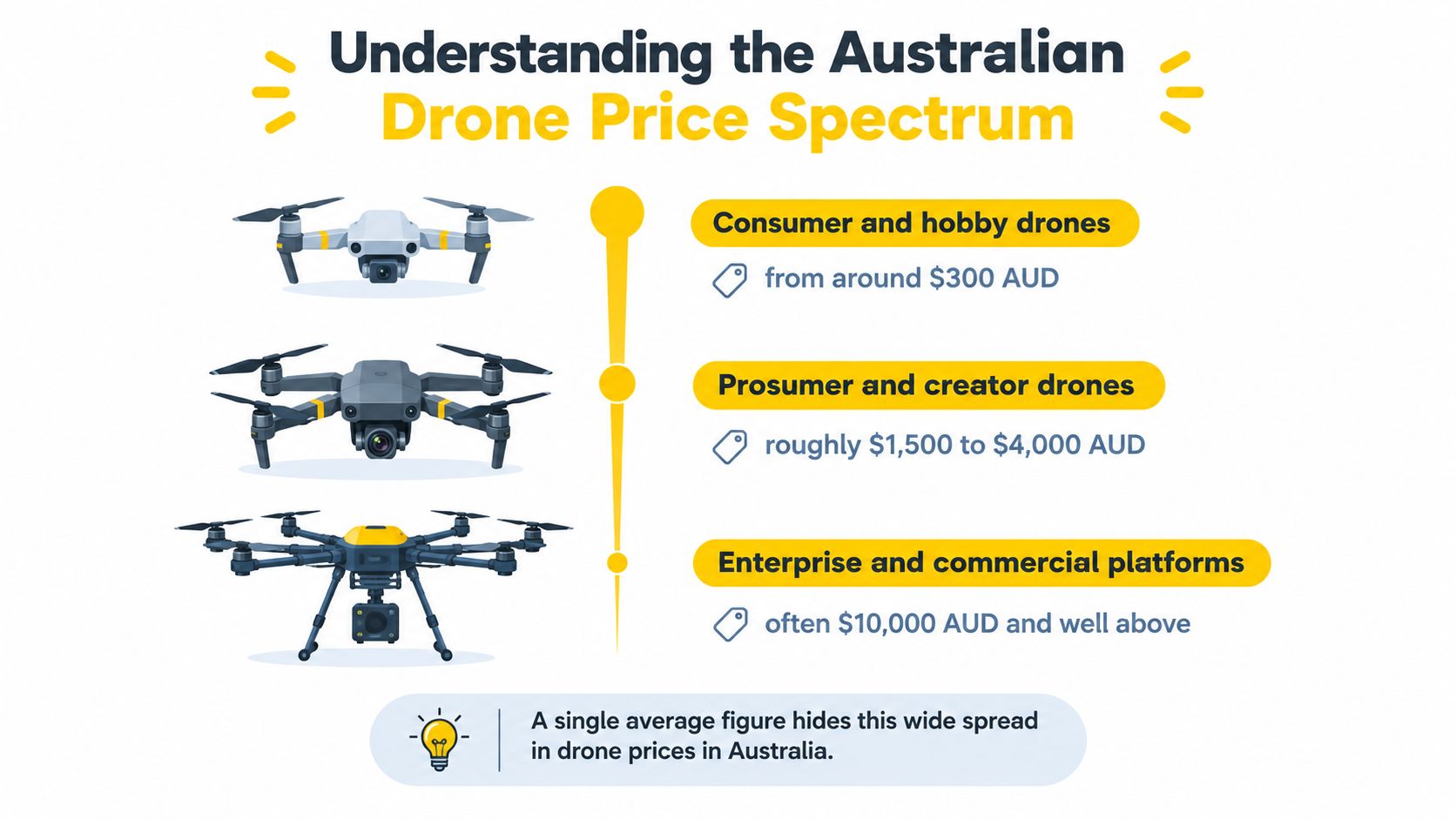
A quick scan of drone prices Australia shows why a single headline number misleads buyers. Current Australian retail comparisons track 67 drone products, with recently checked prices for 19 products across five retailers. The recorded spread runs from AUD 58.20 to AUD 2,429.00, wide enough to cover a basic recreational quadcopter, a camera-ready consumer drone, and a more capable prosumer package. That same comparison also notes that entry-level hobbyist drones generally begin around AUD 150, while professional-grade cinematography equipment can exceed AUD 5,000. Australian drone price comparison
What the retail spread really means
Retail pricing varies sharply. Harvey Norman showed prices from AUD 68 to AUD 2,184, The Good Guys from AUD 384 to AUD 2,429, JB Hi-Fi from AUD 99 to AUD 1,279, Amazon Australia from AUD 447 to AUD 1,448, and the listed eBay product at AUD 58.20. That spread is normal in a market shaped by bundles, stock levels, accessories, and warranty terms. A low listing price can also hide a stripped-back package that still needs extra batteries, a controller, or care support before it is ready for use.
The practical takeaway is simple. A sub-AUD 1,000 drone can suit casual flying or learning, but it should not be treated as a stand-in for a serious commercial aircraft. Buyers comparing a hobby model against a camera drone, or a commercial platform against an enterprise system, need to separate purchase price from mission suitability.
For readers who also want the legal side of ownership, drone laws in Australia sit alongside price from the beginning, not after the purchase.
Why one average figure misleads drone buyers
Australian pricing also reflects a broader shift from specialist hardware toward more accessible consumer technology. Statista's Australia market overview points to lightweight hobbyist drones priced below US$100 and prosumer models above US$1,000 when they include features like a 4K camera, obstacle sensing, flight ranges of up to 5 kilometres, and about 30 minutes of flight time. Australia drone market overview
That matters because the right price depends on the job. A drone bought for filming, mapping, inspections, or site documentation needs different hardware from one bought for weekend recreation. For commercial work, the better question is which drone can complete the task without creating avoidable risk or rework.
Price Tiers for Hobby, Prosumer and Commercial Drones
Australian buyers get better results when they sort drones by use case rather than by a single headline price. Consumer and prosumer models sit in one tier. Enterprise aircraft and spray platforms sit in another, and the cost jump reflects what the machine is built to do after take-off.
Consumer and prosumer options
Retail pricing in Australia gives a clear entry point. The DJI Neo is listed at about AUD 299, the DJI Mini 4 Pro at AUD 1,119, the DJI Air 3 Fly More Combo at AUD 1,950, and the DJI Mavic 3 Fly More Combo at AUD 2,999. Those prices show the move from basic recreational flying into packages with better imaging, longer flight time, and more complete kits. DJI retail range in Australia
This tier suits creators, small operators, and businesses that need straightforward visual work. It covers inspection footage, light media capture, and basic site documentation. It does not usually cover survey-grade output, complex industrial jobs, or spray work.
A practical rule applies here.
Practical rule: if the drone has to support business-grade evidence, not just images, the specification sheet matters more than the sticker price.
For a grounded example of where specialised equipment sits, XAG P150 Max in Australian agriculture shows how farm-ready drones belong in a different buying class from consumer aircraft.
Enterprise and agricultural systems
Enterprise aircraft sit in a higher band because they are designed for commercial work. The DJI Mavic 3 Enterprise is listed at AUD 6,319 including GST, and the Matrice 4E is listed at AUD 7,355 including an enterprise protection plan. These systems are aimed at surveying, mapping, construction, and mining, where reliability and data quality matter more than a low entry price. Enterprise drone pricing in Australia
Agricultural spray drones sit higher again. An Australian market guide lists the DJI Agras T50 at about AUD 15,000 excluding GST, the T70P at AUD 18,500, and the T100 at AUD 24,199. That pricing reflects payload demands, charging needs, and field logistics, not camera quality. Australian agricultural drone market guide
A simple way to read the market is this:
- Consumer and hobby drones: suitable for learning, casual flying, and light imaging.
- Prosumer drones: better for creators, small businesses, and higher-quality video or inspection work.
- Enterprise and agricultural platforms: built for commercial output, payload carrying, and regulated operations.
The difference between tiers is operational capacity. A cheaper drone may be fine for weekend flying, but a commercial buyer pays for the ability to deliver work consistently, safely, and with less rework.
Key Factors That Influence Drone Pricing in Australia
A low sticker price can hide a lot. In commercial use, the cost difference usually comes from what the aircraft can do after take-off, how long it can stay productive, and how much rework it avoids in the field.
Battery life and endurance
Longer flights need better batteries, and better batteries cost more. That matters on consumer drones, but it becomes more obvious in commercial work where air time drives output. A drone that lands too early creates extra battery swaps, more downtime, and more job interruptions.
Endurance also ties directly to payload. Once a drone is carrying more equipment, the battery works harder to keep the aircraft stable. That is one reason enterprise systems and spray platforms sit above lightweight camera drones in price.
Camera and payload
The biggest jump often comes from the payload. RTK GNSS positioning supports survey-grade accuracy, while zoom or multisensor payloads let operators collect usable data without flying too close to assets. Rugged construction adds cost too, because these aircraft are built for harsh industrial environments, not casual weekend flying.
Agricultural systems show the same pattern in a different form. Adding batteries, a charger, and a generator can push a practical full-day spray setup into the AUD 20,000 to AUD 40,000 range. Specialist multispectral, hyperspectral, or thermal sensors can add around AUD 15,000 to a mapping platform. Australian farm drone cost guide
Range, transmission and support
Reliable control links and enterprise transmission systems matter because a commercial operator cannot afford dropped signals or inconsistent performance in the middle of a job. Secure transmission, longer range, and stronger support systems all raise the purchase price because they reduce the risk of loss, delay, or failed capture.
A cheaper drone can look attractive on the shelf. If it cannot carry the right payload or hold a stable link in the field, the saving disappears quickly.
For Australian commercial users, affordability only matters once the aircraft can do the job repeatedly, safely, and without expensive rework.
Hidden Costs Beyond the Aircraft Purchase Price
The advertised drone price is only part of the bill. Commercial owners also carry registration, compliance, insurance, batteries, software, maintenance, and training. Those costs can matter more than the hardware gap between two similar aircraft.
Registration and regulatory charges
CASA's cost-recovery statement includes a AUD 40 annual charge for each remotely piloted aircraft over 500 g and up to 150 kg used commercially. That creates a direct ownership cost difference at the 500 g threshold, independent of the aircraft's sticker price. CASA also says it has more than 260 regulatory service fees covering licences, examinations, permits, exemptions, and operator certificates, with some fixed on the application form and some estimated after the application is received. CASA fees and charges
For a business, this means the drone itself is only one line in the budget. The operator may also need licensing, certificate work, or other approvals depending on the activity.
Insurance, maintenance and tax treatment
The practical budget should also include insurance, battery replacement, maintenance, and software subscriptions. Those costs are not optional in commercial use, even if they're not as visible as the aircraft purchase. A drone that sits idle because its batteries are worn out or the software is unsupported is not a bargain.
The Australian Taxation Office adds one more layer. A GST-registered business that can claim the full GST credit excludes GST when calculating the asset cost, while a business not registered for GST includes GST in that cost. The ATO also states that assets in a low-value pool are depreciated at an annual rate of 37.5%, subject to the applicable rules and eligibility requirements. ATO depreciation rules
For a pricing comparison tool, AAA quote calculator is a sensible starting point because it keeps the equipment discussion tied to actual operating budgets rather than a retail headline.
Total Cost of Ownership Across Australian Use Cases
The right way to compare drone prices Australia is to match the aircraft to the mission and then add the operating costs that follow. A recreational flyer, a real estate content creator, a survey team, and a spray operator do not need the same machine, and they definitely don't carry the same overhead.
Recreational, commercial and enterprise use
A sub-AUD 2,000 aircraft may be enough for visual inspection or media work, but it should not be benchmarked against an RTK-equipped system built to produce survey-grade data. Those are different tools with different roles. Treating them as interchangeable is how budgets get blown and expectations get missed.
A sensible way to think about it is:
| Use case | What usually matters most | Budget focus |
|---|---|---|
| Recreational flying | Ease of use, portability, learning value | Aircraft price plus basic accessories |
| Commercial visual work | Camera quality, controller bundle, battery life | Aircraft, registration, insurance, training |
| Enterprise operations | RTK, support, payloads, reliability | Aircraft, software, maintenance, compliance |
| Agricultural work | Payload, endurance, charging logistics | Full system cost, not just the drone |
Commercial operators should also separate one-off purchase costs from recurring costs. Registration, battery wear, maintenance, and insurance don't disappear after day one.
Agriculture and break-even thinking
Agricultural buying needs a different lens again. The main question is not whether a spray drone is expensive, it's whether ownership beats contracting. The answer depends on hectares treated, crop type, terrain, chemical-handling requirements, seasonal utilisation, and compliance complexity. A machine that sits unused between seasonal jobs can be far more expensive per hectare than a contractor who arrives with the right kit.
That is why cost per hectare matters more than a showroom sticker. Farmers comparing ownership to contracting should include downtime, spare batteries, application equipment, and CASA requirements in the same calculation. Anything less gives a false sense of savings.
Investing in CASA Compliant Training and Certification
A drone purchase without training is a weak commercial decision. The aircraft might be capable, but the operator still needs to know how to fly legally, communicate properly, and avoid turning a cheap purchase into an expensive mistake.
Why training belongs in the budget
Commercial drone work in Australia normally brings Remote Pilot Licence (RePL) and, where radio use applies, an Aeronautical Radio Operator Certificate (AROC) into the discussion. Those aren't add-ons. They are part of the operational pathway for anyone who wants to fly for work with confidence and credibility.
Formal training also reduces the chance of expensive errors. Poor airspace decisions, weak flight planning, and bad maintenance habits tend to cost more than a proper course ever does.
Where structured training fits
For beginners, ACE READY covers drone fundamentals, aviation safety, CASA regulations, flight operations, and preparation for later RePL training. For those moving into licensed work, ACE BRONZE focuses on drone operations, flight safety, aviation theory, and practical skills for students starting toward commercial flying. Ace Aviation Aerospace Academy also supports pathways such as RePL, AROC, Certificate III in Aviation, ReOC Consulting, Enterprise Drone Training, and Corporate Drone Training where those fit the organisation's needs. Drone licence training and certification
Proper training is not a cost centre. It's the part of the budget that helps prevent avoidable incidents, failed jobs, and compliance mistakes.
Commercial buyers often spend too much on the drone and too little on the person flying it. That's backwards. A well-trained operator can get more value from a modest aircraft than a poorly trained pilot can get from a premium one.
Making Your Drone Purchase Decision with Confidence
The safest buying process starts with three questions. What job must the drone do, what regulatory category will it fall into, and what is the full cost of ownership after registration, insurance, training, maintenance, and tax treatment? If the answers are clear, the purchase decision gets much easier.
A practical buying checklist
Before committing, buyers should check:
- Mission fit: Match the aircraft to recreation, visual inspection, media, mapping, or spraying.
- Payload needs: Don't buy a camera-only drone if the job needs multispectral, thermal, or RTK capability.
- Weight and registration: Check whether the aircraft sits above the 500 g threshold that changes the ownership cost.
- Current retail price: Verify the live Australian price, because promotions, bundles, and stock levels move fast.
- GST and warranty terms: Confirm whether the quoted price includes GST and what warranty support is covered.
- Training pathway: Make sure the operator is ready for the job on day one, not after the aircraft arrives.
Retail listings change quickly, so current pricing should always be checked before purchase. Supplier inclusions matter just as much as the number on the screen.
Local sourcing and review research
For buyers still comparing suppliers, find local drone businesses can help identify nearby options, while AAA reviews gives a useful sense of the training and support environment around commercial drone work in Australia. Used together, those checks make the buying process more grounded and less impulsive.
The right drone is the one that fits the mission, the budget, and the operator's legal pathway. Price matters, but only after capability and compliance are set.
Ace Aviation Aerospace Academy provides CASA-compliant drone training, including RePL, AROC, and commercial pathways that help buyers turn equipment into real operational capability. For training that fits this buying decision, visit Ace Aviation Aerospace Academy and compare the course path against the way the drone will be used.