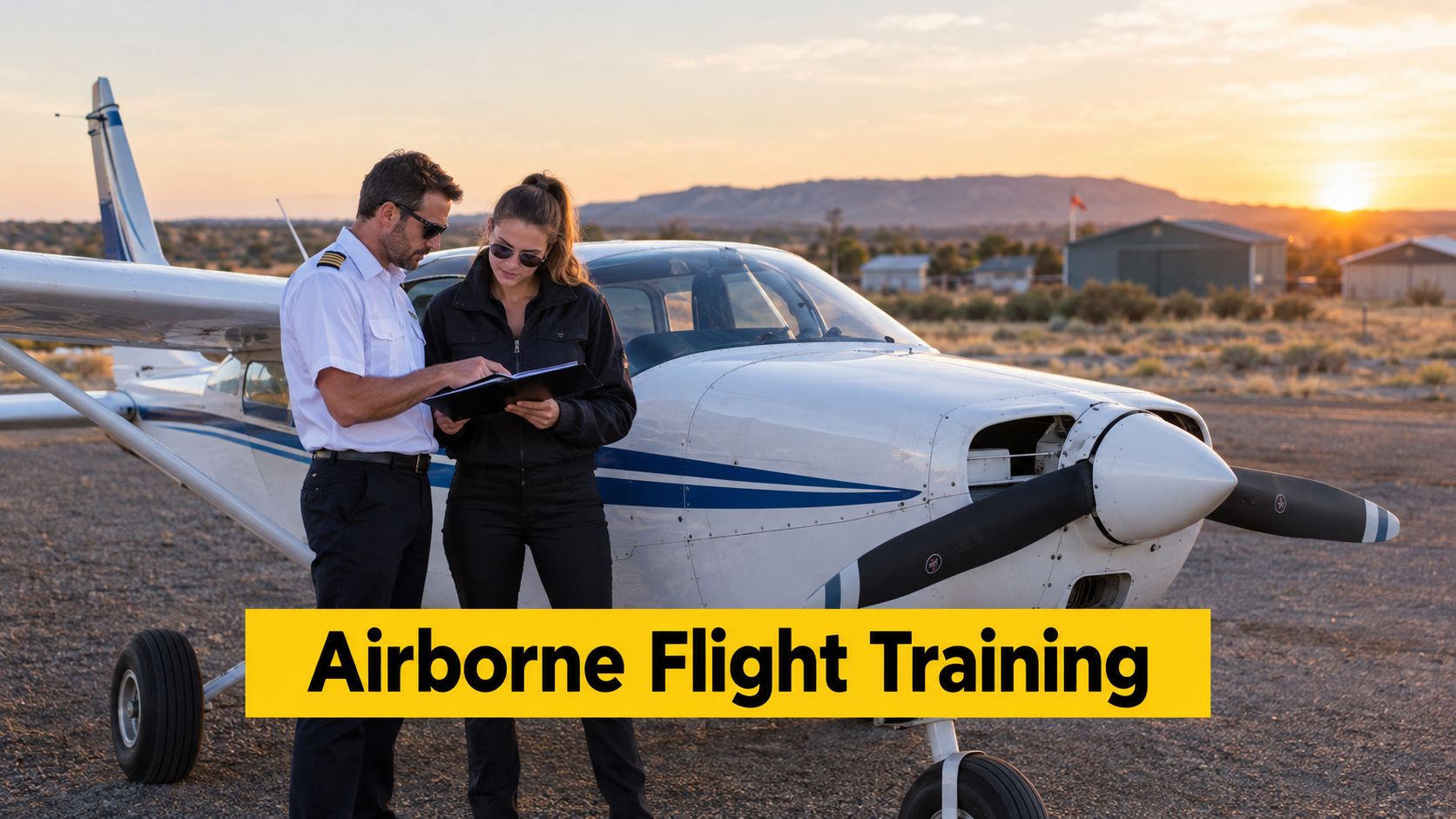
Australian instructional flying has been shaped by hard numbers, not slogans. In the five years from 1987 to 1991, authorities recorded 1,037 safety occurrences in flying-training operations, and poor approach technique, loss of control on the ground, and incorrect in-flight procedures kept showing up as recurring weaknesses in the data from that period (ATSB review). That history is why airborne flight training in Australia has never been just about logging time in an aircraft, it's about building judgement, discipline, and repeatable procedures.
The same logic applies today, whether a student is training for a manned aviation licence or a remotely piloted aircraft qualification. The aircraft may differ, but the standard stays the same, the operator must be able to manage the aircraft, the environment, the rules, and the unexpected. Training is only useful when it produces a pilot who can act safely under pressure, not just repeat a lesson when conditions are ideal.
Table of Contents
- Understanding Airborne Flight Training Fundamentals
- Exploring Fixed-Wing, Rotary and RPAS Pathways
- Navigating CASA Regulations and Safety Requirements
- Mastering Core Aviation Skills and Practical Curricula
- Evaluating and Selecting a Certified Training Provider
- Transitioning from Certification to Commercial Aviation Careers
- Frequently Asked Questions About Flight Training
Understanding Airborne Flight Training Fundamentals
The scale of Australian instructional flying makes one thing clear, it is a safety-critical activity, not a classroom formality. CASA's sector safety profile recorded 4,769 instructional-flying occurrences between 2014 and 2023, including 4,155 incidents, 394 serious incidents, and 220 accidents. Fourteen accidents were fatal, and the profile estimates 3,516,000 flight hours across Part 141 and Part 142 training operations (CASA sector safety profile).
What the term really covers
Airborne flight training means more than manipulating controls in the air. It combines aeronautical knowledge, practical handling, standard operating procedures, risk management, communication discipline, and assessment against a defined standard. In Australian aviation, that standard sits inside a regulated framework, so training has to produce competence that holds up outside the lesson environment too.
That is why the old accident patterns still matter. The ATSB review found that the flying-training accident rate remained about 7 accidents per 100,000 flight hours even after minimum hour requirements were reduced in 1992 (ATSB review). The message is plain, reducing hours on paper does not reduce risk unless the training design, supervision, and operational discipline are strong.
Practical rule: A student is not ready because the lesson felt comfortable. A student is ready when the same procedure can be repeated correctly with changing weather, workload, and airspace demands.
Why structure matters
Australian training providers therefore have to teach the habit of doing things the same safe way every time. That includes supervised solo practice, radio work, navigation, and risk assessment. Those are not add-ons, they are the baseline skills that stop small mistakes from becoming operational events.
The same principle sits behind modern RPAS training as well. CASA expects competence to be shown in a way that transfers into real operations, because the aircraft type changes, but the need for sound judgement does not. Ace Aviation Aerospace Academy positions its drone education around that same practical foundation, with entry-level preparation available through ACE READY, an introductory course for drone fundamentals, aviation safety, CASA regulations, flight operations, and preparation for RePL study.
Exploring Fixed-Wing, Rotary and RPAS Pathways
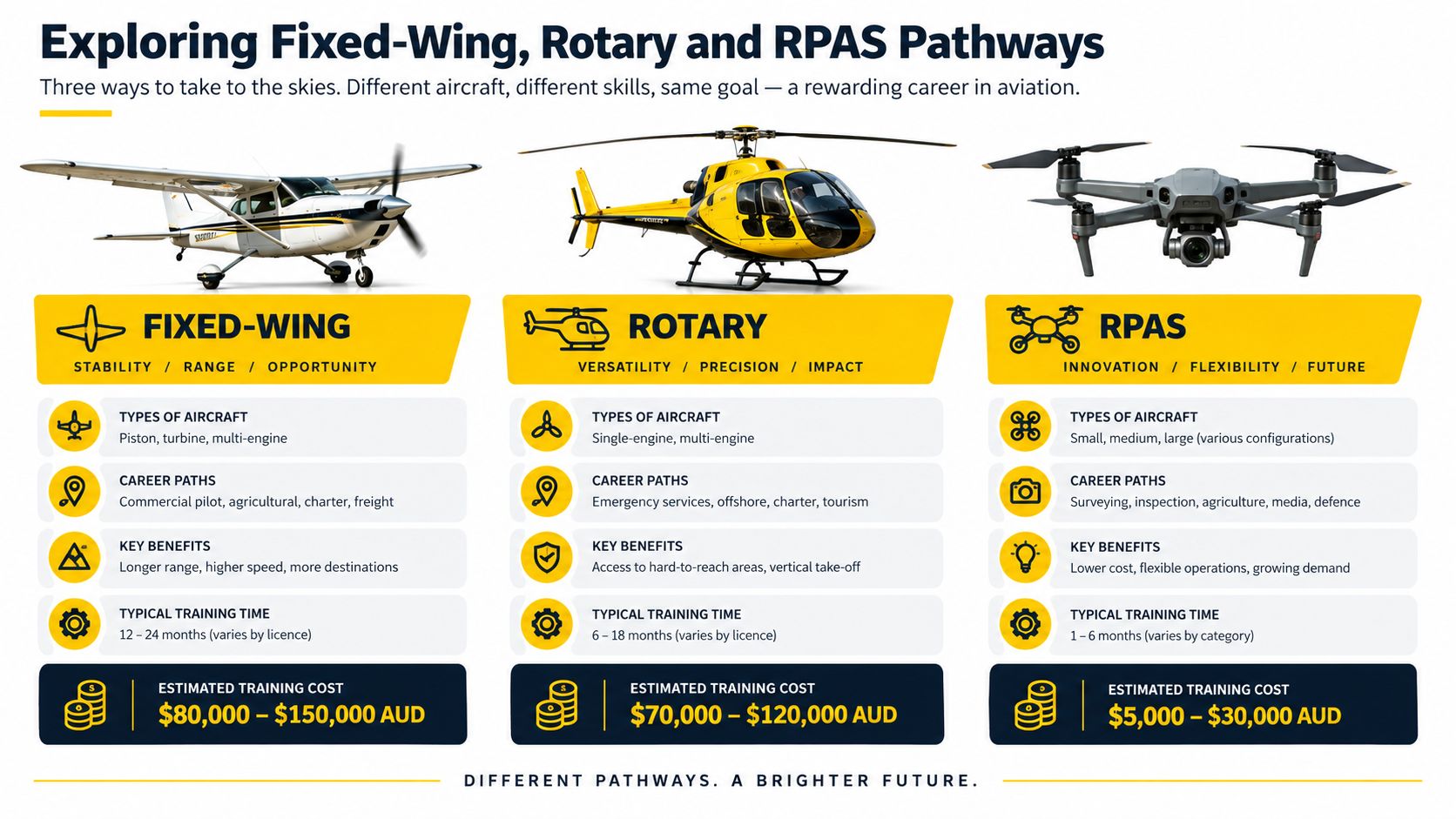
Airborne training branches into three very different operating environments, and students often get confused because the licensing language sounds similar. A fixed-wing aeroplane, a helicopter, and an RPAS all demand aviation discipline, but they do not ask the pilot to solve the same problems. The best training choice depends on whether the goal is passenger transport, rotary-wing work, or remote operations in industry.
Fixed-wing and rotary training
Fixed-wing training teaches energy management. The aircraft wants to keep moving forward, so the student has to think in terms of speed, attitude, descent profile, and runway alignment. The sensory workload is high, because the pilot is inside the aircraft and must interpret pitch, noise, vibration, sight picture, and instrument cues together.
Rotary-wing training is a different discipline again. A helicopter can hover, translate, and work in tighter spaces, which makes precise control feel more immediate and more demanding. Students who move from fixed-wing assumptions into rotary training usually discover that control inputs, workload distribution, and flight planning need a new mental model.
RPAS training
RPAS training shifts the workload away from bodily sensation and towards remote decision-making. The operator is managing the aircraft from the ground while monitoring telemetry, airspace, battery state, communications, and the worksite. That means the training challenge is often cognitive, not physical, and students need to build a habit of scanning multiple sources of information at once.
For readers comparing pathways, the key question is simple, what job does the aircraft need to do. Agricultural spraying, mapping, inspection, surveillance, passenger transport, and emergency response each place different demands on the pilot and the aircraft. That is why the right licence stream matters more than the brand of aircraft or the speed of course completion.
For beginners, ACE BRONZE is a foundation commercial drone course covering drone operations, flight safety, aviation theory, and practical skills. It sits naturally beside entry-level and advanced training for students who are still building the core skills needed before taking on commercial work.
A useful rule of thumb is to match the training stream to the job, not the other way around. A student interested in line-of-sight inspection work needs different preparation from someone aiming at airline flying or rotorcraft operations. The aircraft class shapes the manoeuvres, the working environment, and the decision-making pressure.
Navigating CASA Regulations and Safety Requirements
A licence is only as sound as the training behind it. In Australian flight training, CASA decides who may teach, what may be taught, and what privilege a student receives at the end. CASA states that training leading to a flight crew licence, rating, or endorsement must be conducted by an appropriately authorised operator under CASR Parts 61, 141, and 142 (CASA training operator guidance). That matters because authorisation is not a formality, it is part of how the qualification is made valid.
What the main CASA parts mean
Part 61 sets the licensing rules and the limits that apply to flight crew. Parts 141 and 142 are operator approvals for different kinds of training, with Part 141 commonly covering recreational and private training, and Part 142 covering commercial and integrated training. Training can be delivered in an aircraft, on a flight simulation training device, or through a mix of both.
For drone pilots, the same discipline appears in the RePL framework. CASA requires training to combine aeronautical theory, aircraft-specific practical competence, and a separately conducted flight test. CASA also requires at least 5 hours of live flight time under standard RPA operating conditions on the relevant category of remotely piloted aircraft (CASA RePL guidance). That minimum is a floor, not a statement of readiness.
Clear distinction: A RePL shows competency in the category and weight class assessed. It does not automatically authorise every aircraft or every operating environment.
For readers wanting the wider rule context, this overview of Australian drone laws helps explain how operational limits sit beside licensing and training.
Why radio and airspace matter
CASA guidance also says that for airborne operations involving an RPA above 2 kg in controlled airspace, an aeronautical radio qualification is required under CASR regulation 101.285 (CASA training provider guidance). New operators often understand the aircraft itself but still lack the radio and airspace privileges the job needs.
For commercial work, that difference matters in practice. A pilot can be competent on the controls and still be unable to lawfully complete a mission if the operation requires controlled-airspace access, radio competence, or a different aircraft category from the one assessed. Ace Aviation Aerospace Academy's consulting and training pathways, including ACE Consulting, are relevant where an organisation needs training and compliance aligned with its actual mission profile.
Mastering Core Aviation Skills and Practical Curricula
Good flight training follows a sequence. The student learns the knowledge first, then applies it in the aircraft or device, then proves it independently. That structure exists because skills that are understood in a quiet classroom often fall apart when the aircraft is moving, the radio is busy, or the wind changes.
The progression from theory to practice
The starting point is aeronautical knowledge. Students need the basics of meteorology, airspace classification, navigation, human factors, and local operating procedures before they can make good decisions in the air. Without that base, practical flying becomes guesswork dressed up as experience.
After that comes controlled practice. In RPAS training, CASA requires at least 5 hours of live flight time under standard operating conditions, but that number is only a minimum baseline, not a guarantee of readiness (CASA RePL guidance). Training should spread those hours across normal manoeuvres, abnormal and emergency procedures, pre-flight risk assessment, communications, and repeat performance in changing conditions.
How competence is actually tested
The flight test matters because it should be separate from routine instruction. If the instructor only validates familiar lesson patterns, the student may pass without showing the ability to think and act independently. CASA's model is built to reduce that risk by requiring a flight test that assesses overall competency outside the ordinary teaching loop.
That independence is especially important for commercial operations. An operator's real job usually involves deadlines, clients, and mission pressure, so the student has to show more than air sense. They need to demonstrate that they can plan, brief, operate, communicate, and recover when conditions don't match the lesson.
A broader qualification pathway can also matter for students who want aviation roles beyond piloting alone. Ace Aviation Aerospace Academy's Certificate III in Aviation sits naturally in that conversation for learners building an aviation career with structured theory, operations awareness, and workplace discipline.
Evaluating and Selecting a Certified Training Provider
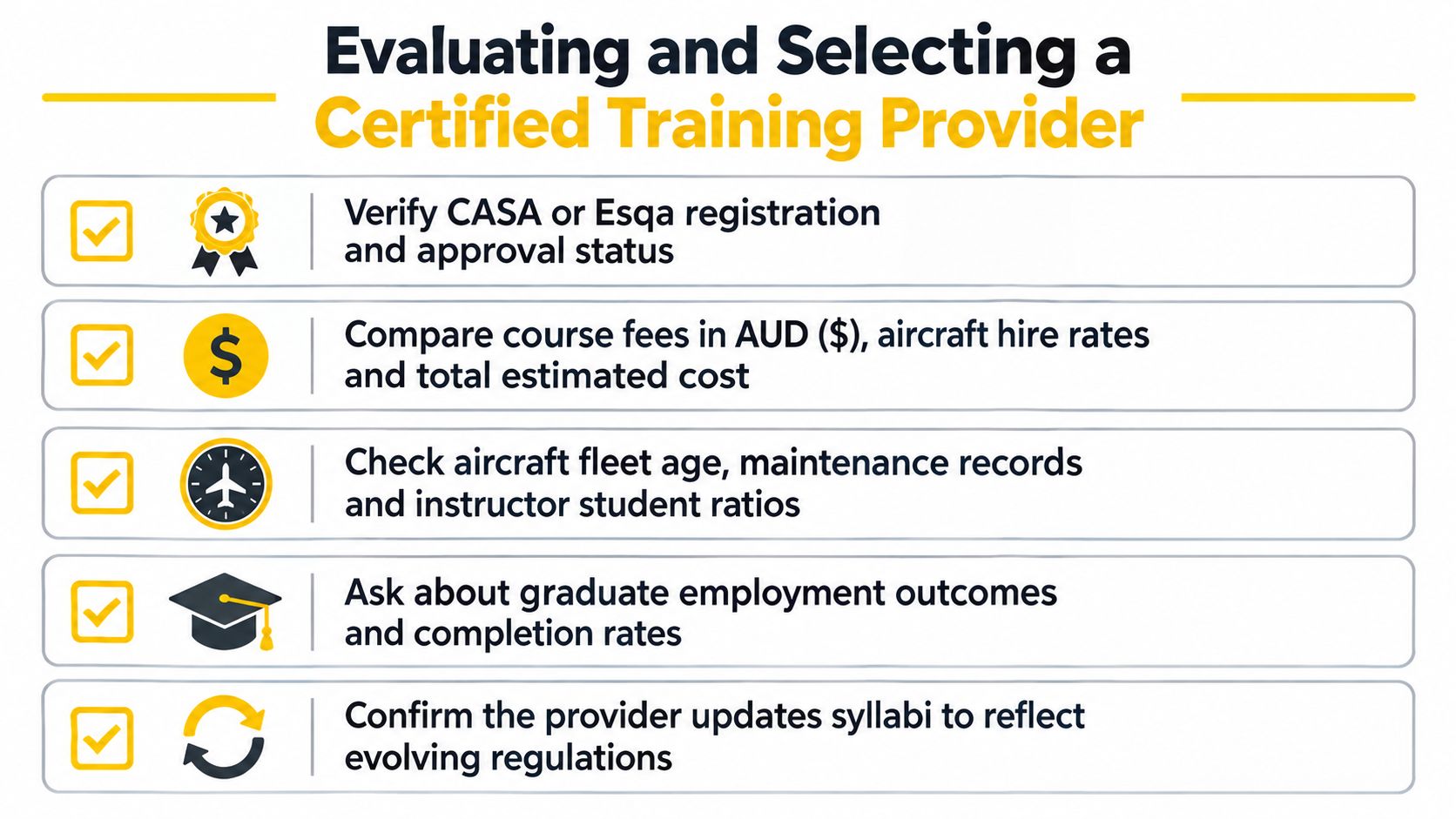
Not every provider prepares students for the same future. The cheapest course can look attractive, but if it only trains a single model or a narrow operating case, the student may need retraining when rules or mission needs change. CASA has already signalled reforms, including proposed category-based approvals, nationally managed knowledge examinations, and category-specific RePL flight testing, so transferable competence matters more than a narrow certificate.
What to look for
A strong provider teaches the skills that survive regulatory change. That includes radio communication, airspace risk assessment, operational documentation, site planning, and abnormal-event response. It also means the provider updates syllabi when the rules change, rather than selling a static course that assumes today's framework will never move.
Students should also ask how the provider assesses practical competence. A proper program should show how the student is checked, supervised, and signed off, not just how many hours are booked. Where company or enterprise training is involved, documented inductions and practical competency checks on the RPAS used by the organisation are part of a serious safety system.
Choosing for the long term
The right question is not, “What gets the certificate fastest?” It's, “What remains useful when the mission expands?” That matters for commercial drone operators, government teams, and businesses that need staff to work across multiple sites, categories, and airspace environments.
A training provider should also be clear about what sits outside the licence itself. For example, a RePL does not replace the need for the right operator approval for commercial work, and a course should make that plain rather than burying it in fine print. In a regulated industry, clarity is not a marketing line, it's part of safety.
Ace Aviation Aerospace Academy structures its training around that practical reality, with programs that can include RePL, AROC, and operator-focused support depending on the student's role and operating environment. That combination is useful where a learner needs more than a one-off certificate and wants a pathway that stays aligned with actual work.
Transitioning from Certification to Commercial Aviation Careers
Certification opens the door, but commercial work begins when the operator can deliver a repeatable service safely. In Australian drone work, that often means moving from solo training to real missions in agriculture, mining, surveying, infrastructure inspection, emergency services, or media production. The aircraft may be small, but the responsibility quickly becomes organisational.
What the transition looks like in practice
A new commercial operator usually starts with a defined job in a defined environment. A survey team may need consistent data capture. An agriculture operator may need disciplined site setup, communication, and operational checks. An emergency-service operator may need rapid tasking, strong documentation, and clear airspace coordination.
That's where operator approval matters. Commercial drone work generally requires the relevant operating authority under a ReOC, plus company inductions and standardisation checks so that the pilot works the business way, not just the training-school way. That is also why recurrent practice matters, because skill fades if it is not used.
From individual skill to team reliability
Businesses and government teams often care less about the licence itself than the reliability it creates. They need pilots who can follow local procedures, brief a job, identify risk, and document what happened. Those habits reduce confusion when multiple staff, shifting sites, and changing operational conditions are part of the work.
Training can support that move into commercial work when it includes more than solo handling. Recurrent assessment, operational procedures, radio use, and category awareness all help close the gap between passing a course and completing paid work safely. Ace Aviation Aerospace Academy's Corporate Drone Training fits this kind of environment where an organisation needs its staff trained for operational consistency rather than isolated pilot competence.
Frequently Asked Questions About Flight Training
What is the difference between a RePL and a ReOC?
A RePL is the remote pilot licence held by the operator. A ReOC is the operator certificate needed for commercial drone work. In practice, the RePL shows the person is trained, while the ReOC covers the business or organisation that conducts the operation.
Does simulator time count towards practical flying requirements?
CASA says flight training may be delivered in an aircraft, on a flight simulation training device, or through a combination of both for licence and rating training. For RPAS training, CASA still requires at least 5 hours of live flight time under standard operating conditions, so simulator work can support training but doesn't replace that live-flight minimum (CASA RePL guidance).
Can a RePL holder fly any drone?
No. CASA states that a RePL authorises operation only for the specific aircraft category and weight class assessed. If the mission needs a different category or extra operating privileges, further training or authorisation may be needed.
Is radio training always required for drone work?
No. CASA's radio qualification requirement is tied to certain operations, including RPA above 2 kg in controlled airspace under regulation 101.285 (CASA training provider guidance).
What should a student ask before choosing a provider?
The student should ask whether the provider is authorised for the training being delivered, how practical competence is checked, whether the syllabus is updated for regulatory changes, and whether the course teaches transferable skills such as airspace, radio, and documentation.
Ace Aviation Aerospace Academy supports students, businesses, and government teams with CASA-aligned drone and aviation training that links theory, practical flying, and operational compliance. If the goal is to build safe, transferable competence in airborne flight training, visit Ace Aviation Aerospace Academy to explore pathways that fit current CASA requirements and the changing future of Australian aviation.