The pilot training cost in Australia splits into two very different worlds. A CASA RePL path usually starts in the low thousands and can make you job-ready in weeks, while a manned-aircraft commercial pathway is a five-figure, multi-stage commitment driven by flight hours and instructor time.
Pilots often find that the price listed in a course brochure is not the complete cost. The total amount includes aircraft hire, instruction, medicals, exams, logbooks, admin, and the time required to finish without interruptions.
Table of Contents
- Understanding the True Cost of Pilot Training in Australia
- What Makes Up the Total Pilot Training Cost
- Drone RePL Versus Manned CPL Pathways in Australia
- Why Flight Hours Drive Pilot Training Cost the Most
- CASA-Specific Costs Most Budgets Overlook
- ROI of Pilot Training Across Australian Industries
- Financing, Subsidies and Smart Payment Planning
- How Ace Aviation Fits Into Your Training Decision
Understanding the True Cost of Pilot Training in Australia
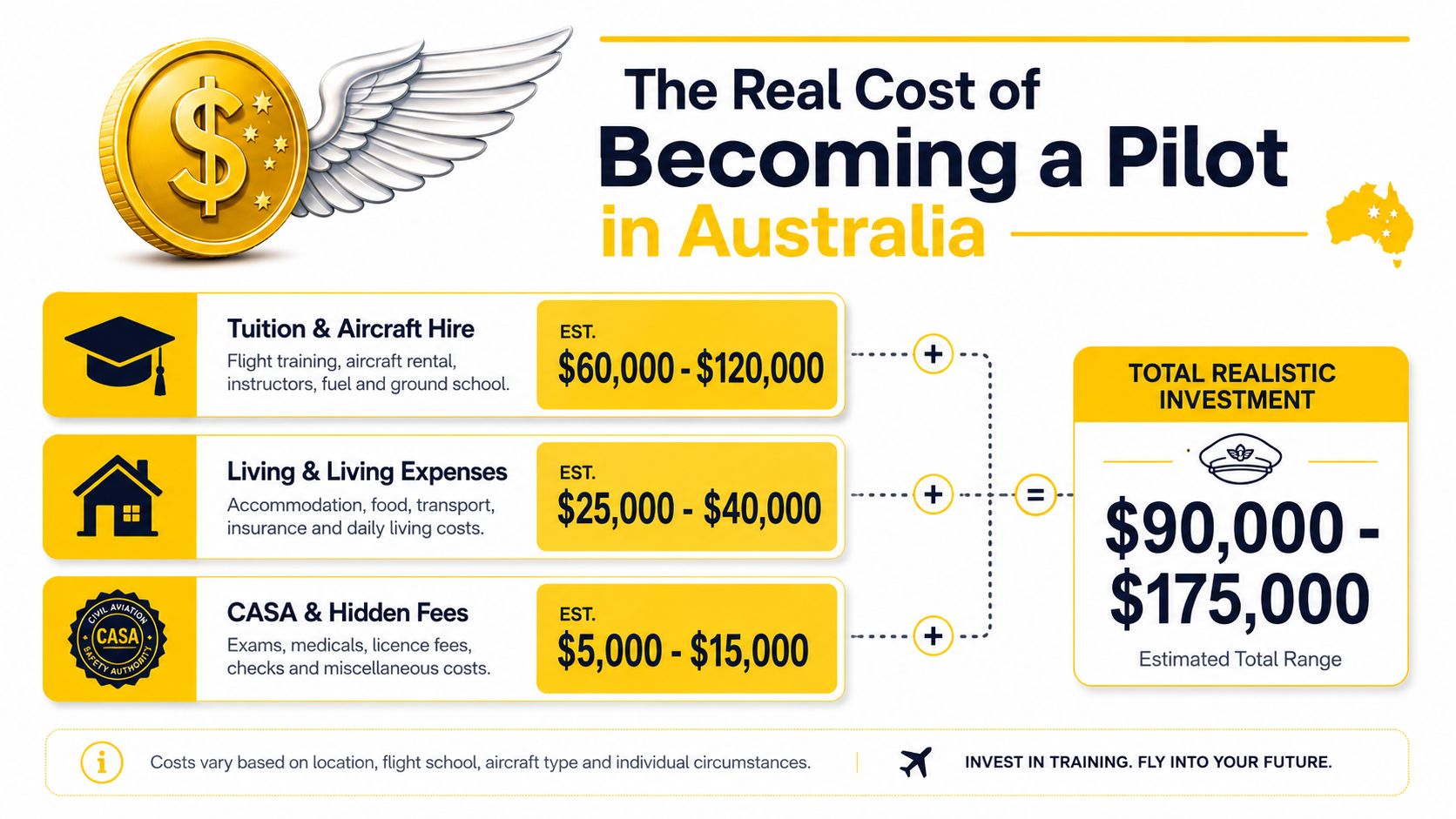
A student can sign up expecting a straightforward training bill, then discover the budget breaks apart fast. That is the normal pattern with pilot training cost in Australia, because the headline fee only covers part of the cashflow burden.
Headline fee versus total spend
Australia's training debate keeps landing on the same problem, the course fee is only the start. The UK Department for Transport's aviation training paper notes total ATPL or MPL costs of £60,000 to £150,000 and a seven-month full-time initial-licence program in the US at close to US$92,000. Those figures are not Australian figures, but they are useful reference points because they show how fast professional flight training turns into a serious financial commitment. Productivity Commission aviation training discussion paper
For Australian students, the message is plain. Commercial pilot training is usually a five-figure investment and often runs past the brochure price because flight hours, simulator time, medicals, exams, and instructor charges keep landing on the bill.
Practical rule: Budget for the full pathway you actually want, not the entry fee that gets you started.
Why the total matters more than the brochure
A student who budgets only for tuition gets caught out twice. First by the course itself, then by the extras that arrive later and are hard to avoid. The right way to model the number is cashflow by stage, month by month, until licence issue.
That matters even more if you are comparing manned aviation with RPAS. A RePL pathway can lead to paid, CASA-compliant work far sooner than a CPL track, so time-to-revenue belongs in the same budget conversation as training cost. For a quick planning pass, the Ace Aviation quote calculator is the right place to sanity-check a budget before any commitment is made.
What Makes Up the Total Pilot Training Cost
A realistic budget has to separate fixed costs from variable ones. That distinction is where most first-time students go wrong, because they compare schools on tuition alone and miss the costs that sit underneath it, much like understanding what counts as a fixed expense matters in any other business budget.
The main line items
Tuition is only the visible part. The rest of the bill usually includes aircraft hire, instructor time, theory study, exam charges, medicals, logbooks, admin, and recurring validity costs after qualification.
| Cost Category | Nature | Typical Range |
|---|---|---|
| Tuition | Mostly fixed, provider-dependent | Varies by pathway |
| Aircraft hire | Variable, hour-based | Varies by aircraft and training pace |
| Instructor time | Variable, hour-based | Varies by lesson length and efficiency |
| Theory and exams | Partly fixed | Varies by qualification stage |
| Medicals | Fixed per assessment | Varies by licence class |
| Logbook and admin | Small but recurring | Varies by provider |
| Recurrency and revalidation | Ongoing after issue | Varies by operation and licence type |
A good quote should make it clear which items are bundled and which are not. If the provider can't separate those out, the student is guessing.
Fixed costs versus variable costs
Some expenses barely move. Enrolment fees, examination charges, and certain admin items are predictable. Others swing hard with training pace, especially aircraft hours and instructor time.
That is why a provider quote that looks cheap can end up expensive in practice. If the syllabus is inefficient, the student pays for extra flying, extra instruction, and extra calendar time. A structured beginner path such as ACE BRONZE sits in the foundation category, with flight safety, aviation theory, and practical skills for students starting the journey toward licensed drone work in Australia.
Use a comparison lens
The cleanest comparison is not “which school is cheapest?” It's “which school gives the fastest, safest path to the licence I need?” That question matters when a student is choosing between a commercial drone pathway, a recreational path, or a manned-aircraft licence. The licence finder is useful here because it forces the student to match the training path to the end goal instead of buying the wrong course first.
Drone RePL Versus Manned CPL Pathways in Australia
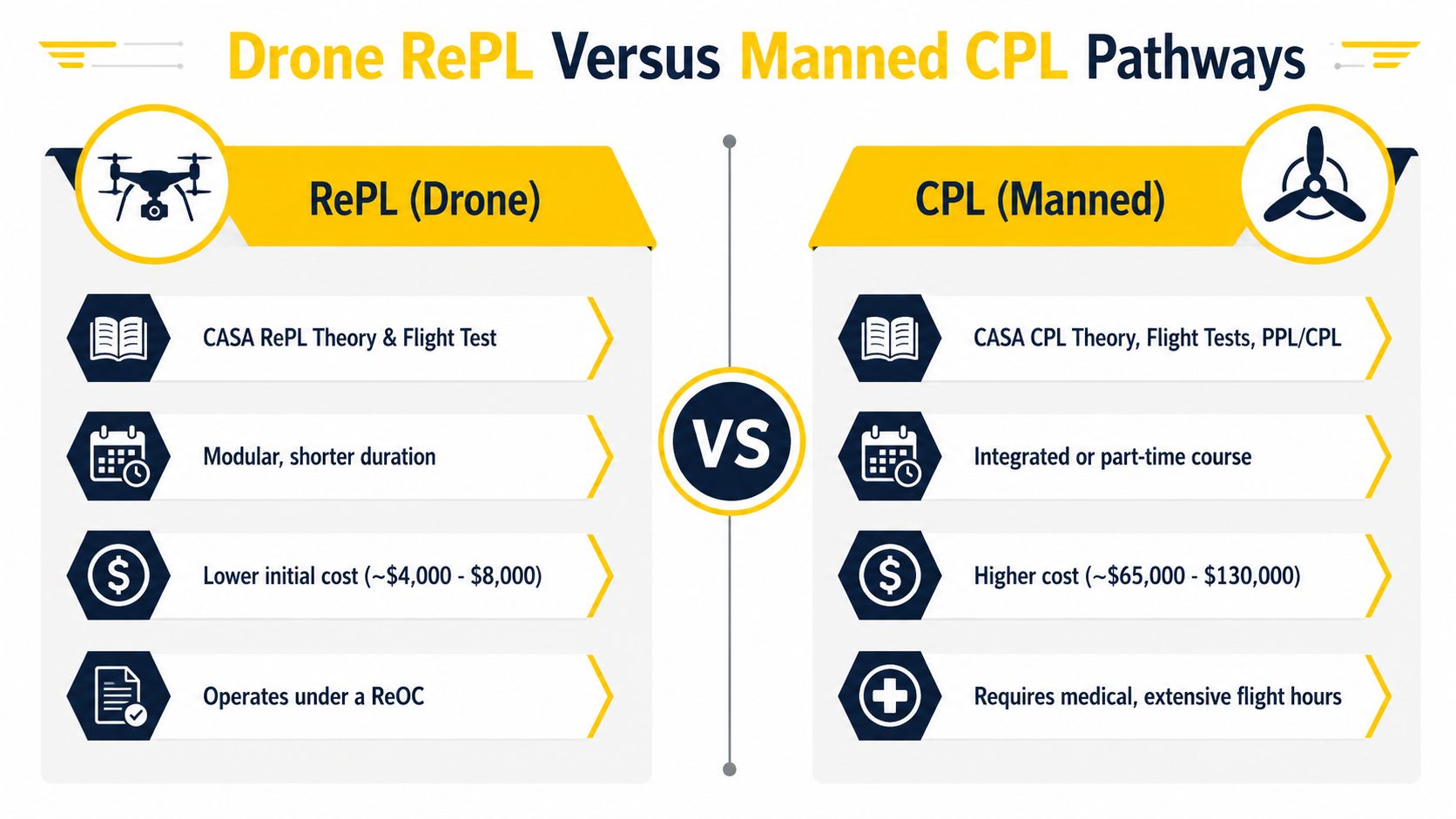
The choice is practical, not theoretical. In Australia, the two serious pathways are a CASA RePL for commercial drone work, or a manned-aircraft commercial track that begins with CPL and, for many career pilots, continues toward ATPL bridging. Those paths sit in different cost brackets, different time frames, and different cashflow profiles.
RePL is a compliance pathway, not just a flying course
A RePL holder can fly a remotely piloted aircraft commercially only within the operating conditions of the licence and the relevant operator framework. Commercial drone work operates under CASA regulation, where compliance depends on the licence and operator setup, not on drone ownership. The operator side often sits under a ReOC, which turns business compliance into part of the training and operating model. CASA RePL compliance framework
That structure suits people who want to start billing sooner in surveying support, construction, agriculture, and inspection. It is shorter, more modular, and built around getting into operational work without carrying the cost burden of a full manned-aircraft ladder.
CPL is for people committing to manned aviation
A commercial manned-aircraft route is heavier in every sense. It demands more hours, more checks, more medical oversight, and more time before the student is commercially employable. As noted earlier, the UK benchmark figures and the comparison in the earlier section show why this pathway sits in a very different financial category. UK aviation training cost benchmark
The better question is not which path looks cheaper on a brochure. It is which path gets the student paid for the work they want to do. If the goal is drone operations, a RePL plus ReOC framework usually makes far more sense than a full manned-aircraft sequence.
Controlled airspace changes the equipment mix
A commercial drone operator may also need an AROC if radio work is part of the operating environment. For enterprise teams, that sits alongside the pilot licence and the operator framework, and it matters when the work moves into controlled or higher-complexity airspace. The Ultimate Guide to ReOC Australia is the right companion read for operators who need the business side as well as the pilot side.
Why Flight Hours Drive Pilot Training Cost the Most
A pilot training budget breaks when students focus on theory and ignore aircraft time. The bill comes from the hours spent in the aircraft with an instructor, and every extra hour adds both the aircraft wet rate and dual instruction. Once training moves into more advanced stages, that combination gets expensive fast.
Hourly rates are the engine of the bill
A 2025 multi-school survey found a median trainer aircraft rate of $157/hour and a median instructor rate of $75/hour, while multi-engine aircraft averaged $405/hour. Those figures explain why advanced ratings climb far beyond a basic certificate before landing fees, exams, and simulator charges even enter the budget. PilotBound flight training cost report
That pricing structure puts pressure on school efficiency. A provider that uses fewer aircraft hours, tighter lesson planning, and better prep between flights usually costs less in the end.
Bottom line: Pay for fewer wasted flying hours, not a prettier brochure.
Why advanced ratings cost more
Commercial and multi-engine training are heavier than basic flying for a reason. The aircraft cost more to run, the standards are tighter, and every hour carries more financial weight. Multi-engine training in particular can look steep because the aircraft and supervision requirements push the hourly cost up quickly.
The smart question is not which school advertises the lowest tuition. It is how the provider reduces expensive aircraft time through simulator substitution, structured ground preparation, and checkride readiness. A complete enterprise-style package such as ACE PLATINUM fits that logic, and you can explore all available courses at https://aaa.edu.au/courses to compare pathways. It bundles RePL, AROC, Aviation English, Express ReOC, Certificate III in Aviation, advanced operations training, and preparation to operate and manage a commercial drone business.
What students should do differently
Budget control comes from discipline, not wishful thinking. Keep training sessions close together, arrive prepared, and stop paying twice for the same lesson content.
- Fly consistently: Long gaps force revision and repetition.
- Use simulators where they help: Save aircraft time for tasks that need it.
- Arrive exam-ready: A poor checkride attempt is expensive.
- Keep booking gaps tight: Idle weeks usually increase total spend.
That is the part many students miss. The hourly meter punishes inconsistency, and once the aircraft is turning, your budget starts moving fast.
CASA-Specific Costs Most Budgets Overlook
Australian budgets often miss the costs that sit around the licence, not inside it. Those hidden items are where the surprise comes from, because students plan for flying and forget certification, validity, and operator-side compliance.
The local checklist
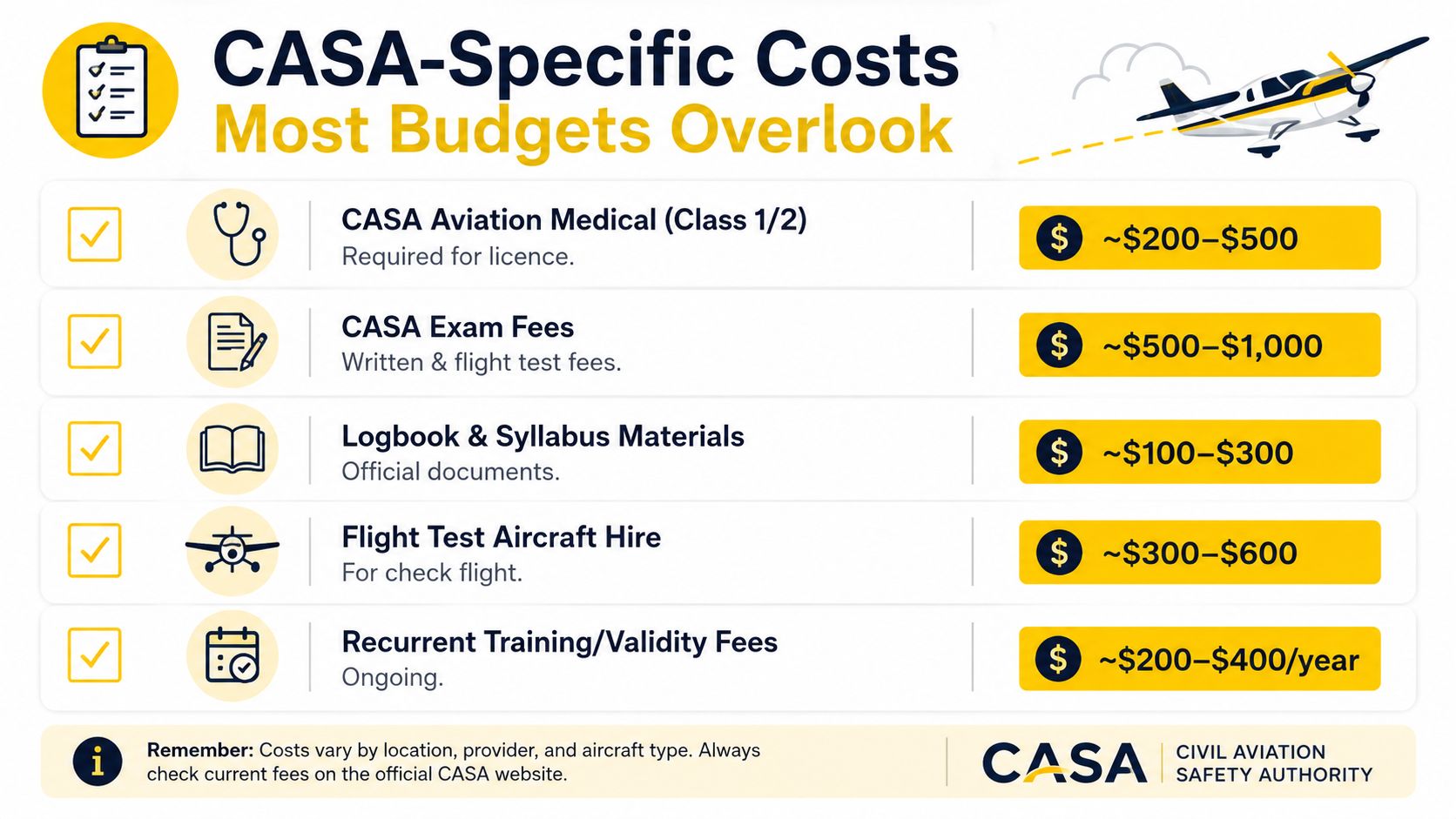
The common misses are easy to name. Medicals, exam fees, theory materials, flight test aircraft hire, and recurrent training all need to be in the plan from day one.
- CASA Aviation Medical: Required for the licence pathway, and it can't be ignored.
- CASA Exam Fees: Written and flight test charges land later, when cash is already tight.
- Logbook and Syllabus Materials: Small individually, but they still need funding.
- Flight Test Aircraft Hire: The final check often uses paid aircraft time.
- Recurrent Training or Validity Fees: Ongoing costs matter after the initial issue.
Early-stage training still needs to be bought carefully. A course like ACE READY suits beginners because it covers fundamentals, aviation safety, CASA regulations, and flight operations before more advanced RePL training. That kind of base work can stop students from wasting money by jumping into the wrong pathway too soon.
AROCs and operator systems matter too
A lot of students focus on the licence and forget the operator framework. For commercial drone work, the business side matters because compliance is part of getting paid. ReOC costs and admin belong in the budget from the start, not on the “maybe later” list.
Controlled airspace also brings AROC into the picture, particularly for organisations that need trained radio operators as part of a safe operating setup. For any budget, the right question is not only “can the student fly?” but also “can the operation be run legally and efficiently?”
The right budgeting habit
Build an all-in list before signing anything, then compare that list against the training provider's quote.
A student who budgets only for lessons often runs short at the finish line.
That final gap is usually where the budget blows out, because the hidden CASA-related items arrive after the student has already committed. If you are also comparing cashflow pressure on the business side, see Samba on payment processing for a useful parallel on costs that sit inside the structure rather than the headline number.
ROI of Pilot Training Across Australian Industries
Cost matters, but value matters more. The right return on investment depends on what kind of work the qualification enables and how quickly the operator can start billing or delivering value.
Drone pathways usually pay back sooner
A CASA-compliant drone route can make sense faster than a manned-aircraft career path because the student can move into billable work without chasing the same depth of hour-building. That's especially true in agriculture, construction, mining, infrastructure inspection, emergency services support, and media production, where organisations want capability and compliance, not a cockpit career ladder.
The business comparison also has a payments angle. If a company is evaluating training as an operational investment, it should look at how cash moves through the business, not just at the training fee itself. The practical payment issue is similar to the merchant-side detail in Samba's guide to payment processing fees, where the cost is often buried in the structure rather than the headline number.
Manned aviation pays off differently
A CPL path can still be the right call, but only for people who want the manned-aircraft career. The value comes later, through airline progression, charter work, or other commercial flying roles. That is a different ROI model from drone operations, where compliance capability can lead to work much earlier.
Match the course to the work
A business should ask three things before funding training:
- What work does the qualification enable?
- How soon can the operator start contributing value?
- Does the pathway fit the organisation's compliance burden?
If the answer is drone operations, the RePL plus ReOC route usually makes more sense than paying for a manned-aircraft ladder that the business will never use. If the answer is airline or charter flying, the higher cost of the CPL route is part of the job.
That is why the cheapest training is not automatically the smartest investment. Value sits in what gets billed, delivered, or flown next.
Financing, Subsidies and Smart Payment Planning
Paying for training is easier when the funding plan is set before the first lesson. A sensible structure lowers stress because the student is not constantly stopping to find the next payment.
Use the funding tools that genuinely exist
In Australia, the practical options are VET Student Loans for eligible qualifications, state and federal skills incentives, provider payment plans, and employer-sponsored training in agriculture, mining, and government contracting. Those options do not wipe out the cost, but they can make the cashflow manageable.
The monthly plan matters most. Divide the full pilot training cost by the expected training period, then add a contingency buffer for weather, resits, or extra lessons. That gives a real monthly burden instead of a fantasy number.
Treat cashflow as the actual test
Students often ask whether they can “afford” a course, when the better question is whether they can keep paying for it without stalling halfway through. A low upfront deposit can still turn into a problem if the remaining payments land faster than training progress.
That same discipline applies to tax and repayment planning. For students wanting broader context on structured repayments, HECS repayment for Australian students helps explain how staged obligations feel in practice, even though flight training is its own category.
A simple stress test for any quote
Use this quick filter before signing.
- Add every known cost. Tuition, aircraft, instructor time, medicals, exams, and materials.
- Spread it across realistic weeks. Do not assume perfect weather or perfect attendance.
- Add a buffer. Training interruptions happen.
- Compare against the likely earning path. A training investment only makes sense if the qualification enables work at a sensible pace.
If you want a provider example to compare against, why Ace Aviation fits different training goals is a useful place to check how a course is framed before you commit.
That is the cleanest way to decide whether the funding plan is solid or fragile.
How Ace Aviation Fits Into Your Training Decision
A training decision should start with the job you want, then the cashflow you can sustain. The cheapest line in a brochure often looks attractive until the extra fees, missed sessions, and compliance steps land on the invoice. For some students, the sensible move is a beginner drone pathway. For others, the better spend is a commercial package that gets them ready for enterprise work without forcing a costly restart later.
Where Ace Aviation fits
Ace Aviation Aerospace Academy offers CASA-compliant drone training, RePL pathways, AROC, ReOC consulting, aviation management qualifications, and specialised drone operation courses. For beginners, ACE READY builds fundamentals before advanced RePL training. For learners who need a broader commercial package, ACE SILVER sits as a CASA-compliant RePL pathway that bundles the Aeronautical Radio Operator Certificate and aviation English proficiency.
If you want to see how the academy frames its training approach before you commit, read more about why students choose Ace Aviation.
That matters because value comes from how quickly the training gets the student into compliant, billable work, or into the next stage of a longer aviation plan. A cheap course that leaves gaps in compliance or practical readiness costs more in the end.
The best question to ask
The smart buyer asks whether the pathway fits the intended work. A drone operator who needs commercial capability should focus on compliance, operational readiness, and operator approval. A future airline pilot should accept that the budget will be much larger and the timeline will be much longer.
Short version: Cheapest is not the same as best value.
FAQ
Is a RePL enough to charge for commercial drone work in Australia?
Yes, but only within the licence conditions and the applicable operator framework. Commercial drone work is regulated, and the operator side matters.
How long does a CASA-compliant pilot training program take?
It depends on the pathway. RePL training is much shorter than a manned-aircraft commercial route, which usually takes far more time because of flight hours and stage progression.
Are financing options available for RePL training?
Sometimes, but the option depends on the provider, the qualification, and whether the pathway is eligible for a lending or support scheme. A provider should spell that out clearly.
Do cheaper courses compromise safety or compliance?
They can, if the lower price comes from fewer hours, weaker structure, or missing compliance components. The key check is whether the course covers the operational and regulatory requirements properly.
Does a lower pilot training cost always mean better value?
No. The better value is the one that gets the student to compliant, useful work without unnecessary repeat training or hidden fees.
What should a student ask before enrolling?
Ask for the all-in cost, the expected training rhythm, the compliance requirements, and the likely total cashflow through to licence issue.
Ace Aviation Aerospace Academy helps students and organisations choose a training path that fits the actual job, not just the brochure price. If the next step is RePL, AROC, ReOC support, or a broader commercial drone plan, visit Ace Aviation Aerospace Academy and compare the pathway against your budget, timeline, and compliance needs.